


































Best country in Europe for international doctors: UK, Ireland, Germany, the Netherlands, the Nordics and the USA compared
Which European country suits an international medical graduate? We compare the UK, Ireland, Germany, the Netherlands, Sweden, Norway, Denmark and Finland, with the USA as a contrast, on exams, language, working before full registration, specialist recognition, official pay, visas and settlement.

MedicSail
Published
The short answer
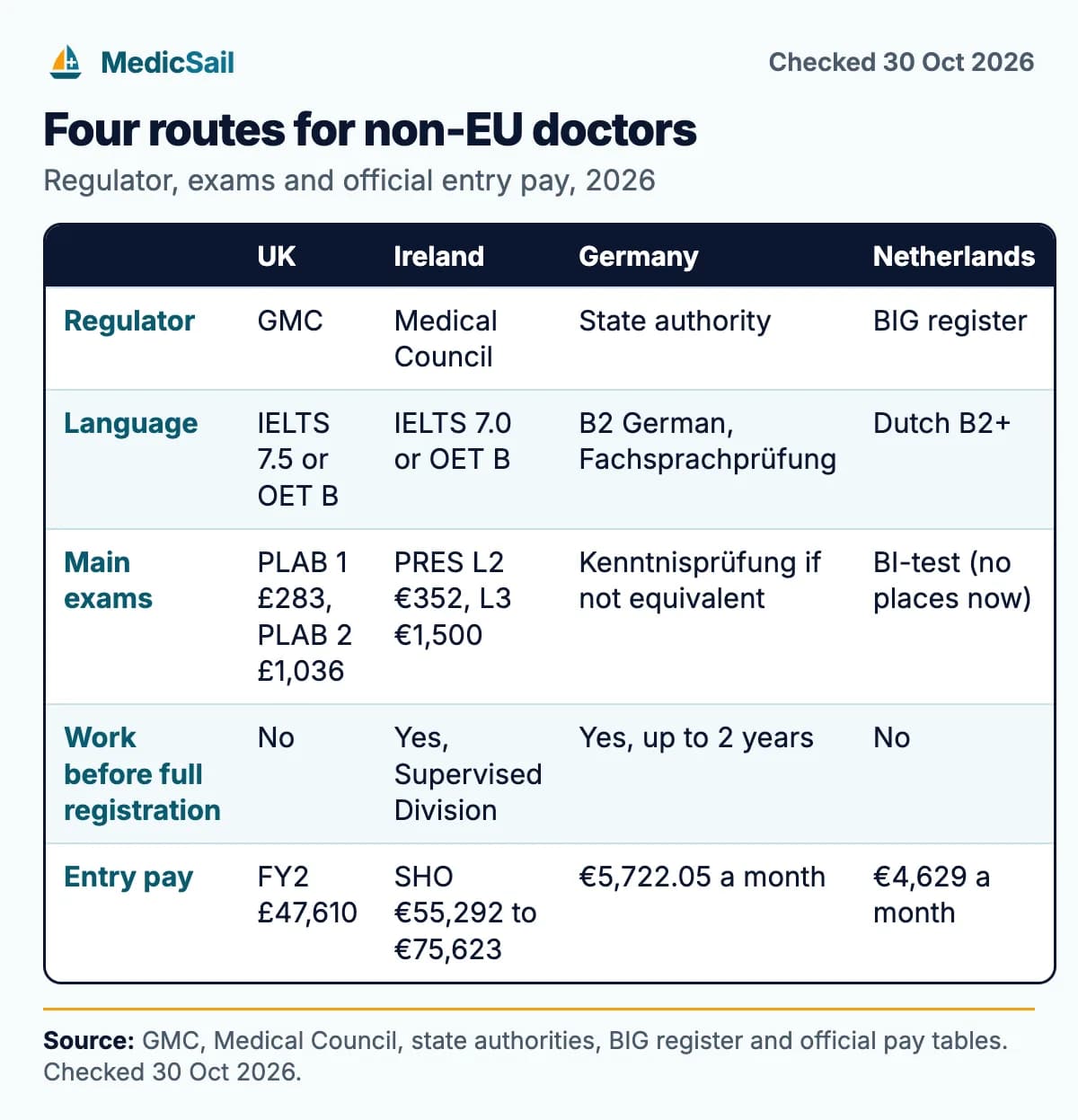
The best country in Europe for an international doctor depends mostly on two things: the language you can practise in, and whether you want to train in a specialty or work at your current level. If you want to work in English, the UK and Ireland are the realistic choices. The UK has the clearest single route for most international medical graduates (English test, PLAB 1, PLAB 2, then GMC registration with a licence) and the largest employer. Ireland offers three routes to general registration, one of which, PRES, can be avoided if you hold a recognised postgraduate qualification or an accepted internship, and a PLAB 2 pass exempts you from PRES entirely.
If you are willing to practise in another language, Germany has the clearest mainland route that lets you work while you qualify: you need B2 German, the Fachsprachprüfung and, usually, the Kenntnisprüfung, but you can work on a temporary licence while you prepare, and municipal hospital pay starts at €5,722.05 a month in 2026. The Netherlands and the Nordic countries have high standards and good conditions, but the Dutch BI-test for doctors currently has no places, Norway states a 23-month processing time, and Denmark is closed to most non-EU doctors in 2026.
We compare each country below on registration difficulty, language, exams, time, official pay, visa, family and settlement, and add the USA as a contrast, because many doctors weigh it against Europe. Every figure is from the regulator, exam body or official pay table, checked on 29 October 2026. Which country is best is your judgement to make; this guide sets out the trade-offs so you can make it.
What decides the best country for a doctor
For doctors, salary comparisons are even less useful than for other professions, because pay depends on grade, and your grade depends on whether a country recognises your specialist training. Use these criteria instead:
- Route to registration. Exams, document routes and how many years the whole sequence takes.
- Language. English, or a national language to a level where you can take histories and write discharge letters.
- Whether you can work while you finish. Germany's Berufserlaubnis, Finland's limited licences and Ireland's supervised division all let you work before full registration; the UK and the Netherlands generally do not.
- Specialist recognition. Whether your specialist training abroad can be recognised, or whether you will retrain.
- Training posts. How you enter specialty training, and how competitive it is.
- Pay. Official scales for the grade you will realistically start in.
- Visa, family and settlement. The permit, what it costs and when you can stay permanently.
Doctors licensed in the Gulf should note that no European regulator accepts a DHA, DOH, MOHAP, SCFHS or QCHP licence in place of its own route, although Gulf posts, logbooks and good standing support your application.
The comparison at a glance
For a doctor whose primary medical qualification is from outside the EU/EEA and not automatically recognised:
| Country | Regulator | Language | Main exams | Can you work before full registration? | Pay at entry grade (official, year) | Visa |
|---|---|---|---|---|---|---|
| UK | GMC | IELTS Academic 7.5 overall (7.0 each) or OET Medicine B | PLAB 1 (£283), PLAB 2 (£1,036) | No; you register first | FY2 £47,610; CT1/ST1 £55,355 (England, from 1 April 2026) | Health and Care Worker visa |
| Ireland | Medical Council (IMC) | IELTS 7.0 (6.5 each) or OET Medicine B | PRES Level 2 (€352) and Level 3 (€1,500), unless exempt | Yes, in the Supervised Division | SHO €55,292 to €75,623 (HSE, 1 June 2026) | Critical Skills Employment Permit |
| Germany | State authorities (Approbation) | B2 German plus Fachsprachprüfung (oriented to C1) | Kenntnisprüfung, if training is not equivalent | Yes, on a Berufserlaubnis of up to two years | Ä1 €5,722.05 a month (TV-Ärzte/VKA, from 1 June 2026) | § 16d, then EU Blue Card |
| Netherlands | BIG register | Dutch B2+ and English reading B2 | BI-test: iVTG and clinical skills test | No | AIOS €4,629 a month (Cao Ziekenhuizen, 1 August 2026) | Highly skilled migrant |
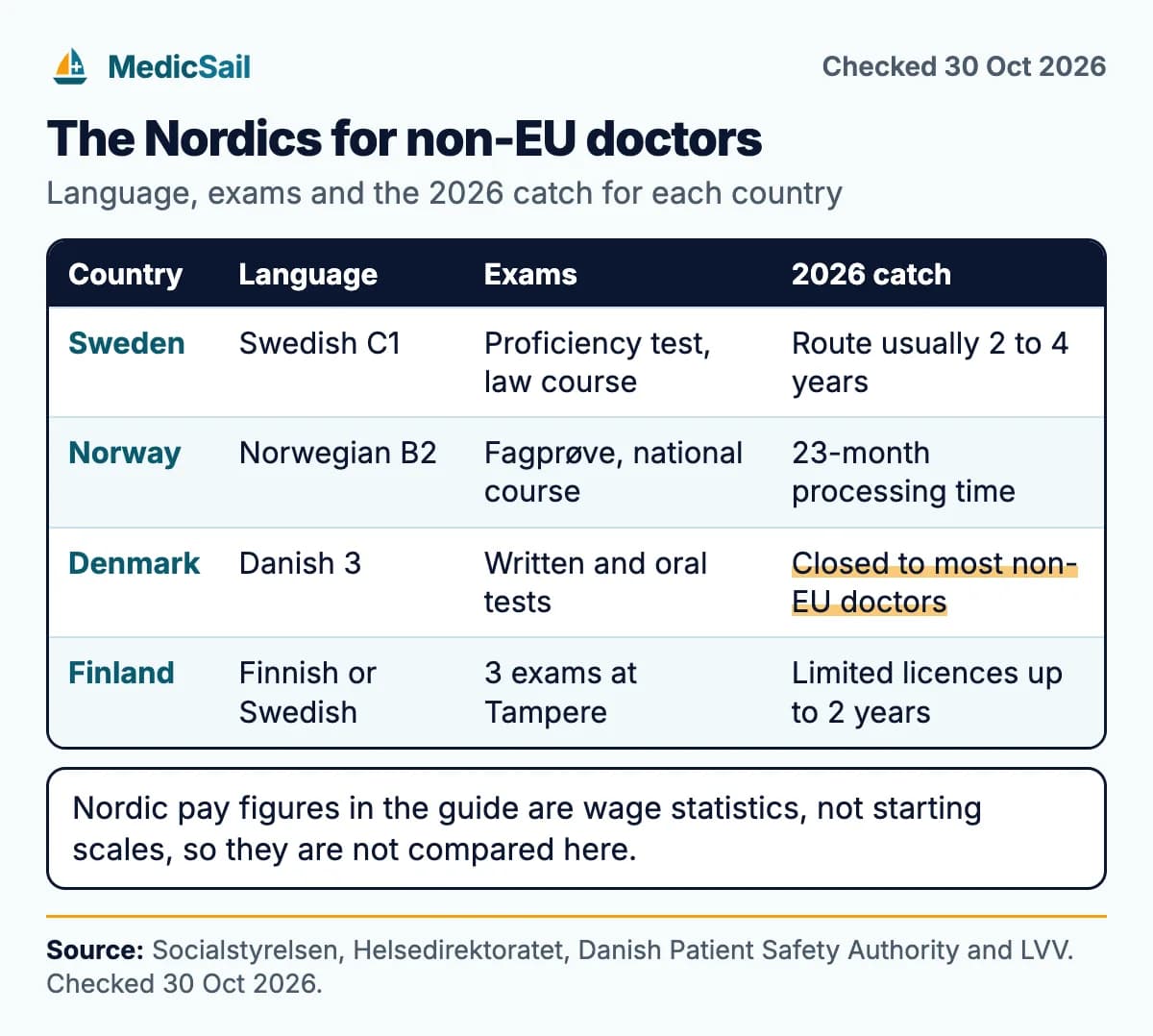
| Sweden | Socialstyrelsen | Swedish C1 or Swedish 3 | Proficiency test (theory and practical), law course | Yes, with a special authorisation after the test | Average intern doctor salary SEK 41,700 a month (Statistics Sweden, 2025) | Work permit |
| Norway | Helsedirektoratet | Norwegian B2 | Fagprøve at the University of Oslo, national course | No | Median generalist NOK 78,850 a month (Statistics Norway, 2025) | Skilled worker permit |
| Denmark | Danish Patient Safety Authority | Danish 3 exam | Written and oral medical tests, law course | Yes, in an adaptation job | Average doctor in training DKK 60,554 a month (Danske Regioner, Feb 2026) | Quota closed to most in 2026 |
| Finland | LVV (formerly Valvira) | Finnish or Swedish, YKI level 4 for the practical exam | Three exams at Tampere University | Yes, on limited licences | Median generalist €8,067 a month (Statistics Finland, 2024) | Specialist permit or EU Blue Card |
Nordic figures are wage statistics (averages or medians including supplements), not starting pay on a scale, so read them as an indication of level only.
UK: one route, many posts, and a long road to specialist training
The UK's route is a single, well-documented sequence for most international medical graduates. You verify your medical degree through EPIC, pass IELTS Academic (7.5 overall with 7.0 in each skill) or OET Medicine (grade B in each sub-test), pass PLAB 1 (180 single best answer questions, held in the UK and abroad) and PLAB 2 (a 16-station OSCE in Manchester), then apply for registration with a licence to practise. Our PLAB 1 and PLAB 2 guide covers each stage, and GMC registration sets out the alternatives.
Costs and time
- PLAB 1 £283 and PLAB 2 £1,036 from 1 April 2026, plus the GMC's registration fee and EPIC verification, which ECFMG charges in US dollars.
- You must pass PLAB 2 within two years of PLAB 1, and be registered within two years of PLAB 2. The GMC warns that demand for PLAB 2 is high and you may wait for a date.
- PLAB is not the only route: an acceptable postgraduate qualification, or sponsorship by an approved body, can replace it. Specialists can apply through the portfolio pathway (£1,974).
Pay and the trade-off
Resident doctors in England are paid £41,226 at FY1, £47,610 at FY2 and £55,355 at CT1 to ST2 from 1 April 2026, with consultants on £113,565 to £150,569, according to the NHS Employers pay circular. Many international doctors start in non-training (locally employed) posts, and entry to specialty training is competitive. See the UK route for doctors for the full pay table.
Ireland: English, a supervised start and three routes to general registration
Ireland's Medical Council registers doctors in divisions. If you qualified outside the EU/EEA you usually start in the Supervised Division, which lets you work under supervision for an aggregate of two years, and then reach general registration through one of three routes: the Certificate of Experience route (if your internship was in a country the Council recognises), the Higher Qualification route (with a recognised postgraduate qualification such as MRCPI, MRCP(UK), MRCS or FRCR), or the Pre-Registration Examination System (PRES). Our Medical Council registration guide and the PRES guide cover the detail.
Costs and exams
- First-time application €451; PRES Level 2 €352 (a three-hour multiple choice exam, held in Dublin and Dubai in 2026) and Level 3 €1,500 (a clinical assessment in Ireland).
- A PLAB 2 pass exempts you from PRES completely. PLAB 1, USMLE Step 1 and 2 CK, MCCQE Part 1 and the AMC MCQ exempt you from Level 2 only.
- English: IELTS Academic 7.0 overall with at least 6.5 in each module, or OET Medicine grade B in each, in one sitting. Online versions are not accepted.
Pay and the trade-off
HSE scales from 1 June 2026 pay a senior house officer €55,292 to €75,623 and a registrar €70,276 to €82,756, with consultants on €238,221 to €286,151 under the 2023 contract. Medical practitioners are on the Critical Skills Occupations List. The trade-off is that structured training posts are filled through competitive selection, so plan for a period in non-training posts first. Our Ireland route for doctors covers the permit and family rules.
Germany: work while you qualify, if you commit to German
Germany's licence to practise, the Approbation, is granted by the authority of the federal state where you plan to work. For a third-country doctor the usual sequence is a B2 general German certificate, the Fachsprachprüfung (a medical language exam run by the state medical chamber and oriented to C1), and either a finding that your training is equivalent or a pass in the Kenntnisprüfung, an oral-practical exam in internal medicine and surgery. Our guides to the Fachsprachprüfung and the Kenntnisprüfung go step by step.
Why many doctors choose it
- You can work on a temporary licence (Berufserlaubnis) of up to two years in total while you prepare for the Kenntnisprüfung.
- The authority must decide within four months of a complete file, or two months under the fast-track procedure, and must offer a Kenntnisprüfung date within six months of the decision.
- Fees are moderate: for example the Ärztekammer Westfalen-Lippe charges €400 for the Fachsprachprüfung and €1,050 for the Kenntnisprüfung, and the Bezirksregierung Münster €150 to €700 for the Approbation decision.
- Make it in Germany lists doctors as a shortage occupation for the EU Blue Card, with a 2026 threshold of €45,934.20 a year, and Blue Card holders can apply for settlement after 27 months with A1 German or 21 months with B1.
Pay and the trade-off
Under TV-Ärzte/VKA, a doctor in municipal hospitals earns €5,722.05 a month in year one rising to €7,355.29 in year six, and a specialist (Ä2) €7,552.19 to €9,698.91, from 1 June 2026, before on-call pay. The trade-off is language: German usually takes longer than any administrative step. See the route for doctors in Germany.
The Netherlands: high standards, very limited test places
A doctor trained outside the EEA needs a certificate of competence from the BIG register before registering as an arts. Since 1 March 2026 the doctors' BI-test consists of the interuniversity Progress Test for Medicine (iVTG) and a clinical skills test, taken in Dutch. You also need Dutch at B2+ from one of the institutes the BIG register lists, and English reading at B2.
The decisive issue in 2026 is capacity. The BIG register's test page says there are no test places for doctors at the moment and it is not known when new participants can be scheduled. Even after the test, the CBGV may advise a hospital internship lasting from a few months to three years. Registration then costs €85, and you work three months under supervision before it becomes definitive.
Pay in general hospitals is high once you are in: €4,629 to €6,047 a month on the doctors-in-training (AIOS) scale and €8,868 to €15,392 for employed specialists on the AMS table, from 1 August 2026. If your plan depends on the Netherlands, check the test page before investing in B2+ Dutch, and read our BI-test guide.
The Nordic countries: structured, language-heavy and slow to enter
Sweden
After Socialstyrelsen assesses your education (SEK 990, about three months), you need Swedish at C1, then a proficiency test run by Umeå University (a theoretical part and then a practical part), a free online course in Swedish health law, and six months of clinical training at one workplace. Once you have passed both parts of the test, public healthcare providers can give you a special authorisation to work as a doctor for a limited period. Socialstyrelsen says its route usually takes two to four years.
Norway
Helsedirektoratet requires doctors to verify their diploma and transcript through DataFlow and states a processing time of 23 months for applicants educated outside the EU/EEA. You then have three years to pass Norwegian at B2, the national courses and a three-part fagprøve at the University of Oslo (written, clinical oral and OSCE).
Denmark
The Danish Patient Safety Authority says doctors who are citizens of, or trained in, a non-EU/EEA country cannot apply in 2026 unless exempt, for example through legal residence in Denmark or a job offer as a specially requested healthcare professional. Those who can apply pay DKK 3,689, pass the Danish 3 exam and written and oral medical tests, and complete an adaptation job of 12 months (or six months with recognised specialist training).
Finland
The Finnish Supervisory Agency (LVV, formerly Valvira) recognises your degree; you then do at least six months' internship, pass three examinations at Tampere University in Finnish or Swedish, and work under limited licences, generally for up to two years, before full legalisation. Our Finland country guide and Sweden country guide have the permit thresholds.
The USA as a contrast
Many doctors weigh Europe against the USA. The US route is longer and does not let you skip residency in most states. You become ECFMG certified (USMLE Step 1 and Step 2 CK at $695 each, OET Medicine, credential verification and a Pathway), apply through ERAS and match into a residency programme through the NRMP Main Residency Match, which runs once a year, then pass USMLE Step 3 and apply to a state board. Most international residents train on a J-1 visa sponsored by ECFMG, which carries a two-year home residence requirement unless waived, or on an H-1B.
The reward is pay: the Bureau of Labor Statistics gives a median of $275,930 a year for physicians and surgeons in May 2025, although residents are paid stipends set by each programme. The cost is time, uncertainty in the Match, and visa rules that change often. Our USMLE guide and the ECFMG page explain the sequence. None of this is legal advice; use an immigration attorney for your case.
If you are already a specialist
Specialists face a different question: can I be recognised at my level, or must I retrain? The answers differ.
- UK. The GMC's portfolio pathway lets you show, with verified evidence, that you meet the UK curriculum's high-level outcomes. It costs £1,974, and the GMC says you have up to 24 months to build the application and 6 to 12 months for processing.
- Ireland. The Medical Council offers specialist evaluation of your training and experience for €4,086.
- Germany. Doctors who want a German specialist title apply to the state medical chamber once they hold their licence; the chamber assesses how much of your training counts.
- Netherlands. Specialist recognition goes through the RGS, which the BIG register estimates at about €2,285, and may require an adaptation period.
- Sweden. Socialstyrelsen says foreign specialists must first be licensed as doctors and then complete Swedish specialist training for a specialist certificate.
If you are a consultant-level specialist and want to work in English, compare the UK portfolio pathway with Ireland's specialist evaluation; in the other countries, plan for a period at a lower grade while your training is assessed.
Which country fits which doctor
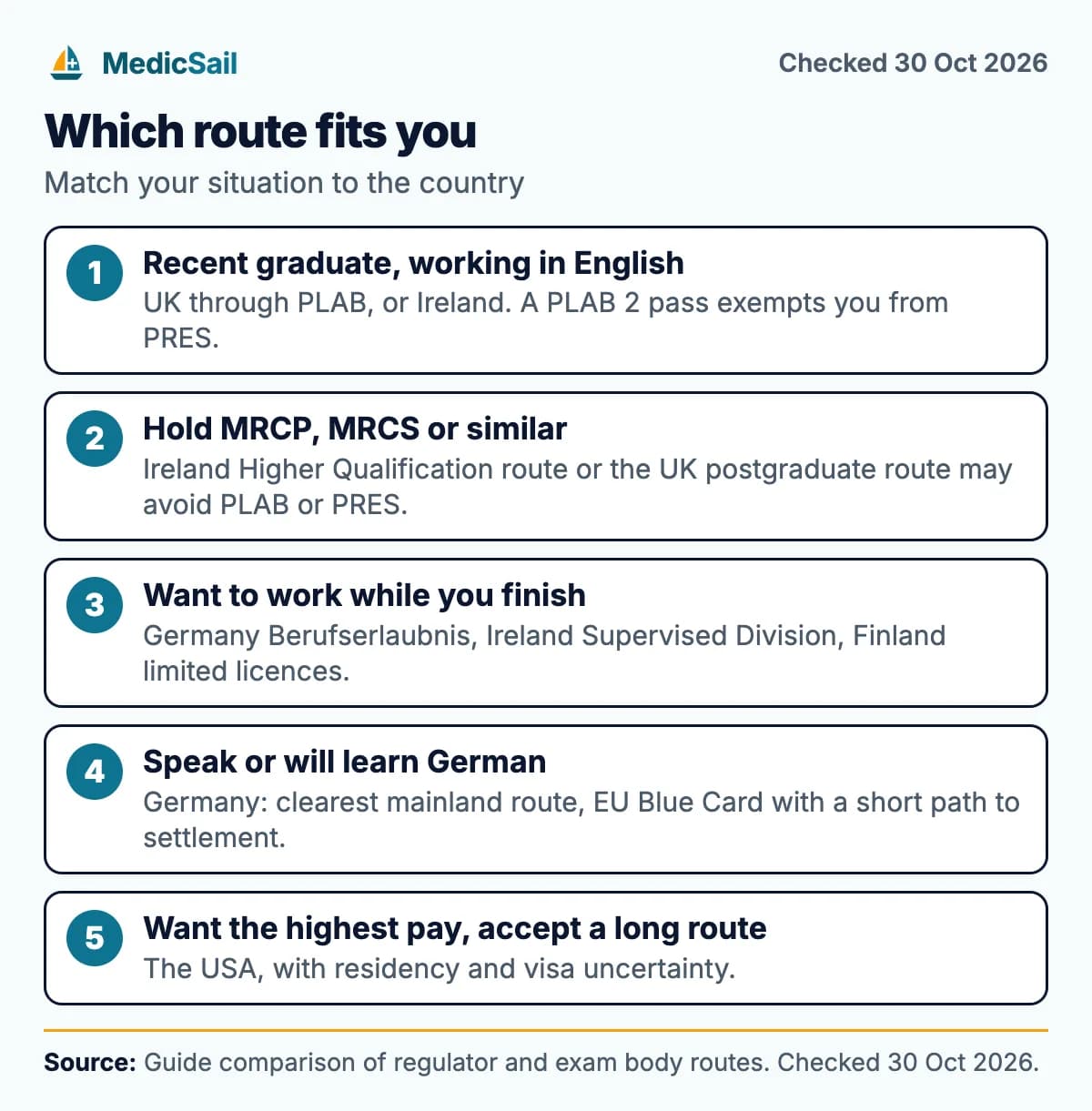
- Recent graduate who wants to work in English. The UK through PLAB, or Ireland, where a PLAB 2 pass also exempts you from PRES. Consider both together.
- You hold MRCP, MRCS or a similar postgraduate qualification. Ireland's Higher Qualification route and the UK's acceptable postgraduate qualification route may let you avoid PLAB or PRES.
- You want to work while you finish your licence. Germany's Berufserlaubnis, Ireland's Supervised Division and Finland's limited licences allow this.
- You speak German or are prepared to study it. Germany offers the clearest mainland route and an EU Blue Card with a short path to settlement.
- You want the highest pay and accept a long route. The USA, with residency and visa uncertainty.
- You are drawn to the Nordics or the Netherlands. Check test capacity (Netherlands) and quotas (Denmark) first, and plan two years or more for language.
Your next step: verify your degree through EPIC early, because the GMC, the Medical Council and Denmark all rely on it and the GMC says most schools reply within 90 days. Our EPIC verification guide explains how, and the international doctor hub links every country route.
Questions
For English speakers, the UK and Ireland have the most direct routes, and a PLAB 2 pass works for both (it exempts you from Ireland's PRES). On the mainland, Germany lets you work on a temporary licence while you prepare for the Kenntnisprüfung. Easiest depends on your qualifications and languages.
In the UK and Ireland, yes. Germany, the Netherlands and the Nordic countries require the national language for registration: B2 German plus the Fachsprachprüfung in Germany, B2+ Dutch in the Netherlands, and B2 or C1 in the Nordics.
Yes. The Medical Council says a PLAB 2 pass exempts you from PRES completely, and PLAB 1 exempts you from PRES Level 2 only. You still apply to the Medical Council and meet its other requirements.
On official scales, Irish consultants (€238,221 to €286,151 from 1 June 2026) and Dutch employed specialists (€8,868 to €15,392 a month from 1 August 2026) are high. At entry level, a German Ä1 doctor earns €5,722.05 a month and a UK FY2 £47,610 a year. Tax and hours differ, so compare net pay where you can.
Often, yes. You can usually apply for a Berufserlaubnis, a temporary licence for up to two years in total, at the same time as the Approbation, so you can work while you prepare. Aim to pass the Kenntnisprüfung within that time.
At the time of checking, the BIG register's test page says there are no test places for doctors and it is not known when new participants can be scheduled. Check the page before planning a Dutch route.
Mostly not. The Danish Patient Safety Authority says doctors who are citizens of, or trained in, a non-EU/EEA country cannot apply in 2026 unless exempt, for example through legal residence in Denmark or a job offer as a specially requested healthcare professional.
They support your application as evidence of experience and good standing, but no European regulator registers you on the strength of a DHA, DOH, MOHAP, SCFHS or QCHP licence. The GMC's alternative to an English test needs recent work in a country where English is the first and native language, so Gulf practice does not replace IELTS or OET.
The USA pays more (BLS median $275,930 for physicians in May 2025) but usually needs USMLE, ECFMG certification and a full US residency, entered through an annual Match, plus a J-1 or H-1B visa. European routes are usually shorter and let you start work sooner, at lower pay.
Sometimes. The UK portfolio pathway (£1,974) and Ireland's specialist evaluation (€4,086) assess your training against local standards. Sweden requires Swedish specialist training after licensing. Outcomes depend on your training and evidence.
Sources
- 1GMC: fees for doctors
- 2GMC: a guide to the PLAB test
- 3GMC: using your IELTS certificate
- 4GMC: primary source verification for international medical graduates
- 5GMC: specialist registration, portfolio
- 6NHS Employers: Pay and Conditions Circular (M&D) 1/2026 (PDF)
Show all 36 sourcesShow fewer sources
- 7GOV.UK: Health and Care Worker visa
- 8Medical Council: first-time applicants
- 9Medical Council: PRES Level 2
- 10Medical Council: PRES Level 3
- 11Medical Council: fees
- 12Medical Council: English language
- 13HSE: Consolidated salary scales, 1 June 2026 (PDF)
- 14DETE: Critical Skills Occupations List
- 15Bezirksregierung Münster: Approbation for third-country qualifications
- 16Ärztekammer Westfalen-Lippe: Fachsprachprüfung
- 17Ärztekammer Westfalen-Lippe: Kenntnisprüfung
- 18Marburger Bund: TV-Ärzte/VKA pay tables (PDF)
- 19Make it in Germany: EU Blue Card
- 20BIG register: professional tests
- 21BIG register: change to the BI-test for physicians (24 February 2026)
- 22BIG register: roadmap to working in the Netherlands
- 23Cao Ziekenhuizen: AIOS salary scales 2025-2027 (PDF)
- 24Cao Ziekenhuizen: AMS salary tables 2025-2027 (PDF)
- 25Socialstyrelsen: doctor of medicine educated outside the EU/EEA
- 26Socialstyrelsen: recognition of a specialist qualification
- 27Helsedirektoratet: medical practitioner educated outside the EU/EEA
- 28Danish Patient Safety Authority: medical doctor, non-EU countries, quota
- 29LVV: medical doctor trained outside the EU or EEA
- 30Statistics Sweden: salary structure statistics
- 31Statistics Norway: table 11418
- 32Danske Regioner: Personalestatistik 2026 (PDF)
- 33Statistics Finland: table 15au
- 34ECFMG: fees
- 35USMLE: apply for the exams
- 36US Bureau of Labor Statistics: physicians and surgeons
Plan it with our free tools
MedicSail
Healthcare licensing consultants for the UK, Europe and the USA
Updated and checked against the sources listed above. How we research and check our guides