


































NCLEX-RN for international nurses: eligibility, the Next Generation NCLEX, fees and results
How internationally educated nurses become eligible through a state board, what the Next Generation NCLEX looks like, where to test abroad, the 2027 fee change, results, retakes and preparation.

MedicSail
Published
The short answer
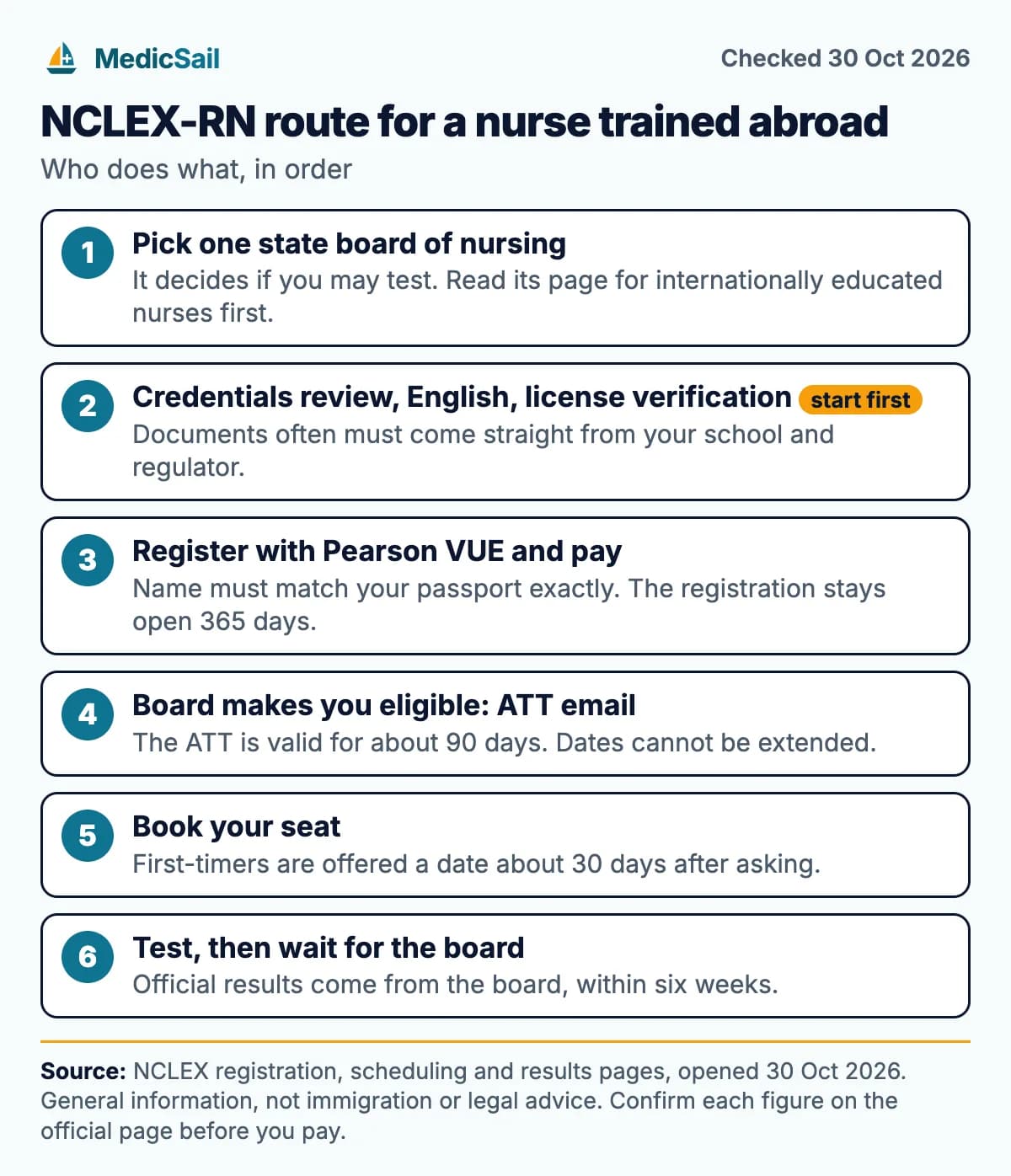
To sit the NCLEX-RN as a nurse educated outside the United States, you apply to one state board of nursing, not to a national body. That board checks your nursing education (usually through a credentials evaluation agency), your license history, your English and your criminal background. When it is satisfied, it makes you eligible, and Pearson VUE emails you an Authorization to Test (ATT). You then book the exam at a Pearson VUE center in the US or in one of the 19 countries and territories NCLEX lists for international testing.
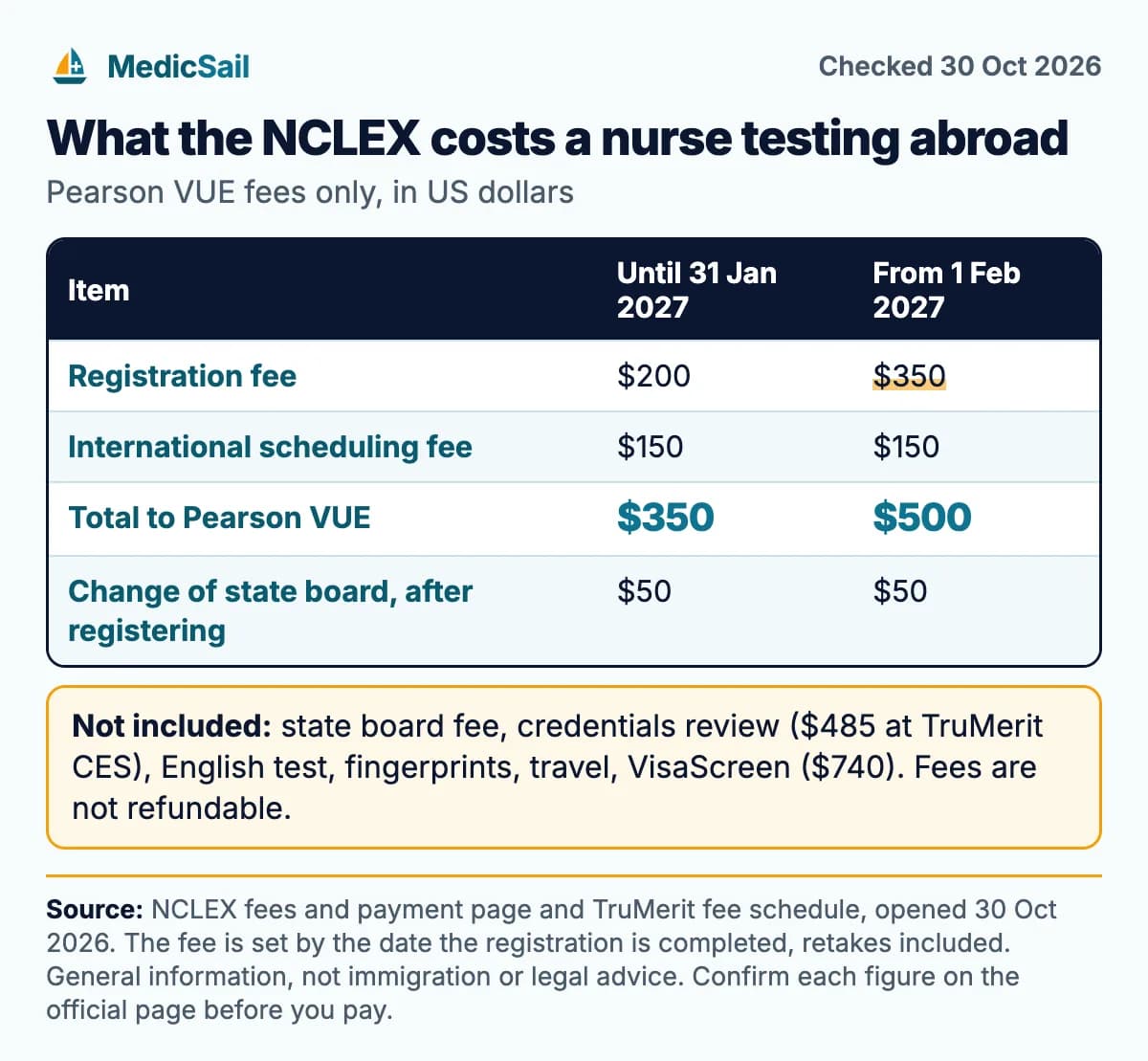
The NCLEX-RN is the Next Generation NCLEX. It is a computerized adaptive test that gives you between 85 and 150 items in up to five hours, including breaks, and it now measures clinical judgment through case studies. Registration costs $200 and testing outside the US adds a $150 international scheduling fee plus any VAT. NCLEX has confirmed that the registration fee rises to $350 from February 1, 2027. Official results come only from your board, within about six weeks. If you fail, you wait at least 45 days before you can test again.
Passing the NCLEX is a licensing step, not an immigration one. Most nurses coming from abroad also need a VisaScreen certificate and a sponsoring employer. Our page on NCSBN and US nursing licensure covers the regulator side, and our guide to working as a nurse in the USA covers jobs, pay and the green card route.
Who runs the NCLEX and who decides you can take it
Three organizations are involved, and mixing them up causes most of the early confusion.
- NCSBN (the National Council of State Boards of Nursing) develops and owns the NCLEX-RN and NCLEX-PN. NCSBN says every US board of nursing uses these exams. It does not license anyone.
- Your state board of nursing decides whether you are eligible to test and issues your license. Each state, the District of Columbia and the territories have their own board, and NCSBN itself says that "variations exist among the states."
- Pearson VUE takes your registration and payment, sends the ATT and runs the test centers.
So the first real decision is the state. Pick the state where you plan to work, or one whose rules you can meet. Read that board's page for internationally educated applicants before you pay for anything, because the accepted evaluation agencies, English tests, scores, time limits since graduation and extra courses all differ. Texas, for example, requires its Nursing Jurisprudence Exam and says first-time internationally educated applicants must have worked as a nurse within the four years before applying or be within four years of graduating. New York requires approved infection control and child abuse reporting coursework.
If you change your mind after registering with Pearson VUE, it charges $50 to change your nursing regulatory body, and you may have to meet the new board's requirements from the start. Our overview of working in US healthcare explains how state licensing, national credentialing bodies and immigration fit together.
Eligibility: what a state board will ask for
NCSBN publishes uniform licensure requirements for internationally educated nurses, which boards use as a model. In outline, you need:
- A comparable nursing education. Graduation from a nursing program comparable to a board-approved US RN program, verified by a credentials review agency the board accepts. Your program must also be approved by the body that approves nursing programs in your country.
- A credentials evaluation. TruMerit (formerly CGFNS International) says its Credentials Evaluation Service (CES) Professional Report is accepted by all 50 state boards, and it costs $485. Some boards accept other agencies; Texas also lists ERES, Josef Silny & Associates and The Evaluation Company. New York uses TruMerit's separate Credentials Verification Service. Our TruMerit (CGFNS) page explains each service.
- License verification. Your nursing license or authorization to practice in your country, sent directly by the licensing authority. Some boards, such as Texas, want verification from every country or state where you have ever held a license.
- English. A pass on an English test covering reading, speaking, writing and listening, unless you are exempt. Under the federal rules NCSBN cites, nurses educated in Australia, Canada (except Quebec), Ireland, New Zealand, the UK or the US are exempt, but boards may set their own rules.
- Background checks. State and federal fingerprint-based criminal background checks, plus self-disclosure of all misdemeanors, felonies and plea agreements, any substance use disorder in the last five years and any action against any professional license.
- Board-specific extras, such as a jurisprudence exam or required coursework.
The documents that cause the longest delays are the ones that must come directly from your school and your regulator. Copies you send yourself are almost always refused. Start those requests first, and give the agency your name exactly as it appears on your passport.
Some boards require the TruMerit Certification Program (a credentials review, the Nurse Qualifying Exam and English) before the NCLEX-RN; TruMerit says about two-thirds of state boards do. Check your board's page to see which TruMerit service it actually wants, because the fees are not interchangeable.
English tests and scores
Each board sets the tests and scores it accepts. As one example, the Texas Board of Nursing lists these minimums for applicants whose nursing education was not in English or not in an exempt country:
| Test | Texas Board of Nursing minimum |
|---|---|
| IELTS (Academic) | 6.5 overall, 7 in speaking |
| OET | 360 speaking, 340 reading, 350 writing, 320 listening |
| TOEFL iBT | 4.5 overall, 4.5 speaking, 3.5 in reading, listening and writing |
| PTE Academic | 55 overall, 76 speaking, 62 in reading, writing and listening |
| Michigan English Test (MET) | 58 overall, 59 speaking |
Texas also stopped accepting the paper-based and computer-based TOEFL, the TSE and the TWE from September 1, 2026, so check whether your own board has made similar changes.
The useful point for planning is that these Texas figures match the VisaScreen scores TruMerit publishes for registered nurses (table effective May 12, 2026). If you will need a visa, choose one test and one score that satisfy both your board and VisaScreen, and take it at a test center, because VisaScreen does not accept at-home versions. Our VisaScreen guide has the full federal table for every occupation level.
Have the testing agency send scores directly to the board and to the evaluation agency. TruMerit's CES needs scores less than two years old, so do not take the test too early.
Registering with Pearson VUE and getting your Authorization to Test
You can register with Pearson VUE at the same time as you apply to the board, or after. The rules from the NCLEX registration and scheduling pages:
- Register online or by phone with Pearson VUE, giving your board's program code, an email address and payment. The first and last name you register with must match exactly the identification you show on exam day.
- Pay the registration fee ($200 now, $350 from February 1, 2027). It is not refundable for any reason, including duplicate registrations.
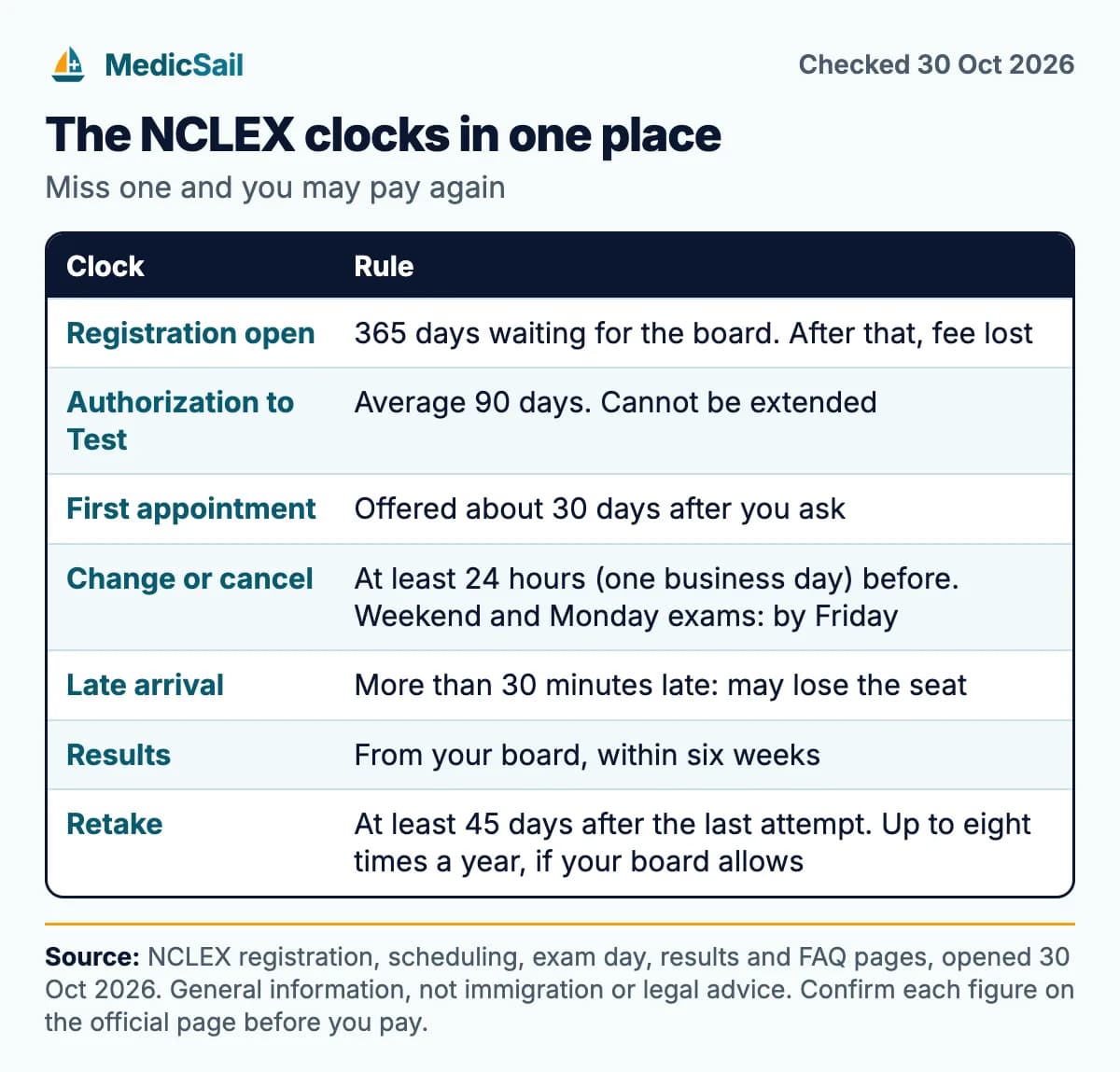
- Wait for the board to make you eligible. NCLEX says a registration stays open for 365 days waiting for eligibility. If the board has not approved you in that time, you lose the registration and the fee. You cannot hold two registrations at once; a second registration is denied and its fee forfeited.
- Receive your ATT email. It contains validity dates. NCLEX says the average ATT is valid for 90 days and the validity dates "cannot be extended for any reason."
- Schedule promptly. First-time candidates are offered appointments within 30 days of asking. If you will test outside the US, booking adds the $150 international scheduling fee plus any VAT, and that fee is not refundable.
To reschedule or cancel, you must give at least 24 hours' notice; for a weekend or Monday exam, contact Pearson by the Friday. If you miss the appointment without notice, NCLEX says you lose the exam fee and your ATT is invalidated, so you must re-register and pay again.
A practical point for nurses abroad: the fee timing. If you register before February 1, 2027 you pay $200. If your board is slow, check that your registration will not lapse at the 365-day mark, because re-registering after that date costs $350.
The Next Generation NCLEX format
Since April 1, 2023 the NCLEX has been the Next Generation NCLEX (NGN), built on NCSBN's Clinical Judgment Measurement Model. The current test plan is the 2026 NCLEX-RN Test Plan, effective April 1, 2026 to March 31, 2029. The figures below come from that document.
| Feature | 2026 NCLEX-RN Test Plan |
|---|---|
| Number of items | Minimum 85, maximum 150 |
| Time | Five hours, including all breaks |
| Minimum-length exam | 52 scored content items, 18 items in three clinical judgment case studies, 15 unscored pretest items |
| Case study | Six items about one client presentation with unfolding information |
| Stand-alone clinical judgment items | About 10% of items |
| Scoring | Computerized adaptive testing; partial credit on items with more than one key |
Each case study tests the six steps of the clinical judgment model: recognize cues, analyze cues, prioritize hypotheses, generate solutions, take action and evaluate outcomes. The test plan says all item types may include charts, tables and graphics, and that partial credit is scored in three ways: plus/minus, zero/one and rationale scoring. In practice this means many items are not single-answer multiple choice, and that choosing extra wrong options can cost you points on plus/minus items.
The content follows the Client Needs categories:
| Client Needs category | Share of items |
|---|---|
| Management of Care | 15 to 21% |
| Safety and Infection Prevention and Control | 10 to 16% |
| Health Promotion and Maintenance | 6 to 12% |
| Psychosocial Integrity | 6 to 12% |
| Basic Care and Comfort | 6 to 12% |
| Pharmacological and Parenteral Therapies | 13 to 19% |
| Reduction of Risk Potential | 9 to 15% |
| Physiological Adaptation | 11 to 17% |
Two rules from the test plan change how you take the exam. First, once you confirm an answer and press Next, you cannot go back. Second, you must answer every item to move on, so a considered guess is always better than freezing. Many study guides still describe the old exam of 75 to 265 questions in six hours; that format ended before the NGN launched.
How the exam decides pass or fail
The test plan sets out three scenarios. Most often, the exam stops once the computer is 95% certain your ability is clearly above or clearly below the passing standard, after at least 85 items. If your ability is close to the standard, you continue to 150 items and the final ability estimate decides. If you run out of time, you fail if you have not answered the minimum number of items; otherwise your final ability estimate decides. The length of your exam does not tell you whether you passed, and there is no fixed percentage of candidates who pass.
International test centers and exam day
NCLEX lists these international locations: Australia, Brazil, France, Hong Kong, India, Israel, Japan, Jordan, Kenya, Malaysia, Mexico, Pakistan, the Philippines, Puerto Rico, South Africa, Spain, Taiwan, Türkiye and the United Kingdom. There is currently no center in any Gulf country, so nurses working in the UAE, Saudi Arabia, Qatar, Oman, Kuwait or Bahrain usually travel to Jordan, India, Pakistan, the Philippines, Türkiye or the UK, or test in the US.
The international scheduling fee is $150 plus any VAT. NCLEX says it is not refundable, so if you later move your appointment to a US center you lose it.
On the day, the NCLEX exam day rules are:
- Arrive at least 30 minutes early. Arriving more than 30 minutes late can mean losing the appointment and paying again.
- Bring a passport. NCLEX says passport books and cards are the only identification accepted at international test centers, including Puerto Rico. The name must match your registration.
- Biometrics. You give a signature, photograph and palm vein scan and go through security scanning.
- Devices go in a sealed bag. Phones and all electronic devices are switched off and sealed; having one during the exam means dismissal.
- Materials provided. An on-screen calculator and an erasable note board and marker.
- No results at the center. Results come only through your board.
The test plan also warns that disclosing exam items before, during or after the exam is a violation of law and can lead to denial of a license.
NCLEX fees, including the 2027 increase
These are the fees NCLEX publishes for US licensure candidates, plus the main costs around them.
| Item | Fee | Notes |
|---|---|---|
| NCLEX registration | $200 | Rises to $350 from February 1, 2027. Not refundable. |
| International scheduling fee | $150 | Plus VAT where applicable. Not refundable. |
| Change of nursing regulatory body | $50 | Paid to Pearson VUE. |
| Change of exam type (RN/PN) | $50 | |
| Quick Results (unofficial) | $7.95 | Only where your board participates. |
| TruMerit CES Professional Report | $485 | If your board uses it. Expedited review $425 extra. |
| TruMerit Certification Program | $495 | Only if your board requires it. Re-examination $250. |
| State board application | Set by each state | For example $75 in Texas (jurisprudence exam included) and $143 in New York. |
A realistic first-attempt budget for a nurse testing abroad, using the current fee, is $350 to Pearson VUE ($200 plus $150), about $485 for a CES report, the board fee, the English test, fingerprints and travel to a test center. From February 1, 2027 the Pearson VUE part becomes $500. Then add $740 for VisaScreen if you will need a visa. Some US employers who recruit internationally pay part of these costs; what they cover and whether you repay it if you leave early varies by employer, so ask for it in writing.
Results and retakes
Official results come only from your board of nursing, usually within six weeks of the exam. NCLEX tells candidates not to contact NCSBN, Pearson VUE or the test center for results.
Quick Results. If your board participates, you can buy unofficial results for $7.95 two business days after the exam. They are not a license, and you cannot start work on them.
If you fail, you receive a Candidate Performance Report, which shows how you performed in each content area and is designed to guide your preparation for the retake. To retake:
- Tell your board you plan to retest and complete any fees or forms it requires.
- Re-register with Pearson VUE and pay the registration fee again.
- Wait for a new ATT.
- Schedule at least 45 days after your previous attempt. NCLEX says repeat candidates are offered appointments 45 days after the last exam, and some boards set longer waits.
NCLEX describes the retake policy as allowing up to eight attempts a year, with the 45-day interval between them. Boards can add their own limits on the total number of attempts or require remediation, so read your board's retake rules. Texas, for example, says it reviews retest applications within 15 business days of receiving the last item.
NCSBN can also cancel results where it finds unusual answer patterns, unusual score increases or testing irregularities; candidates can appeal.
How to prepare for the NGN as an internationally educated nurse
Start with the free official materials. The NCLEX site offers the 2026 NCLEX-RN Test Plan, a Sample Pack with three RN case studies, an Exam Preview, the Pearson VUE candidate tutorial and the 2026 Candidate Bulletin. Use the tutorial early so the item formats do not surprise you, and the test plan as your revision checklist.
A plan that works for many working nurses:
- Weeks 1 and 2: map the gaps. Read the activity statements in the test plan and mark the ones that differ from how you practice now. For nurses trained abroad these are often delegation to unlicensed assistive personnel, client rights and advance directives, US infection control precautions, and medication rules.
- Weeks 3 to 8: content in test plan order. Give most time to Management of Care and Pharmacological and Parenteral Therapies, the two largest categories. Do daily practice questions and read the rationale for every answer, right or wrong.
- From week 4: case studies. Practice the six-step clinical judgment sequence on full case studies, not just single questions. Be careful on select-all items: under plus/minus scoring, extra wrong choices cost points.
- Final two weeks: full-length timed practice. Practice up to 150 items in five hours with breaks, so the length of a maximum-length exam does not unsettle you.
The commonest mistake is answering from your home practice instead of the US scope of practice for an entry-level RN. When a question asks for a priority, think safety first, then airway, breathing and circulation, and remember what an RN can and cannot delegate. Commercial question banks can help, but NCSBN's own documents define what is tested.
After the NCLEX: license, VisaScreen and a job
When your board receives a pass, it completes its checks and issues your license. If you live in a Nurse Licensure Compact state you may hold a multistate license; the compact's website lists 43 participating jurisdictions, and your home state for compact purposes is where you live, not where you trained.
For immigration, an NCLEX-RN pass is one of the VisaScreen requirements for registered nurses, not a replacement for VisaScreen. Most nurses then immigrate on an employer-sponsored EB-3 green card, where registered nurses are a Schedule A occupation. The timeline is set by the State Department's Visa Bulletin for your country of birth, so keep your license, English scores and VisaScreen valid while you wait. Our US nursing route covers EB-3, H-1B and pay.
If you are working in the Gulf: a DHA, DOH, MOHAP, SCFHS, QCHP or other Gulf license does not exempt you from the NCLEX or from the English test, even if your degree was taught in English. Ask each Gulf authority for license verification while your license is active, plan travel to a listed test center, and register before February 1, 2027 if you want the $200 fee. If you are comparing destinations, the nursing hub sets the US beside the UK, Ireland, Germany and the Netherlands, and our NMC CBT guide explains the UK's equivalent first exam.
Questions
Registration is $200 and testing at an international Pearson VUE center adds a $150 scheduling fee plus any VAT, so $350 in total. NCLEX says the registration fee rises to $350 from February 1, 2027, which makes the total $500 abroad. Board, evaluation and English test fees are extra.
Yes, at Pearson VUE centers in the countries NCLEX lists: Australia, Brazil, France, Hong Kong, India, Israel, Japan, Jordan, Kenya, Malaysia, Mexico, Pakistan, the Philippines, Puerto Rico, South Africa, Spain, Taiwan, Türkiye and the United Kingdom. There is no center in the Gulf at present.
Between 85 and 150 items in up to five hours, including breaks, under the 2026 NCLEX-RN Test Plan. A minimum-length exam has 52 scored content items, three case studies of six items each and 15 unscored pretest items.
No. You apply to a state board of nursing, which decides your eligibility, and you register and pay with Pearson VUE. NCSBN develops the exam but does not license nurses or approve individual candidates.
NCLEX says the average ATT is valid for 90 days and the dates cannot be extended for any reason. First-time candidates are offered appointments within 30 days of asking, so book as soon as the ATT arrives.
Official results come from your board, usually within six weeks. If your board takes part in Quick Results, you can buy unofficial results for $7.95 two business days after the exam.
You must wait at least 45 days after your previous attempt, and some boards require longer. You re-register, pay the fee again and wait for a new ATT, and you receive a Candidate Performance Report to guide your preparation.
No. Every US board uses the NCLEX for licensure by examination, and a Gulf license does not replace it. An English-taught degree from the Gulf, India or the Philippines also does not exempt you from the English requirement.
No. You also need a state license and immigration status that allows you to work. For most nurses that means an employer-sponsored green card or work visa and a VisaScreen certificate.
Ideally the state where you plan to work. Requirements differ on accepted evaluation agencies, English scores, time limits since graduation and extra courses, and changing your board after registering costs $50 with Pearson VUE.
Sources
- 1NCLEX: fees and payment
- 2NCLEX: registration
- 3NCLEX: scheduling
- 4NCLEX: exam day
- 5NCLEX: testing locations
- 6NCLEX: results
Show all 22 sourcesShow fewer sources
- 7NCLEX: Quick Results
- 8NCLEX: FAQs
- 9NCLEX: Next Generation NCLEX
- 10NCLEX: test plans
- 11NCLEX: 2026 NCLEX-RN Test Plan (PDF)
- 12NCLEX: prepare for the exam
- 13NCSBN: U.S. nursing licensure for internationally educated nurses
- 14NCSBN: Licensure of Internationally Educated Nurses, a resource manual
- 15TruMerit: CES Professional Report
- 16TruMerit: Certification Program
- 17TruMerit: fee schedule
- 18Texas Board of Nursing: licensure by examination
- 19Texas Board of Nursing: approved English proficiency exams
- 20Texas Board of Nursing: fees
- 21NYSED Office of the Professions: RN license requirements
- 22Nurse Licensure Compact
Plan it with our free tools
MedicSail
Healthcare licensing consultants for the UK, Europe and the USA
Updated and checked against the sources listed above. How we research and check our guides