


































Passed the NMC OSCE: what happens next, how long the PIN takes and your first job as a registered nurse
The final steps from an OSCE pass to your NMC PIN, why some nurses wait longer, and what changes in your band, pay, preceptorship and visa once you are registered.

MedicSail
Published
The short answer
After you pass the NMC OSCE, the test centre uploads your result to your NMC application, usually within five working days. If you have also passed the CBT, completed your face-to-face ID check, submitted your health, character and English evidence and paid the £182 registration fee, the NMC verifies your information with your referees and makes a decision. It aims to consider a complete registration application within 30 days, and by law must decide within three months of receiving a complete application. When you are registered you receive your NMC PIN and can work as a registered nurse or midwife.
For most internationally recruited nurses, the PIN is also the moment you move from a pre-registration post (often paid at Band 3 or Band 4, depending on the employer) to a registered nurse post at Band 5, start preceptorship, and become subject to the NMC's annual fee and three-yearly revalidation.
The steps that most often hold people up after a pass are an incomplete ID check, a referee or doctor who has not responded, and English evidence that has expired before the application reaches the assessment queue. This guide covers each of those, how long each stage takes according to the NMC, what changes in your job, pay and visa, and what to do in your first months on the register. For the exam itself, see our NMC OSCE guide.
The steps between your OSCE pass and your PIN
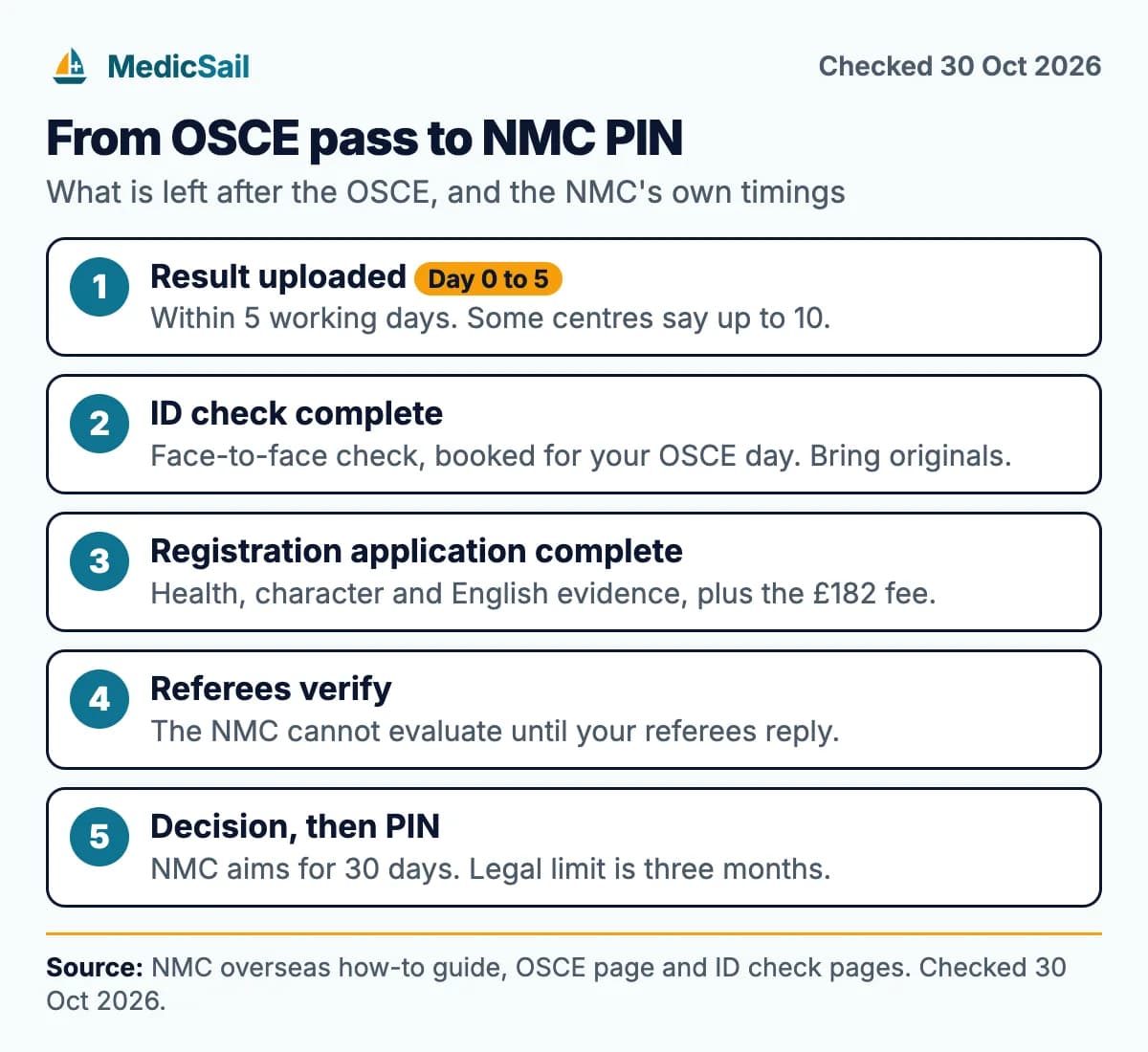
The NMC's overseas route has five stages: check you are ready, the eligibility and qualification application, the Test of Competence, the registration application, and evaluation. Passing the OSCE completes the third. What is left looks like this:
- Result uploaded. The NMC's OSCE page says test centres email your result within five working days. Leeds Teaching Hospitals' test centre says it can occasionally take up to 10 working days. The result also appears on your NMC portal.
- ID check completed. Every applicant needs a face-to-face ID check. For first-attempt OSCE candidates the NMC books it for the day of the exam. If it could not be completed, your application cannot move to the final stage until it is.
- Registration application complete. Health, character and language evidence, the professional indemnity declaration and the £182 fee. Many candidates submit this before the OSCE because the ID check requires the application to be submitted.
- Verification. The NMC contacts your nominated referees. It says it can evaluate your application only once it has all your supporting information and verification from your referees.
- Decision. The NMC emails you the decision and next steps.
- PIN and register entry. Once registered, your name appears on the NMC's online register and your employer can confirm your registration.
| Stage | What the NMC or centre says |
|---|---|
| OSCE result | Within 5 working days (up to 10 at some centres) |
| Registration decision | Aims for 30 days from a complete application |
| Legal maximum | Must decide within three months of a complete application, or you have a right of appeal |
| Test of Competence validity | 5 years once both parts are passed |
The ID check: if it was done on the day, and if it was not
The NMC says all applicants must have a face-to-face ID check, carried out by its ID verification team at a Test of Competence centre to confirm that your documents are originals. On the Test of Competence overseas route it takes place on the day of your first OSCE attempt and is pre-booked.
Bring originals. The NMC's ID check page for this route lists a valid passport, your nursing or midwifery qualification certificate, your registration certificate or card from any regulator you have been registered with, evidence of any name change, certified English translations of documents not in English, and national police clearance certificates (regional or state certificates are not accepted). The NMC says it cannot conduct your check if any documents are not original or are missing.
If the check was not completed on the day:
- You still sit the OSCE and receive your result.
- Your application will not move to the final registration stage until you attend a follow-up ID check. The NMC says that where your application was unsubmitted on the day, "a further in-person appointment will be required at your own expense".
- Follow-up checks are by appointment only and are confirmed by the NMC's ID verification team. The NMC gives [email protected] as the contact.
- If you are resitting, the NMC asks you to arrange the ID check for the day of your resit, and if you move to a different centre the check must be done at the new centre.
An outstanding ID check is one of the most common reasons a nurse who has passed the OSCE is still waiting for a PIN weeks later. If you were given a follow-up sheet at the centre, act on it the same week.
What the NMC still needs from you
Check MyNMC for any outstanding item. These are the requirements that most often remain open after the OSCE:
- CBT pass. The NMC says you must pass the CBT and OSCE within two years of each other.
- English language evidence. IELTS and OET results are valid for two years from the test date and must be valid when your application joins the assessment queue. If your test is close to two years old, check the date now. Our guide to IELTS or OET for UK regulators lists the scores and other accepted evidence.
- Character evidence. Police clearance from each country where you have lived for 12 months or more in the last ten years, a DBS check if you have lived in the UK for three months or more, and a character referee. The NMC says the clearance from your current country should be issued no more than 12 months before the assessment date.
- Health declaration. A registered medical practitioner must confirm they assessed your health in the last twelve months.
- Professional indemnity. You declare that you will have appropriate indemnity cover when practising. Most NHS employers provide it.
- Registration fee. £182 since the NMC's fee increase on 1 October 2026. Some older pages and test centre sites still show £153.
If the NMC asks for more information, it does so by email. Reply quickly and fully, and check your spam folder.
How long it takes to get your NMC PIN
There is no single figure, because the clock only starts when your application is complete. The NMC's published targets are:
- A qualification evaluation within 14 days of receiving everything it needs.
- A registration decision within 30 days of receiving your health, character and language evidence, any CBT and OSCE results and your registration fee.
- A legal requirement to decide within three months of receiving your completed application, with a right of appeal if it does not.
In practice, nurses whose application, ID check and references were all complete before the OSCE often report hearing within days of the result, while those with a missing police clearance or an unresponsive referee wait much longer. Neither is a promise; the NMC's targets are the only official figures.
If you are waiting longer than expected:
- Log in to MyNMC and look for outstanding items or unread messages.
- Confirm with the NMC's ID team that your ID check is marked complete.
- Ask your character referee and the doctor who gave your health declaration whether they received and returned the NMC's request.
- Contact the NMC with your application details if 30 days have passed since everything was complete.
If the NMC refuses the application at this stage, read our guide on what to do if your NMC application is refused or closed; refusals on health, character or English grounds must be appealed within 28 days.
When your PIN arrives
Your NMC PIN is your registration number. Once you have it:
- Check the register. Search your name on the NMC's online register and confirm the details and the part of the register (for example, registered nurse adult) are correct.
- Tell your employer. NHS employers check the register before you work as a registrant. Your ward manager, education team and HR all need to know the date.
- Do not practise as a registered nurse until you appear on the register. Until then you stay in your pre-registration role.
- Set up your annual fee. The NMC's annual fee is £143 for notices sent on or after 1 October 2026. You can pay by annual or quarterly Direct Debit from a UK bank account, or by card. If you do not pay on time, the NMC says your registration automatically lapses, and readmission can take two to six weeks.
- Note your renewal date. You revalidate every three years from the date you joined the register. Our guide to NMC revalidation for international nurses explains what to start recording now.
- Keep your documents. Your decision email, register entry and payment receipts are useful later for visa applications, job moves and tax relief.
From a pre-registration post to Band 5
Most NHS trusts that recruit overseas nurses employ them in a pre-registration role from arrival until registration. NHS Employers says candidates have up to 12 weeks from the employment start date on their certificate of sponsorship to sit a first OSCE attempt, can work as pre-registration candidates during that period, and must pass the OSCE within eight months of the start of the visa.
The band during that time is set by the employer and varies. Chesterfield Royal Hospital, for example, says its internationally educated nurses work as Band 3 health care professionals when they start and function as Band 5 registered nursing professionals after passing the OSCE and receiving a valid PIN. Other trusts use Band 4. NHS Employers advises employers to band nurses according to their role and skills.
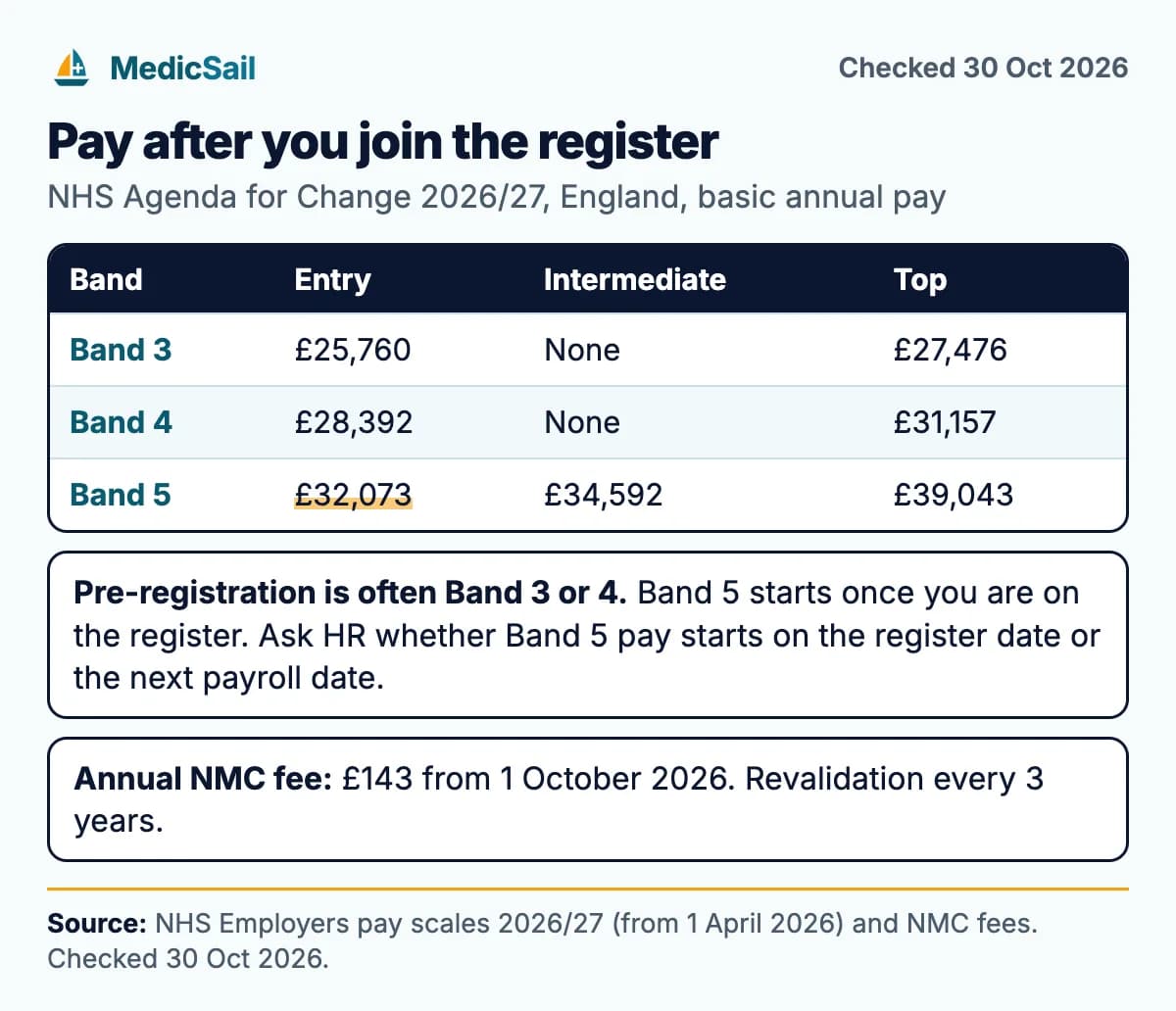
These are the NHS Agenda for Change rates for 2026/27 in England, effective from 1 April 2026, as published by NHS Employers:
| Band | Entry | Intermediate | Top |
|---|---|---|---|
| Band 3 | £25,760 | None | £27,476 |
| Band 4 | £28,392 | None | £31,157 |
| Band 5 | £32,073 | £34,592 | £39,043 |
The figures are basic annual pay before any High Cost Area Supplement. Scotland, Wales and Northern Ireland set their own scales. Ask HR when the Band 5 rate starts: some employers apply it from the date you appear on the register, others from the next payroll date, and your contract should say which. Ask too whether your employer recognises any of your overseas experience when setting your pay point; this is a local decision. Our UK healthcare overview explains how Agenda for Change works, and the NHS take-home pay calculator shows what a Band 5 salary means after tax.
Preceptorship: your first months as a registrant
Preceptorship is a period of structured support at the start of your career on the NMC register. The NMC describes it as "the structured start for newly registered nurses, midwives and nursing associates" and says its principles can also be applied to "those coming to work in the UK from within or outside the EEA/EU".
Three points from the NMC's preceptorship page matter to internationally educated nurses:
- It is not a legal requirement. The NMC says preceptorship is voluntary, though it helps newly registered professionals.
- There is no fixed length. Programmes should vary according to the needs of the individual and the organisation, and countries, regions or employers may set their own minimum or maximum lengths.
- Your employer runs it. Chesterfield Royal Hospital, for example, describes a 12-month preceptorship period for its internationally educated nurses. Some trusts offer a shorter programme to experienced nurses.
Ask your employer who your preceptor is, how much protected time you have, and what competencies you need to sign off (for example medicines management or IV administration). If you were an experienced nurse at home, say so: preceptorship should be built around what you already know, and some trusts let experienced nurses move through competencies faster. Our page on working as a nurse in the UK covers how careers usually progress after Band 5.
Your visa after registration
Most overseas nurses arrive on the Health and Care Worker visa, sponsored by their employer. GOV.UK lists the eligible nursing occupation codes, from 2231 (midwifery nurses) through 2232 to 2237 (registered community, specialist, practitioner, mental health, children's and other registered nurses), as well as 6131 (nursing auxiliaries and assistants).
What changes when you register depends on what your certificate of sponsorship already says. Points to check with your sponsor:
- Same employer, same job: many nurses are sponsored from the start for the registered nurse role they move into, so registration completes a condition of that role rather than changing it. Ask HR to confirm in writing that no new application is needed.
- Changing job or employer: GOV.UK says that "if you want to change your job or employer, you must apply to update your visa". That includes moving to another trust after you get your PIN.
- The OSCE deadline is over once you pass. The NHS Employers rule that you must pass the OSCE within eight months of the start of your visa no longer applies once you are registered.
- Your family and longer-term plans. Our Health and Care Worker visa guide covers dependants, extensions and the route to settlement.
This is general information, not immigration advice. Your sponsor is responsible for reporting certain changes to the Home Office, and a regulated immigration adviser can advise on your own case.
Repayment clauses and moving jobs after your PIN
Once you are registered you are more employable, and some nurses start looking at other trusts or private employers soon after. Before you do, read the repayment clause in your contract.
The government's Code of Practice for international recruitment in England (updated 27 March 2025) sets the rules for NHS and other employers that follow it:
- Only "genuine, evidenced, auditable expenses incurred can be reclaimed", such as relocation expenses, visa fees and regulatory exam fees the employer paid for you.
- Employers cannot reclaim costs they must bear themselves, including the agency fee, the immigration skills charge, the sponsor licence fee, the certificate of sponsorship and interview costs.
- Rechargeable costs must taper down over time. The Code's example is 100% if you leave within 12 months, 50% within 13 to 24 months, 25% within 25 to 36 months and nothing after 36 months.
- Repayments must not carry interest, employers should offer a monthly repayment plan, and employees must not be charged for any part of supervised practice.
Moving employer also means a new certificate of sponsorship and a visa application, which has its own cost. Our guide to NMC registration costs sets out what employers commonly pay and how to read a repayment clause.
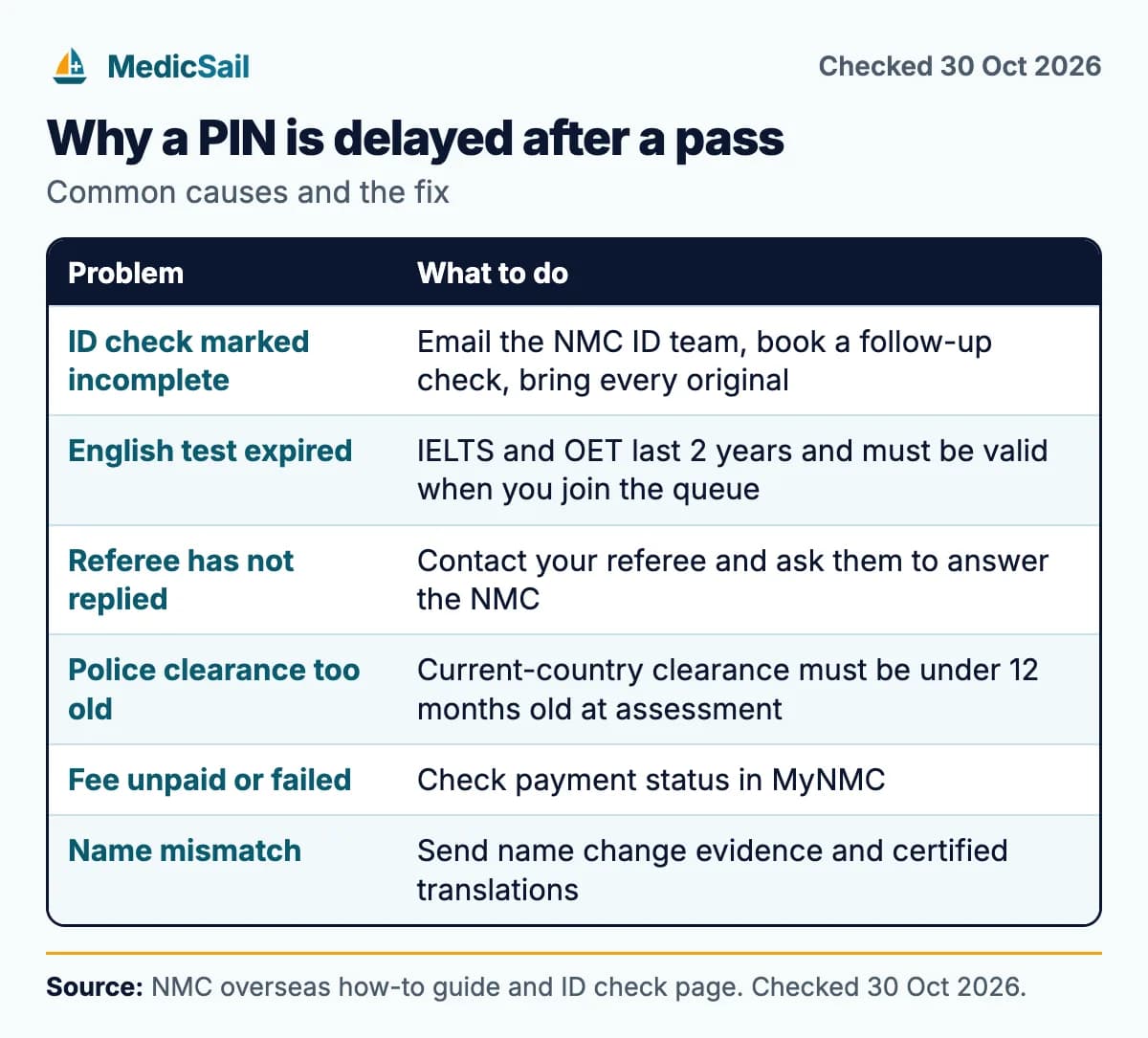
Common delays after an OSCE pass and how to fix them
| Problem | Why it happens | What to do |
|---|---|---|
| ID check marked incomplete | A document was missing, not original, or the application was not submitted on the day | Email the NMC ID team, book a follow-up check and bring every original listed by the NMC |
| English test expired | IELTS and OET are valid for two years from the test date and must be valid when the application joins the queue | Check the date early; if it will lapse, book a new test or check whether other accepted evidence applies |
| Referee has not replied | The NMC cannot evaluate until verification from referees arrives | Contact your referee directly and ask them to respond to the NMC's request |
| Police clearance out of date | The clearance from your current country must be issued no more than 12 months before the assessment date | Apply for a new clearance; the NMC may ask for a more recent one |
| Registration fee not paid or failed | The application cannot be submitted without it | Check MyNMC for the payment status |
| Name mismatch across documents | Marriage, spelling differences or transliteration | Provide name change evidence and certified translations |
Midwives follow the same steps after the midwifery OSCE. The only difference is the part of the register you join, so check that your register entry says registered midwife. The NMC sets a separate Test of Competence for each part of the register, so if you are dual qualified, ask the NMC how an application to a second part works for you.
Your first-year checklist
- Week one on the register: confirm your entry on the NMC register, tell HR and your manager, set up the annual fee Direct Debit, and save your decision email.
- First month: agree your preceptorship plan and preceptor; confirm your band, pay point and start date for Band 5 pay; check whether you need any trust competencies before working alone.
- From the start: keep a log of practice hours, CPD, feedback and reflections. You need 450 practice hours, 35 hours of CPD, five pieces of practice-related feedback and five written reflective accounts for your first revalidation, three years after joining the register.
- Tax: GOV.UK says you can claim tax relief on professional fees you must pay to do your job, for the current tax year and the four previous tax years, so keep your NMC fee receipts.
- If your plans change: do not resign or change employer before checking your visa and any repayment clause.
If you are coming from the Gulf and have not started yet, our guide on moving from a Gulf licence to UK registration covers what transfers and what does not.
Questions
It depends on when your application is complete. The NMC aims to decide a complete registration application within 30 days and must decide within three months. Nurses whose ID check, references and evidence were all done before the OSCE usually hear sooner than those with items outstanding.
The NMC says test centres email results within five working days of the OSCE. Leeds Teaching Hospitals' centre says it can occasionally take up to 10 working days. The result is also uploaded to your NMC application.
You still get your OSCE result, but your application will not move to the final registration stage until you attend a follow-up ID check. The NMC says a further in-person appointment is at your own expense; contact its ID team at [email protected].
The £182 registration fee must be paid before the NMC can decide, if you have not already paid it. Once registered you pay the annual fee, which is £143 for notices sent on or after 1 October 2026.
Usually when you are registered and appear on the NMC register. The exact date the Band 5 rate starts is set by your employer and contract. The 2026/27 Band 5 range in England is £32,073 to £39,043.
The NMC says preceptorship is voluntary and has no fixed length, but most NHS employers offer it to newly registered and internationally educated nurses. Many trusts run a 12-month programme, and some offer shorter routes for experienced nurses.
Not necessarily. If you stay in the same job with the same sponsor, ask HR to confirm no change is needed. GOV.UK says you must apply to update your visa if you change job or employer.
You can, but you need a new sponsor and a visa update, and you may owe money under a repayment clause. The Code of Practice says rechargeable costs must taper down, for example 100% in the first 12 months and nothing after 36 months.
Three years after you joined the register. Your renewal date is in MyNMC. Start recording practice hours, CPD, feedback and reflections from your first day as a registrant.
Sources
- 1NMC: how-to guide for applicants trained outside the UK
- 2NMC: OSCE
- 3NMC: Test of Competence
- 4NMC: ID check process and requirements
- 5NMC: ID check, Test of Competence overseas route
- 6NMC: ID check, OSCE resits
Show all 22 sourcesShow fewer sources
- 7NMC: how long it will take
- 8NMC: verifying your information
- 9NMC: registration decision
- 10NMC: character evidence
- 11NMC: language evidence
- 12NMC: registration fee
- 13NMC: paying your annual fee
- 14NMC: preceptorship principles
- 15Leeds Teaching Hospitals: the OSCE process
- 16Chesterfield Royal Hospital: internationally educated nurses
- 17NHS Employers: recruitment of overseas nurses and midwives
- 18NHS Employers: pay scales for 2026/27
- 19GOV.UK: Health and Care Worker visa, your job
- 20GOV.UK: Health and Care Worker visa, update your visa
- 21GOV.UK: Code of practice for the international recruitment of health and social care personnel in England
- 22GOV.UK: tax relief for professional fees and subscriptions
Plan it with our free tools
MedicSail
Healthcare licensing consultants for the UK, Europe and the USA
Updated and checked against the sources listed above. How we research and check our guides