


































NMC application refused or closed: what it means and what to do next
Closed, refused or not eligible: what each NMC outcome means, which ones you can appeal within 28 days, and a checklist for reapplying so it does not happen twice.

MedicSail
Published
The short answer
If your NMC application has been closed or refused, first find out exactly which one it is, because the two lead to different next steps. A closed application has stopped. That can happen because nothing happened on it for three months, because the NMC decided you were not eligible for the overseas route, because you used all three attempts at the CBT or OSCE, or because supporting evidence did not arrive in time. A refused application is a formal decision by the NMC's Assistant Registrar that you do not meet a registration requirement, most often on health, character or English language grounds.
Your options depend on which of these applies:
- Closed for inactivity: the NMC says you can sign up again when you are ready to actively progress your application. There is no appeal; you start a new application.
- Closed after three failed Test of Competence attempts: you must wait at least six months, then make a new application and sit the test again.
- Refused on health, character or English language grounds: you can appeal within 28 days of the decision, or fix the problem and apply again.
- Refused because you did not pay the fee or sent an incomplete application: the NMC says there are no appeal rights, so the route is a new, complete application.
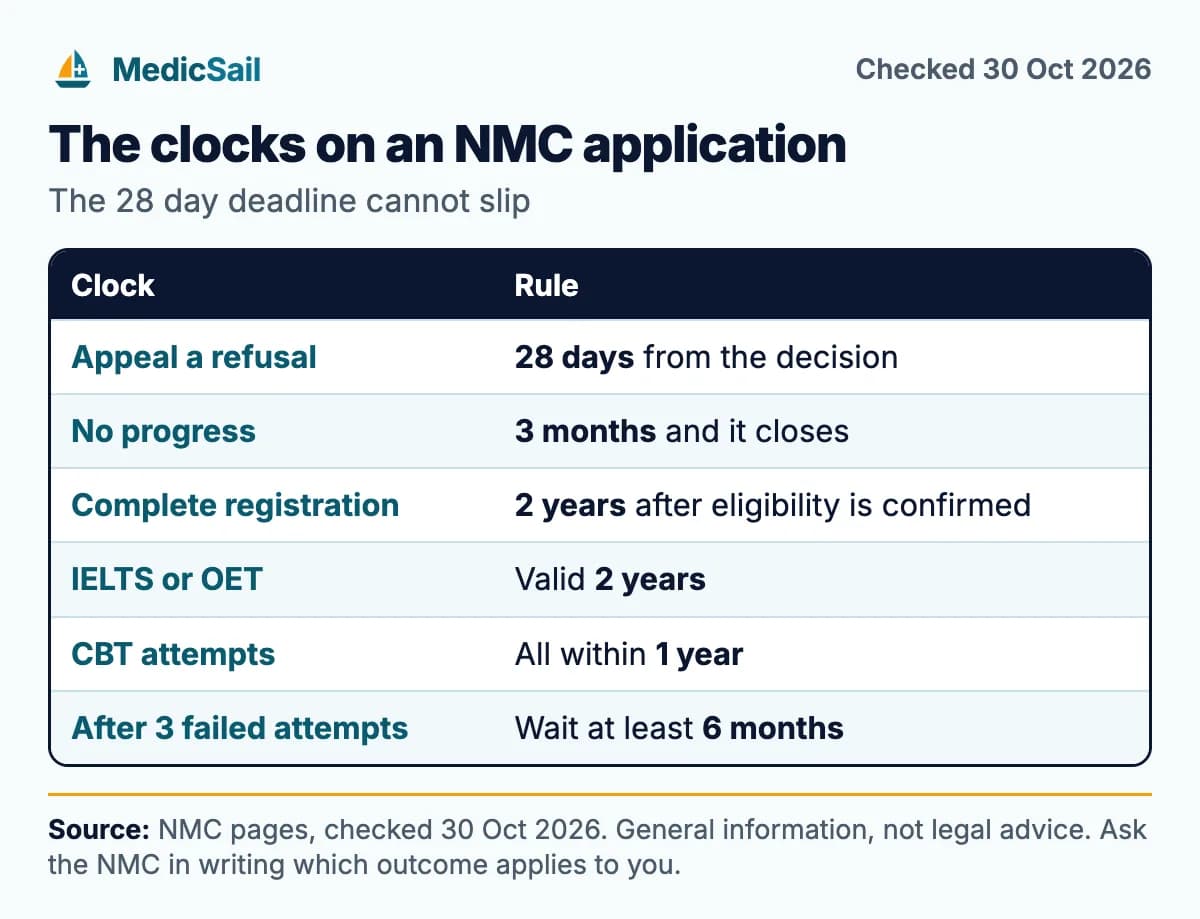
The 28-day appeal deadline is the one date that cannot slip. If your letter is a refusal, read it the day it arrives, note the final date it gives for an appeal, and decide quickly whether you will appeal or reapply. This guide goes through every reason an overseas application closes or is refused, what the NMC's own pages say about each one, and what to do next. For the full route from the start, see our page on NMC registration for nurses and midwives trained abroad.
Closed, refused or not eligible: what your status means
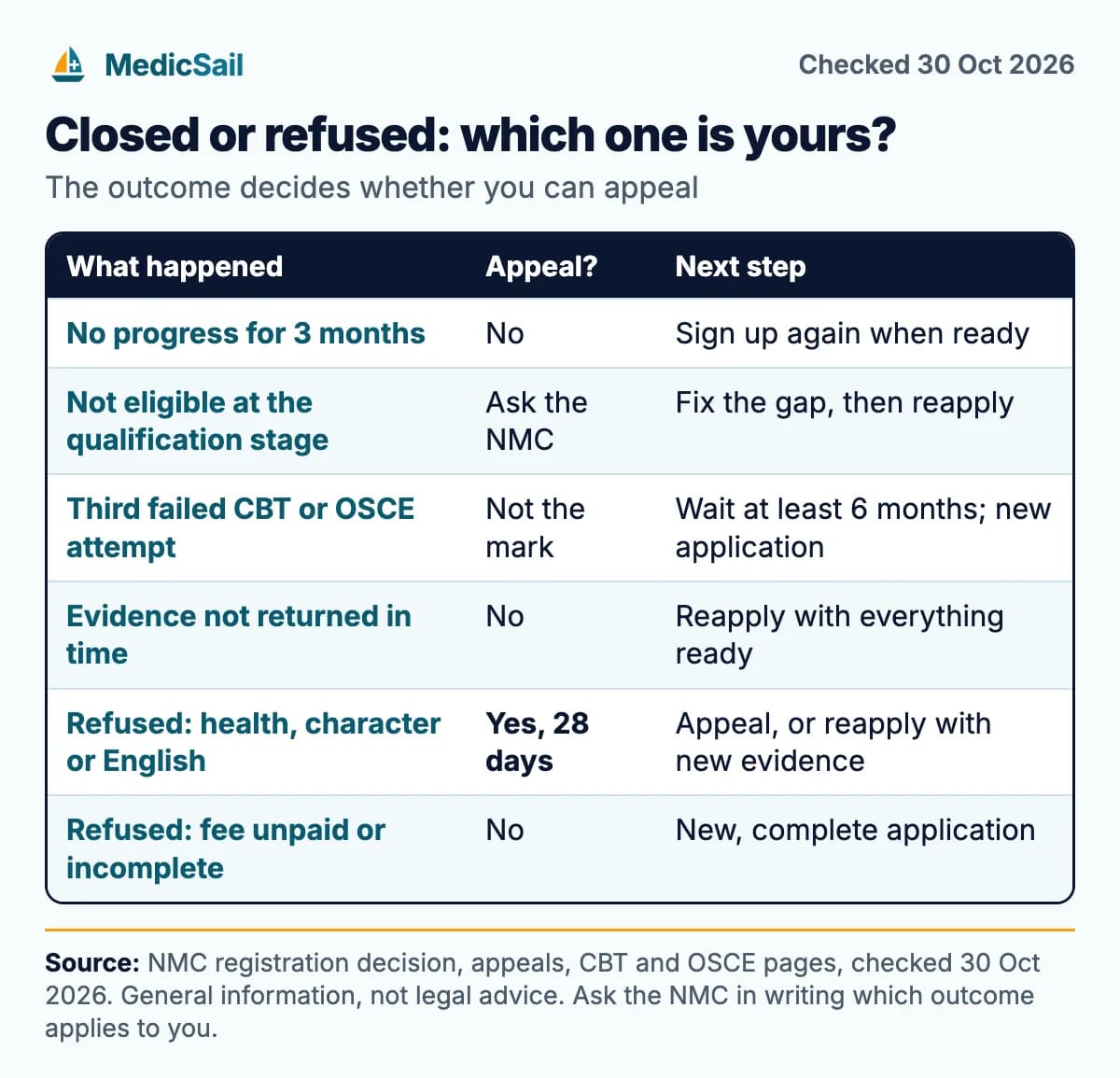
Applicants often use "rejected" for anything that stops their application. The NMC's process has several distinct outcomes, and each has its own remedy. This table sets them out side by side, using the NMC's own wording where it exists.
| What happened | What it means | Can you appeal? | What to do next |
|---|---|---|---|
| No activity for three months | The NMC closes the application and removes the online account | No | Sign up again when you can actively progress it |
| Not eligible at the qualification stage | Your qualification or registration could not be confirmed or does not meet the criteria; the NMC emails you and closes the application | The NMC's appeal page refers to refused registration applications; ask the NMC in writing whether your decision carries appeal rights | Fix the gap (for example, regulator verification) and apply again, or consider another country |
| Three failed CBT or OSCE attempts | The application closes | No appeal against the result itself; you can appeal the exam process | Wait at least six months, then make a new application |
| Evidence not returned by the NMC's deadline | The NMC closes the application; the registration fee is refunded | No | Apply again with everything ready |
| Refused on health, character or English language | A formal decision that you do not meet a requirement | Yes, within 28 days | Appeal, or reapply with new evidence |
| Refused for non-payment or an incomplete application | A formal decision | No, the NMC says | Make a new, complete application |
If you are not sure which of these applies to you, log in to MyNMC and read every message on your account, then contact the NMC and ask, in writing, for the reason your application was closed or refused and whether you have a right of appeal. Keep that reply. A recruiter or a forum post is not a substitute for the NMC's own answer, and the reason matters: it decides whether a 28-day clock is running.
Closed for inactivity: the three-month rule
This is the most common closure and the least serious. The NMC's guide says that if there is no further activity on your application for three months, for example because you have not submitted it, "the application will be closed and the online account removed". It adds that you will be able to sign up again when you are ready to actively progress your application.
It usually catches people who open an account early, before their English test, police clearances or referee details are ready, and then wait. It also catches people who start the eligibility and qualification application but do not submit it and pay the evaluation fee.
What to do:
- Get everything ready before you sign up again. Use the NMC's pre-application checklist tool and gather your passport, qualification and registration details, and the contact details of your regulator. The NMC CBT guide explains how the eligibility stage leads into booking the test.
- Brief your referees first. The NMC's character and health pages both warn that your application may be delayed if your character referee or the doctor giving your health declaration has not been contacted before you apply.
- Check your English evidence dates. IELTS and OET results are valid for two years from the test date, and must be valid when your application joins the assessment queue. Our guide to IELTS or OET for UK regulators sets out the NMC's scores.
- Ask about exam results already passed. If you passed the CBT under the old application, ask the NMC in writing how it will treat that result on a new application. The NMC's Test of Competence page says you must pass the CBT and OSCE within two years of each other; it does not say a closed application cancels a pass, so get the answer for your own case rather than assuming.
The evaluation fee is non-refundable, so if you paid it before the application closed, expect the fees that apply to a new application when you start again. The NMC's current fees are set out in our guide to the total cost of NMC registration.
Closed at the eligibility stage: qualification or registration not confirmed
At the first stage the NMC checks that you are on the right route and that your qualification and registration can be confirmed. Its evaluation outcome page sets out the three possible results:
- Eligible: you are asked to complete the registration application.
- Test of Competence required: if you do not hold a relevant European qualification, the NMC says you will need to take the Test of Competence because it cannot recognise your qualification directly. This is the normal outcome for most nurses trained outside Europe, not a rejection.
- Not eligible: if your regulator cannot confirm your registration or qualification, the NMC says it "may not be able to accept your eligibility application". If you do not meet the criteria, it says you will not be able to proceed, it will email you, "and then close your application".
The NMC aims to tell you the outcome within 14 days of receiving everything it needs, including your regulator's response. Many delays and some closures come from the regulator, not from you: the regulator does not reply, replies to the wrong address, or gives details that do not match what you entered.
What to do:
- Read the email for the specific reason. "Regulator could not confirm" and "does not meet the criteria" need different fixes.
- If the problem was verification, contact your home regulator, confirm that your registration is active or was active, and check that names, dates of birth and registration numbers match exactly (a certificate of good standing from your regulator helps) across your passport, certificates and the NMC form. Name changes need evidence.
- If the problem was the qualification itself, ask the NMC which criterion you did not meet before you pay to apply again. A second application with the same qualification and no new evidence is likely to end the same way.
- If you trained as a midwife or in a specific nursing field, check you applied to the right part of the register. Our pages on nursing in the UK and midwifery in the UK explain the parts and fields.
The evaluation fee is not refunded. The NMC's evaluation fee page says this is the case "even if we determine that you're not eligible to apply or you don't gain registration".
Closed after three failed CBT or OSCE attempts
You have three attempts at the CBT and three at the OSCE within one application, with at least 10 days between sittings. The NMC's CBT page says that after three failed attempts "your application will close and you will need to wait six months" before you submit a new application and sit the CBT again. Its OSCE page says the same: the application closes, you must wait at least six months before you sit the OSCE again, and you retake all 10 stations.
There is one more CBT trap. The NMC says your three CBT attempts all need to be taken within one year, and after that period you need to resit both modules again. So a slow sequence of resits can cost you a pass on one part.
A closure after three attempts is not a refusal on character grounds and does not stop you applying again. It does, however, have consequences for anyone already in the UK on a sponsored visa: NHS Employers says that if an applicant is unsuccessful after their permitted attempts, the employer must stop sponsoring them and their leave is shortened. We cover attempt limits, fees and the visa side in detail in our guide on failing the NMC CBT or OSCE.
Before your new application:
- Use the six months. Read the feedback from your failed OSCE stations, or the CBT score report, and rebuild your preparation around the gaps, not around what you already know.
- Check whether your English test will still be valid by the time your new application reaches the assessment queue.
- If you think something went wrong with how the exam was run, the route is an appeal about the process, through the test centre or the CBT booklet, not a challenge to the mark.
Closed because evidence did not arrive, or refused as incomplete
After eligibility, the registration application needs health, character and English language evidence, a professional indemnity declaration and the registration fee. The NMC then contacts your nominated referees and can only evaluate the application once it has "received all your supporting information and verification from your referees".
The registration fee page lists three cases in which the fee is refunded, and one of them tells you that a deadline exists: you get the fee back if you "don't return the required supporting evidence within our deadline, so we close your application". The other two are withdrawing before registration is completed and being found not to meet the requirements.
The NMC's decision page is clear that there are "no appeal rights where your application was refused because you failed to pay your registration fee or if you submitted an incomplete application". So for this group the only route is a new, complete application.
The usual causes are practical:
- A police clearance that is missing for one of the countries where you lived for 12 months or more in the last ten years, or a clearance from your current country issued more than 12 months before the assessment date.
- A regional or state police certificate where a national one was needed.
- A character referee or doctor who never received the request, or who replied late.
- Emails from the NMC asking for more information that went to a spam folder.
- A registration fee payment that failed.
Before applying again, make a list of every document, who issues it and how long it takes, and get the slow ones (police clearances and regulator letters) moving first. Our guide on moving from a Gulf licence to UK registration covers police clearances and good standing letters for nurses already working in the GCC.
Refused on health, character or English language grounds
These are the refusals that carry a right of appeal. The NMC's decision page says you may appeal a decision on entry to the register "where the refusal concerns your good health or character, or a requirement to undergo an English language test".
Character. Alongside a police clearance certificate from each country you have lived in for 12 months or more in the last ten years, you must declare police charges, cautions, convictions and conditional discharges, and any regulatory determinations by a body other than the NMC, in the UK or overseas. You do not need to declare protected items that would not appear on a police clearance or DBS check, charges where no further action was taken, or motoring offences unless they led to disqualification. A declaration is not an automatic refusal. The NMC's character page invites you to explain the incident and give a reflective statement covering your insight, the potential impact on safe practice and what you have done to stop it happening again. Applicants are more often refused for not declaring something that later appears on a clearance than for the matter itself, because non-disclosure raises a question of honesty.
Health. You make a self-declaration and nominate a registered medical practitioner who has assessed your health within the last twelve months. The NMC says that "declaring a health condition and/or disability doesn't necessarily mean you won't be able to join our register"; it needs to be sure you have taken steps to manage the condition. You can explain its nature, how it affects your practice and how you avoid putting patients at risk, and upload supporting documents.
English language. The NMC accepts IELTS Academic (7 in reading, listening and speaking, 6.5 in writing) or OET (grade B in reading, listening and speaking, C+ in writing), a qualification taught and examined in English, or recent practice in a majority English-speaking country. If it is not satisfied with what you sent, it says it will ask you for an alternative type of evidence, often a test. A refusal on this ground is usually about evidence that does not meet the published rules: an expired score, a combined result that does not meet the combining rules, or training that was not both taught and examined in English.
In each case the strongest response is new evidence that answers the specific concern in the letter: a clearer reflective statement, a supporting letter from a treating doctor, character references, or a fresh test result.
Refusals linked to test integrity or documents
A smaller group of refusals is about whether the evidence itself can be trusted. The clearest example is the NMC's position on CBT results from the Yunnik test centre in Ibadan, Nigeria. The NMC's guidance for employers says that, because of evidence of widespread fraud there, it considers all CBT results obtained at that centre to be invalid and that affected people need to retake the test. Registration appeal panels have heard many of these cases since, and the NMC publishes their reasons.
Other published appeal decisions concern supporting documents, for example identical wording across references or employment evidence that the NMC could not verify. If your refusal letter raises a concern of this kind:
- Read the published registration appeal outcomes (separate from fitness to practise hearings) on the NMC website to see what panels looked at in similar cases.
- Gather independent evidence: original employment records, payslips, a letter directly from your former employer or regulator, and any later test you passed under clean conditions.
- Consider advice from a solicitor who handles NMC registration appeals, or your union if you are a member. These cases turn on evidence and credibility.
Never use a third party who offers to sit a test for you, provide references or "speed up" your NMC decision. Apart from the risk of refusal, the NMC treats dishonesty as a serious concern if it comes to light after you are registered.
How to appeal an NMC registration decision
If your refusal carries appeal rights, these are the rules the NMC publishes:
- The deadline is 28 days from the decision. The NMC's registration appeals page says your decision letter gives the specific final date. Work from that date, not from the date you read the letter.
- Use the NMC's notice of appeal form. The appeals page links to appeal guidance and a notice of appeal proforma and recommends using it. A notice must meet legal criteria to be valid.
- Set out your grounds and evidence. The NMC says the appeal "should set out the grounds of the appeal and any evidence to be used, such as the details of character referees or supporting statements".
- Acknowledgement and listing. The NMC says it acknowledges a valid notice within five working days and typically lists appeals within three to six months.
- The decision may be conceded. If new information satisfies the Assistant Registrar, the NMC may concede the appeal, sometimes without a hearing.
- Otherwise an independent Registration Appeal Panel hears it. The panel's reasons are published.
There is also a separate right if the NMC is slow. Its decision page says it is required to make a decision "within three months of receiving your completed application" and that "if we fail to do this, you have a right of appeal".
Appeal or reapply? An appeal makes sense when you believe the decision was wrong on the evidence the NMC had, or when you have new evidence that answers its concern. Reapplying makes sense when the problem was missing or out-of-date evidence that you can now supply. Published appeal outcomes show that a dismissed appeal does not stop you making a fresh application later. If the decision concerns honesty or test fraud, take legal advice before choosing. This guide is general information, not legal advice.
Reapplying: a checklist so it does not happen twice
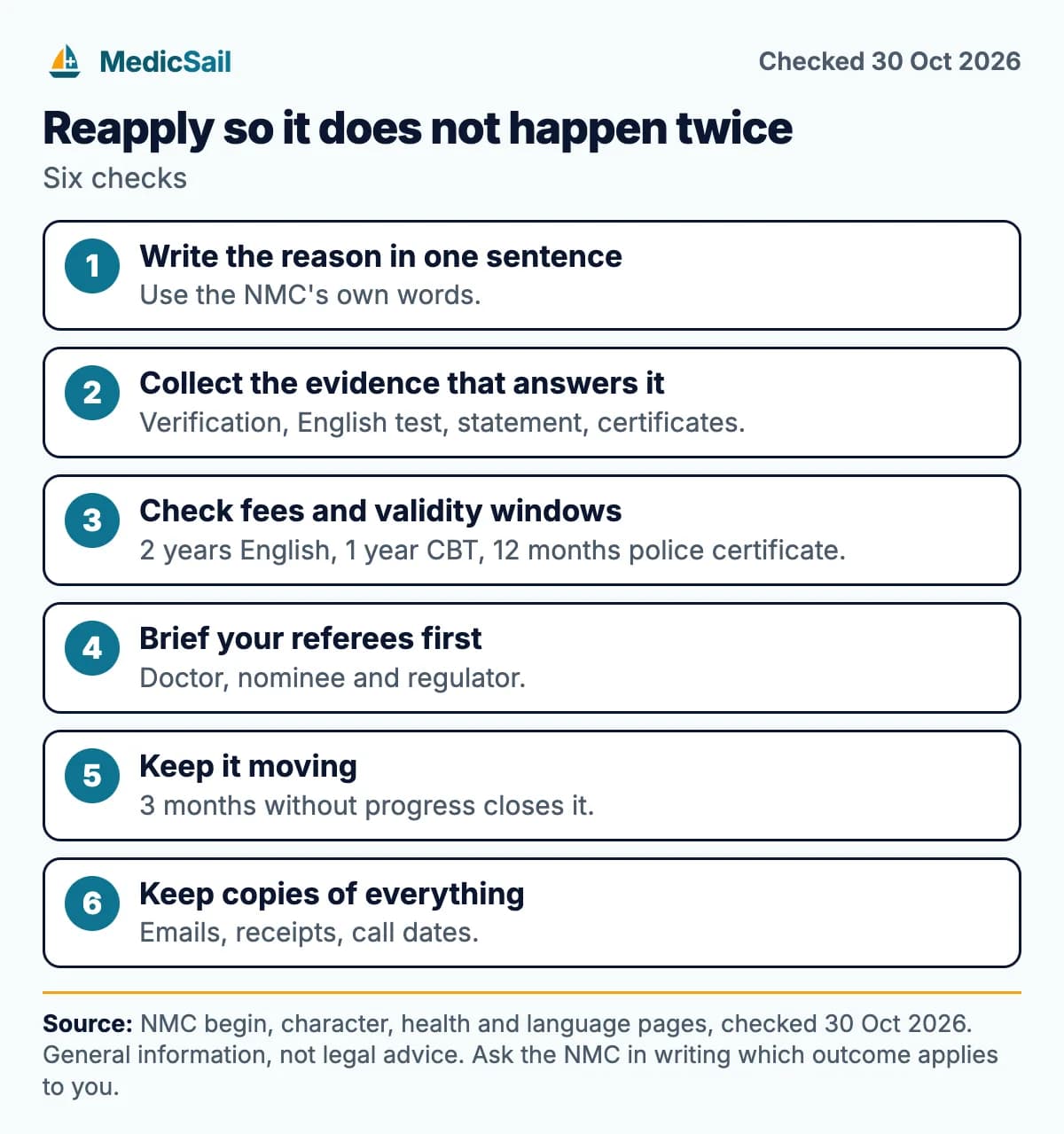
Whatever the reason, a second application should look different from the first. Work through this list before you sign up again:
- Write down the reason in one sentence, using the NMC's words from your letter or email.
- Collect the evidence that answers it: regulator verification, a new English test, a reflective statement, medical evidence or police clearances.
- Check the fees. The NMC raised its fees on 1 October 2026. Its costs page now lists £167 for the qualification evaluation and £182 for registration, with the CBT at £83 and the OSCE at £794. The evaluation fee is non-refundable.
- Check every validity window: two years for IELTS or OET; one year for your CBT attempts; two years between passing the CBT and the OSCE; and, for the current country police clearance, issue within 12 months of the assessment date.
- Brief your referees, the doctor for your health declaration and your regulator before you submit.
- Keep the application moving. Three months without activity closes it again.
- Keep copies of every email and document, and note dates of calls.
The NMC aims to consider a complete registration application within 30 days of receiving all the evidence, test results and fee. Most of the time lost by applicants comes from the steps before "complete".
Your job, your visa and your other options
If you have a UK job offer, tell your recruiter or employer what has happened and when you expect to reapply or hear about an appeal. Offers are usually conditional on registration, and the employer decides whether it can hold a role open.
If you are already in the UK on a Health and Care Worker visa, your position depends on your sponsor and the conditions of your visa. NHS Employers says that an overseas nurse can work as a pre-registration candidate while preparing for the OSCE, must pass within eight months of the start of the visa, and that if the nurse is unsuccessful after the permitted attempts the employer must stop sponsoring them and their leave to remain will be shortened. Our Health and Care Worker visa guide explains how the visa is tied to your sponsor. Speak to your employer early and take advice from a qualified immigration adviser about your own situation.
If you are working in the Gulf, keep your current licence and good standing active while you reapply. A Gulf licence does not exempt you from the NMC's Test of Competence, but recent practice in your current post is useful evidence in other parts of the application.
If the UK route is closed to you for now, other countries have different routes for nurses trained abroad. Ireland uses a qualification recognition process with an aptitude test or adaptation period, described on our NMBI registration page and in our NMBI aptitude test and adaptation guide. The nursing hub compares the UK, Ireland, Germany, the Netherlands and the USA.
Questions
The NMC closes overseas applications for four main reasons: no activity for three months, a finding that you are not eligible at the qualification stage, three failed attempts at the CBT or OSCE, or supporting evidence not returned by its deadline. Check MyNMC and ask the NMC in writing which reason applies.
Yes, if the refusal concerns your health, character or an English language requirement. You must appeal within 28 days of the decision, and your letter gives the final date. There are no appeal rights where the refusal was for non-payment of the fee or an incomplete application.
The NMC says it acknowledges a valid notice of appeal within five working days and typically lists appeals within three to six months. If new information satisfies the Assistant Registrar, the appeal may be conceded without a hearing.
Yes. After a closure for inactivity the NMC says you can sign up again when you are ready to progress your application. After three failed test attempts you must wait at least six months before making a new application.
The £167 evaluation fee is non-refundable in all cases. The £182 registration fee is refunded if you withdraw before registration is completed, if your application is closed because you did not return evidence within the deadline, or if you are found not to meet the requirements.
Not automatically. You must declare charges, cautions, convictions and conditional discharges, and you can give an explanation and a reflective statement. Failing to declare something that later appears on a police clearance is often treated more seriously than the matter itself.
No. The NMC says declaring a health condition or disability does not necessarily mean you cannot join the register. It needs to be satisfied that the condition is managed and that you can practise safely.
The NMC's pages do not say a closed application cancels a CBT pass, but you must pass the CBT and OSCE within two years of each other and take your CBT attempts within one year. Ask the NMC in writing how it will treat your result on a new application.
The NMC says it is required to decide within three months of receiving your completed application, and that you have a right of appeal if it does not. It aims to decide complete applications within 30 days.
Sources
- 1NMC: how long it will take (three-month closure, 14 and 30 day targets)
- 2NMC: begin your application
- 3NMC: evaluation outcome
- 4NMC: evaluation fee
- 5NMC: character evidence
- 6NMC: health evidence
Show all 17 sourcesShow fewer sources
- 7NMC: language evidence
- 8NMC: registration fee and refunds
- 9NMC: verifying your information
- 10NMC: registration decision and appeal rights
- 11NMC: registration appeals
- 12NMC: costs for applicants trained outside the UK
- 13NMC: Test of Competence
- 14NMC: CBT
- 15NMC: OSCE
- 16NMC: Yunnik test centre guidance for employers
- 17NHS Employers: recruitment of overseas nurses and midwives
Plan it with our free tools
MedicSail
Healthcare licensing consultants for the UK, Europe and the USA
Updated and checked against the sources listed above. How we research and check our guides