


































IELTS or OET? Which English test each UK healthcare regulator accepts
Every UK healthcare regulator accepts IELTS, but OET is not open to everyone. A regulator-by-regulator comparison of tests, scores, sittings, validity and exemptions, plus how the visa English rule differs.

MedicSail
Published
The short answer
Every UK healthcare regulator accepts IELTS, but not every regulator accepts OET. The GMC's English requirements for doctors, the NMC's English rules for nurses and midwives and the GPhC's requirements for pharmacists all accept both IELTS Academic and the profession-specific OET. The HCPC accepts OET for only six of the professions it regulates, and the GDC names IELTS as its test for dentists and dental care professionals, with no OET option of its own.
The scores are different for each regulator. Doctors need IELTS 7.5 overall with 7.0 in every skill, or OET Medicine grade B in all four sub-tests. Nurses and midwives need IELTS 7 in listening, reading and speaking with 6.5 in writing, or OET B in three sub-tests with C+ in writing. Pharmacists need 7 in every IELTS skill, or OET Pharmacy grade B throughout. Dentists need IELTS 7 overall with 6.5 in each skill. Most HCPC professions need IELTS 7.0 overall with no element below 6.5, or OET 1400 with no element below 300 where OET is allowed.
So the real choice is narrower than it looks. If you are a paramedic, biomedical scientist or practitioner psychologist, OET is not an option with the HCPC. If you are a dentist, plan for IELTS. If you are a doctor, nurse, midwife, pharmacist or one of the six HCPC professions with an OET version, you can pick the test that suits you, and this guide explains how to decide. It also covers the separate English rule for the Health and Care Worker visa, which is not the same thing as your regulator's rule. For the wider picture of moving to the UK, start with our guide to working in UK healthcare.
IELTS and OET by regulator: the comparison table
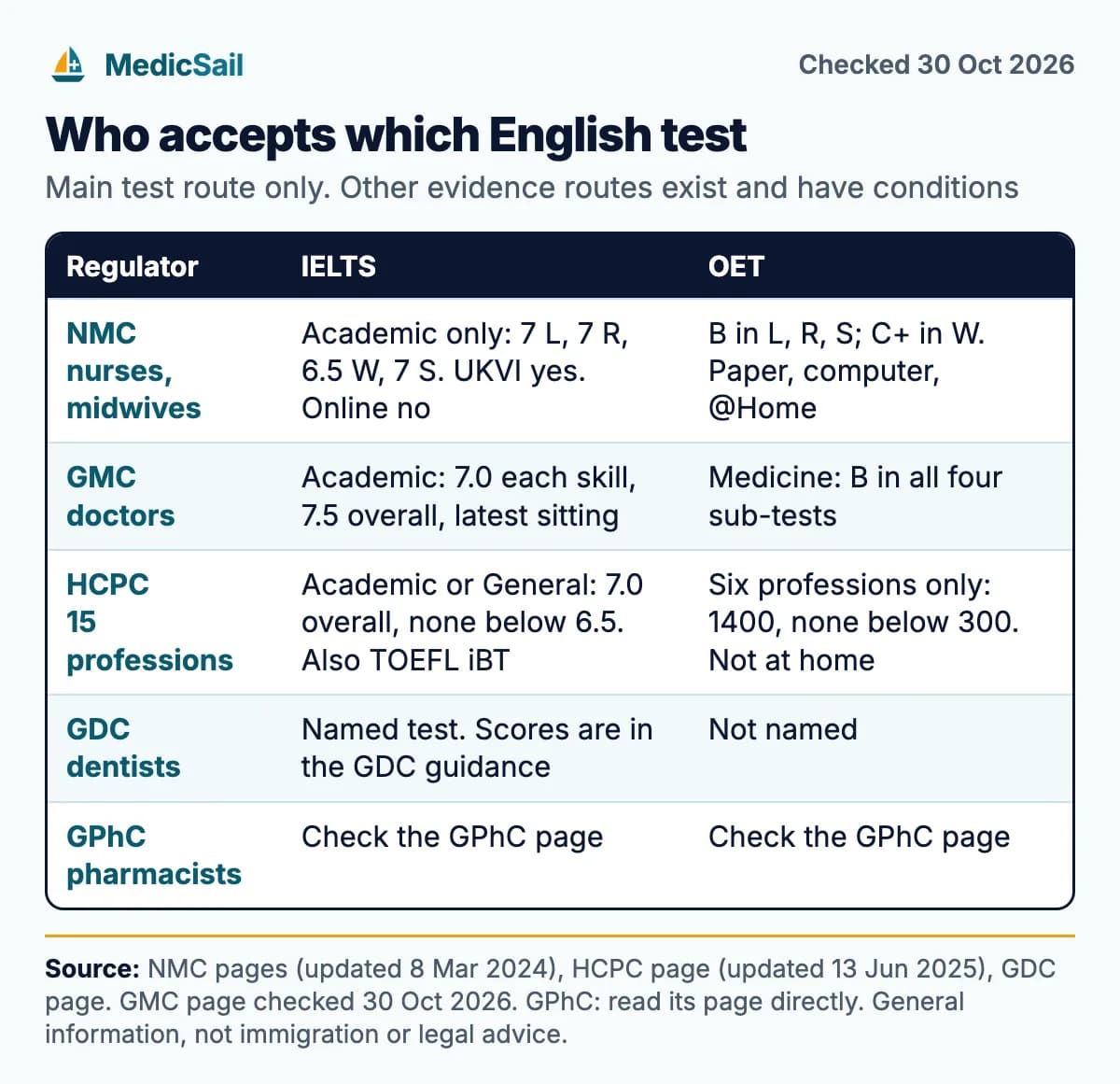
This table sets out what each regulator says on its own English language pages. It covers the main test route only. Each regulator also accepts other kinds of evidence in some cases, which are covered further down.
| Regulator | Professions | IELTS | OET | Other tests |
|---|---|---|---|---|
| GMC | Doctors | Academic only: 7.5 overall, at least 7.0 in each skill, same sitting | Medicine only: at least B in all four sub-tests, same sitting | None |
| NMC | Nurses, midwives, nursing associates | Academic: 7 listening, 7 reading, 6.5 writing, 7 speaking | B (350+) in listening, reading and speaking; C+ (300+) in writing | None: IELTS Academic and OET are the only tests accepted |
| GDC | Dentists and dental care professionals | Academic: 7 overall, at least 6.5 in each skill, on a single Test Report Form | Not one of the GDC's named tests | None named; a recent pass in another English-speaking regulator's test can count as evidence |
| GPhC | Pharmacists, pharmacy technicians | Academic (including IELTS for UKVI, not Life Skills): 7 overall and at least 7 in each skill, one sitting | Pharmacy, paper or computer: at least B in each sub-test, one sitting. OET@Home not accepted | None |
| HCPC | 15 health and care professions | Academic or General Training: 7.0 overall, no element below 6.5 (speech and language therapists 8.0, no element below 7.5) | Six professions only: 1400 with no element below 300 (speech and language therapists 1800, no element below 400) | TOEFL iBT, taken outside the UK |
Two points stand out. First, the NMC is the only regulator that accepts a lower score in one IELTS skill (writing at 6.5) than in the others. Second, the HCPC is the only regulator that accepts IELTS General Training as well as Academic, and the only one that accepts TOEFL iBT. Everyone else wants IELTS Academic.
GMC: doctors
Doctors applying through PLAB or a postgraduate route need English evidence before they can book PLAB 1 and again when the GMC approves their registration. The GMC accepts two tests.
- IELTS Academic, including IELTS for UKVI and IELTS Online, with at least 7.0 in each of listening, reading, writing and speaking and 7.5 overall. The scores must come from the same test and from your most recent sitting. The IELTS Indicator test is not accepted.
- OET Medicine, on paper, on computer or OET@Home, with at least grade B in each of the four sub-tests, again in the same sitting and your most recent sitting. You need to select the General Medical Council as a recognising organisation in your OET account.
The GMC accepts IELTS One Skill Retake once, for one section, if you sat the full test on computer at a centre that offers it and you retake within 60 days. There is no equivalent for combining two separate full sittings.
The "most recent sitting" rule catches people out. If you pass IELTS, then sit it again to try for a higher score and do worse, the GMC looks at the later result. The safest approach is not to resit once you hold a certificate that meets the requirement.
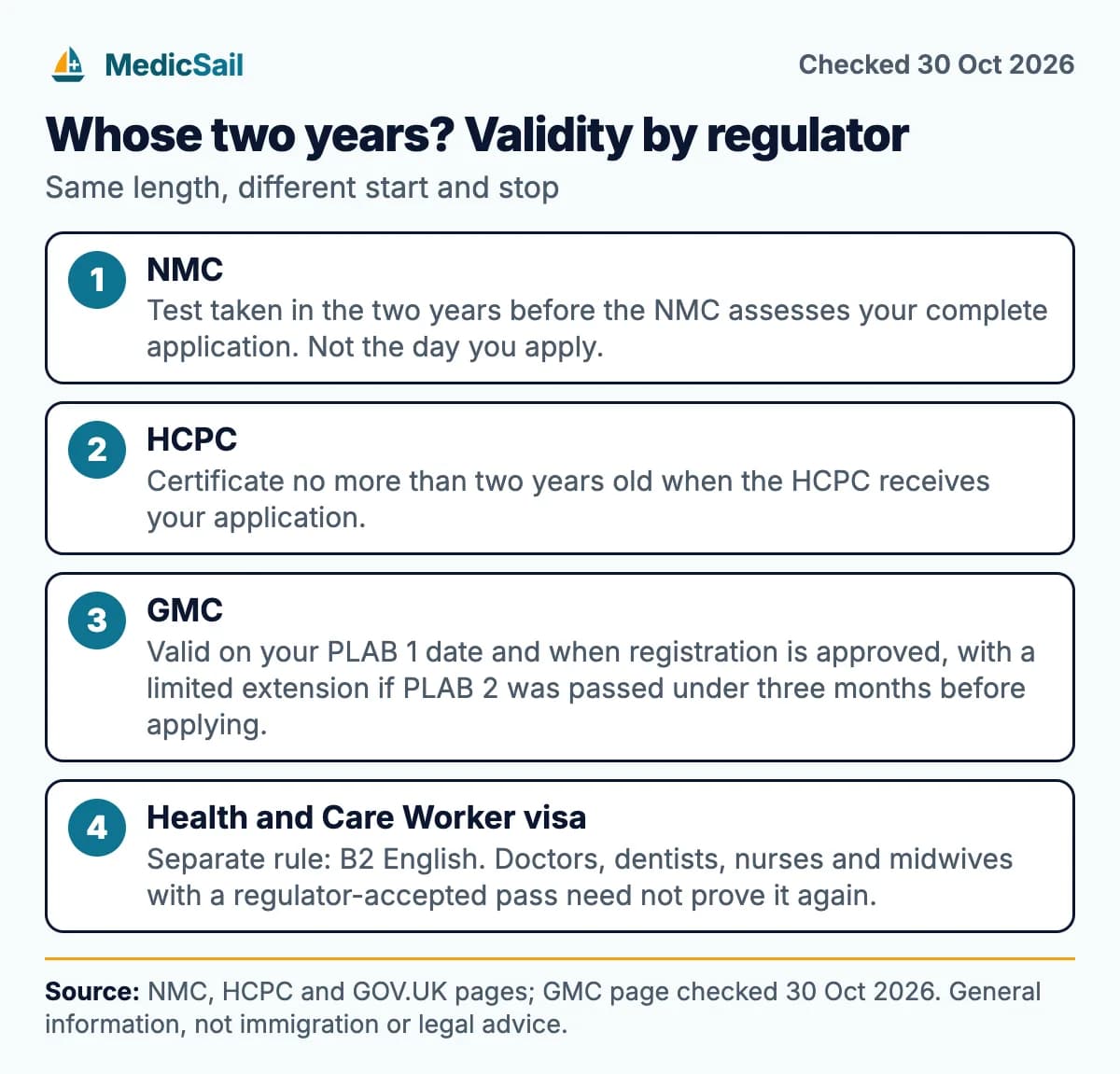
Certificates are valid for two years and must still be valid on the day you sit PLAB 1 and on the day the GMC approves your registration. Because the PLAB route can take a long time, this is the point where many doctors run out of time. The GMC treats your English as maintained if your IELTS or OET is less than three years old and you passed PLAB 2 less than three months before you apply for registration. Our guide to PLAB 1, PLAB 2 and GMC registration shows how to time the exams around your certificate, and the guide for doctors moving to the UK covers the full route.
NMC: nurses and midwives
The NMC says IELTS Academic and OET are the only tests it accepts as proof of English. The required scores are:
- IELTS Academic: 7 in listening, 7 in reading, 6.5 in writing and 7 in speaking. There is no separate overall score requirement on the NMC page.
- OET: B (350 or above) in listening, reading and speaking, and C+ (300 or above) in writing.
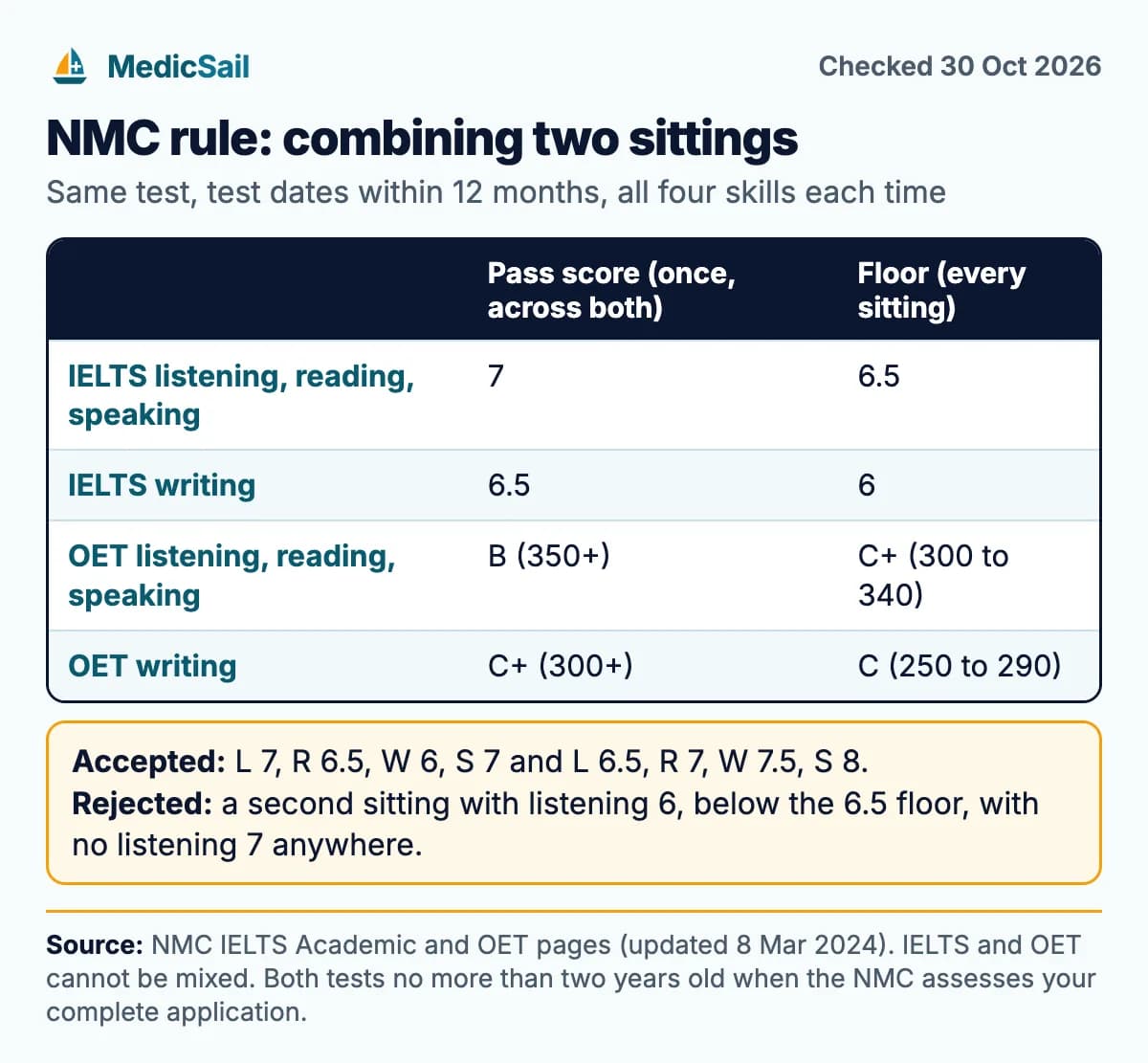
The NMC's distinctive rule is that you can combine results from two sittings of the same test. Both tests must be taken within 12 months of each other, both must be no more than two years old when the NMC assesses your complete application, all four skills must have been tested at each sitting, and you must reach the required score in each skill across the two. You cannot combine an IELTS result with an OET result. The NMC also says the speaking element must be tested by a person, not by a computer.
In practice, combining helps when you keep missing one skill. For example, if your first IELTS sitting met every score except reading, and a second sitting within 12 months reached 7 in reading, the NMC's rule may let you use the two together, as long as each skill reaches the minimum across the two sittings and both meet the other conditions.
Validity is two years, measured to the date the NMC assesses your application rather than the date you apply. If your certificate is close to expiry, submit early. The guide for international nurses and the guide for international midwives explain where English fits in the NMC process, and the NMC CBT guide for international nurses covers the test of competence that follows.
GDC: dentists and dental care professionals
The GDC's English language guidance names one test: the Academic version of IELTS. Dentists and all dental care professional titles need an overall score of 7 with at least 6.5 in each of reading, writing, listening and speaking. The GDC says it accepts results from IELTS One Skill Retake and IELTS Online at the same minimum scores.
The guidance asks for a single IELTS Test Report Form, which must usually be no more than two years old when you apply. It does not describe any way of combining two separate sittings, so plan to reach every score in one test.
OET is not one of the GDC's named tests. The GDC does, however, accept "a recent pass in a language test for registration with a regulatory authority" in a country where English is the first language, with supporting evidence from that regulator showing which test was used and what it required. Recent here means less than two years old. If you registered in such a country using a different test, ask the GDC before booking IELTS.
The GDC also defines countries where English is the first language using the UK government's list of majority English-speaking countries. Gulf countries are not on that list, so practice in the UAE, Saudi Arabia or Qatar does not count as English-language practice for this purpose. See the guide for dentists moving to the UK for the ORE and registration steps.
The GDC also says it is reviewing its English language guidance and will update it when the review is complete, so check the English language controls page again before you book a test. You can read the full rules on the GDC registration page.
GPhC: pharmacists
The GPhC accepts two tests for internationally qualified pharmacists.
- Academic IELTS, including IELTS for UKVI but not IELTS Life Skills, with an overall score of at least 7 and at least 7 in each of reading, writing, listening and speaking, at one sitting.
- Pharmacy OET, on paper or on computer, with at least grade B in each sub-test, at one sitting. The GPhC does not accept OET@Home. You share results with the GPhC through the myOET portal.
That makes the GPhC's IELTS bar higher in writing than the NMC's, and its OET rule stricter on format than the GMC's. A pharmacist who sat OET at home for another purpose will need to sit it again at a test venue.
Results must normally be less than two years old when you apply. The GPhC says older results may be accepted if you can show you have kept up your English, for example by working as a pharmacy professional in a mainly English-speaking country. One more point is specific to pharmacy: the overseas pharmacists' assessment programme (OSPAP) is a university course, and universities set their own English entry requirements. They may still ask for a test even when the GPhC accepts other evidence. The guide for pharmacists moving to the UK explains OSPAP and foundation training.
HCPC: allied health professions, and who cannot use OET
The HCPC accepts three tests: IELTS, TOEFL iBT and OET. All must be taken at an official test centre, not at home, and the certificate must be no more than two years old when the HCPC receives your application.
- IELTS (Academic or General Training, UKVI or non-UKVI): 7.0 overall with no element below 6.5. Speech and language therapists need 8.0 overall with no element below 7.5. One-skill retakes are accepted if the retake is within six months of the original test and the results appear on the same test report.
- TOEFL iBT: for tests taken on or after 21 January 2026, Reading 4.5, Listening 5, Writing 4.5, Speaking 5 and Overall 5 (speech and language therapists: Reading 5.5, Listening 5.5, Writing 6, Speaking 6, Overall 6). TOEFL tests taken in the UK, combined scores, superscores and MyBest scores are not accepted.
- OET, profession-specific, for six professions only.
The HCPC accepts OET for:
| Profession | Test | Minimum |
|---|---|---|
| Chiropodists / podiatrists | Profession-specific OET | 1400, no element below 300 |
| Dietitians | Profession-specific OET | 1400, no element below 300 |
| Occupational therapists | Profession-specific OET | 1400, no element below 300 |
| Physiotherapists | Profession-specific OET | 1400, no element below 300 |
| Radiographers | Profession-specific OET | 1400, no element below 300 |
| Speech and language therapists | Profession-specific OET | 1800, no element below 400 |
Every other HCPC profession has to use IELTS or TOEFL iBT unless an exemption applies. That includes paramedics, biomedical scientists, clinical scientists, practitioner psychologists and operating department practitioners. Our profession pages confirm this one by one: the paramedic registration guide, the biomedical scientist guide and the practitioner psychologist guide each list IELTS and TOEFL iBT as the only test options.
If you are in one of the six OET professions, see the physiotherapist guide, the radiographer guide, the occupational therapist guide or the dietitian guide for the rest of the HCPC route.
The HCPC also exempts you from English evidence altogether if the qualification that first allowed you to practise was gained in a country on its list of qualifying countries, which includes Australia, Canada, Ireland, Kenya, New Zealand and the USA among others.
Combining sittings, retakes and validity compared
The rules on sittings and expiry decide more applications than the headline scores. Here they are side by side.
| Regulator | Combine two sittings? | One Skill Retake (IELTS) | Validity |
|---|---|---|---|
| GMC | No. Same sitting, and it must be your most recent | Accepted once, within 60 days, for computer-delivered tests | Two years, on the PLAB 1 date and at registration |
| NMC | Yes, two sittings of the same test within 12 months | Not addressed on the NMC's accepted tests page | Two years, at the date the NMC assesses your application |
| GDC | Not described; a single Test Report Form is asked for | Accepted | Usually no more than two years at submission |
| GPhC | No. One sitting | Not stated on the GPhC pages we reviewed | Normally less than two years when you apply |
| HCPC | No for TOEFL (no combined or superscores); IELTS one-skill retakes allowed | Accepted within six months, on the same test report | No more than two years when the HCPC receives your application |
Where the table says "not addressed" or "not stated", the regulator's page does not mention One Skill Retake either way. Ask the regulator before relying on a retake result.
Notice that the date each regulator measures from is different: the GMC checks validity at two points, the NMC at assessment, the HCPC at receipt and the GDC and GPhC at application. If your certificate has less than six months left, work out which date applies to you before you submit anything.
Exemptions and alternatives to a test
All five regulators accept some evidence other than a test, but the routes are narrow and often need documents from employers or other regulators.
- GMC: an employer confirmation is accepted for registration only if you have worked in a medical capacity for at least the past two years in a country on the GMC's list where English is the first and native language. It is not accepted for PLAB or for the sponsorship route. For older certificates the GMC may accept references covering at least three months of full-time study or work in the last two years in such a country.
- NMC: a pre-registration qualification taught and examined in English, or at least one year of registered practice in the last two years in a majority English-speaking country where you passed an English assessment to register. The NMC's supporting information from employers (SIFE) route lets a UK health or care employer back up a near-miss test result or an English-taught qualification from a non-majority English-speaking country, after at least 12 months full time in a non-registered role.
- GDC: a recent dental qualification taught and examined entirely in English with at least 75% of clinical interaction in English, a recent pass in another English-speaking regulator's language test, or recent and continuous practice in a country where English is the first language.
- GPhC: a pharmacy qualification of three or more years taught and examined in English in a majority English-speaking country other than the UK, or at least two years of practice as a registered pharmacist or pharmacy technician in such a country.
- HCPC: a first qualification gained in a country on the HCPC's qualifying countries list.
If you trained or work in the Gulf, assume you will need a test. GCC countries are not majority English-speaking countries on the UK government's list, so neither an English-medium job in Dubai or Riyadh nor an English-taught degree from many countries is enough on its own. The NMC's qualification route is the main exception, and it depends on detailed transcript evidence. Our guide to moving from a Gulf licence to UK registration covers this in more detail.
Regulator English versus the visa English requirement
Your regulator's English rule and the Home Office's English rule are two separate requirements. Passing one does not automatically satisfy the other.
For the Health and Care Worker visa, GOV.UK says you must prove English to at least level B2 on the Common European Framework of Reference (CEFR). You can do this with a Secure English Language Test (SELT) from an approved provider, a UK school qualification or degree, or a degree taught in English outside the UK that Ecctis has assessed. Nationals of the listed majority English-speaking countries, such as Australia, Canada, New Zealand and the USA, do not need to prove it.
GOV.UK also says you do not need to prove your English if you have already passed an English language assessment accepted by your regulated professional body. Its page names doctors, dentists, nurses and midwives. For these four professions, a GMC, GDC or NMC English pass usually covers the visa too.
Pharmacists and HCPC professionals should not assume the same. GOV.UK's list of approved SELTs includes IELTS for UKVI, IELTS Life Skills, LanguageCert SELTs, PTE Academic UKVI, Skills for English UKVI and Trinity's SELTs. Standard IELTS Academic and OET are not on that list. SELT results are valid for two years from the date the test is awarded.
This is the strongest practical argument for IELTS for UKVI if you are a pharmacist or in an HCPC profession. The HCPC accepts IELTS UKVI, and the GPhC accepts IELTS for UKVI, so one test can meet both requirements if the scores and dates line up. If you sit OET instead, you may need a second test for the visa unless you have another way to meet the B2 rule.
How to choose between IELTS and OET
Once you know both tests are open to you, the choice comes down to the content, the scores you need and what else the result has to do.
- Check whether you have a choice at all. Dentists use IELTS. Paramedics, biomedical scientists, clinical scientists and practitioner psychologists use IELTS or TOEFL iBT. Everyone else on this page can choose.
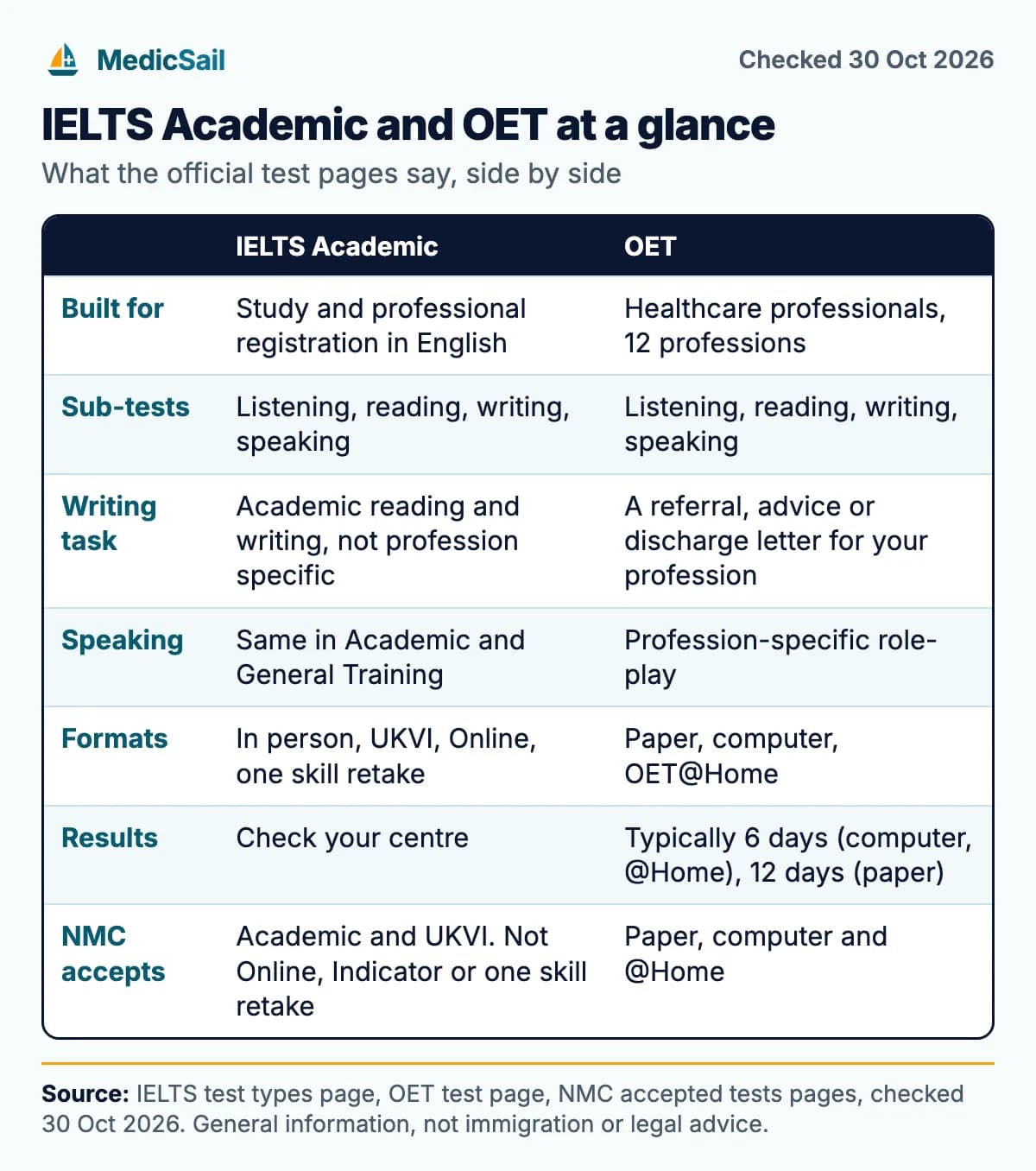
- Think about the content. OET is written for healthcare: the reading, listening and writing tasks use clinical material, and the writing task is profession-specific. IELTS Academic uses general academic material. Many health professionals find clinical content more familiar, but that depends on how you work in English every day.
- Look at the score shape. For nurses and midwives, both tests allow a slightly lower writing result (6.5 in IELTS or C+ in OET). For doctors and pharmacists, every skill must reach the same grade. If writing is your weakest skill, that matters more than which test you take.
- Use the NMC's combining rule if you are a nurse or midwife. Sticking with one test gives you the option of combining two sittings. Switching between IELTS and OET resets you, because they cannot be combined.
- Consider the visa. Doctors, dentists, nurses and midwives can usually rely on their regulator's English pass for the visa. Pharmacists and HCPC professionals may save a test by choosing IELTS for UKVI.
- Check the format rules. The GPhC does not accept OET@Home and the HCPC does not accept any test taken at home. The GMC accepts OET@Home and IELTS Online.
- Plan the timing. Every certificate here lasts about two years. Book the test so that it is still valid at the point your regulator checks it, not just when you start.
- Consider other countries. If you might also apply elsewhere, check which tests those regulators accept before choosing. Our UK country guide lists the regulators and their pages.
Neither test is easier in general. The right test is the one your regulator accepts, in the format it accepts, that you can pass at the required level in every skill at one sitting, and that fits your visa plans. For nurses, that often makes OET or IELTS a genuine toss-up decided by practice-test results. For HCPC paramedics and scientists, it is IELTS or TOEFL iBT by rule.
Questions
OET is not one of the tests the GDC names. Its guidance names IELTS Academic, with 7 overall and at least 6.5 in each skill. A recent pass in a language test used for registration by a regulator in a country where English is the first language can be accepted with supporting evidence from that regulator.
No. The HCPC accepts OET only for chiropodists/podiatrists, dietitians, occupational therapists, physiotherapists, radiographers and speech and language therapists. Paramedics need IELTS or TOEFL iBT unless their first qualification was gained in a country on the HCPC's qualifying countries list.
The NMC needs grade B (350 or above) in listening, reading and speaking, and C+ (300 or above) in writing. Results must be no more than two years old when the NMC assesses your application.
No. The GMC needs all scores in the same sitting, and it must be your most recent sitting. It accepts IELTS One Skill Retake once, for one section, within 60 days of a computer-delivered test at a centre that offers it.
No. The NMC lets you combine two sittings of the same test taken within 12 months of each other, but you cannot mix an IELTS result with an OET result.
No. The GPhC accepts Pharmacy OET on paper or on computer at a test venue, with at least grade B in each sub-test at one sitting. OET@Home is not accepted.
Only for the HCPC, which accepts Academic or General Training. The GMC, NMC, GDC and GPhC all ask for IELTS Academic.
OET is not on GOV.UK's list of approved Secure English Language Tests. Doctors, dentists, nurses and midwives who passed an English assessment accepted by their regulator usually do not need to prove English again for the visa. Other professions should check how they will meet the B2 rule.
About two years at every regulator, but the date they measure from differs. The NMC counts to when it assesses your application, the HCPC to when it receives it, and the GMC needs the certificate valid on your PLAB 1 date and when it approves registration.
Usually yes. Gulf countries are not on the UK government's list of majority English-speaking countries, so practice there does not count under the GMC, GDC, GPhC or NMC practice-based exemptions.
Sources
- 1GMC: Using your IELTS certificate
- 2GMC: Using your OET certificate
- 3GMC: Providing a reference from your employer (English)
- 4NMC: Accepted English language tests
- 5NMC: English language requirements
- 6NMC: SIFE for applicants
Show all 14 sourcesShow fewer sources
- 7GDC: English language controls
- 8GDC: Guidance on English language controls (PDF)
- 9GPhC: Language requirements
- 10GPhC: Guidance on evidence of English language skills (PDF)
- 11HCPC: Certificate of English language proficiency
- 12GOV.UK: Health and Care Worker visa, knowledge of English
- 13GOV.UK: Prove your English language abilities with a SELT
- 14IELTS: Test types
Plan it with our free tools
MedicSail
Healthcare licensing consultants for the UK, Europe and the USA
Updated and checked against the sources listed above. How we research and check our guides