


































The ORE for overseas dentists: Part 1, Part 2 and GDC registration
Everything an overseas-qualified dentist needs for the GDC's Overseas Registration Exam, in order: eligibility and the candidate list, Part 1 and Part 2, how booking and priority places work, current fees, the four-attempt and five-year rules, preparation and registration.

MedicSail
Published
The short answer
If your primary dental qualification is from outside the UK and the European Economic Area (EEA), the General Dental Council (GDC) says you will most likely need to pass the Overseas Registration Examination (ORE) before you can register as a dentist in the UK. The route is: apply to join the ORE candidate list (£115), pass ORE Part 1 (two three-hour computer-based papers, £485), pass ORE Part 2 (a four-component clinical exam at the UCL Eastman Dental Institute in London, £6,967), then apply to the GDC for registration.
You have four attempts at each part, and you must pass Part 2 within five years of first attempting Part 1. The GDC says that if you pass each part first time you could finish in around six to 12 months, but demand for places is extremely high: every place in 2026 sittings has been taken within 30 minutes of a booking window opening. Getting a seat, not passing the exam, is the main source of delay for many candidates.
This guide covers each stage in the order you meet it, with the rules and fees as the GDC publishes them on 20 October 2026. For the regulator itself, see our GDC registration overview, and for pay, employers and the visa, our page on working as a dentist in the UK.
Who needs the ORE, and who does not
The ORE is for dentists. The GDC says that if you qualified as a primary dentist outside the UK and the EEA, you will most likely need to pass it before you can apply for registration. Dental care professionals (dental nurses, hygienists, therapists, technicians, clinical dental technicians and orthodontic therapists) trained overseas do not sit the ORE: an independent GDC panel assesses their qualification and experience on paper. If that is you, see our page on dental hygienists in the UK for the assessed route.
The short list of exemptions
A small number of older dental qualifications from named universities in Australia, Hong Kong, Malaysia, New Zealand, Singapore and South Africa are recognised for direct registration if they were granted before the GDC's cut-off dates. The list is short and the dates are strict. Check the GDC's recognised overseas qualifications page against the exact name of your degree, your university and your graduation date before you assume you are exempt. If your degree is not on the list, or was granted after the cut-off, you need the ORE however long you have practised.
What does not exempt you
- A licence from another country's regulator, including Gulf authorities such as the DHA, DOH, MOHAP, SCFHS or QCHP.
- Specialist qualifications or fellowships gained outside the UK. They may matter later for the GDC's specialist lists, but you register as a dentist first.
- Years of experience. Experience counts towards the 1,600 clinical hours you need to apply, but it does not replace the exam.
- An overseas dentistry degree used to register as a dental nurse or hygienist. The GDC says you can no longer register as a dental care professional if you hold only an overseas dentistry qualification.
Reforms
New rules took effect on 9 March 2024 that give the GDC more flexibility over international registration. The GDC says that in the short term this means continuing with the ORE for dentists and assessed applications for dental care professionals while it develops longer-term plans. No replacement route has been announced, so plan on the ORE.
Step 1: apply to join the ORE candidate list
You cannot book either part until the GDC has accepted you onto the ORE candidate list. You apply through MyGDC, the GDC's online account, and pay a £115 application fee. The exam fees are charged separately when you book each sitting.
Documents the GDC asks for
- Clinical references on the GDC's form showing at least 1,600 hours of clinical experience treating patients in the dental chair. The documents must be no more than three months old when you apply.
- A character reference from the head of your dental school if you graduated within the last 12 months, or otherwise from a professional such as a doctor, dentist or lawyer who has known you for more than 12 months. Family members cannot act as referees.
- A UK ENIC Statement of Comparability for your dental degree, uploaded with a certified copy of the qualification itself.
- An original certificate of good standing (or certificate of current professional status) from the country where you last practised, no more than three months old.
- A valid passport for the GDC's online identity check, which the GDC says works best on a mobile phone.
- Evidence of English, usually Academic IELTS at the GDC's scores (see below).
Certifying copies
Copies must be certified by a notary, solicitor or similar official, who writes "I have inspected the original document and I certify that this is a true copy", with their signature and details. Wording that does not match, or a certificate of good standing that goes past three months while you gather other papers, are the most common avoidable reasons for an application to stall.
How long it takes
The GDC aims to assess complete applications within 60 working days of receipt, and longer at peak times. That is roughly three months, so if you want to be ready for a particular booking window, apply well before it. Order your UK ENIC statement and English test first, because they take the longest to arrive, and request your good standing certificate last so that it is still in date.
English: the GDC's requirement
The GDC asks for Academic IELTS with at least 6.5 in each of reading, writing, listening and speaking, and an overall score of 7. The test report must usually be no more than two years old when you apply, and the GDC accepts IELTS One Skill Retake and IELTS Online at the same minimum scores.
The GDC's English guidance also accepts, case by case, a recent (under two years old) primary dental qualification taught and examined entirely in English with at least 75% of clinical interaction in English, a recent pass in a test used by a regulator in a majority English-speaking country, or recent and continuous practice in a majority English-speaking country backed by employer references. Gulf countries are not on the UK government's list of majority English-speaking countries, so practice there does not count, even if you worked in English.
The GDC's guidance names IELTS as the test it directs applicants to take and does not list OET. If you are weighing up tests, our comparison of IELTS and OET for UK healthcare regulators sets out what each regulator accepts. The GDC also says it is reviewing its English guidance, so check its English language controls page before you book.
ORE Part 1: format, venues and results
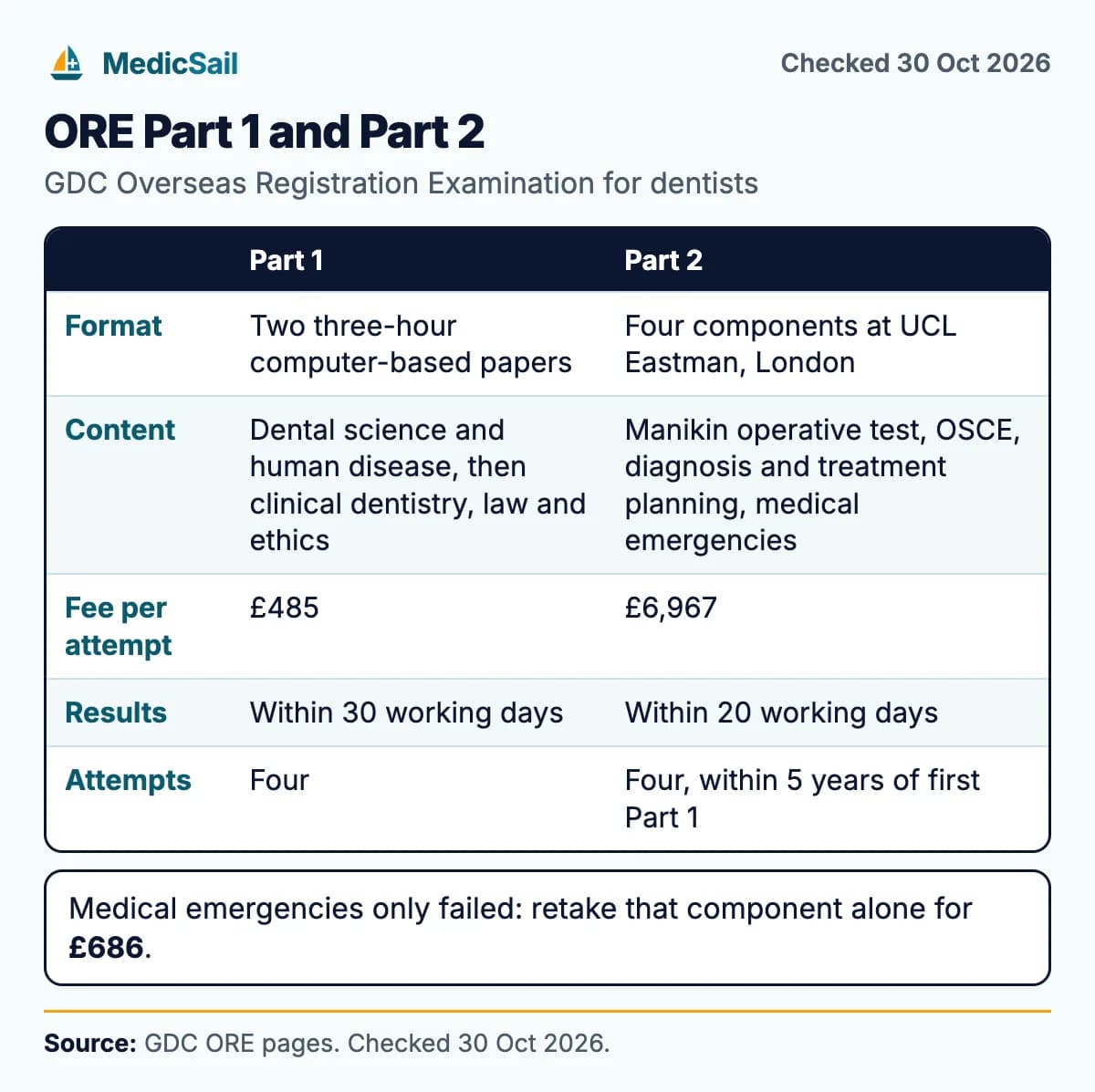
Part 1 tests the application of knowledge to clinical practice. It is a computer-based exam of two papers, each lasting three hours, and you must pass both.
| Paper | What it covers |
|---|---|
| Paper A | Dental science and human disease: anatomy, bacteriology, biochemistry, dental anatomy and embryology, dental materials, immunology, pathology and human disease, pharmacology, physiology and statistics. |
| Paper B | Aspects of clinical dentistry, including law and ethics, and health and safety. |
Questions are extended matching questions and single best answer questions. The GDC lists 600 places per Part 1 exam, held at London venues: Teamco on Gray's Inn Road (WC1X 8HB), Escalla in Kentish Town (NW5 3AB) and Tobacco Dock in Wapping (E1W 2SF). Check your booking confirmation for your venue. The most recent sitting, on 14 and 15 October 2026, was fully booked.
Marking and results
Results come by email within 30 working days, as a percentage mark out of 100 for each paper. From August 2026 each paper is standard set, so the GDC says the pass mark can vary between papers and sittings rather than being a fixed percentage. Feedback is available about 21 working days after results are released, through UCL Consultants.
Attempts
You have four attempts at Part 1. If you fail it four times, you cannot sit the ORE again. Each attempt costs £485.
ORE Part 2: the four clinical components
Part 2 assesses practical clinical skills. It is held at the UCL Eastman Dental Institute, Rockefeller Building, in London, and has four components.
| Component | What happens |
|---|---|
| Operative test on a dental manikin (DM) | Three procedures over three hours, focused on tooth preparation and restoration. |
| Objective structured clinical examination (OSCE) | A series of stations testing clinical skills such as history taking, communication, clinical judgement, ethics and clinical examination across the dental specialties. |
| Diagnostic and treatment planning (DTP) | An actor gives a history, with supporting material such as photographs, radiographs and study models, and you diagnose and plan treatment. |
| Medical emergencies (ME) | A structured, scenario-based oral and a demonstration of single-handed basic life support. |
Part 2 costs £6,967 per attempt. If you fail only the medical emergencies component, you can retake that component alone at a later sitting for £686, rather than resitting the whole exam. Results come within 20 working days.
Attempts and the five-year rule
You have four attempts at Part 2, and you must pass it within five years of your first attempt at Part 1. The clock starts at your first Part 1 sitting, not your pass, so a slow start on Part 2 eats into the same window. Once you have passed both parts, the GDC says there is no time limit for applying for registration.
Dates and places for 2026 and 2027
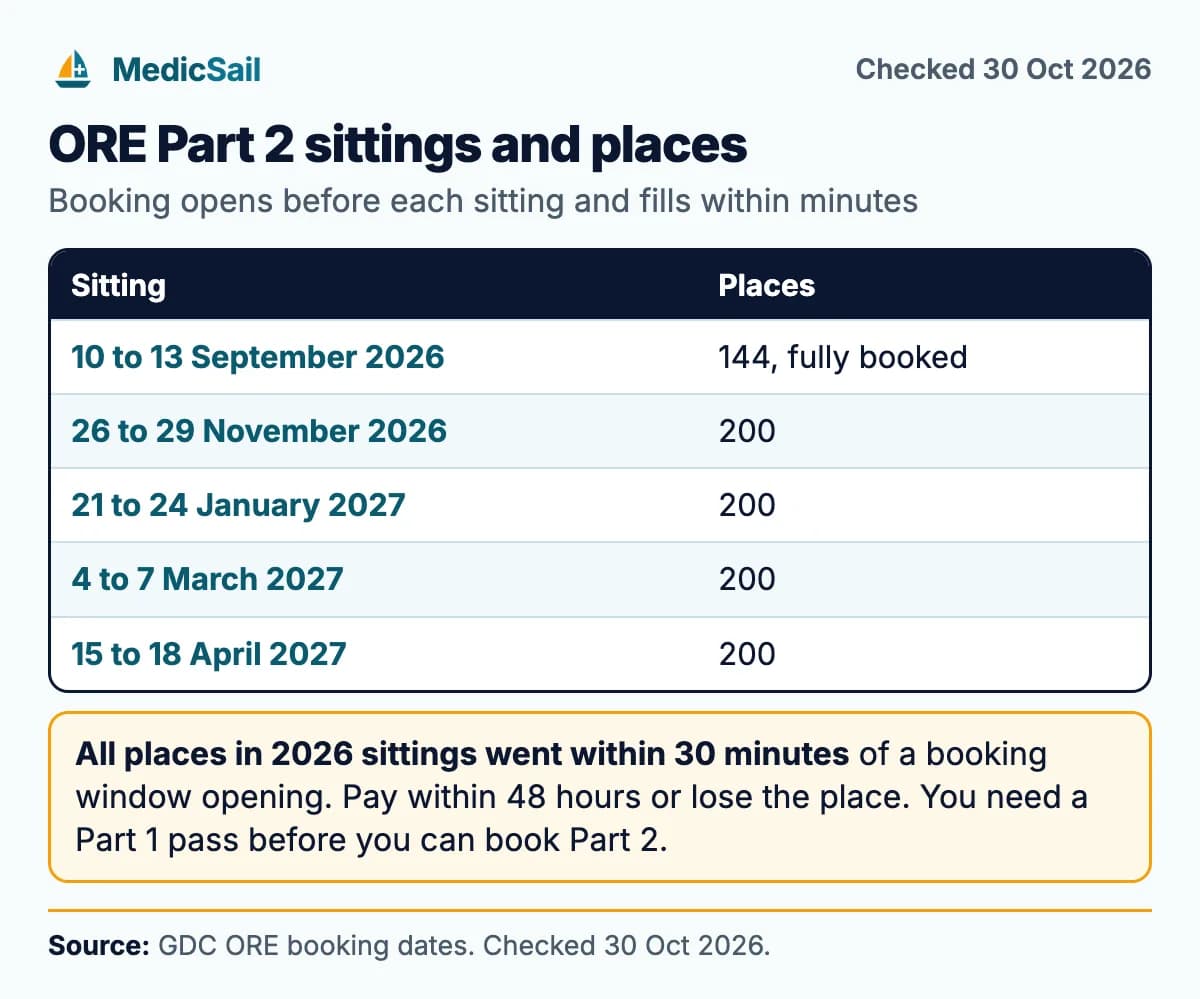
| Sitting | Places |
|---|---|
| 10 to 13 September 2026 | 144 (fully booked) |
| 26 to 29 November 2026 | 200 |
| 21 to 24 January 2027 | 200 |
| 4 to 7 March 2027 | 200 |
| 15 to 18 April 2027 | 200 |
The GDC publishes when each booking window opens on its ORE booking dates page; the September 2026 window opened at 14:30 UK time on 21 July 2026. You need a Part 1 pass before you can book Part 2.
How booking works, and how to get a place
The GDC is open about the problem: demand for exam places is extremely high, and in 2026 all places were taken within 30 minutes of a booking window opening. Understanding the booking rules is part of preparing for the ORE.
Priority candidates go first
Before general booking opens, the GDC offers places to priority candidates. These are candidates who may have only a few sittings left before their time limit expires, and candidates with refugee status, who get priority access for up to two attempts at Part 1 and two attempts at Part 2. Priority candidates receive a separate email explaining how to secure a place.
Then first come, first served
- Everyone else books on a first-come, first-served basis when the window opens. Note the exact time in UK time and convert it to your own time zone.
- You can log in to your account on only one device at a time, so do not try to book from a phone and a laptop together.
- If you secure a place, you must pay within 48 hours, or you lose it. Have the full fee ready on a card that allows a large overseas payment, especially for Part 2.
- Check that your MyGDC login works and your details are up to date before the window opens.
Plan for missing a sitting
Treat each window as a chance rather than a certainty. Keep your leave, travel and savings flexible enough to move to the next sitting, and avoid booking non-refundable flights to London until your exam place is confirmed and paid.
What the ORE and registration cost
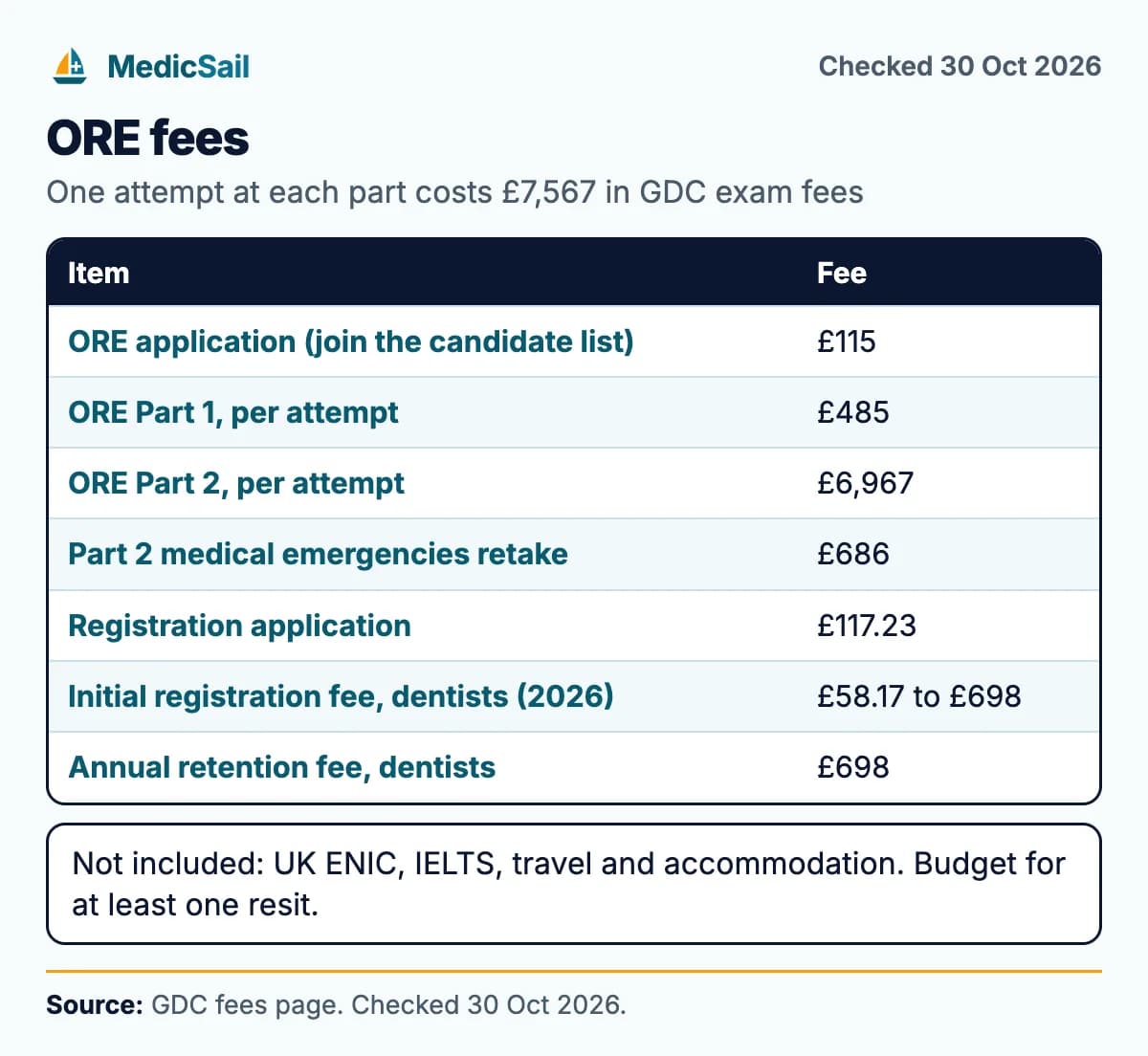
These are the fees the GDC publishes, as checked on 20 October 2026.
| Item | Fee | Notes |
|---|---|---|
| ORE application (join the candidate list) | £115 | Paid when you apply. |
| ORE Part 1 | £485 | Per attempt. |
| ORE Part 2 | £6,967 | Per attempt. |
| Part 2 medical emergencies retake | £686 | Only if ME is the only component you failed. |
| Registration application (after the ORE) | £117.23 | Processing fee £41.42 plus assessment fee £75.81, from 16 January 2026. The GDC's how-to-apply page may still show an older figure; the fees page is the current source. |
| Initial registration fee, dentists (2026) | £58.17 to £698 | Pro rata, depending on the month you join. |
| Annual retention fee, dentists | £698 | Covers 1 January to 31 December. |
| UK ENIC, IELTS, travel and accommodation | Charged separately | Check current prices with each provider. |
One attempt at each part therefore costs £7,567 in GDC exam fees, before registration, English testing, UK ENIC, courses and travel to London. Every resit adds the full fee again, except an ME-only retake. Budget for at least one resit and one missed booking window; it is better to have the money and not need it.
Preparing for Part 1 and Part 2
The ORE is set against the GDC's learning outcomes for UK dental graduates, so preparation is about UK practice, not just clinical knowledge. The exam provider's guidance, updated on 4 August 2026, says the current exam aligns with the GDC's "Preparing for Practice" outcomes, and candidates should disregard earlier references to the Safe Practitioners Framework.
Use the official material first
- Exam specification for candidates: one document covering both parts, on the guidance pages of orepart1.org.uk and orepart2.org.uk.
- Part 2 component guides: separate guidance for the ME, DM, DTP and OSCE components, plus a DTP guidance video.
- Part 1 familiarisation exercise: the provider says it is for getting used to the format only. It is not a mock exam and does not reflect the full content, difficulty or timing of Part 1.
- Policy documents: rules for each part, including conduct, reasonable adjustments and appeals.
Practical tips
- For Paper B, study UK law, ethics, consent, safeguarding, infection control and health and safety as they apply in UK dentistry. These are areas where experienced overseas dentists often lose marks.
- For the manikin test, practise the preparations and restorations you will be asked to do under timed conditions on a manikin, not only on patients.
- For the OSCE and DTP, practise structured history taking and explaining options to a patient in plain English, including consent and costs where relevant.
- For medical emergencies, follow current UK resuscitation and medical emergency guidance, and practise single-handed basic life support until it is automatic.
- Book your Part 2 preparation around your likely sitting. Because places are scarce, there can be months between passing Part 1 and sitting Part 2.
Private ORE courses are widely advertised. They are optional, are not endorsed by the GDC and vary in quality, so judge them against the official specification.
Step 4: apply for GDC registration
Once you have passed both parts, you apply for registration through MyGDC. The GDC asks for a character reference on its form (from your dental school head if you graduated within the last 12 months, or another professional who has known you for more than 12 months), completes an online identity check with your passport, and needs certified copies with its exact certification wording. The application fee is £117.23.
The GDC aims to assess complete applications within three months of receipt, and says this can increase at peak times. When your application is approved, you pay the initial registration fee for the rest of the calendar year (£58.17 to £698 in 2026, depending on the month) and then the £698 annual retention fee each year from 1 January.
After registration
- Registration lets you practise as a dentist, but providing NHS care has its own requirements in each UK nation. In England, dentists who provide NHS care also need to be on the NHS performers list. Ask employers which requirements apply before you accept an offer.
- Most UK dentists work in general dental practice, and most dentists in NHS practices are self-employed associates rather than salaried employees. Salaried posts exist in community dental services and hospitals.
- If you need a visa, dental practitioners (occupation code 2253) are an eligible occupation for the Health and Care Worker visa when the employer is the NHS, an NHS supplier or in adult social care and is a licensed sponsor. Our Health and Care Worker visa guide covers eligibility and costs.
How long the whole route takes
The GDC's own figures give the fixed points:
- Candidate list application: the GDC aims to assess complete applications within 60 working days.
- Part 1: results within 30 working days, with feedback about 21 working days later.
- Part 2: bookable once you have passed Part 1; results within 20 working days.
- Registration: the GDC aims to assess complete applications within three months.
- Overall: the GDC says six to 12 months if you pass each part first time, but current demand for places substantially extends this.
Realistically, many overseas dentists should plan for two years or more from first application to registration, depending mainly on how quickly they secure exam places. Add NHS onboarding and, if you need one, a visa. Remember the hard limit: Part 2 must be passed within five years of your first Part 1 attempt.
If you practise in the Gulf, and where to go next
- Your Gulf licence does not exempt you from the ORE. Whether you need it depends on where and when you qualified, not where you work now.
- Gulf clinical work counts towards the 1,600 chair-side hours. Ask your clinical director or licensed supervisor for references on headed paper, and time them so they are under three months old when you apply.
- Request your certificate of good standing from your current Gulf regulator early, as some take several weeks, but make sure it is still within three months when the GDC receives it.
- Gulf practice does not count as practice in a majority English-speaking country, so most Gulf-based dentists take Academic IELTS.
- Plan leave around London trips for each part, and keep enough savings for a resit and a missed booking window.
Our guide to what carries over from a Gulf licence covers good standing certificates and experience for every UK regulator. If you are also considering Ireland, compare the Dental Council's route on our dentists in Ireland page, and for every country we cover, see our guide for dentists. For the wider move, read our guide to working in UK healthcare.
Questions
The Overseas Registration Examination is the GDC's exam for dentists whose primary dental qualification is from outside the UK and EEA. It has two parts: Part 1, two three-hour computer-based papers, and Part 2, a clinical exam with a manikin test, an OSCE, a treatment planning exercise and a medical emergencies component. Passing both lets you apply for GDC registration.
The GDC charges £115 to join the candidate list, £485 for each Part 1 attempt and £6,967 for each Part 2 attempt, so £7,567 for one attempt at each. A medical emergencies-only retake costs £686. Registration costs £117.23 to apply, plus a pro rata registration fee.
At least 1,600 hours of clinical experience treating patients in the dental chair, shown on the GDC's clinical reference form. The references must be no more than three months old when you apply.
In London only. Part 1 is held at venues including Teamco on Gray's Inn Road, Escalla in Kentish Town and Tobacco Dock in Wapping. Part 2 is held at the UCL Eastman Dental Institute, Rockefeller Building.
Demand is far higher than supply. The GDC says all places in 2026 were taken within 30 minutes of booking opening. Priority candidates near their time limit and candidates with refugee status are offered places first, then booking is first come, first served, and you must pay within 48 hours.
Four at each part. If you fail Part 1 or Part 2 four times, you cannot sit the ORE again. You must also pass Part 2 within five years of your first Part 1 attempt.
The GDC lists Part 2 sittings on 26 to 29 November 2026, 21 to 24 January 2027, 4 to 7 March 2027 and 15 to 18 April 2027, each with 200 places. Check the GDC's booking dates page for when each window opens.
Yes. From August 2026 each Part 1 paper is standard set, so the pass mark can vary between papers and sittings instead of being a fixed percentage. Results still arrive within 30 working days as a percentage mark for each paper.
The GDC's English guidance names Academic IELTS, with 6.5 in each skill and 7 overall, and does not list OET. Other evidence, such as a recent English-taught dental degree, can sometimes be accepted. Check with the GDC before relying on anything else.
The GDC says there is no time limit for applying for registration once you have passed both parts. You will still need up-to-date documents, such as a current character reference and English evidence that meets its rules, when you apply.
Sources
- 1GDC: About the ORE
- 2GDC: How to apply for the ORE
- 3GDC: ORE Part 1
- 4GDC: ORE Part 2
- 5GDC: ORE booking dates
- 6ORE Part 1: guidance documents
Show all 16 sourcesShow fewer sources
- 7ORE Part 2: guidance documents
- 8GDC: How to apply as an overseas-qualified dentist
- 9GDC: Recognised overseas qualifications
- 10GDC: International registration reforms
- 11GDC: English language controls
- 12GDC: Guidance on English language controls (PDF)
- 13GDC: Registration application fee
- 14GDC: Registration fee
- 15GDC: Annual retention fee
- 16GOV.UK: Health and Care Worker visa, your job
Plan it with our free tools
MedicSail
Healthcare licensing consultants for the UK, Europe and the USA
Updated and checked against the sources listed above. How we research and check our guides