


































How internationally qualified pharmacists register with the GPhC
The current GPhC route for pharmacists qualified outside the UK and EEA, step by step: OSPAP eligibility and documents, the one-year OSPAP, the national recruitment scheme and 52 weeks of foundation training, the Common Registration Assessment, English, every fee, the four-year limit and the 2026 consultation.

MedicSail
Published
The short answer
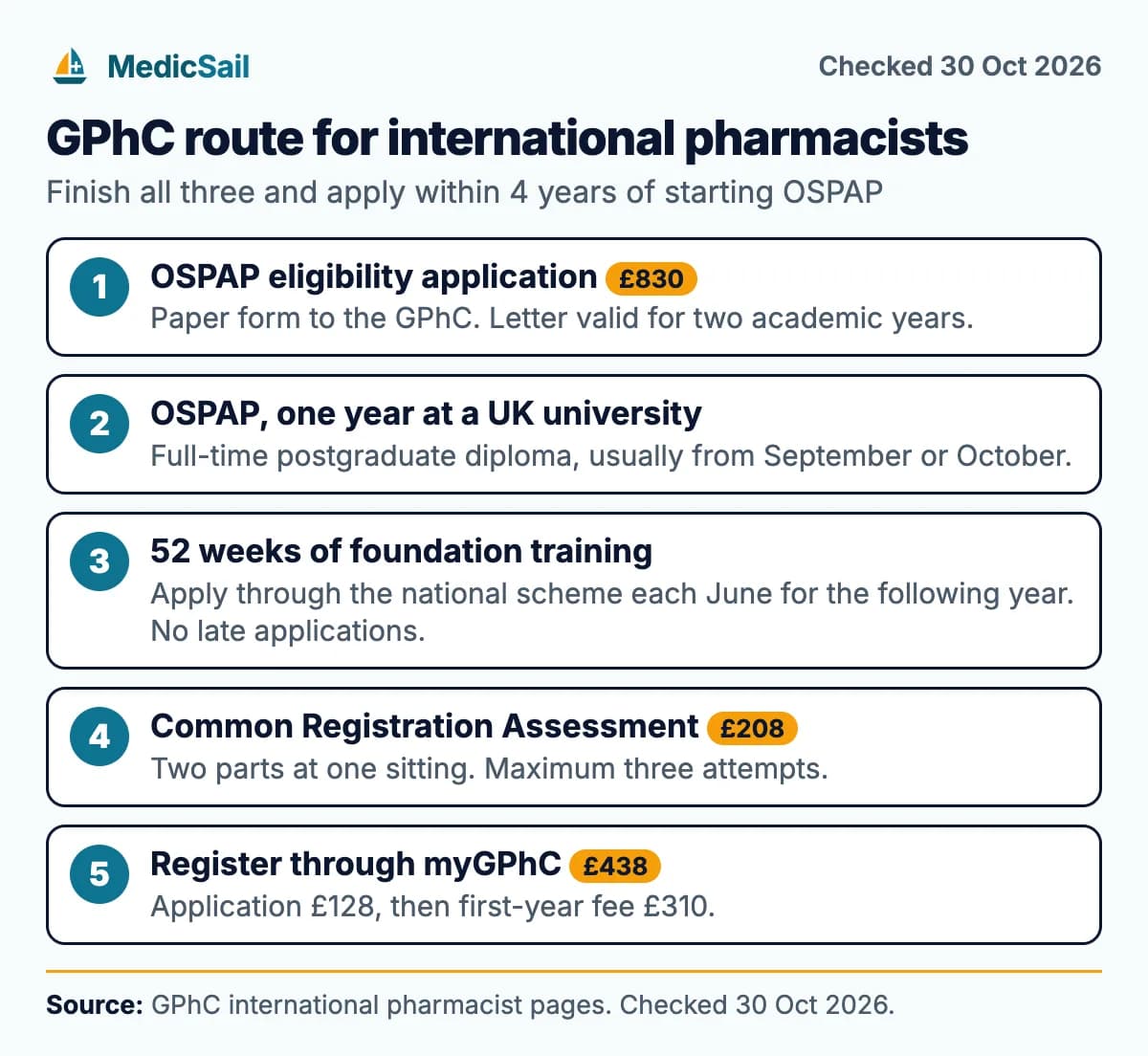
If you qualified as a pharmacist outside the European Economic Area (EEA), or hold an EEA qualification that is not recognised in the UK, the General Pharmaceutical Council (GPhC) says you must complete three things in Great Britain before you can apply to register: the Overseas Pharmacists Assessment Programme (OSPAP), a one-year postgraduate diploma at a UK university; 52 weeks of foundation training in England, Scotland or Wales, recruited through the national recruitment scheme; and a pass in the Common Registration Assessment. You must finish all three and apply to register within four years of starting your OSPAP.
The first step is an OSPAP eligibility application to the GPhC, which costs £830 and is non-refundable. There is no exam-only route, whatever your experience abroad. The GPhC consulted in 2026 on replacing this route with a one-year integrated programme, but it says there is no firm timetable for any change, so the OSPAP route is the one to plan around.
This guide follows the route in order, using the GPhC's own pages and guidance as checked on 20 October 2026. For the regulator at a glance, see our GPhC registration overview, and for NHS pay, employers and visas, our page on working as a pharmacist in the UK.
Who this route is for
The GPhC regulates pharmacists, pharmacy technicians and registered pharmacies in England, Scotland and Wales. This route applies if you:
- hold a pharmacist qualification from outside the EEA, or are a non-EEA national with an EEA qualification that is not a UK-recognised pharmacist qualification, and
- have completed all the education and training needed to register as a pharmacist in the country where you qualified.
If you did not complete the full requirements to register where you qualified, you are not eligible for OSPAP, and the GPhC says you would need to complete a qualification that leads to registration, such as an MPharm.
Northern Ireland is separate
GPhC registration covers Great Britain only. Northern Ireland has its own regulator, the Pharmaceutical Society of Northern Ireland, which runs the Common Registration Assessment jointly with the GPhC but has its own registration and foundation training requirements.
The right to study and work
The GPhC is clear that meeting its criteria does not mean you will be able to enter the UK or find a job, and it cannot answer visa questions. OSPAP is a university course, and foundation training is a salaried training post, so if you are not already entitled to live and work in the UK you will need the right immigration permission for each stage. Check the rules on GOV.UK before you pay any fees.
Step 1: apply to the GPhC for OSPAP eligibility
Before any university can offer you an OSPAP place, the GPhC checks that you are eligible. It looks at your qualifications and work experience, your fitness to practise and your English. The application is a paper form, printed, completed by hand in block capitals and posted with your documents.
Start with UK ENIC
Apply to UK ENIC for a Statement of Comparability, which says how your degree compares to UK qualifications. UK ENIC charges for this. If your qualification is assessed as at least equivalent to a UK bachelor's degree in pharmacy with at least three academic years of pharmacy content, you need nothing more on this point. If it is not, you must also send the syllabus you actually studied and complete the GPhC's international comparative assessment framework, which the GPhC sends you.
What you send with the form
- Proof of English (the GPhC will not consider an application without it).
- A certified copy of your degree certificate and of your UK ENIC statement.
- A certified copy of your passport photo page and a certified copy of your birth certificate.
- Two passport photos countersigned by the legal professional who certifies your documents, with the GPhC's photograph certification form.
- Professional translations of anything not in English, and a statutory declaration (made with a solicitor present) if your name differs across documents or your birth was registered more than a year after you were born.
What must reach the GPhC directly
- Your academic transcript, signed by the university and listing every module and mark. If you studied a bachelor's and a master's at different universities, both are needed.
- A letter of good standing from the regulator where you qualified, and from any other healthcare regulator you have been registered with in the last five years. The GPhC must receive it within three months of issue, and it is valid for six months.
- Two references: one academic and one from your current or most recent employer, on headed paper with an official stamp. Referees cannot be related to you, and emailed references must come from an official organisation domain, not a personal account.
Certification, payment and decision
Outside the UK, copies must be certified by a regulated legal professional, who writes "I certify that I have seen the original document and that this is a true copy" with their signature, name, registration number and date. Once the GPhC has your application it emails a Worldpay payment link for the £830 fee, valid for 28 days. Incomplete applications are returned unprocessed. The GPhC says it will give you an update within eight weeks of receiving your application, and it recommends that it receives your application before 31 July if you want to start a course that autumn.
Step 2: secure a place and complete OSPAP
If you are eligible, the GPhC writes to confirm it and notifies the universities you chose on your form. Each university then decides whether to offer you a place, and may ask for more information. The GPhC recommends contacting the universities yourself once you have your outcome, and checking availability with them before you apply for eligibility at all. It publishes a list of universities that run OSPAP courses on its website.
The two-academic-year window
Your eligibility letter is valid for two academic years: you must start an OSPAP course within that time or apply again. The GPhC's guidance gives the example that a letter received before November in one year means starting that year or the next. Timing your application matters: apply too early and you lose a year of the window.
What the course involves
OSPAP is a one-year, full-time postgraduate diploma, normally starting in September or October. It includes a structured academic assessment of your qualifications, taught modules and assessments. You may be exempt from some teaching based on prior learning, but you must complete every assessment. Passing shows you meet the UK MPharm graduate criteria, but it does not award an MPharm degree.
You pay tuition to the university and must support yourself during the year. Universities set their own English entry requirements and may ask for a test even where the GPhC accepted other evidence.
Step 3: apply for foundation training a year ahead
This is where most people lose time. All foundation training posts in Great Britain are filled through national recruitment schemes run by the statutory education body in each country: NHS England in England, HEIW in Wales and NHS Education for Scotland in Scotland. The National Recruitment Scheme covers England and Wales, and Scotland fills posts in a similar way. You cannot apply to employers directly.
The June deadline
Places are filled one year in advance. The GPhC's factsheet gives the example that you would apply in June 2026 to start training in 2027. If you want to start straight after OSPAP, you must apply in June of the year before you finish, which can be before your OSPAP course has even begun.
- You must register within the application window, even if you do not yet have your eligibility confirmation from the GPhC or your university.
- The schemes do not allow late applications under any circumstances.
- Missing the window usually means waiting a full year for the next one, which also uses up your four-year limit.
The training year
You train for at least 52 weeks at a training site quality managed by your statutory education body, under a designated supervisor who guides and signs off your progress against the GPhC's learning outcomes using an e-portfolio. Before you start, the GPhC will tell you when to create a myGPhC account and apply for foundation trainee status; a fee applies, so check the current amount on myGPhC. Your training must be signed off as satisfactory before you can register.
Independent prescribing
OSPAP students are assessed in practice against a modified version of the GPhC's 2021 learning outcomes, but they are not eligible to register as independent prescribers when they first register, regardless of when they finish. To prescribe, you take an accredited independent prescribing course after you have registered.
Step 4: pass the Common Registration Assessment
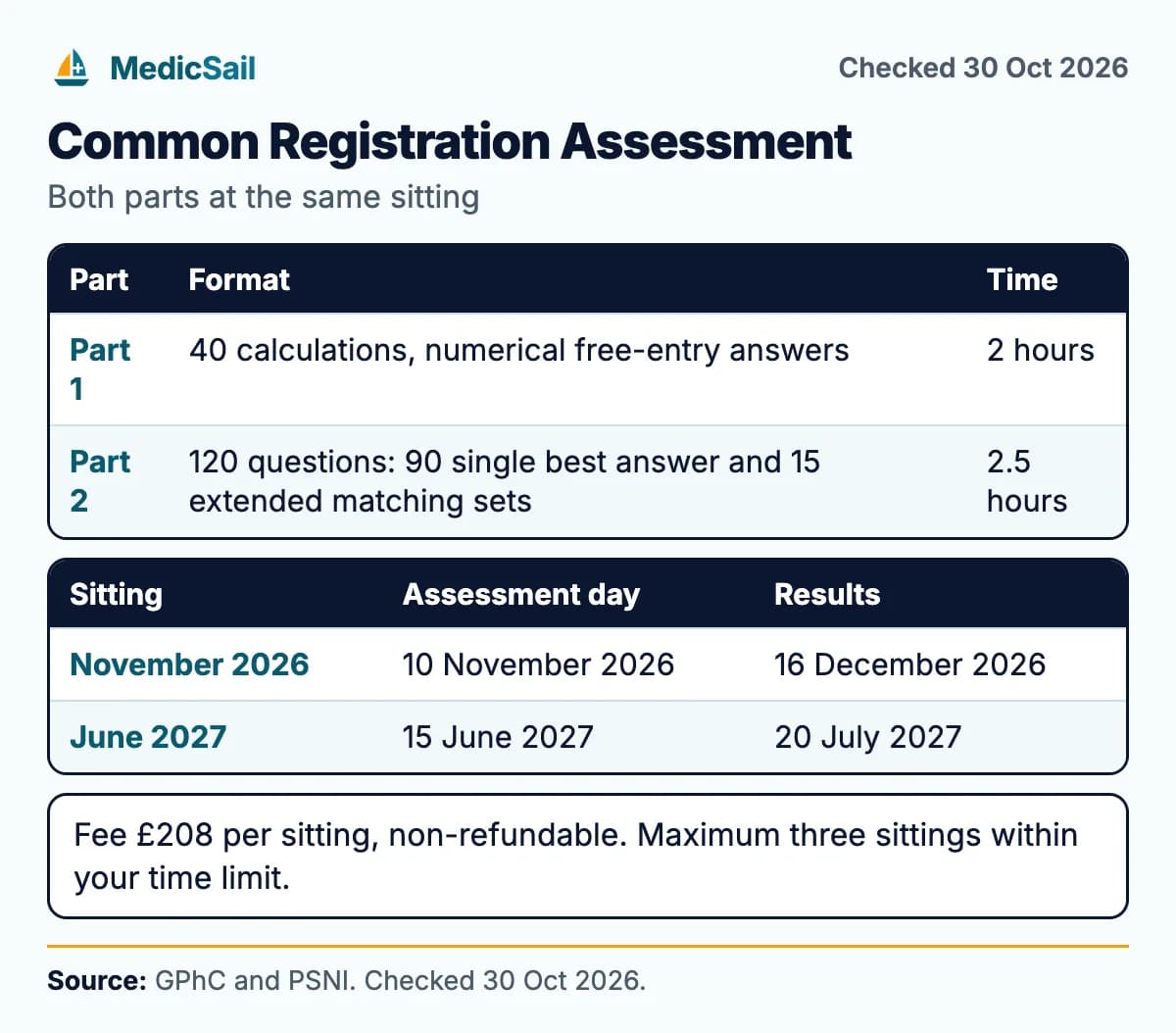
The Common Registration Assessment is delivered jointly by the GPhC and the Pharmaceutical Society of Northern Ireland. It is a two-part, timed, computer-based assessment held at test centres across the UK, usually twice a year, in summer and autumn.
| Part | Format | Time |
|---|---|---|
| Part 1 | 40 pharmacy and healthcare calculations, with numerical free-entry answers | 2 hours (120 minutes) |
| Part 2 | 120 questions on the safe and effective pharmacy care of the public: 90 single best answer questions with five options, and 15 sets of extended matching questions (two questions per set, eight shared options) | 2.5 hours (150 minutes) |
You must reach the pass mark in both parts at the same sitting, and you can sit the assessment a maximum of three times within your time limit for registration. The application fee is £208 per sitting and is non-refundable. You apply through myGPhC when the GPhC invites you, giving the passport or driving licence you will show on the day.
Upcoming sittings
| Sitting | Assessment day | Results |
|---|---|---|
| November 2026 | Tuesday 10 November 2026 | 16 December 2026 |
| June 2027 | Tuesday 15 June 2027 | Tuesday 20 July 2027 |
For the June 2027 sitting, the reasonable adjustment deadline is 17:00 on Wednesday 17 February 2027, and the GPhC will publish the application window nearer the time. To be eligible for a sitting, you must have approved foundation trainee status and have started training in the right window for your statutory education body: for example, the summer 2027 sitting is for trainees who started in their body's summer 2026 window.
Preparing
The GPhC publishes a Common Registration Assessment framework, which sets out the topics and skills that can be assessed, a specification with the list of permitted items (including the approved calculators), the regulations for each year's sittings and a "ready to apply" guide. Only sit when you are fit to do so: the GPhC treats anyone who sits while unwell, without an approved adjustment, as fit to sit.
Step 5: apply to register
Once you have completed OSPAP, 52 weeks of signed-off foundation training and passed the assessment, you apply to register through myGPhC. The registration application fee is £128 and non-refundable. When your pass and your training sign-off are confirmed, you pay the first-year registration fee of £310. The annual renewal fee for pharmacists is also £310. You need professional indemnity cover before you practise.
The GPhC sets fixed registration dates after each sitting. After the November 2026 assessment, the first possible registration date is 1 January 2027, if the GPhC receives your complete and correct application by 3 December 2026; the next is 15 January 2027, for applications received by 17 December 2026.
The four-year limit and extensions
You must apply to register within four years of the date you start OSPAP. The GPhC may extend this if your training was interrupted or part time, for example because of maternity or paternity leave, serious illness, reasonable adjustments, part-time study, reserve service or a pandemic, but only with appropriate evidence. It sends an extension request form when your limit is approaching, usually 12 weeks before it expires, and may ask for evidence that you have kept your knowledge up to date.
English language evidence
English is checked at the eligibility stage, not just at registration. The GPhC accepts three types of evidence:
- A recent test pass: Academic IELTS (including IELTS for UKVI, but not the Life Skills tests) with at least 7 overall and at least 7 in each of reading, writing, listening and speaking at one sitting; or Pharmacy OET with at least grade B in each of the four areas at one sitting. The GPhC does not accept OET@Home.
- A pharmacy qualification of three or more years, taught and examined in English in a majority English-speaking country other than the UK, that allows you to practise there.
- At least two years' practice as a registered pharmacist or pharmacy technician in a majority English-speaking country, with the evidence its guidance sets out.
The GPhC's English guidance says test results should normally be less than two years old. GOV.UK publishes the list of majority English-speaking countries, and Gulf countries are not on it. If you rely on the second or third option, check with your chosen university, because it may still ask for a test. Our comparison of IELTS and OET for UK healthcare regulators shows how the GPhC's scores compare with other regulators.
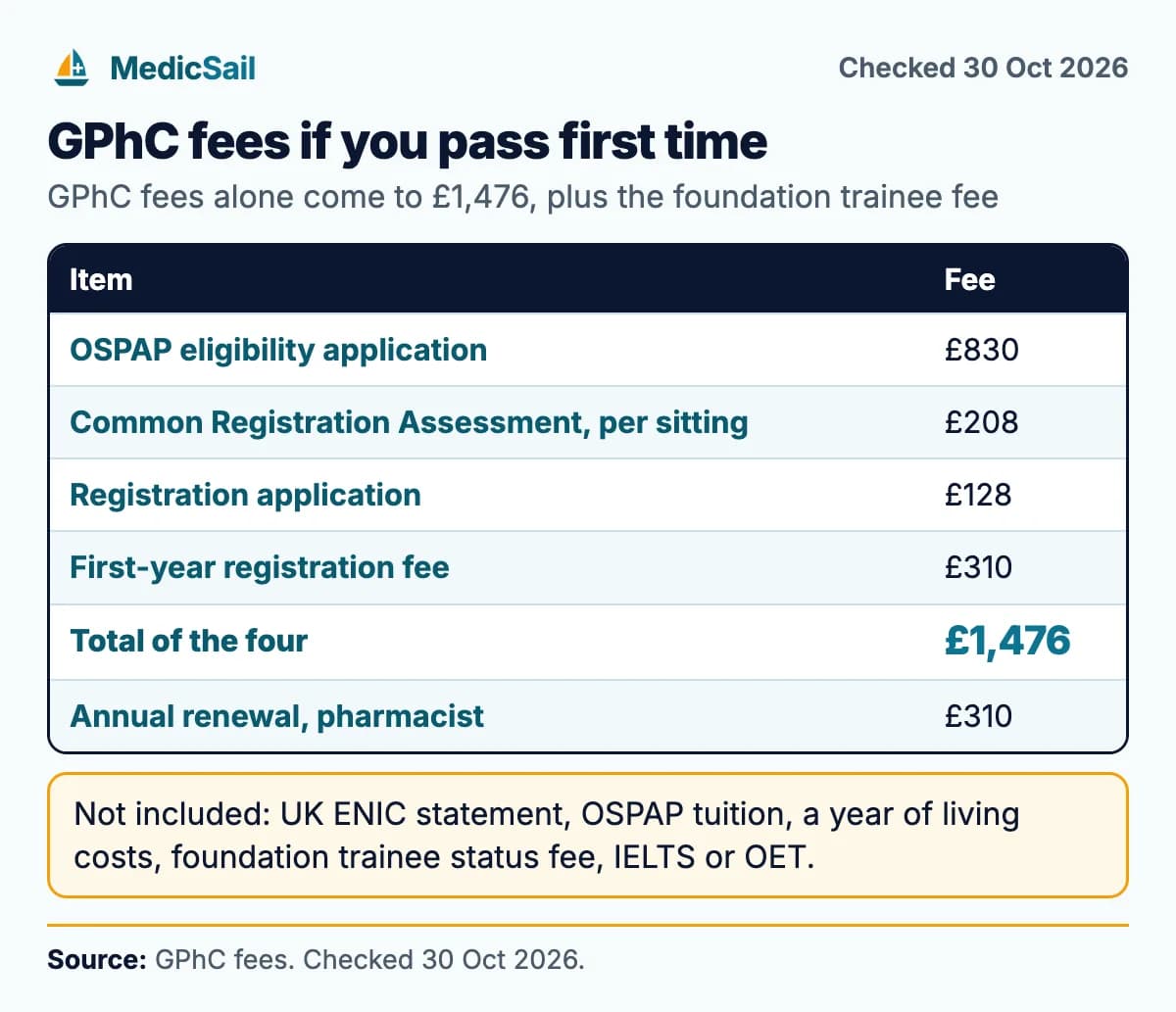
Every fee on the route
| Item | Fee | Notes |
|---|---|---|
| OSPAP eligibility application (GPhC) | £830 | Non-refundable, even if you are not eligible or cannot get a university place. Waived for applicants with refugee status. |
| UK ENIC Statement of Comparability | Charged by UK ENIC | Check the current fee with UK ENIC. |
| OSPAP tuition | Set by each university | Paid to the university; living costs for the year are extra. |
| Foundation trainee status (GPhC) | A fee applies | Paid on myGPhC; check the current amount there. |
| Common Registration Assessment | £208 per sitting | Non-refundable. |
| Registration application | £128 | Non-refundable. |
| First-year registration fee | £310 | Requested once your pass and training sign-off are confirmed. |
| Annual renewal, pharmacist | £310 | Each year after registration. |
| IELTS or OET, translations, certification | Charged separately | Check with each provider. |
The GPhC fees alone come to £1,476 if you pass the assessment first time (£830, £208, £128 and £310), plus the foundation trainee fee. University tuition and a year of living costs during OSPAP are usually far larger, so check international tuition fees with each university before you apply for eligibility.
How long it takes
- UK ENIC and English test: allow one to three months before you apply.
- OSPAP eligibility: the GPhC says it will give you an update within eight weeks; it recommends it receives your application before 31 July for an autumn start.
- OSPAP: one academic year, usually from September or October.
- Foundation training: 52 weeks, applied for through the national scheme that opens each June for the following year.
- Assessment and registration: sittings in summer and autumn, results about five weeks later, then fixed registration dates.
If every step goes to plan, expect around three years from your eligibility application to registration. The GPhC's hard limit is four years from the start of OSPAP, and three assessment attempts, so a missed recruitment window or a failed sitting needs to fit inside that.
The 2026 consultation: what may change
The GPhC published a consultation on 27 April 2026 on education and training for internationally qualified pharmacists. It was open for 12 weeks and closed on 21 July 2026. The proposals were to:
- replace the current two-year route with a one-year programme of integrated academic learning and learning in practice;
- include independent prescribing, in line with the 2021 standards for UK pharmacists, so internationally qualified pharmacists could register as independent prescribers;
- recognise relevant prior learning and experience;
- set updated learning outcomes and standards for providers; and
- keep the Common Registration Assessment as a requirement for everyone.
The GPhC says it now needs to consider the feedback and finalise its proposals, and that there is currently no firm timetable for implementing any changes. Until it announces otherwise, apply on the OSPAP route described above, and recheck the GPhC's international pages before each major payment.
If you are a pharmacist in the Gulf, and where to go next
- A DHA, DOH, MOHAP, SCFHS, QCHP or other Gulf licence does not exempt you from OSPAP, foundation training or the assessment.
- Ask every Gulf authority you have been registered with in the last five years for a letter of good standing, sent directly to the GPhC. Time requests so each arrives within three months of issue.
- Your Gulf employer can provide the employer reference, on headed paper with an official stamp, sent from an official organisation email if it goes electronically.
- Gulf practice does not count as practice in a majority English-speaking country, so plan for Academic IELTS (7 in every skill) or Pharmacy OET (B in every skill).
- Budget for a year of study without a salary, then a salaried training year, and plan your resignation around the June recruitment window.
The GPhC also points international pharmacists to the Royal College of Pharmacy (RCPharm), the professional body for pharmacists in Great Britain, which can help you find a mentor and offers international membership. Membership is optional and separate from registration. Read our guide on moving from a Gulf licence to UK registration, and if you need a work visa for foundation training or your first post, our Health and Care Worker visa guide. If you are comparing destinations, see the PSI route on our pharmacists in Ireland page, the US route on pharmacists in the USA, and our guide for pharmacists in every country we cover. For the wider move, read our guide to working in UK healthcare.
Questions
Not if you qualified outside the EEA, or hold an EEA qualification that is not recognised in the UK. The GPhC requires OSPAP, 52 weeks of foundation training and a pass in the Common Registration Assessment. There is no exam-only route.
£830, paid through a Worldpay link the GPhC emails once it has your application. It is non-refundable even if you are found ineligible or cannot get a university place, and it is waived for applicants with refugee status.
The GPhC says it will give you an update within eight weeks of receiving your application. It recommends it receives your application before 31 July if you want to start a course that autumn.
In June of the year before you finish OSPAP, which can be before your course starts. Places are filled a year in advance through the national recruitment schemes, you cannot apply to employers directly, and late applications are never accepted.
Academic IELTS with at least 7 overall and 7 in each of reading, writing, listening and speaking, at one sitting. Pharmacy OET with at least B in each area is also accepted, but OET@Home is not.
Part 1 has 40 calculations in two hours. Part 2 has 120 questions in two and a half hours: 90 single best answer and 15 sets of extended matching questions. You must pass both parts at the same sitting, and you have a maximum of three attempts.
The next sittings are on Tuesday 10 November 2026, with results on 16 December 2026, and Tuesday 15 June 2027, with results on 20 July 2027. The June 2027 reasonable adjustment deadline is 17:00 on 17 February 2027.
Not on the current OSPAP route. OSPAP graduates cannot register as independent prescribers at first registration and need an accredited prescribing course afterwards. The 2026 consultation proposed adding prescribing to a new route, but no timetable has been set.
You must apply to register within four years of starting OSPAP. The GPhC may extend the limit with evidence, for example for serious illness, parental leave or part-time training, and usually sends an extension form about 12 weeks before your deadline.
It consulted from 27 April to 21 July 2026 on a one-year integrated route that would include independent prescribing and recognise prior learning. The GPhC says there is no firm timetable for changes, so OSPAP remains the current route.
Sources
- 1GPhC: Non-EEA qualified international pharmacists
- 2GPhC: Registering as a pharmacist in Great Britain, internationally-qualified pharmacists factsheet (PDF)
- 3GPhC: Applying for eligibility to complete an OSPAP, guidance and form (September 2026)
- 4GPhC: Consultation on internationally-qualified pharmacists' education and training
- 5GPhC: Foundation training
- 6GPhC: Common Registration Assessment
Show all 12 sourcesShow fewer sources
- 7GPhC: Sitting the Common Registration Assessment
- 8GPhC: Language requirements
- 9GPhC: Guidance on evidence of English language skills (PDF)
- 10GPhC: Applying to register with a UK qualification, guidance (September 2026)
- 11GPhC: Renew your registration
- 12GOV.UK: Health and Care Worker visa, knowledge of English (majority English-speaking countries)
Plan it with our free tools
MedicSail
Healthcare licensing consultants for the UK, Europe and the USA
Updated and checked against the sources listed above. How we research and check our guides