


































Health and Care Worker visa: eligibility, costs and dependants
Who qualifies for the UK Health and Care Worker visa, the occupation code for each profession, salary and English rules, fees and the surcharge exemption, the care worker dependant restrictions, switching and settlement, from GOV.UK.

MedicSail
Published
The short answer
The Health and Care Worker visa is the main UK work visa for qualified doctors, nurses, midwives, pharmacists, dentists and allied health professionals. GOV.UK says you need a confirmed job offer in an eligible health or care role, from a Home Office approved employer that is the NHS, an organisation providing medical services to the NHS or an organisation providing adult social care, and a certificate of sponsorship from that employer.
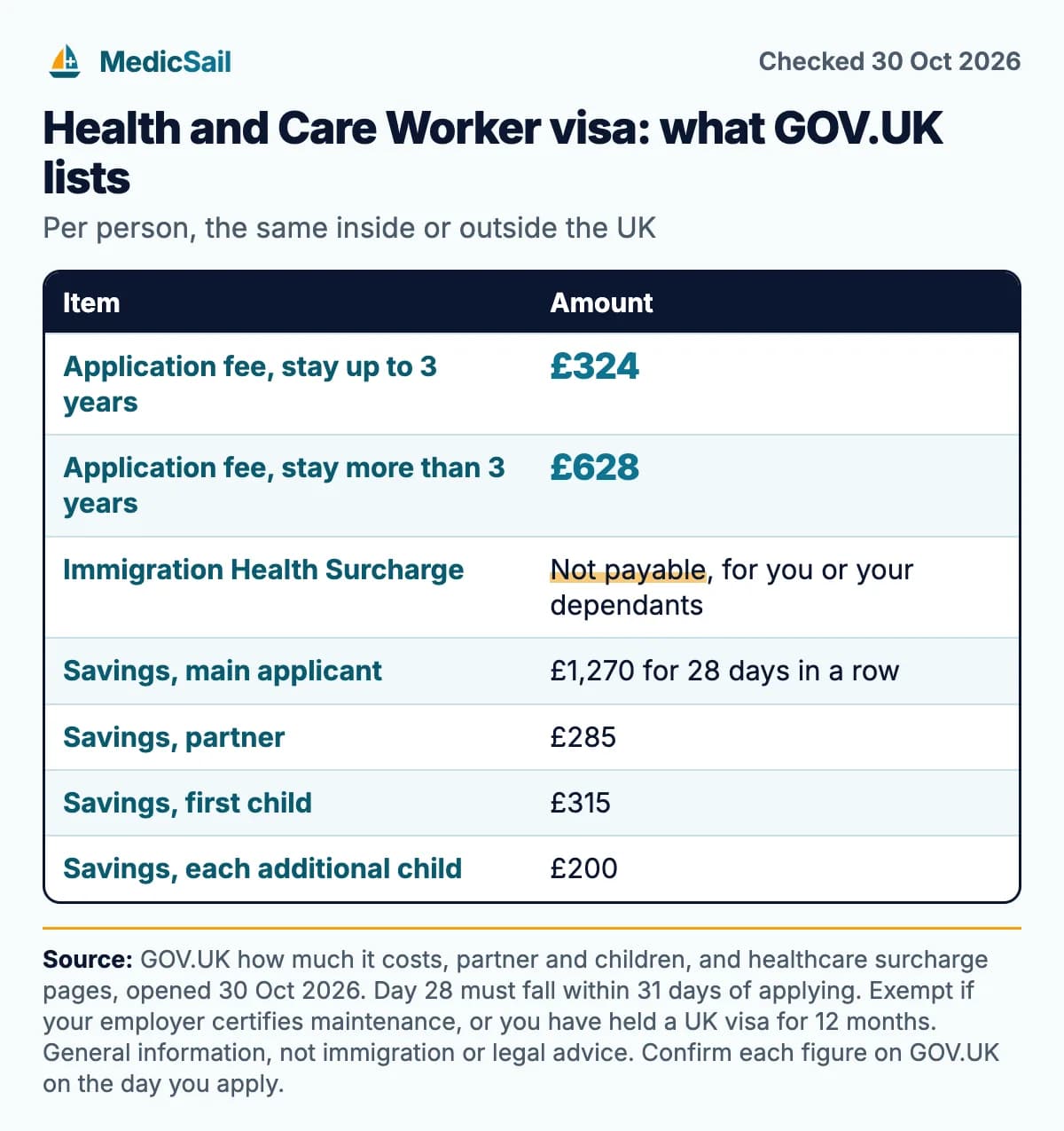
The application fee is £324 per person for a visa of up to three years, or £628 per person for more than three years, the same whether you apply from inside or outside the UK. You and your partner and children do not pay the Immigration Health Surcharge. You usually need to be paid at least £25,000, or the going rate for the job if that is higher, and you need English at CEFR level B2 unless you are exempt. GOV.UK says you will usually get a decision within three weeks. The visa can last up to five years, can be extended, and after five years you may be able to apply for indefinite leave to remain.
Two things have changed in recent years that matter if you are planning a move. Care workers and senior care workers can no longer make a new application from abroad in those roles, and their ability to bring dependants is restricted. The English level for new applicants is B2, while people who already held the visa before 8 January 2026 need B1 when they extend. Both are explained below, using GOV.UK's own wording. For the full route to working in the UK, including registration, see our UK healthcare guide.
Who is eligible
GOV.UK sets out the core conditions. To apply you must:
- be a qualified doctor, nurse, health professional or adult social care professional
- work in an eligible health or social care job
- work for a UK employer that has been approved by the Home Office
- have a certificate of sponsorship from your employer with information about the role you have been offered
- be paid the minimum salary for the type of work you are doing
- prove you can speak, read, write and understand English
- have a confirmed job offer before you apply
"Qualified" in practice means registered, or on the way to registration, with the UK regulator for your profession. The visa itself is decided by the Home Office, but your employer will not usually offer a registered post until you have a clear path to registration. Nurses, for example, often arrive before completing the NMC test of competence, with the OSCE taken in the UK, while doctors usually need to have passed PLAB 1 and PLAB 2 and secured GMC registration or be close to it. Employers handle this differently, so read your offer letter carefully.
The employer is the deciding factor between this visa and the Skilled Worker visa. If your employer is a private clinic or company that is not the NHS, does not provide medical services to the NHS and is not an adult social care provider, you may need the Skilled Worker visa instead. GOV.UK points doctors, nurses and people working in health or adult social care to the Health and Care Worker visa where they qualify, because it is cheaper and has no health surcharge.
Eligible occupation codes for each profession
Every sponsored job is matched to a Standard Occupational Classification (SOC) 2020 code, and that code appears on your certificate of sponsorship. GOV.UK lists 31 codes that are eligible for a new Health and Care Worker visa application. These are the codes for the professions MedicSail covers:
| Profession | SOC 2020 code and GOV.UK title | Regulator |
|---|---|---|
| Doctors | 2211 generalist medical practitioners; 2212 specialist medical practitioners | GMC |
| Nurses | 2232 registered community nurses; 2233 registered specialist nurses; 2234 registered nurse practitioners; 2235 registered mental health nurses; 2236 registered children's nurses; 2237 other registered nursing professionals | NMC |
| Midwives | 2231 midwifery nurses | NMC |
| Dentists | 2253 dental practitioners | GDC |
| Pharmacists | 2251 pharmacists | GPhC |
| Physiotherapists | 2221 physiotherapists | HCPC |
| Occupational therapists | 2222 occupational therapists | HCPC |
| Radiographers | 2254 medical radiographers | HCPC |
| Paramedics | 2255 paramedics | HCPC |
| Dietitians | 2259 other health professionals not elsewhere classified | HCPC |
| Biomedical scientists | 2113 biochemists and biomedical scientists (laboratory technicians are 3111) | HCPC |
| Practitioner psychologists | 2225 clinical psychologists; 2226 other psychologists | HCPC |
The other codes on GOV.UK's list for new applications are 1171 (health services and public health managers and directors), 1232 (residential, day and domiciliary care managers and proprietors), 2114 (physical scientists), 2223 (speech and language therapists), 2224 (psychotherapists and cognitive behaviour therapists), 2229 (therapy professionals not elsewhere classified), 2252 (optometrists), 2256 (podiatrists), 2461 (social workers), 3212 (pharmaceutical technicians) and 6131 (nursing auxiliaries and assistants).
Your profession page explains the code in context: see the guides for doctors, nurses, midwives, dentists, pharmacists, physiotherapists, radiographers, paramedics, occupational therapists, dietitians, biomedical scientists and practitioner psychologists.
If you start in a lower role, for example as a laboratory technician or a nursing assistant while you wait for registration, the code on your certificate will be different, and so may the salary rule and the rules on dependants. Check the code with your employer before you accept.
Care workers and senior care workers: what changed
Care workers and home carers (code 6135) and senior care workers (code 6136) are not on GOV.UK's list of codes for a new Health and Care Worker visa application. GOV.UK says that if you are extending, updating or switching to a Health and Care Worker visa, your job can also be in one of these "medium skilled" codes. In other words, these roles are now open only to people already in the UK.
GOV.UK adds some conditions:
- If you are a care worker or senior care worker working in England, your employer must be registered with the Care Quality Commission.
- If you are switching into one of these roles, you must have worked legally in your job for your sponsor for at least three months.
- If you are extending or updating your visa and got your certificate of sponsorship before 22 July 2025, some older medium skilled codes (1231, 3211, 3213, 3219, 6132 and 6133) can still be used, provided you have continually held one or more Health and Care Worker or Skilled Worker visas since you got that certificate.
- Care workers and senior care workers have their own salary requirements, which GOV.UK sets out in separate guidance rather than on the main salary page.
The rules on dependants for care workers and other medium skilled jobs are covered in the dependants section below.
Your employer and the certificate of sponsorship
Your employer must hold a Home Office sponsor licence. Once they offer you the job, they assign you a certificate of sponsorship. GOV.UK describes it as an electronic record, not a physical document, with a reference number you need for your visa application. You must apply for the visa within three months of getting the certificate.
The certificate carries the details the Home Office checks: your job title, occupation code, salary, start date and whether the employer will cover your maintenance funds. If any of these are wrong, the application can be refused, so ask to see the details before you apply.
If your employer is not yet approved, GOV.UK says it can apply for a sponsor licence. The licence fee is £611 for small businesses and charities and £1,682 for medium and large organisations, and it usually takes about eight weeks. NHS trusts and boards that recruit internationally already hold licences, so this usually only affects smaller employers.
You can apply up to three months before the day you are due to start work, according to the date on your certificate of sponsorship.
Salary rules
GOV.UK says you will usually need to be paid at least £25,000. If the going rate for your job is higher than £25,000, you will usually need to be paid at least the going rate.
For many health roles the going rate is set by GOV.UK's table of national pay scales for eligible healthcare jobs, organised by NHS pay band and UK nation. In practice, this means the employer must pay you at least the national pay scale rate for the band your job is in. NHS posts on Agenda for Change bands, and doctors on national contracts, are usually set at or above these rates already, but you should still check that the salary on your certificate matches the band of the job you are actually doing.
Two points often go wrong:
- If you are recruited on a lower band while waiting for registration, the salary test is applied to that role and code, not to the role you will move into later.
- Care worker and senior care worker roles follow separate salary guidance, as noted above.
Use the official NHS pay scales for the year shown on your contract. Our UK country page sets out the Agenda for Change bands from NHS Employers.
The English requirement
New applicants must prove English to at least level B2 on the Common European Framework of Reference for Languages (CEFR). GOV.UK accepts:
- a GCSE, A Level, Scottish National Qualification level 4 or 5 in English, gained while at school in the UK
- a degree from a UK institution taught in English
- a degree from a non-UK institution taught in English, confirmed by Ecctis
- a pass in a Secure English Language Test (SELT) from an approved provider
You do not need to prove English if you are a national of one of the majority English-speaking countries GOV.UK lists, such as Australia, Canada, Jamaica, Malta, New Zealand or the USA. GOV.UK also says you do not need to prove it if you have already passed an English language assessment accepted by your regulated professional body, and names doctors, dentists, nurses and midwives. A GMC, GDC or NMC English pass usually covers the visa too.
For pharmacists and HCPC professions, a regulator pass may not be enough on its own for the visa. Standard IELTS Academic and OET are not on the SELT list; IELTS for UKVI is. Our guide on which English test each UK regulator accepts explains how to pick one test that meets both the regulator and the visa rule.
If you had this visa before 8 January 2026 and you are applying to extend or update it, GOV.UK says you need level B1 and do not need to prove your English again. If you are switching from a Skilled Worker visa, you do not need to provide proof again either.
Fees, funds and the Immigration Health Surcharge
These are the costs GOV.UK states for the visa:
| Cost | Amount | Notes |
|---|---|---|
| Visa application, up to 3 years | £324 per person | Same inside or outside the UK |
| Visa application, more than 3 years | £628 per person | Same inside or outside the UK |
| Immigration Health Surcharge | Not payable | Health and Care Worker visa holders and their dependants are exempt |
| Personal savings (main applicant) | £1,270 | Held for 28 days in a row, with day 28 within 31 days of applying, unless exempt |
| Savings for a partner | £285 | Unless exempt |
| Savings for one child | £315 | Plus £200 for each additional child |
You do not need to show the £1,270 if you have been in the UK with a valid visa for at least 12 months, or if your employer can cover your costs during your first month in the UK. In that case, the employer must complete the "sponsor certifies maintenance" section on your certificate of sponsorship. Many NHS employers do this, so check your certificate before moving money around.
The surcharge exemption is the biggest financial difference from the Skilled Worker visa. GOV.UK's surcharge guidance says you do not pay if you are a health and care worker who is eligible for a Health and Care Worker visa, or their dependant. You can use the NHS from the date your visa starts, although charges still apply for things such as prescriptions, dental treatment and eye tests where those charges apply to everyone.
Faster decisions are available for an extra fee. Your employer may also cover some costs, such as visa fees or the NMC OSCE, but this varies by employer and is not set by GOV.UK.
Bringing your partner and children
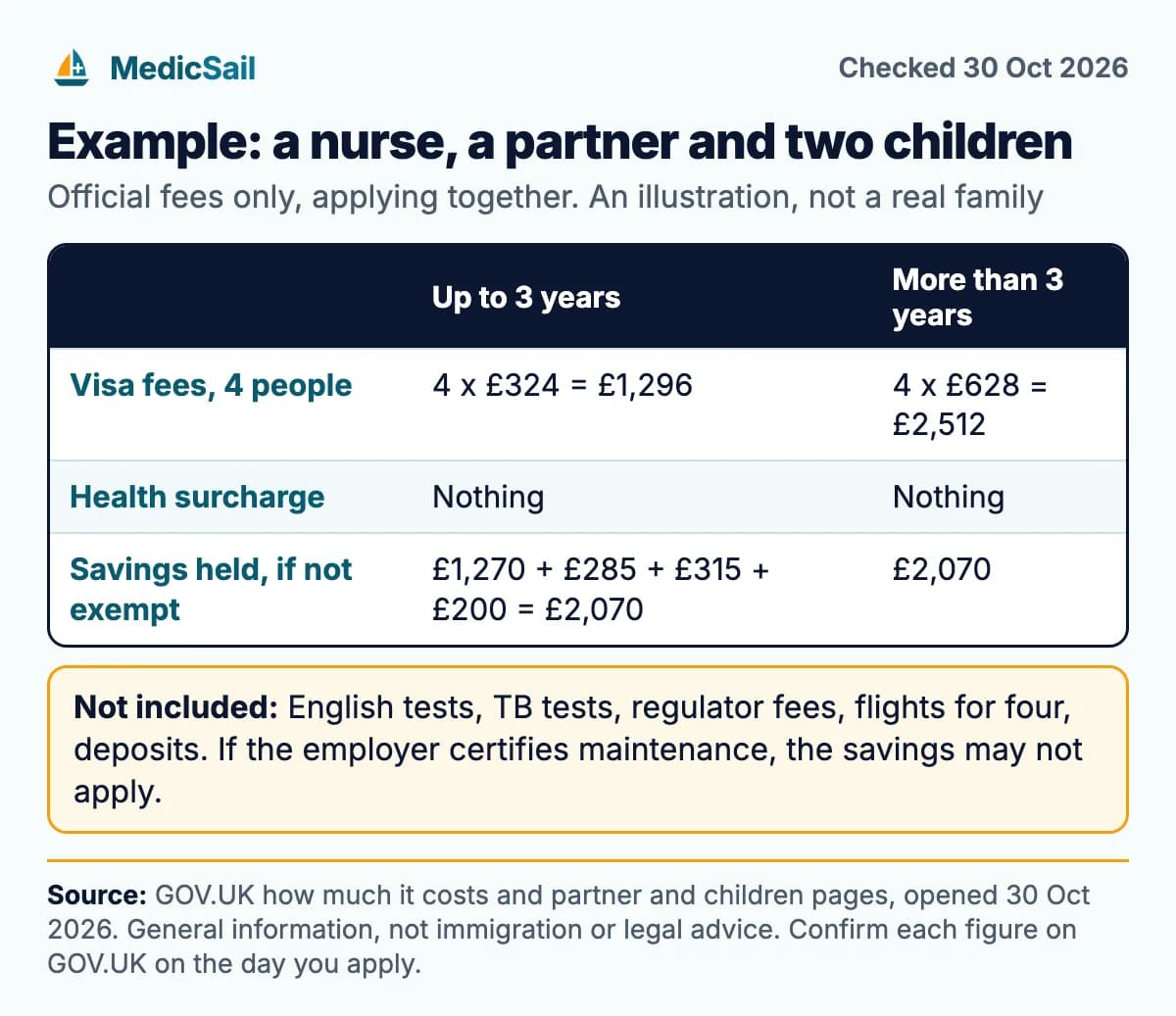
GOV.UK says your partner and children may be able to apply to join you or stay in the UK as your dependants. Dependants are your husband, wife, civil partner or unmarried partner, and your children under 18, including a child born in the UK during your stay. A child over 18 can apply only if they are already in the UK as your dependant. Each dependant pays the same visa fee as you and does not pay the surcharge.
If your job is a registered professional role, such as doctor, nurse, midwife, pharmacist or physiotherapist, the extra conditions below do not apply: GOV.UK sets them only for care workers, senior care workers and jobs listed as medium skilled.
If you are a care worker or senior care worker, one of the following must be true:
- you have been continually employed in the UK as a care worker or senior care worker, on a Health and Care Worker or Skilled Worker visa, since before 11 March 2024
- you are applying for a child born in the UK
- you are the only living parent responsible for your child and you are applying for permission for your child to stay in the UK
- your child's other parent is also sponsored as a care worker or senior care worker and you are applying for permission for your child to stay in the UK
If your job is listed as "medium skilled", the same structure applies with a different date: you must have been continually employed in the UK on a Health and Care Worker or Skilled Worker visa in a medium skilled job since before 22 July 2025, or meet one of the child-related conditions. GOV.UK's eligible occupations list marks which codes are medium skilled; laboratory technicians (3111), pharmaceutical technicians (3212) and nursing auxiliaries and assistants (6131) are among them. This matters if you plan to start as a nursing assistant or lab technician while waiting for registration.
Children born in the UK do not automatically become British citizens. You need to apply for them as dependants, using a full UK birth certificate showing both parents' names, before they turn 18. Partners and children do not switch automatically when you switch visas; they must apply separately.
Applying, processing times, extending and switching
You apply online. As part of the application you prove your identity and provide your documents; GOV.UK says there is no fee for giving your biometric information. Have ready your certificate of sponsorship reference, passport, proof of English if you need it, and bank evidence if your employer is not certifying maintenance. GOV.UK's application pages list any further documents that apply to you, such as a tuberculosis test result for some countries.
GOV.UK says you will usually get a decision within three weeks once you have applied online, proved your identity and provided your documents, both from outside the UK and when switching or extending inside it. Faster decisions may be available for an extra fee.
The visa can last up to five years before you need to extend, and GOV.UK says you can extend as many times as you like if you still meet the requirements. To extend you must:
- be in the same job as when you were given your previous permission
- be in the same occupation code
- still be working for the employer that gave you your current certificate of sponsorship
- still meet the salary requirements
If you change employer or move into a job with a different code, you update your visa rather than simply extending it. You must not travel outside the UK, Ireland, the Channel Islands or the Isle of Man until you get a decision. While on the visa you can work in your eligible job, take some additional work in certain circumstances, study and do voluntary work, but you cannot claim most benefits or change jobs without updating your visa.
Switching from another visa
If you are already in the UK, you may be able to switch to a Health and Care Worker visa without leaving. GOV.UK says you cannot switch if you are in the UK on a visit visa, a short-term student visa, a Parent of a Child Student visa, a seasonal worker visa or a domestic worker in a private household visa, or on immigration bail or permission granted outside the immigration rules. In those cases you must leave the UK and apply from abroad.
Common switching routes for health professionals:
- From a Student visa, for example after an OSPAP year for pharmacists or a UK degree. You must have completed your course, or your job start date must be after the course end date.
- From a Skilled Worker visa, if you move to an eligible employer and job. You do not need to prove English again.
- Into care worker or senior care worker roles, only if you have worked legally in that job for your sponsor for at least three months.
The fees are the same as applying from outside the UK, and decisions usually take three weeks.
Settlement: indefinite leave to remain
After five years living and working in the UK on a Health and Care Worker, Skilled Worker or Tier 2 (General) visa, you may be able to apply for indefinite leave to remain (ILR). GOV.UK says:
- you can apply up to 28 days before you reach five years on a qualifying visa
- you must meet the salary requirements and your employer must confirm in writing that you will continue to be needed for your job
- if you are 18 to 64 you must pass the Life in the UK Test
- you do not need to prove English again when settling from these visas
- the fee is £3,226 for each person applying
- you will usually get a decision within six months, with priority services available for an extra fee
Your partner and children may be able to apply for settlement alongside you if they meet the dependant rules. Time on some other visas may count towards the five years, and there are rules about absences from the UK, so check GOV.UK's settlement pages before you plan travel. Settlement rules are reviewed from time to time; rely on GOV.UK on the day you apply rather than on any summary, including this one.
Planning the visa around registration
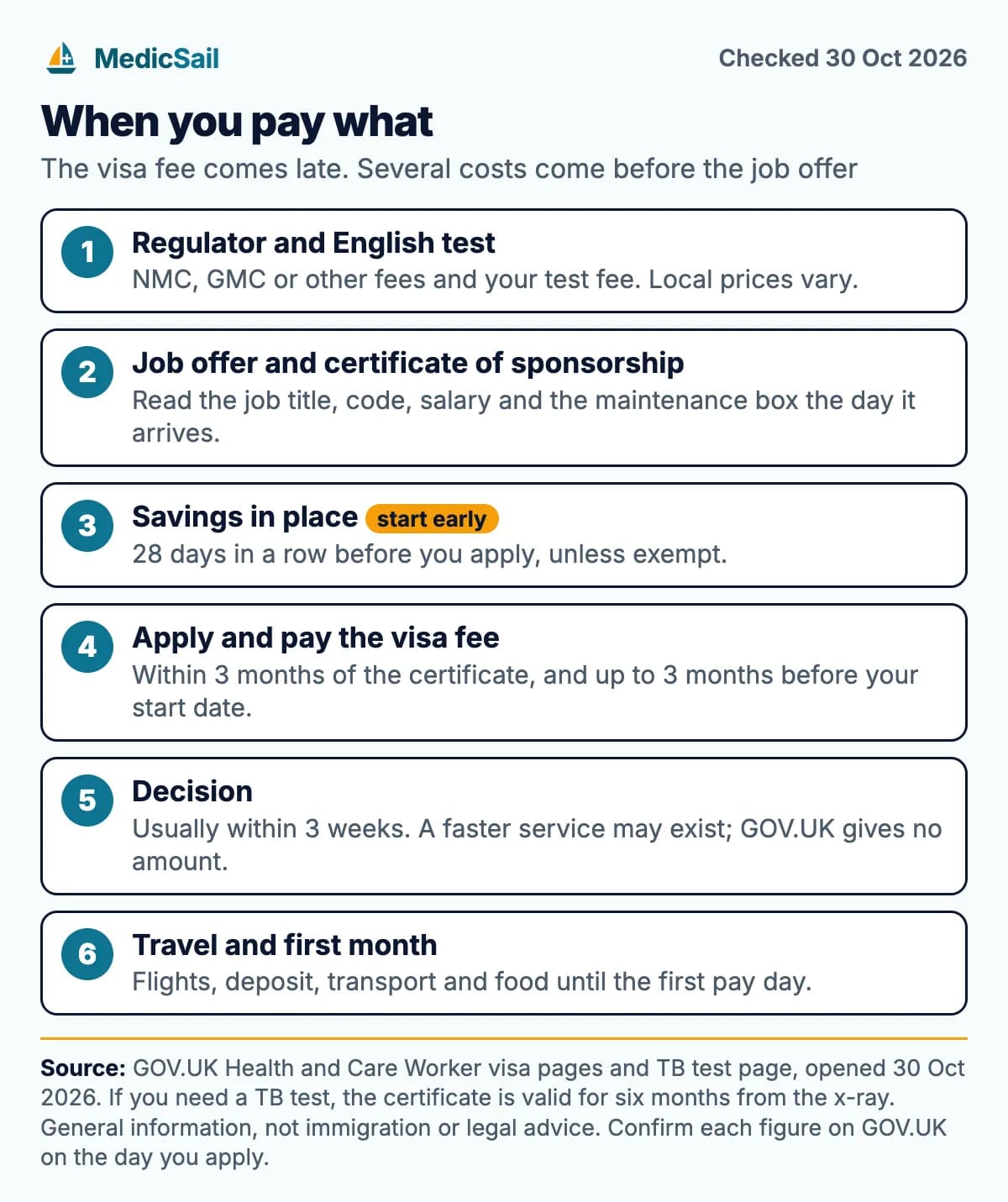
The visa is usually the last step, not the first. A realistic order for most professions is:
- Choose and pass the English test your regulator accepts, at the right scores.
- Apply to your regulator: the GMC, NMC, GDC, GPhC or HCPC.
- Pass any exam or test of competence the regulator requires.
- Secure a job offer from an eligible employer.
- Receive your certificate of sponsorship and check the code, salary and maintenance details.
- Apply for the visa within three months of getting the certificate, and no more than three months before your start date.
If you are currently licensed in the Gulf, the visa itself works the same way, but your registration and English evidence may need extra steps, since GCC countries are not on the UK's list of majority English-speaking countries. Our guide to moving from a Gulf licence to UK registration covers certificates of good standing, experience and timing.
Recruitment is governed by the NHS Employers code of practice for international recruitment, last updated on 27 March 2025. It says you must not be charged fees for recruitment services, and any repayment clause in your contract must be transparent, proportionate, time-limited and flexible.
Questions
GOV.UK says £324 per person for a visa of up to three years, or £628 per person for more than three years, whether you apply inside or outside the UK. There is no Immigration Health Surcharge for you or your dependants.
No. GOV.UK says health and care workers who are eligible for a Health and Care Worker visa, and their dependants, do not pay it. You still pay standard NHS charges such as prescriptions where they apply.
GOV.UK says you will usually need to be paid at least £25,000, or the going rate for the job if that is higher. For many health roles the going rate comes from GOV.UK's table of national pay scales by NHS band and UK nation.
Codes 6135 (care workers and home carers) and 6136 (senior care workers) are not on GOV.UK's list for new applications. GOV.UK says they can be used when extending, updating or switching to a Health and Care Worker visa.
Only in limited cases. GOV.UK says the care worker must have been continually employed in that role on a Health and Care Worker or Skilled Worker visa since before 11 March 2024, or meet one of the conditions about children, such as a child born in the UK.
GOV.UK says you will usually get a decision within three weeks once you have applied online, proved your identity and provided your documents. Faster decisions may be available for an extra fee.
Usually not. GOV.UK says you do not need to prove English if you have passed an English assessment accepted by your regulated professional body, and names nurses, midwives, doctors and dentists.
£1,270 held for 28 days in a row, with day 28 within 31 days of applying, plus £285 for a partner, £315 for one child and £200 for each additional child. You are exempt if your employer certifies maintenance or you have been in the UK on a valid visa for 12 months.
After five years living and working in the UK on a qualifying visa, and up to 28 days before you reach five years. The fee is £3,226 per person and you need to pass the Life in the UK Test if you are 18 to 64.
Yes, but you must update your visa with a new certificate of sponsorship before you start the new job. GOV.UK says you cannot change jobs or employers without updating your visa.
Sources
- 1GOV.UK: Health and Care Worker visa
- 2GOV.UK: Health and Care Worker visa, your job
- 3GOV.UK: Health and Care Worker visa, knowledge of English
- 4GOV.UK: Health and Care Worker visa, how much it costs
- 5GOV.UK: Health and Care Worker visa, your partner and children
- 6GOV.UK: Health and Care Worker visa, extend your visa
Show all 14 sourcesShow fewer sources
- 7GOV.UK: Health and Care Worker visa, switch to this visa
- 8GOV.UK: Skilled Worker visa eligible occupations and codes
- 9GOV.UK: Pay for UK healthcare as part of your immigration application
- 10GOV.UK: Indefinite leave to remain (Skilled Worker, Health and Care Worker)
- 11GOV.UK: Indefinite leave to remain, eligibility
- 12GOV.UK: Prove your English language abilities with a SELT
- 13GOV.UK: Skilled Worker visa
- 14NHS Employers: Code of practice for international recruitment (March 2025)
Plan it with our free tools
MedicSail
Healthcare licensing consultants for the UK, Europe and the USA
Updated and checked against the sources listed above. How we research and check our guides