


































PLAB 1 and PLAB 2: the complete route to GMC registration
Every stage of the PLAB route for international medical graduates, in order: eligibility, English, EPIC, PLAB 1 and PLAB 2, attempts and validity, 2026 GMC fees, registration with a licence, and the alternatives now that MTI has closed.

MedicSail
Published
The short answer
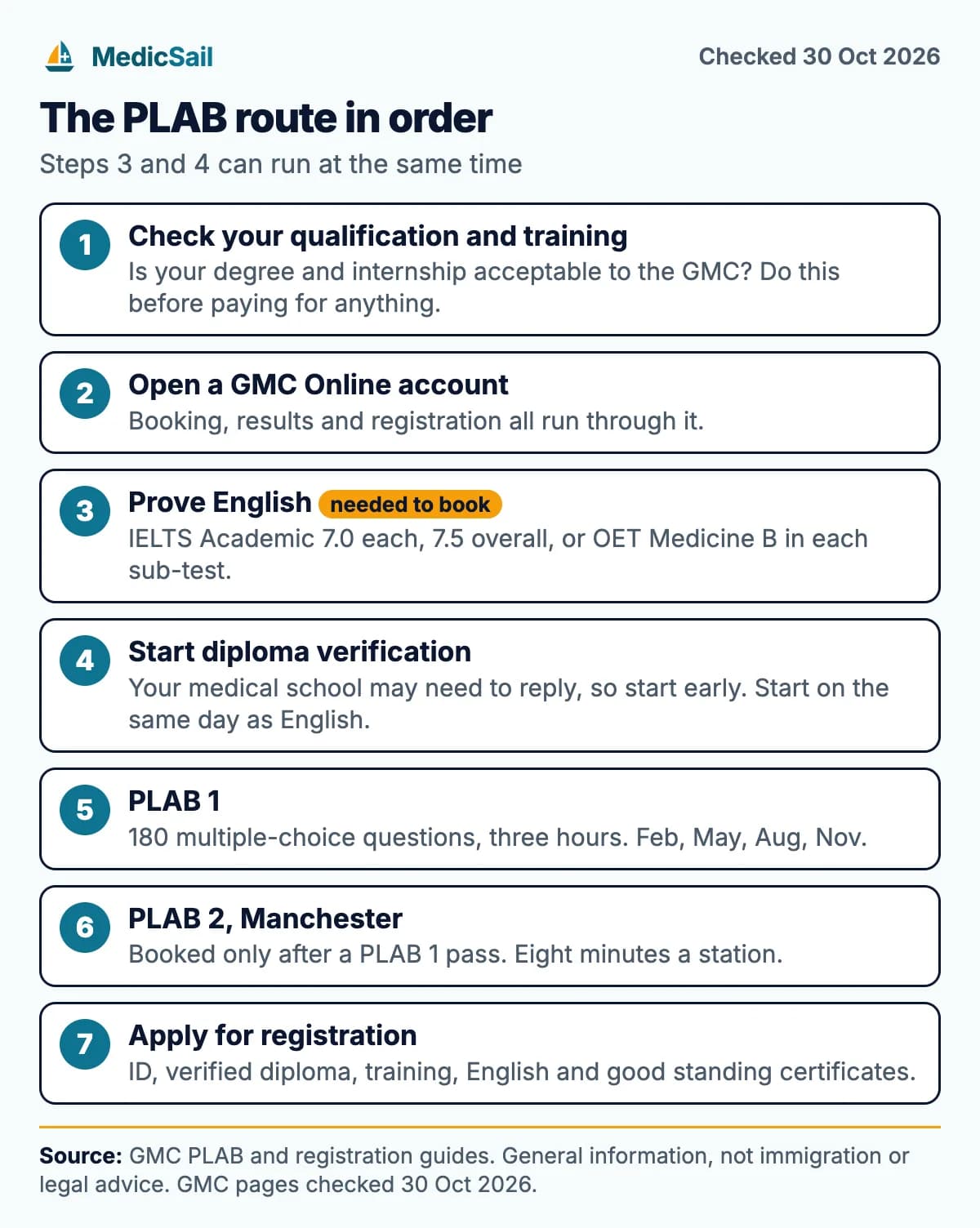
If you qualified in medicine outside the UK, the European Economic Area (EEA) and Switzerland, the usual route to practising in the UK is: verify your medical degree through EPIC, prove your English with IELTS Academic or OET Medicine, pass PLAB 1 (a written exam you can sit in the UK or overseas), pass PLAB 2 (a clinical OSCE held only in Manchester), then apply to the General Medical Council (GMC) for registration with a licence to practise. The GMC says PLAB checks that you know and can do the same as a doctor starting the second year of the UK Foundation Programme.
From 1 April 2026, the GMC charges £283 for PLAB 1, £1,036 for PLAB 2 and £481 to apply for full registration with a licence. You must pass PLAB 2 within two years of passing PLAB 1, and your registration must be approved within two years of passing PLAB 2. You can attempt each part until you have failed it four times.
PLAB is not the only route. Doctors with an accepted postgraduate qualification such as MRCP(UK) or MRCS, or who are accepted onto a GMC-approved sponsorship scheme, can register without it. This guide walks through every stage in order, with the rules as the GMC publishes them. For the wider picture of moving to the UK, see our guide to working in UK healthcare, and for the regulator itself, our GMC registration overview.
Do you need PLAB? Eligibility before you book
The GMC says that if you graduated from a medical school outside the UK, the EEA or Switzerland, you will probably need to take the PLAB test. Before you can book PLAB 1, you must set up a GMC Online account and show the GMC that your medical qualification and your knowledge of English are acceptable. The GMC verifies this information and only then lets you book.
Your primary medical qualification
Your medical degree must be one the GMC accepts. Check your medical school and qualification against the GMC's acceptable overseas qualifications guidance before you spend money on anything else. Your final medical diploma will later be verified at source through EPIC (covered below).
Your internship or postgraduate practice
To get full registration you must show acceptable practical training. The GMC's standard is at least 12 months' continuous internship in an approved post, with at least three months each in medicine and surgery (for internships of 12 to 18 months) or at least six months each (for 18 months or longer). If you did not complete an internship, the GMC accepts two years' continuous supervised postgraduate practice in a public hospital, including at least three months each of medicine and surgery.
Observerships, clinical attachments, shadowing and clerkships do not count as practical training. A common, expensive mistake is to pass both PLAB parts and only then discover that an internship with long breaks, or with too little surgery, does not meet the GMC's criteria. Check this first.
What you will need overall
- An acceptable primary medical qualification, verified by ECFMG through EPIC.
- An acceptable internship or two years' qualifying postgraduate practice.
- IELTS Academic or OET Medicine at the GMC's scores.
- Passes in PLAB 1 and PLAB 2 (or another registration route).
- A certificate of good standing from every medical regulator you have been registered or licensed with in the last five years.
- A full account of your activities over the last five years, including any gaps.
Our page on working as a doctor in the UK puts these requirements alongside NHS pay and the visa.
English first: IELTS or OET before PLAB 1
English comes before PLAB, not after it. The GMC asks you to show that your knowledge of English is acceptable before you can book PLAB 1, and your English certificate must be valid on the day you sit PLAB 1 and again when the GMC approves your registration.
| Test | Version | GMC minimum |
|---|---|---|
| IELTS | Academic only (including IELTS for UKVI and IELTS Online) | 7.0 in each of reading, writing, listening and speaking, and 7.5 overall |
| OET | Medicine only (paper, computer or OET@Home) | Grade B in each of the four sub-tests |
The scores must come from one sitting, and it must be your most recent sitting. The IELTS Indicator test is not accepted. The GMC accepts IELTS One Skill Retake once, for one section, if you sat the full test on computer at a centre that offers it and retake within 60 days. For OET, select the General Medical Council as a recognising organisation in your OET account. You then enter your results in the 'My Tests' section of GMC Online, and the GMC says verification can take up to two working days.
Validity and the PLAB 2 wait
IELTS and OET certificates are valid for two years. Because PLAB 2 dates can involve a wait, some doctors find their certificate expires before they can register. The GMC has a specific concession: it currently accepts a recent PLAB 2 pass as evidence that you have maintained your English, if you passed PLAB 2 less than three months before applying to join the register and you achieved the GMC's minimum IELTS or OET scores less than three years ago. The GMC checks this automatically when you apply.
Employer confirmation of English is accepted for registration only if you have worked in a medical capacity for at least the past two years in a country on the GMC's list where English is the first and native language. It is not accepted for PLAB. If you are deciding between the two tests, our comparison of IELTS and OET for UK healthcare regulators sets out the scores every UK regulator asks for.
EPIC: start primary source verification early
The GMC verifies your primary medical qualification through EPIC, a service run by ECFMG (a division of Intealth). You create an account with ECFMG and submit your final medical diploma. ECFMG then contacts your medical school directly to confirm the diploma is genuine and sends its report to the GMC. If your qualification has already been verified by ECFMG, for example for a US application, you can ask for that report to be released to the GMC.
The GMC says most medical schools respond within 90 days, and postal requests take longer. EPIC fees are set by ECFMG in US dollars, paid to ECFMG and depend on how many qualifications you verify; refunds are not available once verification starts. The GMC pays the EPIC fee for doctors with UK refugee status. If you apply on the basis of a postgraduate qualification, that may need verifying too.
Slow responses from medical schools are one of the most common causes of delay in the whole process. Because the GMC can keep a registration application open for a limited time, start EPIC as soon as you decide to pursue UK registration, ideally in parallel with your English test.
PLAB 1: format, dates, venues and booking
PLAB 1 is an applied knowledge test. It is a written exam of 180 multiple choice questions that you answer within three hours. Each question starts with a short clinical scenario followed by a question, and you choose the single best answer from five options. The GMC says it tests your ability to apply knowledge to patient care rather than recall facts, and you should answer according to current UK best practice and published evidence, not local arrangements.
What it covers
The exam can cover any of the common, important or acute conditions seen by a doctor in a Foundation Year 2 (F2) post, and the management of long-term conditions seen in primary care. It excludes the advanced duties of a GP. PLAB 1 is compliant with the Medical Licensing Assessment (MLA) requirements.
When it runs
The GMC runs PLAB 1 four times a year, with sittings in February, May, August and November. Scheduled exam and results dates are shown in the GMC's PLAB 1 guide, and results come out about six weeks after the exam.
Where you can sit it
UK venues are Belfast, Birmingham, Cardiff, Edinburgh, London, Manchester, Oxford and Sheffield. PLAB 1 is also held in Dublin and Madrid, and at British Council centres overseas. The GMC's list of overseas locations includes Dubai (UAE), Riyadh (Saudi Arabia), several Indian cities, Karachi and Islamabad, Dhaka, Cairo, Lagos and Colombo, among others. Availability changes, so check the live list in the PLAB booking service.
Booking and cancelling
- Book through GMC Online once the GMC has verified your qualification and English.
- Bookings for overseas centres close about six weeks before the exam; UK bookings close two weeks before.
- Places are limited and in high demand. If you have a UK NHS job offer that requires GMC registration, or UK refugee status, the GMC asks you to email [email protected] so it can try to offer an earlier place.
- For UK and EU venues, the GMC's supplier VICTVS sends your venue address within seven days of the exam. Overseas candidates get venue details from the British Council.
- Cancelling more than 42 days before the exam costs 10% of the fee; cancelling 42 days or less before costs the full fee.
PLAB 2: the OSCE in Manchester
PLAB 2 is a clinical and professional skills assessment, the style of exam often called an objective structured clinical exam (OSCE). It has 16 scenarios, each lasting eight minutes, set in real-life settings such as a mock consultation or an acute ward. There are at least two rest stations, and the whole exam takes around three hours. After reading the instructions and patient information outside each room, you enter the cubicle and complete the task until a timer tells you to move on.
Like PLAB 1, it is set at the level of a doctor starting F2 and tests clinical knowledge, skills and behaviours rather than recall. Drug names follow the most recent edition of the British National Formulary (BNF). PLAB 2 is also compliant with the MLA requirements.
Where and when
PLAB 2 is held only at the GMC's two Clinical Assessment Centre sites in Manchester: 3 Hardman Square (M3 3EB) and 3 Hardman Street (M3 3AW). The addresses look very similar, so check your booking confirmation for which site you are going to. Test dates run throughout the year.
You can only see and book PLAB 2 dates once you have your PLAB 1 result; you cannot apply for PLAB 2 before results are issued. The GMC says demand is high and you may wait for a date. As with PLAB 1, candidates with an NHS job offer requiring GMC registration, or with UK refugee status, can contact [email protected] about an earlier place. The GMC notes that the number of exam places is not linked to the number of jobs.
Getting to the UK for the exam
If you live outside the UK, you need to travel to Manchester for PLAB 2. Check the UK entry rules for your nationality on GOV.UK well before your exam date, and budget for travel and accommodation on top of the £1,036 exam fee. Cancellation charges also apply to PLAB 2, so check the GMC's cancellation rules before you book flights.
Attempts, validity and deadlines
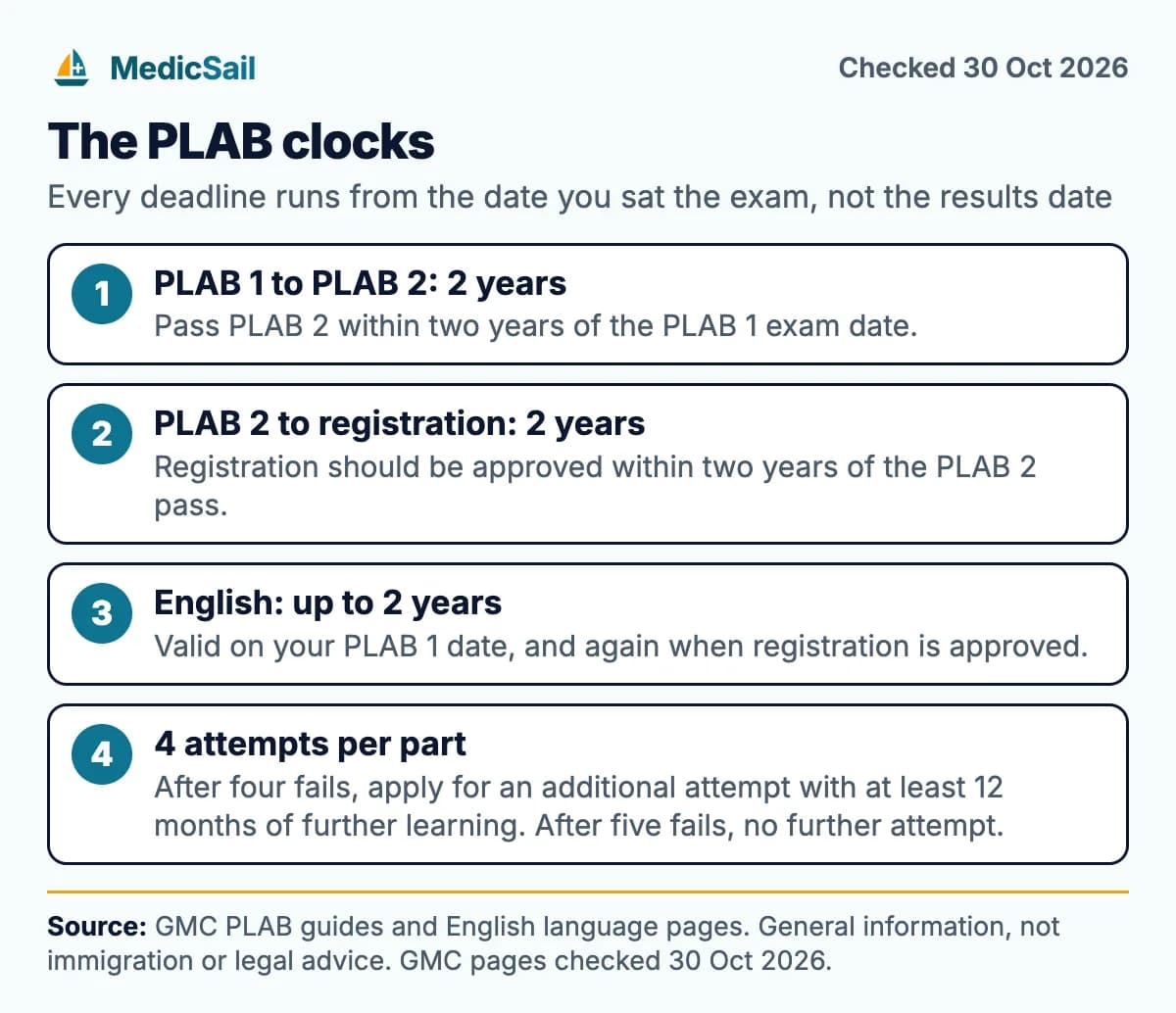
The PLAB clock rules catch many doctors out. The key dates the GMC sets are:
- PLAB 1 to PLAB 2: you must pass PLAB 2 within two years of passing PLAB 1. During the COVID-19 pandemic the GMC extended this to three years, but that extension ended on 31 March 2025.
- PLAB 2 to registration: your application for registration with a licence should be approved within two years of passing PLAB 2. If more than two years have passed, the GMC asks for additional evidence of your knowledge and skills.
- Pass dates: your pass date is the date you took the test, not the date the results were issued.
- English: your IELTS or OET certificate (valid for two years) must be valid on your PLAB 1 date and when your registration is approved, subject to the recent PLAB 2 concession described above.
How many attempts
For each part, you can keep booking as long as you still meet the requirements, until you have failed that part four times. After four fails you can apply for one final attempt, but you must show evidence of additional learning over a 12-month period and make an application to the GMC.
Results checks and appeals
The GMC no longer offers manual checks of PLAB results, saying it is confident its marking is robust. You can still appeal a result through the process set out in each PLAB guide.
What PLAB and registration cost in 2026
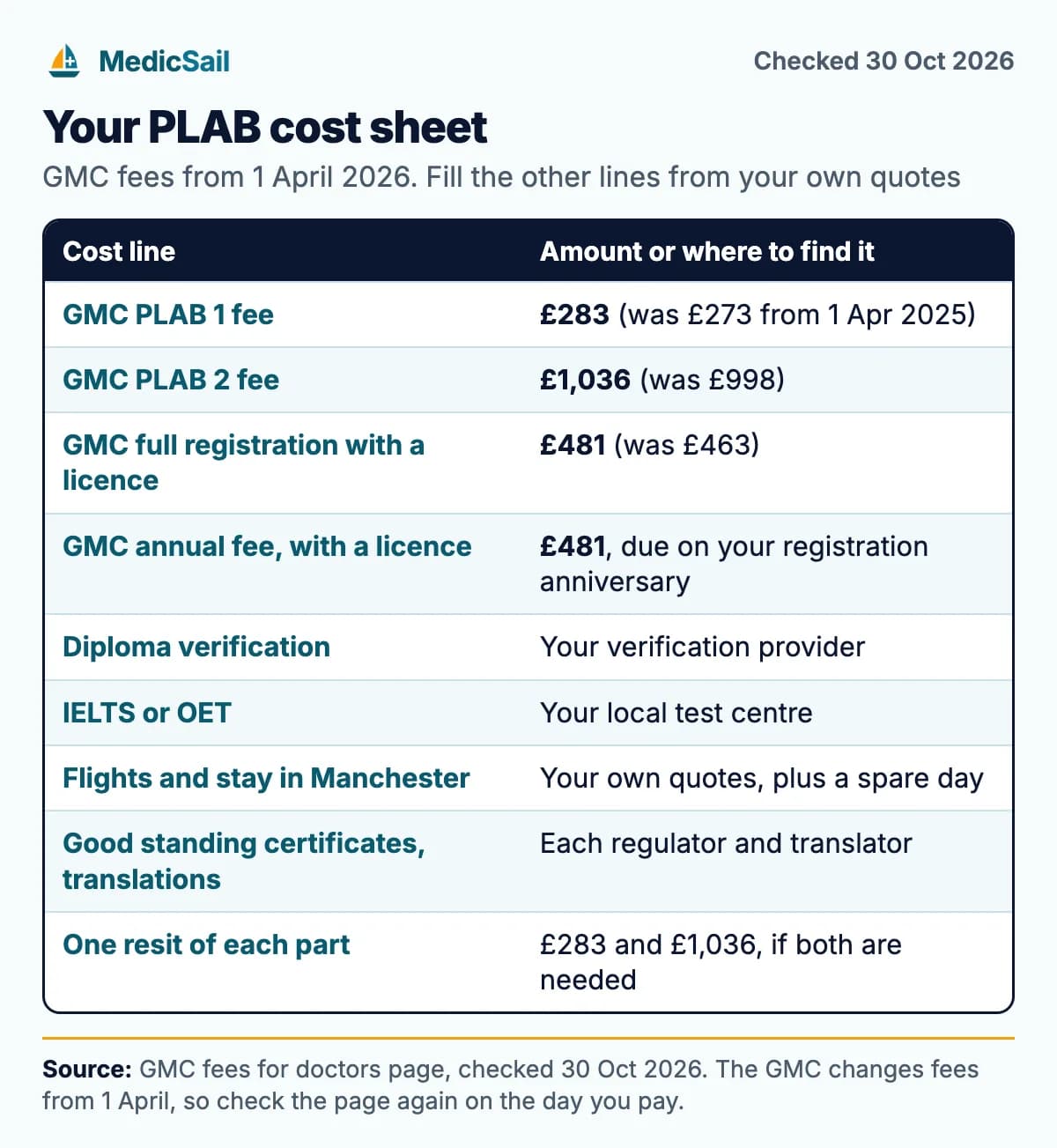
These are the GMC fees from 1 April 2026, as published on the GMC fees page. EPIC, English tests and travel are charged separately.
| Item | Fee | Notes |
|---|---|---|
| PLAB 1 | £283 | Was £273. 10% charge to cancel more than 42 days before; full fee at 42 days or less. |
| PLAB 2 | £1,036 | Was £998. Cancelling more than 42 days before costs 10%, 42 to 29 days 50%, and 28 days or less the full fee. |
| Full registration with a licence (application) | £481 | Paid when you submit your application. |
| Discounted full registration | £184 | For doctors moving from provisional to full registration, or who gained their primary medical qualification within the past five years. |
| Scrutiny fee | £110 | Kept if your application is refused, closed or withdrawn. |
| Annual fee with a licence | £481 | Due on the anniversary of registration. 50% discount if your worldwide income is under £38,500, applied for once you are registered. |
| EPIC verification | Set by ECFMG in US dollars | Paid to ECFMG. |
| IELTS or OET | Set by the test provider | Check your local test centre. |
A doctor who passes everything first time therefore pays the GMC £1,800 across PLAB 1, PLAB 2 and the registration application, before EPIC, English testing, travel to Manchester and the first annual fee. Resits add the full exam fee each time. Our UK doctors page adds the visa costs to this budget.
Applying for registration with a licence to practise
Once you have passed both parts, you apply through GMC Online for full registration with a licence to practise. The GMC's guide for this route says it is for doctors who graduated outside the UK and passed both parts of PLAB within the past two years. Registration and the licence are separate things in the UK: registration shows you are in good standing, but it is the licence that allows you to practise, prescribe and treat patients.
Evidence you will provide
- Your passport and identity details.
- Your EPIC-verified primary medical qualification.
- Evidence of your internship or qualifying postgraduate experience.
- Your English evidence (or the recent PLAB 2 concession).
- A certificate of good standing from each medical regulator you have been registered or licensed with in the last five years, even if you did not work in that country. Ask each regulator to email it to the GMC directly where possible. Each certificate is valid for three months from the date it is signed and must be valid when the GMC approves your application. The GMC will ask you to post the original to its Manchester office and cannot return it.
- A record of your activities over the last five years, including gaps, with references for non-medical work, unregistered medical work and observerships of more than two months.
- Certified translations of any document not in English.
You have three months to complete an application once you start it. Once the GMC has assessed your evidence, you complete an identity check before registration is granted. After that you can work as a doctor in the UK, subject to your employer's own checks.
After you register
You pay the annual fee each year, have a yearly appraisal and revalidate every five years through a responsible officer. The GMC encourages doctors new to the UK to book its free Welcome to UK practice workshop through GMC Online.
How long the whole route takes
The GMC does not publish a single end-to-end timeline, because it depends on your medical school, exam dates and your own preparation. These are the fixed points it does publish:
- EPIC verification: most medical schools respond within 90 days, according to the GMC.
- English test result: verification in GMC Online can take up to two working days after you enter your results.
- PLAB 1: four sittings a year; overseas bookings close about six weeks before. Results about six weeks after the exam.
- PLAB 2: bookable only after your PLAB 1 result; the GMC warns you may wait for a date. Must be passed within two years of PLAB 1.
- Registration: must be approved within two years of PLAB 2; you have three months to complete the online application, and certificates of good standing last three months.
- Visa and job start: GOV.UK says you can apply for a Health and Care Worker visa up to three months before your start date and usually get a decision within three weeks.
Putting the sequence together, a doctor who passes first time cannot normally get from EPIC submission to registration in a matter of weeks: at least one PLAB 1 cycle plus results, the wait for a PLAB 2 date and the registration stage all have to fit in. Build in slack for resits and for the PLAB 2 wait, and plan your English test date so the certificate does not expire mid-route.
Alternatives to PLAB: postgraduate qualifications and sponsorship
Acceptable postgraduate qualifications
The GMC keeps a list of postgraduate qualifications it accepts as evidence that you have the knowledge, skills and experience for full registration with a licence. It includes UK royal college qualifications such as MRCP(UK), MRCS (several versions), FRCS, MRCOG, MRCPCH, MRCPsych, FRCA (and the Primary FRCA, with a college letter), MRCEM and FRCEM, FRCOphth by examination and FRCR, plus a separate list of named overseas qualifications from bodies in Australia and New Zealand, Canada, Ireland, Hong Kong and elsewhere.
The qualification should have been awarded no more than three years before the date the GMC approves your application; if it is older, you must provide further evidence of recent medical experience. If your qualification is not on the list, it is not acceptable for this route, though the GMC may accept a letter from a UK medical royal college confirming that an international qualification is equivalent to its own. The GMC notes that the JRCPTB, the Royal College of Anaesthetists and the Faculty of Intensive Care Medicine no longer offer equivalence recognition. It also says these qualifications do not guarantee entry to UK specialty training.
Sponsorship
Some NHS trusts, universities, royal colleges and other bodies run GMC-approved sponsorship schemes. If you satisfy a sponsor's scheme, it issues a Sponsorship Registration Certificate, which you use instead of PLAB. This is not the same as a UK visa certificate of sponsorship, and the GMC cannot accept a visa certificate for registration. Every sponsor requires that you have been in medical practice for three of the last five years, including the most recent 12 months. On the sponsorship route you must use IELTS Academic or OET Medicine at the GMC's scores, awarded within the last two years, unless you are a national of, and qualified in, a country where English is the first and native language.
Specialists
Experienced specialists can also apply to the Specialist or GP Register through the Portfolio pathway (formerly CESR and CEGPR), which costs £1,974 from 1 April 2026; the GMC says processing takes 6 to 12 months after submission. You must hold full registration with a licence when specialist registration is granted. Our guide for doctors across every country compares this with the specialist routes elsewhere.
Your first UK job, the visa and the end of MTI
The GMC does not recruit doctors, and registration does not guarantee a job. It recommends checking the job market in your specialty and location before you spend money on exams. Most international doctors start in non-training posts, often called clinical fellow, trust grade or locally employed doctor roles, advertised on NHS Jobs, the national sites for Scotland and Northern Ireland and BMJ Careers. Employers then run pre-employment checks including GMC status, references and occupational health.
Specialty training
The UK government's Medical Training (Prioritisation) Act 2026, which received Royal Assent on 5 March 2026, prioritises UK graduates and certain other groups for Foundation and specialty training places. International graduates can still apply, but competition is stronger, which is one reason many doctors build UK experience in non-training posts first.
The visa
With a job offer from a Home Office approved NHS or health employer, most doctors come on the Health and Care Worker visa. GOV.UK sets the fee at £324 per person for up to three years or £628 for longer, and Health and Care Worker visa holders and their dependants do not pay the immigration health surcharge. Our Health and Care Worker visa guide covers eligibility, salary rules and family members. If you hold a licence in the Gulf, read what carries over from a Gulf licence, and if a partner is a nurse, our guide to the NMC CBT for international nurses explains their route.
Questions
The Professional and Linguistic Assessments Board test is the GMC's assessment for doctors who qualified outside the UK, the EEA and Switzerland. It has two parts: PLAB 1, a 180-question written exam, and PLAB 2, a 16-station OSCE in Manchester. It checks you can work at the level of a doctor starting the second year of the UK Foundation Programme.
No. The GMC asks you to show that your medical qualification and English are acceptable before you can book PLAB 1. You need IELTS Academic with 7.0 in each area and 7.5 overall, or OET Medicine with grade B in each sub-test, from your most recent sitting.
The GMC lists British Council centres in Dubai (UAE) and Riyadh (Saudi Arabia) among its overseas PLAB 1 locations. Overseas bookings close about six weeks before the exam, so book early and check current availability in the PLAB booking service.
No. PLAB 2 is held only at the GMC's Clinical Assessment Centre sites on Hardman Square and Hardman Street in Manchester. You can book it only once you have your PLAB 1 result.
You must pass PLAB 2 within two years of passing PLAB 1. The three-year COVID-19 extension ended on 31 March 2025. Your pass date is the date you sat the exam, not the date the results came out.
You can sit each part until you have failed it four times. After that you can apply to the GMC for one final attempt, with evidence of additional learning over a 12-month period.
From 1 April 2026, PLAB 1 costs £283 and PLAB 2 costs £1,036. The application for full registration with a licence costs £481. EPIC verification, English tests and travel to Manchester are extra.
Yes, with a postgraduate qualification on the GMC's accepted list awarded within three years of approval, or a Sponsorship Registration Certificate from an approved sponsor. Specialists may use the Portfolio pathway or a recognised specialist qualification. Each route still needs English, EPIC and certificates of good standing.
Not for new applicants. The Medical Training Initiative closed to new participants at noon on 31 March 2026, with a grace period to 30 June 2026 only for applications already in progress with a medical royal college. The Academy of Medical Royal Colleges says no replacement has been confirmed.
The GMC currently accepts a recent PLAB 2 pass as evidence you have kept up your English, if you passed PLAB 2 less than three months before applying and your IELTS or OET is less than three years old. The GMC checks this automatically; other English evidence options are set out in its guidance.
Sources
- 1GMC: A guide to the PLAB test
- 2GMC: What is the PLAB 1 exam?
- 3GMC: When and where can I take PLAB 1?
- 4GMC: PLAB 1, what to do after your results
- 5GMC: What is the PLAB 2 exam?
- 6GMC: When and where can you take PLAB 2?
Show all 22 sourcesShow fewer sources
- 7GMC: PLAB 2, what to do after your results
- 8GMC: Fees for doctors
- 9GMC: Using your IELTS certificate
- 10GMC: Using your OET certificate
- 11GMC: Primary source verification for international medical graduates
- 12GMC: Check if your practical training (internship) is acceptable
- 13GMC: Acceptable postgraduate qualifications
- 14GMC: Applying for registration using sponsorship
- 15GMC: Full registration for international medical graduates
- 16GMC: Your certificate of good standing
- 17GMC: Portfolio pathway application
- 18Academy of Medical Royal Colleges: MTI scheme closure questions and answers
- 19GOV.UK: Medical Training (Prioritisation) Bill impact statement
- 20GOV.UK: Health and Care Worker visa
- 21GOV.UK: Health and Care Worker visa, how much it costs
- 22UK Parliament: Medical Training (Prioritisation) Act 2026 (Royal Assent 5 March 2026)
Plan it with our free tools
MedicSail
Healthcare licensing consultants for the UK, Europe and the USA
Updated and checked against the sources listed above. How we research and check our guides