


































Moving from a Gulf licence to UK registration: what carries over
For doctors, nurses, dentists, pharmacists and allied health staff licensed in the Gulf: what UK regulators accept from your Gulf years, what they do not, and how to time good standing, references and the visa.

MedicSail
Published
The short answer
A licence from the Dubai Health Authority (DHA), the Department of Health Abu Dhabi (DOH), the UAE Ministry of Health and Prevention (MOHAP), the Saudi Commission for Health Specialties (SCFHS), Qatar's Department of Healthcare Professions (QCHP) or any other Gulf authority does not transfer to the UK. No UK regulator registers you on the strength of a Gulf licence, and none of them exempts Gulf-licensed applicants from its exams. Each UK regulator assesses your original qualification and then sets its own exam or assessment.
What does carry over is more useful than many people expect: your clinical experience (which counts in specific, defined ways), your record of good standing (which every UK regulator asks for), and documents you can only easily collect while you are still in post, such as detailed references. What does not carry over is just as clear: Gulf practice does not count as practice in an English-speaking country, so almost everyone needs IELTS or OET, and Gulf board or specialty certificates do not replace UK exams.
This guide sets out, regulator by regulator, what the General Medical Council, the Nursing and Midwifery Council, the General Dental Council, the General Pharmaceutical Council and the Health and Care Professions Council say about experience, good standing, English and exams, followed by practical steps for leaving a Gulf post well. For the UK system as a whole, start with our overview of working in UK healthcare.
Why a Gulf licence does not transfer
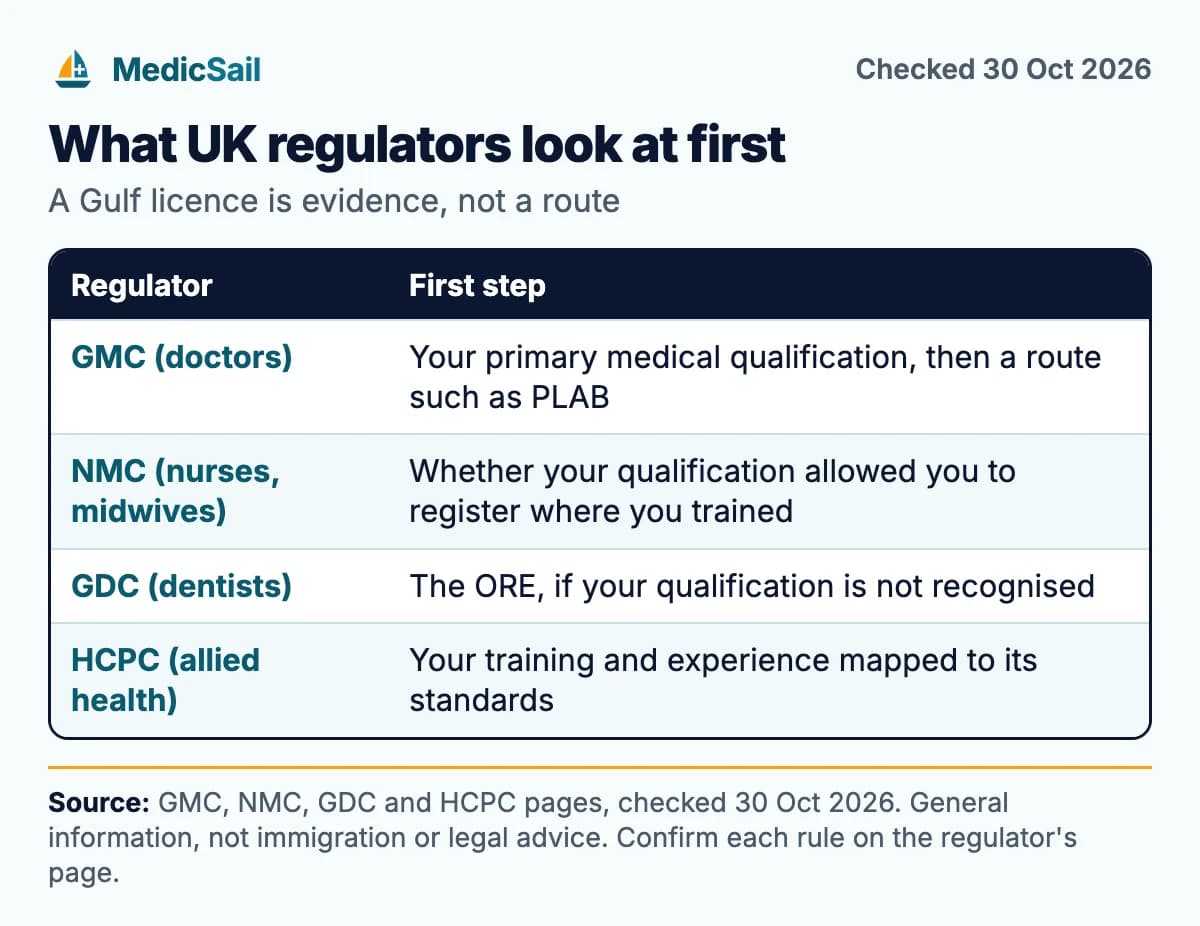
Gulf licensing authorities and UK regulators both check qualifications, but there is no agreement under which one recognises the other's licence. UK regulators look back to the qualification that first allowed you to practise and, in most cases, the country where you gained it. Your Gulf licence matters as evidence of your registration history and good standing, not as a qualification in itself.
- GMC (doctors): assesses your primary medical qualification, verified through EPIC, and your internship. You then need a registration route: PLAB, an accepted postgraduate qualification, sponsorship or a recognised specialist qualification.
- NMC (nurses and midwives): checks that your qualification allowed you, or will allow you, to register in the country where you trained, and contacts that regulator. Gulf experience does not exempt you from the Test of Competence.
- GDC (dentists): recognises only a short list of older qualifications from named countries, based on where and when you qualified. Everyone else, wherever they practise, takes the Overseas Registration Examination (ORE).
- GPhC (pharmacists): everyone qualified outside the EEA follows the same route of OSPAP, foundation training and the registration assessment.
- HCPC (allied health): assesses the qualification that first allowed you to practise against its standards of proficiency, together with your training and experience.
So if you trained in India, Egypt, the Philippines, Pakistan, Jordan or elsewhere and then moved to the Gulf, the UK regulator looks first at that original training. The Gulf years then add to your file through experience, references and good standing.
What Gulf experience counts for, profession by profession
Doctors
The GMC accepts two years' continuous supervised postgraduate practice in a public hospital, including at least three months each of medicine and surgery, as an alternative to an internship. Supervised practice in a Gulf public hospital can count towards this if it meets those criteria. Gulf practice also counts towards the rule every GMC-approved sponsor applies: medical practice in three of the last five years, including the most recent 12 months. Specialists can use Gulf training and board certification towards Portfolio pathway eligibility (a specialist qualification, or at least six months' continuous specialist training in the specialty), but must still show they meet the UK curriculum with verified evidence. Our complete guide to PLAB and GMC registration covers each route.
Nurses and midwives
Your Gulf experience does not reduce the NMC process: you still pass the CBT and OSCE in your field. Employers may take it into account when deciding your band and role, though practice varies by employer. See our guide for nurses moving to the UK for the full sequence.
Dentists
To join the ORE candidate list the GDC needs clinical references showing at least 1,600 hours of clinical experience treating patients in the dental chair, on documents no more than three months old at the time of application. Gulf clinical work can count towards those hours. The GDC also says you can no longer register as a dental care professional if you hold only an overseas dentistry qualification.
Pharmacists
Gulf practice does not shorten the route. You still complete OSPAP, a 52-week foundation year and the Common Registration Assessment. The GPhC notes that you must pass all OSPAP assessments even where a university exempts you from some taught content.
Allied health professionals
The HCPC assesses your training and relevant experience together against the standards of proficiency for your profession. Since 20 November 2025, every international application needs a standards of proficiency mapping document, in which you point to evidence for each standard. Gulf experience, such as inpatient, intensive care or rehabilitation work for a physiotherapist, or CT, MRI or radiotherapy work for a radiographer, is exactly the kind of evidence that can fill gaps left by your degree. The HCPC no longer asks for further information after you submit, so any gap left in the mapping can lead to a test of competence or a refusal.
Certificates of good standing from Gulf authorities
Every UK regulator asks for evidence of good standing, but they ask for it in different ways. Get this right, because it is a frequent cause of delay.
| Regulator | Whose certificate | Timing rules |
|---|---|---|
| GMC | Every medical regulator you have been registered or licensed with in the last five years, even if you did not work in that country | Valid for three months from the date signed; must be valid when the GMC approves your application |
| NMC | Your regulator, with a copy of your registration certificate; the NMC contacts the regulator directly | A statement of entry to the register is accepted if your regulator no longer issues certificates |
| GDC | The dental authority of the country in which you were last working (a certificate of good standing or certificate of current professional status) | Must be current; the GDC asks for the original |
| GPhC | The regulator where you qualified, and every healthcare regulator you have been registered with in the past five years | Letter valid for six months and must reach the GPhC within three months of issue |
| HCPC | You list every registration; the HCPC contacts relevant regulators during verification | Keep licences in good standing so they can be verified |
For doctors, the GMC says a regulator may send a certificate of past good standing if you are no longer registered with it, and its certificate of good standing directory shows which authority to contact. Where possible, ask the Gulf authority to email the certificate to the GMC directly. If you have held licences in more than one emirate or more than one Gulf country (for example DHA and DOH, or SCFHS and then QCHP), each one may be needed, depending on the regulator's rule above.
Nurses: the NMC asks for good standing from your regulator and verifies the registration in the country where you trained. If you also hold a Gulf licence, declare all your registrations and be ready to provide good standing from each; check the NMC's current guidance on exactly which certificates it needs for your case.
English: Gulf practice does not count
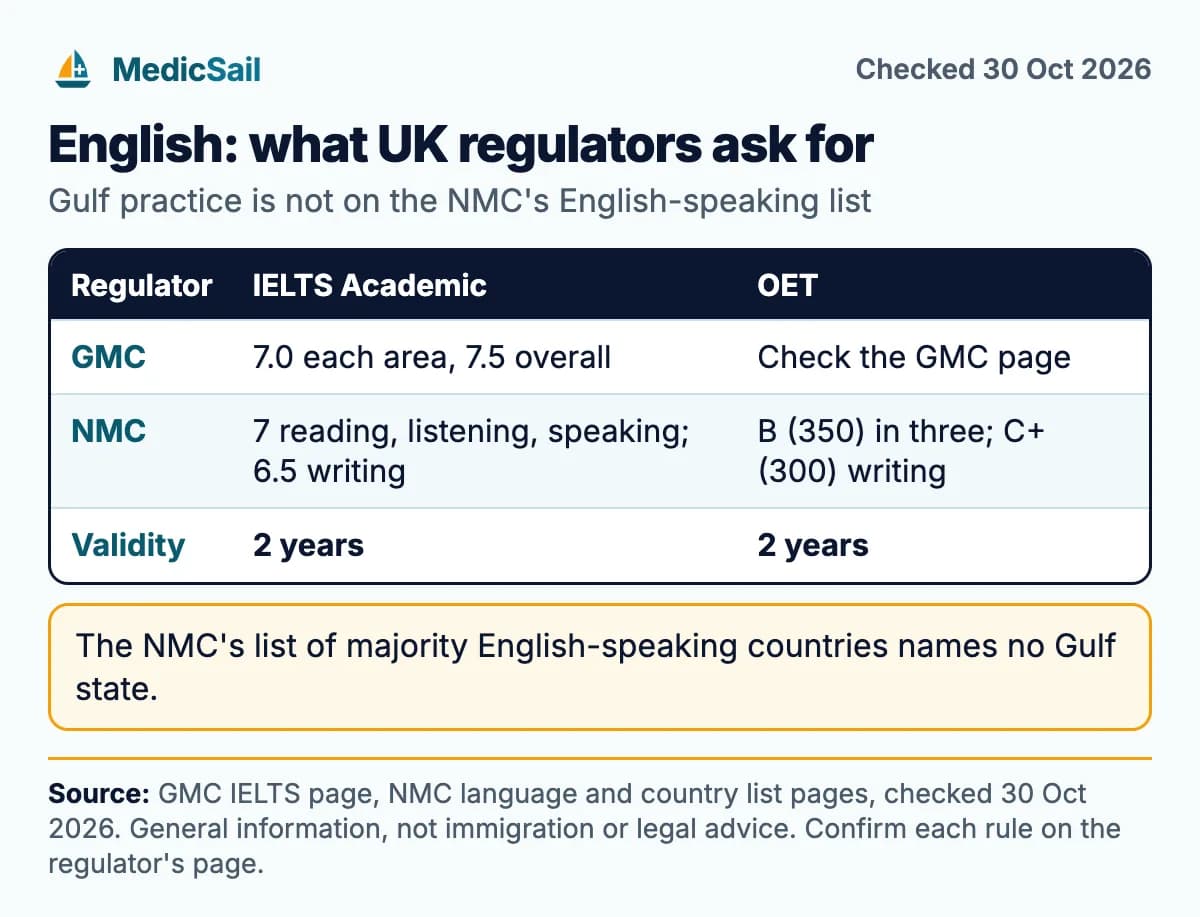
Many Gulf hospitals work in English, but UK regulators decide English exemptions by country lists, and no Gulf country is on them. In practice this means:
- GMC: employer confirmation of English is accepted only for doctors who have worked for the past two years in a country on the GMC's list where English is the first and native language. No GCC country is on that list.
- NMC: the recent-practice route needs registered practice in a majority English-speaking country on the NMC's list.
- GDC: recent, continuous practice in a country where English is the first language can be accepted, but Gulf countries do not count.
- GPhC: two years' practice in a majority English-speaking country can count; the Gulf is not one.
- HCPC: exemption depends on the country where you gained the qualification that first let you practise; GCC countries are not on its list.
| Regulator | IELTS | OET |
|---|---|---|
| GMC (doctors) | Academic: 7.0 in each skill, 7.5 overall | Medicine: grade B in each sub-test |
| NMC (nurses, midwives) | Academic: 7 in listening, reading and speaking, 6.5 in writing | B in listening, reading and speaking; C+ in writing |
| GDC (dentists) | Academic: 6.5 in each skill, 7 overall | Check the GDC's English guidance |
| GPhC (pharmacists) | Academic: 7 in each skill, 7 overall | Pharmacy: B in each skill (OET@Home not accepted) |
| HCPC (allied health) | 7.0 overall, no element below 6.5 (at a test centre) | Profession-specific OET where offered: 1400 overall, no element below 300 |
Results usually need to be less than two years old when you apply or when the regulator assesses you, and each regulator has its own rules on combining sittings. Our guide to choosing IELTS or OET for UK regulators compares the details. For the visa, GOV.UK says you do not need to prove English again if you have passed an English assessment accepted by your regulator.
Which exams you still need
| Profession | UK exam or assessment | Where |
|---|---|---|
| Doctors | PLAB 1 (180 single best answer questions) and PLAB 2 (16-station OSCE), unless you use an accepted postgraduate qualification or sponsorship | PLAB 1 at British Council centres including Dubai and Riyadh, or in the UK; PLAB 2 only in Manchester |
| Nurses and midwives | Test of Competence: CBT (Part 1) and OSCE (Part 2) | CBT at Pearson VUE centres, including in the Gulf; OSCE only at NMC-approved centres in the UK |
| Dentists | ORE Part 1 (two written papers) and ORE Part 2 (manikin, OSCE, treatment planning and medical emergencies) | London |
| Pharmacists | OSPAP assessments, then the Common Registration Assessment after foundation training | UK university, then UK test centres |
| Allied health (HCPC) | No routine exam; a paper assessment, with a test of competence (a structured professional discussion) if assessors cannot decide on paper | Usually online on Microsoft Teams, sometimes in person |
Exams you passed to get your Gulf licence do not substitute for any of these. Neither do Gulf board certificates: the GMC's list of acceptable overseas postgraduate qualifications contains no qualification awarded by a GCC body, so a Saudi Board, Arab Board or similar certificate does not by itself replace PLAB. UK college qualifications on the list, such as MRCP(UK), MRCS or MRCOG, do count if awarded within three years of your registration being approved, and many Gulf-based doctors already hold one. The GMC's recognised specialist qualification list currently covers Australia, Canada, Ireland and New Zealand only.
For dentists, a specialist qualification does not by itself put you on a UK specialist list: you register as a dentist first. Read our guide for dentists moving to the UK for ORE dates and the realistic timeline, and our pharmacist route to UK registration for OSPAP and foundation training.
Documents to collect before you leave the Gulf
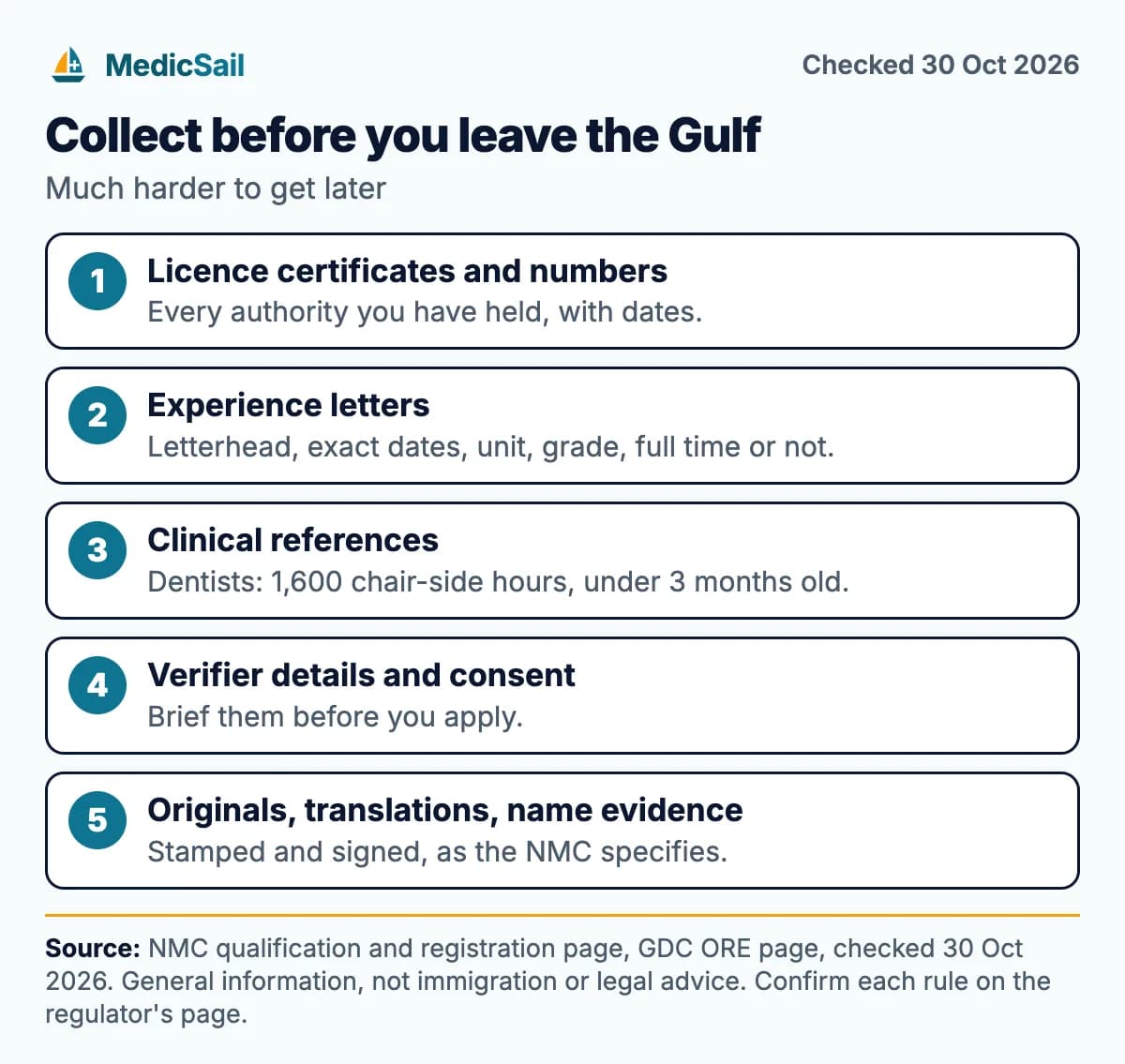
Some evidence is far easier to collect while you are still employed and licensed. Use this list before you hand in your notice.
- Licence certificates and registration numbers for every Gulf authority you have held a licence with, with dates. All UK regulators ask you to declare your registrations.
- Experience letters on hospital letterhead showing exact start and end dates, department or unit, grade, and whether the post was full time. The GMC's five-year activity history needs exact dates, and gaps must be explained.
- Clinical references. Dentists need references covering at least 1,600 chair-side hours, no more than three months old when they apply. The GPhC wants an employer reference on headed paper with an official stamp, sent from an official organisation email if sent electronically. HCPC referees must have supervised you and be contactable on an official work email address.
- Contact details for verifiers. The NMC recommends contacting your referees and verifiers before you submit, getting their consent to share their details and checking they are correct; otherwise your application may be delayed.
- Your original qualification documents from your country of training, with transcripts. The HCPC needs its course information form completed, stamped and signed by your university; the GPhC needs your transcript sent directly by your university.
- Certified translations of anything in Arabic or another language. The NMC asks for a stamped and signed copy of the original from a translation service, a complete English translation also stamped and signed, and the translator's contact details.
- Name change evidence if your name differs between documents, such as a marriage certificate.
Our UK page for doctors and the equivalent pages for other professions list each regulator's full document set.
Timing your exit, references and the visa
The UK regulators' timing rules interact with Gulf employment contracts, so plan the order carefully.
Good standing and validity windows
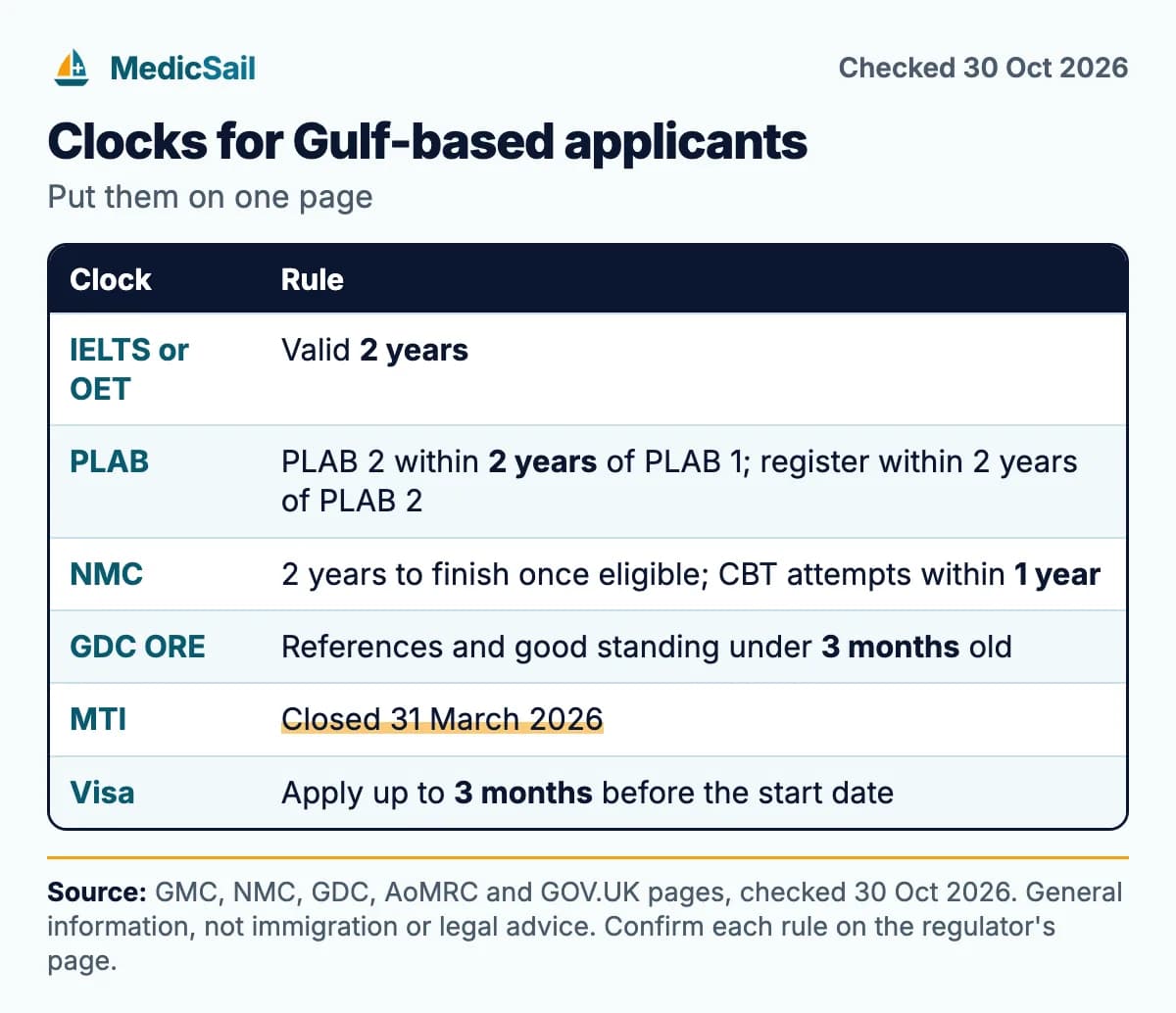
GMC certificates of good standing last three months from signature and must be valid when the GMC approves your application, and you have three months to complete an online application once you start it. The GPhC's letter must reach it within three months of issue. Requesting certificates too early is a common reason for having to request them again. Ask your Gulf authority how long it takes to issue one, then request it close to the point you need it.
Keep your licence in good order
Do not let a Gulf licence lapse with unpaid renewals or unresolved issues while your UK application is in progress. UK regulators verify your registrations directly, and the HCPC and NMC both contact other regulators as part of verification. A GMC applicant who has already left can ask for a certificate of past good standing, but it is simpler to request what you need while you are still registered.
End of service
Your end-of-service settlement, notice period and exit formalities are governed by your Gulf contract and local labour law, not by UK regulators, so check them with your employer's HR team before you set dates. Ask for experience letters and references as part of your exit process, while your line manager and medical or nursing director are still easy to reach.
The visa
Once you have a UK job offer from a Home Office approved health or care employer, you usually apply for the Health and Care Worker visa. GOV.UK says you can apply up to three months before your start date and usually get a decision within three weeks. The fee is £324 per person for up to three years or £628 for longer, there is no immigration health surcharge, and you need £1,270 held for 28 days in a row unless your employer certifies maintenance. Avoid resigning in the Gulf before your UK registration and visa are secure. The Health and Care Worker visa guide covers the rest.
A quick route map for each profession
- Doctors: EPIC verification, IELTS Academic or OET Medicine, PLAB 1 (possibly in Dubai or Riyadh), PLAB 2 in Manchester, then GMC registration with a licence; or an accepted UK college qualification or sponsorship instead of PLAB. The Medical Training Initiative closed to new applicants on 31 March 2026. See the doctors' hub across every country.
- Nurses: NMC eligibility application, IELTS or OET, CBT (bookable at Pearson VUE centres in the Gulf), OSCE in the UK, then registration. Our NMC CBT guide for international nurses covers Part 1 in detail.
- Midwives: the same NMC Test of Competence structure, in midwifery.
- Dentists: GDC application to join the ORE candidate list (the GDC aims to assess complete applications within 60 working days), ORE Part 1 and Part 2 in London, then registration.
- Dental care professionals: an assessed application to the GDC against its learning outcomes, with no exam; an overseas dentistry qualification alone is no longer enough to register as a DCP.
- Pharmacists: UK ENIC statement, IELTS or Pharmacy OET, GPhC OSPAP eligibility, a year of OSPAP, a 52-week foundation year, the Common Registration Assessment, then registration, all within four years of starting OSPAP.
- Physiotherapists, radiographers, paramedics, biomedical scientists and other HCPC professions: an HCPC international application with a course information form, mapping document, referees and English evidence; the HCPC says assessment takes about three months from a complete application, and verification about three months more if you are accepted.
Common mistakes Gulf-based applicants make
- Assuming English is covered because you have worked in English for years. Every UK regulator excludes Gulf practice from its English-speaking country routes.
- Collecting good standing from only the current authority. The GMC needs every medical regulator from the last five years, and the GPhC every healthcare regulator from the last five years.
- Requesting certificates too early and letting them expire before approval.
- Leaving without references. Supervisors move on, and some regulators need official employer email addresses that you cannot obtain later.
- Relying on a Gulf board certificate to bypass PLAB. Only qualifications on the GMC's list count.
- Vague experience letters. Exact dates, units, specialties and hours matter for the GMC's activity history, the GDC's 1,600 hours and the HCPC's mapping document.
- Resigning before the visa is issued, leaving a gap with no income and no licence in either country.
None of these are hard to avoid if you start a few months before you plan to leave. Read the regulator pages for your profession, such as the NMC international registration route or the HCPC international application process, and build your timeline from their rules.
Questions
No. No UK regulator registers you on the basis of a Gulf licence. The GMC, NMC, GDC, GPhC and HCPC each assess your original qualification and set their own exams or assessments. Your Gulf licence is still important as evidence of good standing.
No. Internationally educated nurses follow the same Test of Competence route whatever their experience. Your Gulf experience matters to employers when they decide your band and role, not to the NMC's exam requirement.
Not usually. UK regulators accept employer or practice evidence only for work in countries on their English-speaking lists, and no GCC country is on them. Plan to take IELTS or OET at the score your regulator sets.
No. The GMC's list of acceptable overseas postgraduate qualifications contains no qualification awarded by a GCC body. UK college qualifications on the list, such as MRCP(UK) or MRCS, can replace PLAB if awarded within three years of your registration being approved.
It depends on the regulator. The GMC wants every medical regulator from the last five years, and the GPhC every healthcare regulator from the last five years. The GDC wants the authority where you last worked, and the NMC asks for your regulator's certificate and contacts it directly.
Some parts. PLAB 1 is held at British Council centres including Dubai and Riyadh, and the NMC CBT is available at Pearson VUE centres in the Gulf. PLAB 2, the NMC OSCE and both parts of the dental ORE are held only in the UK.
It can count towards the 1,600 hours of chair-side clinical experience the GDC needs before you join the ORE candidate list. Your clinical references must be no more than three months old when you apply.
UK regulators do not require it, and it is usually easier to collect references, letters and good standing while you are still in post. Avoid resigning before your UK registration and visa are secure, and check your notice period and end-of-service terms with your employer.
Yes. The HCPC assesses your training and relevant experience together against its standards of proficiency, and since 20 November 2025 you map that evidence in a standards of proficiency mapping document. Detailed Gulf experience can fill gaps left by your degree.
No. The code of practice for international recruitment, last updated on 27 March 2025, says international health and social care staff must not be charged fees for recruitment services relating to getting a job in the UK. Any repayment clause in your contract must be transparent, proportionate, time-limited and flexible. NHS Employers keeps an ethical recruiters list of agencies that have agreed to follow the code, but being on it does not make an agency a preferred supplier.
Sources
- 1GMC: Your certificate of good standing
- 2GMC: Check if your practical training (internship) is acceptable
- 3GMC: Acceptable postgraduate qualifications
- 4GMC: Applying for registration using sponsorship
- 5GMC: Recognised specialist qualifications list
- 6GMC: Providing a reference from your employer (English)
Show all 24 sourcesShow fewer sources
- 7GMC: When and where can I take PLAB 1?
- 8NMC: Provide qualification and registration information
- 9NMC: English language requirements
- 10NMC: Recent practice in English
- 11NMC: Test of Competence for nurses and midwives
- 12GDC: How to apply for the ORE
- 13GDC: English language controls
- 14GDC: How to apply as an overseas-qualified DCP
- 15GPhC: Non-EEA qualified international pharmacists
- 16GPhC: Applying for OSPAP eligibility, guidance (September 2026)
- 17HCPC: International applications
- 18HCPC: Certificate of English language proficiency
- 19HCPC news: Updates to our international applications process (20 November 2025)
- 20HCPC: Test of competence
- 21GOV.UK: Health and Care Worker visa
- 22GOV.UK: Health and Care Worker visa, knowledge of English
- 23GOV.UK: Health and Care Worker visa, how much it costs
- 24NHS Employers: Code of practice for international recruitment (March 2025)
Plan it with our free tools
MedicSail
Healthcare licensing consultants for the UK, Europe and the USA
Updated and checked against the sources listed above. How we research and check our guides