


































EPIC verification: how ECFMG checks your medical degree for the GMC and the USA
What EPIC is, who needs it and how to use it: MyIntealth and identity checks, which documents the GMC wants verified, the April 2026 fees, how long schools take, how EPIC relates to ECFMG Certification and US licensure, and the mistakes that cause delays.

MedicSail
Published
The short answer
EPIC (the Electronic Portfolio of International Credentials) is a primary source verification service run by ECFMG, a division of Intealth. You upload your medical credentials through a MyIntealth account, ECFMG checks each one directly with the institution that issued it, and then sends a verification report to the organisation you are applying to. The UK's General Medical Council (GMC) uses EPIC to verify the primary medical qualification of every doctor who qualified outside the UK and does not already hold provisional registration.
From 1 April 2026, ECFMG charges $110 to set up a MyIntealth account (including online notarisation of your identity form), $35 to establish an EPIC Portfolio, $110 for each credential verification request and $60 for an EPIC Report. ECFMG says about 80% of EPIC credentials are verified within 30 days and 90% within 90 days, and the GMC says most medical schools respond within 90 days. Because the GMC can keep a registration application open for only 90 days, start EPIC early.
For the USA, EPIC is optional: if you are pursuing ECFMG Certification, ECFMG verifies your diploma and transcript inside the certification process instead. This guide covers both uses, with the rules as ECFMG and the GMC publish them. For the regulators themselves, see our ECFMG certification page and our GMC registration overview.
What EPIC is, and what primary source verification means
Primary source verification means confirming that a credential is genuine directly with the body that issued it, rather than trusting a copy or a notarised photocopy. ECFMG describes it as best practice and the best protection against fraudulent credentials. It has done this for its own certification programme for decades, and EPIC applies the same multi-step process to credentials that other organisations need checked.
EPIC has two sides:
- For doctors, it is a portfolio of verified credentials that grows with your career. Once a credential is verified, you can send reports on it to regulators, hospitals and training programmes anywhere in the world, without verifying it again.
- For organisations, such as medical regulatory authorities, hospitals and credential verification organisations, ECFMG provides EPIC at no cost. They receive the reports you choose to send them.
Organisations see only the reports and credentials you send them, not your whole portfolio. ECFMG keeps a list of EPIC Partner Organizations with special instructions; it includes the GMC, the Medical Council of Ireland, the Medical Council of Canada, the Medical Council of New Zealand, the Singapore Medical Council, the Malaysian Medical Council, Kuwait's Ministry of Health and several African medical councils, among others.
Who needs EPIC
Doctors applying to the GMC
The GMC requires verification through EPIC if you qualified at a medical school outside the UK and do not already hold provisional registration. That covers every international medical graduate route: PLAB, an acceptable postgraduate qualification, sponsorship and the Portfolio pathway. If your primary medical qualification was verified when you first gained registration, you do not need to verify it again. Our guide to PLAB 1, PLAB 2 and GMC registration shows where EPIC fits in the full route.
Doctors applying to the Medical Council of Ireland
The Medical Council of Ireland also uses EPIC. Your basic medical qualification, and depending on your route your internship certificate or other credentials, must be verified and the reports must reach the Council before you submit your application. See our page on the Medical Council of Ireland for that route.
Doctors heading to the USA
ECFMG says that if you are pursuing ECFMG Certification, you are not required to use EPIC. You provide your final medical diploma and final medical school transcript to ECFMG for verification through the certification programme itself. EPIC becomes relevant in the USA mainly for credentials outside certification and for organisations that ask for EPIC reports, covered further below.
Not other professions
Verification through EPIC is for physicians only. ECFMG's GMC instructions say other health professionals applying to the GMC (such as physician associates) should ask the GMC first whether anything needs verifying. Nurses, dentists and pharmacists use their own regulators' processes; for example, the GDC's ORE route for dentists and the GPhC's route for international pharmacists do not involve EPIC.
Setting up MyIntealth and your EPIC Portfolio
Every Intealth and ECFMG service runs through MyIntealth. Use a desktop or laptop computer: ECFMG says MyIntealth is not designed for phones or tablets, and recommends an up-to-date browser, preferably Google Chrome.
- Create a login with your email address and a password. If you used ECFMG's older systems (such as IWA, OASIS or the EPIC Physician Portal), use your email address of record so that your old account links across.
- Request account establishment and pay the fee ($110 from 1 April 2026, which includes a $50 NotaryCam fee).
- Verify your identity by completing the Intealth Identification Form (IIF), notarised online through NotaryCam. Your account is fully established only when a valid IIF is on file and you have a MyIntealth ID.
- Establish an EPIC Portfolio: in MyIntealth, choose Services, then EPIC, then the Credential Verification tab, and click "Establish EPIC Portfolio". If you are applying to a partner organisation, select it from the list (for the UK, the General Medical Council). The portfolio fee is $35.
- Find your MyIntealth ID under Identity Information in My Profile. If you were issued an EPIC ID in the past, it appears there too. You will give this ID to the GMC.
ECFMG's processing estimates, published in January 2026, were about one week to review an account establishment request and three business days to process a completed identity form, and it warned that processing was taking longer than usual because of demand. Use your name exactly as it appears on your passport.
Which documents to upload
EPIC accepts ten credential types: final medical diploma, alternate graduation document, final medical school transcript, student medical school transcript, pregraduate internship certificate, postgraduate training credential, specialist qualification, certificate of good standing, medical registration certificate or licence, and advanced degree in the medical sciences. Upload only what the organisation you are applying to needs.
What the GMC wants verified
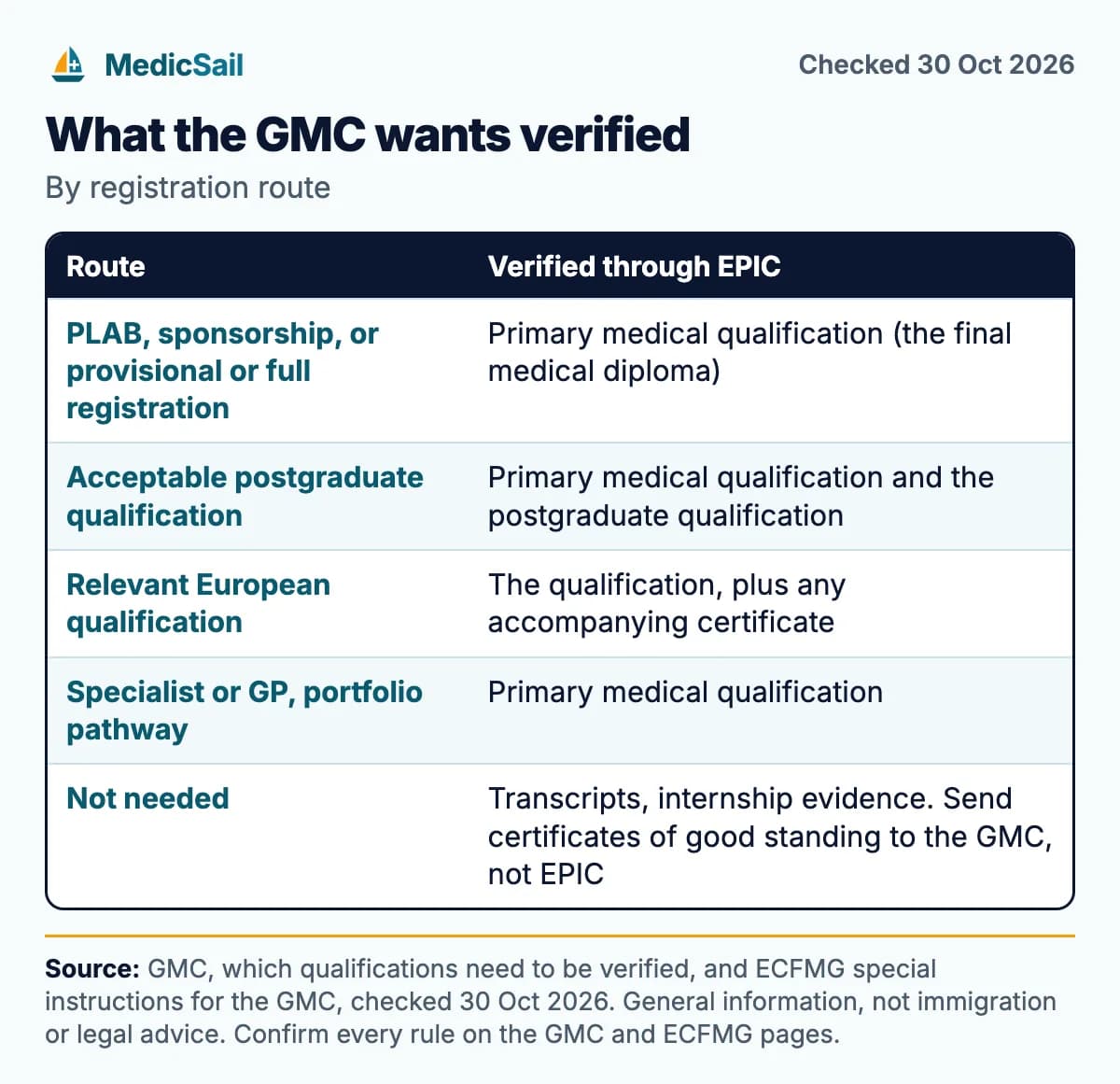
| Your GMC route | Verify through EPIC |
|---|---|
| PLAB (provisional or full registration) | Primary medical qualification |
| Acceptable postgraduate qualification | Primary medical qualification and the postgraduate qualification (even if the PGQ was awarded in the UK) |
| Approved sponsor | Primary medical qualification |
| Portfolio pathway (specialist or GP registration) | Primary medical qualification |
| Recognised specialist qualification | Primary medical qualification, any accompanying certificate, the specialist or GP qualification and any supporting letter the GMC list indicates |
The primary medical qualification the GMC means is your final medical diploma: the degree certificate issued once you have been awarded your degree, sometimes called the carton degree, conferral certificate or the diploma used for framing. ECFMG lets you upload only one final medical diploma.
The GMC does not need your transcript, internship evidence or an alternate graduation document verified through EPIC, and you should not submit a certificate of good standing through EPIC for the GMC: send it to the GMC directly. Postgraduate qualifications go in as a postgraduate training credential (for a training programme) or a specialist qualification (for board certification, college membership or fellowship).
If you do not have your final diploma
Recent graduates whose diploma is not yet issued, doctors who lost theirs, and doctors with refugee status can submit an alternate graduation document, such as a graduation certificate or letter from the school confirming you met all degree requirements. ECFMG warns that if you use one for the GMC, you cannot use the GMC's online application and must ask the GMC for a hard-copy application. Doctors who lost their diploma can instead obtain a duplicate from their school.
File requirements
- DOCX, GIF, JPG or JPEG, PDF, PNG or TIFF, up to 10MB.
- Page size between 5 x 8 inches and 9 x 12 inches, with all pages combined into one file.
- A scan of a complete, accurate copy is acceptable; it need not be scanned from the original.
- Anything not in English needs an English translation that meets ECFMG's requirements. ECFMG recommends Straker Translations, whose translations it says will not be rejected on those grounds.
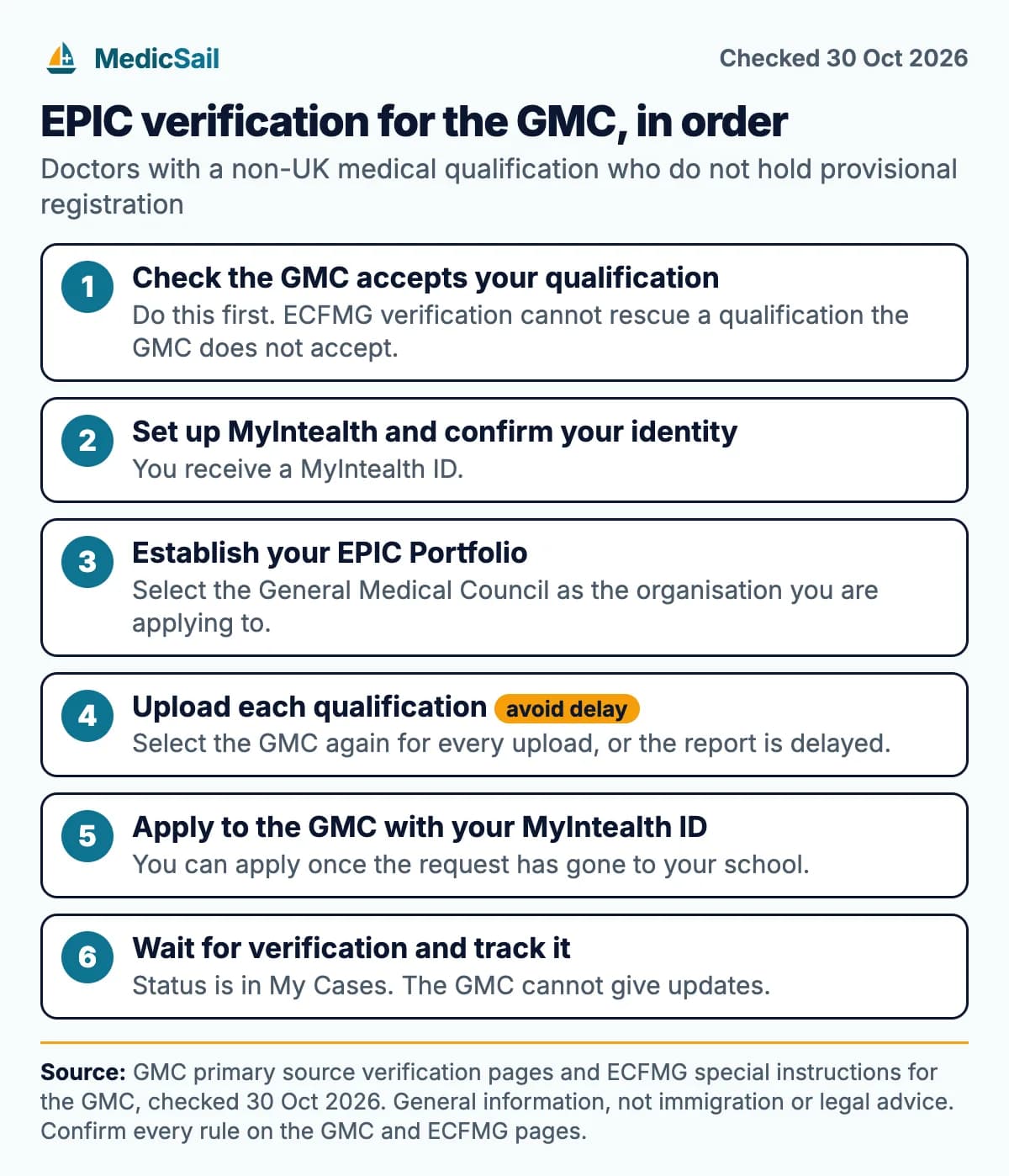
Using EPIC for the GMC, step by step
- Check your qualification first. Create a GMC Online account and check that the GMC accepts your primary medical qualification (and any postgraduate qualification). The GMC cannot register you if your qualification does not meet its criteria, even if ECFMG has verified it. If your school is on the GMC's "not acceptable" or "may be acceptable" lists, or is not listed at all, contact the GMC before you start. If you have UK refugee status, contact the GMC before creating your MyIntealth account, because it pays the EPIC fees for you.
- Set up MyIntealth and your EPIC Portfolio, selecting the General Medical Council.
- Upload your final medical diploma, and select the GMC to receive an EPIC Report as you upload it. ECFMG and the GMC both stress this: if you do not select the GMC at upload, the GMC is not updated automatically and you will have to request a report later, which causes delay.
- Wait for confirmation that your diploma has been sent for verification. You cannot submit your GMC application until then. You can apply at that point, but the GMC recommends waiting until verification is complete if you can, because it keeps applications open for only 90 days.
- Submit your GMC application and give the GMC your MyIntealth ID (or EPIC ID). The GMC does not process your verification report until you have applied and supplied the ID. Giving the ID authorises ECFMG and the GMC to share information about your verification and application.
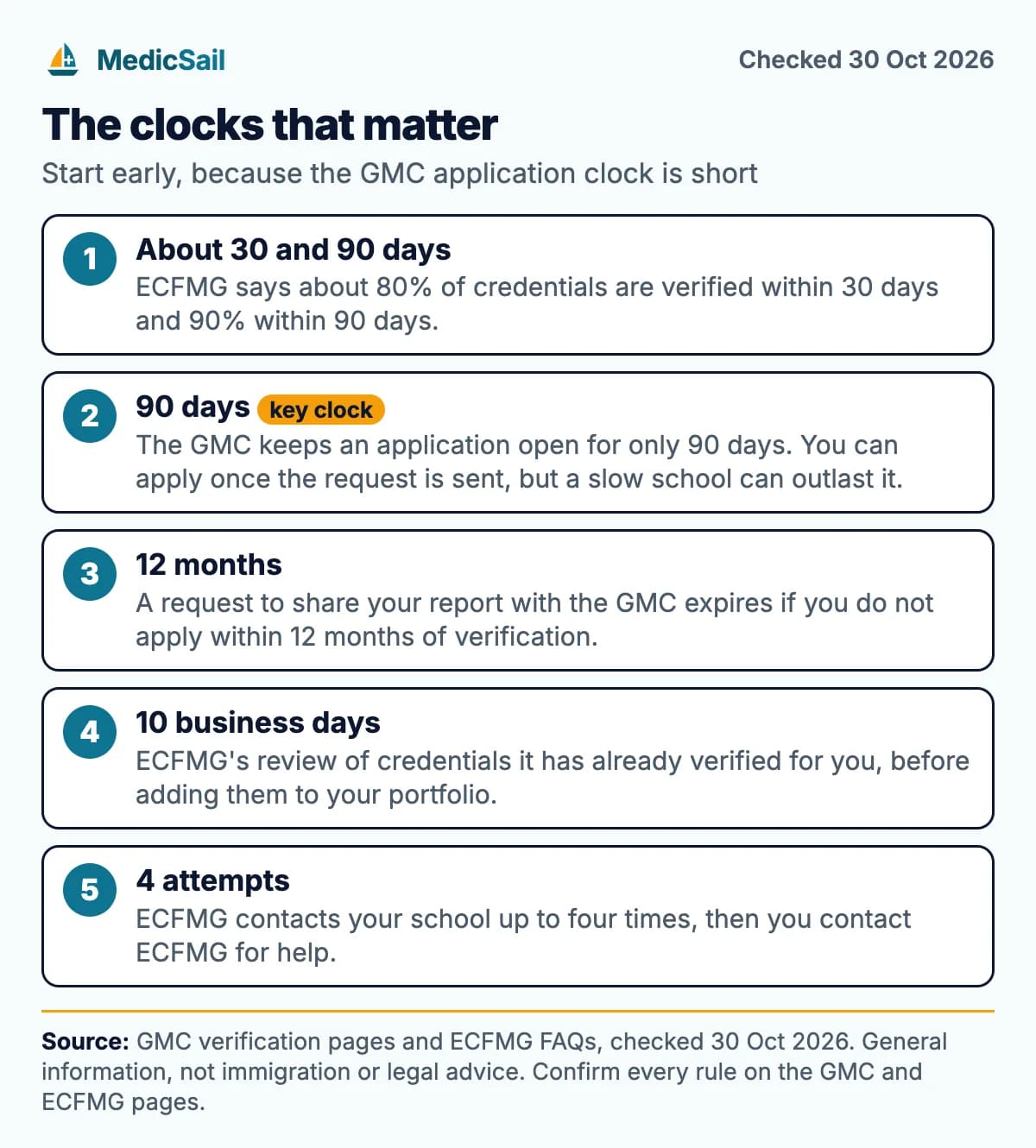
Once your school confirms the diploma and ECFMG accepts the verification, ECFMG confirms it with the GMC. The GMC says requests to share EPIC reports expire if you do not apply within 12 months of your qualification being verified; after that you must ask ECFMG to share the report again. The GMC cannot give you EPIC progress updates, so track everything in the My Cases section of MyIntealth.
What EPIC costs in 2026
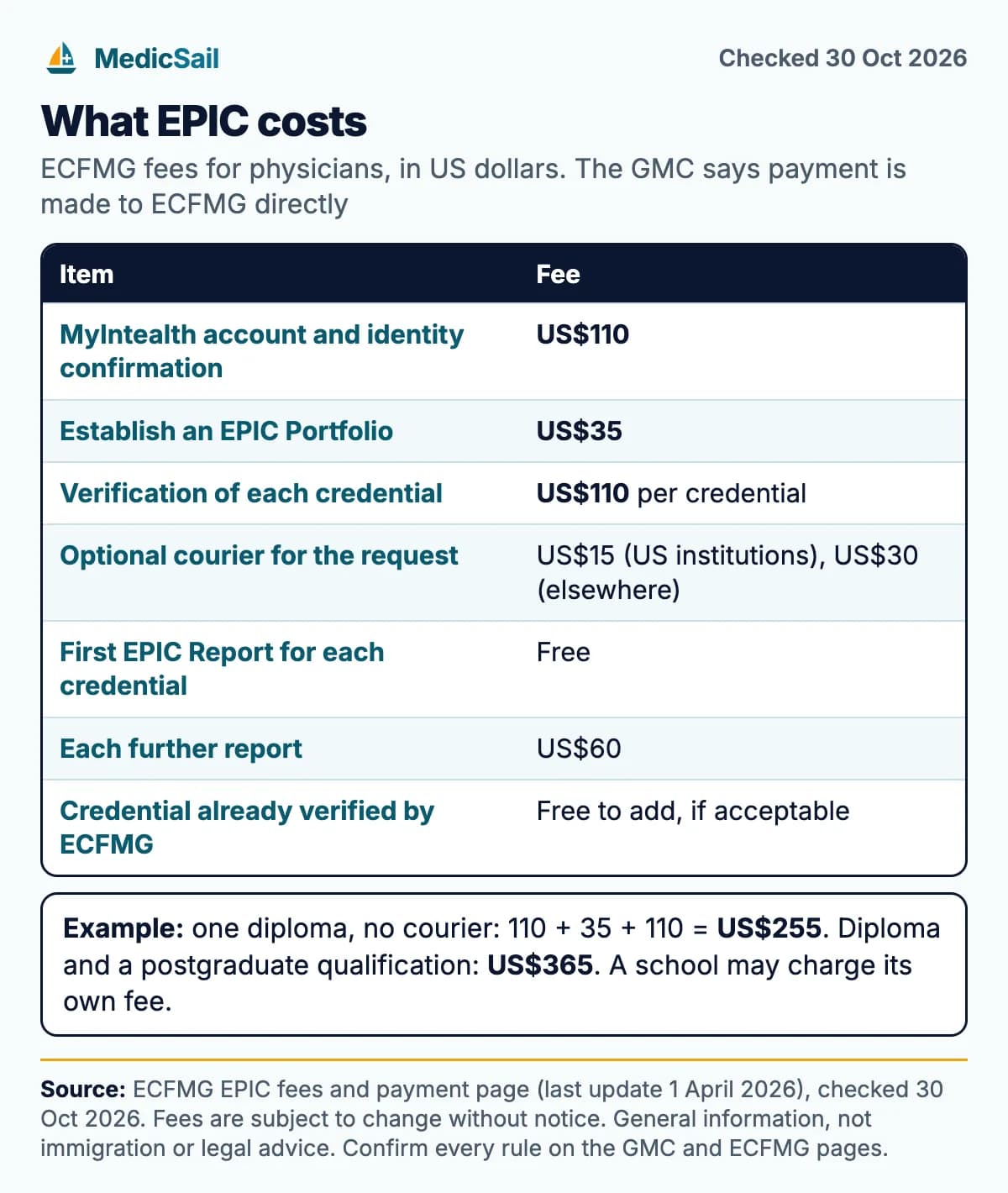
EPIC fees are set by ECFMG in US dollars and paid to ECFMG in MyIntealth. These are the fees for requests submitted on or after 1 April 2026.
| Item | Fee | Notes |
|---|---|---|
| MyIntealth account establishment | $110 | Includes the $50 NotaryCam fee for notarising your identity form. Paid once. |
| EPIC Portfolio establishment | $35 | Paid once. |
| Credential verification request (EPIC) | $110 per credential | ECFMG's fee schedule includes up to four verification requests to the issuing institution. |
| EPIC Report (credential submitted to EPIC) | First report free, then $60 | The first report for each credential submitted to EPIC is free. Each later report for that credential is $60. |
| EPIC Report (previously verified credential) | $60 per report | Applies to credentials ECFMG verified earlier for other purposes. |
| Optional courier to the institution | $15 to institutions in the US, $30 to institutions outside the US | Courier delivery of the verification request. You do not have to use it. |
| Fees charged by your institution | Set by the institution | Usually paid by you directly. If the institution needs ECFMG to pay, ECFMG adds the charge to your account. |
For a doctor verifying only a final medical diploma for the GMC, that means $255 in account, portfolio and verification fees, plus any report fee after your first free report for that credential, and any fee your medical school charges. The GMC says refunds are not available once ECFMG has started the verification process. If you have UK refugee status, the GMC pays the verification fees.
How long EPIC verification takes
Most of the time is spent waiting for your institution, not ECFMG. The published figures are:
- Upload check: ECFMG says it processes an uploaded credential within five business days; its January 2026 estimates put the review and dispatch of an EPIC verification request at about two weeks during a period of high demand.
- Institution response: about 80% of EPIC credentials are verified within 30 days and 90% within 90 days, according to ECFMG. The GMC says most schools respond within 90 days, and requests sent by post or courier take longer than electronic ones.
- Review of the returned verification: ECFMG says it typically reviews a response within five business days; its January 2026 estimate was about three weeks.
- Previously verified credentials: ECFMG reviews your record, typically within 10 business days of your portfolio request, and adds acceptable verifications at no verification fee.
There is no way to pay to speed up verification. ECFMG sends follow-up requests if a school does not reply, and if it has not been possible to verify a credential after four attempts it asks you to contact it for help, including for schools that have closed or are in conflict areas.
The common delays, and how to avoid them
- Not selecting the GMC at upload. The single most avoidable delay. If you missed it, request an EPIC Report for the GMC once the credential is verified.
- Starting EPIC after the GMC application. The GMC closes applications after 90 days. Start EPIC as soon as you decide on UK registration, alongside your English test.
- Name mismatches. If the name on your diploma differs from your passport, ECFMG asks for documents such as a government photo ID, birth certificate, marriage certificate or court name-change order, or a letter on letterhead from the institution stating that both names belong to the same person. It does not accept affidavits or statutory declarations about name variation, re-issued credentials with a corrected name uploaded after the original, or other medical credentials as name evidence.
- Wrong document type. Uploading a transcript or provisional certificate as your final diploma leads to rejection at the upload check. Read ECFMG's reference guide for your country's diploma title.
- Missing or unacceptable translations. A credential not in English without an acceptable translation is returned.
- Slow or paper-only schools. Ask your school's registrar in advance who handles ECFMG requests and whether it charges a fee. Paying the courier option helps where the school does not take requests electronically.
- Sending a report to yourself. You can, but it is not valid proof. Reports count only when the recipient gets them through MyIntealth.
- Letting a report expire. Partner organisations can access a report for 18 months; other recipients get a one-time link valid for 90 days. After that you must request and pay for a new report.
EPIC, ECFMG Certification and US licensure
In the USA, the main gateway for international medical graduates is ECFMG Certification, which you need for ACGME-accredited residency and for USMLE Step 3. Credential verification is built into it: you pay $220 ($110 for your final medical diploma and $110 for your final medical school transcript) when you apply for certification, and ECFMG verifies both with your school. You do not need EPIC for this.
If your credentials were already verified through EPIC, ECFMG says it may be able to use that verification for your certification, but you must still submit your credentials as part of the certification application. The reverse also helps: credentials ECFMG verified for certification can be added to an EPIC Portfolio at no verification fee and reported to the GMC or another regulator, although a report fee applies.
State medical boards
US medical licences are issued by state boards. ECFMG notes that nearly all of them accept the Federation of State Medical Boards' Federation Credentials Verification Service (FCVS), and some require it, so check each board's rules. ECFMG also reports your certification status directly to boards through its Certification Verification Service, which costs $70 per report. A few US bodies, including Virginia and the Illinois Department of Financial and Professional Regulation, appear on ECFMG's EPIC special instructions list, so follow a board's instructions where it names EPIC. Our guide to the USMLE for international medical graduates and our page on working as a doctor in the USA cover the rest of the US route.
Certificates of good standing, and doctors in the Gulf
Some EPIC partner organisations ask for your certificate of good standing to be verified through EPIC. For those, ECFMG says the certificate must have been issued within 90 days of your application, and either your regulator sends it directly to ECFMG, or you upload one issued within the last 90 days and ECFMG verifies it with the issuer. The GMC is different: it asks you not to submit a certificate of good standing through EPIC, but to have each regulator send it to the GMC.
If you are licensed in the Gulf
- Credential checks you completed for a Gulf regulator through another verification provider do not replace EPIC. The GMC and ECFMG need ECFMG's own verification with your medical school.
- Your EPIC verification is of your medical school diploma, so the issuing institution is your school, not your Gulf employer or regulator.
- For the GMC, ask each Gulf authority you have been licensed with in the last five years for a certificate of good standing sent to the GMC, not to ECFMG.
- Kuwait's Ministry of Health is itself on ECFMG's partner list, so doctors applying there may already use EPIC.
Our guide on moving from a Gulf licence to UK registration covers good standing certificates for every UK regulator, and our pages on working as a doctor in the UK and doctors in Ireland show how EPIC fits each country's full route. To compare every destination, see our guide for doctors.
Questions
EPIC is ECFMG's primary source verification service. ECFMG, a division of Intealth, checks your medical credentials directly with the institutions that issued them and sends verification reports to organisations such as the GMC. You use it through a MyIntealth account.
Yes, if you qualified at a medical school outside the UK and do not already hold provisional registration. Every international route, including PLAB, postgraduate qualifications, sponsorship and the Portfolio pathway, needs your primary medical qualification verified through EPIC.
From 1 April 2026, ECFMG charges $110 for a MyIntealth account (including notarisation), $35 for an EPIC Portfolio, $110 per credential verification. The first EPIC Report for each credential submitted to EPIC is free and later reports are $60. Your medical school may charge its own fee. Refunds are not available once verification starts.
ECFMG says about 80% of credentials are verified within 30 days and 90% within 90 days. The GMC says most schools respond within 90 days, and postal requests take longer. There is no way to pay for faster verification.
Your final medical diploma in every case, plus your postgraduate qualification if you apply on that basis, or your specialist qualification and related documents on the recognised specialist route. The GMC does not need your transcript or internship certificate verified, and your certificate of good standing goes to the GMC directly.
Yes, once ECFMG has sent your diploma to your school for verification. The GMC recommends waiting until verification is complete if possible, because it keeps applications open for only 90 days.
No. ECFMG Certification is the US credential for residency and Step 3, and it includes its own verification of your diploma and transcript. ECFMG says you do not need EPIC if you are pursuing certification, though credentials verified for certification can be added to an EPIC Portfolio.
No. Establish an EPIC Portfolio and ECFMG will review your record, typically within 10 business days, and add acceptable verified credentials without a verification fee. You then request an EPIC Report for the GMC, which costs $60 because the credential was previously verified rather than submitted to EPIC.
ECFMG asks for name documents such as a government photo ID, birth or marriage certificate, a court name-change order, or a letter from your school confirming both names are the same person. Affidavits and statutory declarations about name variation are not accepted.
In the My Cases section of MyIntealth. ECFMG emails you when a credential is sent for verification and when it is verified. The GMC cannot give EPIC updates, and ECFMG's customer service sees the same status you do.
Sources
- 1ECFMG: EPIC overview
- 2ECFMG: Using EPIC (physicians)
- 3ECFMG: EPIC frequently asked questions for physicians
- 4ECFMG: EPIC special instructions for the General Medical Council
- 5ECFMG: EPIC special instructions (partner organisations)
- 6ECFMG: Instructions for submitting a certificate of good standing to EPIC
Show all 17 sourcesShow fewer sources
- 7ECFMG: EPIC fees and payment
- 8ECFMG: Fee increases beginning April 1, 2026
- 9ECFMG: Fees
- 10ECFMG: Online services overview (MyIntealth)
- 11ECFMG: Current processing time estimates
- 12GMC: Primary source verification for international medical graduates
- 13GMC: Primary source verification, what do I need to do?
- 14GMC: Primary source verification, what happens during the verification process?
- 15GMC: Primary source verification, how much does it cost?
- 16GMC: Primary source verification, which qualifications need to be verified?
- 17Medical Council of Ireland: First-time applicants
Plan it with our free tools
MedicSail
Healthcare licensing consultants for the UK, Europe and the USA
Updated and checked against the sources listed above. How we research and check our guides