


































NMC CBT for international nurses and midwives: format, booking, results and how to prepare
Part A numeracy and Part B clinical, how to book with Pearson VUE, fees, results, resits and a revision plan built on the NMC blueprint and Future Nurse standards.

MedicSail
Published
The short answer
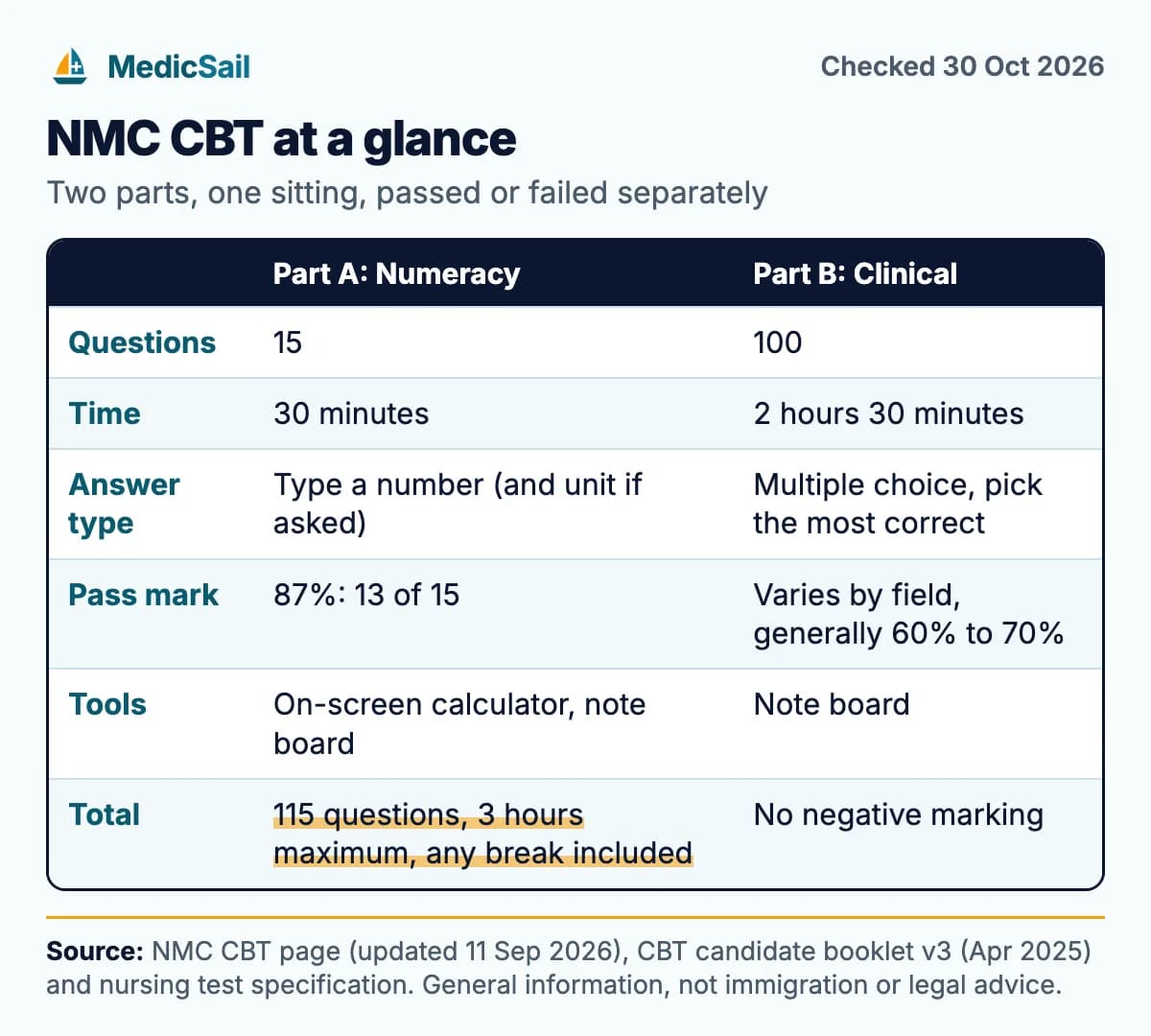
The NMC CBT is Part 1 of the Nursing and Midwifery Council's Test of Competence. It is a computer-based test with two parts taken in one sitting: Part A numeracy (15 questions in 30 minutes) and Part B clinical (100 multiple-choice questions in 2 hours 30 minutes). That is 115 questions in a maximum of 3 hours. You sit it at a Pearson VUE test centre, and Pearson VUE has centres in most countries, so most nurses take it at home before they travel.
The first sitting costs £83. You can only book once the NMC has confirmed you need the Test of Competence. Pearson VUE gives you an exam report at the end of the test and updates your Pearson VUE and MyNMC accounts within 48 hours. Each part is passed or failed on its own, and if you fail one part you resit only that part. You get three attempts in one application, at least 10 days apart and all within one year.
The test measures you against the NMC's Future nurse: Standards of proficiency for registered nurses (2018), or the Future Midwife standards if you are a midwife, and against The Code. The NMC publishes a blueprint and a test specification for each field. Those two documents, plus the free Pearson VUE practice test, are the most useful things you can read before you book.
This guide covers the CBT in detail. For the whole registration route, read our page on NMC registration for nurses and midwives trained abroad. For the practical exam that follows, see our guide to the NMC OSCE.
Where the CBT fits in NMC registration
If you trained outside the UK and do not hold a European qualification that meets the requirements for automatic recognition, the NMC usually asks you to pass its Test of Competence. The test has two parts: the CBT, which tests your knowledge and how you apply it, and the OSCE, a practical exam held only at approved test centres in the UK. The NMC's test specification says the CBT mainly shows your knowledge, understanding and application, and the OSCE mainly shows your skills.
The steps run in this order:
- You open an eligibility and qualification application in your MyNMC account and pay the £167 evaluation fee.
- The NMC checks your qualification and contacts your regulator. If it decides you need the Test of Competence, it sends you an email that authorises you to take the test.
- You book and pay for the CBT with Pearson VUE.
- Alongside the tests, you complete the registration application: health, character and English language evidence, indemnity and the £182 registration fee.
- You sit the OSCE in the UK, attend your ID check and wait for the NMC's decision.
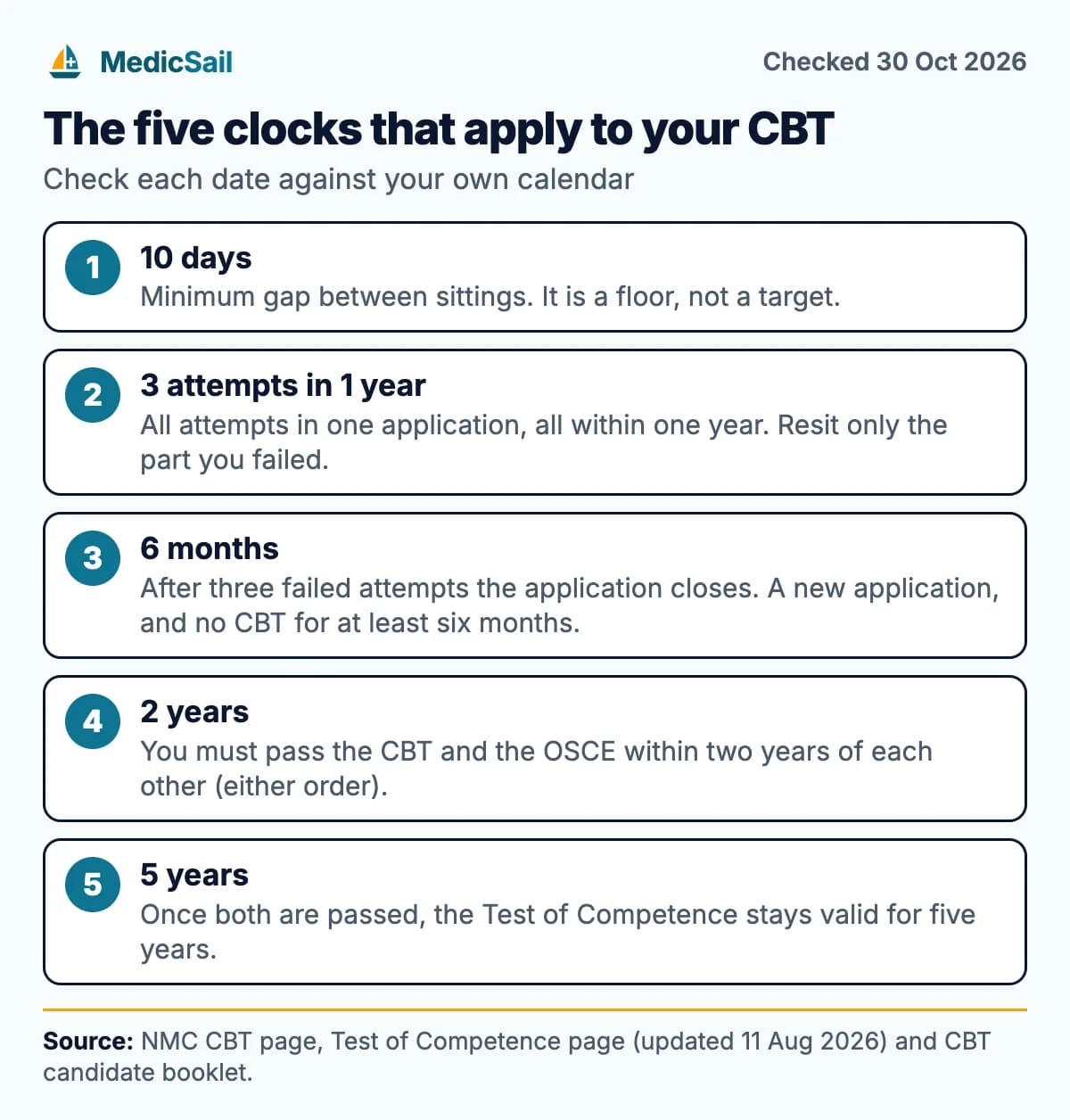
The NMC says you can sit the CBT and OSCE in either order, but you must pass them within two years of each other. Most candidates take the CBT first, in their home country, because UK employers and the visa timeline are built around it. Once you have passed both parts, the NMC says your Test of Competence stays valid for five years.
The CBT is specific to your field. When you apply as a nurse you choose one field (adult, mental health, learning disabilities or children's nursing), and you book the CBT for that field. Midwives sit a midwifery CBT. Our pages on working as a nurse in the UK and working as a midwife in the UK explain how the field you choose affects the rest of your application.
CBT format: Part A numeracy and Part B clinical
Both parts are taken in one sitting at one computer, but they are scored separately. Here is the format as the NMC's CBT page and test specification describe it.
| Part A: Numeracy | Part B: Clinical | |
|---|---|---|
| Questions | 15 | 100 |
| Time | 30 minutes | 2 hours 30 minutes |
| Question type | Short answers: you type a single number, sometimes with the correct unit | Multiple choice: four options, one correct answer |
| Current pass mark (test specification) | 87%, which means 13 out of 15 correct | Varies by test version; the nursing specification says generally 60% to 70%, the midwifery specification says generally 75% to 80% |
| Calculator | An on-screen calculator is available | Not needed |
A few rules from the NMC's CBT candidate information booklet change how you should approach the test:
- Every question is right or wrong. There is no partial credit, and there is no negative marking for a wrong or blank answer. Never leave a question unanswered.
- You can review and change answers before you finish a part.
- Pace yourself. The booklet advises a maximum of 2 minutes per numeracy question and 1.5 minutes per multiple-choice question.
- Pick the most correct answer. Several options may look reasonable. The booklet tells you to choose the one you believe is "most" correct, which in practice means the safest action in line with UK practice and The Code.
- Breaks are not scheduled. You can ask for a break, but the clock keeps running: the 3 hours includes any breaks.
The NMC sets the pass standard using the Angoff method and then uses statistical techniques to keep it the same across different versions of the test. Pass marks can change, so treat the figures above as the current published guide rather than a fixed rule.
What Part A numeracy covers
Part A is applied maths for safe practice, mostly medicine calculations. The test specification lists exactly how the 15 questions are split, and the split is the same for nursing and midwifery:
| Topic | Questions |
|---|---|
| Measuring the correct dose | 2 |
| Metric units | 2 |
| Oral medications | 4 |
| Injections | 3 |
| Intravenous infusions | 3 |
| Fluid balance | 1 |
| Total | 15 |
Because the pass mark is 13 out of 15, you can only afford two mistakes. Most people who fail Part A know the method but lose marks on conversions (micrograms to milligrams, millilitres per hour to drops per minute), on rounding, or on giving the answer in the wrong unit. The specification notes that you may need to give the correct unit.
Practical ways to prepare:
- Learn one formula for each question type and use it every time: what you want, over what you have, multiplied by the volume it comes in, for tablets, liquids and injections; volume over time for infusion rates.
- Drill metric conversions until they are automatic. Write the units next to every number on the note board.
- Practise using an on-screen calculator rather than your phone, so the real one does not slow you down.
- Check each answer against common sense. A dose of 20 tablets or an infusion rate of 2,000 ml per hour is a sign you have slipped a decimal place.
- Time yourself. Fifteen questions in 30 minutes is generous if you are fluent, but tight if you second-guess every step.
What Part B clinical covers: the blueprint and Future Nurse standards
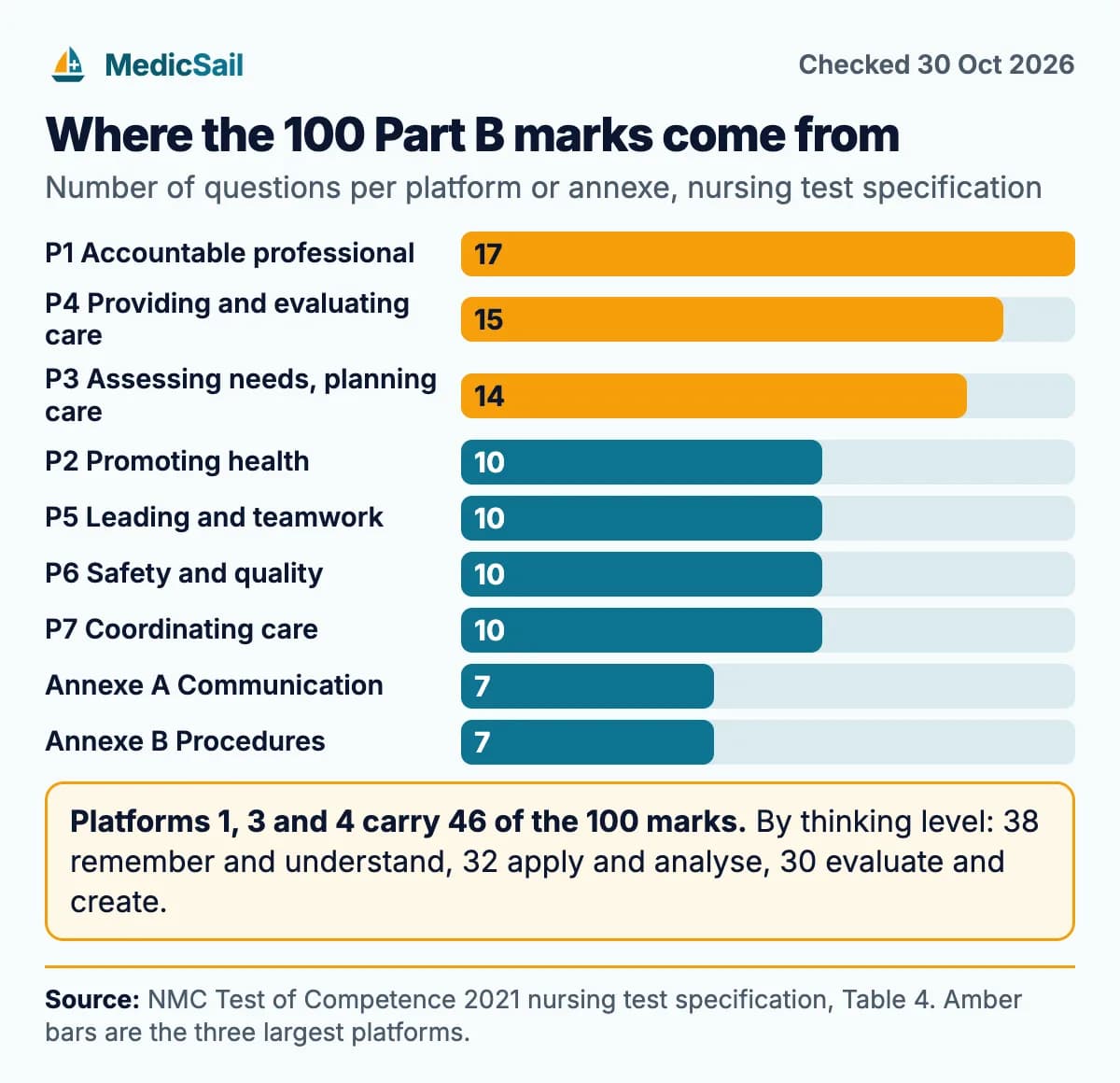
Part B is where most of the preparation goes. The NMC says the Test of Competence measures nurses against Future nurse: Standards of proficiency for registered nurses (2018). Those standards are organised into seven platforms, plus two annexes of communication and procedural skills. The nursing test specification sets out how many of the 100 questions come from each:
| Platform or annexe | Questions |
|---|---|
| Platform 1: Being an accountable professional | 17 |
| Platform 2: Promoting health and preventing ill health | 10 |
| Platform 3: Assessing needs and planning care | 14 |
| Platform 4: Providing and evaluating care | 15 |
| Platform 5: Leading and managing nursing care and working in teams | 10 |
| Platform 6: Improving safety and quality of care | 10 |
| Platform 7: Coordinating care | 10 |
| Annexe A (communication and relationship management skills) | 7 |
| Annexe B (nursing procedures) | 7 |
| Total | 100 |
Two points in the specification matter for how you revise. First, about 90% of the content is generic to all four fields, and 10% of the Part B questions are specific to your field. Second, the questions cover all levels of thinking, from remembering facts to evaluating options, but are weighted towards remembering, understanding and applying. Higher-level judgement is tested more in the OSCE.
The specification also gives examples of field-specific content. For adult nursing these include recognising the deteriorating adult, the A to E assessment and the National Early Warning Score (NEWS), dementia care, blood transfusion, cardiac monitoring and end-of-life care. For mental health nursing they include the Mental Health Act 1983, self-harm and suicide risk assessment, de-escalation and psychopharmacology. For learning disabilities nursing they include the Mental Capacity Act 2005, health passports and the Learning Disability Mortality Review (LeDeR) programme. For children's nursing they include child development, the Children Act 1989, vital signs by age and neonatal care.
The NMC also flags "patient safety proficiencies" in its blueprint. These cover safety issues that the specification says must be passed to protect the public, and a number of them appear in every test.
If you are a midwife
The midwifery CBT has the same shape (15 numeracy questions and 100 clinical questions) but is built on the NMC's Future Midwife standards, which are organised into domains rather than platforms. The midwifery test specification gives the largest shares of Part B to Domain 1, being an accountable, autonomous, professional midwife (22 questions), and to the midwife's role in assessment, screening and care planning (18 questions). It also covers continuity of care, universal care for women and newborn infants, additional care for complications, and the midwife as colleague, scholar and leader. If you are applying as a midwife, read our page on midwifery routes in each country as well.
How to book the CBT with Pearson VUE
You cannot book the CBT until the NMC says you need it. The CBT information booklet says you must receive an "authorisation to test" from the NMC before you can book and pay. In practice this is the Test of Competence email the NMC sends after it has assessed your qualification.
Then:
- Create a Pearson VUE account through Pearson VUE's NMC page. Use the same name as on your passport and your MyNMC account.
- Choose the right exam. Pearson VUE lists a series code for each field: NMC_RNA (adult), NMC_RNC (children's), NMC_RNMH (mental health), NMC_RNLD (learning disabilities) and NMC_RM (midwife). Pearson VUE warns that if you book the wrong type, the NMC cannot accept it and Pearson VUE cannot refund the payment.
- Pick a test centre and date. Pearson VUE says you can book online or by phone, up to one working day in advance. The NMC tells you the date by which you must complete the CBT, and Pearson VUE cannot change it.
- Pay the £83 fee. Pearson VUE says candidates testing in some countries, including Bangladesh, Ghana, Kenya, Nigeria and Pakistan, can buy test vouchers if paying by card is difficult.
- Watch your email, including the junk folder. Pearson VUE sends booking, reschedule and cancellation emails from addresses ending in @pearson.com.
Reasonable adjustments. If you have a disability, health condition or injury, contact the NMC at [email protected] before you book. Pearson VUE says the NMC reviews requests within 10 working days and may ask for evidence. The booklet says adjustments can include a separate room or up to 25% extra time, depending on your needs.
Your passport. The passport you show on the day must be the one recorded on your NMC account. If you have a new passport, the booklet says to update your NMC account at least 48 hours before your appointment.
Many nurses book the CBT while they are still waiting for an English test result. That is fine, but check the NMC's English rules in our guide on IELTS or OET for UK healthcare regulators, because your English scores have their own two-year validity window.
On the day: what happens at the test centre
The CBT information booklet sets out the rules in detail. The ones that catch people out:
- Arrive 30 minutes early. If you arrive more than 15 minutes after your booked time, you may not be allowed to sit the test and will have to book and pay again. A missed test is reported to the NMC but does not count as an attempt.
- Bring your valid passport. It must match your NMC account. You give a digital signature and have your photo taken, and both are sent to the NMC. A palm vein scan may be taken when you leave and re-enter the room.
- Everything goes in a locker: phone, watch, bag, wallet, food, drink and notes. Head coverings worn for religious or cultural reasons are allowed but are inspected.
- You get an erasable note board and marker. Do not write anything on it until the tutorial has finished. The booklet calls writing during the tutorial "brain dumping"; it leads to an incident report and your result being put on hold.
- Breaks come out of your time. Raise your hand, and the test administrator escorts you out. You must not touch your phone or notes during a break.
- Confidentiality is strict. Sharing or posting questions after the test is treated as misconduct and can affect your registration. The NMC warns that it may withhold or cancel results where it finds a testing irregularity.
If something goes wrong during the test, such as a computer fault or a fire alarm, tell the test administrator before you leave so that an incident report is sent to the NMC. The booklet says that questions about your testing session should be raised with the NMC within one week.
CBT fees and results
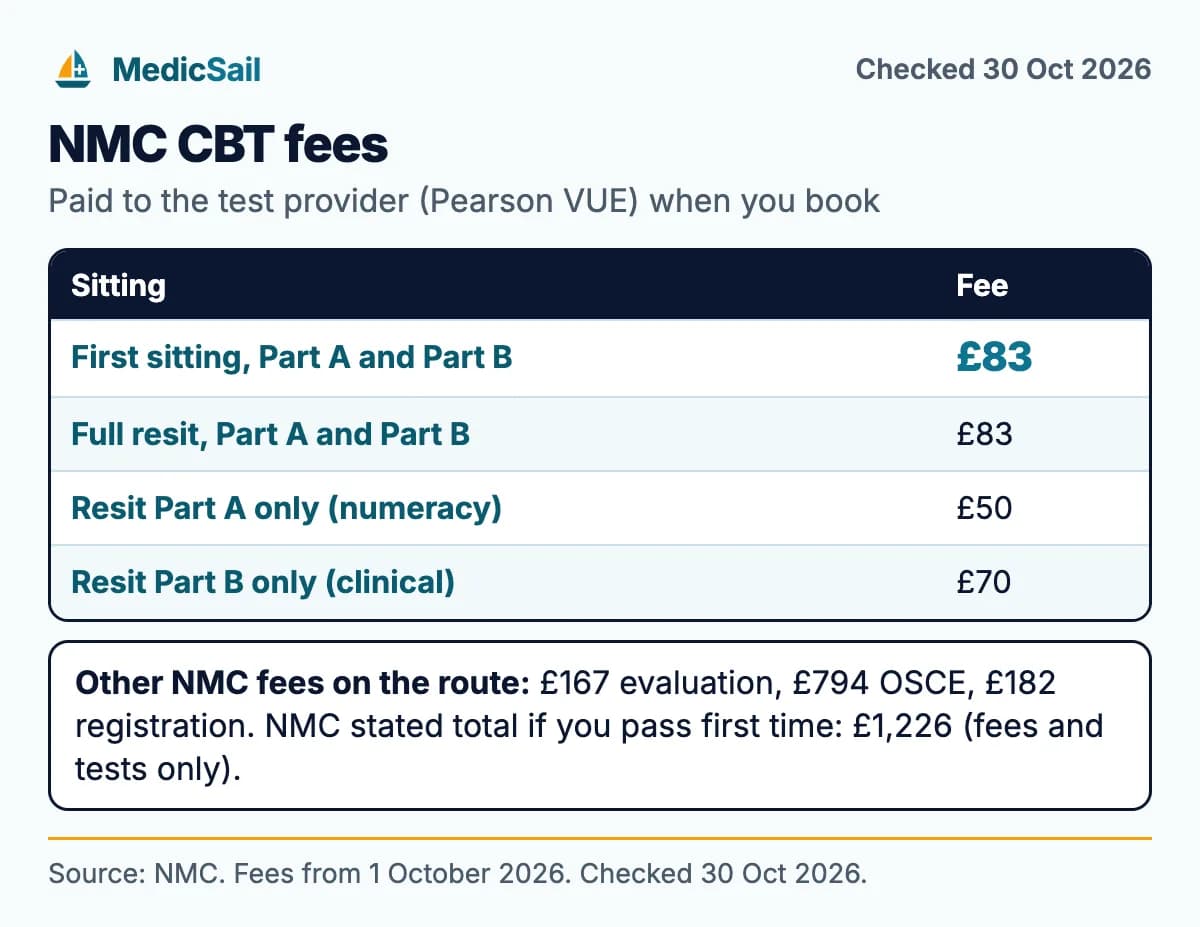
The fees below are from the NMC's costs page, effective from 1 October 2026. You pay them to Pearson VUE when you book.
| Sitting | Fee |
|---|---|
| First sitting (Part A and Part B) | £83 |
| Full resit (Part A and Part B) | £83 |
| Resit, Part A numeracy only | £50 |
| Resit, Part B clinical only | £70 |
The NMC puts the total cost of evaluation, the CBT, the OSCE and registration at £1,226 if you pass both tests first time. That excludes your English test, visa, flights and accommodation. Some UK employers refund part of these costs, which our guide to the Health and Care Worker visa covers alongside the visa fees.
Results. The NMC's CBT page says you receive an exam report at the test centre when you finish, and your Pearson VUE account and MyNMC account are updated within 48 hours. You get a pass or fail for Part A and for Part B separately. You do not get a score breakdown: the NMC says it cannot give further feedback on CBT results, to protect the test.
Resits, waiting periods and what happens if you fail
The resit rules come from the NMC's CBT page and the CBT information booklet:
- Three attempts per application. You may sit the CBT up to three times as part of one application.
- At least 10 days between sittings.
- All attempts within one year.
- Resit only the part you failed. A Part A resit lasts 30 minutes and a Part B resit 2.5 hours. Each resit is a new version of the test.
- After the permitted attempts, your application closes. You must make a new application and wait at least six months before you can sit the CBT again. If one part is failed three times, you resit the whole CBT after the six-month period.
- Exceptional circumstances. The NMC may agree a further attempt, on application, if the test centre did not follow agreed processes, there was an unexpected interruption such as a fire alarm, or the candidate was ill or severely anxious.
Use the 10-day minimum wisely. If you failed Part A narrowly, 10 days of focused calculation practice may be enough. If you failed Part B, look honestly at the blueprint: candidates often know clinical facts well but miss questions about accountability, consent, safeguarding, raising concerns and UK legislation, which together make up a large share of the paper. Rushing back into a resit without changing how you revise wastes an attempt you may need.
How to prepare: a revision plan built on official materials
The NMC publishes free preparation materials and says it does not endorse any course or training provider. You do not need a paid course to pass, although many people find structured practice helpful. Whatever you use, build it around these official documents:
- The blueprint for your field. It shows which standards of proficiency may be tested in the CBT, the OSCE or both. Use it as your revision checklist.
- The test specification. It gives the question split by platform (or domain for midwives), the numeracy topics and the current pass marks.
- Future nurse: Standards of proficiency for registered nurses, or the Future Midwife standards. Read every statement in the seven platforms and both annexes.
- The Code. Questions on accountability, confidentiality, consent, duty of candour and raising concerns are answered from The Code, not from local policy in your home country.
- The CBT candidate information booklet for nurses or midwives.
- The Pearson VUE practice test. The NMC says it is available to all candidates without booking. Do it early to learn the interface, and again near the end to check your pacing.
A realistic plan for a working nurse:
- Weeks 1 and 2: read The Code and the standards for your field. Note every area that differs from how you practise now, such as consent, capacity, safeguarding referrals and escalation using NEWS.
- Weeks 3 to 5: work through the platforms in blueprint order, giving most time to platforms 1, 3 and 4, which carry 46 of the 100 marks for nursing. Do 20 to 30 practice questions a day and read the rationale for every wrong answer.
- Every day: five to ten drug calculations. Short daily practice keeps Part A accurate.
- Final week: timed full-length practice under test conditions, 30 minutes of numeracy then 2 hours 30 minutes of clinical questions, with no phone.
The commonest mistake is revising from your home country's practice. The CBT asks what a newly registered nurse in the UK should do, in line with UK law, NICE guidance and The Code. When an option involves escalating, documenting, gaining consent or protecting a vulnerable person, it is very often the right one.
After the CBT: the OSCE, English and your job offer
Once you have passed, the CBT result sits on your NMC application, and your two-year window for the OSCE is running. Most internationally recruited nurses now look for a UK employer, apply for the visa and take the OSCE after arriving. Our NMC OSCE guide explains the stations, test centres, fees and resits.
At the same stage, make sure your English evidence is ready and still in date, and start the job search. Our guide to working in UK healthcare covers the NHS, pay bands and how the route fits together, and the nursing hub compares the UK with Ireland, Germany, the Netherlands and the USA if you are keeping your options open.
If you are working in the Gulf: you can sit the CBT at a Pearson VUE centre where you live, but a Gulf licence does not exempt you from it. Plan your CBT around your contract and leave enough time for the OSCE in the UK, so that your English scores and both test results are still valid when the NMC assesses your application.
Questions
115 in total: 15 numeracy questions in Part A and 100 multiple-choice clinical questions in Part B. You have 30 minutes for Part A and 2 hours 30 minutes for Part B, so 3 hours overall, including any breaks.
The NMC's test specification says the current Part A pass mark is 87%, or 13 out of 15. Part B pass marks vary by test version: generally 60% to 70% for nursing and 75% to 80% for midwifery. The NMC uses statistical methods to keep the standard consistent, so these figures can change.
The NMC and Pearson VUE describe the CBT as taken at Pearson VUE test centres, which exist in most countries. Neither page offers a home-based online version for the NMC CBT, so plan to attend a test centre.
£83 for the first sitting and £83 for a full resit. A numeracy-only resit costs £50 and a clinical-only resit £70. You pay Pearson VUE when you book.
The NMC says you get an exam report at the test centre when you finish, and your Pearson VUE and MyNMC accounts are updated within 48 hours. Each part is reported as a pass or fail, with no further feedback.
You can sit it up to three times in one application, at least 10 days apart, with all attempts within one year. You only resit the part you failed. After the permitted attempts your application closes and you must wait at least six months before sitting it again.
The NMC says you must pass the CBT and OSCE within two years of each other. Once you have passed both, your Test of Competence is valid for five years.
Yes. The CBT information booklet says an on-screen calculator is available, and you work on an erasable note board provided by the test centre.
The NMC's CBT guidance links booking to its authorisation to take the Test of Competence, not to your English result. You still need accepted English evidence for registration, and your scores must be no more than two years old when the NMC assesses your application.
Start with the NMC blueprint and test specification for your field, Future nurse: Standards of proficiency for registered nurses (or the Future Midwife standards) and The Code. Then use the Pearson VUE practice test and timed practice questions, with daily drug calculation practice for Part A.
Sources
Plan it with our free tools
MedicSail
Healthcare licensing consultants for the UK, Europe and the USA
Updated and checked against the sources listed above. How we research and check our guides