


































NMC OSCE: what to expect at the test centre and how to prepare
The APIE and skills stations, the three UK test centres, booking, fees, resits, what happens if you fail twice, preparing with your employer and how the midwifery OSCE differs.

MedicSail
Published
The short answer
The NMC OSCE (objective structured clinical examination) is Part 2 of the Nursing and Midwifery Council's Test of Competence. It is a practical exam of 10 stations: four linked stations that follow one patient through assessment, planning, implementation and evaluation (the APIE), four clinical skills stations, and two written stations on professional values and evidence-based practice. You must pass every station.
You can only take it in the UK, at one of three NMC-approved test centres: the University of Northampton, Ulster University and Leeds Teaching Hospitals NHS Trust. The first sitting costs £794. Results are emailed within 5 working days. If you fail, you resit only the stations you failed, at £397 if you failed seven or fewer or £794 if you failed eight or more. You have three attempts in one application, at least 10 days apart. If you fail on the third attempt, your application closes and you must wait at least six months before you can apply again.
The OSCE is set at the level of a newly registered nurse or midwife in the UK. It tests safe, person-centred practice and UK standards, not advanced skills. This guide explains each part of the exam, how booking and resits work, and how to prepare, including with your employer. If you have not sat Part 1 yet, start with our guide to the NMC CBT.
Where the OSCE fits in your registration
You need the OSCE if the NMC decides, after assessing your qualification, that you must pass the Test of Competence. The NMC then emails you an invitation confirming that you can sit the CBT and the OSCE. The OSCE booklet says only the NMC can authorise you to sit the OSCE, and you book it directly with a test centre once you have that email.
The CBT and OSCE can be taken in either order, but the NMC says you must pass both within two years of each other. Most candidates pass the CBT at home, accept a job with a UK employer, travel on a Health and Care Worker visa and sit the OSCE within their first weeks or months in the UK. Once you pass both parts, the Test of Competence is valid for five years.
The OSCE is one step in a longer route. Our page on how NMC registration works for overseas nurses and midwives covers the eligibility application, English evidence, ID check and registration fee, and our UK country guide explains how registration, your job and your visa run together.
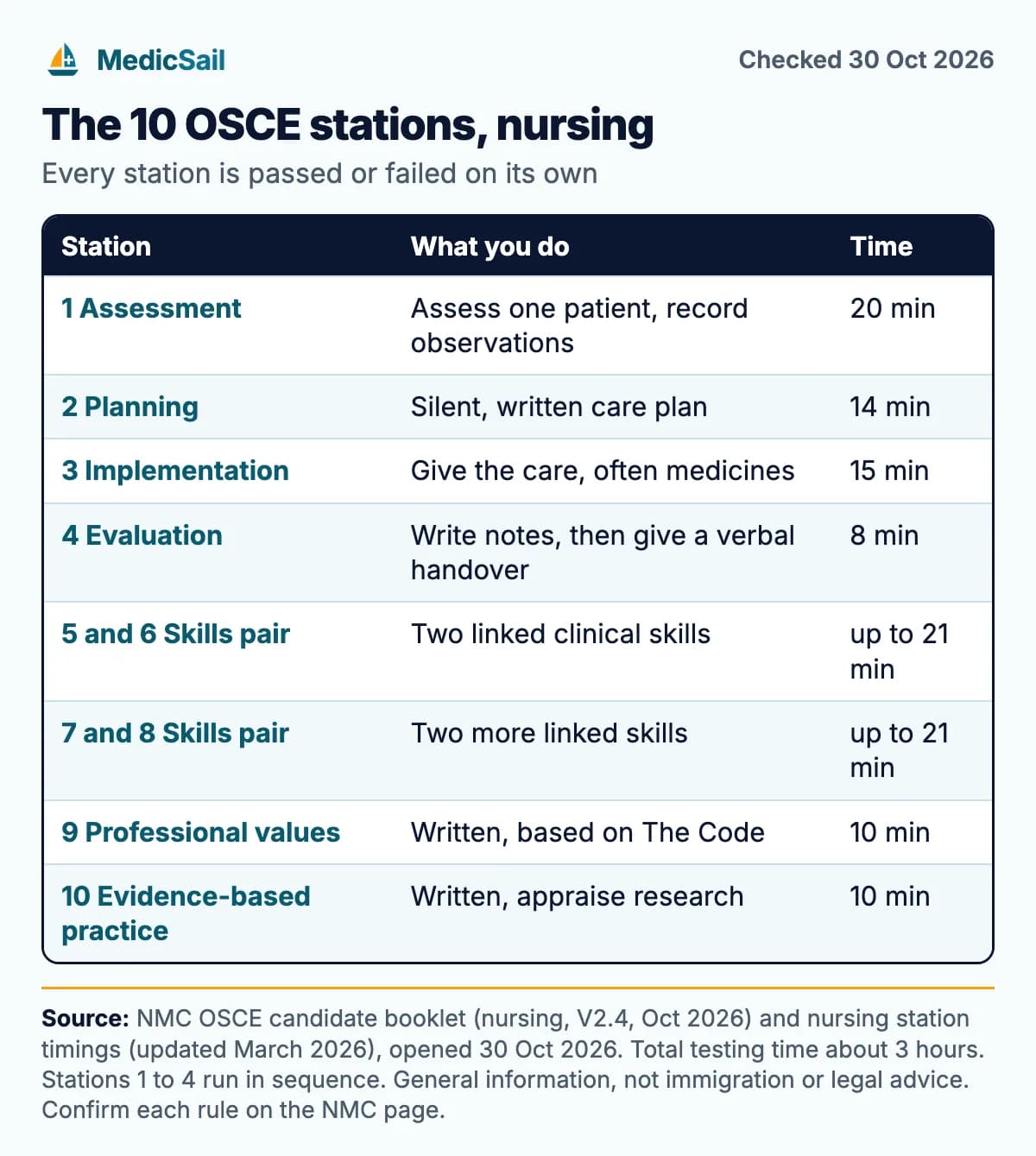
The 10 stations at a glance
The NMC's test specification and the OSCE candidate booklet describe the same structure for every field of nursing:
| Stations | What happens | Time (NMC station timings) |
|---|---|---|
| Assessment (A) | You assess a patient, played by an actor or represented by a manikin, take and record observations, and gather the information you need for the next three stations. | 20 minutes |
| Planning (P) | A silent written station: you write a care plan for the same patient. | 14 minutes |
| Implementation (I) | You carry out care for the same patient, often medicine administration. | 15 minutes |
| Evaluation (E) | You write notes for a transfer or discharge and give a verbal handover. | 8 minutes |
| Four skills stations | Two pairs of linked clinical skills, such as an injection, wound care or a urine specimen. | Each skill between 6 and 21 minutes; each pair up to about 20 minutes |
| Professional values (PV) | A written station on accountability, The Code and communication. | 10 minutes |
| Evidence-based practice (EBP) | A written station on critically appraising a piece of research. | 10 minutes |
The APIE stations run in sequence with no other station in between. There are about 4 minutes between stations while the bay is reset. The NMC's candidate materials put the total testing time at about 3 hours for nursing, and the preparation handbook warns that you may be in the centre for up to 4 hours. Once you have registered on arrival you cannot leave the centre until the OSCE is over.
You will usually stay in one bay, set up as a hospital ward, community setting or patient's home, and the stations come to you. Every bay has a camera and sound system. Filming is part of the exam: you consent to it when you book, and recordings are used for moderation and appeals but are never released to you or your employer.
The APIE stations in detail
The APIE is the backbone of the OSCE: four of your 10 stations depend on how well you assess one patient. The NMC's "Preparing for your OSCE" handbook explains what each station expects.
Assessment
You assess the patient using the 6 Cs (care, compassion, competence, communication, courage and commitment). You may need to take a full set of observations and record them on a chart such as the National Early Warning Score (NEWS) or the Glasgow Coma Scale, and you must finish recording them before time runs out. For all fields except mental health and learning disabilities, you carry out a holistic assessment including an airway, breathing, circulation, disability and exposure (A to E) assessment. You can make notes; they are not marked, but you will use them later.
Planning
A silent written station. You write two relevant aspects of care from the assessment, including relevant self-care, on the NMC's template, in black pen. Common mistakes the handbook lists: an evaluation date outside the expected time frame, illegible writing, unrecognised abbreviations and errors not corrected properly.
Implementation
You give care, for example oral medicines. Read the medicine chart in full, check the patient's identity and allergies, check expiry dates and never sign for a medicine before you give it. Talk to the patient or manikin, not the assessor.
Evaluation
You write notes for a transfer, discharge or other evaluation, usually in the SBAR format (situation, background, assessment, recommendation), and then give a verbal handover. Only the verbal handover is marked.
The NMC's station timings list (updated March 2026) names the current APIE scenarios. For adult nursing they include Alzheimer's disease, chronic heart failure, community assessment, ectopic pregnancy, end of life, suspected deep vein thrombosis, hernia, homelessness, pneumonia and subdural haematoma. Mental health scenarios include depression and suicidal ideation, bipolar disorder and anxiety. Learning disabilities scenarios include behaviours that challenge and Down's syndrome, and children's nursing scenarios include asthma, post-tonsillectomy bleed and child fever. The NMC adds new scenarios regularly, so do not assume you will get the one a friend had.
Skills, professional values and evidence-based practice stations
The four skills stations test practical procedures at the level of a newly registered nurse. The NMC's station timings list for adult nursing (March 2026) includes administration of inhaled medication, administration of a suppository, anti-embolism stockings, blood glucose monitoring, bowel assessment, catheter specimen of urine, fine-bore nasogastric tube, fluid balance, intramuscular and subcutaneous injections, IV flush and VIP score, nutritional assessment, oral care plan, oxygen therapy, pain assessment, peak expiratory flow rate, pre-operative check, pressure area assessment, removal of a urinary catheter, mid-stream urine and urinalysis, and wound assessment with aseptic non-touch technique (ANTT). Other fields have their own lists: mental health nursing includes de-escalation, reminiscence therapy and talking therapies, and children's nursing includes paediatric basic life support.
The two written stations are silent and last 10 minutes each:
- Professional values scenarios in the current nursing list include bullying, a deteriorating patient, a drug error, falsified observations or timesheets, racism, social media, witnessed or possible abuse, patient confidentiality and professional burnout. Answer from The Code: raise concerns, escalate, document and protect the person.
- Evidence-based practice asks you to appraise a research summary on topics such as pressure ulcer prevention, smoking cessation or saline versus tap water for wound cleansing, and decide whether it should change practice.
How the stations are marked
The nursing test specification says each station is marked against up to 20 statements from the standards, each scored as demonstrated, partially demonstrated or not demonstrated, and weighted by importance. Each station has its own pre-set pass mark, generally between 60% and 90%. Assessors also make a holistic judgement, used to set and check standards. On top of that, an assessor can raise a red flag for unsafe or unacceptable behaviour, and an agreed red flag always means you fail that station, however well you did otherwise. The handbook adds that if you make a mistake you should say so and explain how you would correct it within the station time, but explaining will not overturn a critical fail.
Test centres and how to book
The NMC currently lists three approved OSCE test centres. All of them test nurses, midwives and nursing associates.
| Test centre | Where | Contact for nurses and midwives |
|---|---|---|
| University of Northampton | Innovation Centre, Green Street, Northampton, opposite the railway station | [email protected] |
| Ulster University | Magee campus, Northern Ireland | [email protected] |
| Leeds Teaching Hospitals NHS Trust | Suite C5, Joseph's Well, Hanover Lane, Leeds | [email protected]; bookings through the centre's booking website |
The NMC notes that Oxford Brookes University stopped running OSCEs on 31 July 2026 and Northumbria University on 19 February 2026, so older advice that mentions those centres is out of date.
How booking works:
- Wait for the NMC's Test of Competence email. Test centres cannot book you without it.
- Choose your centre carefully. You can pick any of the three, but the booklet says all resits must be taken at the same centre as your first attempt.
- Choose a date and pay the £794 fee. Some employers book and pay on behalf of the nurses they recruit; the University of Northampton has a separate booking contact for trusts and training organisations.
- Ask for reasonable adjustments straight after booking if you need them. You must provide evidence from professional reports when you book. A health condition disclosed after the OSCE cannot be taken into account. The booklet includes a separate risk assessment process for pregnant candidates.
Cancelling or moving your date. The OSCE booklet says you get a full refund only if you give more than 3 weeks' notice. With less notice there is no refund except in exceptional circumstances, for which you may need a medical certificate, and there is no refund if you simply do not attend.
On the day: ID check, dress code and rules
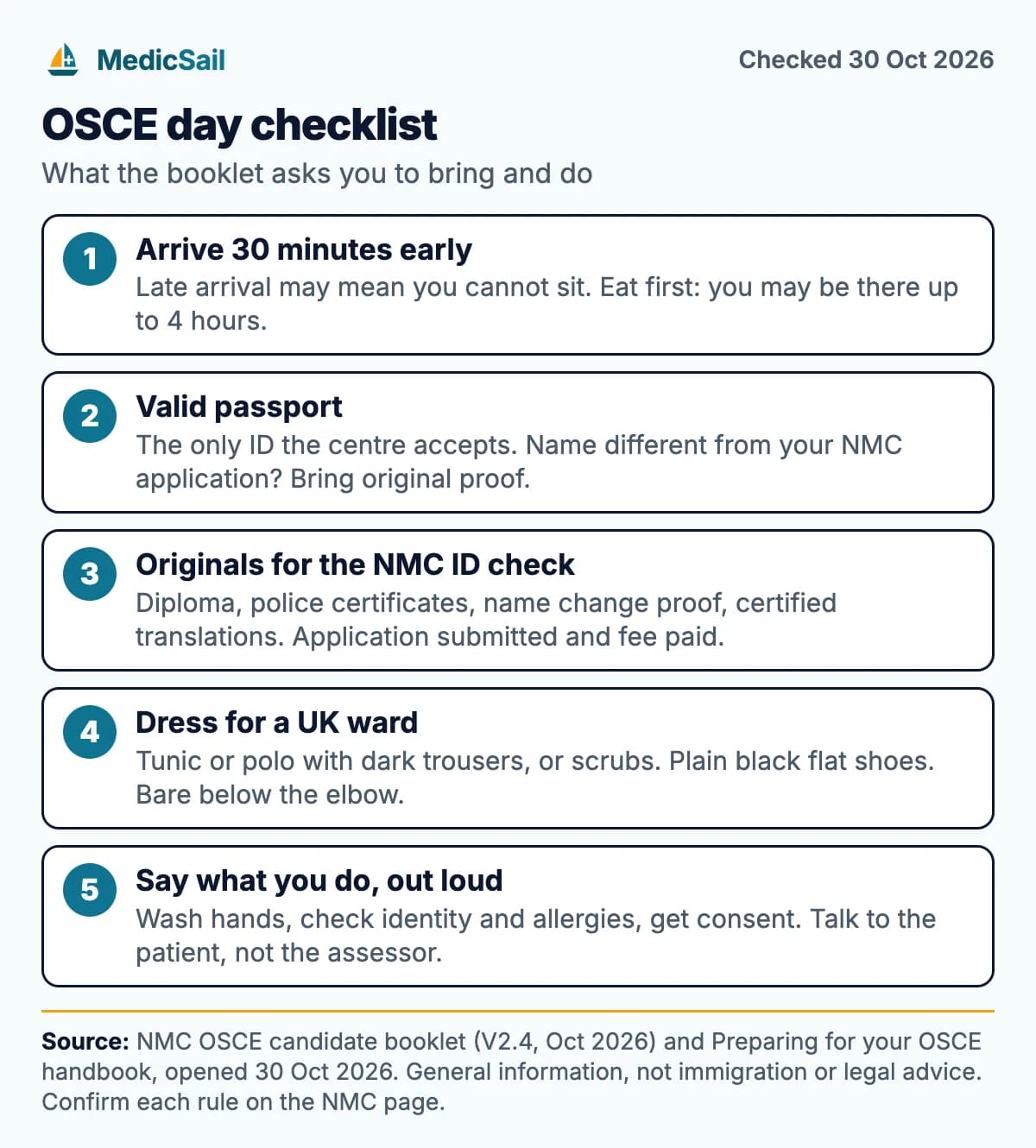
Identification. The test centre checks your identity every time you attend and accepts only a valid passport. If the name on your passport differs from your NMC application, bring original evidence such as a marriage certificate or a legal affidavit. Without these, you will not be allowed to sit the OSCE.
Your NMC ID check usually happens the same day. If you need the Test of Competence, the NMC's ID check is normally carried out during your first OSCE attempt. It does not affect your OSCE result, but you must already have submitted your registration application and paid the registration fee. Bring the originals the booklet lists: passport, qualification certificate, registration certificate if you have one, name change evidence, police checks for countries where you have lived for 12 months or more in the last 10 years (or since age 18), a UK DBS check if you had lived in the UK for 3 months or more when you applied, and certified translations. If something is missing, you have to book and travel to another appointment at your own expense.
Dress as you would on a UK ward. The booklet asks for a clinical tunic or polo shirt with dark smart trousers, or scrubs; no jeans or shorts. Shoes must be plain, flat, black and rubber-soled, enclosing the whole foot. Nails short with no varnish or extensions, hair tied up off the collar, bare below the elbow (no watch or bracelets), one plain band ring and one plain stud per ear at most. Head scarves or turbans should be plain black or navy and tucked in.
Practical points from the handbook: eat beforehand; bring a water bottle, which can be refilled; bring a fob watch if you have one (the centre has spares); arrive at least 30 minutes early; leave suitcases elsewhere, as there is only space for small bags; and friends and family cannot wait for you at the centre. You will sign a confidentiality declaration and must not discuss stations with other candidates or online.
Fees, results and resits
| Sitting | Fee |
|---|---|
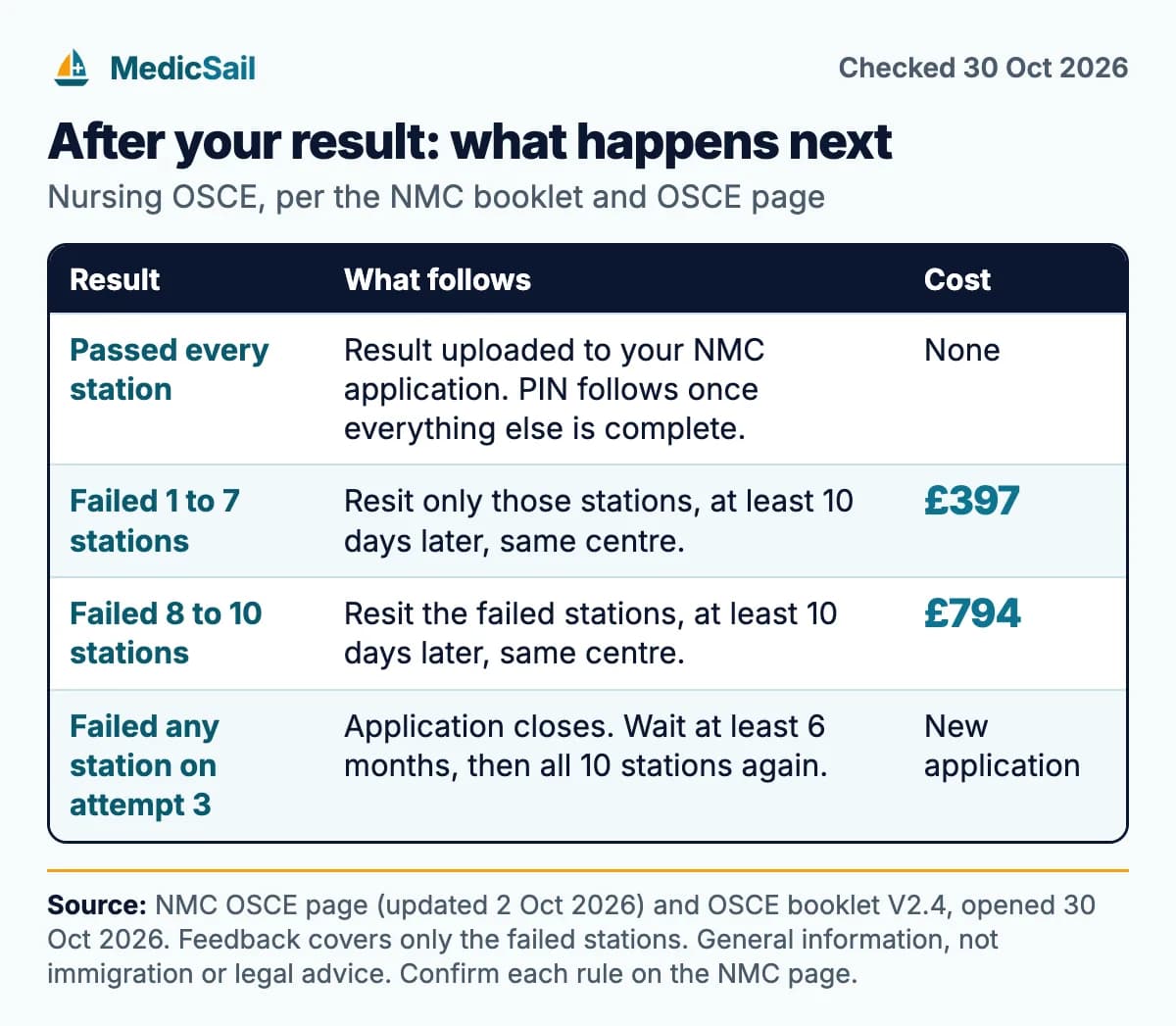
| First attempt (all 10 stations) | £794 |
| Resit after failing up to 7 stations | £397 |
| Resit after failing 8 or more stations | £794 |
These are the NMC's fees from 1 October 2026. The NMC's total of £1,226 for evaluation, CBT, OSCE and registration assumes you pass first time.
Results are emailed by the test centre to the address registered with the NMC, usually within 5 working days. The booklet says it can take up to 10 working days when new OSCE content is being introduced. Assessors and centre staff cannot give you results on the day.
Feedback covers only the stations you failed. It is short and factual: it tells you which areas you did not show competence in and may point to resources, but the centre is not allowed to teach you how to pass.
Resits. You resit only the stations you failed, and you may get the same or a similar station. If you need to resit an APIE station, you are given your original paperwork from the APIE stations you passed so that you can complete the sequence. There must be at least 10 days between sittings.
Timing matters if you are already in the UK. NHS Employers says a nurse entering the UK for a nursing role has up to 12 weeks from the employment start date on the certificate of sponsorship to sit a first OSCE attempt, and must pass within eight months of the start of the visa. If you do not pass within the permitted attempts, the employer must stop sponsoring you and your permission to stay is shortened.
What happens if you fail twice
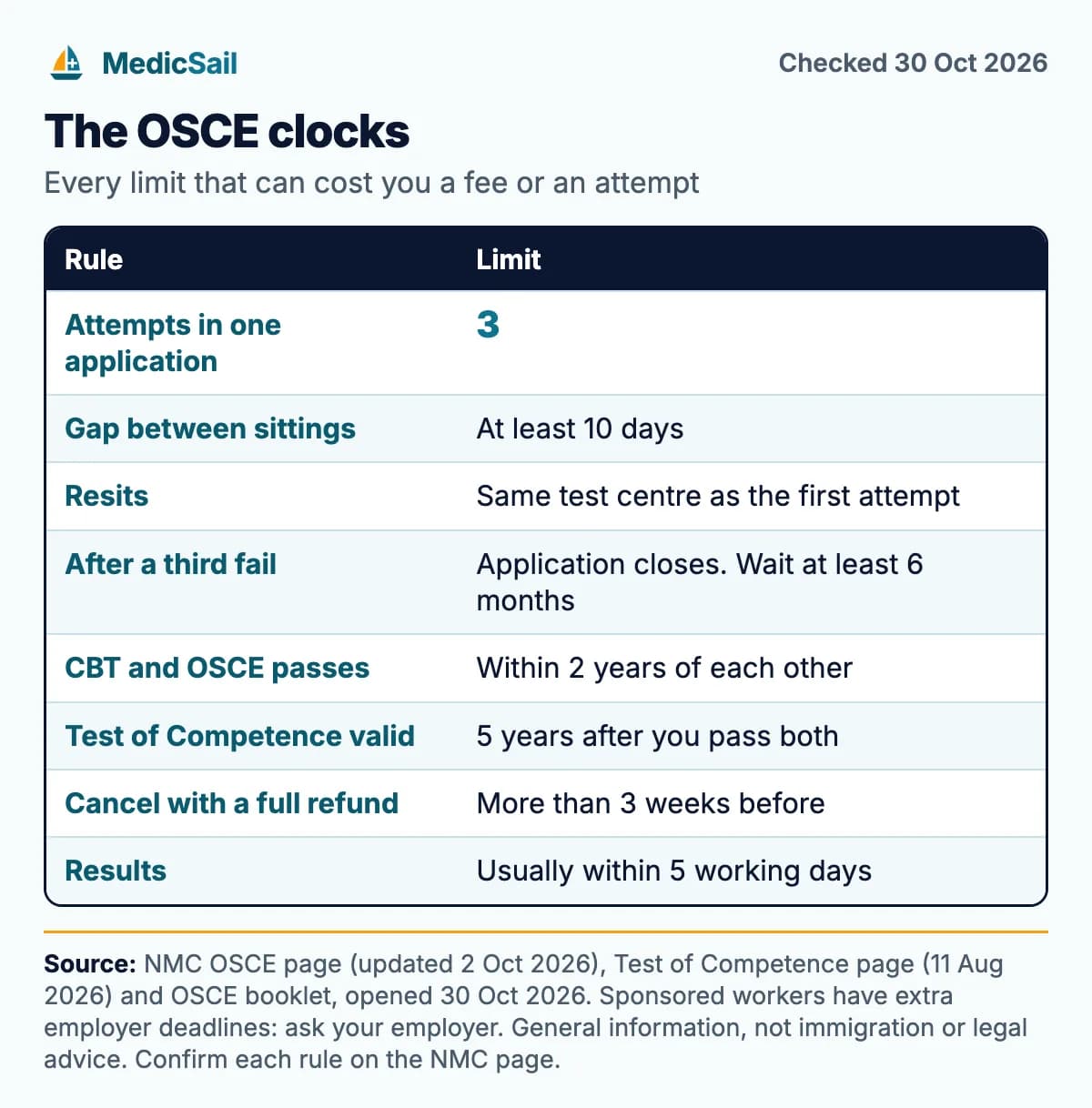
Failing twice does not end your application. The NMC allows three attempts at the OSCE in one application, so after a second fail you still have a third attempt, at the same test centre, at least 10 days later. The fee depends on how many stations you failed that time.
The third attempt is the one that matters most. The NMC's OSCE page says that if you fail your third attempt, your application closes and you must wait at least six months before making a new application, after which you sit the full 10 stations again. The booklet's results table calls this a "full fail": failing any station on the third attempt.
Before a third attempt, consider:
- Exceptional circumstances. The NMC may agree a further attempt, on application, if the centre did not follow agreed processes, an assessor did not comply with them, there was an unexpected interruption such as a fire alarm, or you were ill or severely anxious. If you are unwell on the day, follow the centre's mitigating circumstances process rather than sitting the exam.
- Appeals. You cannot appeal the result itself, only the process. If you think an irregularity affected your performance, use the appeal process in the booklet.
- Timing. Ten days is the minimum, not a target. If the same type of station failed twice, take the time to fix the underlying habit, such as checking allergies or completing observations, before you rebook.
- Your job and visa. A closed application affects the role you were recruited into. What happens next is set by your employment contract and your visa conditions, so speak to your employer early. Our Health and Care Worker visa guide explains how the visa is tied to your sponsor and job.
Preparing, with your employer and on your own
Many internationally recruited nurses prepare for the OSCE through their employer. Some NHS trusts and other employers run training in a skills lab, with mock stations and feedback, and book and pay for the exam. What is included varies, so before you accept a job ask in writing:
- Who pays the OSCE fee, and who pays for resits?
- How many weeks of preparation you get before the exam, and whether it is paid time.
- Whether there is a mock OSCE with feedback from assessors trained in the NMC format.
- Your job title and pay while you wait to pass, and what happens if you fail.
- Whether the employer offers support for midwives specifically, if you are a midwife.
Whatever your employer offers, base your preparation on the NMC's free materials for your field: the mock OSCE, marking criteria, reading lists, station timings, equipment lists, the "Preparing for your OSCE" handbook and the OSCE information booklet. The handbook recommends at least 14 days to review them, and notes that many candidates say they needed more. The marking criteria matter most: they show exactly which actions earn marks.
The NMC and test centres warn that third-party OSCE courses are not endorsed and could prepare you inaccurately. If you do use one, check what it teaches against the NMC's marking criteria.
The handbook's list of common mistakes is a useful final checklist. In every station: not reading the instructions properly, poor communication, not cleaning your hands before touching the patient, not checking identity or allergies, not getting consent, and running out of time. In skills stations: contaminating a sterile field, chest compressions at the wrong depth or rate, and discarding an ampoule before giving the injection.
Practise out loud. With a manikin you must say what you are doing and why, and speak to the manikin as your patient. Time every practice station with a timer. Recruiters and pay bands for this period are covered on our pages for nurses moving to the UK and the wider nursing hub.
How the midwifery OSCE differs
Midwives sit a midwifery OSCE built on the NMC's Future Midwife standards. It has the same 10-station structure, fees and resit rules, but the content differs. The midwifery test specification says that every midwifery OSCE:
- includes at least two emergency scenarios, and
- always includes the systematic physical examination of the newborn.
The midwifery station timings list (February 2026) shows APIE scenarios of antenatal admission, labour and birth, and postnatal visit, with the same APIE timings as nursing. Skills stations include shoulder dystocia and postpartum haemorrhage as emergency birth scenarios, birth, complex birth, postnatal care and check, IV flush and VIP score, IM injection, removal of a urinary catheter, neonatal assessment and the newborn examination, which is the longest station at 25 minutes. The midwifery booklet says skills stations last up to 25 minutes and gives a total testing time of about 2.5 hours. Current written stations include place of birth, induction of labour at term and smoking in pregnancy for evidence-based practice, and bereavement care and safeguarding women and children for professional values.
Marking is slightly different too: the midwifery specification says APIE stations are marked against up to 16 statements and skills stations against up to 12. Use the midwifery mock OSCE, marking criteria and reading list, not the nursing versions. Some employer OSCE programmes are designed around nursing, so ask what midwife-specific practice is available. Our pages on registering as a midwife in the UK and the midwifery hub cover the rest of the route.
After you pass
Your result is uploaded to your NMC application. If you have also passed the CBT and the NMC has your declarations, English evidence and registration fee, it moves on to verification and a decision. The NMC says it aims to decide a complete application within 30 days of having everything. Once registered, you receive your NMC PIN and can work as a registered nurse or midwife.
If you still need to sort out your English evidence, our guide on choosing IELTS or OET for UK regulators sets out the NMC's scores and the other routes it accepts. Remember that your test results and English scores each have their own validity period, so keep the whole timeline in view.
Questions
Ten: four linked APIE stations (assessment, planning, implementation and evaluation), four skills stations, and two written stations on professional values and evidence-based practice. You must pass all 10.
Only in the UK, at an NMC-approved test centre. The NMC currently lists the University of Northampton, Ulster University and Leeds Teaching Hospitals NHS Trust.
£794 for the first attempt. A resit costs £397 if you failed up to seven stations and £794 if you failed eight or more.
The NMC's nursing candidate materials put the testing time at about 3 hours, and the preparation handbook says you may be at the centre for up to 4 hours. The midwifery booklet gives a testing time of about 2.5 hours.
The test centre emails your result, usually within 5 working days. It can take up to 10 working days when new OSCE content is being introduced. You get written feedback on any station you failed.
You still have a third attempt in the same application, at the same test centre, at least 10 days later. If you fail the third attempt, your application closes and you must wait at least six months before reapplying and sitting all 10 stations again.
No. The NMC's OSCE booklet says all resits must be taken at the same test centre where you sat your first attempt, so choose your first centre with that in mind.
The OSCE booklet says you get a full refund only with more than 3 weeks' notice. With less notice, refunds are given only in exceptional circumstances, and there is no refund if you do not attend.
It has the same 10-station structure, fees and resit rules, but it is based on the Future Midwife standards. Every midwifery OSCE includes at least two emergency scenarios and the systematic physical examination of the newborn.
No. The booklet says recordings are treated as exam scripts. They are used for moderation and appeals, but are not released to you or to a sponsoring employer.
Sources
- 1NMC: OSCE (Test of Competence 2021)
- 2NMC: Test of Competence for nurses and midwives
- 3NMC: CBT and OSCE preparation materials
- 4NMC: OSCE candidate information booklet, nursing (V2.4, October 2026)
- 5NMC: OSCE candidate information booklet, midwifery (V2.4, October 2026)
- 6NMC: Preparing for your OSCE, all nursing fields
Show all 16 sourcesShow fewer sources
- 7NMC: nursing OSCE station timings (March 2026)
- 8NMC: midwifery OSCE station timings (February 2026)
- 9NMC: Test of Competence 2021 nursing test specification
- 10NMC: Test of Competence 2021 midwifery test specification
- 11NMC: costs for applicants trained outside the UK
- 12NMC: ID check process and requirements
- 13Leeds Teaching Hospitals: OSCE test centre
- 14University of Northampton: Competence Test Centre
- 15Ulster University: NMC Competence Test Centre
- 16NHS Employers: Recruitment of overseas nurses and midwives (reviewed 23 September 2026)
Plan it with our free tools
MedicSail
Healthcare licensing consultants for the UK, Europe and the USA
Updated and checked against the sources listed above. How we research and check our guides