


































Failed the NMC CBT or OSCE: retake rules, fees, waiting periods and what it means for your visa
Three attempts per test, 10 days apart, resit only what you failed. The fees, the one-year and two-year windows, the six-month wait after a third fail, and the visa deadline.

MedicSail
Published
The short answer
Failing the NMC CBT or OSCE once is not the end of your application. The NMC gives you three attempts at each test within one application, with at least 10 days between sittings. You only resit what you failed: the failed part of the CBT (numeracy, clinical, or both) and the failed stations of the OSCE. A CBT resit costs £50 for numeracy only, £70 for clinical only or £83 for both. An OSCE resit costs £397 if you failed seven stations or fewer and £794 if you failed eight or more.
The rules tighten in two places. Your three CBT attempts must all fall within one year, or you need to resit both parts again. And if you fail a third time, at either test, your application closes and you must wait at least six months before a new application, after which you sit the full CBT or all 10 OSCE stations again.
If you are already in the UK on a sponsored visa, the OSCE has its own timetable. NHS Employers says you must pass the OSCE within eight months of the start of your visa, and if you are unsuccessful after the permitted attempts your employer must stop sponsoring you and your leave is shortened. This guide sets out each rule, what it costs, what it means for your job and visa, and how to use the time between attempts well. For the format of each test, see our guides to the NMC CBT and the NMC OSCE.
The retake rules at a glance
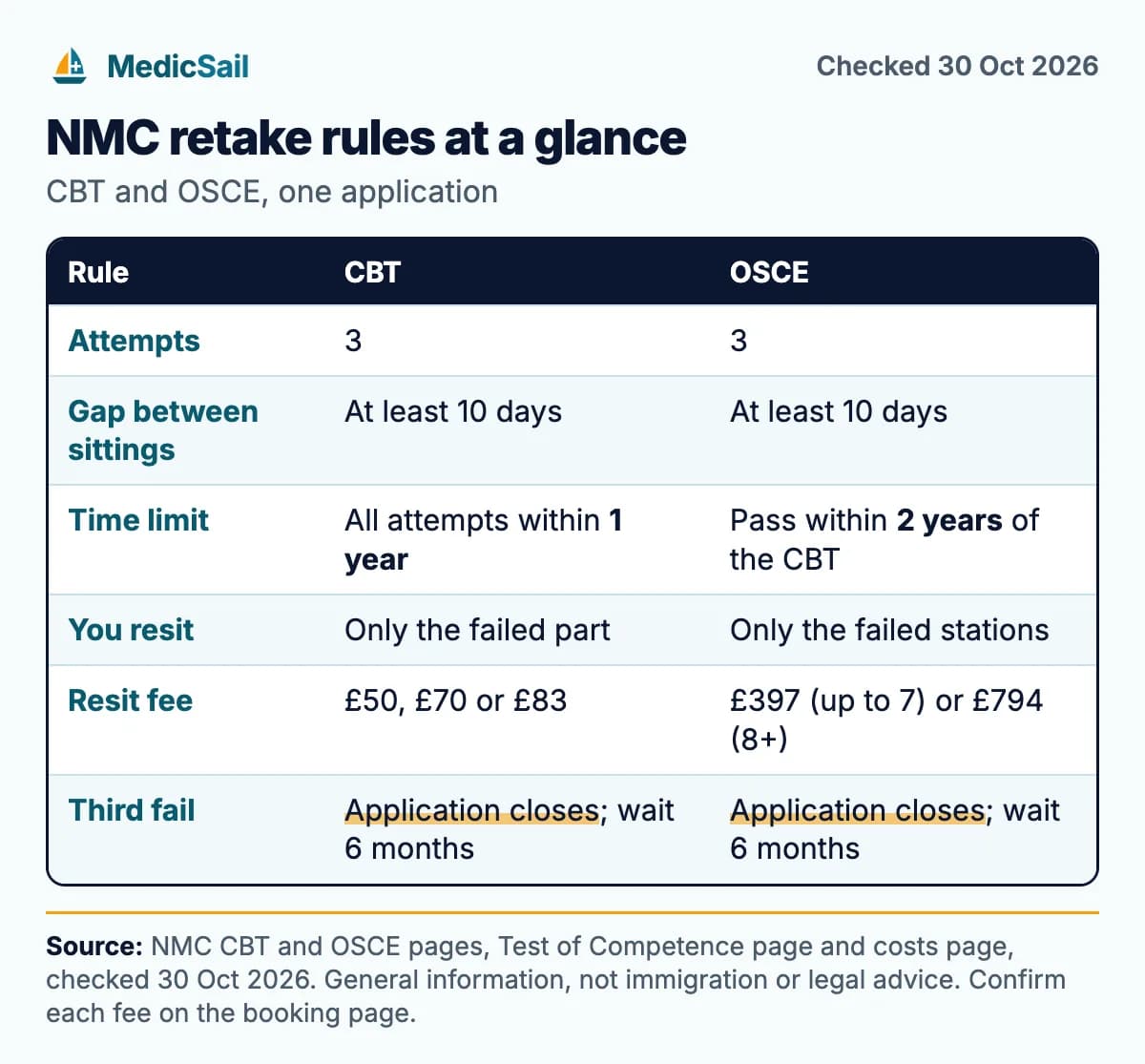
| Rule | CBT | OSCE |
|---|---|---|
| Attempts per application | 3 | 3 |
| Minimum gap between sittings | 10 days | 10 days (NHS Employers says 10 working days) |
| Time limit for attempts | All within one year | Pass within two years of the CBT; for sponsored nurses, within eight months of the visa start |
| What you resit | Only the failed part | Only the failed stations |
| Resit fee | £50 numeracy, £70 clinical, £83 both | £397 for up to 7 stations, £794 for 8 or more |
| Where | Any Pearson VUE centre | The same test centre as your first attempt |
| After a third fail | Application closes; wait six months; new application | Application closes; wait at least six months; new application; all 10 stations |
| Appeal | Process only, not the mark | Process only, not the mark |
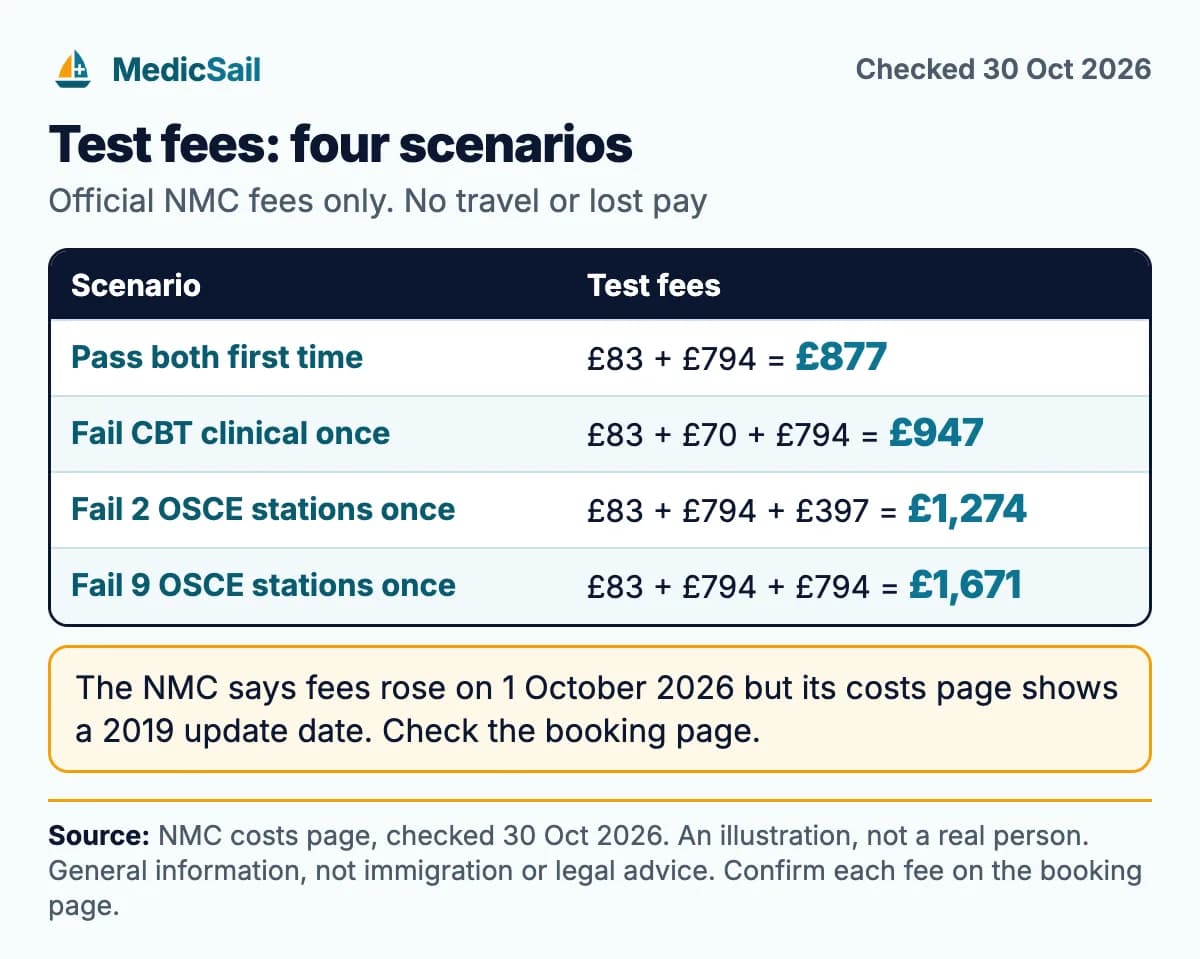
All fees are from the NMC's costs page, which notes that the NMC's fees increased on 1 October 2026. CBT fees are paid to Pearson VUE and OSCE fees to the test centre before you sit.
If you failed the CBT
The CBT has two parts taken in one sitting: Part A numeracy and Part B clinical. The NMC says they are "passed or failed independently" and "you only need to resit the part that you've failed". Your Pearson VUE exam report at the end of the test tells you which part you failed.
What to do next:
- Read your score report. It shows your performance by area. For Part B, map the weak areas to the NMC blueprint for your field, not to a generic question bank.
- Choose your resit date. The minimum is 10 days. Book it once you have changed how you are preparing, not just repeated it.
- Book the right resit. On the Pearson VUE site, choose the partial resit for the part you failed. Paying for the full CBT when you only need one part costs you more and puts a pass at risk.
- Watch the one-year limit. The NMC says your three attempts "all need to be taken within one year", and after this period you need to resit both modules. If you passed numeracy in January and are still resitting clinical the following January, you may lose your numeracy pass.
Most CBT fails are on Part B. Candidates who know clinical facts well are often caught by questions on accountability, consent, safeguarding, raising concerns, the Code and UK law. Part A fails are usually about units, rounding and reading the question, and are often fixed with daily timed practice. Our CBT guide has a revision plan built on the NMC's own blueprint and practice test.
If you failed the OSCE
The OSCE has 10 stations: four linked APIE stations, four skills stations and two written stations on professional values and evidence-based practice. You must pass every station of the OSCE. The NMC says test centres email results within five working days of the exam.
Feedback. The centre sends brief feedback on the stations you failed. It identifies the areas in which you did not show competence, but centres cannot coach you.
Resits. The NMC's OSCE page sets the rules:
- You can take the OSCE "a maximum of three times as part of your application".
- You wait at least 10 days between sittings.
- All resits are taken at the same test centre as your first attempt.
- The reduced resit fee of £397 applies if you need to resit seven or fewer stations. If you failed eight or more, the full £794 applies.
Leeds Teaching Hospitals' test centre adds that a resit after failing 1 to 7 stations is at 50% of the cost and covers only the stations you failed, while failing 8 to 10 stations means resitting the APIE and skills stations you failed at the full fee. If you are resitting an APIE station, you are given your original paperwork from the APIE stations you passed so that you can complete the sequence.
ID check. If your ID check was not completed at your first attempt, the NMC asks you to arrange it for the day of your resit by emailing its ID team, and if you move centre, the check is done at the new centre. Do not leave this until after you pass.
The third attempt and the six-month wait
The third attempt is the one that decides whether your current application survives. For the CBT, the NMC says: "After three failed attempts, your application will close and you will need to wait six months" before submitting a new application and sitting the CBT again. For the OSCE, it says your "application will close", you must wait "at least six months before you sit the OSCE again", and you retake all 10 stations.
What a closed application means in practice:
- A new application. You start the overseas route again. The NMC's qualification evaluation fee, now £167, is non-refundable, so expect to pay the fees that apply to a new application. Ask the NMC in writing which earlier evidence and results it will carry over.
- A full test. After the wait, you sit the full CBT (both parts) or all 10 OSCE stations, at the full first-sitting fee.
- The two-year rule. The NMC says you must pass the CBT and OSCE within two years of each other. A six-month wait plus a new application can push a CBT pass close to that limit. Check the dates before you plan.
- English validity. IELTS and OET are valid for two years from the test date. A long gap can mean a new English test too.
Failing the third attempt is not a finding against your character and does not stop you registering later. Our guide on what to do when an NMC application is closed or refused covers reapplying in detail.
Exceptional circumstances and appeals
You cannot appeal a CBT or OSCE mark because you disagree with it. You can raise a concern about how the exam was run.
Appeals about the process. The NMC's OSCE page says you may be able to appeal "if you believe that the process was compromised during the exam" or an irregularity occurred in the conduct of the examination. The process, evidence and deadlines are set out in the candidate information booklets for each test. Raise any problem on the day with the centre staff, and write it down while it is fresh.
Exceptional circumstances. The NMC's candidate booklets say the NMC may agree a further attempt, on application, in limited situations: where the test centre did not follow agreed processes, where there was an unexpected interruption such as a fire alarm, or where the candidate was ill or severely anxious. If you are unwell on the day, follow the centre's mitigating circumstances process rather than sitting the exam and hoping for the best.
Keep evidence: medical notes, emails to the centre and anything the invigilator recorded. A request with evidence, sent promptly, has a far better chance than one sent weeks later.
What a fail means for your visa
Most internationally recruited nurses sit the CBT at home and the OSCE in the UK after arriving on a Health and Care Worker visa. For them, OSCE fails carry a visa timetable. NHS Employers sets it out for employers:
- Candidates have up to 12 weeks from the employment start date on the certificate of sponsorship to sit their first OSCE attempt, and can work as pre-registration candidates during that period.
- Applicants must pass the OSCE within eight months of the start of their visa.
- Applicants may sit the OSCE up to three times, waiting at least 10 working days after a first or second failure.
- "If the applicant is unsuccessful after their permitted attempts, the employer must stop sponsoring them", and their leave to remain will be shortened.
Two things follow. First, a first or second fail does not by itself end your sponsorship, but every week between attempts uses up the eight months, so book resits with that deadline in mind. Second, a third fail has immigration consequences that depend on your own circumstances. Speak to your employer immediately, and take advice from a regulated immigration adviser before making plans. Our Health and Care Worker visa guide explains how the visa depends on your sponsor.
A CBT fail usually happens before you travel, so it delays your visa rather than ending it. Many employers want the CBT passed before they issue a certificate of sponsorship, so tell your recruiter about a fail and your resit date straight away.
What a fail means for your job and money
Your job. Before registration you work in a pre-registration role. The band is set by your employer: some trusts use Band 3, others Band 4. A resit keeps you in that role longer, so the Band 5 pay rise comes later. Ask your education team about extra OSCE preparation; many trusts that recruit overseas nurses run a preparation programme, and some add sessions for candidates who need to resit.
Who pays for the resit. This varies by employer. Some pay for the first OSCE only, some pay for resits, and some pay and later reclaim the cost under a repayment clause. Read your offer letter. The government's Code of Practice for international recruitment in England says employers may reclaim only genuine, evidenced costs they paid, such as regulatory exam fees, that repayments must taper over time, and that they must not carry interest.
What resits add up to. These examples use the NMC's fees:
| Scenario | Test fees |
|---|---|
| Pass both first time | £83 + £794 = £877 |
| Fail CBT clinical once, then pass | £83 + £70 + £794 = £947 |
| Fail 2 OSCE stations once, then pass | £83 + £794 + £397 = £1,274 |
| Fail 9 OSCE stations, then pass | £83 + £794 + £794 = £1,671 |
| Fail the OSCE twice (up to 7 stations each time), pass third time | £83 + £794 + £397 + £397 = £1,671 |
These are test fees only. Add travel, accommodation and lost earnings where they apply. Our guide to the full cost of NMC registration covers the rest, and the registration cost estimator adds them up for your route.
Why candidates fail, and how to change the result
The NMC publishes the standard each Test of Competence part measures, and the most useful thing you can do after a fail is work from those documents rather than from more practice questions.
CBT.
- Revise from the blueprint and test specification for your field. They show how questions are spread across the Future Nurse or Future Midwife standards.
- Give professional topics the same time as clinical ones: the Code, consent, capacity, safeguarding, duty of candour, raising concerns and UK law.
- For numeracy, practise drug calculations under time pressure, and always write the unit.
OSCE.
- Use the NMC's published marking criteria and mock exam materials for your field. Examiners mark against them.
- Look for the habit behind a failed station: missed allergy checks, patient identification, consent, hand hygiene or failure to escalate a deteriorating observation are common.
- Write documentation stations in the style the criteria expect, and practise against the clock.
- Rehearse with colleagues who have passed, and ask them to mark you strictly against the criteria.
Ten days is a minimum, not a target. If you failed by a single station on a clear error, a short gap may be enough. If you failed several stations or a whole CBT part, take the time to change your preparation, within your visa and one-year limits.
If you failed while still at home or in the Gulf
Not every candidate is on a UK visa when they fail. If you sat the CBT at a Pearson VUE centre in your home country or in the Gulf, the rules are the same three attempts, 10 days apart and within one year, but the pressure is different: there is no sponsorship clock yet, and your job at home carries on.
- Tell your recruiter or prospective employer. A UK offer is usually conditional on progress through the Test of Competence, and the employer will want your resit date to plan your start and visa.
- Keep your English in date. The NMC needs your IELTS or OET result to be valid, within two years of the test date, when your application joins the assessment queue. A run of resits can use up much of that.
- Keep your licence and good standing current. If you work in the Gulf, keep your DHA, DOH, MOHAP, SCFHS or other licence active. You will need evidence of registration from your regulator, and a lapse adds work.
- Plan the OSCE around your pass. The NMC lets you sit the CBT and OSCE in either order but says you must pass them within two years of each other. A late CBT pass shortens the time you have to travel and sit the OSCE.
Our guide on moving from a Gulf licence to UK registration covers what a GCC licence does and does not change on the NMC route.
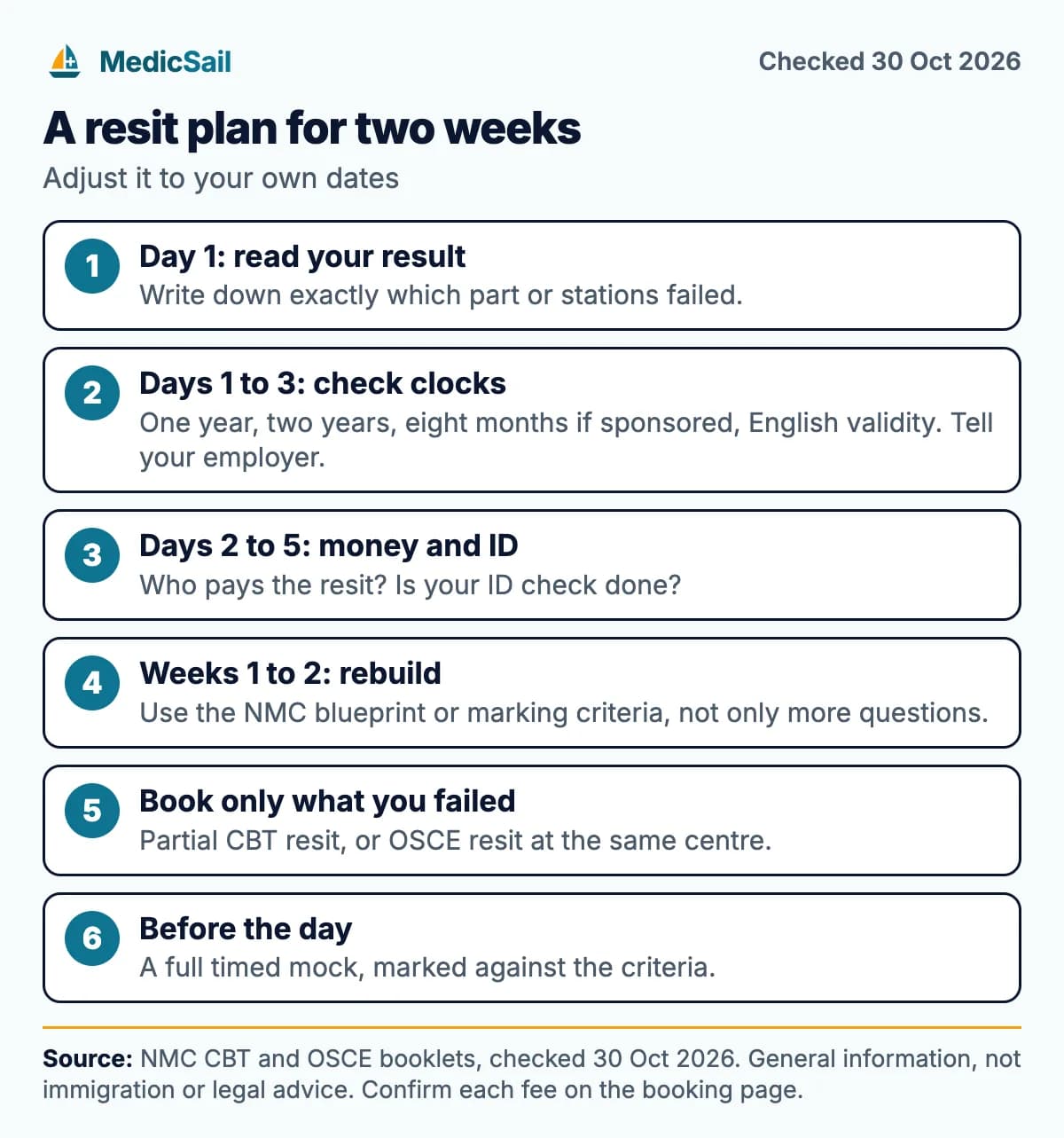
A resit plan, step by step
- Day 1: read your result and feedback. Write down exactly which part or stations you failed.
- Day 1 to 3: tell your employer or recruiter, and check your deadlines: the one-year CBT window, the two-year gap between the CBT and OSCE, the eight-month OSCE deadline if you are sponsored, and your English test expiry.
- Day 2 to 5: check who pays for the resit and whether your ID check is complete.
- Week 1 to 2: rebuild your preparation around the failed areas, using the NMC's materials.
- Book: the CBT partial resit through Pearson VUE, or the OSCE resit at the same centre. Book only the part or stations you need.
- Before the day: do a full timed mock of the failed part or stations, with someone marking against the criteria.
- If something goes wrong on the day: report it to the centre before you leave and keep evidence.
Once you pass, our guide to what happens after the OSCE covers the final steps to your PIN. For the overall route, see our page on NMC registration for overseas nurses and midwives.
If the UK route is not working for you
Some nurses decide, after a closed application, to look at other countries while they wait out the six months. Ireland's NMBI does not use the CBT and OSCE; it assesses your qualification and may ask for an aptitude test or adaptation period, as described in our NMBI aptitude test guide. The USA uses the NCLEX-RN, covered in our NCLEX-RN guide. The nursing hub compares the routes side by side. Each has its own costs and timeline, so compare carefully before you switch.
Questions
Three times in one application, with at least 10 days between sittings, and all within one year. After three failed attempts your application closes and you must wait six months before a new application.
Three times in one application, at the same test centre, with at least 10 days between sittings. If you fail the third attempt your application closes and you must wait at least six months, then sit all 10 stations again.
£397 if you need to resit seven or fewer stations and £794 if you failed eight or more. These are the NMC's fees following its increase on 1 October 2026.
£50 for Part A numeracy only, £70 for Part B clinical only, or £83 to resit both parts. You pay Pearson VUE before you sit.
No. The NMC says the two parts are passed or failed independently and you only resit the part you failed, as long as you are within the one-year window. After a third fail you sit the whole CBT on a new application.
NHS Employers says you must pass within eight months of the start of your visa. A first or second fail does not by itself end sponsorship, but if you are unsuccessful after the permitted attempts the employer must stop sponsoring you and your leave is shortened.
Not because you disagree with the mark. You can appeal if you believe the exam process was compromised or an irregularity occurred. The NMC may also agree a further attempt in exceptional circumstances such as illness or an interruption.
The NMC says you must pass the CBT and OSCE within two years of each other. If a closed application and six-month wait push you past that, you may need to sit the CBT again, so check your dates.
It depends on the employer. Some pay for resits, some do not, and some reclaim exam fees under a repayment clause. The government's Code of Practice allows only genuine exam costs the employer paid to be reclaimed, tapering over time.
Sources
- 1NMC: CBT
- 2NMC: OSCE
- 3NMC: Test of Competence
- 4NMC: costs for applicants trained outside the UK
- 5NMC: CBT candidate information booklet for nurses
- 6NMC: OSCE candidate information booklet for nurses
Show all 13 sourcesShow fewer sources
- 7NMC: ID check, OSCE resits
- 8NMC: evaluation fee
- 9NMC: language evidence
- 10Leeds Teaching Hospitals: the OSCE process
- 11NHS Employers: recruitment of overseas nurses and midwives
- 12GOV.UK: Code of practice for the international recruitment of health and social care personnel in England
- 13Pearson VUE: Nursing and Midwifery Council (NMC)
Plan it with our free tools
MedicSail
Healthcare licensing consultants for the UK, Europe and the USA
Updated and checked against the sources listed above. How we research and check our guides