


































NMBI compensation measures: the RCSI aptitude test or a period of adaptation
What an NMBI compensation measure is, how the RCSI aptitude test works (format, booking, fees, results), how a period of adaptation and assessment works, which one suits you and how to prepare.

MedicSail
Published
The short answer
If the Nursing and Midwifery Board of Ireland (NMBI) finds gaps between your nursing or midwifery training and Irish standards, your decision letter will say you need a compensation measure before you can register. There are two: an aptitude test run by the Royal College of Surgeons in Ireland (RCSI), or a period of adaptation and assessment, which is supervised clinical practice in an NMBI-approved Irish hospital or care facility. NMBI offers the choice only to applicants in the General Nurses and Psychiatric Nurses divisions. Midwives and every other division complete adaptation.
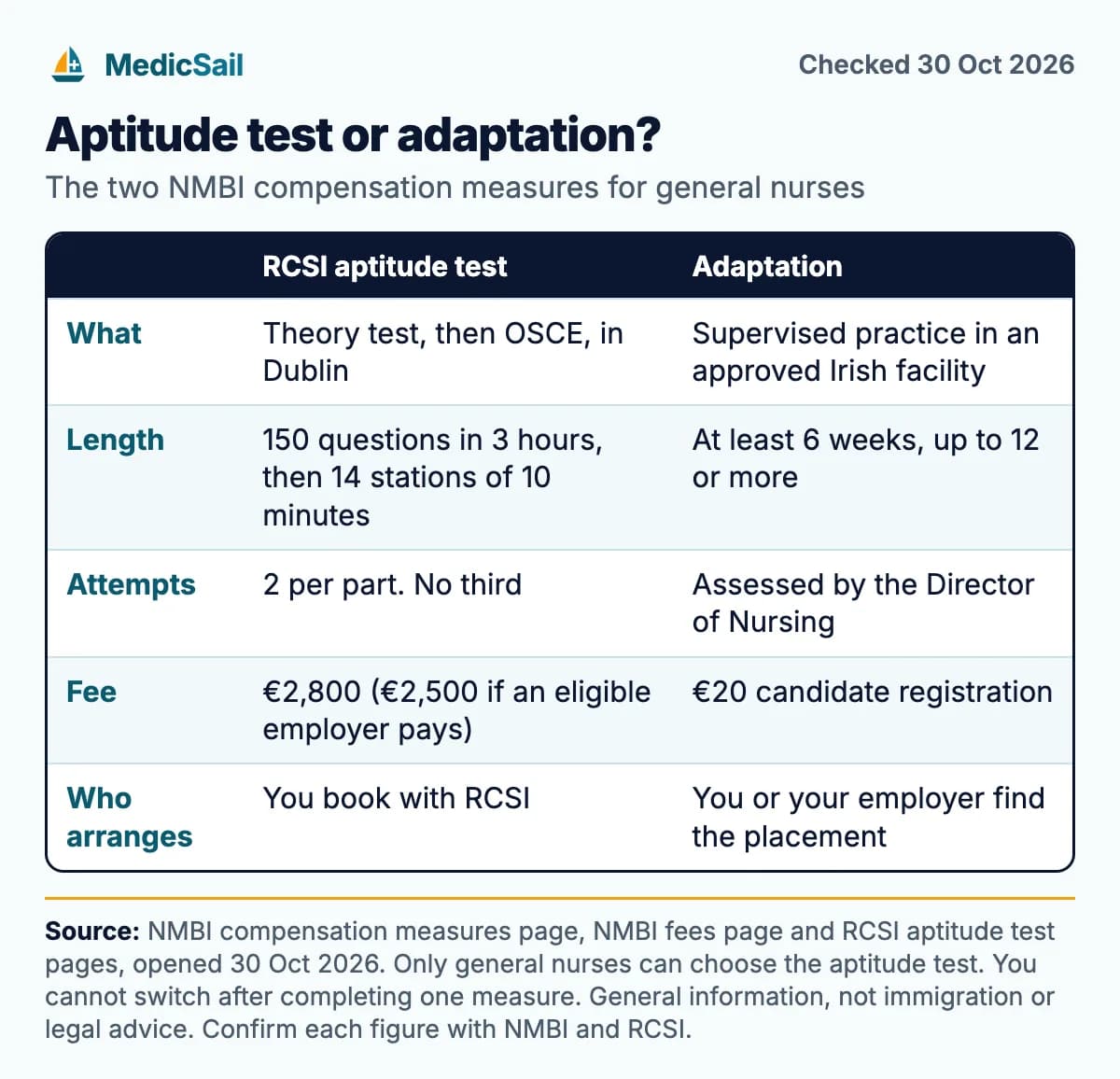
The RCSI aptitude test has two parts, both taken in Dublin: a theory test of 150 multiple-choice questions in three hours (pass mark 50%), then a practical OSCE of 14 stations of 10 minutes each. The fee is €2,800, or €2,500 if an eligible employer pays at the point of application, and it covers two attempts at each part. NMBI says aptitude test results are provided within three days of the test date. Adaptation lasts at least six weeks and may be extended to 12 weeks or more; you are placed on NMBI's Candidate Register for it, and the facility's Director of Nursing or Midwifery assesses you.
Whichever you choose, NMBI gives you 12 months from the date on its email to complete the aptitude test, or 12 months from the date on its letter to secure a period of adaptation, and if you complete one measure and fail it you cannot switch to the other. This guide explains each option in detail, how to choose, and how to prepare. For the full registration route, start with our page on how NMBI registration works for nurses and midwives trained abroad.
Where the compensation measure fits in your registration
NMBI registration for a nurse trained outside the EU is a two-step process. First you apply for recognition of your qualification in your MyNMBI account and pay the €350 overseas recognition fee. An education assessor compares your theory and clinical hours and content with NMBI's standards, and may take your post-qualification experience into account if your employers have completed NMBI's employment forms. Second, once you are recognised, you make a registration application, provide your English evidence and pay the €145 overseas registration fee.
The recognition decision has four possible outcomes: recognised, more information needed, a compensation measure required, or a provisional refusal. A compensation measure is not a fail. It means NMBI thinks the gaps in your training can be made up by showing your competence in Ireland. The measure is provisional and can be appealed, and NMBI gives you 12 months from the date on its email to complete the aptitude test and 12 months from the date on its letter to secure an adaptation placement.
NMBI's own figures show what the extra step costs in time: applicants who need a compensation measure take on average 13 months from submitting their documents to registration. Our guide to working as a nurse in Ireland sets out the whole timeline, including the job search, the employment permit and pay, and the Ireland country guide explains how the regulator, your employer and immigration fit together.
The two options side by side
| RCSI aptitude test | Period of adaptation and assessment | |
|---|---|---|
| Who can choose it | General Nurses division (NMBI also lists Psychiatric Nurses; RCSI currently publishes its test for general nurses) | All divisions, and the only option for midwives, children's and intellectual disability nurses |
| What it is | Part 1: theory test (150 MCQs, 3 hours). Part 2: practical OSCE (14 stations of 10 minutes) | Supervised clinical practice with theoretical and clinical modules, assessed against NMBI's competence assessment tools |
| Where | Dublin; the published venue is the Smurfit Building, Beaumont Hospital, Dublin 9 | An NMBI-approved health care facility anywhere in Ireland |
| How long | Two weekends, according to Immigration Service Delivery; both attempts at both parts must be finished within 12 weeks of your first theory attempt | At least six weeks; may be extended to 12 weeks or more |
| Cost to you | €2,800 to RCSI (€2,500 if an eligible employer pays at application), plus travel | €20 candidate registration fee to NMBI; any placement costs are agreed with the facility or employer |
| Who arranges it | You book with RCSI after your decision letter | You or your prospective employer secure the placement; NMBI does not organise it |
| Attempts | Two at each part; no third attempt | NMBI permits two attempts in total |
| Results | NMBI says results are provided within three days of the test date | The facility assesses you and confirms the outcome to NMBI |
The fees above are the ones RCSI and NMBI publish today. Check the NMBI fees and process summary before you pay, because both bodies change their charges from time to time.
The RCSI aptitude test: format
The test is coordinated by the RCSI Faculty of Nursing and Midwifery and is based on NMBI's Standards and Requirements for Nurse Registration Education Programmes (fifth edition). It is set at the level of a newly qualified general nurse in Ireland. RCSI says its purpose is patient safety and public protection, so it tests safe, effective practice rather than specialist knowledge.
Part 1: the theory test
- A supervised online assessment of professional knowledge and understanding.
- 150 multiple-choice questions in three hours. Each question has four options and you give one answer.
- The pass mark is 50%.
- You cannot leave until 60 minutes have passed.
- You must pass the theory test before you can attempt the OSCE.
- Bring your passport and a one-page copy of its biography page.
Part 2: the practical test (OSCE)
- An objective structured clinical examination of 14 stations, 10 minutes each.
- Each station has a descriptor sheet outside and inside. Some use manikins; at others an assessor plays a patient, relative or colleague. All equipment is provided.
- Assessors are experienced nurses with postgraduate qualifications, trained by RCSI.
- Each competency at each station is marked competent or not competent, and you must be competent in every competency at every station to pass.
- You attend in clinical uniform and present as you would on a ward, because the test simulates a clinical workplace.
RCSI publishes its own success rates: about 60% of candidates pass the OSCE at the first attempt and about 70% at the second. The figure is a useful warning. The OSCE is where most candidates struggle, usually because they have not practised with Irish documentation such as the INEWS chart, ISBAR handover and HSE-style medication records.
If you have seen the UK version, the structure will feel familiar but the content is Irish; our guide to the NMC OSCE in the UK shows how the two compare.
How to apply for and book the aptitude test
RCSI sets out the booking process in six steps. The deadlines are strict, and missing one usually moves you to a later date.
- Check you can travel and take the test. RCSI asks you to confirm your legal entitlement to be in Ireland for the test, your immigration documents, any employment contract, your notice period and your budget before you apply.
- Get your NMBI decision letter. It must be in date, state that the General Nurses Division applies, and state that you must complete the RCSI aptitude test as a compensation measure.
- Apply on the RCSI portal. Upload a recent photograph, the biography page of your passport and your NMBI decision letter. Your name must match the decision letter exactly. You also answer six mandatory questions, including your NMBI number, country of training, citizenship, prospective employer, agent and who is paying the fee.
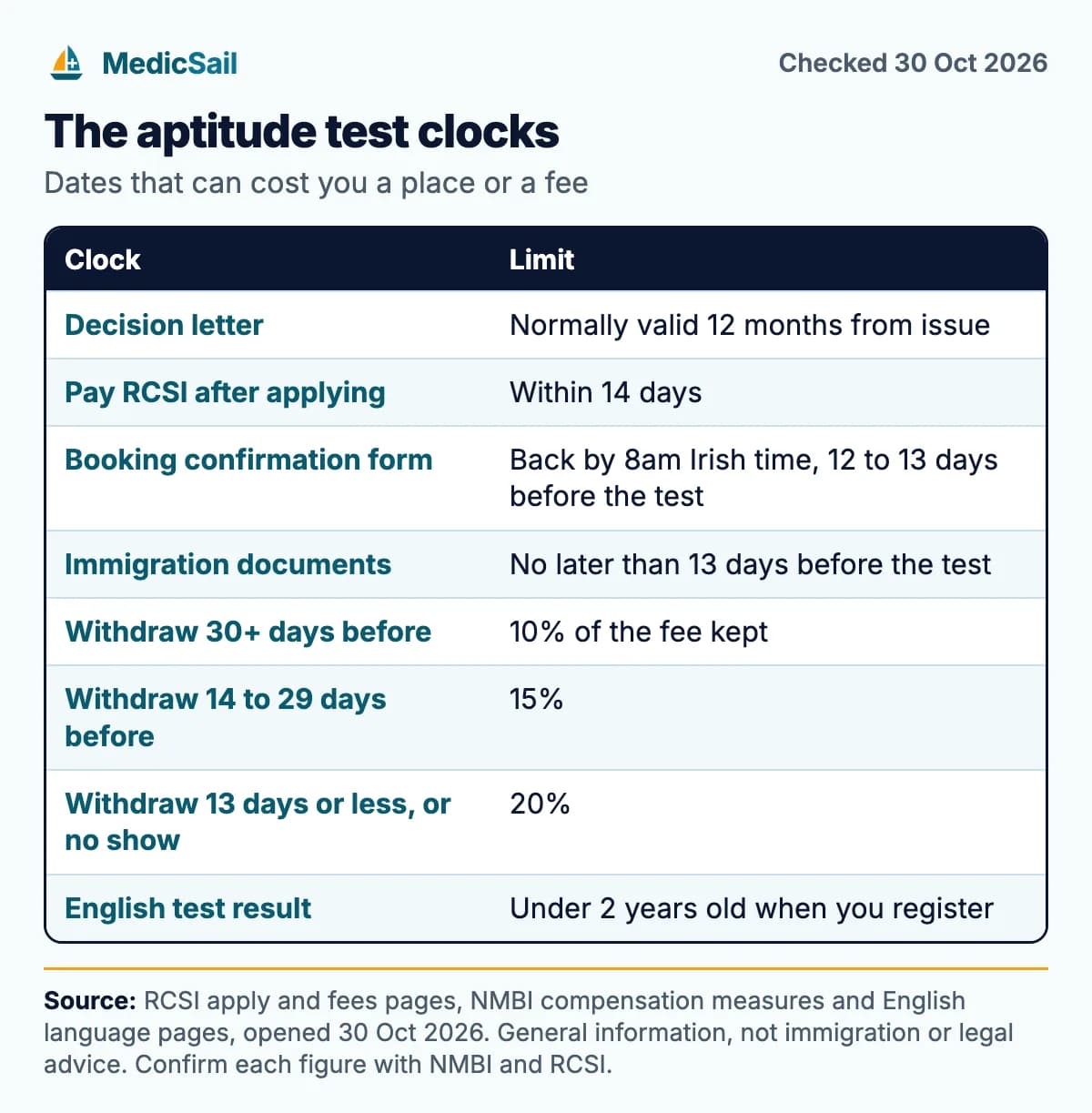
- Pay within 14 days. You receive an eight-digit RCSI ID number automatically. You must pay through TransferMate within a maximum of 14 days and upload the payment notification, or your application is withdrawn.
- Confirm your booking. RCSI sends a booking confirmation form no later than 17 days before the test date. It must reach RCSI by 8am Irish time on the Monday 12 or 13 days before the test, together with your immigration documents. Late forms move you to a later date.
- Update MyNMBI. Immediately before you confirm your place, log in to MyNMBI, open My pending compensation measures, select Aptitude test, choose Royal College of Surgeons, enter the test date and submit.
Test dates
RCSI says 35 tests are planned for 2026, with no tests in July or December, and that a test date generally opens 3.5 to 4.5 months in advance. On the day we checked, RCSI listed the next test as opening on 20 March 2027, which suggests the 2026 dates are fully allocated. Check the RCSI overview page for the current position before you plan travel or give notice.
Attempts and the 12-week window
You have two attempts at each part (one first attempt and one repeat). If you fail the theory test you sit all of it again; if you fail OSCE stations you retake only the stations you failed. RCSI recommends at least two weeks between attempts, and you must complete both attempts at both parts within 12 weeks of your first theory attempt. NMBI does not permit a third attempt.
Aptitude test fees, payments and refunds
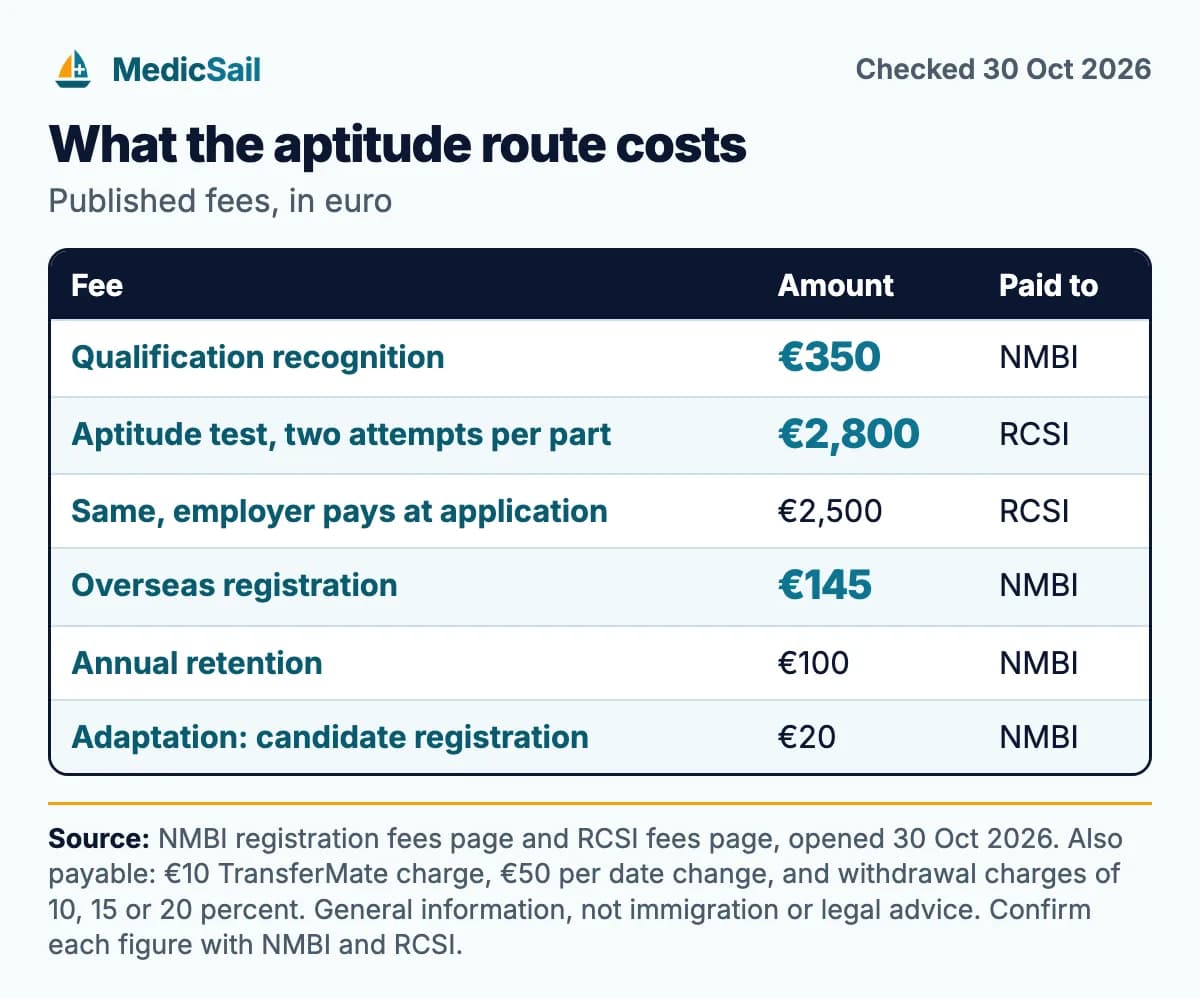
RCSI's published fees and charges are:
| Item | Amount |
|---|---|
| Aptitude test fee (two attempts at each part) | €2,800 |
| Fee where an eligible prospective employer pays at the point of application | €2,500 (not applied retrospectively) |
| TransferMate euro payment charge | €10 |
| Change of test date | €50 per change |
| Withdrawal before you receive a test date | €100 |
| Withdrawal 30 days or more before the test | 10% of the fee |
| Withdrawal 14 to 29 days before | 15% |
| Withdrawal 13 days or less before, a no-show or a missed confirmation | 20% |
| Fee paid outside TransferMate | €200 administration charge |
| Fee paid to the wrong account | €100 administration charge |
You can pay by bank transfer or personal debit or credit card through TransferMate. Each payment must show your full name exactly as on the NMBI decision letter and your eight-digit RCSI ID. There is no automatic refund of unused fees. The exception is a candidate who fails the theory retake: the unused practical portion is refunded. Refunds take about a month for TransferMate payments and up to three months otherwise.
Add the NMBI fees to your budget: €350 for recognition, €145 for registration and €100 each year to stay on the register. If your employer is paying the RCSI fee, ask them to pay at the point of application so the €2,500 rate applies, and get the arrangement in writing, including what happens if you leave within a set period.
The period of adaptation and assessment
A period of adaptation is supervised clinical practice in an NMBI-approved Irish health care facility. NMBI describes it as including theoretical and clinical modules, with a clinical component of at least six weeks that may be extended to 12 weeks or more. The facility's Director of Nursing or Director of Midwifery assesses you, using NMBI's competence assessment tools for nurses or for midwives. NMBI can also decide that adaptation should be supplemented with additional academic training.
Finding a placement
NMBI has no role in organising adaptation placements. It publishes a list of approved facilities by division (general, children's, psychiatric and midwifery), with major sites such as St James's Hospital, Tallaght University Hospital, the Coombe and the Rotunda, and it says you are responsible for contacting the sites and that some may be full. In practice most nurses who adapt do so with the employer that has offered them a job, because the employer has a reason to host and pay for the placement. NMBI says you have 12 months from the date on the letter to secure a period of adaptation; confirm the placement to NMBI in MyNMBI.
The Candidate Register
Once your placement is confirmed, NMBI places you on the Candidate Register for its duration and issues a Candidate Certificate. The candidate registration fee is €20. You are not a registered nurse during adaptation, and you work under supervision.
Pay during adaptation
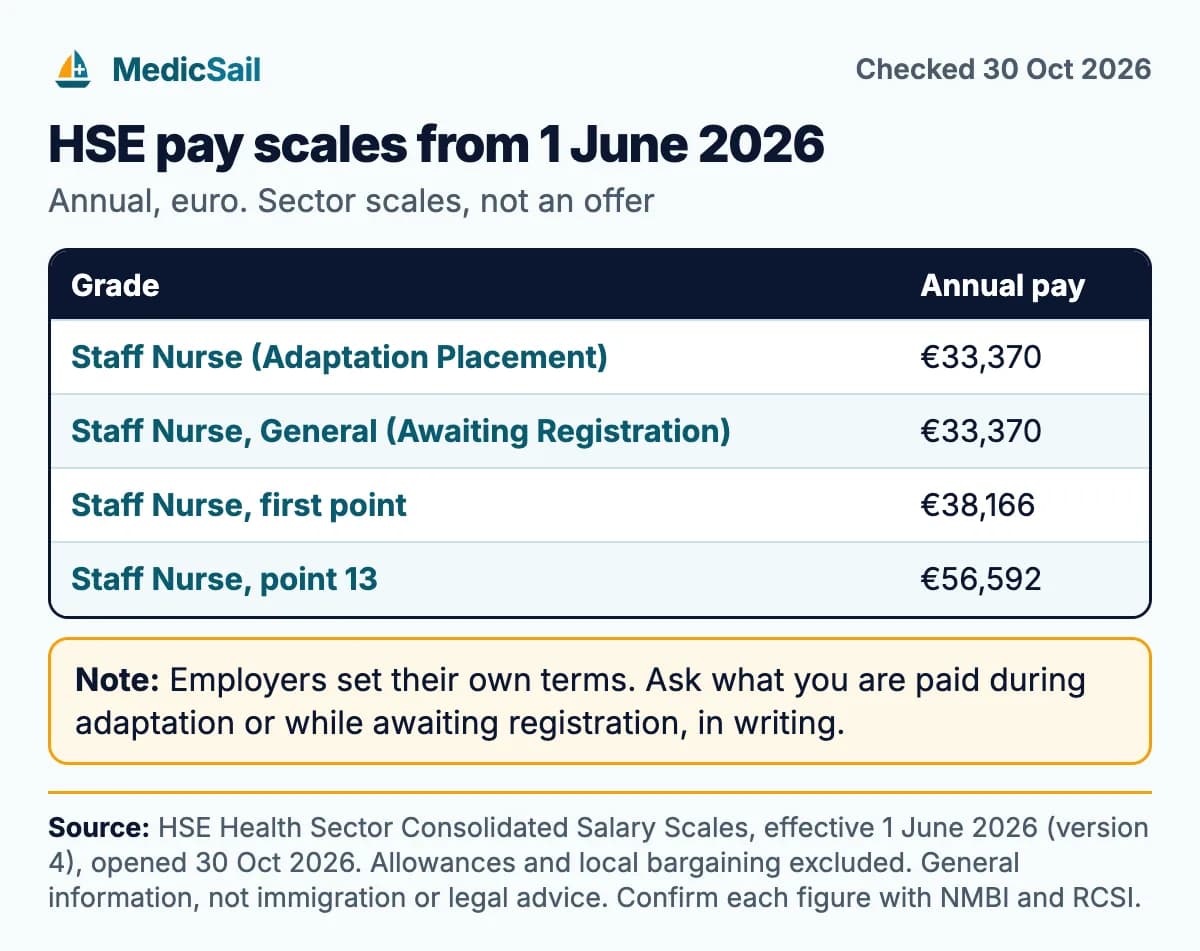
Pay is a matter for the employer. The HSE's consolidated salary scales effective 1 June 2026 include a specific grade for a staff nurse or midwife awaiting registration or an adaptation placement, at €33,370 a year (€34,004 for psychiatric and mental health grades). Once you register you move onto the staff nurse scale, which starts at €38,166. Private employers set their own rates, so check your contract.
Midwives always take this route; our guide to registering as a midwife in Ireland covers the midwifery-specific competence tools and approved maternity units.
Coming to Ireland for the test or for adaptation
Both compensation measures happen in Ireland, so if you are not an EU or EEA national you need permission to enter. For nurses with a job offer, Immigration Service Delivery (ISD) runs the Atypical Working Scheme (AWS) for nurses for exactly this purpose. Its rules, as ISD publishes them, are:
- You need a signed contract of employment of at least two years (it can be permanent), signed in ink and dated by both you and the employer. A letter of offer is not accepted.
- The contract start date must be the date of your aptitude test or the start of your adaptation, and cannot be earlier.
- You apply from outside Ireland before applying for a visa, if you are a visa-required national, and you may make only one AWS application in any 12-month period.
- Permission is granted for a maximum of six months, which ISD says should be enough to finish the measure, receive your NMBI registration, get an employment permit and register your immigration permission.
- AWS permission is not permission to work. You cannot work as a health care assistant or through an agency while on it.
- The permission is tied to the employer and location in your application.
- If you do not achieve registration you may appeal, but you must leave Ireland before your six months expire.
Once you pass and receive your NMBI PIN, your employer applies for your employment permit, usually a Critical Skills Employment Permit for registered nurses. Our guide to the Critical Skills Employment Permit for health workers explains that step, the salary rules for HSE posts and when you can apply for Stamp 4.
If you choose the aptitude test and do not yet have a job offer, the AWS route is not open to you. You would need whatever short-stay permission applies to your nationality to travel for the test, and RCSI asks you to send your immigration documents with your booking confirmation.
How to choose between the aptitude test and adaptation
NMBI does not recommend one measure over the other, and neither do we in general: the right choice depends on your division, your job offer and how you learn. These are the questions that decide it for most general nurses.
- Do you have a job offer? With an employer that runs adaptation, adaptation is usually simpler: the employer finds the placement, may pay you on the awaiting-registration grade and supports your AWS application. Without an offer, the aptitude test is the measure you can arrange yourself.
- Can you get a test date? RCSI's dates open months ahead and fill quickly. If the next open date is far off, a placement with an employer may be faster, and the 12-month limit from NMBI's email or letter keeps running.
- How do you perform under exam conditions? The OSCE is pass-or-fail at every competency of every station, and RCSI's own figures show about 40% of candidates fail at the first attempt. Adaptation assesses you over weeks of real practice, which suits nurses who are strong clinically but nervous in exams.
- How long can you be away? The test is two weekends, though both attempts must fit within 12 weeks. Adaptation takes at least six weeks and can be extended, so you need leave or a notice period that covers it.
- What can you afford? The test costs €2,800 unless your employer pays, plus travel and accommodation in Dublin. Adaptation costs €20 to NMBI, but you need to live in Ireland for the placement.
Think carefully before you start, because NMBI lets you change your selection only before you begin either measure. Once you complete one and fail it, you cannot start the other, and NMBI allows two attempts in total. If you are in the Psychiatric Nurses division, confirm with NMBI and RCSI whether a psychiatric aptitude test is currently available, because RCSI's current pages describe a test for general nurses only.
How to prepare
For the aptitude test
RCSI says to base your revision on NMBI's Standards and Requirements for nurse registration programmes and the NMBI Code of Professional Conduct and Ethics (February 2025). It does not approve or acknowledge any preparation courses. Its preparation page links to the Irish tools and guidance that stations draw on, and these are the ones to practise with until they feel routine:
- INEWS (Irish National Early Warning System) observation charts and escalation.
- ISBAR communication, including the modified ISBAR RCSI uses for its OSCEs.
- HSE medication record templates, weight-based dose calculations, NMBI's guidance on medication administration and the time-critical medicines safety alert.
- Risk tools: the Waterlow pressure ulcer score, MUST, the 4AT delirium screen, the Clinical Frailty Scale, a multifactorial falls risk assessment and the adult sepsis screening tool.
- Infection prevention: hand hygiene, standard precautions, PPE and aseptic non-touch technique.
- Care topics: cardiovascular, respiratory, gastrointestinal, renal and urinary care, wounds and the SSKIN bundle, peripheral venous catheters and fluid balance, palliative and end-of-life care and care of the older person.
- Irish law and policy: consent, safeguarding, open disclosure and the Assisted Decision-Making (Capacity) Act.
RCSI publishes sample MCQs and sample OSCE scenarios. Work through them with a timer, then practise filling in the documentation by hand: many failed stations come from a correct action recorded on the wrong chart, or not recorded at all. Practise speaking aloud as you work, so the assessor can see your reasoning.
For adaptation
Ask your placement for the competence assessment tool before you start and read it with your preceptor in the first week. Learn the local medication policy, the INEWS escalation pathway and the documentation system, and keep a log of the competencies you have shown. Adaptation is assessed on consistent, safe practice over weeks, so ask for feedback early rather than waiting for the final review.
Your English evidence is a separate requirement and is checked at registration, not at the compensation measure. NMBI accepts IELTS Academic or OET from one sitting less than two years old; our comparison of IELTS and OET for healthcare regulators explains how the two tests differ, and the NMBI page lists Ireland's scores.
After you pass, and if you fail
When you pass the aptitude test or complete adaptation successfully, NMBI updates your recognition and you make your registration application in MyNMBI: you answer the registration questions, provide your English evidence and pay the €145 overseas registration fee. NMBI aims to decide within 20 working days of having everything. Once registered you appear on the public register, receive your PIN and can work under the protected title.
If you do not pass, the refusal is provisional. You can appeal to NMBI's Registration Committee (the appeals fee is €150). NMBI says the committee may uphold the refusal, overturn it if there were mitigating circumstances, in very limited circumstances offer another attempt, or direct registration where the documentary requirements are met. If the committee's appeal fails, you can appeal to the High Court within three months.
If you cannot travel within the 12 months, NMBI says it extends decision letters for overseas applicants who are unable to travel, and gives three months' notice before an extension ends. Ask NMBI in writing rather than assuming an extension applies to you.
Nurses who also hold or are considering a UK route can compare the two systems: the UK uses a fixed Test of Competence for everyone, explained in our NMC CBT guide, while Ireland assesses each applicant individually and only some need a compensation measure.
If you are working in the Gulf
Many nurses applying to NMBI are working in Saudi Arabia, the UAE, Qatar, Kuwait, Oman or Bahrain. Your Gulf licence (SCFHS, DHA, DOH, MOHAP, QCHP or another) does not exempt you from a compensation measure, because NMBI assesses the programme you trained on. Gulf experience can still help at the assessment stage, which is earlier: NMBI's assessor can use post-qualification experience to address gaps, but only if each employer completes NMBI's employment form. Ask your Gulf hospitals for these forms before you submit, because a stronger file may mean no compensation measure at all.
Both measures take place in Ireland, so plan leave or your notice period around the test date or placement. NMBI advises against resigning or moving until registration is assured. If an Irish employer has offered you a post, ask whether they host adaptation and pay the RCSI fee, and whether they will support an Atypical Working Scheme application. Our nursing hub compares Ireland with the UK, Germany, the Netherlands and the USA if you are still deciding where to go.
Questions
It is the step NMBI asks you to complete when your training differs from Irish standards in ways that can be made up by showing competence in Ireland. It is either an aptitude test run by RCSI or a period of adaptation and assessment in an approved facility. Only after completing it can your qualification be recognised and your registration go ahead.
No. NMBI offers a choice between the aptitude test and adaptation only in the General Nurses and Psychiatric Nurses divisions. Midwives and all other divisions complete adaptation. RCSI's current pages describe the test for general nurses, so psychiatric nurses should confirm availability with NMBI and RCSI.
RCSI charges €2,800, which covers two attempts at each part, or €2,500 if an eligible prospective employer pays at the point of application. A €10 TransferMate charge applies, and there are charges for changing dates or withdrawing. Travel and accommodation in Dublin are extra.
RCSI describes the theory test as a supervised online assessment, and the OSCE is held in person in Dublin, at the Smurfit Building, Beaumont Hospital. Immigration Service Delivery describes the test as taking place over two weekends, so plan to be in Ireland for it.
The theory test pass mark is 50% across 150 multiple-choice questions. In the OSCE you must be judged competent in every competency at every one of the 14 stations. RCSI says about 60% pass the OSCE at the first attempt and about 70% at the second.
Two at each part of the aptitude test, and no third attempt. You must complete both attempts at both parts within 12 weeks of your first theory attempt. If you fail OSCE stations you retake only those stations.
NMBI says the clinical component is at least six weeks and may be extended to 12 weeks or more. ISD's Atypical Working Scheme page gives 6 to 12 weeks. The facility decides when you have shown the required competence.
No. NMBI publishes the list of approved facilities but has no role in organising placements. You or your prospective employer must arrange it within 12 months of the date on NMBI's letter, then confirm it in MyNMBI.
That depends on your employer. The HSE pay scales from 1 June 2026 include a grade for a staff nurse awaiting registration or an adaptation placement at €33,370 a year, and private employers set their own rates. Check your contract before you travel.
No. NMBI lets you change your choice before you start either measure, but once you complete one and fail it you cannot then start the other. You can appeal the outcome to NMBI's Registration Committee.
Sources
- 1NMBI: Compensation measures
- 2NMBI: Approved health care facilities for adaptation
- 3NMBI: Outcomes of assessment
- 4NMBI: Registration fees
- 5NMBI: Applicant User Guide (PDF)
- 6NMBI: Standards and Requirements for Nurse Registration Education Programmes, fifth edition (PDF)
Show all 14 sourcesShow fewer sources
- 7RCSI: Overseas aptitude test overview
- 8RCSI: Aptitude test theory test
- 9RCSI: Aptitude test practical test
- 10RCSI: Aptitude test preparation
- 11RCSI: Aptitude test fees
- 12RCSI: Apply for the aptitude test
- 13Irish Immigration: Atypical Working Scheme for nurses
- 14HSE: Consolidated salary scales, 1 June 2026
Plan it with our free tools
MedicSail
Healthcare licensing consultants for the UK, Europe and the USA
Updated and checked against the sources listed above. How we research and check our guides