


































PRES: the Medical Council's Pre-Registration Examination System for doctors
Who has to sit the Pre-Registration Examination System, the exemptions, the Level 2 and Level 3 formats, 2026 dates and venues, fees, attempts, results, appeals and the step to registration.

MedicSail
Published
The short answer
The Pre-Registration Examination System (PRES) is the Medical Council's exam for doctors who qualified outside the EU/EEA and want general or trainee specialist registration in Ireland, but who do not qualify through the Certificate of Experience (COE) or Higher Qualification (HQ) routes. It has two parts. PRES Level 2 tests clinical knowledge in a three-hour, scenario-based multiple-choice exam. PRES Level 3 tests clinical skills in a one-hour interpretation exam and a 2 hour 40 minute clinical exam of 12 active seven-minute stations.
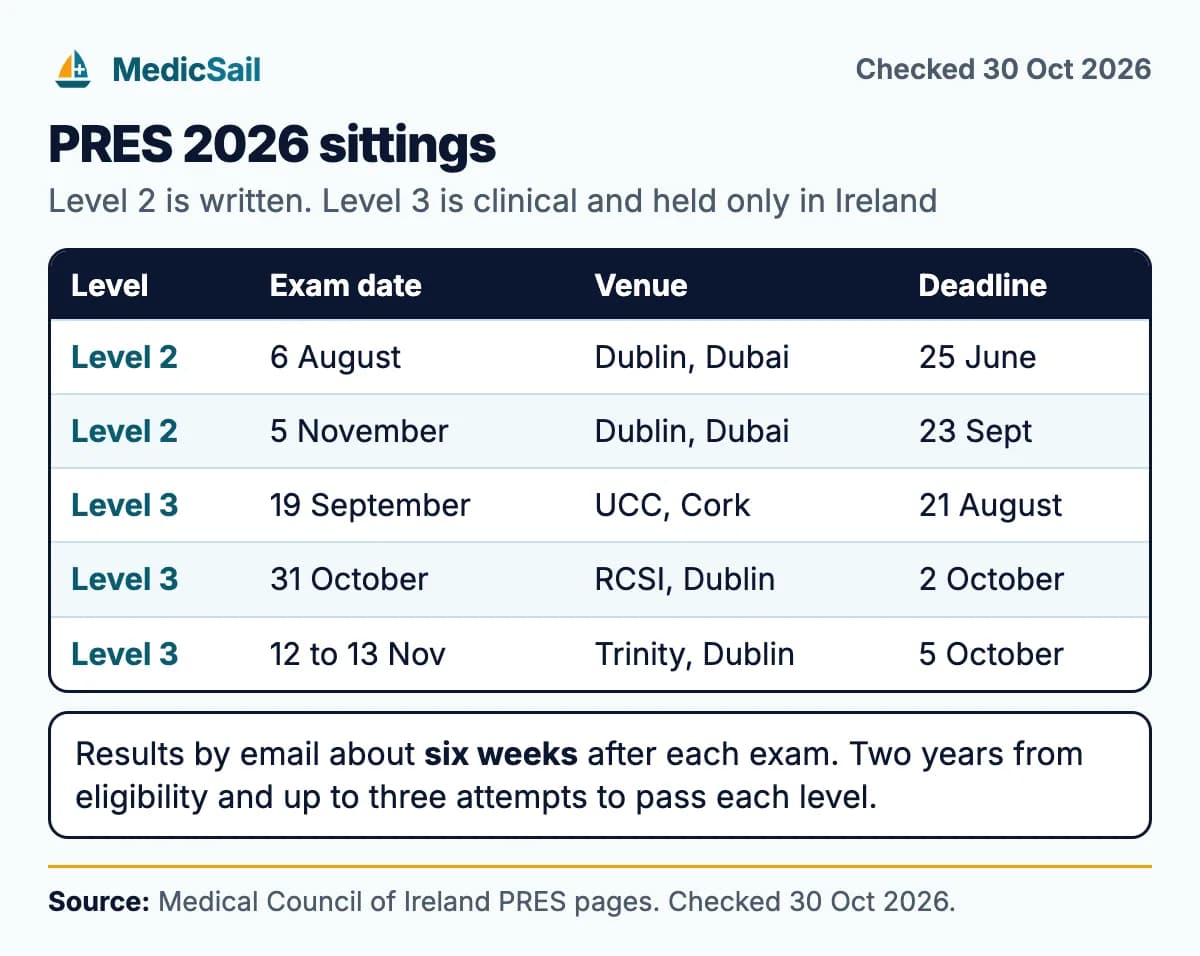
In 2026 the Medical Council held Level 2 on 6 August and 5 November, in Dublin and in Dubai, for a fee of €352. Level 3 costs €1,500 per attempt and is held only in Ireland: the 2026 sittings were at University College Cork (19 September), RCSI in Dublin (31 October) and the Trinity Biomedical Sciences Institute with Tallaght University Hospital (12 and 13 November). Results for both levels arrive by email about six weeks after the exam, as a pass or a fail. You have two years from being declared eligible, and up to three attempts, to pass each level.
You can skip Level 2 with a pass in PLAB 1, USMLE Step 1 and Step 2 CK, MCCQE Part 1 or the AMC MCQ, and a pass in PLAB 2 exempts you from PRES altogether. This guide covers every step, from eligibility to registration. For the wider route, see our page on how Medical Council registration works for international doctors.
Who needs PRES, and who does not
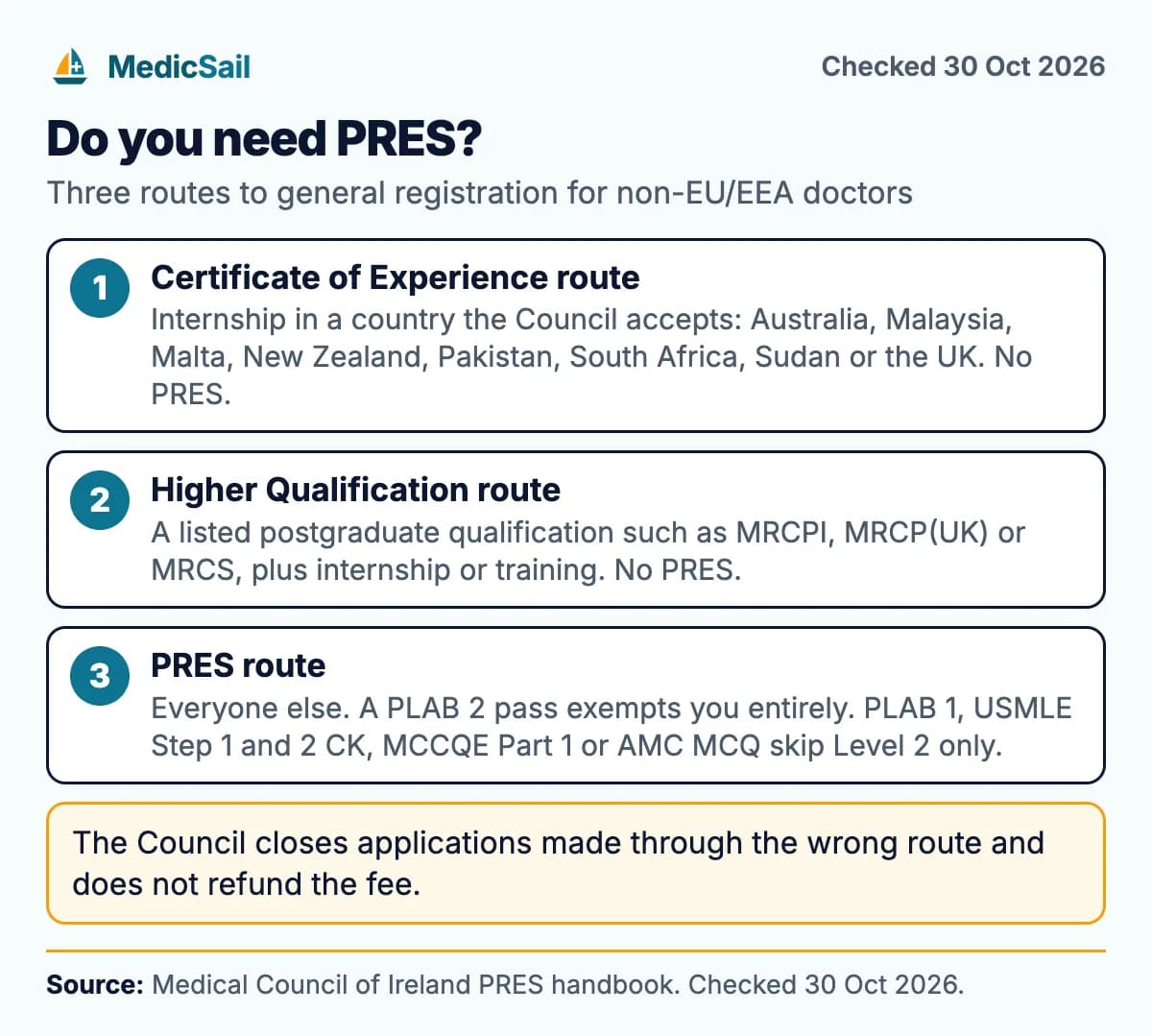
The Medical Council has three routes to general registration for doctors who qualified outside the EU/EEA. Work out which applies to you before you pay anything, because the Council closes applications made through the wrong route and does not refund the fee.
- Certificate of Experience (COE) route: your internship was done in a country the Council accepts as equivalent to the Irish internship. The list is Australia, Malaysia, Malta, New Zealand, Pakistan, South Africa, Sudan and the UK, each with conditions. No PRES.
- Higher Qualification (HQ) route: you hold a postgraduate qualification on the Council's recognised list, such as MRCPI, MRCP(UK), MRCS, FRCR, MRCOG, MRCPCH, MRCPsych or MRCGP, plus an internship or at least three years in one accredited training programme. No PRES.
- PRES route: everyone else who wants general registration, or trainee specialist registration without one of those routes.
Exemptions and alternatives
- PLAB 2: a pass in the GMC's PLAB 2 exempts you from PRES entirely. You still apply through the PRES route, select the PLAB 2 option and upload the GMC's confirmation. If more than three years have passed since PLAB 2 and you have not practised, the Council reviews your recency of practice under its Fit and Proper policy.
- Alternatives to Level 2 only: the PRES handbook accepts PLAB 1 (a pass dated within three years), USMLE Step 1 and Step 2 CK (dated within seven years), MCCQE Part 1 and the AMC MCQ, each for the period the awarding body treats it as valid. With one of these you go straight to Level 3.
The arrangement runs one way. The Council says there is no reciprocal arrangement with the GMC, so PRES does not count towards UK registration, and the handbook says Level 2 is not accepted by any other regulator. If you are weighing both countries, our PLAB 1 and PLAB 2 guide shows how a PLAB 2 pass could serve both.
Step one: the application that makes you eligible
You cannot simply book PRES. The handbook says every applicant's documents are assessed and verified before eligibility for Level 2 or Level 3 is granted. You do this through the Council's online Doctors Portal:
- Verify your degree through EPIC. Your basic medical qualification must be from a school in the World Directory of Medical Schools, and its EPIC verification report must reach the Council before you submit. If you are relying on an internship certificate, that is verified through EPIC too. Our page on ECFMG and EPIC verification explains how to open an account and what it costs.
- Create your account and choose the PRES route. Register on the portal, verify your email and select the PRES route for the General Division.
- Pay the application fee. The first-time application fee for the General or Trainee Specialist Division is €451. It is not refunded if your application is incomplete, ineligible or withdrawn.
- Upload your documents. A notarised or attested copy of your passport, evidence of your communication skills (English) and any route evidence such as PLAB, USMLE, MCCQE or AMC results.
- Arrange certificates of good standing. Each regulator you have been registered with in the past five years emails a certificate directly to the Council. For Level 3 it must be dated within the last three months.
When the assessment is complete, the Council emails you an eligibility letter for Level 2, or for Level 3 if you hold an accepted alternative. The date on that email starts your two-year eligibility window, so do not apply until you are ready to sit within that period.
English is part of the file. The Council accepts OET Medicine at grade B or higher in each module, IELTS Academic at 7.0 overall with at least 6.5 in each module, or Cambridge C1 Advanced or C2 Proficiency, from a single sitting within two years. Online versions are not accepted. Graduates of medical schools in Ireland, the EU/EEA, the UK, Australia, New Zealand and the USA are exempt.
PRES Level 2: clinical knowledge
Level 2 is a written exam of multiple-choice questions, answered in three hours. Each question starts with a short clinical scenario followed by a question, and you choose the best answer from the options given. The exam reflects real day-to-day practice and covers the five disciplines the whole system is built on: obstetrics and gynaecology, paediatrics, psychiatry, surgery, and medicine and general practice. The Council publishes a Level 2 Blueprint that sets out what is examined; use it as your syllabus. PRES as a whole is based on the Council's Eight Domains of Good Professional Practice.
2026 dates, venues and deadlines
| Exam date | Venues | Application deadline |
|---|---|---|
| 6 August 2026 | Dublin, Ireland; Dubai, UAE | 25 June 2026 |
| 5 November 2026 | Dublin, Ireland; Dubai, UAE | 23 September 2026 |
Both 2026 deadlines have passed. The Council publishes the next year's dates on its PRES Level 2 exam page, and the pattern so far has been a deadline about six weeks before each sitting. The May 2023 handbook still says Level 2 is held in Dublin only, so rely on the exam page, not the handbook, for venues.
Booking
Once you are declared eligible, download the application form for your chosen venue (Dublin and Dubai have separate forms) and email it to [email protected]. Places are limited and allocated first come, first served. The confirmation letter arrives about seven days before the exam with your instructions for the day.
Withdrawals
If you cannot attend, tell [email protected] at once. If you do not withdraw before the application deadline, you forfeit the full fee. Transfers between dates or venues are not allowed, and absent candidates forfeit the fee.
Attempts
The handbook says you must pass Level 2 within two years of the date you are declared eligible, with up to three attempts in that time. If you fail three times or the two years run out, your eligibility expires and you must make a new application.
PRES Level 3: clinical skills
Level 3 assesses three types of skill, practical, communication and interpretation, in two examinations that may be held on the same day or on different days.
| Component | Format | Time |
|---|---|---|
| Practical and communication skills | One clinical exam: a circuit of 12 active stations of seven minutes each, plus rest stations and preparatory stations where you read the instructions for the next station. Up to one minute to move between stations. | 2 hours 40 minutes |
| Interpretation skills | One data interpretation exam of six questions, paper-based or computer-based | 1 hour |
Practical stations use simulated patients or anatomical models, and occasionally real patients. The handbook's examples include examining a patient's mental state, procedural skills such as using an auroscope or ophthalmoscope, taking blood pressure, recording an ECG or measuring peak flow, taking a focused history, and giving information to a colleague such as a nurse, paramedic or registrar. Interpretation questions may involve ECGs, prescribing and pharmacology, laboratory results, paediatric growth charts, clinical photographs and X-rays.
How it is marked
- Each station or question is marked out of 20, and each of the three skill types is marked out of 120.
- The pass mark for each skill type is set by the Modified Angoff or borderline regression method.
- You must pass all three skill types. Marks can compensate within a skill type but not between them.
- There is no negative marking.
- A clinical error that compromises the patient, such as not clearing the airway at the start of resuscitation, or one that endangers anyone, such as unsafe sharps disposal, fails that station.
- Concerns about professional or ethical behaviour are recorded as a critical incident and can lead the Examination Board to review your whole performance.
2026 sittings
| Exam date | Venue | Application deadline |
|---|---|---|
| 19 September 2026 | University College Cork | 21 August 2026 |
| 31 October 2026 | Royal College of Surgeons in Ireland, Dublin | 2 October 2026 |
| 12 to 13 November 2026 | Trinity Biomedical Sciences Institute and Tallaght University Hospital, Dublin | 5 October 2026 |
The handbook says Level 3 normally lasts about 3 hours 40 minutes in total and that you may be at the venue for about five and a half hours, including about 40 minutes of signing in. Bring your admission letter and your current passport, the same identity document named on the admission letter; no other ID is accepted.
Booking Level 3: priority, standby and withdrawals
The Medical Council emails Level 3 dates and the application form to every eligible candidate. You send the completed form and payment of the €1,500 fee to [email protected]. Places are limited and allocated in this order of priority, first come first served within each group:
- Candidates sitting Level 3 for the first time.
- Candidates whose eligibility expires before the next Level 3 session.
- Everyone else.
Priority does not guarantee a place at a particular sitting. If you apply after allocations close you may join a standby list; the handbook says standby offers usually give you about 24 hours, sometimes less, to accept.
The fee applies to every attempt and is paid in euro by Visa or Mastercard debit or credit card. If a third party such as an employer pays and the fee is later refunded, the refund goes to you, not to them.
To withdraw, you must complete the Level 3 Withdrawal Form; an email or phone call is not enough. The fee, less a service charge, is forfeited unless the Council receives your withdrawal on or before the closing date. You cannot transfer to another sitting: you withdraw and re-apply with a new fee. Withdrawing, or being absent, does not count as an attempt, but you lose the fee if you are absent or arrive too late to be admitted.
Level 3 is held only in Ireland, so plan your visa early if you need one. The Council says it cannot help with visa applications, and the handbook passes on Immigration Service Delivery's advice to allow at least eight weeks.
Results, attempts and appeals
The Council issues results for both levels by email about six weeks after the exam, as a pass or a fail. No certificate or diploma is issued. For Level 3, successful candidates' Medical Council reference numbers are also posted on the Council's website when the results letters go out. The Council asks candidates not to phone about results, and does not give results by phone or in person.
- If you pass Level 3, and your registration application is complete and satisfactory, you receive an eligibility e-letter explaining the next step in registration.
- If you fail, you receive a breakdown of your results. The handbook says all Level 3 results are checked at least three times and borderline results get extra scrutiny.
- Attempts: the Council limits candidates to three attempts at any level. For Level 3 you have two years from the date you were declared eligible for it. If you fail three times or the two years pass, your eligibility expires and you must submit a new application for Level 2.
- Appeals: you can appeal a Level 3 result on the Level 3 Appeal Form, which appears on the Council's website on results day and must reach the Council within one calendar month. Appeals are decided on set grounds about the conduct of the exam and the marking; being surprised by your result is not a ground. The Examination Coordinator rechecks the scripts, and if the review shows you reached the pass mark in each skill type and overall, the fail can be declared void and a pass awarded.
Because a failed attempt also costs the full fee again, it is worth treating your first Level 3 as the one you intend to pass, rather than a practice run.
How to prepare
The Medical Council does not publish past papers, does not provide or endorse any preparation course, and does not endorse any book written specifically about passing PRES. It suggests the major textbooks in obstetrics and gynaecology, paediatrics, psychiatry, surgery, medicine and general practice, plus journals to stay up to date. That leaves you with three official tools: the Level 2 Blueprint, the PRES handbook and the Council's Guide to Professional Conduct and Ethics.
Level 2
- Map your revision to the Blueprint and the five disciplines, giving obstetrics, paediatrics and psychiatry real time if you have worked mainly in one specialty.
- Practise scenario-based single-best-answer questions under timed conditions so that three hours feels comfortable.
- If you are also preparing for PLAB 1 or USMLE, remember that a pass in either is an accepted alternative to Level 2, so you may only need one of the exams.
Level 3
- Read each station's instructions carefully. The handbook says one of the most common mistakes is doing something other than the task: if you are asked to take a history, you gain no marks for explaining a management plan.
- Listen to the patient, avoid talking at them, use plain language and give information specific to their problem rather than general statements or set phrases.
- Practise procedures with standard precautions, including hand hygiene and safe sharps disposal, because safety errors fail a station outright.
- Practise ECGs, X-rays, laboratory results, growth charts and prescribing questions within a one-hour, six-question format.
- Do not leave a station early, and if you finish, do not make small talk with the examiner or simulated patient.
- Read the Guide to Professional Conduct and Ethics: consent, confidentiality and honesty underpin the communication stations.
After PRES: registration and your first job
Passing PRES does not register you. Once the Council confirms your registration application is complete, you pay the registration fee for the period and your name is entered in the General Division. The Council's 2026/27 annual fees include €616 for a full year for recently registered doctors (under three years) and €665 for doctors on the register for more than three years, with half-year rates for registrations from January to April. The registration year runs from 1 July to 30 June, and a late payment fee of €50 may apply if you miss the 1 July retention deadline.
Your certificates of good standing must still be in date when your registration is activated, and your English certificate must be within two years of both your application and your registration. If your PRES journey has taken a long time, check both before the final step.
The Council advises that you do not accept a job offer until your registration application is complete and active. In practice many doctors interview for non-consultant hospital doctor (NCHD) posts during or after PRES. Medical practitioners are on Ireland's Critical Skills Occupations List, so a two-year post usually leads to a Critical Skills Employment Permit; NCHDs on a two-year multi-site General Employment Permit receive Stamp 1H, which ISD says carries similar benefits. Our guide to the Critical Skills Employment Permit for health workers explains both, and our guide to working as a doctor in Ireland covers HSE pay scales, training posts and specialist registration.
If you have been offered an HSE-approved supervised post, the Supervised Division is a separate route with its own requirements, including proof that you have passed or are exempt from PRES; read the Council's supervised registration page before you apply.
What PRES costs and how long it takes
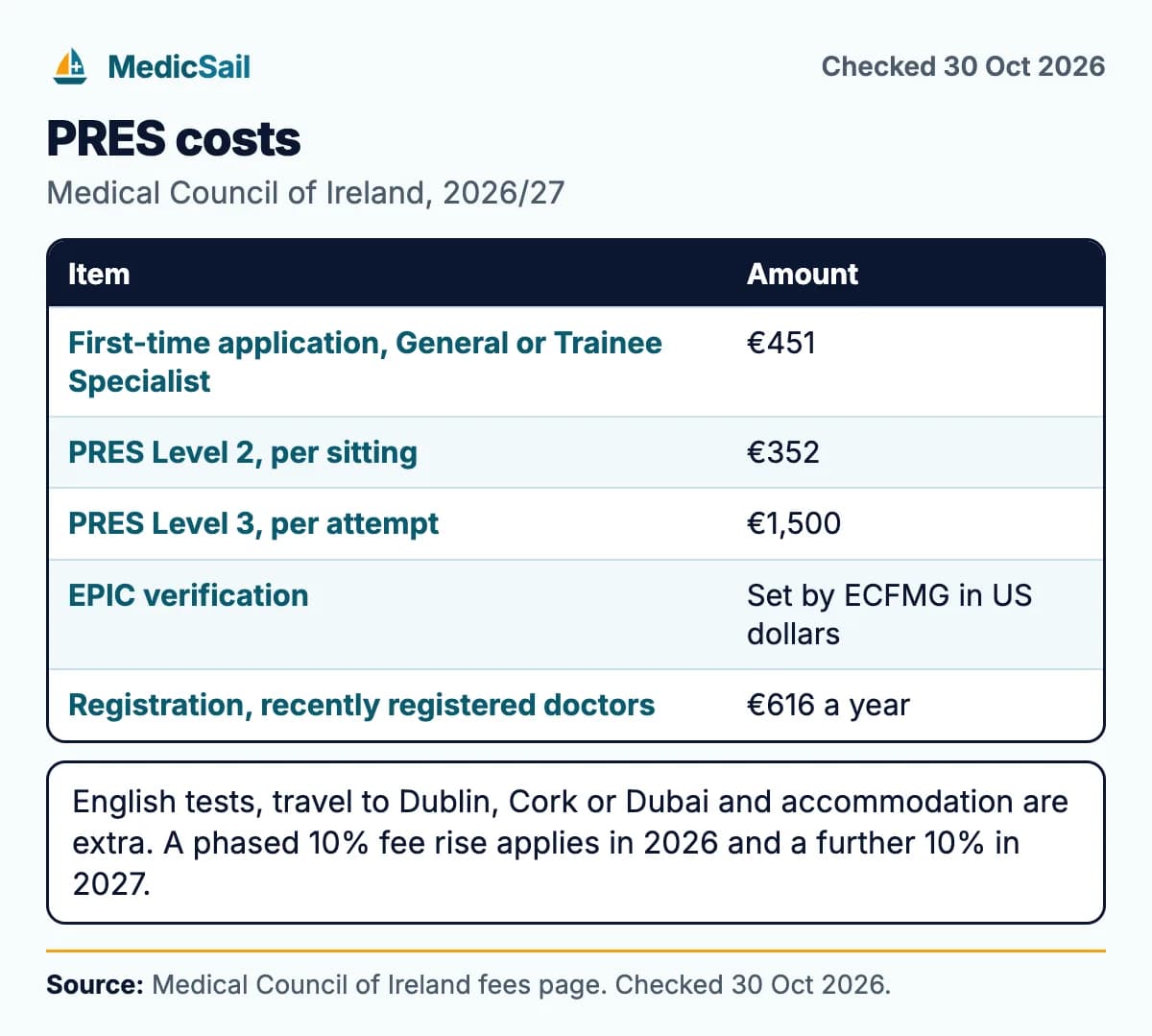
| Item | Amount | Notes |
|---|---|---|
| First-time application, General or Trainee Specialist Division | €451 | Paid to the Council when you apply; not refundable |
| PRES Level 2 | €352 | Per sitting; forfeited if you do not withdraw before the deadline |
| PRES Level 3 | €1,500 | Charged for each attempt |
| EPIC verification | Set by ECFMG in US dollars | Paid directly to ECFMG |
| Registration fee | From the Council's fee schedule | For example €616 a year for doctors registered under three years (2026/27) |
English tests, travel to Dublin, Cork or Dubai, and accommodation are extra. The Council introduced a phased fee increase of 10% in 2026 and a further 10% in 2027, so check the fees page before you pay.
A realistic timeline
- Document assessment and EPIC verification: often the slowest part, because EPIC reports and good standing certificates come from different bodies.
- Level 2: two sittings a year in 2026, with deadlines about six weeks ahead and results about six weeks after.
- Level 3: three sittings in autumn 2026, with results about six weeks after each.
- Registration: once your file is complete, after your Level 3 pass.
A doctor who passes both levels at the first attempt in consecutive 2026 sittings, for example Level 2 in August and Level 3 in November, would get the Level 3 result around the turn of the year. Any resit adds at least one more cycle.
If you are a doctor in the Gulf
PRES is one of the few overseas registration exams you can start without leaving the Gulf: the Medical Council holds Level 2 in Dubai as well as Dublin. Level 3 is held only in Ireland, so you will need leave, and a visa if your nationality requires one, for that sitting.
- No GCC country is on the Certificate of Experience list, but if you did your internship in Pakistan, Sudan, Malaysia, South Africa or the UK before moving to the Gulf, check the COE conditions, because you may not need PRES at all.
- Arab Board, Saudi Board and other GCC certificates are not on the Higher Qualification list. Irish and UK college memberships such as MRCPI, MRCP(UK), MRCS and MRCOG are.
- Ask every Gulf regulator you have held a licence with in the past five years (for example DHA, DOH Abu Dhabi, MOHAP, SCFHS or QCHP) to email a certificate of good standing to the Council. For Level 3 it must be dated within three months, so time the request close to the sitting.
- Gulf practice does not exempt you from English: unless your medical school was in Ireland, the EU/EEA, the UK, Australia, New Zealand or the USA, plan on OET Medicine or IELTS Academic at a test centre.
If you are choosing between Ireland and other destinations, our doctors hub compares the routes in the UK, Ireland, Germany, the Netherlands and the USA, and our guide to USMLE for international medical graduates explains the US exams that also count as an alternative to PRES Level 2. The Ireland country guide covers pay, permits and family visas in one place.
Questions
PRES is the Medical Council of Ireland's Pre-Registration Examination System. It has two parts: Level 2, a three-hour multiple-choice exam of clinical knowledge, and Level 3, a clinical skills exam of interpretation, practical and communication stations. Doctors who qualified outside the EU/EEA and do not meet the COE or HQ routes take it for general registration.
Yes. In 2026 the Medical Council held Level 2 on 6 August and 5 November in both Dublin and Dubai, with separate application forms for each venue. Level 3 is held only in Ireland.
The 2026/27 fees are €352 for Level 2 and €1,500 for each Level 3 attempt. You also pay the €451 first-time application fee to become eligible, EPIC verification fees to ECFMG and, after passing, the registration fee.
A PLAB 2 pass exempts you from PRES entirely; you still apply through the PRES route and select the PLAB 2 option. A PLAB 1 pass dated within three years is accepted instead of Level 2, so you would go straight to Level 3.
Yes, for Level 2 only. The handbook accepts USMLE Step 1 and Step 2 CK (dated within seven years), MCCQE Part 1 and the AMC MCQ instead of Level 2. You still sit Level 3.
Up to three attempts at each level, within two years of the date you are declared eligible for that level. If you fail three times or the two years run out, your eligibility expires and you must make a new application.
There is no fixed percentage. Each station is marked out of 20 and each skill type out of 120, and the pass mark for each is set by the Modified Angoff or borderline regression method. You must pass all three skill types, practical, communication and interpretation.
About six weeks after the exam, by email, as a pass or a fail. For Level 3, successful candidates' reference numbers are also posted on the Medical Council's website on results day.
No. The Medical Council does not publish past papers and does not provide or endorse any preparation courses or PRES-specific books. Use the Level 2 Blueprint, the PRES handbook and standard textbooks in the five disciplines.
No. The Medical Council says there is no reciprocal arrangement with the GMC, so PRES is not recognised for UK registration. The arrangement only works the other way: PLAB 2 exempts you from PRES.
Sources
- 1Medical Council: PRES
- 2Medical Council: What is PRES Level 2?
- 3Medical Council: PRES Level 2 exam dates
- 4Medical Council: What is PRES Level 3?
- 5Medical Council: PRES Level 3 exam dates
- 6Medical Council: Pre-Registration Examination System handbook (May 2023, PDF)
Show all 15 sourcesShow fewer sources
- 7Medical Council: Registration rules and exemptions
- 8Medical Council: General registration, non-EU/EEA trained doctors
- 9Medical Council: English language requirements
- 10Medical Council: Supervised registration
- 11Medical Council: Fees
- 12Medical Council: Certificate of Experience route and recognised internships
- 13Medical Council: Recognised higher qualifications for PRES exemption
- 14DETE: Critical Skills Occupations List
- 15Irish Immigration: Immigration permission stamps (Stamp 1H)
Plan it with our free tools
MedicSail
Healthcare licensing consultants for the UK, Europe and the USA
Updated and checked against the sources listed above. How we research and check our guides