


































Critical Skills Employment Permit for health workers in Ireland
Which health occupations are on the Critical Skills Occupations List, the salary thresholds and the public sector pay rule, how to apply, fees, processing dates, family rights and the route to Stamp 4.

MedicSail
Published
The short answer
The Critical Skills Employment Permit (CSEP) is Ireland's main work permit for registered health professionals from outside the EU/EEA. It is issued by the Department of Enterprise, Tourism and Employment (DETE) for occupations on the Critical Skills Occupations List, which includes medical practitioners, registered nurses, registered midwives, pharmacists, radiographers, physiotherapists, occupational therapists, speech and language therapists, dietitians, medical scientists and several other health roles. You need a job offer of at least two years, there is no labour market needs test, and the fee is €1,000, with 90% refunded if the application is refused.
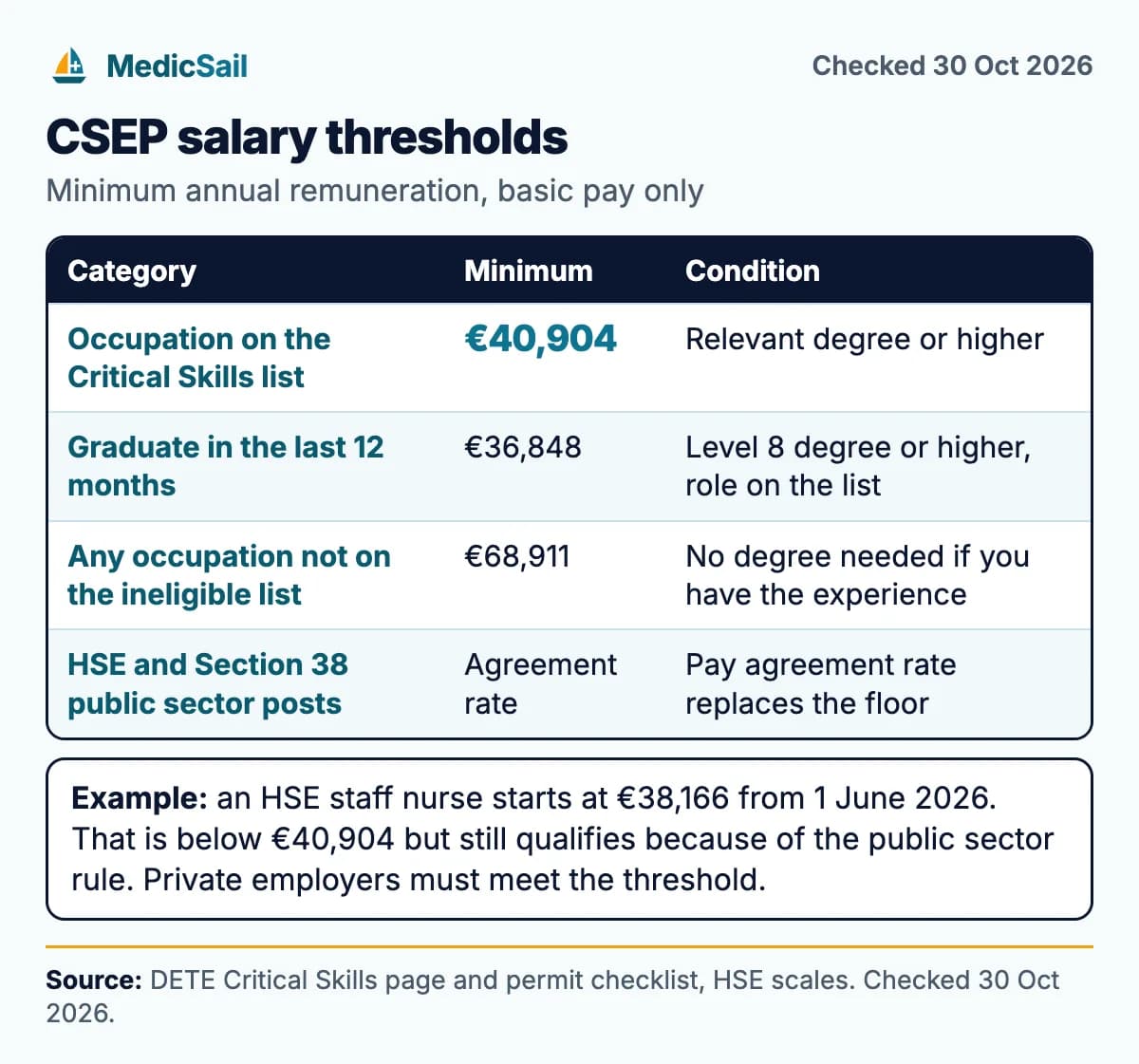
The general salary floor on DETE's permit page is €40,904 a year with a relevant degree, or €36,848 if you qualified in the previous 12 months. For HSE and other public sector posts covered by a public sector pay agreement, including Section 38 voluntary hospitals, the salary is simply the agreement rate, which is why an HSE staff nurse on a starting salary below €40,904 can still get the permit. After 21 months of employment on the permit you can apply directly to the Department of Justice for Stamp 4, which lets you live and work in Ireland without an employment permit, and your spouse or partner can work from the start on Stamp 1G.
This guide covers the occupations, the salary rules, the application, fees, processing times, family and Stamp 4, with the regulator step that has to come first. For the whole move, see our guide to working in Ireland as a health professional.
Which health occupations are on the list
DETE's current Critical Skills Occupations List groups jobs by standard occupational classification (SOC) code. These are the health and care entries:
| SOC code | Occupations listed |
|---|---|
| 1181 | Senior health services and public health managers and directors |
| 2112 | Medical laboratory scientists |
| 2211 | Medical practitioners |
| 2212 | Psychologist |
| 2213 | Pharmacist and industrial pharmacists |
| 2214 | Optometrist; ophthalmic optician (community eye care) |
| 2217 | Radiographers; radiation therapists; cardiac physiologists; vascular, gastrointestinal and respiratory physiologists or technologists |
| 2218 | Podiatrist or chiropodist |
| 2219 | Audiologists; perfusionists; dietitian; medical scientist |
| 2221 to 2223 | Physiotherapist; occupational therapist; speech and language therapist |
| 2229 | Orthoptists |
| 2231 | Registered nurses |
| 2232 | Registered midwives |
| 2442 | Social worker |
| 3213 | PHECC registered paramedics and advanced paramedic practitioners |
| 3218 | Prosthetists; orthotists |
Two common roles are not on the list. Dentists do not appear, so a dentist's job offer is assessed under the General Employment Permit rules unless the salary reaches the higher threshold described below. Health care assistants and home carers are not on it either; they can only qualify for a General Employment Permit, at a lower salary threshold.
The list is reviewed from time to time, so check the current version on DETE's website when your employer applies. Nurses should note the word registered: DETE requires a nurse or midwife to hold a qualification NMBI accepts for registration. Our guide to working as a nurse in Ireland explains NMBI recognition, and our physiotherapy in Ireland guide covers the CORU route that therapists follow.
Salary thresholds and the public sector rule
DETE's Critical Skills page and its permit checklist set out three thresholds:
| Category | Minimum annual remuneration | Conditions |
|---|---|---|
| Occupation on the Critical Skills list | €40,904 | A degree or higher in the relevant field; based on a 39-hour week, an hourly rate of €20.17 |
| Graduate in the last 12 months | €36,848 | A level 8 degree or higher (or equivalent) relevant to the role, obtained in the 12 months before applying; role on the list; €18.27 an hour |
| Any occupation not on the ineligible list | €68,911 | No degree needed if you have the necessary experience; €33.98 an hour |
| Public sector post covered by a pay agreement, including Section 38 employers | The rate of pay under that agreement | Applies to HSE and voluntary hospital posts paid on the consolidated salary scales |
DETE's separate minimum annual remuneration table shows slightly different 2026 figures (€40,909 with a relevant degree and €36,849 for graduates). The permit page and checklist both use €40,904 and €36,848. Your employer should build in a margin above whichever figure is higher rather than rely on the difference of a few euro.
Remuneration means basic pay. The checklist says it excludes bonuses, shift allowances and overtime, although DETE does count employer payments for registered health insurance. A 40-hour week must pay at least €41,953.60 to meet the €40,904 floor.
What the public sector rule means for HSE staff
The HSE consolidated salary scales effective 1 June 2026 start a staff nurse at €38,166 a year, below €40,904. Because HSE and Section 38 posts are covered by public sector pay agreements, DETE accepts the agreement rate instead of the general floor. Private hospitals and nursing homes are not covered by the rule, so a private employer must pay at least the threshold. For other roles, HSE starting points include €45,514 for physiotherapists, occupational therapists and speech and language therapists, €44,956 for radiographers, €50,485 for pharmacists and €55,292 for a senior house officer.
Register with your regulator first
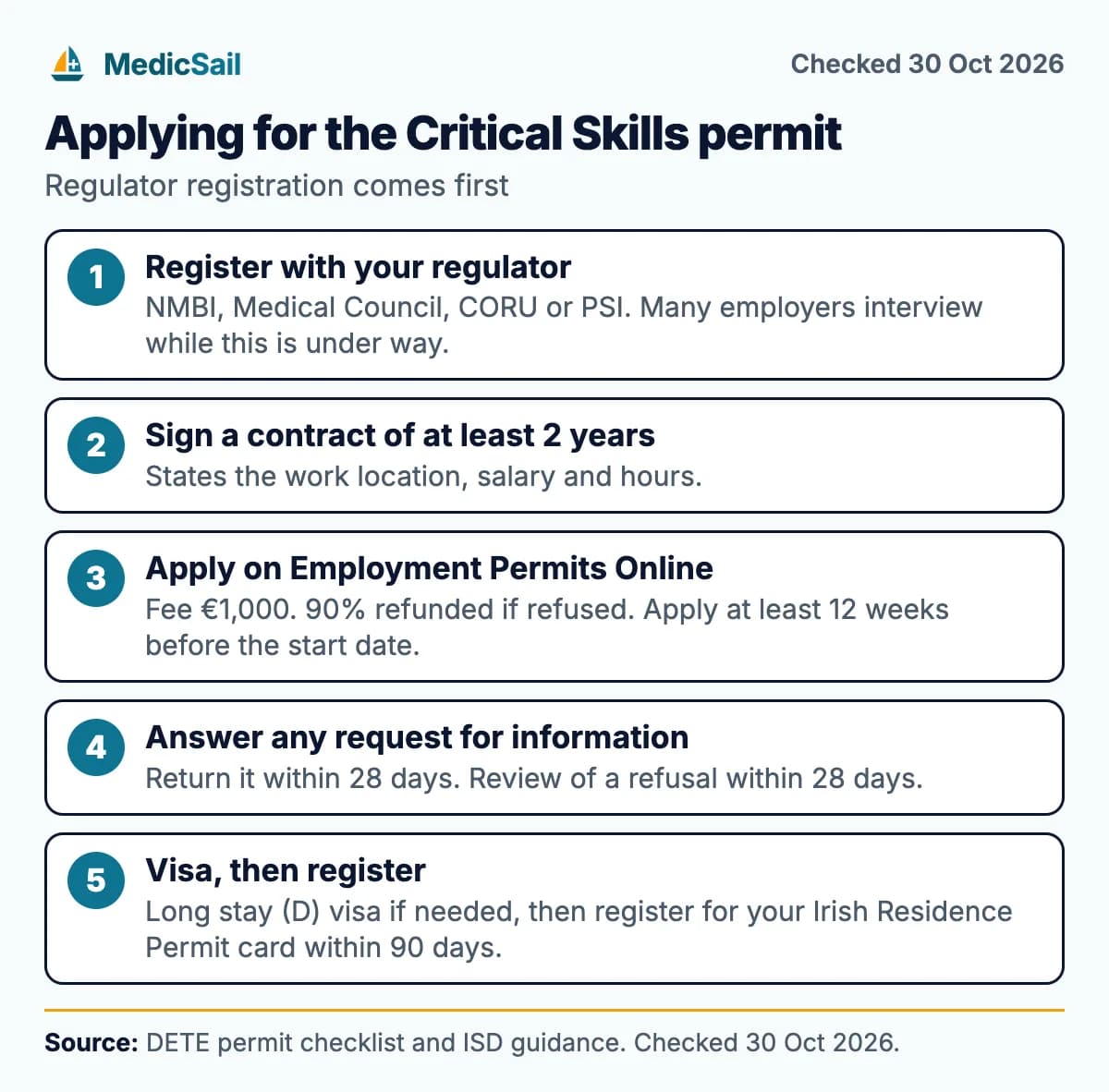
For health jobs, the employment permit comes after professional registration, not before it. DETE's checklist asks for your registration number, PIN or licence number where the employment must be registered with a regulator, and you cannot practise a regulated health profession in Ireland without it. Plan the order like this:
- Nurses and midwives: NMBI recognition and registration. If NMBI asks for a compensation measure, you come to Ireland on the Atypical Working Scheme to complete it, then your employer applies for the permit once you have your NMBI PIN. Our guide to the NMBI aptitude test and period of adaptation explains that stage, and DETE's checklist asks for your AWS permission letter if you are applying while in Ireland under the scheme.
- Doctors: Medical Council registration, through the COE, HQ or PRES route. See our guide to PRES and Medical Council registration.
- Physiotherapists, occupational therapists, radiographers, speech and language therapists, dietitians, medical scientists, social workers and other CORU professions: recognition and registration with CORU, the Health and Social Care Professionals Council.
- Pharmacists: the Pharmaceutical Society of Ireland.
- Paramedics: the list names PHECC registered paramedics and advanced paramedic practitioners only, so registration with PHECC is part of the job description.
Recognition can take months, so many employers interview while it is in progress. Make sure your contract start date allows time for registration and for the permit, which DETE says should be applied for at least 12 weeks before the start date.
The other requirements
- A job offer of at least two years. Shorter contracts need a General Employment Permit instead.
- A genuine Irish employer. The employer must be based and trading in Ireland and registered with the Revenue Commissioners and the Companies Registration Office or the Register of Friendly Societies.
- The 50:50 rule. At the time of application at least 50% of the employer's employees must be EEA nationals. Start-ups supported by Enterprise Ireland or IDA Ireland within two years of being set up are exempt. This rarely affects hospitals, but it can affect small private clinics and nursing homes.
- The right qualifications and experience for the job, shown in the application.
- No labour market needs test. DETE does not require the employer to advertise the post first, because the skills are in short supply.
- A signed contract. The checklist asks for a copy of the contract signed by both employer and employee.
- A fixed location. You can only work at the locations stated in the application and on the permit.
- No deductions for the permit. Employers cannot deduct permit or recruitment costs from your pay.
Either you or your employer can apply, and the permit is issued to you, with a certified copy to the employer.
How to apply, step by step
- Accept a written offer and sign the contract. Check it is for at least two years, names the work location and states the salary, hours and any deductions.
- Collect the documents on DETE's checklist. For the employer: nature of the business, number of EEA and non-EEA employees, whether any redundancies in the same role took place in the last six months, and a contact person. For you: your qualifications, previous Irish permissions or jobs, a passport-type photo, a copy of your current immigration stamp and visa if you are already in Ireland, and your professional registration number.
- Apply on Employment Permits Online. The applicant, employer or employee, completes the form with a full job description, start date, annual remuneration excluding bonuses and the qualifications required. Agents can be named on the form.
- Pay the fee. €1,000 for a Critical Skills permit of up to 24 months. Individuals pay by card; DETE says business applicants pay by electronic funds transfer after receiving an application ID.
- Wait in the queue. Applications are processed strictly in date order, in separate queues for Trusted Partner and standard employers.
- Answer any request for information. The decision maker may ask for more information, which must be returned within 28 days.
- Receive the decision. If refused, you can request a review within 28 days. If granted, the permit is issued to you.
- Apply for your visa, travel and register. Visa-required nationals apply for a long stay (D) employment visa after the permit is granted. After arrival you register your immigration permission and receive an Irish Residence Permit (IRP) card.
Fees and processing times
| Item | Amount | Notes |
|---|---|---|
| Critical Skills Employment Permit | €1,000 | Up to 24 months; there is no renewal fee because the permit is not renewed |
| Refund if refused | 90% (€900) | Paid to the applicant, whoever paid the fee |
| Dependant/Partner/Spouse Employment Permit | No fee | Listed by DETE; spouses and partners on Stamp 1G do not need one to work |
| General Employment Permit (for comparison) | €500 up to 6 months; €1,000 up to 24 months | Renewal €750 or €1,500 |
| Long Term Residency permission | €500 | Paid to the Department of Justice after approval, plus the registration fee |
Your immigration registration and any visa have their own fees, set by the Department of Justice; check the current amounts on irishimmigration.ie when you apply.
How long it takes
DETE does not publish a target in weeks. It publishes the date of the applications it is currently processing. On 20 October 2026, DETE's processing dates page showed Critical Skills applications received on 12 October 2026 being processed, so the queue was running at roughly a week. That figure moves, and it can lengthen sharply at busy times, which is why DETE asks for applications at least 12 weeks before the proposed start date. Add the time for any request for information, the visa (ISD advises allowing at least eight weeks) and immigration registration.
After you arrive: registration and changing jobs
If you are staying more than 90 days you must register your immigration permission. ISD says you should register within 90 days, and that it will not cancel your permission if you cannot get an appointment in time. You then receive an IRP card by post as proof of your permission. Critical Skills holders are registered on Stamp 1. DETE warns that delays in registering can affect later applications for long-term residence or citizenship, so do not leave it.
Staying with your first employer
DETE expects you to stay with your first employer for at least nine months. A new permit for a different employer will not normally be considered before then, unless there is a redundancy or exceptional circumstances that fundamentally change the employment relationship.
If you are made redundant
You must notify DETE's Employment Permits Section on the prescribed form within four weeks. You then have up to six months to find another job, and DETE says new Critical Skills permits can be issued for positions in strategic shortage areas.
If the employer changes
If your hospital or practice is transferred to a new owner under transfer of undertakings rules, the employer completes a Transfer of Undertaking form and a new permit issues on unchanged terms. If your job ends, you must return the permit within four weeks; DETE accepts a PDF copy by email.
Bringing your family
Family rights are one of the main differences between the Critical Skills permit and the General Employment Permit.
- Immediate family reunification. DETE says Critical Skills holders can apply to Immigration Service Delivery for immediate family reunification. Visa-required family members each need their own visa application, and all applications are subject to normal immigration controls.
- Stamp 1G for spouses and partners. ISD may give the spouse or de facto partner of a Critical Skills holder Stamp 1G, which allows them to work in Ireland without an employment permit and to study, but not to run a business or be self-employed. Stamp 1G is renewed annually, and after five years on it your spouse or partner may apply for Stamp 4. Time on Stamp 1G counts as reckonable residence for citizenship.
- Dependant/Partner/Spouse Employment Permit. DETE's page also says resident dependants, partners and spouses can apply for this permit, which is free. Spouses and partners on Stamp 1G do not need it to work.
- General Employment Permit holders. Their family reunification rights are more limited. Since 15 May 2024, though, ISD registers their eligible spouses and partners who have been granted family reunification on Stamp 1G, so they too can work without their own employment permit. ISD's non-EEA family reunification policy sets out the differences.
Family reunification is decided by the Department of Justice, not DETE. Read the current policy on irishimmigration.ie before you apply; we describe the rules, but we do not give immigration legal advice.
Stamp 4 and long-term residence
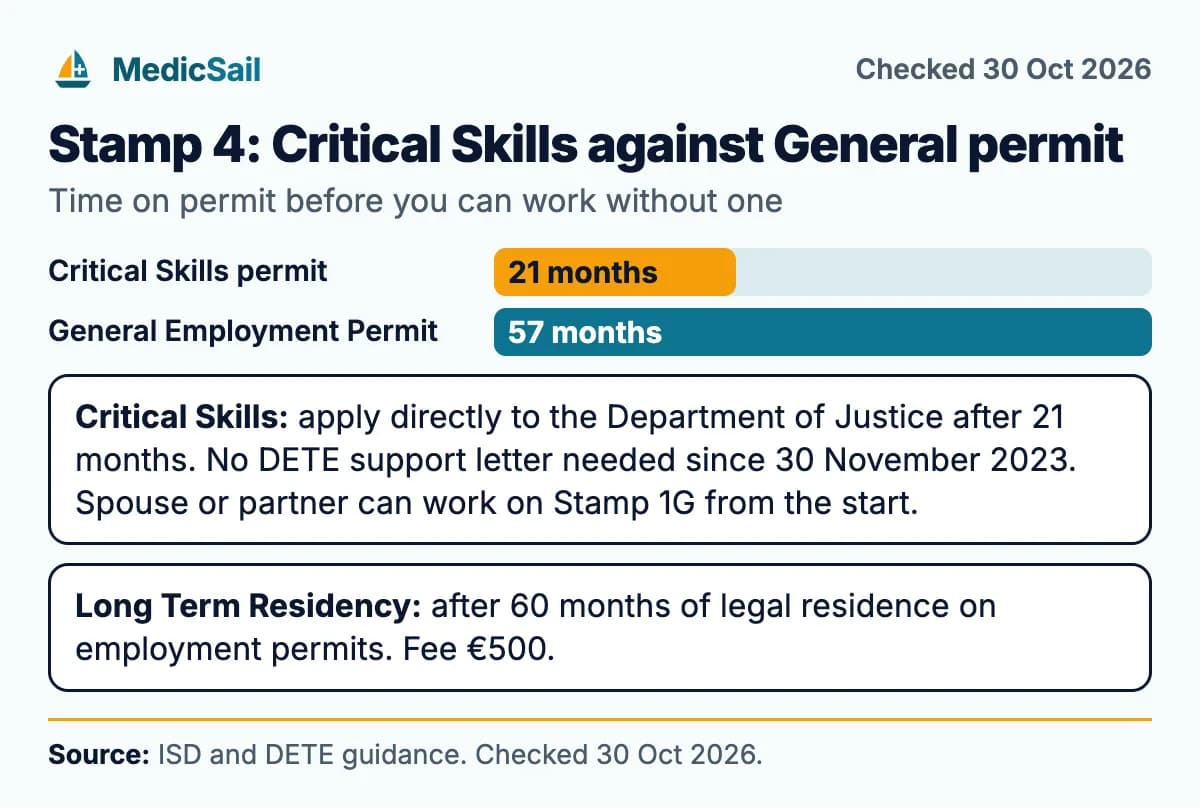
The Critical Skills permit does not need renewing. ISD says you become eligible for Stamp 4 on completing 21 months of employment in Ireland on the permit, and you apply directly to the Department of Justice. Since 30 November 2023 you no longer need a Stamp 4 support letter from DETE. Provided you have complied with your previous immigration and employment permit conditions and are of good character, you are given a permission to live and work in Ireland without a further employment permit. DETE says it is granted for two years and is renewable.
ISD describes what Stamp 4 allows: you can take up employment without an employment permit, work in a profession subject to the rules of the relevant professional body, set up and run a business, and access state services as government departments decide. Stamp 4 counts as reckonable residence for citizenship by naturalisation. For a health professional, that means you can change employer or move from the HSE to the private sector without a new permit, as long as you stay registered with your regulator.
By comparison, holders of a General Employment Permit become eligible for Stamp 4 only after 57 months. After 60 months of legal residence on employment permits, including Critical Skills permits, you can apply for Long Term Residency, which gives permission to work for a further five years without a permit. The fee is €500, payable within 28 days of an approval letter, plus the registration fee; there is no appeal if you are refused, but you can re-apply.
Gaps matter. Only registered permissions with qualifying stamps count, so renew your IRP and your professional registration on time.
Other permits health workers should know about
- General Employment Permit: for eligible jobs not on the Critical Skills list, or offers shorter than two years. DETE's 2026 minimum is €36,605 in general and €32,691 for health care assistants, home carers and care workers. A labour market needs test usually applies.
- Stamp 1H for hospital doctors: ISD gives Stamp 1H to doctors holding a two-year multi-site General Employment Permit as a non-consultant hospital doctor in a public hospital or health care facility. ISD says these doctors have similar benefits to Critical Skills holders, and the same conditions apply to them and their families. Our guide to working as a doctor in Ireland explains NCHD posts.
- Atypical Working Scheme: for nurses coming to Ireland to complete an NMBI compensation measure (six months' permission, not a work permit), and a separate scheme for locum hospital doctors.
If you are comparing Ireland with the UK, the UK route works differently: the Health and Care Worker visa is sponsored by the employer from the start and has its own salary rules. Our Health and Care Worker visa guide sets it out.
If you are applying from the Gulf
- Your Gulf residence visa has no bearing on an Irish permit. You will apply for an Irish long stay (D) visa from the country where you live, if your nationality requires one, after the permit is granted.
- Get your professional registration moving first. NMBI, the Medical Council and CORU each ask for certificates of good standing from every regulator you have been registered with, including DHA, DOH, MOHAP, SCFHS and QCHP, and each sets how recent they must be.
- Check the salary basis. Gulf packages include housing and allowances; Irish permits count basic pay only. Compare the HSE scale point you are offered, not the total package.
- Ask the employer who pays. Many HSE and private employers pay the €1,000 permit fee, and DETE does not allow them to deduct it from your salary.
- Plan your notice period around three clocks: regulator registration, the permit queue and the visa. Do not resign until the permit is granted.
For the full country picture, including pay and the order of steps, see our Ireland country guide and the NMBI registration page for nurses and midwives.
Questions
Yes. Registered nurses (SOC 2231) and registered midwives (SOC 2232) are on the list. DETE requires the nurse or midwife to hold a degree or diploma NMBI accepts for registration, and you must be registered before you work as a nurse.
Yes. Medical practitioners (SOC 2211) are on the list. Many hospital doctors instead hold a two-year multi-site General Employment Permit with Stamp 1H, which ISD says carries similar benefits for them and their families.
DETE's permit page gives €40,904 a year with a relevant degree, €36,848 for those who qualified in the previous 12 months, and €68,911 for any eligible occupation without a degree. For HSE and Section 38 posts the minimum is the public sector pay agreement rate.
Yes. DETE says that where a role is in the public sector and covered by a public sector pay agreement, including Section 38 employers, the remuneration is the rate under that agreement. The HSE staff nurse scale from 1 June 2026 starts at €38,166.
The fee is €1,000 for a permit of up to 24 months. If the application is refused, 90% (€900) is refunded to the applicant. There is no renewal fee because the permit leads to Stamp 4 rather than being renewed.
DETE processes applications in date order and publishes the date it is working on. On 20 October 2026 it was processing applications received on 12 October 2026. DETE asks you to apply at least 12 weeks before the start date because the queue changes.
Yes. ISD may give the spouse or de facto partner of a Critical Skills holder Stamp 1G, which allows them to work without an employment permit. Stamp 1G is renewed each year.
After 21 months of employment on a Critical Skills Employment Permit, you apply directly to the Department of Justice; DETE's support letter has not been needed since 30 November 2023. Stamp 4 is granted for two years and is renewable.
DETE expects you to stay with your first employer for at least nine months, except in cases of redundancy or exceptional circumstances. After that a new employer can apply for a new permit, and once you hold Stamp 4 you can change employer without one.
Neither appears on the current Critical Skills Occupations List. Health care assistants can apply for a General Employment Permit with a 2026 minimum of €32,691, and dentists are assessed under the General Employment Permit rules unless the job pays over €68,911.
Sources
- 1DETE: Critical Skills Employment Permit
- 2DETE: Critical Skills Occupations List (DOCX)
- 3DETE: Critical Skills Occupations List page
- 4DETE: Critical Skills Employment Permit checklist (PDF)
- 5DETE: Minimum annual remuneration thresholds
- 6DETE: Employment permit fees
Show all 16 sourcesShow fewer sources
- 7DETE: Current application processing dates
- 8DETE: General Employment Permit
- 9Irish Immigration: Immigration permission stamps
- 10Irish Immigration: Information on Stamp 4 upgrades
- 11Irish Immigration: Stamp 1G for eligible spouses and partners of employment permit holders
- 12Irish Immigration: Registering your permission for the first time
- 13Irish Immigration: Long term residency
- 14Irish Immigration: Frequently asked questions for working in Ireland
- 15Irish Immigration: Atypical Working Scheme for nurses
- 16HSE: Consolidated salary scales, 1 June 2026
Plan it with our free tools
MedicSail
Healthcare licensing consultants for the UK, Europe and the USA
Updated and checked against the sources listed above. How we research and check our guides