


































NHS interview questions for international nurses: Band 5 questions and how to answer
How NHS Band 5 interviews for international nurses work: the NHS values and 6Cs panels listen for, values and clinical scenario questions with what to cover, STAR answers, questions to ask, and how to handle a video interview from abroad.

MedicSail
Published
The short answer
An NHS Band 5 nursing interview for an international nurse usually has three kinds of question: values questions that test whether you share the NHS values in the NHS Constitution, clinical scenario questions about safe practice (a deteriorating patient, a medication error, a safeguarding concern), and questions about you and the move (why the UK, why this trust, how you will manage the OSCE). Most panels expect you to answer experience questions with the STAR method: situation, task, action, result.
No official body publishes a fixed list of NHS interview questions. Each trust writes its own, based on the job description and person specification. The questions and model answers in this guide are therefore guidance drawn from the NHS's published values, the 6Cs of nursing, the NMC Code and the way NHS adverts and recruitment guidance describe interviews. They are not official rules and no answer guarantees an offer.
If you are interviewing from abroad, the interview will normally be by video and the offer will be conditional on your NMC registration steps, references, health and criminal record checks, and a certificate of sponsorship. The guide ends with questions to ask the panel and a checklist for video interviews across time zones. If you have not found a vacancy yet, start with our guide to finding NHS jobs with visa sponsorship.
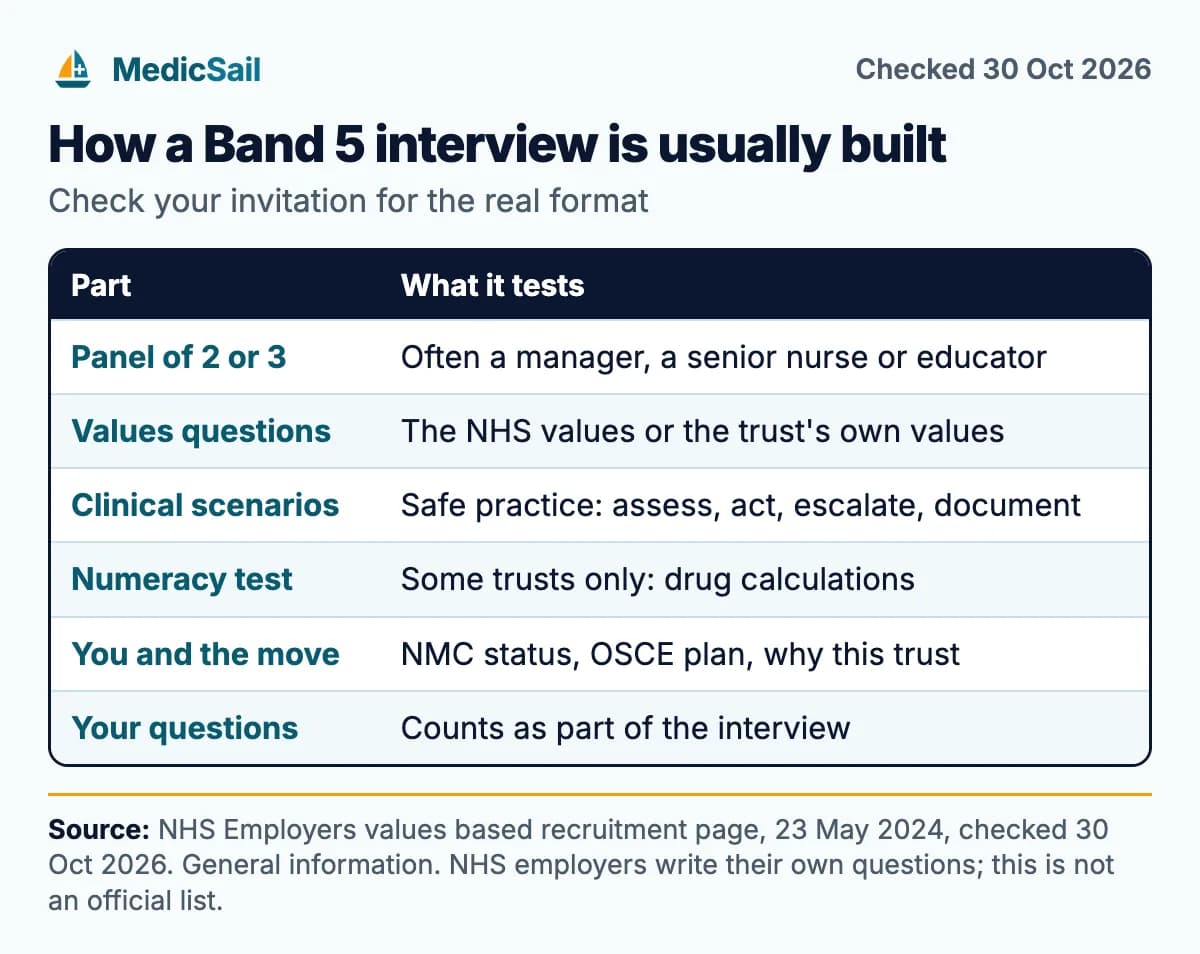
How a Band 5 interview is usually structured
Formats vary by trust and by recruitment campaign. These are the common elements; your invitation email should tell you which apply.
| Part | What happens | How to prepare |
|---|---|---|
| Panel interview | Usually two or three people, often a ward or department manager and a senior nurse or practice educator. International cohorts may also include someone from the recruitment team | Prepare six to eight STAR examples from your own practice |
| Values questions | Questions built around the NHS values or the trust's own values | Read the trust's values on its website and link your examples to them |
| Clinical scenarios | "What would you do if..." questions about patient safety | Revise A to E assessment, NEWS2, SBAR and escalation |
| Numeracy or drug calculation test | Some trusts set a short test, online or on paper | Practise the same calculations as the NMC CBT numeracy section |
| Your questions | Time at the end for you to ask questions | Prepare three or four, listed later in this guide |
NHS shortlisting and interviewing are built around the person specification in the advert, which lists essential and desirable criteria. Print it and make sure you have an example for every essential criterion. NHS Employers describes values-based recruitment as an approach that helps employers find people whose personal values match the organisation's, delivered through values-based interviewing techniques such as role play and written responses to scenarios, as well as pre-screening and assessment centres. That is why so many questions ask what you did, not what you know.
NHS values, the 6Cs and the NMC Code
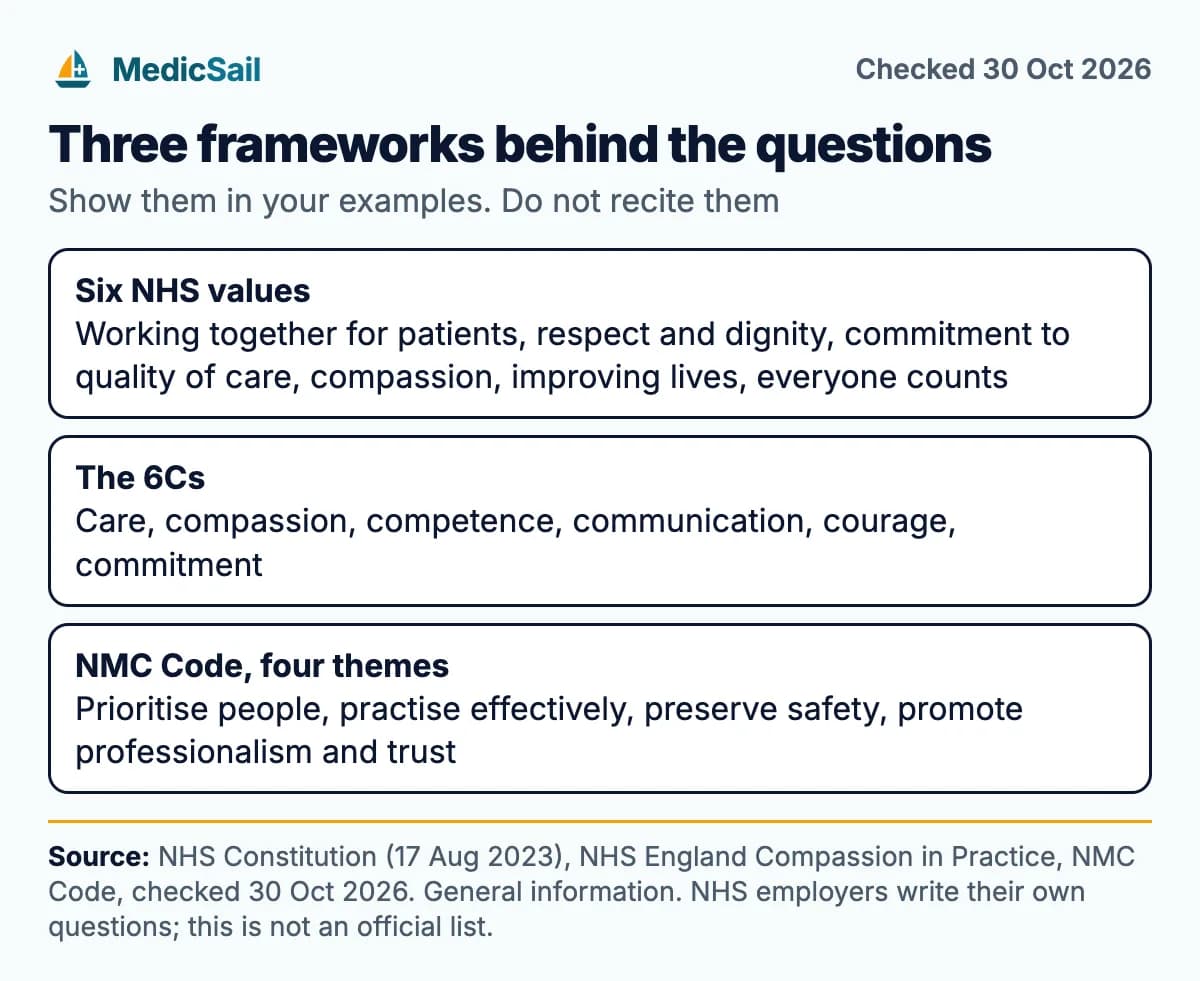
Three frameworks shape what NHS panels listen for. You do not need to recite them, but your answers should show them.
The six NHS values. The NHS Constitution for England, last updated on 17 August 2023, sets out six values:
| NHS value | What it means in an interview answer |
|---|---|
| Working together for patients | You put patients first, work across teams and learn openly from mistakes |
| Respect and dignity | You treat each person as an individual and communicate honestly |
| Commitment to quality of care | You aim for safe, effective care and act on feedback |
| Compassion | You respond with kindness and notice distress without being asked |
| Improving lives | You care about health and wellbeing, not only tasks |
| Everyone counts | You make sure no one is excluded and give extra help to those who need it |
Many trusts also publish their own values, often three or four words such as "kind" or "respectful". Use the trust's own words in your answers; panels notice.
The 6Cs. NHS England's Compassion in Practice strategy for nurses, midwives and care staff set out six values: care, compassion, competence, communication, courage and commitment. The NMC's OSCE preparation handbook also refers to them. Courage is the one candidates forget: speaking up when something is unsafe, even to a senior colleague.
The NMC Code. The Code that every UK nurse works to has 25 standards under four themes: prioritise people, practise effectively, preserve safety, and promote professionalism and trust. Panels often ask about confidentiality, consent, duty of candour, raising concerns and accountability, all of which come from the Code. Our NMC page links to the Code and the registration process.
How to answer with STAR
STAR is a way to tell a short story about your own practice. Panels use it because it shows what you actually did. Spend roughly one sentence on the situation, one on your task, most of your answer on your actions, and finish with the result and what you learned.
- Situation: where you were and what was happening. Keep patient details anonymous.
- Task: what you were responsible for.
- Action: what you did, step by step, in the first person ("I", not "we").
- Result: what happened, and what you learned or changed afterwards.
Example question: "Tell us about a time a patient's condition deteriorated."
Outline answer: "On a night shift on a surgical ward, a patient two days after bowel surgery told me he felt unwell (situation). I was his named nurse for the shift (task). I carried out an A to E assessment and found he was breathing faster, his blood pressure had dropped and his temperature was raised. His early warning score had risen, so I escalated to the doctor immediately using SBAR, started the sepsis protocol as prescribed, increased the frequency of observations and documented everything (action). He was reviewed within minutes, received antibiotics and fluids within the hour and recovered. Since then I check trends in observations, not just single readings, and I teach new staff to escalate early (result)."
Prepare six to eight stories that you can adapt: a deteriorating patient, a mistake or near miss, a disagreement with a colleague, a complaint or difficult relative, a time you advocated for a patient, a time you managed a heavy workload, a time you taught or supported someone, and a time you received feedback.
Common values and behaviour questions
These are typical questions, based on the NHS values and the 6Cs, with what a panel is usually listening for. They are examples, not an official list.
| Question | What the panel listens for |
|---|---|
| Tell us about yourself and why you want to work in the UK. | A short, focused career summary and a reason linked to patient care and development, not only pay |
| Why do you want to work for this trust? | Something specific: its services, values, preceptorship or education programme |
| Describe a time you showed compassion to a patient or relative. | Noticing distress, acting without being asked, dignity |
| Tell us about a time you made a mistake. | Honesty, reporting it, putting the patient first, learning (duty of candour) |
| How have you dealt with a colleague whose practice worried you? | Courage: speaking up, escalating, following policy |
| How do you prioritise when you have more work than time? | Clinical priorities first (ABCDE, time-critical medicines), delegating safely, asking for help |
| Describe a time you dealt with a complaint or an angry relative. | Listening, staying calm, explaining, escalating where needed |
| How do you make sure patients' dignity and privacy are respected? | Concrete actions: curtains, consent, chaperones, confidentiality |
| What does equality and diversity mean in your practice? | Everyone counts: reasonable adjustments, interpreters, cultural and religious needs |
| How do you look after your own wellbeing? | Realistic self-care and knowing where to get support |
Clinical scenario questions and how to approach them
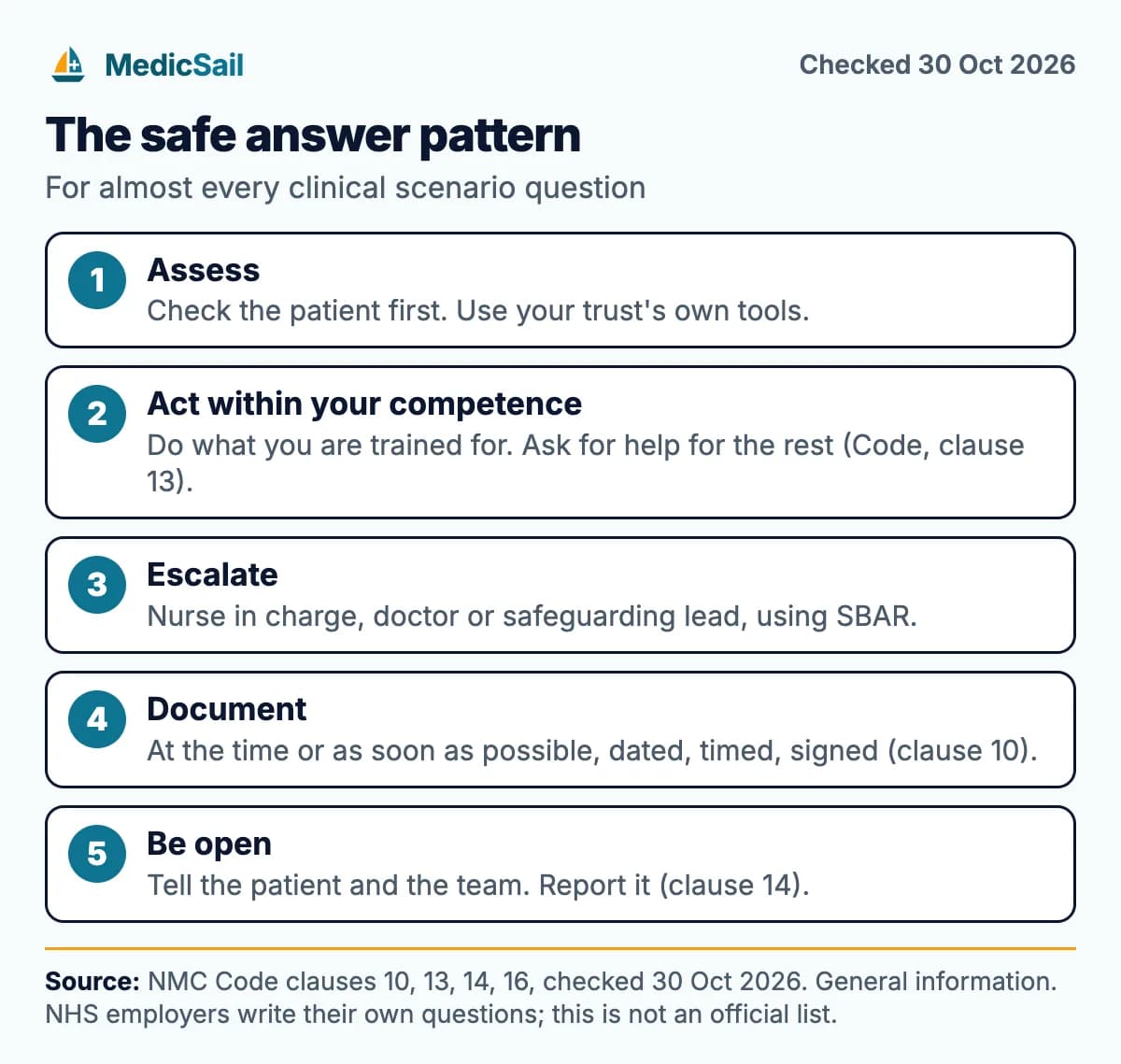
Scenario questions test whether you would act safely in a UK setting. The safe answer is usually: assess, act within your competence, escalate, document and follow local policy. These are common examples and the points to cover.
| Scenario | Points to cover |
|---|---|
| A patient's observations are worsening | A to E assessment, NEWS2 score and local escalation policy, SBAR handover to the doctor or outreach team, repeat observations, document |
| You find you have given a medicine late or wrongly | Check the patient first, inform the nurse in charge and doctor, monitor, complete an incident report, be open with the patient (duty of candour), reflect |
| Suspected sepsis | Recognise signs, escalate urgently, follow the trust sepsis pathway as prescribed, monitor closely |
| A patient has fallen | Do not move them until assessed, check for injury, call for help, post-fall observations, incident report, review falls risk |
| You notice a pressure ulcer forming | Assess and grade it, reposition, involve tissue viability, document and report as per policy |
| You suspect abuse or neglect | Patient safety first, report to the nurse in charge and safeguarding lead, document facts, do not investigate yourself |
| A patient refuses treatment | Respect autonomy, explore reasons, check capacity under the Mental Capacity Act if in doubt, inform the team, document |
| A relative asks for information over the phone | Confidentiality: check identity and the patient's consent before sharing anything |
| You are asked to do something outside your competence | Say so, ask for supervision or training, never act beyond your competence (the NMC Code) |
| Unsafe staffing on your shift | Raise it with the nurse in charge, follow escalation policy, prioritise care, report it |
UK terms matter. Use "escalate", "nurse in charge", "incident report" (often called Datix in NHS trusts), "safeguarding lead" and "capacity". If your home system works differently, say how you would follow the UK process. Our OSCE guide covers A to E assessment, NEWS2 and SBAR in more detail, and the same knowledge serves both the OSCE and the interview.
Questions specific to international nurses
Panels interviewing nurses from abroad often add questions about your registration, your move and how you will adapt. Be honest and specific.
- "Where are you with your NMC application?" Give exact status: English test result, CBT date and result, whether the NMC has authorised the Test of Competence. Employers sponsoring pre-registration nurses usually need you to have passed the CBT. NHS Employers' guidance says candidates must sit their first OSCE within 12 weeks of arriving and pass it within eight months from the start of their visa.
- "How will you prepare for the OSCE?" Mention the NMC's free resources, the station structure and that you will use the trust's OSCE training.
- "What differences do you expect between nursing at home and in the UK?" Good answers mention patient autonomy and consent, documentation, delegation to healthcare assistants, medicines management, escalation and multidisciplinary working.
- "How will you cope with moving away from family?" Show you have thought about support, accommodation and the first weeks. Our first weeks checklist shows what is involved.
- "Which area of nursing interests you?" Name your current specialty and be open to the ward offered. Panels value flexibility in a first post.
- "How long do you plan to stay with us?" Answer honestly and in terms of development: preceptorship, then progression.
If you are newly qualified or have little post-registration experience, prepare for questions on that too. Our guide on working in the UK as a newly qualified international nurse explains what employers ask for and why.
Common mistakes in NHS interviews
These are the patterns that most often cost international candidates an offer. They come from how values-based interviews are scored, not from an official list.
- Answering in theory. "I would always escalate" scores lower than "On my last night shift I escalated a patient with a NEWS2 of 6 to the doctor using SBAR". Panels score evidence of what you did.
- Saying "we" throughout. Team working matters, but the panel needs to hear your own actions.
- Skipping the escalation step. In almost every clinical scenario, the safe answer includes informing the nurse in charge or a doctor and documenting. Leaving this out suggests you would act alone.
- Using home terms without explaining them. Use UK terms where you know them, or explain briefly what a local term means.
- Not knowing the trust. Read its values, main hospitals and services before the interview. Our hospital pages, such as Leeds Teaching Hospitals and Barts Health, summarise this for larger employers.
- Talking only about pay or the visa when asked why you want the job. These are fair reasons, but lead with care, learning and the role.
- Memorised answers. Panels can tell. Learn the structure of your stories, not the words.
- Being vague about your NMC status. Know your dates and results, and say clearly what is still outstanding.
Questions to ask the panel
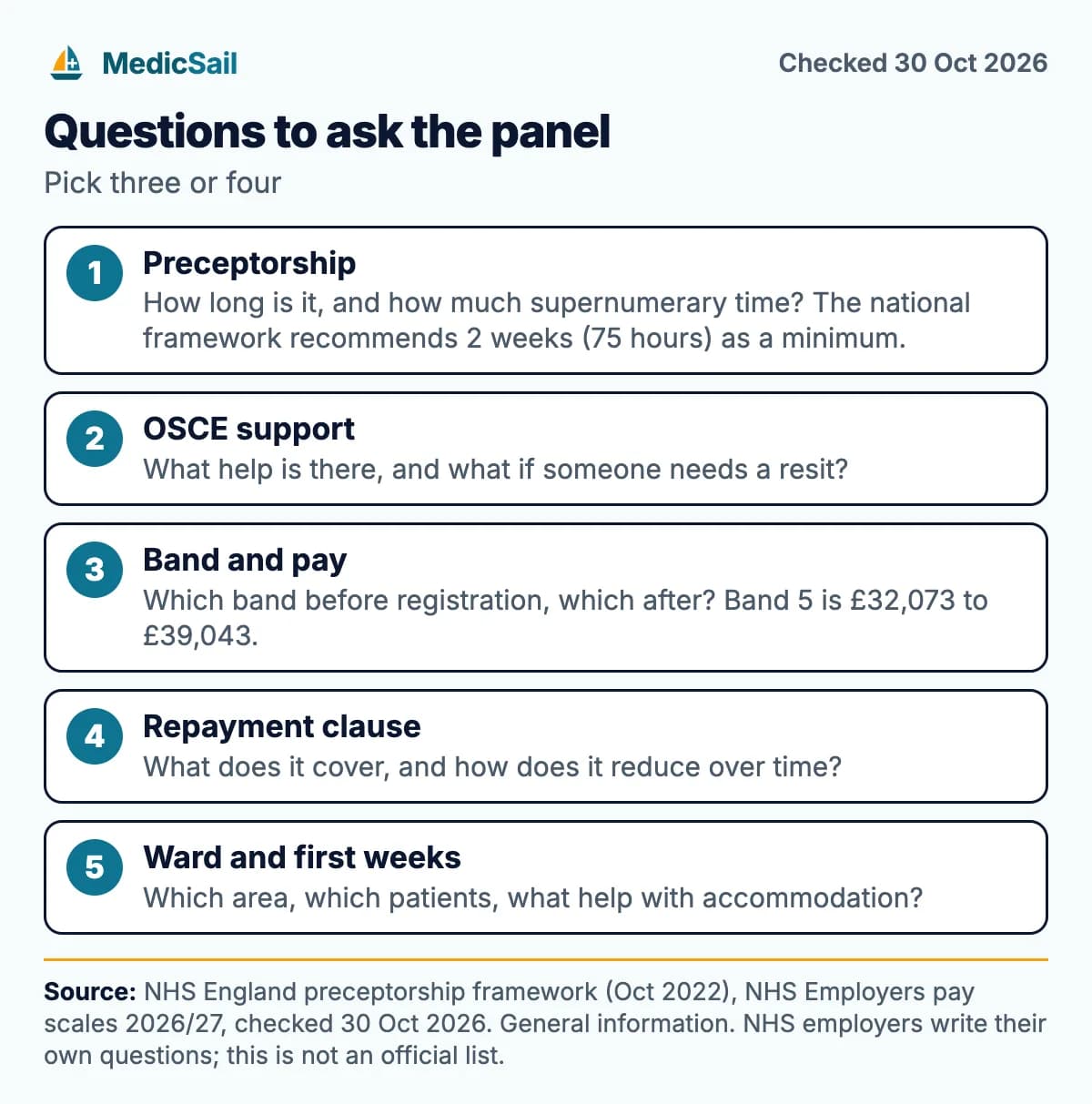
Asking good questions shows you have thought about practice, not only the move. Pick three or four:
- What preceptorship programme do you offer to newly arrived international nurses, and how long is the supernumerary period?
- How do you support candidates through the OSCE, and what happens if someone needs a resit?
- What will my band and salary be before and after I join the NMC register?
- Which ward or department would I join, and what is the usual patient group?
- Is there a repayment clause in the contract, and what costs does it cover?
- What help do you give with accommodation and the first weeks after arrival?
- What development opportunities are there after preceptorship, for example courses or rotation?
Questions about pay, repayment clauses and accommodation are fair to ask. The UK Code of Practice for international recruitment says repayment clauses must be explained before you accept the job. Our preceptorship glossary entry explains what a good programme looks like, and the NHS pay band explorer shows the 2026/27 Agenda for Change bands; NHS Employers puts Band 5 in England at £32,073 to £39,043.
Video interviews from abroad
Most interviews for applicants abroad take place by video, often on Microsoft Teams or a similar platform named in your invitation. Treat it as a face-to-face interview.
- Check the time zone twice. The UK is on GMT in winter and British Summer Time (GMT+1) from the last Sunday in March to the last Sunday in October. Convert the time and confirm it in your reply.
- Test the link a day before on the device you will use, with the camera, microphone and any app updates installed.
- Use a quiet, well-lit room with a plain background. Put the camera at eye level and look at it when you speak.
- Use a wired connection or a strong Wi-Fi signal, and keep a phone with mobile data ready in case the connection fails. Have the recruiter's phone number or email to hand.
- Dress as you would for an in-person interview, and have your passport or ID ready if the panel asks to see it.
- Keep notes short. A list of your STAR examples is fine; reading out scripted answers is noticeable on camera.
- Allow for a short delay. Pause briefly before you answer so you do not talk over the panel.
Some international campaigns use a recorded video stage before the live interview, where you answer questions on screen within a time limit. The same STAR approach works.
After the interview: offers and next steps
If you are successful, you will usually receive a conditional offer. The conditions normally include references, an occupational health check, a criminal record check (including a certificate from each country where you have lived for 12 months or more in the past 10 years, as NHS adverts state for Skilled Worker applicants), your NMC steps and a certificate of sponsorship.
Before you accept, check the employer is an A-rated sponsor on the GOV.UK register, read any repayment clause and ask for the band, salary and start date in writing. Never pay a fee for a job offer. When the certificate of sponsorship arrives, check its details and apply for your visa within three months; our Health and Care Worker visa guide explains the application.
If you are not successful, ask for feedback. Trusts often give it, and it is the fastest way to improve before your next interview. Our guide to nursing in the UK covers the full route from registration to your first post.
Questions
Usually a mix of values questions (compassion, mistakes, teamwork), clinical scenarios (a deteriorating patient, medication errors, safeguarding) and questions about why you want the job. Each trust writes its own questions from the person specification, so there is no official list.
The NHS Constitution lists six: working together for patients, respect and dignity, commitment to quality of care, compassion, improving lives, and everyone counts. Link your examples to these and to the trust's own published values.
Care, compassion, competence, communication, courage and commitment. They come from NHS England's Compassion in Practice strategy for nurses, midwives and care staff, and NHS panels often listen for them in your answers.
Describe the situation and your task briefly, spend most of the answer on the actions you personally took, then give the result and what you learned. Use 'I' rather than 'we' so the panel hears what you did.
It varies by trust and campaign. Many are under an hour, sometimes with a separate numeracy test. Your invitation should give the format and timing.
Some trusts set one, either at interview or before. Practising the same calculations as the NMC CBT numeracy section, such as tablets, liquids, injections and infusion rates, prepares you for both.
Yes. Most international recruitment interviews are held by video. Check the UK time, test the link the day before and have a backup phone with mobile data ready.
Usually not. Many employers interview and sponsor nurses who have passed the CBT and English test, then support them through the OSCE after arrival. NHS Employers' guidance says the first OSCE must be sat within 12 weeks.
Ask about preceptorship and supernumerary time, OSCE support, your band before and after registration, the ward you would join, any repayment clause and accommodation support.
No. NHS employers set their own questions. This guide is built from the NHS Constitution, the 6Cs, the NMC Code and NHS recruitment guidance, and it is meant to help you prepare, not to predict exact questions.
Sources
Plan it with our free tools
MedicSail
Healthcare licensing consultants for the UK, Europe and the USA
Updated and checked against the sources listed above. How we research and check our guides