


































NHS trusts that sponsor visas: how to find visa sponsorship jobs in the NHS
Which NHS employers can sponsor you, how to read the GOV.UK register of licensed sponsors, how to find sponsored vacancies on NHS Jobs, NHS Scotland Jobs and HSC Jobs, what advert wording means, and the red flags the Code of Practice warns about.

MedicSail
Published
The short answer
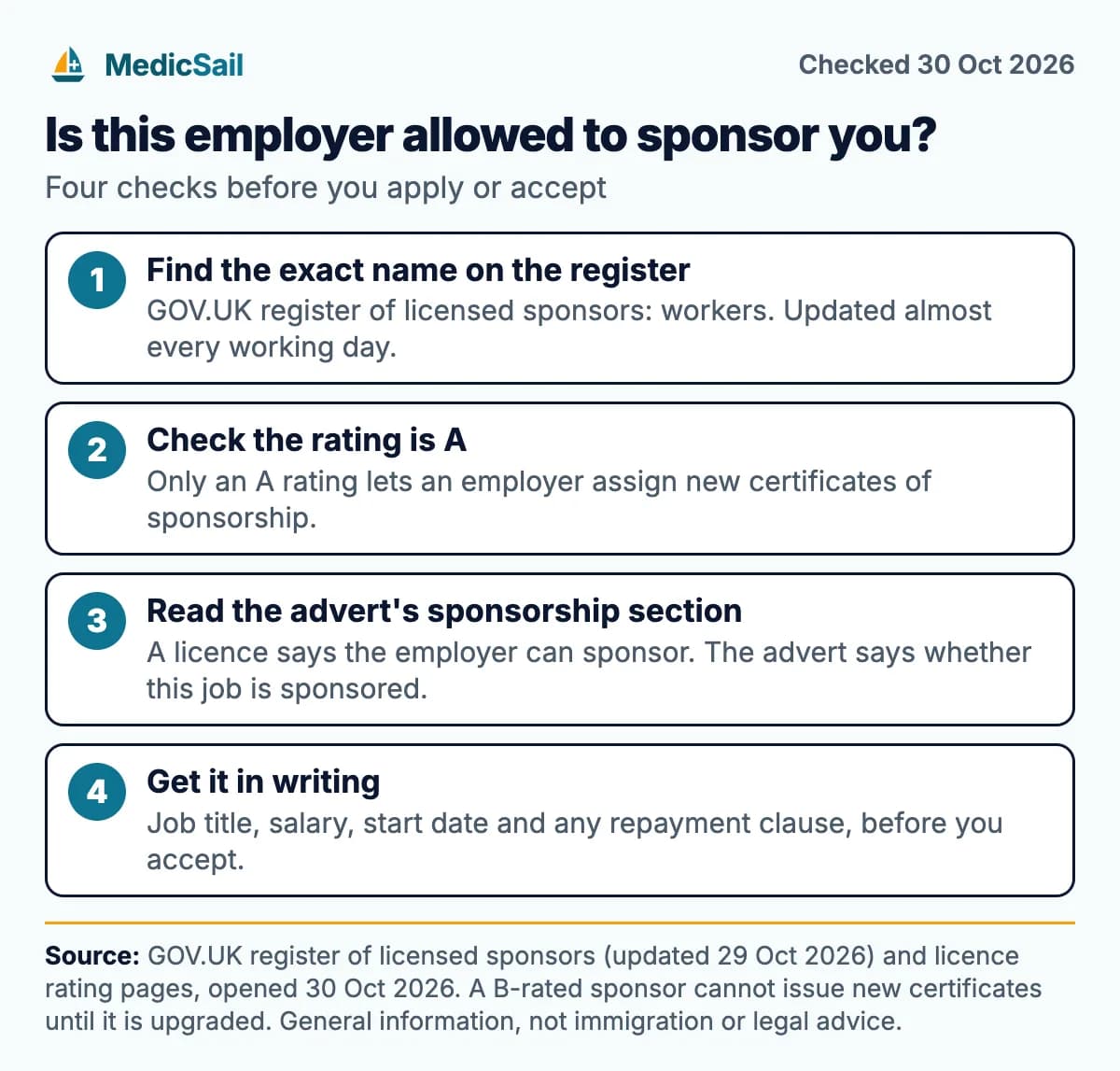
Most NHS trusts in England, and the NHS boards in Scotland and Wales and the Health and Social Care trusts in Northern Ireland that recruit from abroad, hold a Home Office sponsor licence. You can check any employer yourself on the GOV.UK register of licensed sponsors: workers, a spreadsheet the Home Office updates almost every working day. If the trust is listed with an A rating on the Skilled Worker route, it can sponsor you. The Health and Care Worker visa is a subcategory of the Skilled Worker route, so you will not see a separate "Health and Care Worker" entry.
A licence tells you the employer can sponsor, not that a particular job will. To find jobs that actually come with sponsorship, search NHS Jobs and read the "Certificate of Sponsorship" section of each advert, check each trust's international recruitment page, and confirm in writing before you accept an offer. The employer, not you, pays for the certificate of sponsorship: GOV.UK sponsor guidance says a sponsor must not recover any part of that fee from you, and the UK Code of Practice says you must never be charged a recruitment fee.
This guide explains how to read the register, how to search NHS Jobs and the Scottish and Northern Irish job boards, what the sponsorship wording in adverts means, how international recruitment programmes work in 2026, and the red flags that should stop you. For the visa itself, read our Health and Care Worker visa guide.
Which NHS employers sponsor visas
There is no single list of "NHS trusts that sponsor visas" because the Home Office does not publish one by sector. What it publishes is the register of every licensed sponsor in the UK, more than 140,000 rows in the file published on 29 October 2026. When we filtered that file, there were over 200 entries whose names contain both "NHS" and "Trust", almost all of them on the Skilled Worker route with an A rating. That count does not include organisations named differently, such as Scottish health boards, Welsh university health boards or Northern Ireland's Health and Social Care trusts, which are listed under their own names.
The large teaching hospitals that international candidates most often ask about all appear on the register, including Barts Health, Guy's and St Thomas', Imperial College Healthcare, Oxford University Hospitals, Cambridge University Hospitals, Manchester University NHS Foundation Trust, Leeds Teaching Hospitals and University Hospitals Birmingham. In Scotland, NHS Greater Glasgow and Clyde is listed, and in Wales, Cardiff and Vale University Health Board. Our hospital pages describe each employer's international recruitment, the registration you need and how to apply.
Three points matter more than the list itself:
- Licensed is not the same as recruiting. A trust can hold a licence and still have paused overseas recruitment for some roles. University Hospitals of Leicester, for example, says on its international nursing page that it has currently paused direct recruitment of nurses from overseas, although it remains a licensed employer.
- Not every NHS job is sponsored. Each certificate of sponsorship is assigned to a specific job and salary. Lower-banded support roles, for example, may not meet the occupation and salary rules, and some posts are open only to applicants who already have the right to work.
- GP practices, hospices and private providers are separate employers. Many NHS Jobs adverts come from GP surgeries and primary care networks. Each needs its own licence; the trust's licence does not cover them.
How to read the register of licensed sponsors
Download the latest file from the GOV.UK page (it is a CSV that opens in Excel, Google Sheets or Numbers) and use the search or filter tools. The file has five columns:
| Column | What it shows | What to look for |
|---|---|---|
| Organisation Name | The legal name of the sponsor | The exact name of the trust or board in your job offer |
| Town/City | The registered location | Usually the head office, not every hospital site |
| County | Often blank | Do not filter on it |
| Type & Rating | "Worker" or "Temporary Worker", with the rating | "Worker (A rating)" |
| Route | The routes the sponsor is licensed for | "Skilled Worker" |
Why there is no "Health and Care Worker" route in the file. GOV.UK's guidance for sponsors describes the Health and Care visa as a special subcategory of the Skilled Worker route, and says sponsors need a Skilled Worker licence to use it. So an NHS trust that sponsors nurses on the Health and Care Worker visa appears simply as "Skilled Worker". Some online guides tell you to filter for "Health and Care Worker"; if you do that, you will find nothing.
What the rating means. GOV.UK says an A-rated licence lets the sponsor assign certificates of sponsorship. A sponsor can be downgraded to a B rating if it stops meeting its duties, and a B-rated sponsor cannot issue new certificates of sponsorship until it has made improvements, although it can still sponsor workers it already employs. If an employer offering you a new job is B-rated, ask how and when it expects to issue your certificate.
Search tips that save time:
- Search for a distinctive word from the name ("Barnsley", "Alder Hey") rather than the full title, because spelling varies. In the October 2026 file, Barts Health is listed as "Barts Health National Health Service Trust", so a search for "NHS" alone misses it.
- Watch for look-alike names. The same file lists both "Guy's and St. Thomas' NHS Foundation Trust" (the hospital trust) and "Guy's and St Thomas' Foundation", a separate charity. Your contract and certificate of sponsorship should name the trust.
- In Scotland, search for "NHS" plus the board name (for example "NHS Lothian"). In Wales, search for "Health Board". In Northern Ireland, search for "Health and Social Care Trust".
- Check the date in the file name. The register changes as licences are granted, downgraded or revoked, so use the latest version on the day you check.
Our glossary pages on the licensed sponsor and the certificate of sponsorship explain both terms in more detail.
How to find sponsored jobs on NHS Jobs and other boards
Most NHS vacancies in England and Wales are advertised on NHS Jobs, which also has a Welsh-language version. Scotland uses NHS Scotland Jobs and Northern Ireland uses HSC Jobs. Many trusts also run their own careers sites, especially for international cohorts.
When we checked NHS Jobs in October 2026, its filters covered distance, working pattern, contract type, staff group, pay range and NHS pay grades and schemes (Band 2 to Band 9, plus medical grades such as Foundation Doctor, Specialty Doctor and Consultant). There was no filter for visa sponsorship. You find sponsorship information inside each advert instead.
A practical search routine:
- Search by job title ("staff nurse", "band 5 physiotherapist", "clinical fellow") and leave the location as "All locations" if you are flexible.
- Filter by staff group (for example "Nursing & Midwifery Registered" or "Allied Health Professionals") and by band. Newly registered nurses, physiotherapists and radiographers usually start at Band 5.
- Open each advert and scroll to the section headed "Certificate of Sponsorship". This is where the employer states whether it will consider applicants who need sponsorship.
- Read the "UK Registration" section next. It tells you whether you need full registration with the NMC, GMC, HCPC or another regulator before you start.
- Save the search and create a job alert. Adverts in high-demand specialties can close early once enough applications arrive.
Search terms that bring up international roles include "international nurse", "internationally educated nurse", "overseas nurse", "pre-registration nurse", "IENs" and "OSCE". For doctors, "clinical fellow", "trust grade" and "locally employed doctor" adverts are the ones most often open to sponsorship; our guide to locally employed doctor posts explains those roles.
What the sponsorship wording in an advert means
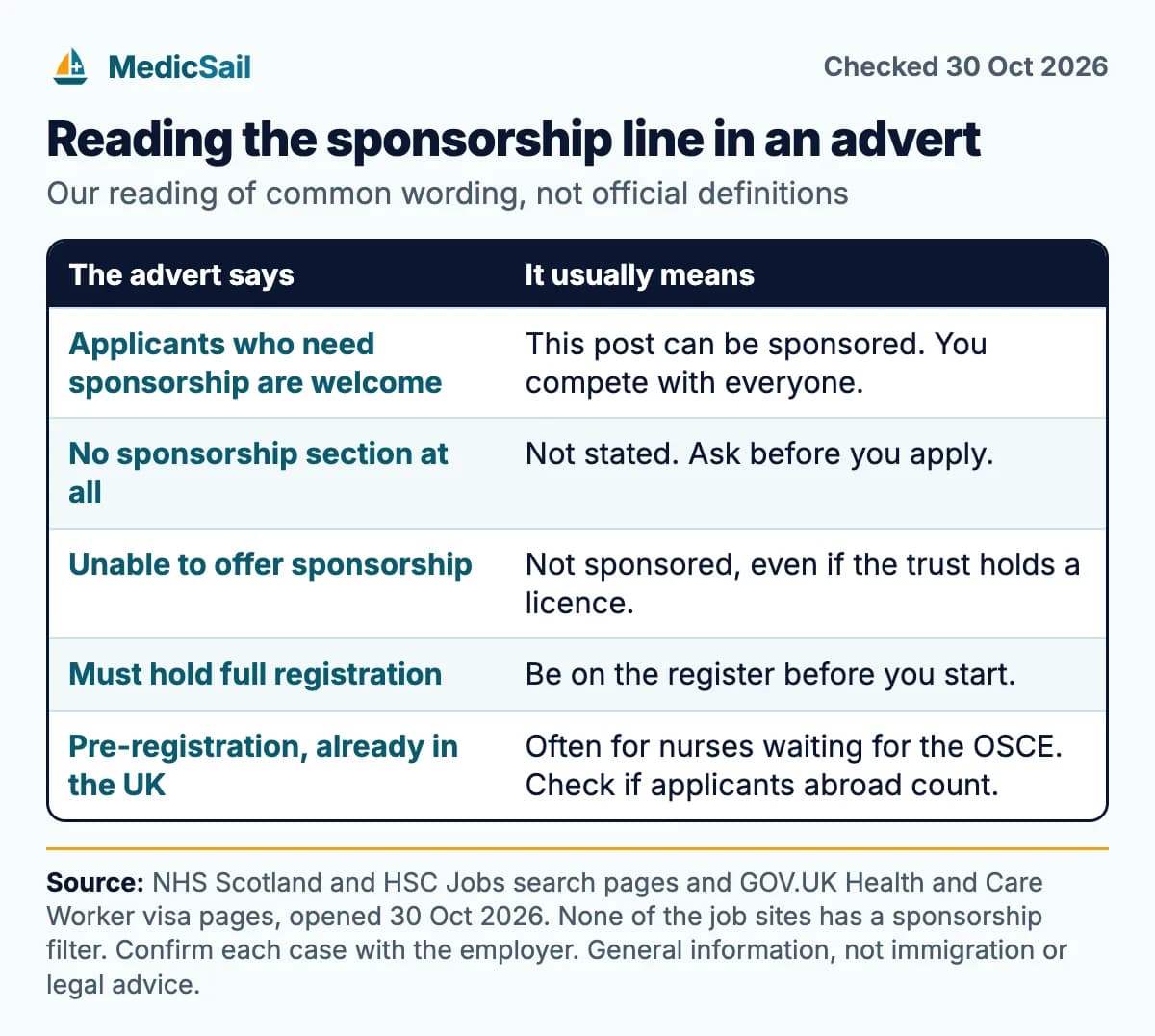
In the adverts we checked on NHS Jobs in October 2026, the standard text in the "Certificate of Sponsorship" section read: "Applications from job seekers who require current Skilled worker sponsorship to work in the UK are welcome and will be considered alongside all other applications." That is the most common wording, but employers phrase it in different ways. This is how to read the common versions. These are our interpretations, not official definitions, so confirm with the employer if anything is unclear.
| Wording in the advert | What it usually means | What to do |
|---|---|---|
| "Applications from job seekers who require current Skilled worker sponsorship ... are welcome and will be considered" | The employer can sponsor this post if you meet the requirements, but you compete with everyone else | Apply if you meet the registration requirement |
| No Certificate of Sponsorship section at all | The employer has not said either way | Check the register and ask the recruiting manager before applying |
| "We are unable to offer sponsorship for this post" | The post is not sponsored, even if the trust is licensed | Do not apply unless you already have the right to work |
| "Pre-registration" or "internationally educated nurse, UK based" | Often for nurses already in the UK, for example on another visa, who are waiting for the OSCE | Read whether applicants abroad are considered |
| "Must hold full NMC registration" or "GMC registration with a licence to practise" | You must be registered before you start | Apply only when your registration is complete or close |
| "International recruitment campaign" or "cohort" | A programme for candidates abroad, often with OSCE support | Follow the trust's own application route |
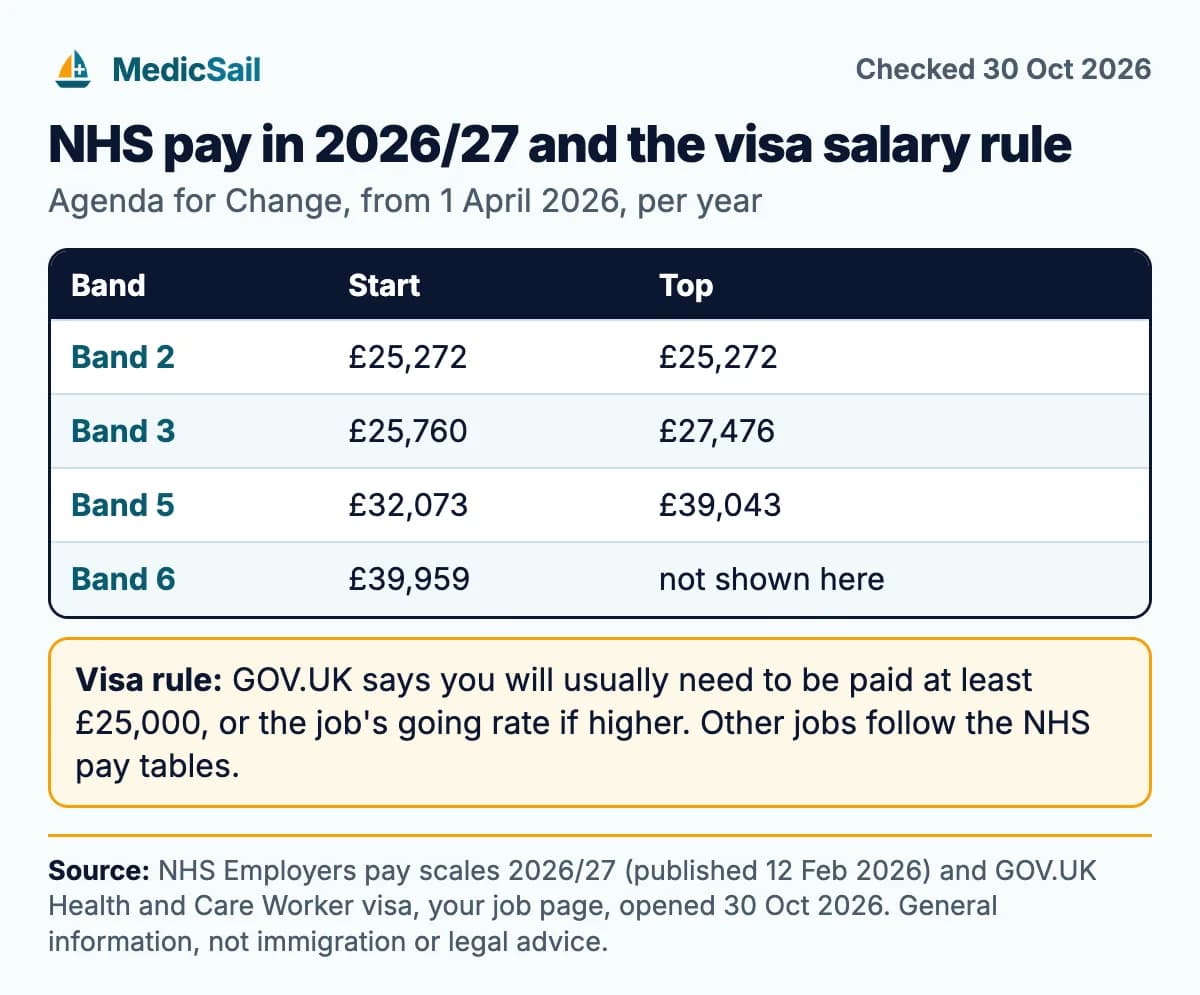
Also check the salary. GOV.UK says a Health and Care Worker visa usually needs a salary of at least £25,000, or the going rate for the job if that is higher, and that for most health jobs the going rate comes from the national pay scales by NHS band and UK nation. NHS Employers' 2026/27 pay scales put Band 5 at £32,073 to £39,043 in England. Our sponsorship salary checker and NHS pay band explorer help you compare an offer with the rules.
International recruitment programmes in 2026
Many trusts recruit internationally in cohorts: a group of nurses or midwives is interviewed online, given conditional offers, sponsored on the Health and Care Worker visa and supported through the NMC OSCE after arrival. NHS Employers' guidance on recruiting overseas nurses and midwives, last reviewed in September 2026, says candidates must sit their first OSCE within 12 weeks and pass it within eight months from the start of their visa, with up to three attempts. During that period they can be employed as pre-registration candidates. Our NMC OSCE guide explains the exam.
The market has changed. The NMC reported in December 2025 that 6,321 internationally educated professionals joined its register in the six months to 30 September 2025, a 49.6% drop on the same period in 2024 and the lowest six-monthly intake in five years. Its chief executive said that "the high-growth era of international recruitment appears to be ending". In practice this means fewer large cohorts, more competition for each sponsored post and more trusts asking for previous acute experience. Direct applications to individual adverts remain the main route in.
How to find programmes that are open:
- Search each trust's website for "international recruitment" or "international nurses". Trusts that run cohorts usually describe eligibility, OSCE support, accommodation and relocation there.
- Look for campaigns run through recruitment agencies on the NHS Employers Ethical Recruiters List. The Code of Practice says employers should only use organisations on that list.
- For doctors, look for trust clinical fellowship schemes and posts that support the PLAB route to GMC registration.
If you live in a red list country. The Code of Practice for international recruitment does not allow active recruitment from countries on its red list, which includes Nigeria, Ghana, Pakistan and Zimbabwe, unless a government-to-government agreement allows it. Kenya and Nepal are on the amber list. GOV.UK's version of the code says people resident in these countries can still apply directly to a specific advertised vacancy on their own behalf, without an agency, and that residence, not nationality, decides the classification. Our pages for nurses and doctors trained in Nigeria and trained in Pakistan explain what this means.
What sponsorship looks like for each profession
The visa rules are the same for every profession, but the point at which employers will sponsor you differs. Employers handle this differently, so treat this as a general picture, not a rule.
| Profession | When NHS employers usually sponsor | Read next |
|---|---|---|
| Nurses and midwives | After you pass the NMC CBT and English test, as a pre-registration nurse until you pass the OSCE | Nursing in the UK |
| Doctors | Usually once you hold, or are close to, GMC registration with a licence to practise | Doctors in the UK |
| Allied health professionals | Usually once you hold HCPC registration | Physiotherapists in the UK |
| Pharmacists | After GPhC registration, which for most overseas pharmacists follows a UK course and foundation training | Pharmacists in the UK |
| Healthcare assistants and care workers | Restricted: care worker roles are closed to applicants abroad | Care worker visa changes |
Your certificate of sponsorship carries an occupation code, and the code must match the job you will actually do. A nurse employed as a pre-registration nurse, a radiographer and a staff grade doctor each sit under different codes. Our route finder shows the registration steps for your profession before you start applying.
Red flags and the UK Code of Practice
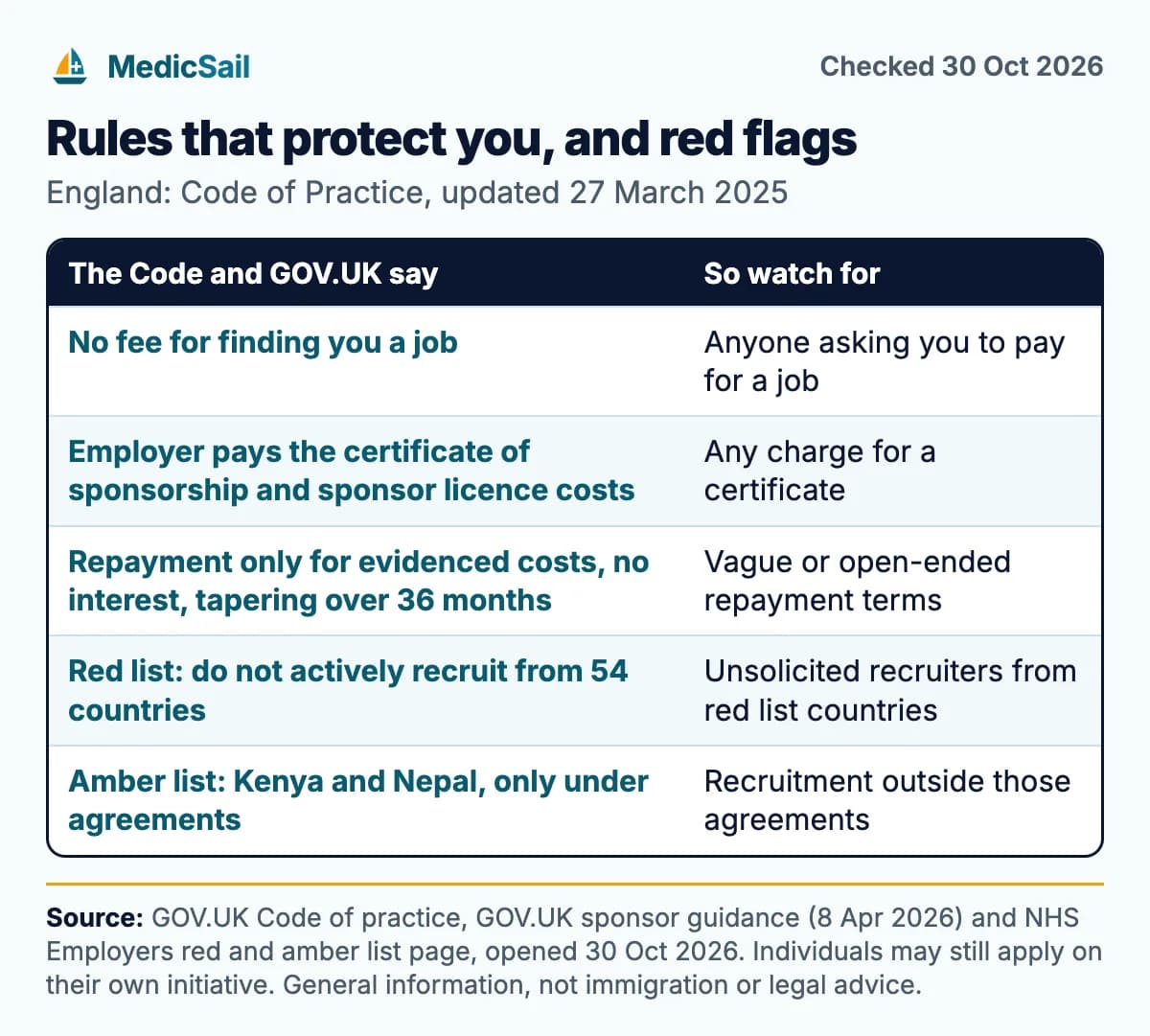
The Code of Practice for the international recruitment of health and social care personnel in England, last updated on 27 March 2025, applies to all health and social care employers in England, public and independent, and to the agencies they use. GOV.UK says Wales follows the England code, and Scotland and Northern Ireland have their own codes. These are the warning signs it helps you spot:
- Anyone asks you to pay for a job, a placement or a certificate of sponsorship. The code says candidates should not be charged recruitment fees. GOV.UK sponsor guidance says that for certificates assigned on or after 31 December 2024, sponsors must not recover any part of the certificate fee or related administrative costs from workers, and a licence will normally be revoked if they do.
- A repayment clause that is vague or punitive. The code says any repayment clause must be transparent, proportionate, time-limited and flexible. It must be in your contract or offer, explained before you accept, and itemised with evidenced costs. Only costs the employer actually paid for you, such as relocation, visa and exam fees, can be reclaimed, never agency or sponsor licence fees, and no interest can be added. The code's example tapers from 100% if you leave within 12 months to 50% at 13 to 24 months, 25% at 25 to 36 months and nothing after 36 months.
- The employer is not on the register, is B-rated with no plan for your certificate, or the name on your offer does not match any licensed sponsor.
- The offer comes without an interview, uses a free email address, or asks for payment to a personal account.
- An agency is not on the Ethical Recruiters List, or offers to recruit you from a red list country.
- The salary or band on the certificate is lower than the job you are told you will do. The salary rules apply to the job and code on the certificate.
Concerns about a breach of the code can be reported to NHS Employers at [email protected]. The code also lists where to report problems with agency fees (the Employment Agency Standards Inspectorate), pay and working hours (Acas) and exploitation (the Gangmasters and Labour Abuse Authority).
A step-by-step plan to find a sponsored NHS job
- Get your registration moving first. Pass the English test your regulator accepts and open your regulator application. Most sponsored NHS adverts expect at least the first exam to be passed. Our guide to IELTS and OET for UK regulators helps you choose.
- Build a shortlist of employers. Pick regions you would accept, list the trusts there and confirm each one on the register with an A rating on the Skilled Worker route.
- Read each trust's international page. Note whether it is recruiting from abroad, what experience it asks for and what support it gives with the OSCE, flights and accommodation.
- Search and set alerts on NHS Jobs (or NHS Scotland Jobs and HSC Jobs) for your job title and band. Read the Certificate of Sponsorship section of every advert.
- Tailor each application to the person specification. NHS shortlisting is done against the essential and desirable criteria, so show evidence for each one. Our guide to NHS interview questions for international nurses covers the next stage.
- Check the offer before you accept. Ask for the job title, band, salary, start date, occupation code and any repayment clause in writing, and check the employer name on the register again.
- Check the certificate of sponsorship details before you apply for the visa. GOV.UK says you must apply within three months of getting the certificate.
When the offer is confirmed, our first weeks in the UK checklist covers what to do when you land.
Questions
Most trusts that recruit from abroad hold a sponsor licence, and you can check any of them on the GOV.UK register of licensed sponsors. A licence does not mean every job is sponsored, so read the Certificate of Sponsorship section of each advert and confirm with the employer.
Download the latest register of licensed sponsors: workers from GOV.UK and search for a distinctive word in the trust's name. Look for 'Worker (A rating)' in the Type and Rating column and 'Skilled Worker' in the Route column.
GOV.UK describes the Health and Care visa as a subcategory of the Skilled Worker route, so sponsors that use it are listed under 'Skilled Worker'. There is no separate Health and Care Worker entry in the file.
When we checked in October 2026, NHS Jobs had filters for staff group, band, pay range, contract type and working pattern, but none for sponsorship. Each advert has a Certificate of Sponsorship section that says whether applicants who need sponsorship will be considered.
GOV.UK says a B-rated sponsor cannot issue new certificates of sponsorship until it has made improvements, although it can still sponsor workers it already employs. Ask a B-rated employer how it will issue your certificate.
No. GOV.UK sponsor guidance says sponsors must not recover any part of the certificate fee or related administrative costs from workers, and the Code of Practice says candidates must not be charged recruitment fees.
Yes, directly. The Code of Practice bans active recruitment by employers and agencies from red list countries, but it says people resident there can apply directly to a specific advertised vacancy on their own behalf.
Only under a repayment clause that the code says must be transparent, proportionate, time-limited and flexible, set out before you accept and limited to costs the employer actually paid. The code's example tapers to nothing after 36 months.
Some do, but each needs its own sponsor licence and must appear on the register. For the Health and Care Worker visa, the employer must be the NHS, an organisation providing medical services to the NHS or an adult social care provider.
Sources
- 1GOV.UK: Register of licensed sponsors: workers
- 2GOV.UK: Workers and Temporary Workers: sponsor a skilled worker (version 04/26)
- 3GOV.UK: UK visa sponsorship for employers, your licence rating
- 4GOV.UK: Health and Care Worker visa, your job
- 5GOV.UK: Code of practice for the international recruitment of health and social care personnel in England
- 6NHS Employers: Code of practice for international recruitment
Show all 14 sourcesShow fewer sources
- 7NHS Employers: Code of practice red and amber list of countries
- 8NHS Employers: Recruitment of overseas nurses and midwives
- 9NHS Employers: Pay scales for 2026/27
- 10NHS Jobs
- 11NHS Scotland Jobs
- 12HSC Jobs (Northern Ireland)
- 13NMC: Sharp drop in international recruitment slows overall growth of UK register (5 December 2025)
- 14University Hospitals of Leicester: International nursing and midwifery careers
Plan it with our free tools
MedicSail
Healthcare licensing consultants for the UK, Europe and the USA
Updated and checked against the sources listed above. How we research and check our guides