


































Can newly qualified international nurses work in the UK without experience?
What the NMC actually requires from newly qualified nurses trained abroad, what NHS employers ask for and why, the English rule that needs experience, realistic routes into a sponsored UK job and how to build experience employers value.

MedicSail
Published
The short answer
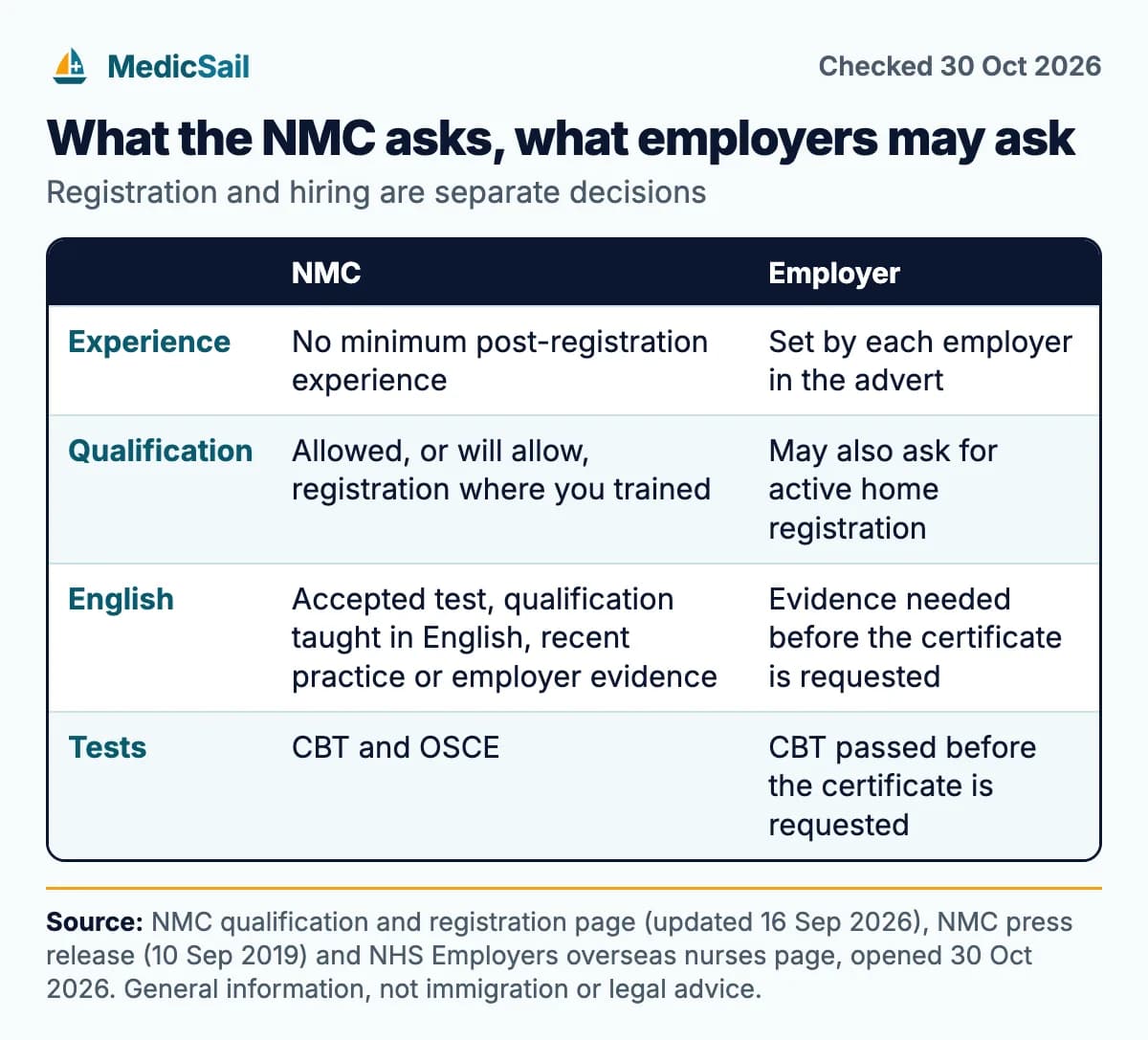
Yes, the Nursing and Midwifery Council (NMC) does not require post-registration work experience from nurses trained outside the UK. In a press release of 10 September 2019, the NMC said its earlier changes had enabled nurses and midwives from outside the EU to apply to work in the UK immediately after qualifying, rather than after a 12 month waiting period. Today the NMC asks for a qualification that has allowed you, or will allow you, to register in the country where you trained, English language evidence, the Test of Competence (the CBT and the OSCE), and health and character checks.
The harder part is the job. Employers set their own experience requirements, and many NHS trusts ask international nurses for six to twelve months or more of post-registration experience, often in an acute hospital. University Hospitals of Leicester, for example, lists 12 months' post-registration experience among its criteria for nurses trained outside the UK. Some employers do take newly qualified international nurses, but fewer of them, and the market has tightened since 2025.
So the honest answer is: you can register without experience, but you will find a sponsored job much more easily with some. This guide explains exactly what the NMC requires, what employers ask and why, how a new graduate can meet the English rules, and the realistic routes in, with official sources throughout. Our NMC page covers the full registration process.
What the NMC requires compared with what employers ask
| Requirement | What the NMC says | What employers commonly ask |
|---|---|---|
| Work experience | No minimum post-registration experience | Often six to twelve months or more, varies by trust and post |
| Qualification | Must have allowed you, or will allow you, to register in the country where you trained | A nursing degree or diploma in the field of the job |
| Home registration | Evidence of registration, or confirmation that your qualification would allow it | Usually active registration and a certificate of good standing |
| English | An accepted test at the required scores, or another accepted route | Usually the NMC's English evidence before interview |
| Test of Competence | Pass the CBT and the OSCE | Usually the CBT passed before an offer or visa |
| Field of practice | You apply for one field (adult, children's, mental health or learning disabilities) | Experience in the same field, often in acute care |
The NMC does not check whether an employer's experience requirement is reasonable; that is each employer's recruitment decision. NHS Employers' guidance on recruiting overseas nurses does not set a minimum experience level either. It focuses on the CBT, a job offer, language capability and the OSCE.
The step most new graduates miss: registration at home
The NMC's eligibility rule is about your qualification, not your experience: it needs to know that your qualification has allowed, or will allow, you to register in the country where you trained. If your qualification does not meet this, the NMC says the application cannot be considered and will be closed.
If you are already registered at home, you give the NMC your regulator's name and a copy of your registration certificate, and the NMC contacts your regulator to confirm it. If you are newly qualified and not yet registered, the NMC asks for the name of the regulator you could register with, plus your education institution's name, address and contact email, so the institution can confirm whether your qualification would allow you to register.
The NMC adds an important warning: if your regulator cannot confirm that your qualification would allow you to register, for example because you have not completed a registration examination, it may not be able to accept your eligibility application. In countries where registration depends on passing a national licensing exam, pass that exam and register at home first. It is the quickest way to make your NMC application straightforward, and employers will want your registration and a certificate of good standing anyway. Our origin pages for nurses trained in India, the Philippines and Nigeria explain the home documents for each country.
English: the route that requires experience
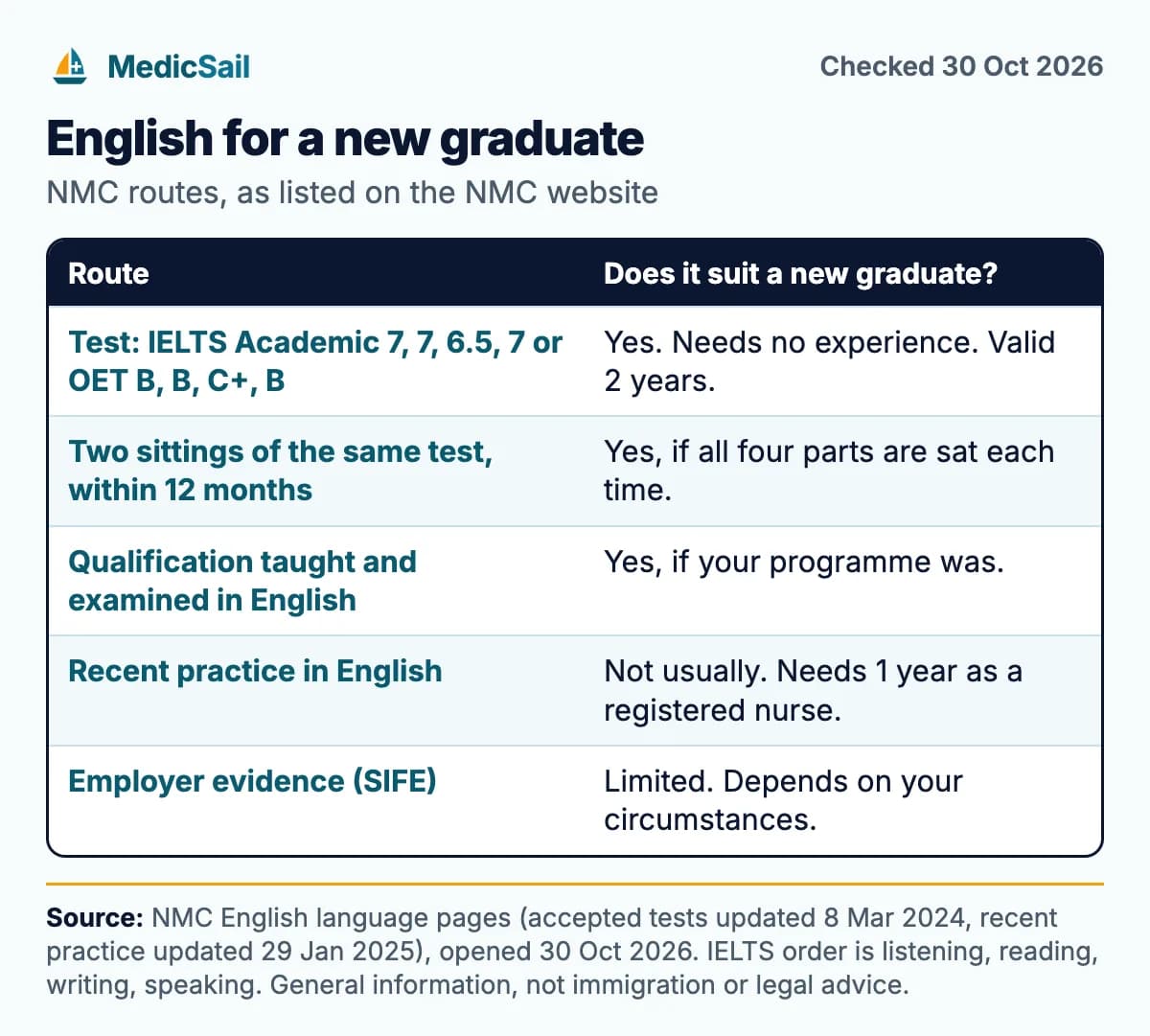
New graduates should be careful with one English route. The NMC accepts several kinds of English evidence, including an accepted test, a qualification taught and examined in English, and recent practice in a majority English-speaking country. That third route does need experience: the NMC says you must have practised for at least one year in a country where English is a majority language, within the last two years when it considers your application, and as a nurse you must have been registered with that country's regulator after completing an English assessment as part of that registration.
For most newly qualified nurses, that means taking a test. The NMC's requirements for nurses are:
| Skill | IELTS Academic | OET |
|---|---|---|
| Listening | 7 | B (350 or above) |
| Reading | 7 | B (350 or above) |
| Writing | 6.5 | C+ (300 or above) |
| Speaking | 7 | B (350 or above) |
The NMC lets you combine results from two sittings of the same test taken within 12 months of each other, provided you sit all four parts each time and meet the minimum scores it sets for each sitting. Our guide to IELTS or OET for UK regulators compares the two tests, and the English test score checker tells you whether your results meet the NMC's rules.
Why employers ask for experience
Employers do not usually publish their reasons, but the rules they work within explain a lot:
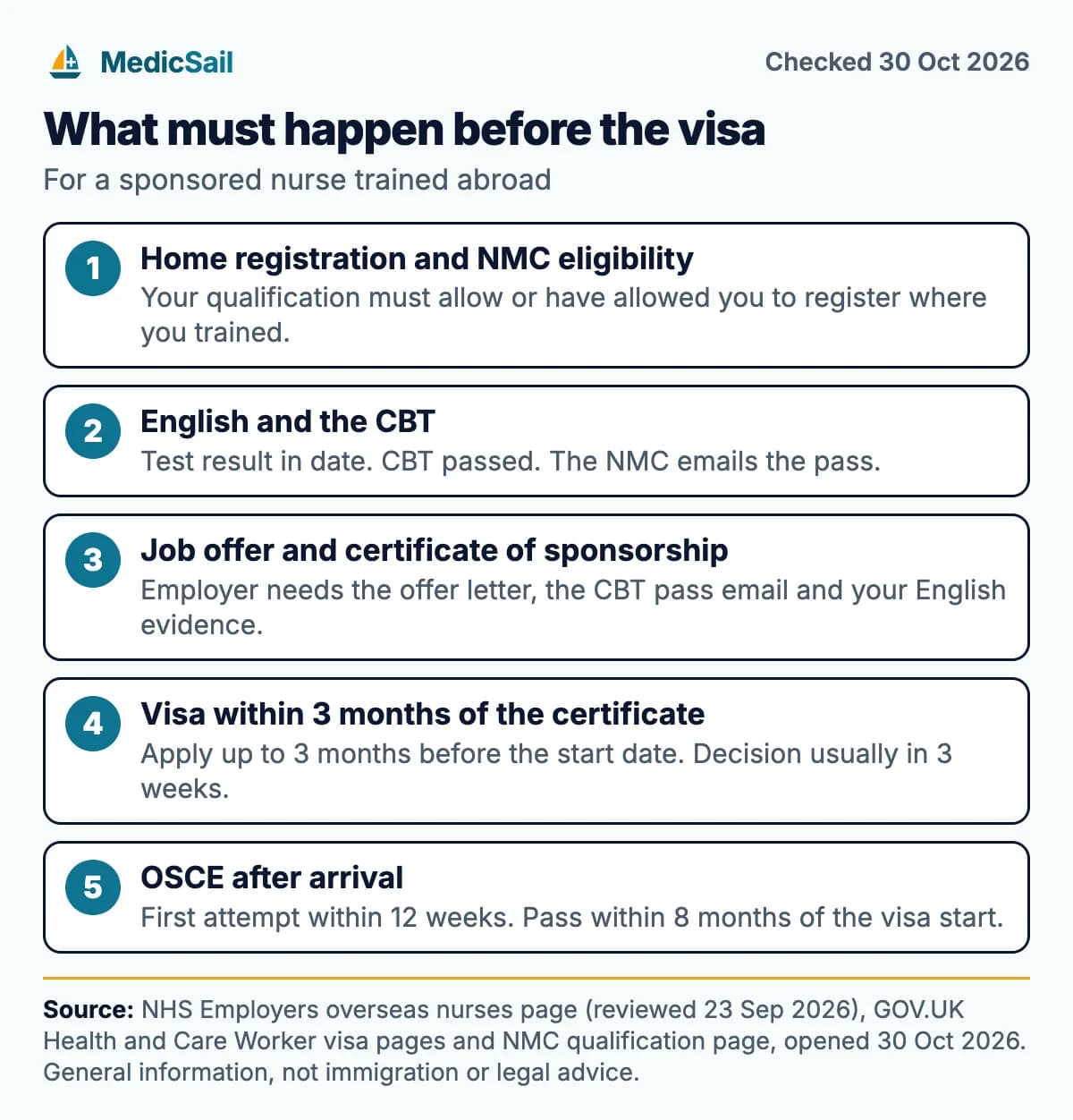
- The OSCE deadline. NHS Employers' guidance says candidates must sit their first OSCE within 12 weeks and pass within eight months from the start of their visa. The OSCE is set at the level of a newly registered UK nurse, but employers carry the risk if a sponsored recruit cannot pass in time, and many see clinical experience as reducing that risk.
- Cost. Employers usually pay for relocation, OSCE training and often the first OSCE sitting, which the NMC prices at £794. They want recruits who will settle and stay.
- Acute wards. Most international recruitment fills adult acute posts, where panels expect you to recognise and escalate deterioration from your first shifts.
- Fewer cohorts. The NMC reported in December 2025 that internationally educated joiners fell by 49.6% in April to September 2025 compared with a year earlier. With fewer places, employers can be more selective.
None of this means a new graduate cannot be hired. It means you need to show the same safety, judgement and communication that experience usually signals. Our guide to NHS interview questions for international nurses shows how to do that with examples from your clinical placements.
Your realistic routes as a newly qualified nurse
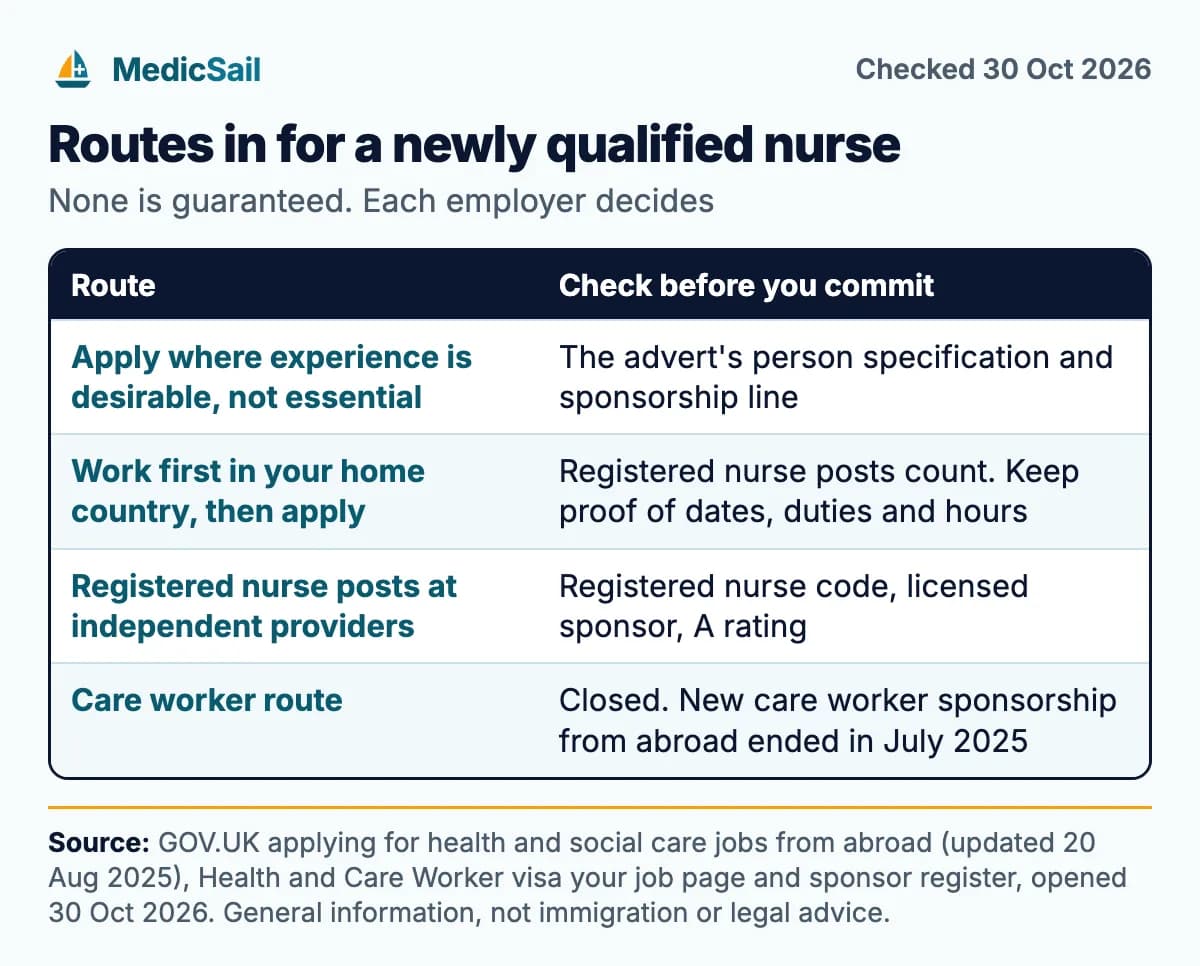
Here are the main options, in the order most new graduates should consider them. None is guaranteed, and employers change their criteria often.
- Apply directly to employers that accept new graduates. Some NHS trusts and independent providers state no minimum experience, or accept recent graduates with strong placement experience. Read the person specification in each advert: if experience is listed as "desirable" rather than "essential", you can still apply. Our guide to finding NHS visa sponsorship jobs explains how to search and read the sponsorship section of each advert.
- Work six to twelve months at home first. This is the most reliable route. Choose an acute hospital post in the field you will apply for, and start your English test and NMC application at the same time, so you are ready to apply once you reach the experience employers ask for.
- Nursing homes and independent hospitals. Some registered nurse posts in nursing homes and independent hospitals are sponsored under the Health and Care Worker visa when the employer provides adult social care or NHS services. Check that the post is a registered nurse role, not a care worker role, and that the employer is on the GOV.UK register of licensed sponsors.
- Other English-speaking destinations. Some nurses register first in another country and move later. Ireland has its own route through the NMBI; see our guide to NMBI registration.
A route to avoid: coming to the UK as a care worker to "get experience". GOV.UK no longer lists care worker and senior care worker codes for new Health and Care Worker applications from abroad, and care work does not count as nursing experience for employers. Our guide to the care worker visa changes explains the rules.
How to get experience that UK employers value
If you decide to build experience first, make it count:
- Work as a registered nurse, not as an assistant or volunteer. Employers usually count only post-registration experience.
- Choose acute care in your field: medical or surgical wards, emergency, critical care, or the acute equivalent in children's or mental health nursing.
- Get a clear certificate of employment with your job title, dates, ward or unit, hours and duties, on headed paper and signed. Ask for a reference from your ward manager.
- Keep a simple practice log: patient groups, skills you used (medicines administration, observations and escalation, wound care, IV therapy where allowed), and examples you can use at interview.
- Take short courses that UK employers recognise, such as basic or immediate life support, if they are available locally.
- Keep your English and CBT moving. The NMC says you can sit the CBT and OSCE in either order, and the CBT can be taken abroad at Pearson VUE centres. Our NMC CBT guide explains it.
Avoid long gaps. Employers and the NMC look at your recent practice, and a long break after qualifying, without work, is harder to explain than limited experience.
Myths new graduates often hear
| What you may hear | What the official sources say |
|---|---|
| "The NMC needs two years' experience." | The NMC sets no minimum post-registration experience. Its 2019 press release says nurses from outside the EU can apply immediately after qualifying. |
| "You cannot sit the CBT until you have worked." | You can book the CBT once the NMC has authorised you to sit the Test of Competence. Authorisation depends on your qualification and eligibility, not experience. |
| "Without experience you must use IELTS General." | The NMC lists IELTS Academic and OET as its accepted tests for nurses, at the same scores for everyone. |
| "Pay an agent and they will find you a job without experience." | The UK Code of Practice for international recruitment says candidates should not be charged recruitment fees. A fee for a job offer is a red flag. |
| "Come as a care worker and convert to nursing later." | GOV.UK no longer lists care worker codes for new applications from abroad. |
| "The visa needs experience." | GOV.UK's Health and Care Worker visa rules are about the job, the employer, the salary and English. They do not set an experience minimum; the employer's job requirements do. |
How to present limited experience in an application
NHS shortlisting compares your application with the person specification, one criterion at a time. If you have little or no post-registration experience, you can still score well by giving evidence for each criterion from your training and any work you have done.
- Use your clinical placements. List the settings, the length of each placement and the skills you were signed off in. A final-year placement on an acute ward is relevant evidence.
- Give specific examples. One clear story about recognising a deteriorating patient and escalating it is worth more than a list of duties.
- Show you know UK practice. Mention the NMC Code, NEWS2, SBAR, safeguarding and consent where they fit. Preparing for the CBT gives you most of this.
- Explain your plan. Say where you are with English, the CBT and your home registration, and that you understand the OSCE timeline.
- Show commitment to learning. Mention preceptorship as something you want, and any short courses you have completed.
- Apply widely but carefully. Apply only where you meet every essential criterion. Repeated applications that clearly do not meet them waste time on both sides.
Requirements also differ by setting. Specialist areas such as critical care, theatres and emergency departments often ask for more experience than general wards. Treat that as a general pattern, not a rule: the essential criteria in each advert are what count.
If you are newly qualified and working in the Gulf
Many new graduates take a first post in a Gulf country to gain experience. That experience can count with UK employers if it is post-registration nursing in a hospital setting and you can document it. Keep your home registration active, get a certificate of good standing from both your home regulator and the Gulf licensing authority when you apply, and remember that Gulf countries are not on the NMC's list of majority English-speaking countries, so working there does not by itself meet the English requirement. Our guide to moving from a Gulf licence to UK registration covers this in detail.
What support new nurses get after arrival
Once you are on the NMC register, UK employers give newly registered nurses a period of preceptorship: structured support as you move into independent practice. NHS England's national preceptorship framework, as summarised in our preceptorship glossary entry, sets a core standard of at least 6 months and a gold standard of at least 12 months, with protected supernumerary time at the start. International nurses usually join the same programme as UK graduates.
Before registration, you work as a pre-registration nurse while you prepare for the OSCE. NHS Employers says employers should place nurses on the relevant band for their role and skills. Once registered, most nurses start at Band 5, which NHS Employers' 2026/27 pay scales set at £32,073 to £39,043 in England. Our NHS pay band explorer shows how pay rises with time in the band.
Your first year will also include the practical steps every new registrant faces: learning your trust's policies and electronic records, completing mandatory training, and having your competencies signed off, for example in medicines administration and intravenous therapy, before you do them unsupervised. Some skills you were allowed to perform at home may need to be reassessed under UK policy. That is normal and is not a judgement on your training. Keep a record of your practice hours, learning and feedback from the start, because you will need them for NMC revalidation three years after you register; our guide to NMC revalidation for international nurses explains the requirements.
Being new is not a disadvantage once you are here. Preceptorship exists precisely because every newly registered nurse, UK-trained or not, needs support in the first year.
A step-by-step plan for new graduates
- Register with your home regulator, passing any licensing exam it requires, and keep the certificate.
- Take IELTS Academic or OET and reach the NMC's scores.
- Open your NMC eligibility and qualification application and pay the evaluation fee. The NMC lists it at £167 on its costs page; check the current amount before you pay.
- Pass the CBT once the NMC authorises you to sit the Test of Competence.
- Work in acute nursing in your field while you apply, and document it.
- Apply to sponsored posts whose person specification you meet, and prepare for values-based interviews.
- Accept a written offer, check the employer on the sponsor register, and apply for your visa with your certificate of sponsorship.
- Arrive, sit the OSCE within the time your employer sets, and register. Our first weeks checklist covers the move itself.
Our guide to nursing in the UK and the registration timeline calculator help you put realistic dates on each step.
Questions
Yes. The NMC does not require post-registration experience. It said in 2019 that its changes had enabled nurses and midwives from outside the EU to apply immediately after qualifying, rather than after a 12 month waiting period.
The NMC needs your qualification to have allowed, or to allow, you to register where you trained. If you are not registered yet, your institution must confirm this, and the NMC warns it may not accept your application if, for example, you have not completed a registration exam.
It varies. Many ask for six to twelve months or more of post-registration experience, often in acute care. University Hospitals of Leicester, for example, lists 12 months, while some employers set no minimum.
Usually not. The NMC's recent practice route needs at least one year of registered practice in a majority English-speaking country within the last two years, with an English assessment as part of that registration.
Employers usually count only experience as a registered nurse. Care worker roles are also closed to new applicants from abroad under the Health and Care Worker visa, so this is not a route into nursing.
The OSCE is set at the level of a newly registered UK nurse, so new graduates can pass it. Employers still weigh experience because NHS Employers' guidance says the OSCE must be passed within eight months from the start of the visa.
Usually a pre-registration band set by your employer until you join the NMC register, then Band 5. NHS Employers' 2026/27 scales put Band 5 at £32,073 to £39,043 in England.
Yes. Employers provide preceptorship for newly registered nurses. NHS England's framework sets a core standard of at least 6 months and a gold standard of at least 12 months.
Gulf hospital experience as a registered nurse can count with UK employers if documented. It does not meet the NMC English requirement on its own, because Gulf countries are not on the NMC's majority English-speaking list.
Sources
- 1NMC: NMC announces further improvements to help overseas applicants (10 September 2019)
- 2NMC: Qualification and registration (eligibility and qualification application)
- 3NMC: Recent practice in English
- 4NMC: Accepted English language tests
- 5NMC: Costs for applicants trained outside the UK
- 6NMC: OSCE
Show all 12 sourcesShow fewer sources
- 7NMC: Sharp drop in international recruitment slows overall growth of UK register (5 December 2025)
- 8NHS Employers: Recruitment of overseas nurses and midwives
- 9NHS Employers: Pay scales for 2026/27
- 10NHS England: National preceptorship framework for nursing
- 11University Hospitals of Leicester: International nursing and midwifery careers
- 12GOV.UK: Health and Care Worker visa, your job
Plan it with our free tools
MedicSail
Healthcare licensing consultants for the UK, Europe and the USA
Updated and checked against the sources listed above. How we research and check our guides