


































NMC revalidation for international nurses and midwives: requirements, dates and a three-year plan
What revalidation needs, when your first one is due after your PIN, why pre-registration hours do not count, and a three-year plan for nurses new to UK practice.

MedicSail
Published
The short answer
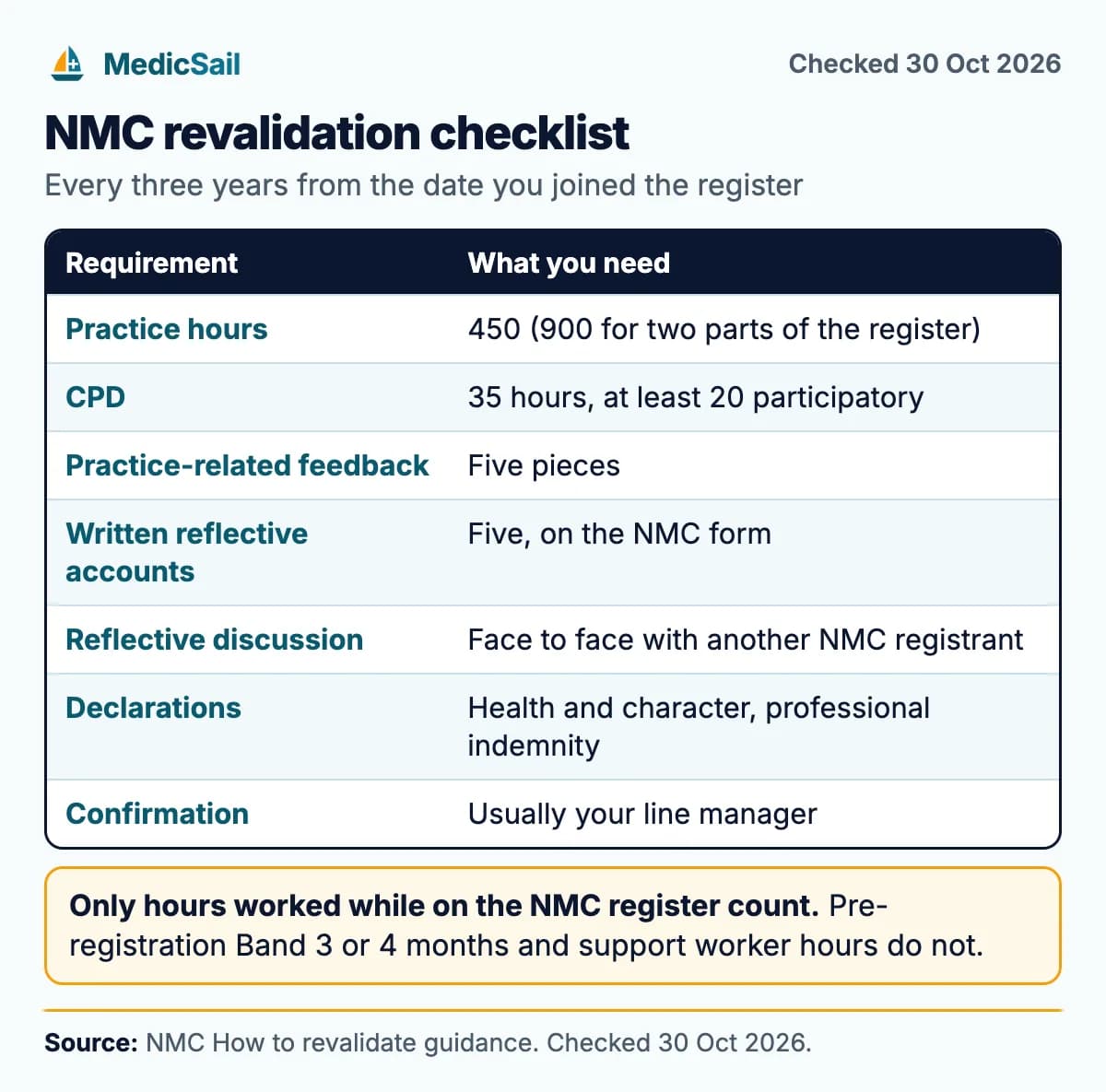
NMC revalidation is how you renew your registration every three years. International nurses and midwives follow exactly the same requirements as UK-trained registrants, and the three years start from the date you joined the register, so your first revalidation falls three years after you received your PIN. To revalidate you need, over those three years:
- 450 practice hours (900 if you are on two parts of the register, such as nurse and midwife)
- 35 hours of CPD, of which at least 20 must be participatory
- five pieces of practice-related feedback
- five written reflective accounts, on the NMC's form
- a reflective discussion with another NMC registrant
- a health and character declaration
- a declaration of a professional indemnity arrangement
- confirmation from an appropriate person, usually your line manager
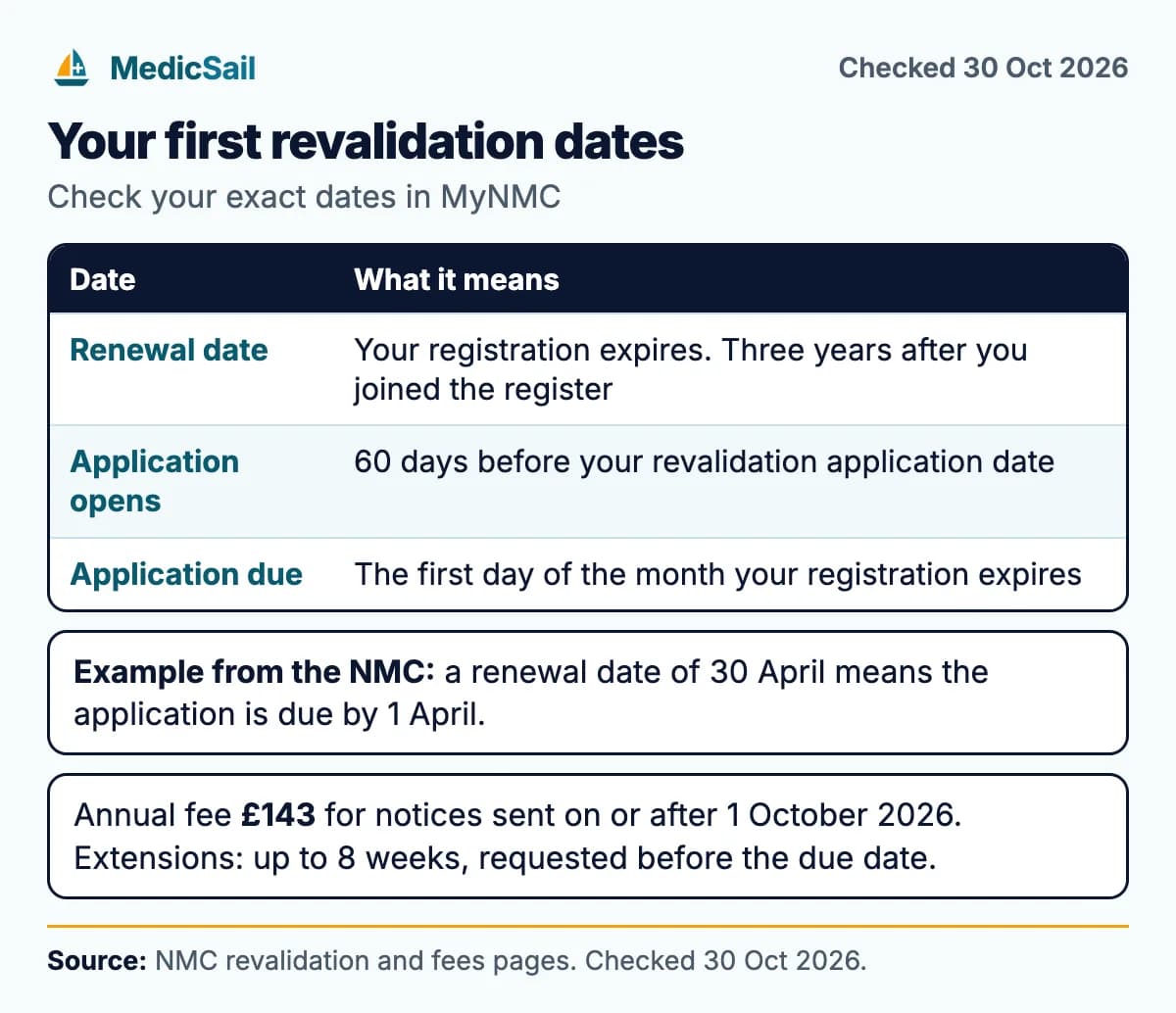
Your application opens in MyNMC 60 days before your revalidation application date and is due on the first day of the month in which your registration expires. You also pay your annual fee, which is £143 for notices sent on or after 1 October 2026.
One rule matters more to internationally educated nurses than to anyone else: you can only count practice hours undertaken while you were registered with the NMC. Hours worked as a pre-registration nurse, healthcare assistant or support worker before you got your PIN do not count. This guide explains each requirement, the traps for international nurses, and a three-year plan. For the route onto the register, see our page on NMC registration for overseas nurses.
When your first revalidation is due
The NMC says: "Every three years from when you join (or rejoin) the register you will need to renew your registration by revalidating." For an internationally educated nurse, that is three years from the date the NMC registered you after your Test of Competence, not from when you arrived in the UK or passed the OSCE.
Your exact date is in your MyNMC account. Three dates matter:
| Date | What it means |
|---|---|
| Renewal date | The date your registration expires; shown in MyNMC |
| Application opens | 60 days before your revalidation application date |
| Application due | The first day of the month in which your registration expires. The NMC's example: a renewal date of 30 April means the application is due by 1 April. |
Submitting before the due date gives the NMC time to process your application and contact you if it needs to. Set a reminder for the day the application opens and aim to submit in the first few weeks of that window.
If you have a Direct Debit, the annual fee is collected at the usual time even if it falls after your revalidation application date. If you do not, the NMC says you must pay your fee before your revalidation application date.
The requirements at a glance
| Requirement | What you need | What you keep or submit |
|---|---|---|
| Practice hours | 450 (single registration); 900 (two registrations); 1,350 (nurse, midwife and nursing associate) | A record of dates, hours, employers, scope and work setting |
| CPD | 35 hours, at least 20 participatory | A CPD log with evidence of each activity |
| Practice-related feedback | Five pieces | A note of each and how you used it |
| Written reflective accounts | Five, on the NMC form | The completed form |
| Reflective discussion | With another NMC registrant, face to face | The reflective discussion form, signed by them |
| Health and character | A declaration | Made in the online application |
| Professional indemnity | A declaration that you have or will have cover | Made in the online application |
| Confirmation | From your line manager or another appropriate person | The confirmation form |
You do not upload your evidence when you apply. You keep it, show it to your confirmer, and provide it if the NMC selects your application for verification. The NMC publishes templates for the practice hours log, CPD log, feedback log, reflective accounts form, reflective discussion form and confirmation form. Use them from the start.
Practice hours: the rule that catches international nurses
The NMC requires 450 practice hours over the three years for a single registration, 900 for dual registration (450 for each part) and 1,350 for nurse, midwife and nursing associate. Hours count where you use your skills, knowledge and experience as a registered nurse, midwife or nursing associate. That includes direct patient care and also management, teaching, and running or shaping a service. Your hours should reflect your current scope of practice.
The NMC's "How to revalidate" guidance adds three rules that matter to internationally recruited nurses:
- Only hours while registered with the NMC count. The guidance says: "You can only count practice hours that you undertook while you were registered with the NMC." So the months you spent as a pre-registration nurse on Band 3 or Band 4 before your PIN do not count, even though you were nursing.
- Support worker hours never count. Hours in a healthcare, nursing or midwifery assistant or support worker role cannot be counted, nor can hours in another regulated profession.
- Overseas hours can count once you are registered. If you work overseas as a nurse or midwife for part of your three-year period while on the NMC register, the guidance says you can count those hours, and you should register with the regulator where you are practising.
For a full-time nurse, 450 hours is reached well within the first year, so most international nurses in NHS posts meet it easily. The risk is for those who move into non-nursing roles, take long breaks, or return home and stop practising. If you cannot meet the hours, the NMC says you must complete an approved return to practice programme or a Test of Competence before your renewal application date.
Keep a log from your first shift as a registrant: dates, hours, the employer's name and address, your scope of practice, the work setting, a short description and evidence such as rotas or timesheets. Your employer's e-rostering system is useful, but do not rely on being able to access it after you leave a job.
Continuing professional development: 35 hours, 20 participatory
You need 35 hours of continuing professional development relevant to your scope of practice in the three years, and at least 20 of those hours must include participatory learning. The NMC defines participatory learning simply: activity "that involves interaction with one or more other professionals", in person or online. Examples include conferences, workshops, training courses and group meetings to discuss an event or a new way of working. Reading an article on your own or completing an e-learning module alone counts as CPD but not as participatory.
Your CPD record should show, for each activity, the method, a description of the topic and how it relates to your practice, the dates, the total hours and participatory hours, the part of the Code it relates to, and evidence such as a certificate.
For internationally educated nurses the first year on the register often produces plenty of CPD without extra effort: preceptorship study days, trust competency training (for example IV therapy or medicines management), simulation sessions and clinical skills workshops. Record them as they happen. Mandatory training may count where it is relevant to your practice and you can explain what you learnt; check with your confirmer.
CPD you completed before you joined the NMC register falls outside the three-year period, which starts when you join. Count only activity from your registration date onwards.
Practice-related feedback and written reflective accounts
Feedback. You need five pieces of practice-related feedback in the three years. It can be written or verbal, formal or informal, and can come from patients and service users, colleagues and managers, team performance reports or your annual appraisal. The NMC recommends keeping a note of each piece and how you used it to improve your practice. Thank-you cards, comments in a preceptorship review and feedback from a teaching session all count.
Reflective accounts. You need five written reflective accounts, recorded on the NMC's reflective accounts form, which is mandatory. Each must refer to an instance of CPD, a piece of feedback, or an event or experience in your own practice, and explain how it relates to the Code. The five accounts can draw on the same CPD and feedback you have already logged.
Two practical points:
- Never identify anyone. The NMC says be careful not to record any information which may identify another person. Leave out names, dates of birth, ward bed numbers and anything else that could identify a patient or colleague.
- Write about what changed. A good account says what happened, what you learnt, how it changed your practice and which part of the Code it relates to (prioritise people, practise effectively, preserve safety, promote professionalism and trust). Nurses new to UK practice often have strong material: adapting to UK documentation, consent and capacity law, escalation systems or safeguarding processes that differ from home.
The reflective discussion
You must discuss your five written reflective accounts with another NMC registrant, and the NMC says the discussion should take place face to face. They must be on the NMC register, as a nurse, midwife or nursing associate. You record the discussion on the NMC's reflective discussion form, which the other registrant signs, giving their name, NMC PIN, email, professional address and postcode, and the date.
You do not submit the form, but you keep it, and you give the registrant's details in your online application. The NMC may contact them if your application is selected for verification.
For international nurses the obvious choices are your preceptor, a senior colleague on the ward or your practice educator. Choose someone who will still be reachable when you apply. The discussion is a professional conversation about how your reflections relate to the Code, not an assessment.
Health and character, indemnity and confirmation
Health and character. You make a declaration in the online application. You must declare if you have been charged with or convicted of a criminal offence, including a conditional discharge, or received a formal caution, and if you have been the subject of an adverse determination by a professional or regulatory body. You do not need to declare again something you have already declared and the NMC has considered.
Professional indemnity. You declare that you have, or will have when practising, appropriate indemnity cover. The NMC says most employers provide this for their employees; check with yours. If you are self-employed, the NMC says you need to arrange your own cover.
Confirmation. An appropriate person reviews your evidence and confirms you have met the requirements. The NMC says, "Where possible, your confirmer should be your line manager", who does not have to be an NMC registrant. If you have no line manager, the NMC recommends an NMC-registered nurse, midwife or nursing associate where possible. Family members and close friends cannot be confirmers. You should get confirmation in the final year of your three-year period, and you record it on the NMC's confirmation form. Your confirmer and your reflective discussion partner can be the same person.
If you work wholly overseas at the time you revalidate, the guidance says you can seek confirmation from your line manager where you work, and where possible your confirmer should be a nurse, midwife or nursing associate regulated where you practise, or another regulated healthcare professional.
Submitting, verification, extensions and lapse
Submitting. Log in to MyNMC, start the revalidation application and complete the declarations. You need the contact details of your reflective discussion partner and your confirmer. You can save and return. The NMC cannot process the application until your fee is paid. Once it has your application and fee, it emails to confirm your registration has been renewed, which the NMC says can take up to two days, or five days after collection if you pay by Direct Debit.
Verification. The NMC's guidance says that each year it selects a sample of revalidation applications and asks for more information. If yours is selected, your registration stays effective until verification is complete, even if that runs past your renewal date, and the guidance says verification is completed within three months of your renewal date. If you do not engage with verification, your registration could lapse.
Extensions. If something serious gets in the way, such as sudden serious illness or a recent bereavement, you can request an extension through MyNMC. The NMC grants up to eight weeks from your due date and says it cannot offer more. Request it as early as possible once your revalidation opens and before your due date.
Lapse. If you do not renew, your registration lapses and you cannot practise as a registered nurse or midwife. The NMC's payment page says readmission can take two to six weeks. The guidance adds that if you apply for readmission within six months of lapsing when your revalidation was due, you must also meet several revalidation requirements. For a sponsored nurse, a lapse can also affect your job and visa, because your role depends on your registration. Treat the due date as fixed.
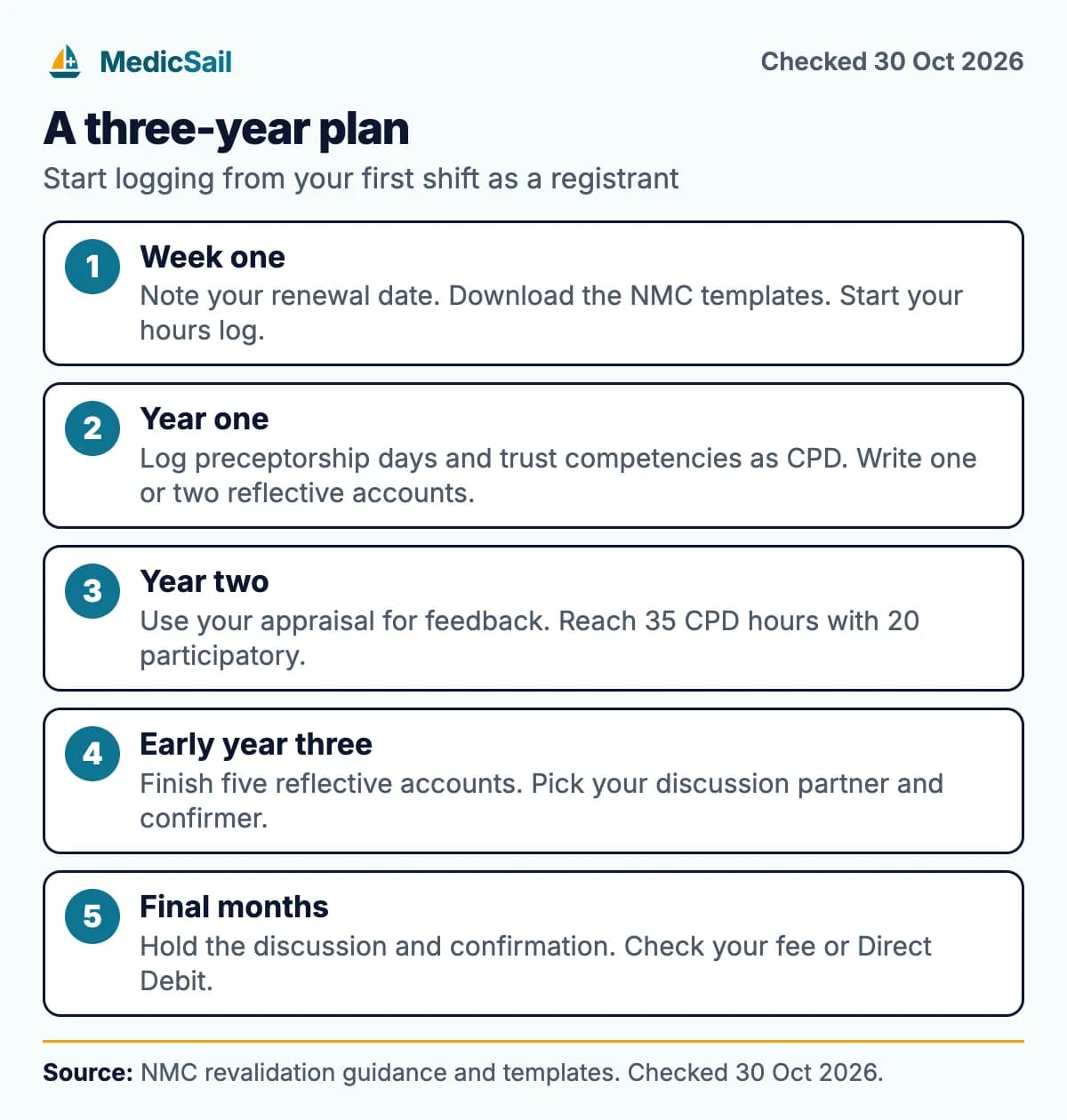
A three-year plan for internationally educated nurses
| When | What to do |
|---|---|
| Week one on the register | Note your renewal date. Download the NMC templates. Start a practice hours log from your registration date, not your arrival date. |
| Year one | Log preceptorship study days and trust competencies as CPD, marking which were participatory. Save feedback from preceptorship reviews and patients. Write one or two reflective accounts while the experience of adjusting to UK practice is fresh. |
| Year two | Keep logging. Use your appraisal as a source of feedback and CPD planning. Bring your CPD to 35 hours and 20 participatory hours with room to spare. |
| Early in year three | Complete your five reflective accounts. Choose your reflective discussion partner and confirmer. Check your indemnity cover. |
| Final months | Hold the reflective discussion, then the confirmation meeting. Check your fee is paid or your Direct Debit is set up. |
| Application window | Submit in MyNMC once it opens, 60 days before the application date. Keep all evidence afterwards in case of verification. |
If you move employer during the three years, take copies of your logs and feedback with you, and remember that a job change on a Health and Care Worker visa needs a visa update, as explained in our Health and Care Worker visa guide. If you are about to join the register, our guide to what happens after the OSCE explains the PIN, preceptorship and the move to Band 5.
Common revalidation mistakes
- Counting hours from your arrival date. Your three years and your practice hours start when you join the register. Pre-registration months do not count.
- Too little participatory CPD. Online modules done alone are CPD but not participatory. Keep a running total of both figures.
- Reflective accounts written on the wrong form or not linked to the Code. The NMC form is mandatory, and each account must explain how it relates to the Code.
- Identifiable details in your records. Names or other details that could identify a patient or colleague should never appear in your portfolio.
- A reflective discussion partner who is not on the NMC register. They must be an NMC registrant. Your confirmer, by contrast, can be a line manager from another profession.
- Leaving it to the last week. Confirmers go on leave, rotas change and colleagues move on. Book the confirmation meeting in the final months, not the final days.
- Forgetting the fee. The NMC cannot process the application until it is paid. Without a Direct Debit, pay before your application date.
The NMC's revalidation process is not an assessment of your fitness to practise. It asks you to show you have kept up to date and reflected on your practice, and most nurses who keep simple records as they go find it straightforward.
If you move abroad, change role or leave the register
Working in Ireland or elsewhere. Many nurses keep their NMC registration while working in another country. The guidance says overseas hours as a nurse or midwife can count once you are registered, and that you should register with the regulator where you practise. If you are considering Ireland, our NMBI registration page explains the separate Irish register, and the nursing hub compares other countries.
Moving into a non-clinical role. Roles in management, education, policy or commissioning can count if you rely on your nursing skills and knowledge. Hours as a healthcare assistant or in another regulated profession cannot.
Not practising. If you cannot meet the requirements, the guidance gives two options: complete an NMC-approved return to practice programme before your application date, or cancel your registration and apply for readmission later. You must not present yourself as a registered nurse or midwife in the UK while you are not on the register.
Tax relief. GOV.UK says you can claim tax relief on professional fees you must pay to do your job, for the current tax year and the four previous ones. Keep your NMC fee receipts. Our guide to NMC registration costs covers ongoing fees.
Questions
Three years from the date you joined the NMC register, not from when you arrived in the UK. Your renewal date is in MyNMC, and your application is due on the first day of the month in which your registration expires.
No. The NMC's guidance says you can only count practice hours undertaken while registered with the NMC. Hours as a pre-registration candidate or in a healthcare assistant or support worker role do not count.
450 hours over three years for a single registration, 900 for two registrations such as nurse and midwife, and 1,350 for nurse, midwife and nursing associate.
35 hours over three years, of which at least 20 must be participatory, meaning they involved interaction with one or more other professionals, in person or online.
Where possible your line manager, who does not need to be on the NMC register. If you have no line manager, the NMC recommends a nurse, midwife or nursing associate. Family members and close friends cannot confirm.
Yes. The NMC says they do not need to be the same person, but it can make the process easier. Your reflective discussion partner must be an NMC registrant.
Yes, if you worked as a nurse or midwife while on the NMC register. The NMC's guidance says overseas hours can count and that you should register with the regulator where you practise.
Yes, through MyNMC, for up to eight weeks from your due date, in circumstances such as sudden serious illness or bereavement. Ask as early as possible and before your due date.
Your registration lapses and you cannot work as a registered nurse or midwife until you are readmitted, which the NMC says can take two to six weeks. A lapse can also affect a sponsored job and visa.
Sources
- 1NMC: revalidation
- 2NMC: what is revalidation
- 3NMC: revalidation requirements
- 4NMC: practice hours
- 5NMC: continuing professional development
- 6NMC: practice-related feedback
Show all 17 sourcesShow fewer sources
- 7NMC: written reflective accounts
- 8NMC: reflective discussion
- 9NMC: health and character
- 10NMC: professional indemnity arrangement
- 11NMC: confirmation
- 12NMC: extensions for revalidation
- 13NMC: find out your revalidation date
- 14NMC: submit your revalidation application
- 15NMC: How to revalidate with the NMC (guidance booklet)
- 16NMC: paying your annual fee
- 17GOV.UK: tax relief for professional fees and subscriptions
Plan it with our free tools
MedicSail
Healthcare licensing consultants for the UK, Europe and the USA
Updated and checked against the sources listed above. How we research and check our guides