


































NMC to NMBI: moving from the UK to Ireland as a nurse
There is no transfer from the NMC register to NMBI. How NMBI assesses UK-trained and overseas-trained NMC registrants, the documents and CCPS, English exemptions, compensation measures, fees, timelines and the right to work in Ireland.

MedicSail
Published
The short answer
There is no transfer of a nursing registration from the UK to Ireland. Your NMC PIN does not carry across, and the Nursing and Midwifery Board of Ireland (NMBI) does not register you because you are on the NMC register. You make a fresh application to NMBI in two stages: recognition of your qualification, then registration. What NMBI asks of you depends mainly on where and when you qualified, not on where you are registered now.
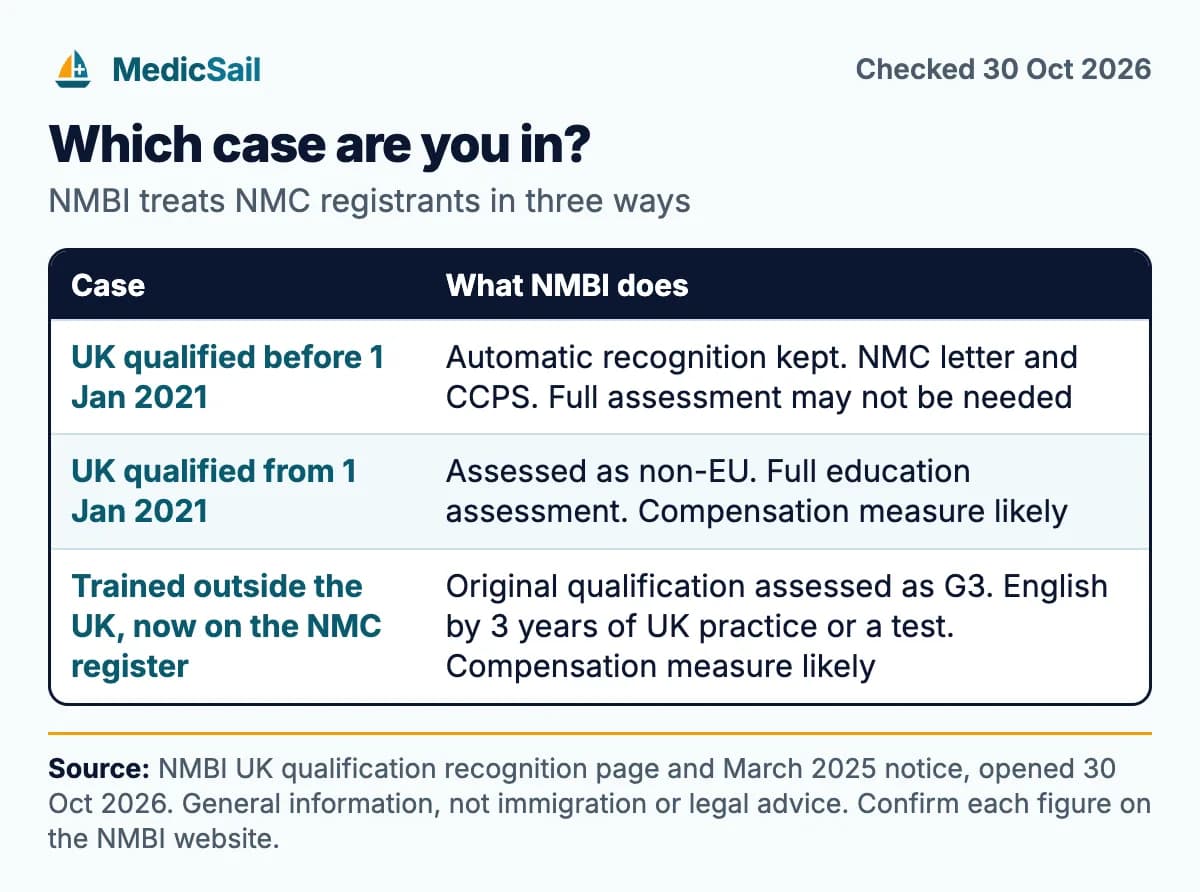
There are three situations, and it is worth working out which one you are in before you open a MyNMBI account:
- You qualified in the UK before 1 January 2021. NMBI kept automatic recognition for UK-educated general nurses and midwives who qualified while the UK was in the EU. With an NMC letter confirming your qualification dates and that it met the EU Directive at the time, plus a certificate of current professional status, a full education assessment may not be needed. NMBI says the compensation measure requirement does not apply to nurses and midwives who qualified in the UK before Brexit.
- You qualified in the UK from 1 January 2021 onwards. NMBI assesses you as a non-EU applicant, with a full education assessment of your qualification form and transcript. In March 2025 NMBI said students who studied in the UK from 2021 onwards will require a compensation measure (an aptitude test or a period of adaptation) to join the register.
- You trained outside the UK (for example in India, the Philippines, Nigeria or Kenya) and then joined the NMC register. NMBI assesses your original qualification as a non-EU (G3) applicant. Your NMC registration still helps: three years of post-registration practice in the UK within the last five years can meet the English language requirement, and your UK experience is taken into account in the assessment. NMBI does not say that passing the NMC test of competence exempts you from its own compensation measure.
Separately from registration, you need the right to work in Ireland. British and Irish citizens can work in Ireland without permission under the Common Travel Area. Other nationals, including people with indefinite leave to remain in the UK, generally need an Irish employment permit, usually the Critical Skills Employment Permit for nurses.
The rest of this guide walks through each case: the documents, the NMC certificate, English, compensation measures, fees, timelines and the move itself, with every figure taken from NMBI, the NMC and the Irish government. If you are new to the Irish system, the NMBI registration overview gives the full picture for all overseas applicants.
Why your NMC registration does not simply transfer
Until the end of 2020 the UK was part of the EU system of recognition under Directive 2005/36/EC. General nurses and midwives trained in one member state had their qualifications recognised automatically in another, and the NMC issued Certificates of Conformity confirming that a UK programme met the Directive. NMBI says the NMC stopped issuing Certificates of Conformity in June 2021, and since Brexit the NMC also says it can no longer issue a certificate under EU directives.
Ireland and the UK still share the Common Travel Area, which covers the right of British and Irish citizens to live and work in each other's country. It does not cover professional regulation. Nursing registers are national: the Nursing and Midwifery Council regulates practice in the UK and NMBI regulates it in Ireland, and neither body recognises the other's register as a licence to practise.
NMBI explains the change in two ways. First, the UK has deviated from the European Directive since Brexit. Second, it points to changes to learning and clinical placements the NMC permitted during Covid. That is why someone who trained in England in 2019 and someone who trained in the same university in 2022 can get very different outcomes from NMBI.
NMBI groups every applicant as G1, G2 or G3:
| Group | What it means | Assessment |
|---|---|---|
| G1 | EU automatic recognition pathway (Directive applicants) | Administrative assessment only |
| G2 | EU general systems pathway (Directive applicants) | Administrative and qualification assessment |
| G3 | Not regulated by the EU Directive (non-Directive applicants) | Administrative and qualification assessment |
MyNMBI classifies you from your answers to screening questions, and the classification decides which documents you are asked for and how long assessment takes. Pre-2021 UK qualifiers can fall within the automatic recognition approach that NMBI has kept; post-2021 UK graduates and nurses who trained outside the UK are assessed as non-EU applicants.
Which case are you? UK-trained before 2021, after 2021, or trained elsewhere
The table below sets out how NMBI treats each group of NMC registrants, from the NMBI pages on UK qualification recognition, English language and compensation measures.
| UK-trained, qualified before 1 January 2021 | UK-trained, qualified from 1 January 2021 | Trained outside the UK, now NMC registered | |
|---|---|---|---|
| How NMBI assesses you | Automatic recognition retained for general nurses and midwives; full education assessment may not be needed | As a non-EU applicant, with a full education assessment | As a non-EU (G3) applicant, on your original qualification |
| Key documents | NMC letter confirming qualification dates and EU Directive conformity at the time, CCPS, copy of NMC documents, qualification parchment | Qualification form, transcript, qualification parchment, CCPS; employment forms optional | Qualification form and transcript from your original education body, syllabus, parchment, CCPS from the NMC and from every other regulator you were registered with, employment forms |
| English | Exempt through training in English in the UK | Exempt through training in English in the UK | IELTS or OET, or 3 years of post-registration practice in the UK within the last five years |
| Compensation measure | NMBI says the requirement does not apply to pre-Brexit UK qualifiers | NMBI says students from 2021 onwards will require one | Likely: NMBI says 97% of applications from people who qualified outside the EU need one |
If you qualified in the UK before 2021 but the NMC cannot confirm it
NMBI says that if the NMC confirmation is not available, a full education assessment is needed instead, including a qualification form and transcript from your university. Ask the NMC early, because without that letter you move into the slower route.
Mental health, children's and learning disability nurses
Automatic recognition under the Directive only ever covered general nurses (adult nursing in UK terms) and midwives. NMBI's register has separate divisions, including the General Nurses, Children's Nurses, Psychiatric Nurses, Intellectual Disability Nurses and Midwives Divisions. You can only apply for recognition in a division whose standards your qualification meets. If you qualified in a UK field other than adult nursing, expect a qualification assessment against the matching Irish division whatever the year, and check with NMBI's team at [email protected] before you apply. The guide to nursing in Ireland describes each division and how Irish nurse education is structured.
If you trained in India, the Philippines, Nigeria or elsewhere
Your NMC PIN shows you have passed the UK test of competence and practised safely in the UK, but NMBI still compares your original programme with Irish standards. It does, however, take relevant work experience and extra courses into account during the qualification assessment, and your UK post-registration years can exempt you from an English test. If you have already been through NMBI's process for an earlier application, any decision letter you hold has a validity period, so check whether it is still live.
Documents NMBI asks for, and how to get them from the UK
MyNMBI generates your exact document list once you have answered the screening questions. The NMBI Applicant User Guide describes each document. These are the ones that matter most for NMC registrants:
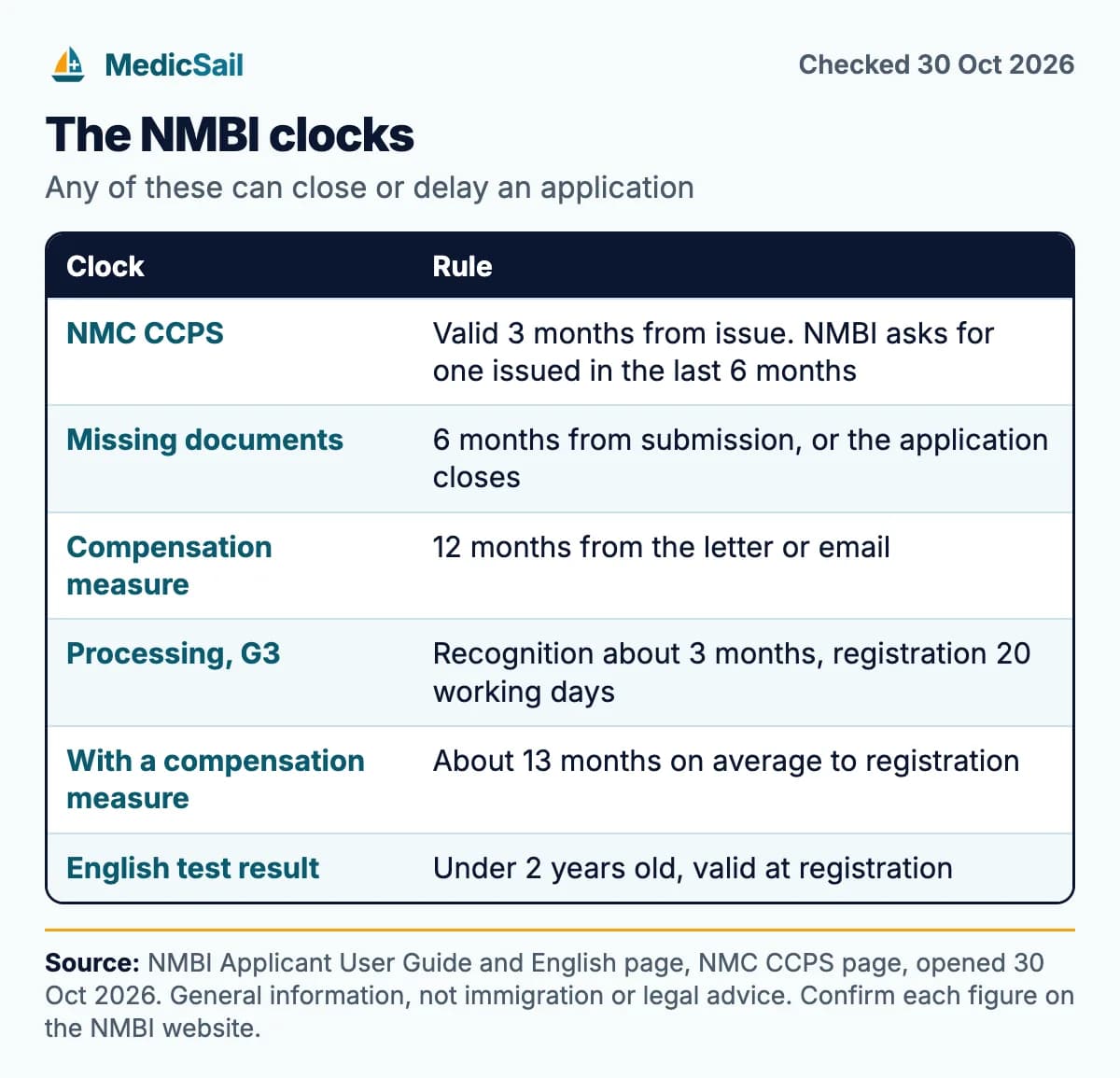
- Certificate of Current Professional Status (CCPS) from the NMC. This confirms your registration dates, status and any fitness to practise restrictions. NMBI wants one from every jurisdiction where you practised or were registered, issued in the last six months. For G3 applicants it is part of the recognition stage; for G1 and G2 applicants it is part of registration.
- NMC letter on EU Directive conformity (pre-2021 UK qualifiers only), confirming your qualification dates and that the qualification conformed with the Directive at that time.
- Qualification form and transcript completed by your university or nursing school. For post-2021 UK graduates and for nurses trained abroad, this is the core of the education assessment. Overseas-trained nurses often find this is the slowest document to obtain, because it comes from the original college.
- Syllabus showing theory and clinical content and hours, where requested.
- Qualification parchment (your degree or diploma certificate), as a certified copy.
- Employment forms from employers. NMBI says these are not required for pre-2021 UK qualifiers on the NMC letter route and are optional for post-2021 UK graduates. They are useful where the assessor is weighing experience against gaps in training.
- Passport or national identity card, certified, plus evidence of any change of name.
- English language evidence (see the next section).
Certifying documents in the UK
NMBI accepts certified copies made by a solicitor or lawyer, notary public, peace commissioner, justice of the peace or commissioner for oaths, and it lists the Post Office as a certifying authority in the United Kingdom only. The certifier must confirm they have seen the original, give their full name and profession, and stamp, sign and date the copy. Wrongly certified documents are one of the most common reasons for delay. Any document not in English needs a certified English translation.
Do it yourself
NMBI says you must upload your own documents, must not share your MyNMBI login, and that only the nurse or midwife, not an agent, can pay the fee. If a recruiter is helping you, they can advise, but the application has to be yours.
Getting your CCPS from the NMC
The NMC calls the document a certificate of current professional status. It is also known as a letter of good standing or a validation of registration. You request it in your NMC Online account, under My Registration. The NMC says it should be requested after you have applied to register in the country where you want to practise, so open your MyNMBI application first.
When it is ready, the NMC emails the overseas registration authority, which downloads the certificate from the NMC's secure portal; you also get a copy in your account. The NMC says that once it has all the references it needs it usually issues the certificate within 24 hours, and that the certificate is only valid for three months from the date it is issued. NMBI's own rule is six months, but the shorter NMC validity is the one to plan around. Request it when the rest of your file is nearly complete, not months in advance.
In MyNMBI you can tick a box to say your nursing council is sending the CCPS to NMBI directly. If you were registered anywhere else before the UK (for example a state nursing council in India, the Philippine Professional Regulation Commission or a Gulf health authority), you need a CCPS or certificate of good standing from each of those too. Some councils take weeks, so start those first.
Keep your NMC registration active while you apply. Your CCPS has to show current registration, and you may want to keep working in the UK until NMBI gives you a decision. Lapsing early can also complicate revalidation if you later return; see the NMC registration page for how renewal works.
English language: who is exempt and what to sit
NMBI has three ways to meet its English requirement. The rules are the same for all overseas applicants; what differs for NMC registrants is which pathway is open to you.
| Pathway | Who it suits | What NMBI asks for |
|---|---|---|
| 1. Trained in English in a recognised country | Everyone who trained in the UK | Evidence from your education body of the programme, dates and location, confirming it was taught and assessed in English. The recognised countries are Australia, Canada, New Zealand, the USA and the UK. |
| 2. Registered and practised in English | Overseas-trained nurses with enough UK experience | 3 years of post-registration practice within the last five years in one of those countries, shown by a letter or email from your employer or nursing authority stating location, dates and that you practised primarily through English |
| 3. English test | Anyone else, including NMC registrants with under three years in the UK | IELTS Academic (including IELTS for UKVI) or OET |
For the test route, NMBI's minimum scores are:
- IELTS Academic: overall 7.0, with Listening 7.0, Reading 7.0, Writing 6.5 and Speaking 7.0, or alternatively 7.0 in any three components and 6.5 in any one.
- OET: B (350 to 450) in Listening, Reading and Speaking and C+ (300 to 340) in Writing, or alternatively B in three components and C+ in one.
Results must be less than two years old and, for applications started online after 28 September 2020, still valid when you submit the registration stage. NMBI accepts one test result only (no combining sittings) and does not accept IELTS One Skill Retake, IELTS online or OET at home. The NMC's rules on combining sittings and online tests are not the same, so a score you used for the NMC may not work for NMBI. The IELTS and OET guide for UK regulators compares the UK rules, and the gap between them is worth checking before you rebook.
If you trained abroad and have, say, two years in the UK, count carefully: the three years must be post-registration, within the last five years and in the recognised countries. Time spent working as a healthcare assistant before your NMC PIN does not count as post-registration practice.
Compensation measures: aptitude test or adaptation
If the education assessment finds gaps between your qualification and experience and the Irish standards, NMBI issues a decision requiring a compensation measure. For many NMC registrants this is now the central step. NMBI's March 2025 notice says UK students from 2021 onwards will need one and that 97% of applications from people who qualified outside the EU need one; its UK qualification page also reports a marked increase in compensation measures, especially for general nurses.
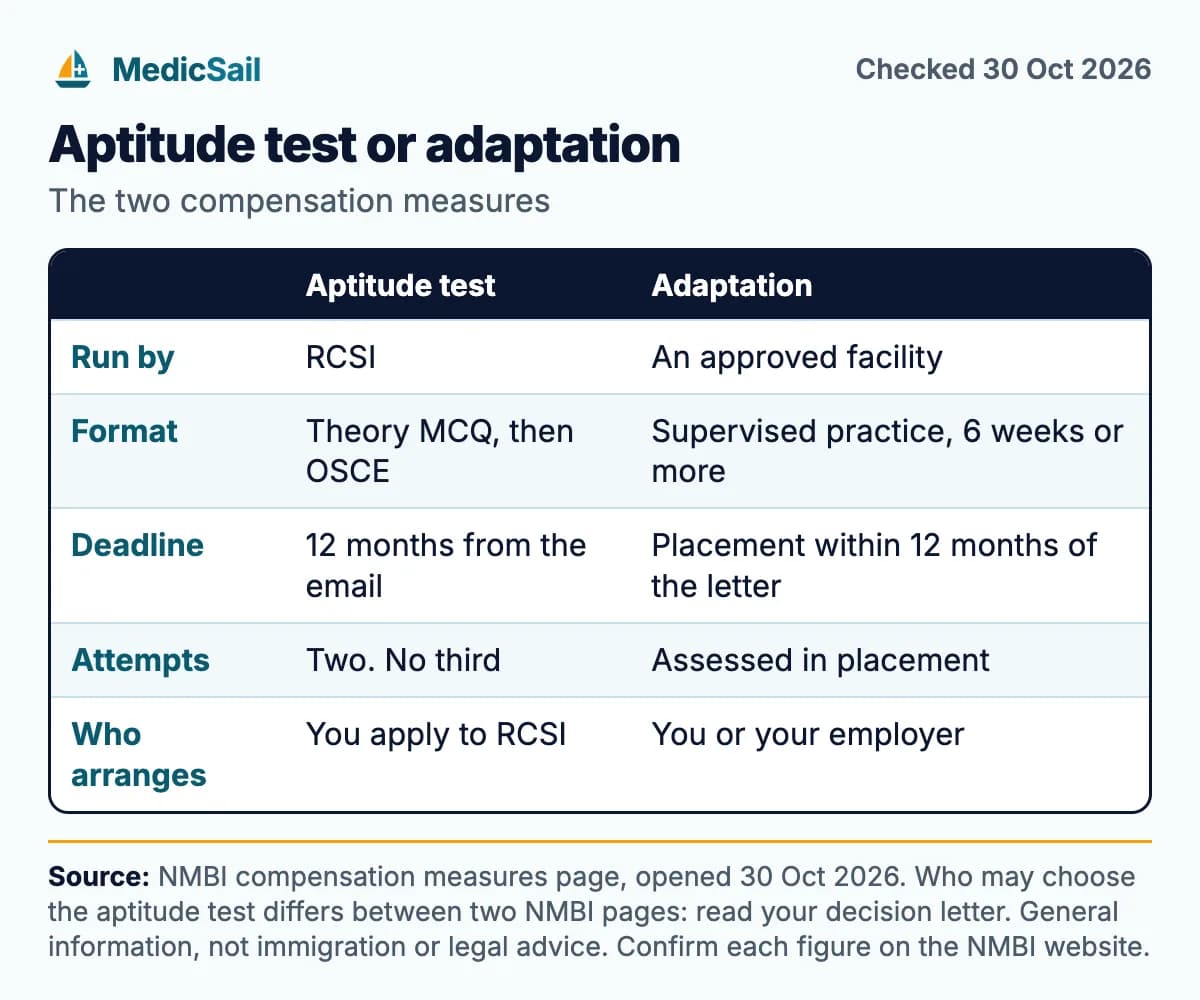
| Aptitude test | Period of adaptation | |
|---|---|---|
| Run by | RCSI Faculty of Nursing and Midwifery, for NMBI | An NMBI-approved health care facility matching your division |
| Format | Two parts: a theory test (MCQ), then a practical OSCE | Supervised clinical practice, possibly with assessed academic training |
| Length | Test days | At least 6 weeks, extendable to 12 weeks or more |
| Deadline | Complete within 12 months of the date on the email | Secure a placement within 12 months of the date on your letter |
| Attempts | Two | Assessed during the placement |
| Status meanwhile | Not registered | On NMBI's Candidate Register, with a Candidate Certificate |
Who can choose: NMBI's compensation measures page says general and psychiatric nurses can choose either option and all other divisions must complete adaptation. Its March 2025 notice says the aptitude test is not available for divisions other than general nurses. Read your own decision letter, which states the options open to you, and check with NMBI if it is unclear. You can change your choice before you start, but not after you complete either one.
NMBI does not arrange adaptation placements: you or your employer must find one. Many Irish hospitals that recruit from the UK arrange adaptation for the nurses they hire, which is often why UK nurses find a job offer before the measure. The full detail of both options, including the RCSI fees, test format and preparation, is in the NMBI aptitude test and adaptation guide.
If you are used to the NMC process, note the parallel: the RCSI aptitude test is structured like the NMC test of competence (an MCQ, then an OSCE). But passing the NMC OSCE does not count as passing NMBI's test. NMBI lists previous compensation measures completed in another EU country as something its assessors consider; the UK is no longer an EU country, and NMBI does not state any exemption for the NMC test of competence.
If you disagree with a decision requiring a compensation measure or refusing recognition, those outcomes are provisional and can be appealed to NMBI's Registration Committee for a fee, with a further appeal to the High Court within three months.
Step by step: from NMC registrant to NMBI registration
- Work out your case and division. Note your qualification date, field of nursing and every country where you have been registered. Decide which NMBI division you are applying for. Read the NMBI Applicant User Guide before starting.
- Check English. UK-trained nurses use the training exemption. Overseas-trained nurses count their post-registration UK years; if you are short of three, book IELTS Academic or OET in a single sitting, timed so the result is still valid at the registration stage.
- Request university documents. Ask your UK university, or your original nursing school abroad, for the qualification form, transcript and syllabus. For pre-2021 UK qualifiers, ask the NMC for the letter confirming your dates and Directive conformity.
- Open MyNMBI and start an overseas recognition application. Answer the screening questions, get your G group and document list, upload certified copies and pay the €350 recognition fee. If a document is missing, you have six months from submission to provide it, or the application closes and you start again.
- Request your CCPS. Once your NMBI application is open, request the NMC CCPS and any other certificates of good standing, sent directly to NMBI.
- Wait for the recognition decision. NMBI processes applications in date order and says it does not fast-track for any reason, including job offers. Outcomes are: recognised, missing documents, compensation measure required, or refused.
- Complete any compensation measure within 12 months: book the RCSI aptitude test or secure an adaptation placement (usually through an Irish employer).
- Apply for registration. Make the registration application in MyNMBI, with valid English evidence where needed, and pay the €145 overseas registration fee. NMBI's guide gives 20 working days for the registration decision.
- Arrange your right to work and move. British and Irish citizens can start once registered. Others need an employment permit, which the employer usually starts once you have a job offer.
NMBI's own advice is not to move to Ireland or leave your current job until you have a registration decision, and not to apply for posts before you have a decision. In practice, many Irish employers interview UK nurses during the process and support the adaptation route, but whether they will hire before registration varies by employer.
Fees and timelines
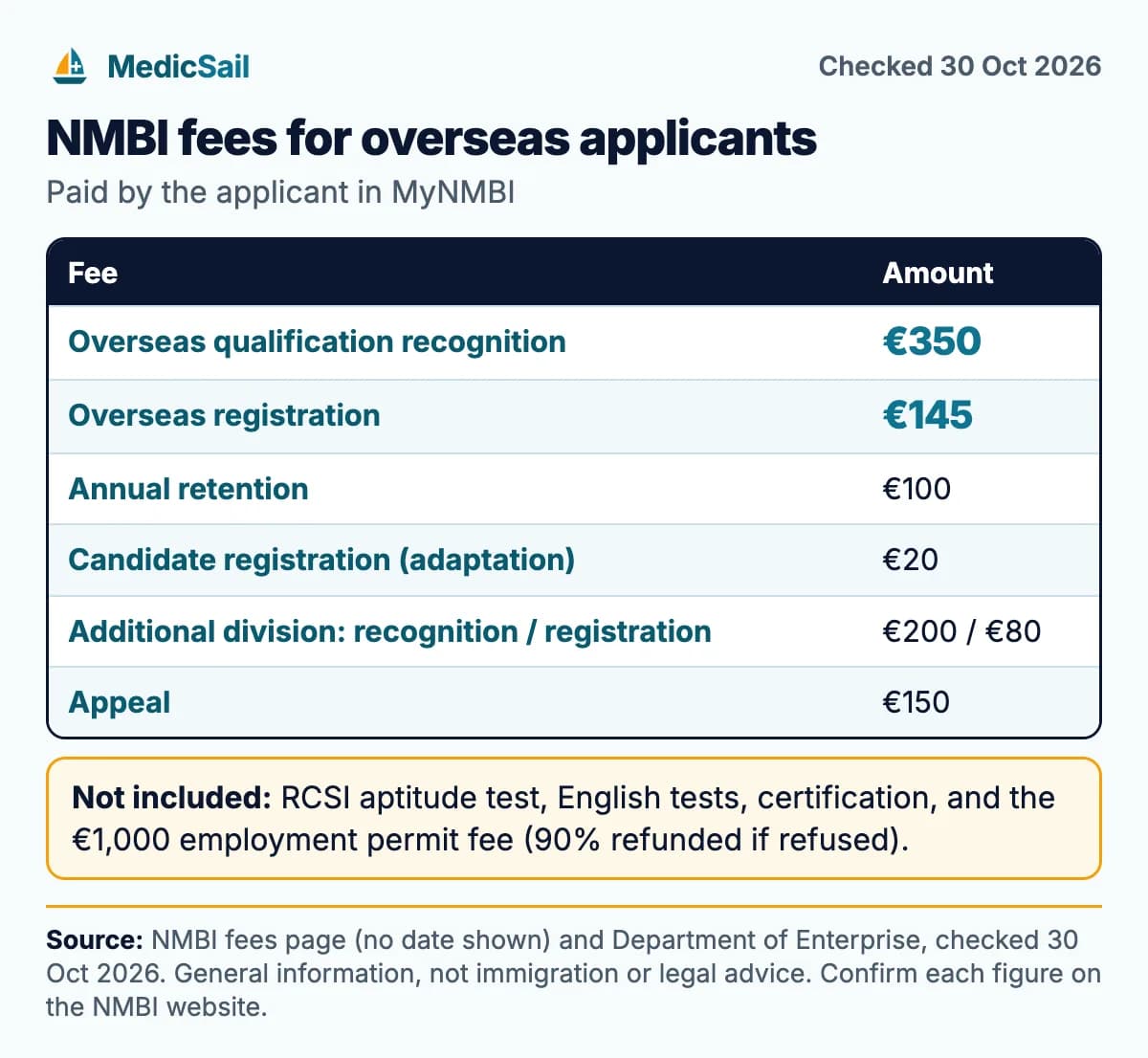
These are NMBI's published fees. They are paid in MyNMBI by the applicant.
| Fee | Amount | When |
|---|---|---|
| Overseas qualification recognition | €350 | When you submit recognition |
| Overseas additional division recognition | €200 | For a second division, such as midwifery |
| Overseas registration | €145 | At the registration stage |
| Overseas additional division registration | €80 | Per additional division |
| Candidate registration | €20 | For the Candidate Register during adaptation |
| Annual retention | €100 | Each year to stay registered |
| Appeal | €150 | If you appeal a decision |
On top of this you pay for the compensation measure if you take the aptitude test (RCSI sets that fee; see the aptitude test guide for the current figure), any English test, certification and translation costs, and an employment permit if you need one. If you submit a second recognition application within seven days of the first, NMBI says you do not pay the recognition fee twice.
How long it takes
NMBI's Applicant User Guide gives these processing times once it has all your documents:
| Application type | Recognition decision | Registration decision | Overall |
|---|---|---|---|
| G1, no European Professional Card | 3 months | 20 working days | About 4 months |
| G2, no European Professional Card | 3 months | 20 working days | About 4 months |
| G3 | 3 months | 20 working days | About 4 months |
UK applicants cannot use the European Professional Card, so the faster EPC lines in NMBI's table do not apply. Those times start only when NMBI has everything, and they do not include a compensation measure. The guide says successful applicants who need a compensation measure take on average 13 months from submitting documents to registration. A pre-2021 UK qualifier with an NMC letter is at the fast end; a nurse trained abroad waiting for a qualification form from their original college is usually at the slow end.
Your right to work in Ireland: Common Travel Area or employment permit
NMBI registration lets you practise; it does not give you the right to work. That depends on your nationality, not on your NMC registration.
- British and Irish citizens. Under the Common Travel Area, British citizens in Ireland can work, including self-employed, without needing permission. The Irish government notes that these rights belong to Irish and British citizens only, not to other nationals living in the UK.
- Everyone else living in the UK. Indefinite leave to remain, a Health and Care Worker visa or settled status in the UK does not give you the right to work in Ireland. The Department of Enterprise, Tourism and Employment says all non-EEA nationals need a valid employment permit or relevant immigration permission. EEA and Swiss nationals have free movement in Ireland.
For nurses the usual route is the Critical Skills Employment Permit. The Department says nurses and midwives are eligible with a third-level degree or diploma accepted by NMBI that is sufficient for registration in the State, the job offer must be for at least 2 years, the processing fee is €1,000 (90% refunded if refused), and public sector posts covered by a pay agreement are assessed on that agreement's rate. Holders can later move to Stamp 4. The Critical Skills Employment Permit guide covers thresholds, the application and family members in full.
If you are in the UK on a Health and Care Worker visa, leaving your sponsoring employer affects that permission, so plan the timing with your current trust and check your contract for any repayment clause.
What changes when you start work in Ireland
- Pay is national. HSE nurses are paid on national consolidated salary scales rather than hospital-by-hospital rates. Ask your employer in writing where on the scale your UK experience places you.
- Annual retention. Instead of NMC revalidation every three years, you pay NMBI's €100 annual retention fee each year. NMBI has its own professional competence requirements; read them when you register.
- Divisions matter more. Irish posts are advertised by division. A UK adult nurse registers in the General Nurses Division, and moving into children's or mental health nursing in Ireland needs registration in that division.
- Keeping the NMC. Many nurses keep NMC registration for a while in case they return. You must keep paying the NMC fee and meeting its revalidation requirements to stay on its register; check with the NMC how practice outside the UK is counted.
For an overview of the Irish health system, the HSE, Section 38 voluntary hospitals and private hospitals, read the Ireland country guide. If you are comparing Ireland with staying in the UK, the UK nursing page and UK country guide set out the other side.
Common mistakes that slow UK nurses down
- Assuming you are on the fast route. Only UK qualifiers from before 1 January 2021, with NMC confirmation, avoid the full education assessment. Graduates from 2021 onwards should plan for a compensation measure from the start.
- Requesting the CCPS too early. The NMC certificate is valid for three months. If NMBI is still waiting for your transcript, it can expire before it is used.
- Re-using an NMC English score. A combined-sitting OET or IELTS result, or IELTS One Skill Retake, may have satisfied the NMC but NMBI does not accept them.
- Counting pre-PIN years. Only post-registration practice counts towards NMBI's three-year English exemption.
- Letting the six-month and 12-month clocks run out. Missing documents must reach NMBI within six months of submission, and compensation measures must be completed or placed within 12 months of the letter.
- Letting an agent run your MyNMBI account. NMBI requires you to upload your own documents and pay your own fees.
- Handing in notice before a decision. NMBI cannot fast-track based on a job offer, and it advises against moving before you have its decision.
If you are a midwife, the same two-stage process applies through the Midwives Division; see the midwifery in Ireland page.
Questions
No. There is no transfer between the two registers. You apply to NMBI for recognition of your qualification and then for registration, and NMBI assesses you according to where and when you qualified. Your NMC registration supports the application through your CCPS, your UK experience and, for some nurses, the English exemption.
NMBI says the compensation measure requirement does not apply to nurses and midwives who qualified in the UK before Brexit. UK-educated general nurses and midwives who qualified while the UK was in the EU keep automatic recognition, supported by an NMC letter confirming your qualification dates and Directive conformity. If the NMC cannot provide that letter, NMBI carries out a full education assessment instead.
NMBI assesses UK graduates from 1 January 2021 as non-EU applicants, with a full education assessment of your qualification form, transcript and parchment plus an NMC CCPS. In March 2025 NMBI said UK students from 2021 onwards will require a compensation measure, either the RCSI aptitude test (general nurses) or a period of adaptation in an approved Irish hospital.
Probably not, if you can show at least three years of post-registration practice in the UK within the last five years, confirmed by your employer in a letter or email stating location, dates and that you practised primarily through English. Your original Indian qualification is still assessed as a non-EU (G3) application, and a compensation measure is likely.
NMBI does not state any such exemption. Its assessors consider other relevant training and previous compensation measures completed in another EU country, and the UK is no longer in the EU. Plan for whatever your NMBI decision letter requires.
NMBI's Applicant User Guide gives about 4 months overall for a G3 application once all documents are in (3 months for recognition and 20 working days for registration). Where a compensation measure is needed, NMBI says successful applicants take on average 13 months from submitting documents to registration.
NMBI charges €350 for overseas qualification recognition and €145 for overseas registration, then €100 a year in retention. Add the RCSI aptitude test fee if you take that route, certification and translation costs, and a €1,000 Critical Skills Employment Permit fee if you are not a British, Irish, EEA or Swiss citizen.
Yes, generally. Common Travel Area rights belong to British and Irish citizens only, so indefinite leave to remain in the UK does not give you the right to work in Ireland. Non-EEA nationals need an employment permit, usually the Critical Skills Employment Permit for nurses with an NMBI-accepted qualification.
Request a certificate of current professional status in your NMC Online account under My Registration, after you have started your MyNMBI application. The NMC tells the overseas regulator when it is ready and usually issues it within 24 hours once it has what it needs. It is valid for three months, so time the request carefully.
That is your choice. Keeping it means continuing to pay the NMC fee and meeting revalidation requirements, but it makes returning to the UK simpler. You must stay registered at least until your NMBI application no longer needs a current CCPS.
Sources
- 1NMBI: UK qualification recognition
- 2NMBI: Compensation measure required for nurses and midwives (March 2025 notice)
- 3NMBI: Qualified outside the EU
- 4NMBI: G1, G2 and G3 applicants
- 5NMBI: Application assessment
- 6NMBI: English language requirements
Show all 14 sourcesShow fewer sources
- 7NMBI: Compensation measures
- 8NMBI: Registration fees
- 9NMBI: The register and divisions
- 10NMBI: Applicant User Guide (PDF)
- 11NMC: Working outside the UK (CCPS)
- 12DETE: Critical Skills Employment Permit
- 13DETE: Who needs an employment permit
- 14Government of Ireland: Questions on trade in services and the Common Travel Area
Plan it with our free tools
MedicSail
Healthcare licensing consultants for the UK, Europe and the USA
Updated and checked against the sources listed above. How we research and check our guides