


































Best country in Europe for international nurses: UK, Ireland, Germany, the Netherlands and the Nordics compared
Which European country suits an internationally trained nurse? We compare the UK, Ireland, Germany, the Netherlands, Sweden, Norway, Denmark and Finland on registration, language, exams, time, official pay scales, visas, family and settlement, with the trade-offs of each.

MedicSail
Published
The short answer
There is no single best country in Europe for international nurses, but there is usually a best country for you, and the deciding factor is language. If you want to work in English, the realistic choices are the UK and Ireland. The UK has the most structured route (an English test, the NMC's CBT, then the OSCE after you arrive) and the largest employer, the NHS, with a dedicated Health and Care Worker visa. Ireland has fewer steps for many nurses, a Critical Skills Employment Permit that lets your spouse work, and a public pay scale that starts at €38,166 and rises to €56,592 for a staff nurse from 1 June 2026.
If you are prepared to learn a new language to a professional level, Germany and the Netherlands open up, and the Nordic countries (Sweden, Norway, Denmark and Finland) follow, but each adds a year or more of language study before you can register. Germany needs B2 German and has the most employers recruiting abroad; the Netherlands needs Dutch at B1 for nurses plus a BI-test; the Nordics need the local language at B2 or C1 and, in Denmark's case, nurses from outside the EU/EEA cannot apply in 2026 at all unless they are exempt from the quota.
This guide compares all of them on the things that actually decide your move: registration difficulty, language, exams, time to register, pay from official scales, visa, family and settlement. Every rule and figure comes from the regulator, government or official pay table, checked on 29 October 2026. Where we say one country suits a type of nurse better, that is a judgement based on those criteria, not a ranking of quality. If you already know your destination, go straight to our international nurse hub for the full route in each country.
How to judge which country is best for you
Rankings that put one country at number one usually weigh salary converted at today's exchange rate and ignore the two things that decide most nurses' moves: whether you can register at all with the language you have, and how long it takes before you are paid as a registered nurse. We use eight criteria instead, and we suggest you score each country against your own situation.
- Registration difficulty. How many assessments stand between your qualification and a licence, and whether they are exams, adaptation placements or both.
- Language. English or the national language, the level required, and how long it realistically takes you to reach it.
- Exams. What you sit, where, and how many attempts you have.
- Time to register. The regulator's own processing times, plus the stages you control (tests, documents).
- Pay. Official pay scales or collective agreements where they exist, with the year stated. Converting currencies hides tax, pension and cost of living, so compare within each country first.
- Visa. Whether nursing has a dedicated or fast route, and what it costs.
- Family. Whether your partner can come and work, and what that costs.
- Settlement. When you can apply for permanent residence, as each government states it.
Two things are deliberately not on the list. We do not rank countries on lifestyle or culture, because that is personal. And we do not treat demand as a criterion on its own: every country here recruits international nurses, but demand does not shorten registration.
The comparison at a glance
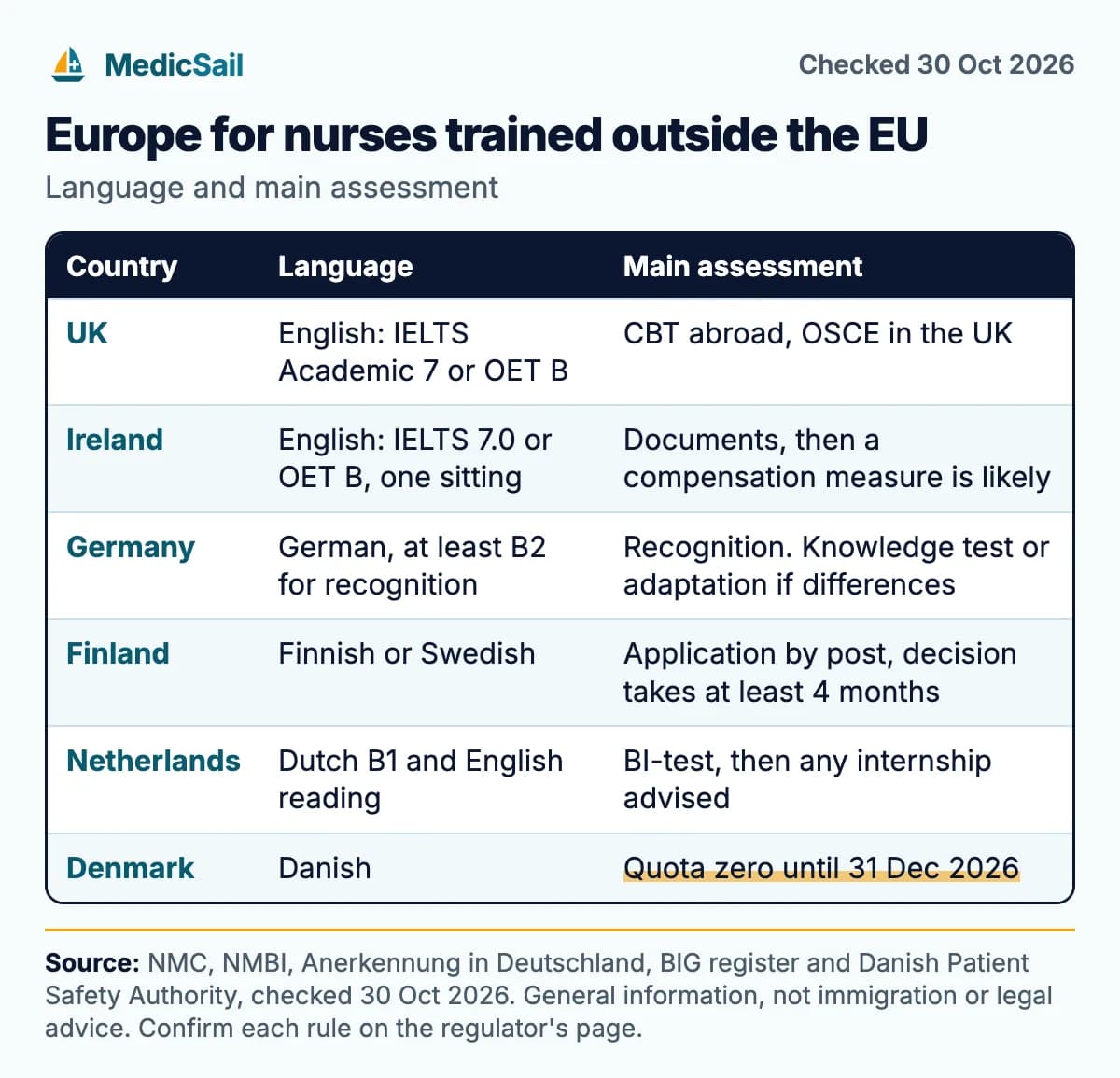
The table summarises the route for a nurse who trained outside the EU/EEA and does not hold an EU-recognised qualification. Fees and pay are the official figures we checked; follow the links to each country page for the full detail and sources.
| Country | Regulator | Language | Main assessment | Official time guide | Pay (official source, year) | Visa route |
|---|---|---|---|---|---|---|
| UK | NMC | English: IELTS Academic 7 (6.5 writing) or OET B (C+ writing) | CBT (abroad), then OSCE in the UK | NMC aims to assess eligibility within 14 days and decide registration within 30 days of complete evidence | Band 5 £32,073 to £39,043 (NHS Agenda for Change 2026/27) | Health and Care Worker visa, £324 up to 3 years |
| Ireland | NMBI | English: IELTS 7.0 overall (one band at 6.5 allowed) or OET B (one C+ allowed) | Document assessment, then adaptation or RCSI aptitude test if required | About 3 months for a decision; NMBI says those needing a compensation measure average 13 months to registration | Staff nurse €38,166 to €56,592 (HSE scales, 1 June 2026) | Critical Skills Employment Permit, €1,000 |
| Germany | State authorities | German B2 | Knowledge test or adaptation period, if differences are found | Decision within 4 months of a complete file | TVöD P 7 €3,510.30 to €4,305.40 a month (VKA, from 1 May 2026) | § 16d recognition permit, then § 18a skilled worker |
| Netherlands | BIG register (CIBG) | Dutch B1 (Staatsexamen NT2) plus English reading A2 | BI-test (€400), then any advised internship | File accepted within 4 weeks; results 3 to 6 weeks; CBGV advice within 12 weeks | Set by the hospital's function group; for example FG 45 €3,228 to €4,346 a month (Cao Ziekenhuizen, 1 August 2026) | Highly skilled migrant, if the salary threshold is met |
| Sweden | Socialstyrelsen | Swedish at C1 or Swedish 3 | Proficiency test, law course, 3-month clinical placement | Assessment about 3 months; whole route usually 2 to 4 years | Average nurse salary SEK 44,000 a month (Statistics Sweden, 2025) | Work permit, with a healthcare salary exemption |
| Norway | Helsedirektoratet | Norwegian B2 | National course, medicines course and fagprøve | 23 months' processing for applicants educated outside the EU/EEA | Median NOK 56,660 a month (Statistics Norway, 2025) | Skilled worker permit |
| Denmark | Danish Patient Safety Authority | Danish 3 exam | 6-month adaptation job | Quota closed to most non-EU nurses in 2026 | Average gross DKK 50,173 a month (Danske Regioner, February 2026) | Authorisation permit or Positive List |
| Finland | LVV (formerly Valvira) | Finnish or Swedish, YKI level 3 | Additional studies if differences are found | At least 4 months to decide | Median €3,587 a month (Statistics Finland, 2024) | Residence permit for an employed person |
The Nordic pay figures are national statistics, not pay scales, and include supplements in some cases, so they are not directly comparable with the UK, Irish, German and Dutch scale points. Read them as a guide to the level of pay, not as a starting salary.
UK: the most structured English-language route
The UK's route is the most predictable of the countries compared here. You prove English, apply to the NMC, pass the computer-based test (CBT) in your own country, get a job offer and a certificate of sponsorship, travel on a Health and Care Worker visa, and sit the OSCE in the UK. Our page on NMC registration covers each stage, and the step-by-step route for nurses in the UK has every fee.
What it costs and how long it takes
- NMC qualification evaluation fee £167, CBT £83, OSCE £794 and registration fee £182, according to the NMC. Many NHS employers pay the OSCE fee, but check your offer.
- The NMC aims to assess your qualification within 14 days of hearing back from your regulator, and to decide your registration within 30 days of having all your evidence. You have two years from eligibility to finish.
- The CBT allows three attempts within one year. OSCE results come within five working days.
Strengths and trade-offs
The strengths are English, a single national pay scale and a visa built for health workers: GOV.UK says Health and Care Worker visa holders and their dependants do not pay the immigration health surcharge, and the fee is £324 for up to three years or £628 for longer. The trade-offs are that you start at Band 5 regardless of seniority abroad, the OSCE has to be passed in the UK, and NHS pay looks lower than some European figures once converted. Read our guides to the NMC CBT and NMC OSCE before you book either.
Ireland: English, fewer exams for many, and a strong permit
Ireland is the other English-speaking option, and for many nurses it involves fewer assessments than the UK. NMBI assesses your qualification on documents. If it finds no significant gaps you register directly; if it does, it sets a compensation measure: an adaptation period of at least six weeks in an approved hospital, or the RCSI aptitude test. Our NMBI registration guide explains each outcome, and the full route for nurses in Ireland has the documents.
What it costs and how long it takes
- NMBI overseas qualification recognition fee €350, overseas registration fee €145 and €20 for the Candidate Register during adaptation. The RCSI aptitude test is €2,800 (two attempts at each part), or €2,500 if an eligible employer pays.
- NMBI gives about three months for a decision once it has every document, and says applicants who need a compensation measure take on average 13 months from submission to registration.
- NMBI's English rules are strict on format: results must come from a single sitting, and IELTS One Skill Retake, IELTS online and OET at home are not accepted.
Strengths and trade-offs
Registered nurses are on the Critical Skills Occupations List, so most international nurses get a Critical Skills Employment Permit (€1,000, with 90% refunded if refused). Your spouse or partner can be given Stamp 1G and work without a permit, and after 21 months you can apply for Stamp 4. The trade-offs are the cost of housing in Dublin and other cities, and the waiting time for adaptation places. Our guide to the NMBI aptitude test and adaptation sets out how to choose between them, and the Critical Skills Employment Permit guide covers the permit.
Germany: the most recruitment, if you learn German
Germany actively recruits international nurses, and it has a clear legal route: recognition as a Pflegefachfrau or Pflegefachmann by the authority of the federal state where you will work. The authority compares your training with German nursing training. If it finds substantial differences, you close them with a knowledge test or an adaptation period, which can by law be up to three years but is usually much shorter. The route for nurses in Germany covers the documents and each state's fees.
Language is the real exam
The Recognition Finder profiles for Berlin, North Rhine-Westphalia and Bavaria give the level as B2 German. English tests are not accepted instead. Reaching B2 from beginner level commonly takes many months of study, and this is usually the longest stage. You can start the process earlier: the recognition partnership and the § 16d residence permit for recognition measures usually need only A2 German to enter.
Time, cost and pay
- The authority confirms receipt within one month and decides within four months of a complete file. A knowledge test must be offered at least twice a year, and you must be able to sit it within six months of the decision.
- Recognition fees vary by state: for example €25 to €430 in Berlin and up to €277.50 in North Rhine-Westphalia, according to the Recognition Finder. A national D visa costs €75.
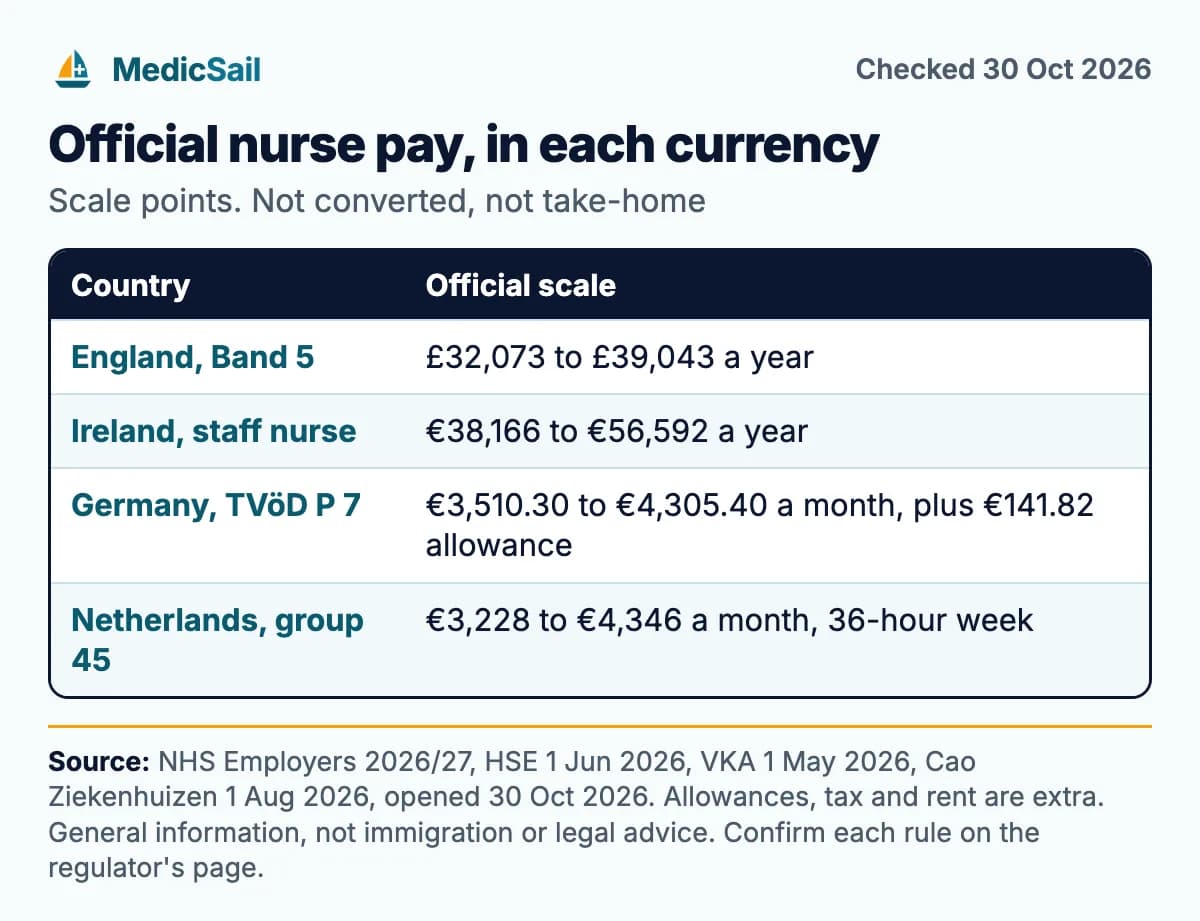
- In municipal hospitals, registered nurses are paid on TVöD P 7: €3,510.30 a month at the entry step rising to €4,305.40, plus a €141.82 monthly nursing allowance, from 1 May 2026 (VKA). Our nurse salary comparison sets this against the other countries.
The trade-off: Make it in Germany says the EU Blue Card does not apply to nursing, so you use the skilled worker permit instead. See our Germany country guide for the residence rules.
The Netherlands: a lower language bar for nurses, but salary thresholds matter
The Netherlands sets its Dutch requirement by the level of the profession, and nursing is classed at mbo level, so nurses need Dutch at B1, shown by the Staatsexamen NT2, plus English reading at A2. That is a lower bar than doctors (B2+). You apply to the BIG register for a certificate of competence, sit the nurses' BI-test (a written test, a skills test and a clinical reasoning interview, €400 in total), and then complete any internship the CBGV advises.
Time and pay
- The BIG register says your file is accepted within four weeks, results come three to six weeks after the BI-test, and CBGV advice follows within 12 weeks. Extra training can take from three months to two years. BIG registration costs €85.
- Hospital pay follows the Cao Ziekenhuizen. The agreement does not fix a group for nurses; the hospital grades each post into a function group. For example, function group 45 runs from €3,228 to €4,346 a month and group 50 from €3,463 to €4,914, for a 36-hour week, from 1 August 2026.
The trade-off to check before you accept
Your residence permit usually depends on salary. The IND's 2026 highly skilled migrant threshold is €5,942 gross a month if you are 30 or over and €4,357 under 30. Many staff nurse posts sit below the over-30 threshold, so ask the employer, before you sign, which permit it will use. Our guide to the BI-test in the Netherlands explains the test, and the Netherlands country guide the permits.
Sweden, Norway, Denmark and Finland: high standards, long language routes
The Nordic countries attract nurses with good working conditions, but every route runs in the national language and most take longer than the four countries above. Here is how they differ for a nurse educated outside the EU/EEA.
Sweden
Socialstyrelsen first assesses your education (SEK 990, about three months). You then need Swedish at C1 or Swedish 3, pass a proficiency test run by the University of Gothenburg for nurses, take a free course in Swedish health law, and complete a three-month clinical placement you find yourself. Socialstyrelsen says its own route usually takes two to four years. Nurses in the process of certification are listed by the Migration Agency as exempt from the standard work permit salary floor.
Norway
Helsedirektoratet states a processing time of 23 months for applicants educated outside the EU/EEA. If your education is found equivalent you then have three years to pass Norwegian at B2, the national course and medicines course, and the nurses' fagprøve at USN. The application fee is NOK 1,665.
Denmark
The Danish Patient Safety Authority says nurses who are citizens of, or trained in, a country outside the EU/EEA cannot apply in 2026 unless they are exempt, for example by already living legally in Denmark or holding a job offer as a specially requested healthcare professional. If you can apply, you need the Danish 3 exam and a six-month adaptation job. See our Denmark country guide before you spend anything.
Finland
The Finnish Supervisory Agency (LVV) took over from Valvira. It compares your training with Finnish nursing and may require additional studies at a university of applied sciences. You need Finnish or Swedish at YKI level 3 in all four skills, and LVV says processing takes at least four months once it has everything. Our Finland country guide has the permit thresholds.
Pay: what the official figures say, and what they leave out
Comparing nurse pay across Europe is where most rankings go wrong. A salary converted into one currency hides income tax, social insurance, pension contributions, housing costs and the number of hours in a working week. The fairest comparison is the official scale in each country, read alongside those costs.
| Country | Official figure for a registered nurse | Source and year |
|---|---|---|
| UK (England) | £32,073 a year at Band 5 entry, £39,043 at the top | NHS Employers, 2026/27, from 1 April 2026 |
| Ireland | €38,166 to €56,592 a year, 13-point staff nurse scale | HSE consolidated scales, 1 June 2026 |
| Germany (municipal hospitals) | €3,510.30 to €4,305.40 a month at P 7, plus €141.82 nursing allowance | VKA TVöD, from 1 May 2026 |
| Netherlands (general hospitals) | Depends on function group; for example €3,228 to €4,346 a month in group 45 | Cao Ziekenhuizen, 1 August 2026 |
| USA (for contrast) | Median $97,550 a year | Bureau of Labor Statistics, May 2025 |
Things the scale points leave out: London's High Cost Area Supplement (20% of basic pay in inner London, within a minimum and maximum), Irish location and specialist qualification allowances, German shift and night supplements, and the Dutch holiday allowance. Tax and social contributions are generally higher in Germany, the Netherlands and the Nordics than in the UK, and rents in Dublin, London and Amsterdam are among the highest in each country. We do not publish an after-tax figure for every country because no single official source covers them all; the nurse salary comparison goes deeper.
Family, permits and settlement
For many nurses the question is not where to work for three years, but where the family can build a life. The rules below are as each government states them.
- UK. Your partner and children may be able to come as dependants on the Health and Care Worker visa, without paying the immigration health surcharge. GOV.UK says that after five years living and working in the UK on this visa you may be able to apply for indefinite leave to remain; the fee is £3,226 per person.
- Ireland. A Critical Skills permit lets your spouse or partner get Stamp 1G and work without a permit. You can apply for Stamp 4 after 21 months, and for long-term residence after 60 months (€500 plus the registration fee).
- Germany. Spouses and children can usually join you, and spouses of skilled workers do not need to prove German. Holders of a skilled worker permit can apply for settlement after three years if they meet the conditions, including pension contributions and B1 German.
- Netherlands. Family members of a highly skilled migrant can usually apply with you; the permit depends on your salary meeting the IND threshold, so check it first.
- Norway. UDI says that for a job needing a university degree you can normally get a permit for up to three years at a time and apply for permanent residence after three years.
- Sweden, Denmark, Finland. Family members can apply with you under the work and authorisation routes; each sets its own maintenance requirement. See the country guides for the figures.
Settlement rules change. Check the official page for your country close to the date you plan to apply, and treat this summary as general information, not immigration advice.
Which country fits which nurse
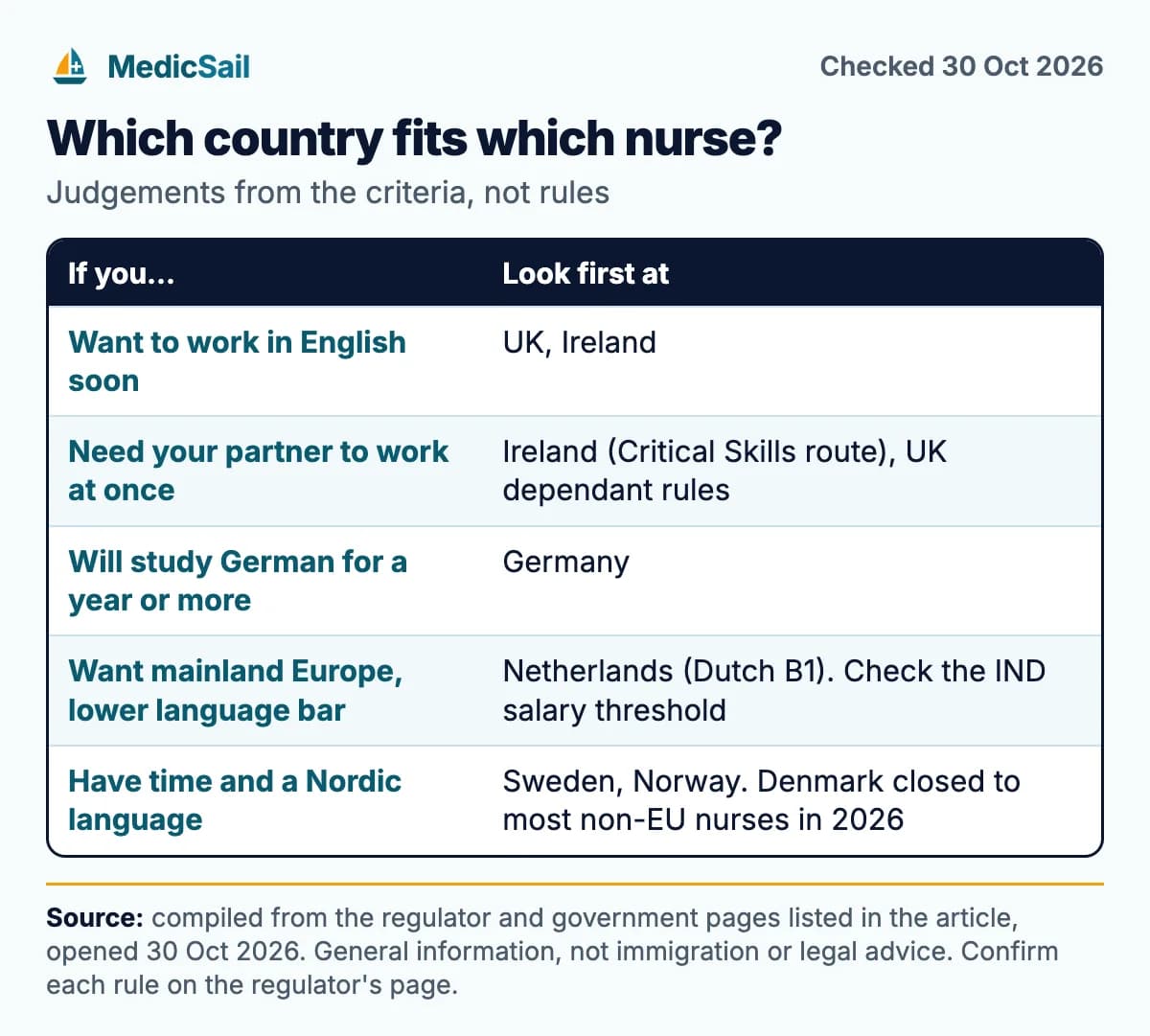
Based on the criteria above, these are the patterns we see. They are judgements, not rules: your qualification, your English or language level and your family situation can change the answer.
- You want to work in English as soon as possible. The UK and Ireland. The UK has the more predictable timeline; Ireland may need fewer exams if NMBI finds no major gaps.
- Your partner needs to work straight away. Ireland's Stamp 1G for Critical Skills spouses and the UK's dependant rules both allow this; compare the costs.
- You already speak some German, or are willing to study for a year. Germany has many employers recruiting abroad and a clear legal route, with the option to enter before recognition.
- You want a lower language level than German but a European mainland country. The Netherlands' B1 for nurses is lower than Germany's B2, but check the IND salary threshold for your age.
- You have time and want a Nordic career. Sweden and Finland are open; Norway's processing time is long; Denmark is closed to most non-EU nurses in 2026.
- You are licensed in the Gulf. No European regulator accepts a DHA, DOH, MOHAP, SCFHS or QCHP licence in place of its own process, but your experience supports your application and good standing certificates are needed. Gulf countries are not on the UK's majority English-speaking list, so practice there does not exempt you from an English test. Our guide to moving from a Gulf licence to UK registration covers this.
If you are also weighing the USA, it pays more in nominal terms but needs the NCLEX-RN and an employer-sponsored green card whose timing depends on the Visa Bulletin for your country of birth; see our NCLEX-RN guide.
Your next steps
- Decide on language first. If you will work in English, book IELTS Academic or OET and check the exact scores the NMC and NMBI accept in our IELTS and OET comparison. If you will work in German, Dutch or a Nordic language, start classes now.
- Collect documents that every regulator asks for. Your diploma, transcript with theory and clinical hours, registration certificate and a recent certificate of good standing. Order the good standing certificate last, because most regulators want it recent.
- Read the regulator's own page. Use the links in this guide to the NMC, NMBI, German state authorities and the BIG register, and check fees on the day you apply.
- Compare offers, not just salaries. Ask employers who pays for exams, flights and accommodation, the pay before and after registration, and any repayment clause.
- Check the visa rules for your family. Use the UK, Ireland and other country guides for fees and dependant rules.
Questions
For nurses who work in English, Ireland often has the fewest assessments if NMBI finds no significant gaps, while the UK has the most predictable sequence of tests (CBT and OSCE). On the European mainland, the Netherlands asks nurses for Dutch at B1, lower than Germany's B2, but adds a BI-test. Easiest depends on your qualification and languages.
Only in the UK and Ireland, where English is the working language. Germany, the Netherlands and the Nordic countries require the national language for registration, and English tests are not accepted instead.
On official scales, Ireland's staff nurse scale (€38,166 to €56,592 from 1 June 2026) is higher at the top than NHS Band 5 in England (£32,073 to £39,043 for 2026/27). Germany and the Netherlands pay monthly under collective agreements. Tax, hours and housing costs differ so much that gross figures alone do not show who takes home more.
It depends on what matters to you. The UK has more jobs, a single NHS pay scale and a visa with no health surcharge. Ireland may need fewer exams, lets a Critical Skills permit holder's spouse work on Stamp 1G, and allows Stamp 4 after 21 months. Housing costs are high in both capital cities.
Mostly not. The Danish Patient Safety Authority says nurses who are citizens of, or trained in, a country outside the EU/EEA cannot apply in 2026 unless they are exempt, for example through legal residence in Denmark or a job offer as a specially requested healthcare professional.
B2 on the CEFR scale, according to the Recognition Finder profiles for Berlin, North Rhine-Westphalia and Bavaria. You can enter Germany earlier on a recognition partnership or § 16d permit, which usually need about A2, and finish the language and recognition there.
It supports your application with experience and good standing, but no European regulator accepts it in place of its own assessment. The UK does not treat Gulf practice as practice in a majority English-speaking country, so you still need an English test for the NMC.
The UK route can be completed within months once you have your English scores, because the NMC aims to decide within weeks at each stage. Ireland averages 13 months for successful applicants who need a compensation measure, according to NMBI. Germany, the Netherlands and the Nordics usually take longer because of the language stage.
In every country compared here your partner and children can usually apply with you, but the conditions differ. The UK and Ireland let partners work. The Netherlands permit depends on your salary meeting the IND threshold. Check each country guide for fees and maintenance rules.
The USA pays more in nominal terms (BLS median $97,550 in May 2025) but needs the NCLEX-RN, VisaScreen and usually an EB-3 green card, whose timing depends on the Visa Bulletin for your country of birth. European routes start work sooner for most nurses but pay less in gross terms.
Sources
- 1NMC: register as a nurse or midwife if you trained outside the UK
- 2NMC: costs
- 3NMC: how long is it going to take
- 4NMC: accepted English language tests
- 5NHS Employers: pay scales for 2026/27
- 6GOV.UK: Health and Care Worker visa, how much it costs
Show all 38 sourcesShow fewer sources
- 7GOV.UK: Indefinite leave to remain (Skilled Worker, Health and Care Worker)
- 8NMBI: Qualified outside the EU, application process
- 9NMBI: English language requirements
- 10NMBI: Applicant User Guide (PDF)
- 11NMBI: Registration fees
- 12RCSI: Overseas aptitude test fees
- 13HSE: Consolidated salary scales, 1 June 2026 (PDF)
- 14DETE: Critical Skills Employment Permit
- 15Irish Immigration: Stamp 4 upgrades
- 16Irish Immigration: Long term residency
- 17Recognition Finder: Pflegefachperson, Berlin
- 18Recognition Finder: Pflegefachperson, North Rhine-Westphalia
- 19VKA: TVöD hospitals edition with Anlage E pay tables (PDF)
- 20Make it in Germany: nursing
- 21Make it in Germany: settlement permit
- 22BIG register: Professional tests (BI-test)
- 23BIG register: Dutch language proficiency
- 24BIG register: Processing time and costs
- 25Cao Ziekenhuizen: salaries per function group from 1 August 2026 (PDF)
- 26IND: Required amounts and income requirements
- 27Socialstyrelsen: nurse educated outside the EU/EEA
- 28Swedish Migration Agency: salary requirements for a work permit
- 29Statistics Sweden: salary structure statistics
- 30Helsedirektoratet: general nurse educated outside the EU/EEA
- 31Statistics Norway: table 11418
- 32UDI: skilled workers
- 33Danish Patient Safety Authority: nurse, non-EU countries
- 34Danish Patient Safety Authority: quota for applications (nurses)
- 35Danske Regioner: Personalestatistik 2026 (PDF)
- 36LVV: registered nurse trained outside the EU or EEA
- 37Statistics Finland: table 15au
- 38US Bureau of Labor Statistics: registered nurses
Plan it with our free tools
MedicSail
Healthcare licensing consultants for the UK, Europe and the USA
Updated and checked against the sources listed above. How we research and check our guides