


































The BI-test and CBGV assessment: registering in the Netherlands with a foreign diploma
How the Netherlands assesses doctors, dentists, nurses and other health professionals trained outside the EEA: the Dutch and English levels, the BI-test for each profession, booking and capacity in 2026, fees, the CBGV's advice, the three possible outcomes and registration in the BIG register.

MedicSail
Published
The short answer
If you trained as a doctor, dentist or nurse outside the European Economic Area (EEA) and Switzerland, you cannot register in the Netherlands until the BIG register has issued you a certificate of professional competence (verklaring van vakbekwaamheid). To get it, you sit the BI-test (beroepsinhoudelijke toets, professional knowledge test), and the Commission for Foreign Healthcare Graduates (Commissie Buitenlands Gediplomeerden Volksgezondheid, CBGV) uses your results, training and experience to advise the BIG register. Other registered professions, such as pharmacists, midwives, physiotherapists and healthcare psychologists, skip the BI-test and are assessed by the CBGV on their documents and at a meeting.
The BI-test is not a pass-or-fail exam. It shows where your knowledge and skills meet the level of a Dutch graduate and where they do not yet, and the CBGV then advises recognition, extra training or refusal. The BIG register's roadmap says 50 to 75 per cent of applicants are asked to do additional training or an internship. The test costs €400 for nurses and €1,500 for dentists, while the BIG register lists no doctors' fee because there are no test places for doctors; the application and the CBGV assessment are free; and registration costs €85 for five years. Before you apply you need Dutch at B1 (nurses), B2 (higher professional professions) or B2+ (doctors, dentists, pharmacists).
Capacity is the biggest practical problem in 2026. On 21 October 2026 the BIG register says there are no BI-test places for doctors, with no known date for new bookings, and dentists' places for 2026 are full. This guide explains the whole procedure, profession by profession. For the regulator itself, see our guide to the BIG register, and for life and work in the country, our guide to working in Dutch healthcare.
Which route applies to you
The Netherlands keeps one legal register of health professionals, the BIG register, under the Individual Healthcare Professions Act (Wet BIG). It is run by CIBG for the Ministry of Health, Welfare and Sport. How you get onto it depends on where you obtained your diploma, not on your nationality.
- Diploma from the EEA or Switzerland: automatic recognition for some EU diplomas, or a recognition of professional qualifications procedure. The BIG register lists €85 for automatic recognition. There is no BI-test.
- Diploma from anywhere else: the certificate of competence procedure described in this guide, followed by registration. This includes diplomas from India, the Philippines, Egypt, Pakistan and the Gulf states.
The BIG register's advice wizard on its website tells you which procedure applies. It also offers a free 30-minute consultation hour, online or in person in The Hague, which you book by emailing [email protected] with your name, phone number, profession, country of graduation and preferred dates. The consultation is held in Dutch or English. Using it before you pay for language courses or translations can save you from preparing for the wrong procedure.
The procedure only covers the Article 3 professions in the Wet BIG, such as doctor (arts), dentist (tandarts), pharmacist (apotheker), healthcare psychologist (gezondheidszorgpsycholoog), physiotherapist (fysiotherapeut), midwife (verloskundige) and nurse (verpleegkundige). Professions outside Article 3 are not covered by this procedure.
Dutch and English before you apply
Language comes first in the Netherlands. You apply with your language certificates, not after. Since 1 January 2024 the old general knowledge and skills test (algemene kennis- en vaardighedentoets, AKV) has been replaced by language certificates; components passed before then remain valid. Some pages and older guides still mention the AKV, but it is no longer part of the procedure.
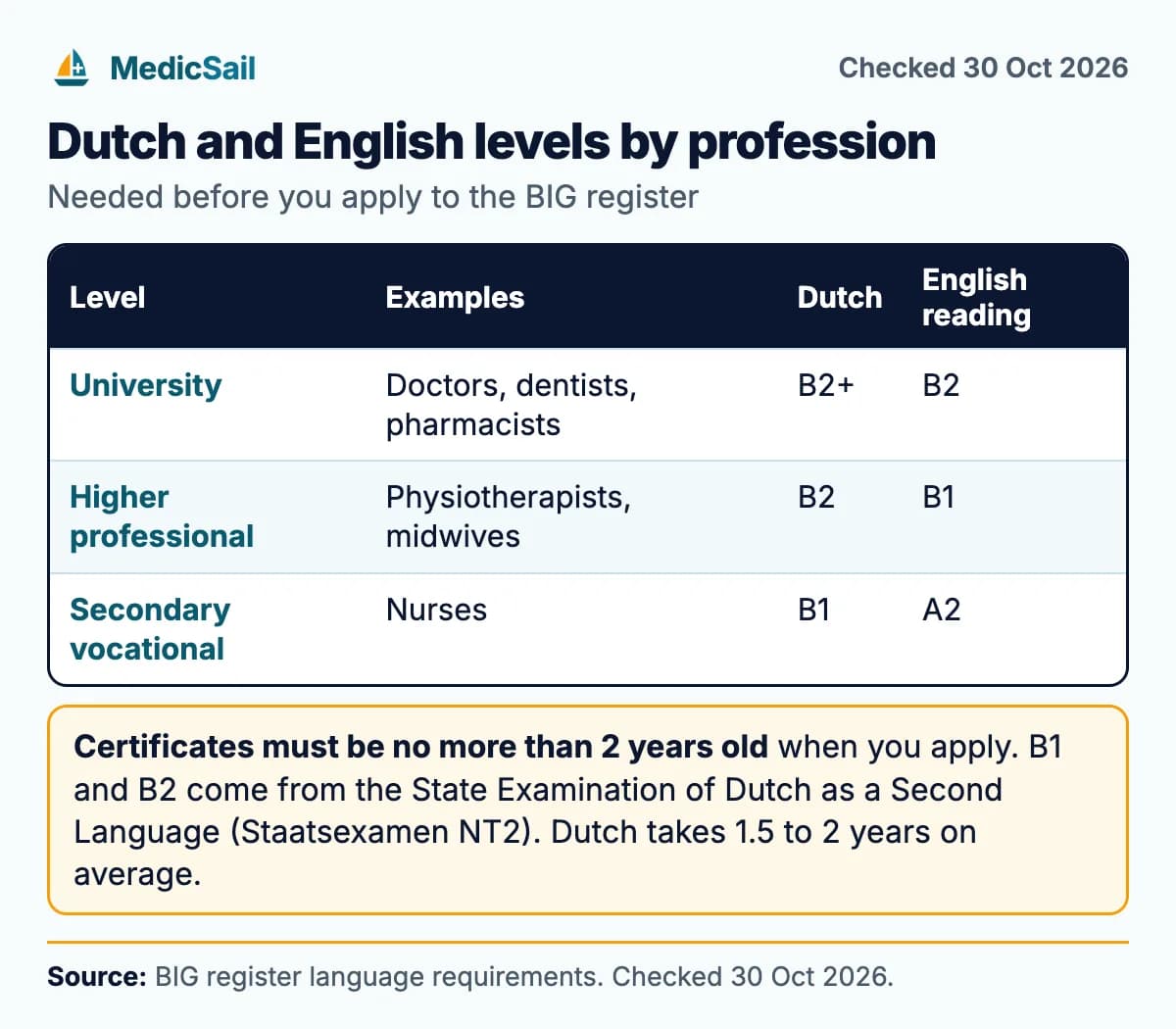
| Level of the profession | Examples | Dutch | English reading |
|---|---|---|---|
| University (wo) | Doctors, dentists, pharmacists, healthcare psychologists | B2+ | B2: IELTS 5.5 to 6.0, TOEFL 72 to 94, Cambridge 160 to 179, or EnglishScore |
| Higher professional (hbo) | Physiotherapists, midwives, dietitians | B2 | B1: IELTS 4.0 to 5.0, TOEFL 42 to 71, Cambridge 140 to 159, or EnglishScore |
| Secondary vocational (mbo) | Nurses, nurses in individual healthcare (verzorgende IG) | B1 | A2: Cambridge 120 to 139 or EnglishScore (none for verzorgende IG) |
Key rules from the BIG register:
- B1 and B2 must come from the State Examination of Dutch as a Second Language (Staatsexamen NT2), covering reading, writing, speaking and listening.
- B2+ is only accepted from the institutes the BIG register lists: Babel Language Institute, NedLes, BGB Academy, Elycio Talen, VU-NT2, Taalbureau Lest Best, Stichting Op Weg naar Werk/BIG-navigator, Taalschool De Vrije Taal and Refugee Healthcare Talent.
- Certificates must be no more than two years old when you apply. Proof that you were educated in Dutch can count instead.
- The BIG register says learning Dutch to the right level takes one and a half to two years on average, and estimates €200 to €300 for language testing, excluding courses.
Note the two-year limit. If you get your certificate early and then wait a long time before applying, it can expire. Plan the language exam so it is fresh when your documents are ready.
The BI-test, profession by profession
Only doctors, dentists and nurses sit the BI-test. It is taken in the Netherlands.
Doctors (arts)
From 1 March 2026 the doctors' BI-test has two parts: the interuniversity Progress Test for Medicine (interuniversitaire Voortgangstoets Geneeskunde, iVTG), a knowledge test that Dutch medical schools use for students at every stage, and a clinical skills test (deeltoets klinische vaardigheden, DKV) with test subjects on set topics. The clinical knowledge part (DKK), which used to sit alongside them, was dropped. The BIG register says waiting times were long because more non-European doctors applied and because the AKV's abolition in 2024 moved them to the BI-test sooner, while budget limits prevent more test places; dropping the DKK temporarily allows more doctors to be tested, and it says the quality of the test stays the same. Because the iVTG samples the whole of basic medicine, expect questions far from your own specialty. Read our guide for doctors moving to the Netherlands for the full route, including specialist recognition.
Dentists (tandarts)
A written test of basic and clinical knowledge plus a skills test, held in two rounds a year at the Academic Centre for Dentistry Amsterdam (ACTA). After you register, ACTA gives you access to preparation courses in its Canvas learning environment, and the BIG register's roadmap names practice on the Simodont dental simulator as an important part of preparation. See our guide for dentists in the Netherlands.
Nurses (verpleegkundige)
Three parts: a written knowledge test (kennistoets), a skills test (vaardighedentoets) and a clinical reasoning interview (gesprek klinisch redeneren). The test shows whether you have the knowledge and skills of a nurse finishing Dutch nursing training. Information for foreign graduates, including a study guide, training options and example knowledge questions, is on the herregistratiewetbig.nl site for foreign graduates. To join an information meeting about the nurses' test, email [email protected] with your name, profession and contact details. Our guide for nurses moving to the Netherlands explains the full process.
Booking, waiting lists and refunds
You do not book the BI-test independently. The sequence is:
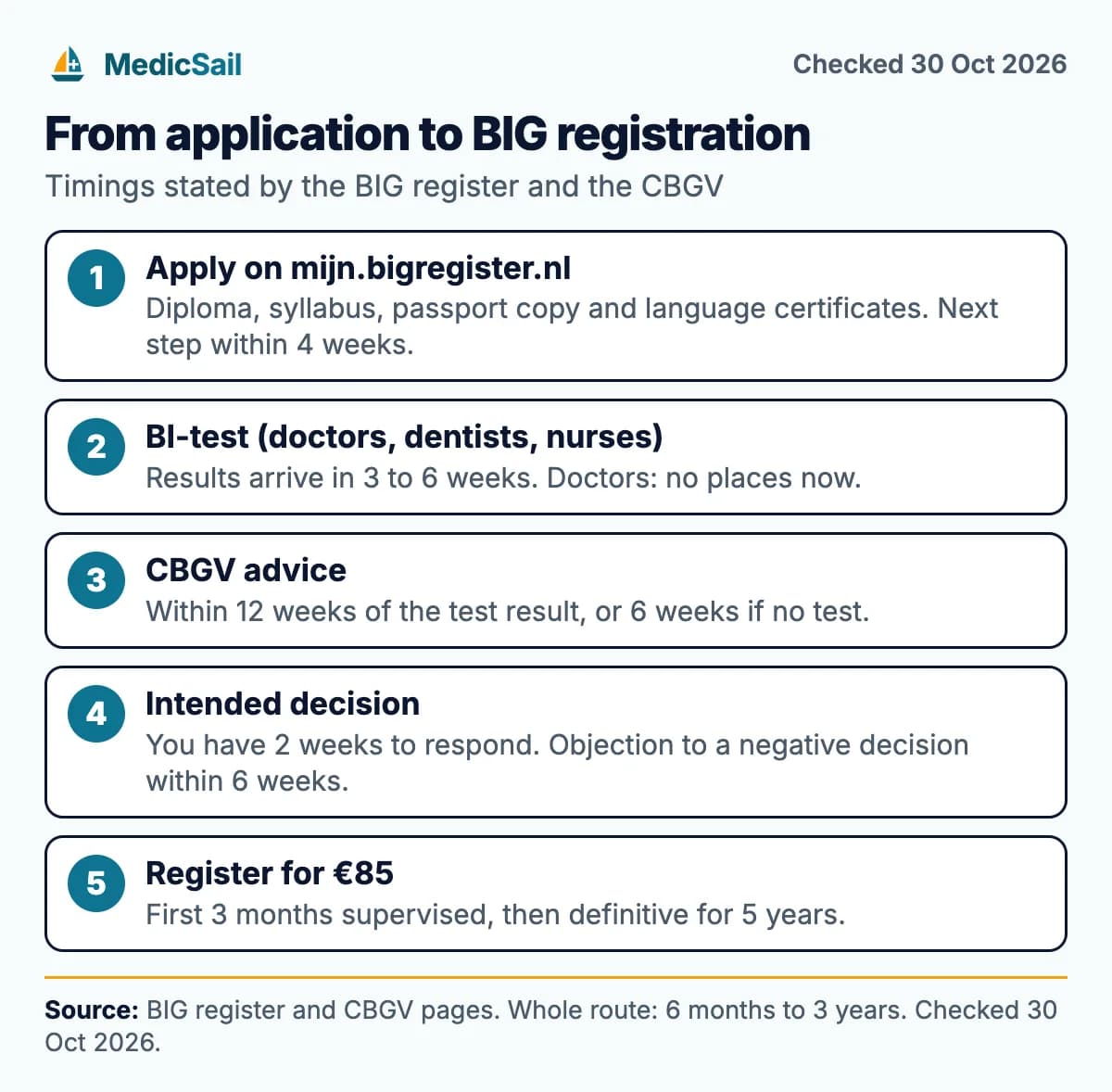
- You apply for the certificate of competence through mijn.bigregister.nl, with your diploma, course overview, certified passport copy, declaration of competence and language certificates. Doctors and dentists wait for a request before sending their syllabus.
- The BIG register checks your file. It aims to tell you the next step within four weeks of a complete application.
- If you need the BI-test, you receive an invitation letter with payment details. After you pay, you receive the registration details for the test. For doctors and dentists, the testing organisation then contacts you; nurses can also join an information meeting about their test.
Capacity is limited and published by the BIG register. As of 21 October 2026:
- Doctors: the test page says there are no test places at the moment and the test is full for this year, and it is not known when new participants can be scheduled. The roadmap page says it is full for this year and next year.
- Dentists: there are no more places for 2026, and you may not get a place in the next round either.
- Nurses: the BIG register does not report the nurses' test as full.
If you have paid and cannot take part, tell the organisers promptly: the BIG register says the fee is then refunded. Check the BIG register's test page before you make plans around a date, because the position changes.
Waiting has a hidden cost: your language certificates must be no more than two years old when you apply, so time them to your application. Use any waiting time to study for the test and improve your Dutch.
What the BI-test and the procedure cost
| Item | Fee | Notes |
|---|---|---|
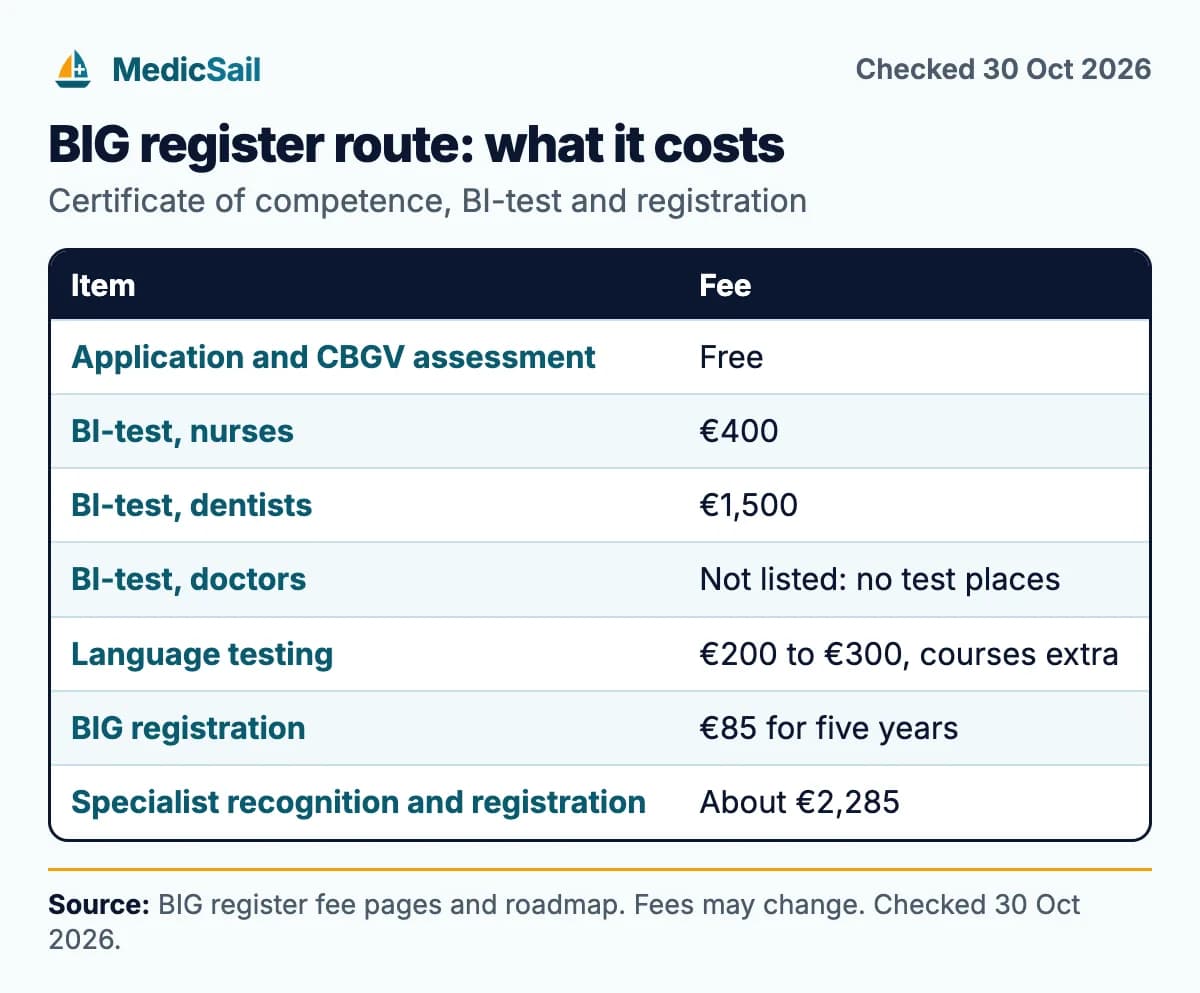
| Certificate of competence application and CBGV assessment | Free | The BIG register says there are no costs for the application or the commission's assessment |
| BI-test, nurses | €400 | Written test, skills test and clinical reasoning interview |
| BI-test, dentists | €1,500 | At ACTA; the BIG register says this may change |
| BI-test, doctors | Not listed | The test page says there are no test places for doctors at the moment and lists no fee; the older roadmap page still mentions €1,700 |
| Language testing | €200 to €300 | BIG register estimate; courses extra |
| BIG registration | €85 | For five years; re-registration is also €85 |
| Specialist recognition and registration | About €2,285 | Roadmap estimate for doctors and dentists with a specialty, plus about €750 if an adaptation internship is needed |
| Extra training or internship, if advised | Set by the provider | Often the largest cost; you arrange and pay for it |
| Certified copies, sworn translations, criminal record certificates | Varies | Depends on the country and provider |
The BIG register says the BI-test fees may change in future. Certified copies must come from an authorised body: the BIG register does not accept an apostille, because it proves only the signature, not the content. Documents not in Dutch or English need a sworn translation.
Results and the CBGV assessment
BI-test results arrive within three to six weeks. They show, area by area, where your knowledge and skills reach the Dutch level and where they do not. They then go to the CBGV.
Who the CBGV is
The CBGV is an independent committee set up in 1995, supported by CIBG's Admission and Supervision department. It has about 165 members and substitute members, nominated by professional organisations and training institutions and appointed by the Minister for four years. Each profession has its own subcommittee of up to eight members, all practising in the profession or working in education, and the meetings are held in Utrecht.
What it decides
The CBGV compares your education, qualifications and work experience with the current Dutch training. Where there are differences, it considers whether experience, courses or other training make up for them. It advises within 12 weeks of your BI-test result, or within six weeks of receiving your file if your profession has no BI-test. In most cases you are invited to a meeting where the commission explains its advice and discusses the next steps.
The CBGV notes that two people with the same diploma can receive different advice, because experience and test results differ. Detailed, verifiable work certificates therefore matter.
The three possible outcomes
- Positive: your training is at the Dutch level. You receive the certificate of competence and can apply for registration.
- Extra training first: the most common outcome. The CBGV advises a course, an internship or a period of supervised work in specific areas. You find and arrange it yourself, often with a Dutch hospital, university or college. The BIG register says extra training takes three months to two years, and the roadmap mentions up to three years.
- Negative: the differences are too large to close in that time. Your qualification is not recognised and you cannot work in that profession in the Netherlands; the CBGV will discuss other ways of reaching the Dutch level with you, such as a Dutch degree.
Whatever the advice, the BIG register sends an intended decision first. You have two weeks to respond. If you do not, the final decision follows; if it is negative you can lodge an objection within six weeks. A positive final decision is your certificate of competence. Keep it safe: if it is five or more years old when you register, extra work experience or training requirements apply.
Then registration
You apply for BIG registration with a Certificate of Current Professional Status from your country of training and every country where you lived or worked for three months or more, a certificate of good conduct (each no more than three months old) and your CV, and pay €85. Your first registration is conditional: you work for three months under the supervision of a BIG-registered professional in your field, using your title and performing reserved procedures, and send in the completed supervision form. Then your registration becomes definitive, renewable every five years.
The BIG register puts the certificate procedure at six months to one and a half years from a complete application; the roadmap puts the whole route at six months to three years, depending on language, documents, test dates and extra training.
Pharmacists, midwives, physiotherapists and psychologists
The other Article 3 professions have no BI-test. The CBGV assesses your file and usually meets you, and it often advises extra training. The language rules still apply: B2+ for pharmacists and healthcare psychologists, B2 for physiotherapists and midwives. Profession-specific details are in our guides for pharmacists in the Netherlands, physiotherapists in the Netherlands, midwives in the Netherlands and psychologists in the Netherlands.
Because the advice is based on paper, your syllabus is your evidence. List subjects, hours of theory and practice per year, placements and assessments, and add certified evidence of courses taken since graduation.
How to prepare for the BI-test
- Doctors: the roadmap suggests the progress test (VGT) manual and e-learning, the Compendium Medicine website, the digital clinical textbooks on studeergeneeskunde.nl, and workshops from OBUA, VBGA, Stichting Op Weg naar Werk and Edu4you. Revise across all of basic medicine, because the iVTG is designed for students across the whole medical course. Practise clinical skills in Dutch with a partner.
- Dentists: use ACTA's Canvas courses as soon as you have access, practise on the Simodont where you can, and read the BIG register's assessment document for the skills topics. Revise basic sciences as well as clinical dentistry.
- Nurses: start with the study guide and example questions for foreign graduates, join the information meeting, and revise Dutch protocols for medication safety, hygiene and patient safety. For the clinical reasoning interview, practise talking through the nursing process aloud in Dutch: assessment, problems, goals, interventions and evaluation.
- Everyone: the test shows gaps rather than awarding a pass, so a strong result can shorten or avoid extra training. Preparing well is worth the time.
If you are comparing countries, Germany's equivalent is the Kenntnisprüfung, Germany's knowledge test, which has a pass mark and limited attempts, and the UK uses the PLAB test for GMC registration.
If you are working in the Gulf, and the alternatives
A licence from the DHA, DOH, MOHAP, SCFHS, QCHP, OMSB or NHRA does not transfer to the Netherlands, and Gulf practice in English or Arabic does not count towards the Dutch language requirement. What helps:
- Detailed experience letters (dates, departments, duties, procedures) that the CBGV can weigh against your training.
- A Certificate of Current Professional Status from every Gulf regulator you held a licence with, requested close to your registration so it is under three months old.
- Starting Dutch while still employed. For most people it is the longest stage of the route.
For nurses facing a long training requirement, the roadmap points to alternatives: registration as a nurse in individual healthcare (verzorgende IG), which needs recognition but no BI-test, or a work-based learning route (BBL) that leads to a Dutch verzorgende IG diploma in just over two years while you earn a salary. Neither is a registered nurse post, but both let you work in Dutch healthcare sooner. If German is closer to hand than Dutch, compare the Fachsprachprüfung, Germany's medical German test.
Questions
The beroepsinhoudelijke toets is the professional knowledge test that doctors, dentists and nurses with a diploma from outside the EEA and Switzerland sit as part of the certificate of competence procedure. It shows where your knowledge and skills meet the Dutch graduate level. The CBGV uses the results to advise the BIG register.
No. The BIG register's roadmap says the test shows in which areas you have sufficient knowledge and skills and in which you do not yet. The CBGV then advises recognition, extra training or refusal.
€400 for nurses and €1,500 for dentists, according to the BIG register's test page. It lists no fee for doctors because there are no test places for doctors at the moment. The certificate of competence application and the CBGV assessment are free, and registration costs €85 for five years.
Since 1 March 2026 it has two parts: the interuniversity Progress Test for Medicine (iVTG) and the clinical skills test (DKV). The clinical knowledge part was dropped to allow more doctors to be tested.
As of 21 October 2026, the BIG register says there are no test places for doctors at the moment, that the test is full for this year and that it is not known when new participants can be scheduled. Its roadmap page says the doctors' test is full for this year and next year. Check its test page for updates before you plan around a date.
No. Only doctors, dentists and nurses take it. The CBGV assesses other registered professions on their documents and usually at a meeting.
B1 for nurses, B2 for higher professional professions such as physiotherapists and midwives, and B2+ for doctors, dentists, pharmacists and healthcare psychologists. B1 and B2 come from the Staatsexamen NT2; B2+ only from an institute the BIG register lists.
Within 12 weeks of your BI-test result, or within six weeks of receiving your file if your profession has no BI-test. You then have two weeks to respond to the intended decision.
You arrange the course or internship yourself. The BIG register says it takes three months to two years. When it is completed you receive the certificate of competence and can register.
No. It was replaced by language certificates from 1 January 2024, and components passed before then remain valid.
Sources
- 1BIG register: BI-tests
- 2BIG-register: BI-toetsen (Dutch)
- 3BIG register: Change BI-toets physicians
- 4BIG register: Certificate of professional competence
- 5BIG register: Commission for Foreign Healthcare Graduates
- 6BIG register: Assessment and decision
Show all 19 sourcesShow fewer sources
- 7BIG register: Processing time and costs
- 8BIG register: Dutch language proficiency
- 9BIG register: English reading skills
- 10BIG register: Information meetings and consultation hours
- 11BIG register: Supporting documents
- 12BIG register: Certifying and translating
- 13BIG register: Registration with a recognised qualification
- 14BIG register: Roadmap to working in the Netherlands
- 15BIG register: AKV test is replaced by language certificates
- 16BIG register: Automatic recognition of some EU diplomas
- 17BIG register: Specialisation
- 18Herregistratie Wet BIG: foreign-trained nurses
- 19ACTA: foreign-trained dentists
Plan it with our free tools
MedicSail
Healthcare licensing consultants for the UK, Europe and the USA
Updated and checked against the sources listed above. How we research and check our guides