


































The Fachsprachprüfung: Germany's medical German test explained
Everything about the medical German test for foreign-trained doctors: why it exists, the C1 standard, the doctor-patient, documentation and doctor-doctor parts, how the state chambers book you, published fees, retakes, the B2 certificate and how to prepare, plus the versions for dentists, pharmacists and nurses.

MedicSail
Published
The short answer
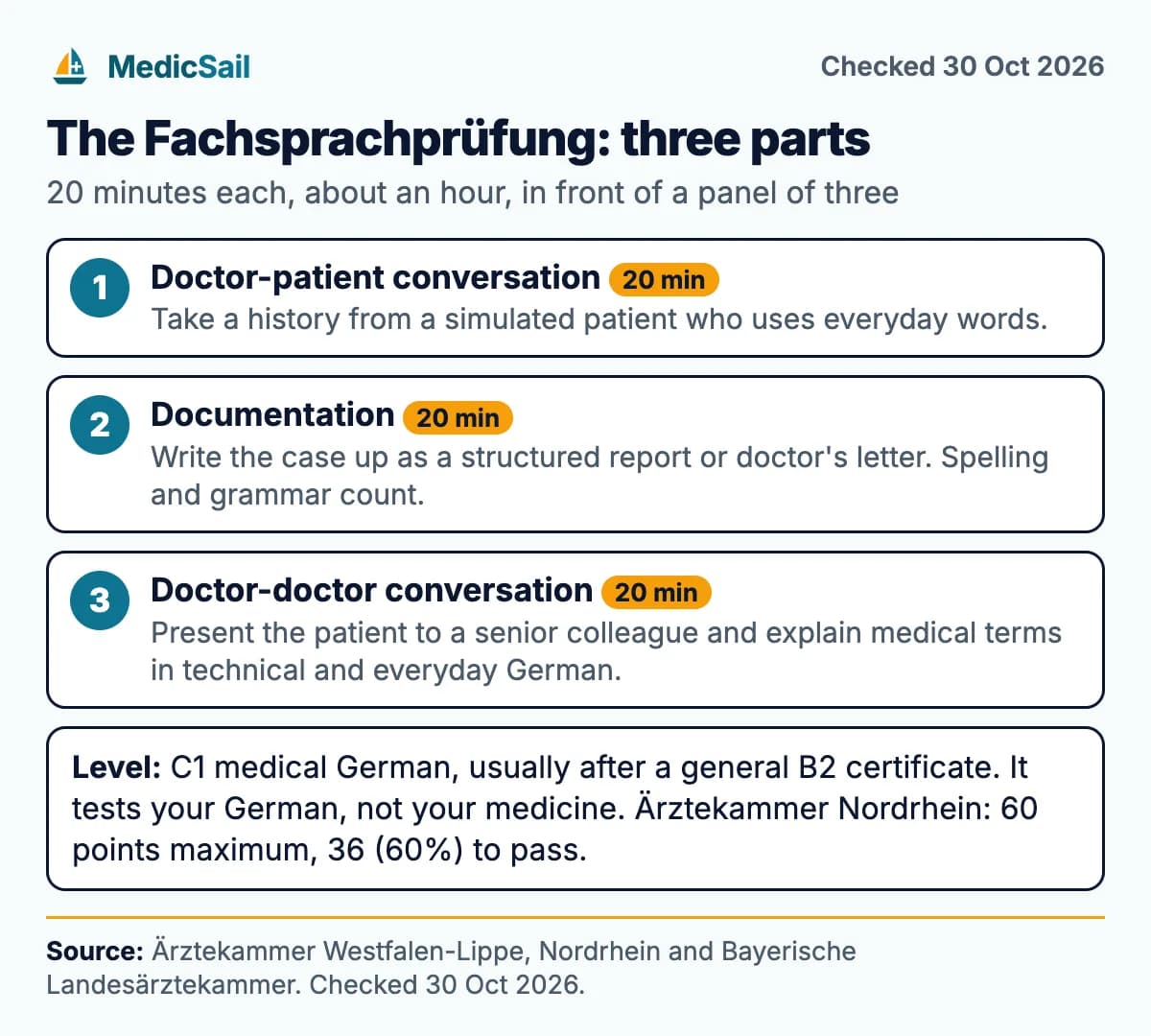
The Fachsprachprüfung (medical German test, also spelled Fachsprachenprüfung) is the language exam that foreign-trained doctors must pass before a German state will grant the Approbation (full licence) or, in most states, a temporary licence (Berufserlaubnis). It is run by the state medical chamber (Landesärztekammer) on behalf of the licensing authority, at language level C1 of the Common European Framework of Reference (CEFR), and it has three parts of 20 minutes each: a doctor-patient conversation, a written medical report, and a doctor-to-doctor conversation.
You cannot book it yourself the first time: the licensing authority registers you with the chamber once your application is in order. You usually need a general German certificate at B2 before the chamber will examine you. Fees are set by each chamber: €400 at the Ärztekammer Westfalen-Lippe, €430 at the Ärztekammer Nordrhein and €550 at the Bayerische Landesärztekammer, as published on 20 October 2026. The chambers we checked allow unlimited retakes, each paid again.
The test checks your German, not your medical knowledge; that is tested separately in the Kenntnisprüfung, Germany's knowledge test. Dentists and pharmacists sit their own chamber versions, and nurses and other health professions usually prove German at B2, sometimes with a profession-specific exam. This guide explains each part, how booking works, what the chambers charge and how to prepare. For the full licensing route see our guide to the German Approbation.
Why the test exists, and the C1 standard
German law makes language a condition of the licence. Section 3 of the Bundesärzteordnung (BÄO) says you must have the knowledge of German needed to practise as a doctor. The law does not set a level; the states agreed one. The Bayerische Landesärztekammer (BLÄK) explains that the 87th Conference of Health Ministers (Gesundheitsministerkonferenz) in 2014 set common standards for checking the German of foreign doctors, and the states then built their tests on them.
The result is a two-layer requirement:
- General German at B2. The Bezirksregierung Münster says you should normally show a B2 certificate from a recognised provider, and the Ärztekammer Westfalen-Lippe (ÄKWL) asks for it when you register for the exam.
- Medical German at C1. The ÄKWL says the test is set at C1 of the CEFR, and the BLÄK says the test is carried out at C1 German. C1 here means professional, medical German: taking a history in everyday language, writing a report in correct medical terms and discussing a case with a colleague.
So a general C1 certificate from a language school does not replace the Fachsprachprüfung, and passing the Fachsprachprüfung does not mean you speak C1 in every setting. It means you have shown the chamber you can communicate safely as a doctor in German.
English tests such as IELTS and OET play no part. If you are weighing Germany against an English-speaking country, our guide to IELTS and OET for UK regulators shows how different the language step is there.
The three parts of the exam
Every chamber we checked uses the same structure: three parts of 20 minutes each, about an hour in total, taken individually in front of a panel of three. At the ÄKWL at least two of the three examiners are licensed doctors; at the BLÄK the panel is two doctors and one linguist.
Part 1: doctor-patient conversation (Arzt-Patienten-Gespräch), 20 minutes
You take a history from a simulated patient. You introduce yourself, ask about the presenting complaint, past medical history, medicines, allergies, family and social history and a review of systems, and you explain the next steps in plain language. The patient will use everyday words, regional expressions and may not understand medical terms. Examiners listen for whether you can switch between lay German with the patient and medical German later. The Ärztekammer Nordrhein publishes a sample history form (Anamnesebogen) you can download to practise with; you do not need to bring it to the exam.
Part 2: documentation (Dokumentation), 20 minutes
You write up the case you have just taken, usually as a structured report or doctor's letter: history, likely diagnosis, differential diagnoses and planned investigations and treatment. This part tests written German, medical terminology and the ability to translate what the patient said into precise clinical language. Spelling and grammar count.
Part 3: doctor-doctor conversation (Arzt-Arzt-Gespräch), 20 minutes
You present the patient to a senior colleague, played by an examiner, and answer questions about your thinking and the next steps. The ÄKWL adds a vocabulary list to this part: you are asked to explain or translate medical terms between technical and everyday German. Fluency, structure and correct use of medical Latin and German terms matter more here than in part 1.
The test does not mark your medicine as such. A wrong diagnosis costs you only where it shows you misunderstood the patient or cannot express yourself. But you cannot discuss a case convincingly without the clinical knowledge to reason about it, so revise common presentations as you prepare.
How it is marked and when you get the result
Most chambers do not publish their marking scheme. The Ärztekammer Nordrhein does: the examiners' scoring gives a maximum of 60 points, and you need 60 per cent, or at least 36 points, to pass.
Results come quickly. The ÄKWL and the BLÄK both tell you the result immediately after the exam, and the ÄKWL confirms it in writing within the following week. The BLÄK says it does not issue a separate certificate; the result goes to the licensing authority, which records it in your file. Keep any written confirmation you receive, because employers and other states may ask for evidence.
The result counts for your licensing procedure in the state that registered you. If you later move your application to another state, ask the new authority whether it accepts a Fachsprachprüfung passed elsewhere before you assume you will not need to sit it again.
Who runs it: the chambers and what they publish
For doctors, the test is run by the state medical chamber in most states, under a procedure agreed with the state health ministry and licensing authorities. Here is what three of the largest chambers publish.
| Chamber | Where you apply first | Fee | Dates and place |
|---|---|---|---|
| Ärztekammer Westfalen-Lippe (Münster) | Zentrale Anerkennungsstelle für Gesundheitsberufe, Bezirksregierung Münster | €400 | Usually four times a month, on Thursdays or Saturdays |
| Ärztekammer Nordrhein (Düsseldorf) | Bezirksregierung Münster, which sends your data to the chamber | €430 | At the chamber, Tersteegenstraße 9, Düsseldorf |
| Bayerische Landesärztekammer (Munich) | Zentrale Anerkennungsstelle für Approbationsberufe, Regierung von Oberbayern | €550 | Several dates a month, only in Munich |
The BLÄK says it carried out 3,557 Fachsprachprüfungen in a year and can currently run about 300 a month, which gives a sense of scale. Waiting times vary by state and season, so ask your authority what it expects when you apply.
Dentists and pharmacists
Dental and pharmacists' chambers run their own versions. The Zahnärztekammer Nordrhein charges €450, including for retakes. The Apothekerkammer Nordrhein describes its test as based on C1, 60 minutes long, with a patient consultation, documentation and a pharmacist-to-pharmacist discussion with a vocabulary test, for €375. See our guides for dentists in Germany and pharmacists in Germany.
Nurses and other health professions
Nurses, midwives and physiotherapists are not examined by medical chambers. The Recognition Finder profiles we checked set B2 for them. North Rhine-Westphalia also accepts the nursing language exam (Fachsprachprüfung Pflege) at the Pflegekammer NRW, and in Bavaria the Bayerisches Landesamt für Pflege runs a specialist language exam for health professions: two 20-minute dialogues and a 20-minute written task, €350, with 60 per cent needed in both the oral and the written part. Our guide for nurses moving to Germany explains what each state accepts.
How booking works, step by step
- Apply for the Approbation. Send your application to the authority in the state where you want to work. The Recognition Finder at anerkennung-in-deutschland.de names it. In North Rhine-Westphalia that is the Zentrale Anerkennungsstelle at the Bezirksregierung Münster; in Bavaria, the central office at the Regierung von Oberbayern.
- The authority registers you. Once your file is in order, the authority passes your details to the chamber. The ÄKWL says first registrations come exclusively through the authority, usually weekly on Fridays, and that you cannot register yourself. The BLÄK and the Ärztekammer Nordrhein say the same.
- The chamber contacts you. You receive an email or letter with the fee and the documents to send. The ÄKWL asks for proof of payment, your B2 certificate, a current CV and a signed data protection declaration.
- You pay and send the documents. The chamber then gives you a date.
- You sit the exam. Read the invitation carefully for what to bring and when to arrive.
- The result goes to the authority. It then continues with the equivalence decision, the Berufserlaubnis if you applied for one, and later the Approbation.
Look after your date. The ÄKWL asks you to tell it within three working days if you need to change a date; otherwise the fee may be charged again. The ÄKWL also charges again for missed dates.
For a retake, you contact the chamber directly. At the ÄKWL you register by post or by email to [email protected]; you do not need to go back through the authority.
Where the test fits in your route to the Approbation
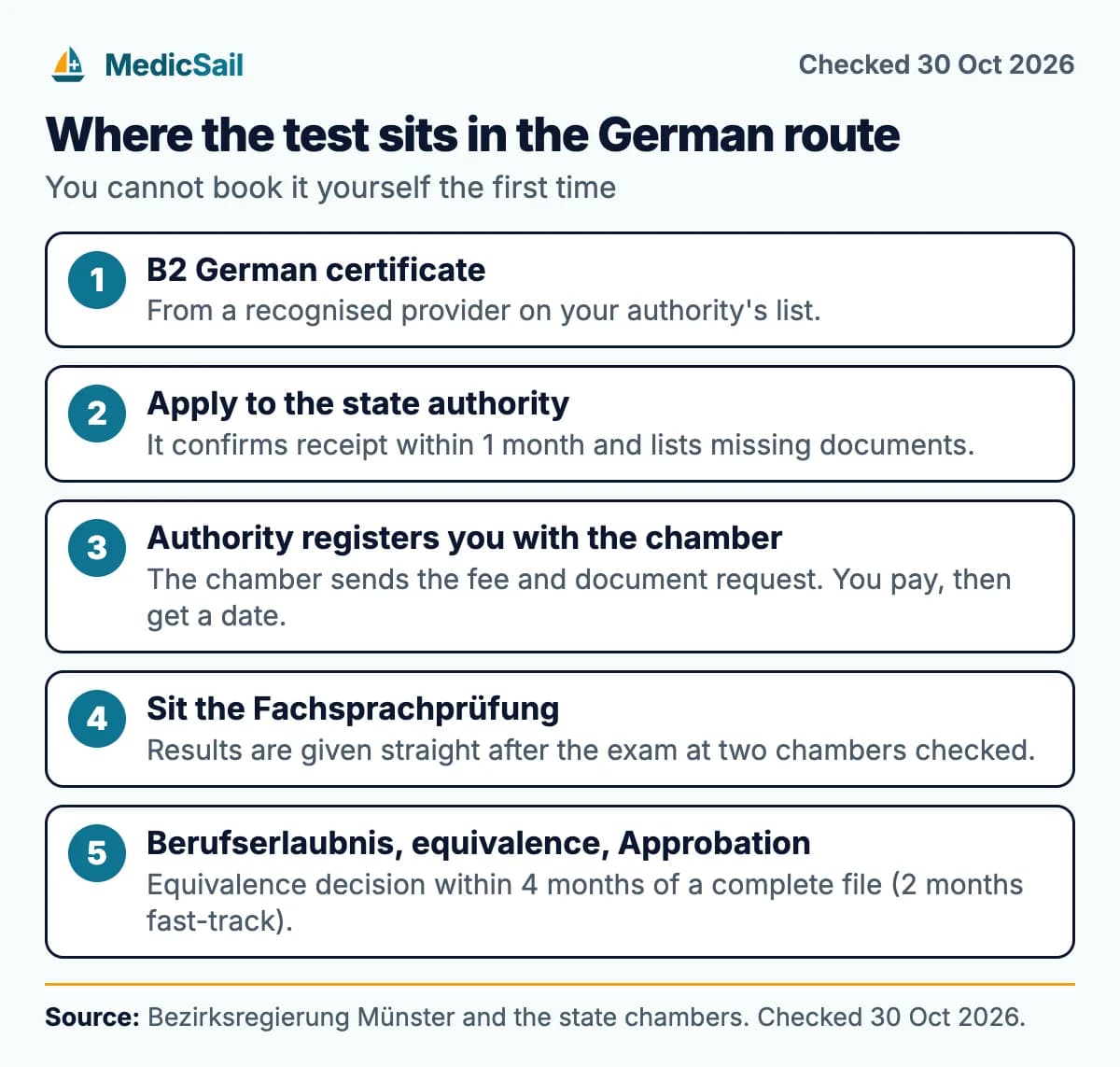
The Fachsprachprüfung is usually the first exam you sit in Germany, and the rest of the route depends on it. A typical order for a doctor trained outside the EU looks like this:
- B2 certificate, often obtained before you apply or while your file is being checked.
- Application to the state authority for the Approbation, and usually for a Berufserlaubnis at the same time. The authority must confirm receipt within one month and list any missing documents.
- Fachsprachprüfung, booked by the authority with the chamber. At the ÄKWL, exams run about four times a month once your documents are in.
- Berufserlaubnis, if granted. The Bezirksregierung Münster normally issues it for two years after you pass the Fachsprachprüfung, limited to North Rhine-Westphalia, and says there is no legal right to it.
- Equivalence decision, due within four months of a complete file (two months under the fast-track procedure for skilled workers), followed where needed by the Kenntnisprüfung.
- Approbation, valid throughout Germany.
Because the Berufserlaubnis in North Rhine-Westphalia follows the language test, passing early lets you start work, earn a salary and improve your German on the ward while you prepare for the knowledge test. A late pass delays everything after it.
Mistakes that cost time
- Booking before you are ready. Each attempt costs the full fee, and the chambers recommend months between attempts.
- Relying on a general C1 certificate. It does not replace the Fachsprachprüfung, which tests medical communication specifically.
- Ignoring the written part. Candidates who speak well can still fail on the report, where spelling, grammar and terminology are all visible.
- Losing the link to your state. The authority must stay responsible for your case, so moving states mid-procedure can mean starting parts of it again.
- Missing a date without notice. At the ÄKWL, changes need three working days' notice, or the fee may be charged again.
What it costs
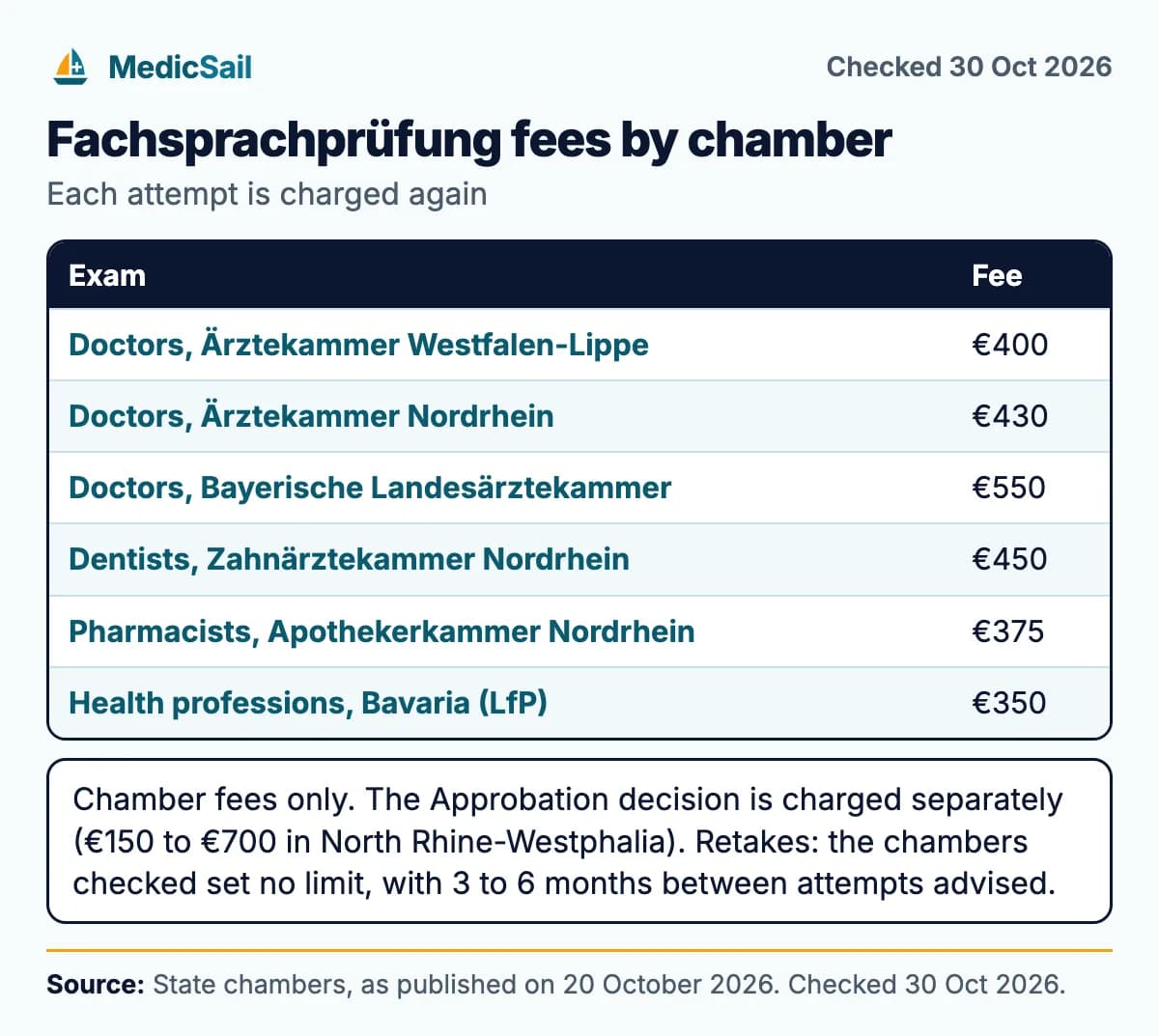
| Item | Fee | Notes |
|---|---|---|
| Fachsprachprüfung, doctors, Ärztekammer Westfalen-Lippe | €400 | Charged again for retakes and missed or late-cancelled dates |
| Fachsprachprüfung, doctors, Ärztekammer Nordrhein | €430 | Each attempt |
| Fachsprachprüfung, doctors, Bayerische Landesärztekammer | €550 | Each attempt |
| Fachsprachprüfung, dentists, Zahnärztekammer Nordrhein | €450 | Retakes too |
| Fachsprachprüfung, pharmacists, Apothekerkammer Nordrhein | €375 | 60-minute exam |
| Specialist language exam, health professions, Bavaria (LfP) | €350 | For example physiotherapists and midwives, where the authority requires it |
| B2 certificate | Set by the provider | From a recognised provider |
| Other states | Set by each chamber | Check the chamber's page once the authority registers you |
These are chamber fees only. The licensing authority charges separately for the Approbation (€150 to €700 in North Rhine-Westphalia), and German courses are usually the largest cost of all. If you live in Germany, the federal recognition grant may help with recognition costs; the portal anerkennung-in-deutschland.de says you must apply for it before you apply for recognition.
Retakes and how long to wait
Unlike the Kenntnisprüfung, which doctors can repeat only twice, the Fachsprachprüfung can usually be repeated as often as you need. The BLÄK says there is currently no limit on retakes, and the Ärztekammer Nordrhein says the test can be repeated several times. Each attempt costs the full fee.
The chambers advise a gap. The ÄKWL recommends three to six months between attempts, and the Ärztekammer Nordrhein suggests planning several months. That is good advice: a fail usually reflects a gap in fluency that takes weeks of practice to close, and immediate resits mostly add cost.
If you fail, ask which part let you down. Many candidates pass the conversation with the patient but lose marks on the written report or the vocabulary questions, which are easier to fix with targeted practice.
The B2 certificate and who is exempt
The chambers expect a general German certificate at B2 before they examine you. The Bezirksregierung Münster publishes a list of recognised providers. Check your own authority's list before you book a language exam, because not every certificate is accepted everywhere.
The Bezirksregierung Münster says the B2 certificate is not needed if you:
- took your final medical exam in German;
- passed a Kenntnisprüfung or a specialist exam in Germany;
- are a native German speaker;
- gained your university entrance qualification at a German-language school or had at least ten years of schooling in German; or
- completed at least three years of vocational training in German.
Those exemptions apply to the B2 certificate. Whether you are also exempt from the Fachsprachprüfung itself is for your authority to decide, so ask before you assume.
For a residence permit to pursue recognition (section 16d of the Residence Act), German at about A2 is usually enough to start. That lets you move to Germany, work in a related role and study for B2 and C1 there. The details for doctors are in our guide for doctors moving to Germany.
How to prepare
The BLÄK says it offers no official courses and that candidates should prepare at C1 level on their own. Many private schools run Fachsprachprüfung courses, often with mock exams; quality varies, so look for courses taught by doctors with exam experience. Whatever route you choose, these habits make the difference.
- Drill history-taking in German until it is automatic. Work through a fixed order of questions and practise them aloud, with a partner playing patients who use lay terms and dialect.
- Build two vocabularies. For every condition, learn the medical term, the Latin or Greek root and the everyday German phrase a patient would use (for example "Hypertonie" and "Bluthochdruck").
- Write a report every day. Time yourself to 20 minutes. Use a template: personal details, presenting complaint, history, medicines, allergies, social history, suspected diagnosis, differentials, plan.
- Practise presenting to a colleague. A short structured case presentation, then questions. Record yourself and listen for hesitation, missing articles and wrong verb positions.
- Revise common presentations. Common presentations such as chest pain, abdominal pain, shortness of breath, headache, fever and back pain make good practice cases. Know the German differentials and work-up for each.
- Use the chamber's material. Download the Ärztekammer Nordrhein's sample history form and read your chamber's exam page closely before the day.
Doctors who move to Germany with A2 or B1 often reach the Fachsprachprüfung faster by working in a German environment, for example in a hospital in a non-medical role or an internship, than by studying abroad alone.
If you are working in the Gulf now
Work in the Gulf is in English and Arabic, so it does not count towards the German requirement, and no Gulf licence (DHA, DOH, MOHAP, SCFHS, QCHP, OMSB, NHRA) exempts you from the Fachsprachprüfung. What you can do from the Gulf:
- Start German early and aim to reach B2 before you leave, checking that the certificate you work towards is on your German authority's list.
- Collect certificates of good standing, translated documents and detailed work certificates while you are still in post, so your application is ready when your German is.
- Plan the move around a realistic language timeline. For most doctors, reaching the level the Fachsprachprüfung demands takes longer than every administrative step put together.
Our guide to working in German healthcare covers visas, pay and employers, and our hub for internationally trained doctors compares Germany with the UK, Ireland, the Netherlands and the USA. If the Netherlands is on your list, its language rules are different again: see our guide to the BI-test and Dutch language requirements.
Questions
C1 of the Common European Framework, in medical German. The Ärztekammer Westfalen-Lippe and the Bayerische Landesärztekammer both state C1. You usually need a general B2 certificate before you can sit it.
For doctors, the state medical chamber in most states, on behalf of the licensing authority. Examples are the Ärztekammer Westfalen-Lippe, the Ärztekammer Nordrhein and the Bayerische Landesärztekammer. Dental and pharmacists' chambers run their own versions.
Not for your first attempt. The licensing authority registers you with the chamber once your application is in order. For retakes you usually contact the chamber directly.
Each chamber sets its fee. As of 20 October 2026 it is €400 at the Ärztekammer Westfalen-Lippe, €430 at the Ärztekammer Nordrhein and €550 at the Bayerische Landesärztekammer, paid again for every attempt.
A 20-minute doctor-patient conversation (history-taking), 20 minutes of written documentation of the case, and a 20-minute doctor-doctor conversation in which you present the case to a colleague. The Ärztekammer Westfalen-Lippe adds a vocabulary list to the last part.
The Ärztekammer Nordrhein requires 60 per cent of the maximum, or at least 36 of 60 points. Other chambers do not publish a pass mark.
The chambers we checked allow repeated attempts; the Bayerische Landesärztekammer says there is currently no limit. They recommend waiting several months, three to six months at the Ärztekammer Westfalen-Lippe, between attempts.
No. It tests whether you can communicate as a doctor in German. Medical knowledge is assessed in the equivalence check and, where needed, the Kenntnisprüfung.
Nurses usually need B2 German. North Rhine-Westphalia accepts the nursing language exam at the Pflegekammer NRW as proof, and Bavaria runs a specialist language exam for health professions. Check what your state authority accepts.
No. Germany requires German. English test results do not count towards the Approbation or the Fachsprachprüfung.
Sources
- 1Bundesärzteordnung (BÄO) section 3
- 2Ärztekammer Westfalen-Lippe: Fachsprachenprüfung
- 3Ärztekammer Nordrhein: Fachsprachprüfung
- 4Bayerische Landesärztekammer: Fachsprachenprüfung
- 5Zahnärztekammer Nordrhein: Fachsprachenprüfung
- 6Apothekerkammer Nordrhein: Fachsprachprüfung
Show all 12 sourcesShow fewer sources
- 7Bayerisches Landesamt für Pflege: Fachsprachenprüfung Gesundheitsfachberufe
- 8Bezirksregierung Münster: Approbation, third-country training
- 9Bezirksregierung Münster: Approbation FAQ
- 10Anerkennung in Deutschland: financial support
- 11Anerkennung in Deutschland: Recognition Finder
- 12Residence Act section 16d
Plan it with our free tools
MedicSail
Healthcare licensing consultants for the UK, Europe and the USA
Updated and checked against the sources listed above. How we research and check our guides