


































The Kenntnisprüfung: Germany's knowledge test for foreign-trained health professionals
How Germany's knowledge test works for doctors trained outside the EU: the legal basis, the patient presentation and oral exam, who runs it in each state, published fees, attempts and preparation, plus how the test differs for nurses, midwives, physiotherapists, dentists and pharmacists.

MedicSail
Published
The short answer
The Kenntnisprüfung (knowledge test) is the German state exam that doctors trained outside the EU, the EEA and Switzerland sit when the licensing authority finds substantial differences (wesentliche Unterschiede) between their training and German medical training. For doctors it is set out in section 37 of the Approbationsordnung für Ärzte (ÄApprO): an oral-practical exam in German, on one day, with a patient presentation, covering internal medicine and surgery plus emergency medicine, clinical pharmacology, imaging, radiation protection and medical law. Each candidate is examined for 60 to 90 minutes, in groups of up to four, and you can repeat the exam twice.
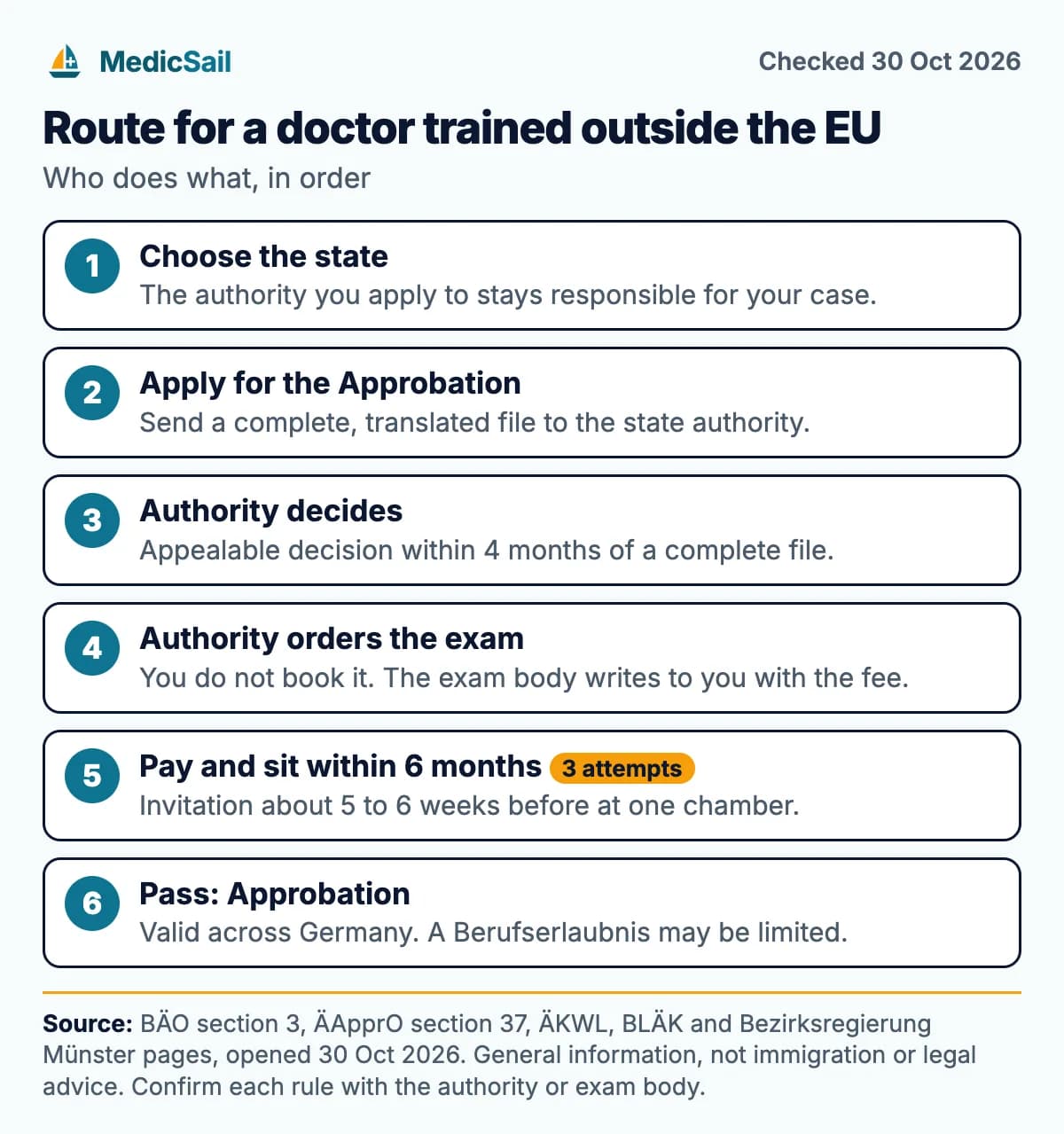
You do not book it directly. You apply for the Approbation (full licence) to the authority of the federal state (Land) where you want to work, that authority issues a decision (Bescheid) naming the differences, and then registers you with whoever runs the exam in that state, often the state medical chamber (Ärztekammer). Fees are set locally: the Ärztekammer Westfalen-Lippe charges €1,050, and the Bayerische Landesärztekammer, which takes over the Bavarian exam from 1 January 2027, publishes €1,185 per attempt.
Nurses, midwives, physiotherapists, dentists and pharmacists also have a Kenntnisprüfung, each under its own federal ordinance and with its own format; for most of them it is one of two options, the other being an adaptation period. This guide explains the doctors' exam in full, then how the test works for the other professions. For the whole licensing route, read our guide to the German Approbation alongside it, and for the bigger picture of moving, our guide to working in German healthcare.
Who has to sit the Kenntnisprüfung
The Kenntnisprüfung exists because Germany compares every foreign medical qualification with its own six-year, 5,500-hour medical degree. How you are treated depends first on where you trained, not on your passport.
- Trained in the EU, EEA or Switzerland: qualifications listed in the annex to the EU directive are recognised largely automatically. Where they are not, and there are substantial differences, you sit the Eignungsprüfung (aptitude test) under section 36 ÄApprO, which covers only the subjects where differences were found. This guide does not deal with that route in detail.
- Trained in a third country (Drittstaat): India, Pakistan, Egypt, Syria, the Philippines, the Gulf states and every other country outside the EU, EEA and Switzerland. The authority carries out an equivalence assessment (Gleichwertigkeitsprüfung). If it finds substantial differences that your professional experience or certified further learning does not make up for, you must pass the Kenntnisprüfung.
- Documents cannot be produced: section 3 of the Bundesärzteordnung (BÄO) also requires the Kenntnisprüfung where the documents needed for a document-based check cannot be obtained for reasons outside your control, or would take disproportionate effort. The Bezirksregierung Münster in North Rhine-Westphalia offers this option on its application form, and many applicants choose it to save time. Ask your authority whether it is open to you before you decide.
An important point that many guides miss: the Kenntnisprüfung is not a test of your specific gaps. Section 3 BÄO says it covers the content of the German state final examination (staatliche Abschlussprüfung), and section 37 ÄApprO says it always covers internal medicine and surgery. If your decision names further subjects, those are added. A favourable equivalence decision can mean you do not sit the exam at all, so a complete, well-translated file with detailed transcripts is worth the effort.
The Kenntnisprüfung is one of several conditions for the Approbation. You also need the German language skills for the profession (usually a B2 general certificate plus a passed Fachsprachprüfung, the medical German test), a certificate of good standing and a medical certificate. Our step-by-step guide for doctors moving to Germany puts these in order.
The legal basis, profession by profession
There is no single national exam body. The rules are federal, in the licensing law for each profession, but each of the 16 states runs its own exams through its authority, a chamber or a university. The table shows where to find the rule that applies to you on gesetze-im-internet.de, the federal law website.
| Profession | Law and section | What the test is |
|---|---|---|
| Doctors (Arzt, Ärztin) | BÄO section 3; ÄApprO section 37 | Oral-practical exam with a patient presentation, 60 to 90 minutes per candidate |
| Dentists (Zahnarzt, Zahnärztin) | ZHG section 2; ZApprO sections 104 to 118 | Written treatment plan, oral exam and practical exam on simulated cases, taken in order |
| Pharmacists (Apotheker, Apothekerin) | BApO section 4; AAppO section 22d | Oral exam of 30 to 60 minutes on pharmaceutical practice and law, plus one subject chosen by the authority |
| Nurses (Pflegefachfrau, Pflegefachmann) | PflBG section 40; PflAPrV sections 45 and 45a | Oral and practical parts, or a five-station simulation circuit |
| Midwives (Hebamme) | HebG section 59; HebStPrV sections 49 to 51 | Oral case plus three practical care situations |
| Physiotherapists (Physiotherapeut, Physiotherapeutin) | MPhG section 2; PhysTh-APrV sections 21a and 21b | Oral part plus a practical patient exam |
For doctors, the important difference from the other professions is that there is no choice. Under section 3 BÄO, third-country doctors with substantial differences prove equivalent knowledge by passing the Kenntnisprüfung; there is no adaptation period alternative. For nurses, midwives and physiotherapists the law lets you choose between the Kenntnisprüfung and an adaptation period (Anpassungslehrgang) of up to three years. The government portal anerkennung-in-deutschland.de says you generally choose the measure yourself and tell the competent authority which one you have opted for.
The doctors' exam: format, subjects and the day itself
Section 37 ÄApprO describes the exam in a few lines. The state chambers that run it fill in the practical detail. Here is how it works, using the ordinance and the published descriptions from the Ärztekammer Westfalen-Lippe (ÄKWL) and the Bayerische Landesärztekammer (BLÄK).
The examination commission
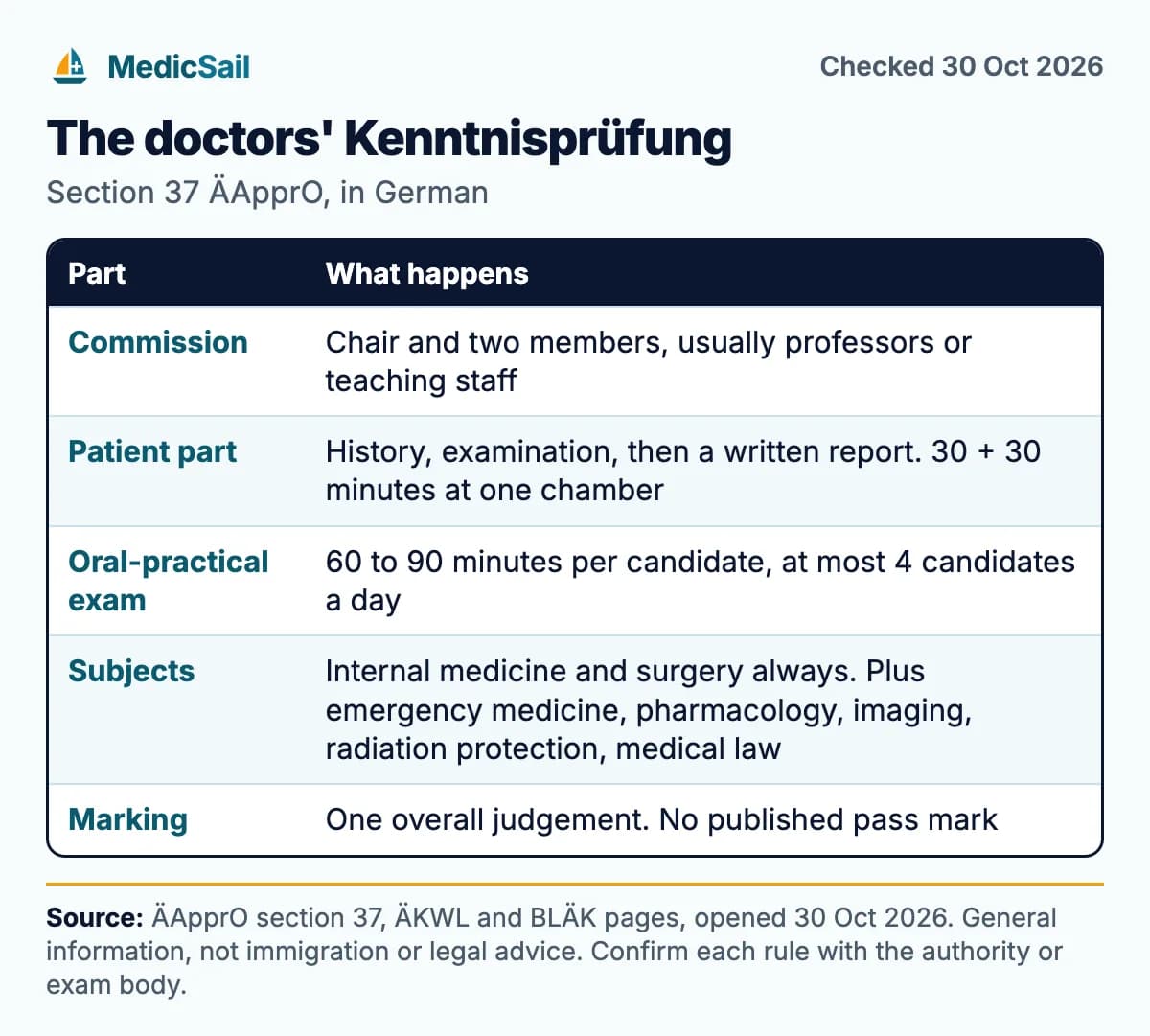
You are examined by a commission of three: a chair and two further members, each with a substitute. The ordinance says they are usually professors or other teachers in the relevant subjects, although suitably qualified doctors can also serve. You will meet examiners who know the German final exam well.
Part one: the patient
Before the oral exam you are assigned a patient. You take the history, examine the patient and write a report (Bericht) with the history, diagnosis, prognosis, treatment plan and an epicrisis (a concluding summary of the case). The ÄKWL gives 30 minutes for the history and physical examination and 30 minutes for the report, and uses trained simulated patients who play a disease role. Section 37 allows simulated patients or models where that is appropriate, so other states may use real hospital patients.
Part two: the examination discussion
The oral-practical exam then lasts at least 60 and at most 90 minutes per candidate, with no more than four candidates on one day. It starts from your patient presentation and moves to the subjects:
- Internal medicine and surgery, always.
- Questions on emergency medicine, clinical pharmacology and pharmacotherapy, imaging, radiation protection and the legal aspects of medical practice.
- Any extra subject named in your equivalence decision.
The BLÄK describes its version as three stations taking about 90 minutes in total: a practical exam with a simulated patient, a written patient report and an expert discussion (Fachgespräch). The content is the same; only the layout differs.
How it is marked
The commission makes an overall judgement of your patient presentation and your answers across the subjects. The ordinance sets a single pass standard: you pass if your performance meets the requirements despite its shortcomings. There are no published question banks or pass marks, which is why preparation has to cover the whole of internal medicine and surgery rather than a list of topics.
Language
The whole exam is in German, including the written report. The BLÄK states this explicitly. Weak German costs marks even when the medicine is right, so most doctors pass the Fachsprachprüfung first and sit the Kenntnisprüfung after months of working in German.
Who runs it in your state, and how booking works
Who runs the doctors' Kenntnisprüfung depends on the state. The authority always decides that you need it; the exam itself may be held by the authority, a state examination office (Landesprüfungsamt), a university faculty or the medical chamber. Two published examples:
- North Rhine-Westphalia: applications go to the Zentrale Anerkennungsstelle für Gesundheitsberufe (ZAG) at the Bezirksregierung Münster, and the Ärztekammer Westfalen-Lippe has run the Kenntnisprüfung since 5 February 2021.
- Bavaria: applications go to the central recognition office at the Regierung von Oberbayern. The BLÄK says it will conduct the Kenntnisprüfung from 1 January 2027, together with the Bavarian university medical faculties.
Booking follows the same pattern in both. You do not register yourself.
- The authority sends your details to the exam body once it has issued the decision that you must sit the exam.
- The exam body writes to you with the fee, the documents it needs and, at the ÄKWL, a form on which you state the period in which you would like to sit.
- You pay and return the documents, and the exam body confirms the booking. The ÄKWL says invitations usually go out five to six weeks before the exam date.
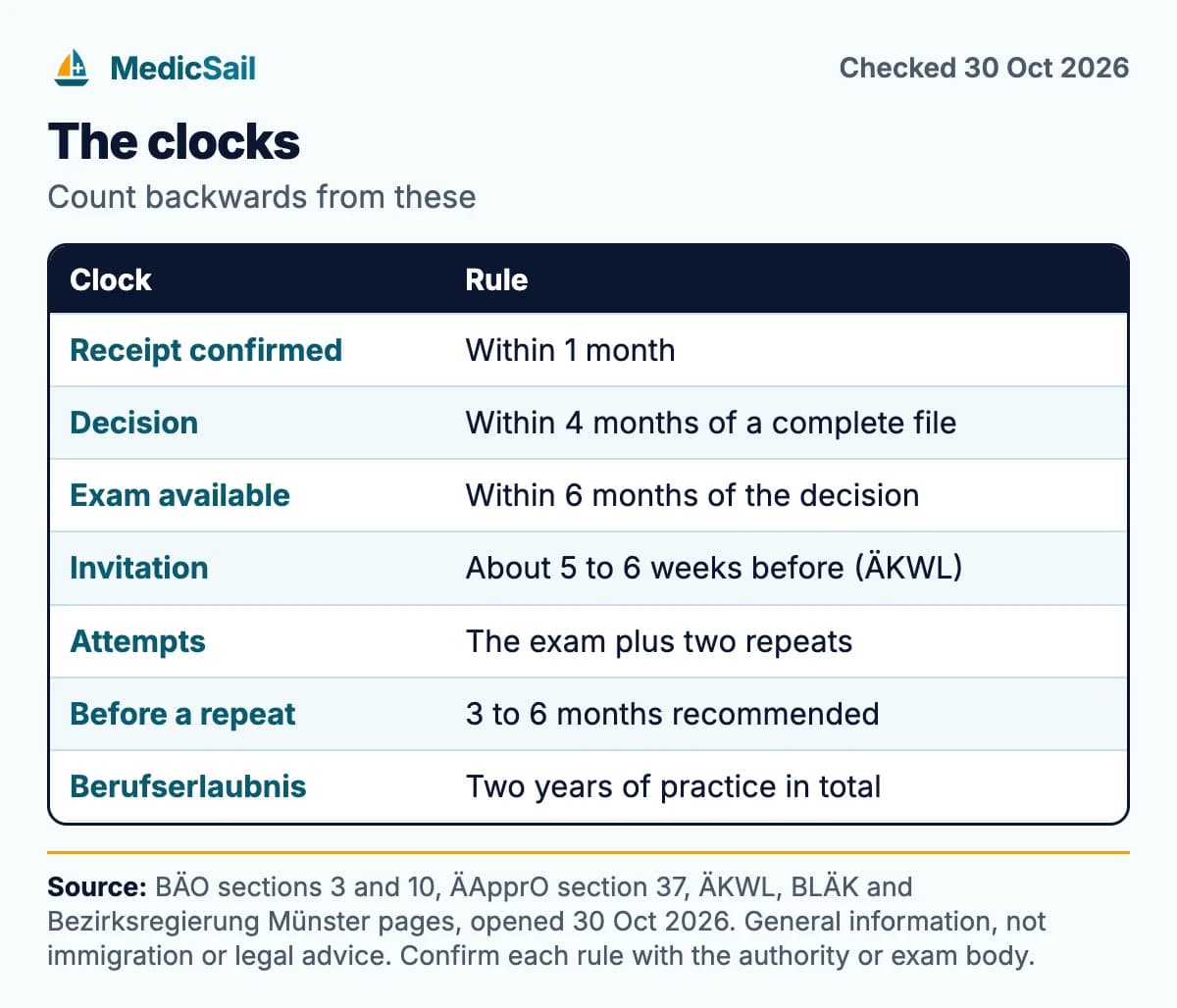
Section 37 ÄApprO says the exam must be offered at least twice a year and that you must be able to sit it within six months of the decision on equivalence. In practice some states run sessions far more often. If you are offered a date and are not ready, think carefully: at the ÄKWL, withdrawing without an accepted important reason (such as illness, an accident or a death in the family, reported immediately with evidence) counts as a failed attempt and the fee is lost.
Which state you choose matters. The authority must stay responsible for your case throughout, so you usually need a job offer, a placement or an address in that state, or a location note from the Central Service Point for Professional Recognition (ZSBA) at the Federal Employment Agency if you are still abroad.
What the Kenntnisprüfung costs
Each exam body sets its own fee, and many states do not publish one at all. These are the figures we could confirm from official pages on 20 October 2026.
| Item | Fee | Notes |
|---|---|---|
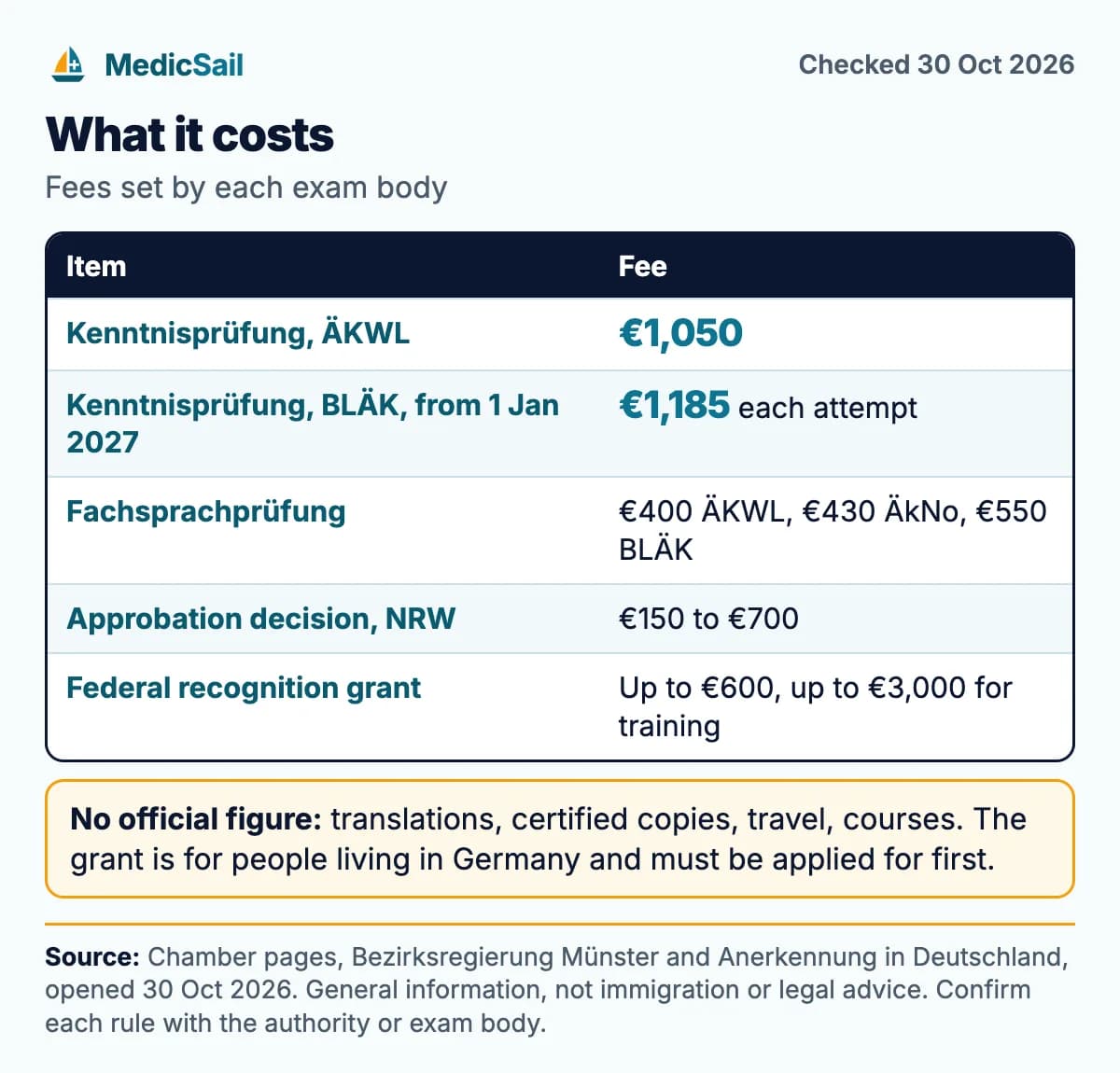
| Kenntnisprüfung for doctors, Ärztekammer Westfalen-Lippe | €1,050 | Due when you register; same procedure for retakes |
| Kenntnisprüfung for doctors, Bayerische Landesärztekammer | €1,185 per attempt | From 1 January 2027, when the BLÄK takes over the exam |
| Kenntnisprüfung for dentists, Zahnärztekammer Nordrhein | €330 written, €960 oral, €1,210 practical | Charged per part, and again for each retake |
| Approbation decision, North Rhine-Westphalia | €150 to €700 | Bezirksregierung Münster; depends on the work involved |
| Fachsprachprüfung for doctors | €400 (ÄKWL), €430 (Ärztekammer Nordrhein), €550 (BLÄK) | Charged separately by the chamber |
| Nurses, midwives, physiotherapists | Set by the state | The Recognition Finder profiles we checked do not publish a figure for the knowledge test |
Budget for more than the exam. Translations of every document by a translator publicly appointed in Germany, certified copies, travel to the exam city and any preparation course usually cost more than the exam fee. If you already live in Germany, the federal recognition grant (Anerkennungszuschuss) can pay up to €600 towards the direct costs of the recognition procedure and up to €3,000 towards training to close substantial differences. The portal is clear that you must apply for the grant before you apply for recognition, so check this first if it applies to you.
Attempts, results and what happens if you fail
Section 37 ÄApprO lets you repeat the doctors' Kenntnisprüfung twice, so you have three attempts in total. The BLÄK recommends allowing three to six months before a repeat. Each attempt costs the full fee again.
Count your attempts carefully. Unlike the Fachsprachprüfung, which most chambers let you repeat without limit, the Kenntnisprüfung has a hard ceiling. Turning up to an exam you are not ready for, or missing it without an accepted reason, can use up one of only three chances. Ask your authority in writing what a final failure would mean for your application before your third attempt.
For the other professions the counts differ:
- Dentists: each failed part (written, oral, practical) can be repeated twice.
- Pharmacists: the oral exam can be repeated twice.
- Nurses: each failed part, and each failed care situation, can be retaken once. If your state uses the simulation circuit, the whole circuit can be repeated once.
- Midwives and physiotherapists: each failed part (and, for physiotherapists, each failed specialty of the practical part) can be retaken once.
Once you pass, you send the result to the authority, which checks the remaining conditions and issues the Approbation. It is valid throughout Germany, whichever state granted it.
How the Kenntnisprüfung works for nurses and other professions
Nurses
For nurses trained outside the EU, the Kenntnisprüfung is a state exam under section 45 of the nursing training and examination ordinance (PflAPrV). The oral part is one complex case covering at least three competence areas, lasting 45 to 60 minutes before two examiners. The practical part is two to four care situations chosen by the authority, each lasting up to 120 minutes, usually with real patients. Section 45a lets a state run the test instead as a simulation circuit (Parcoursprüfung) of five stations of 30 minutes each, with two examiners per station; you must pass every station. Ask your authority which format it uses. Nurses can instead choose an adaptation period of up to three years. Our guide for nurses moving to Germany covers the whole recognition route as Pflegefachfrau or Pflegefachmann.
Midwives
The midwives' test has an oral case of 45 to 60 minutes and three practical care situations (pregnancy, birth, and the postnatal and breastfeeding period), each up to 120 minutes. The birth situation is held at a university with models and simulated patients. See our guide for midwives in Germany.
Physiotherapists
The oral part lasts 15 to 60 minutes and covers professional law, assessment techniques, massage, electrotherapy, hydrotherapy, anatomy, physiology and pathology. The practical part is on one to seven patients from the specialties where your gaps lie, and should be completed within two weeks. Details are in our guide for physiotherapists in Germany.
Dentists and pharmacists
Dentists sit three parts in order: a 45-minute written treatment plan, an oral exam of 60 to 90 minutes, and practical exams on simulated cases in prosthetics, conservative dentistry and oral surgery. Pharmacists sit a single oral exam of 30 to 60 minutes. Our guides for dentists in Germany and pharmacists in Germany set out the full process.
Working before you pass: the Berufserlaubnis, and a realistic timeline
Most third-country doctors do not wait unemployed for the Kenntnisprüfung. If the authority grants it, a temporary licence (Berufserlaubnis) lets you work as a doctor under restrictions, often as an assistant doctor (Assistenzarzt) in a hospital. The BÄO limits it to a total of two years, and it can be restricted to particular activities, workplaces or one state. The Bezirksregierung Münster normally grants it for two years after you pass the Fachsprachprüfung, limited to North Rhine-Westphalia, and says there is no legal right to it or to an extension.
That two-year ceiling is the clock to plan around. Working on a ward in German is the best preparation for the exam, but if you leave the Kenntnisprüfung until late in the two years and then fail, you may lose the right to work before your next attempt.
Typical sequence and timings, from the official rules:
- The authority confirms receipt within one month and lists missing documents.
- The equivalence decision is due within four months of a complete file, or two months under the fast-track procedure for skilled workers. The Bezirksregierung Münster warns that high demand means longer processing in practice.
- The Fachsprachprüfung is usually available within weeks once the chamber has your documents; the ÄKWL runs it about four times a month.
- The Kenntnisprüfung must be available within six months of the decision; the ÄKWL invites you five to six weeks ahead.
- German from beginner to the professional level is usually the longest stage of all.
How to prepare
No chamber we checked publishes an official syllabus beyond the ordinance, and the ÄKWL page gives no preparation advice. These points follow from how the exam is built.
- Revise to German final-exam level in internal medicine and surgery. The exam is based on the content of the German state exam, so use German textbooks and German guidelines (Leitlinien) rather than the books you used at home.
- Practise the written report. History, diagnosis, prognosis, treatment plan and epicrisis in 30 minutes, in German, is a skill. Write one for every patient you see on your Berufserlaubnis and ask a German colleague to correct it.
- Do not neglect the side subjects. Emergency algorithms, drug interactions and dosing, the indications and radiation risks of imaging, radiation protection rules and medical law (for example consent and confidentiality) are named in the ordinance and are asked.
- Rehearse the oral format. Practise presenting a case aloud in under five minutes, then answering follow-up questions from two or three people. Hospital colleagues, preparation groups and paid courses all offer mock exams; choose one that uses examiners who know the German final exam.
- Learn the German approach to work-up. Examiners expect a structured differential diagnosis and step-by-step diagnostics, justified by German guidelines.
- Sit only when you are ready. With three attempts, one well-prepared sitting is cheaper than two rushed ones.
If you are comparing countries, the UK's two-part PLAB test for GMC registration is written and OSCE-based in English, while the Netherlands uses a progress test and skills test, described in our guide to the BI-test and CBGV assessment.
If you are licensed in the Gulf
A licence from the DHA, DOH Abu Dhabi, MOHAP, SCFHS, QCHP, OMSB, NHRA or Kuwait's Ministry of Health does not replace the Approbation or exempt you from the Kenntnisprüfung. Germany assesses where you trained: a degree from a Gulf, South Asian or Arab university is third-country training.
- Experience can reduce the gaps. Section 3 BÄO lets the authority offset substantial differences with knowledge gained in professional practice, regardless of the country. Detailed work certificates from your Gulf hospitals (dates, departments, duties, procedures) give the authority something to weigh and may spare you the exam.
- Good standing letters expire fast. German authorities want certificates of good standing no more than three months old. Request them from every Gulf regulator you hold or held a licence with, timed to your application.
- Plan German from the start. Work in the Gulf is in English and Arabic, so it does not help with the German requirement. Most Gulf-based doctors need to study German for a long time before they can pass the Fachsprachprüfung, let alone the Kenntnisprüfung.
- Specialist titles come later. Saudi Board, Arab Board and similar certificates are assessed by the state medical chamber after you hold the Approbation; they do not affect the Kenntnisprüfung.
Our hub for internationally trained doctors compares this route with the UK, Ireland, the Netherlands and the USA.
Questions
It is the German state knowledge test for health professionals trained outside the EU, EEA and Switzerland whose training differs substantially from German training. For doctors it is an oral-practical exam with a patient presentation under section 37 ÄApprO, in German, covering internal medicine and surgery plus related subjects.
Section 3 BÄO requires the Kenntnisprüfung where documents for a document-based check cannot be produced for reasons outside your control or would take disproportionate effort. The Bezirksregierung Münster offers this choice on its form. Ask your own state authority whether it applies to you.
Doctors can repeat it twice, so three attempts in total. Dentists can repeat each failed part twice, pharmacists twice, and nurses, midwives and physiotherapists can retake each failed part once.
It depends on the state. The Ärztekammer Westfalen-Lippe charges €1,050 for doctors, and the Bayerische Landesärztekammer lists €1,185 per attempt from 1 January 2027. Many states do not publish a fee, so ask the body that will run your exam.
Internal medicine and surgery, with questions on emergency medicine, clinical pharmacology and pharmacotherapy, imaging, radiation protection and the legal aspects of medical practice. Any other subject named in your equivalence decision can be added.
Not by law in every state, but the authorities usually register you for the Fachsprachprüfung first, and in North Rhine-Westphalia the Berufserlaubnis normally follows it. Since the Kenntnisprüfung is in German, most doctors pass the language test first and then sit the knowledge test.
The ordinance allows real patients, simulated patients or models. The Ärztekammer Westfalen-Lippe and the Bayerische Landesärztekammer use trained simulated patients.
Section 37 ÄApprO says you must be able to sit it within six months of the decision on substantial differences, and it must be offered at least twice a year. The Ärztekammer Westfalen-Lippe sends invitations five to six weeks before the date.
No, nurses with substantial differences can choose between the Kenntnisprüfung and an adaptation period of up to three years. The test has an oral and a practical part, or a five-station simulation circuit in some states.
Yes. Once you pass and the Approbation is granted, it is valid throughout Germany. A Berufserlaubnis, by contrast, may be limited to the state that issued it.
Sources
- 1ÄApprO section 37: Kenntnisprüfung
- 2ÄApprO section 36: Eignungsprüfung
- 3Bundesärzteordnung (BÄO) section 3
- 4Bundesärzteordnung (BÄO) section 10: Berufserlaubnis
- 5ZApprO section 107: Kenntnisprüfung for dentists
- 6AAppO section 22d: Kenntnisprüfung for pharmacists
Show all 22 sourcesShow fewer sources
- 7PflAPrV section 45: Kenntnisprüfung for nurses
- 8PflAPrV section 45a: simulation circuit
- 9PflBG section 40
- 10HebStPrV section 50: practical part for midwives
- 11PhysTh-APrV section 21b
- 12Ärztekammer Westfalen-Lippe: Kenntnisprüfung
- 13Bayerische Landesärztekammer: Kenntnisprüfung
- 14Bayerische Landesärztekammer: Fachsprachenprüfung
- 15Ärztekammer Westfalen-Lippe: Fachsprachenprüfung
- 16Ärztekammer Nordrhein: Fachsprachprüfung
- 17Zahnärztekammer Nordrhein: Kenntnisprüfung
- 18Bezirksregierung Münster: Approbation, third-country training
- 19Bezirksregierung Münster: Approbation FAQ
- 20Anerkennung in Deutschland: after the notice (compensation measures)
- 21Anerkennung in Deutschland: financial support
- 22Anerkennung in Deutschland: Recognition Finder
Plan it with our free tools
MedicSail
Healthcare licensing consultants for the UK, Europe and the USA
Updated and checked against the sources listed above. How we research and check our guides