


































Nurse recognition in Germany (Anerkennung): the complete route for foreign nurses
How foreign-trained nurses get the Pflegefachfrau or Pflegefachmann title: which state authority, the deficit notice, knowledge test or adaptation period, German rules by state, the recognition visas and Triple Win.

MedicSail
Published
The short answer
If you trained as a nurse outside the EU, EEA and Switzerland, you cannot work as a registered nurse in Germany until the authority of the federal state (Land) where you plan to work grants you permission to use the protected title Pflegefachfrau or Pflegefachmann. That permission is the end point of the recognition procedure, the Anerkennung. There is no national nursing register and no national licensing exam for foreign nurses: each state runs its own procedure under the same federal law, the Pflegeberufegesetz (PflBG).
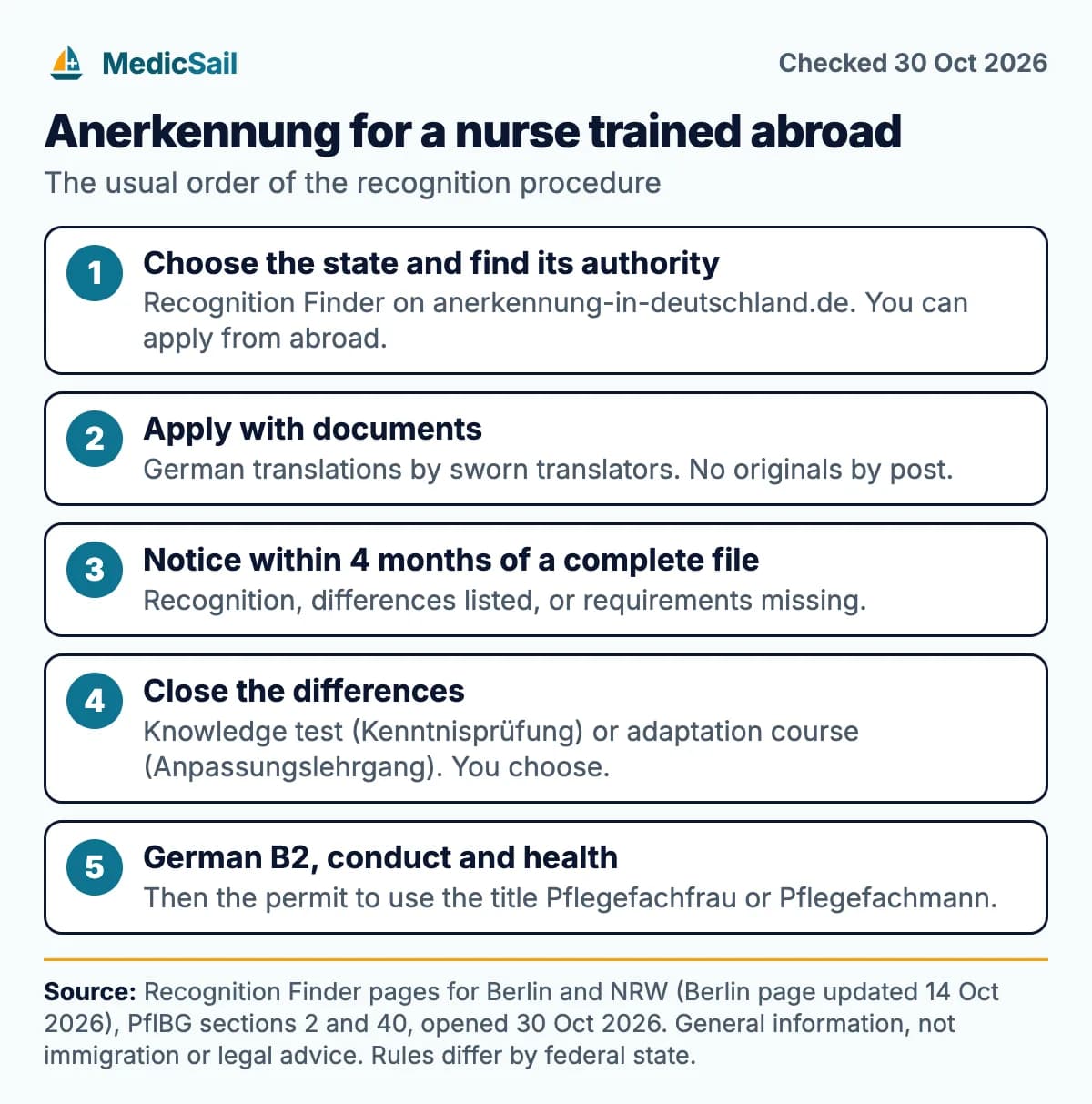
In practice almost every applicant from outside Europe goes through the same five stages: you apply to the state authority, the authority compares your training with the German three-year training, it issues a notice that usually lists the substantial differences (the Defizitbescheid), you close those differences by passing a Kenntnisprüfung (knowledge test) or completing an Anpassungslehrgang (adaptation period), and you prove German at B2. The Recognition Finder on the federal portal anerkennung-in-deutschland.de says the authority decides within 4 months of a complete file, though it can extend this in specific cases.
You do not have to be in Germany to start. You can apply from abroad, and the Residence Act (Aufenthaltsgesetz, AufenthG) has visa routes built around recognition: section 16d lets you come to complete the compensation measure or to work while the procedure runs, and section 18a gives you a skilled worker permit once you hold the title. This guide walks through each stage, the differences between states, the language rules, the visa sections and the government-run Triple Win programme, with the official sources at the end. For the country overview, see our guide to working in Germany as a health professional, and for the profession page, nursing registration in Germany.
The protected title and who needs recognition
Section 1 of the PflBG says that anyone who wants to use the title Pflegefachfrau or Pflegefachmann needs a permit (Erlaubnis). Section 2 sets four conditions for that permit: you have completed the training and passed the state exam (or have a foreign qualification recognised as equivalent), you are reliable, you are not unfit to practise for health reasons, and you have the German language skills needed for the job. Everything in the recognition procedure maps onto those four conditions.
German nurse training is now generalist, so your foreign general nursing qualification is compared with the generalist training behind the Pflegefachfrau and Pflegefachmann titles.
- Trained outside the EU, EEA and Switzerland (for example India, the Philippines, Nigeria, Kenya, Pakistan or the Gulf): you go through the full procedure in this guide, under section 40 PflBG.
- Trained in the EU, EEA or Switzerland with a qualification that meets the minimum standards of Directive 2005/36/EC: section 41 PflBG gives you automatic recognition, and the Recognition Finder gives a maximum of three months for these decisions.
- Trained outside Europe but already recognised in another EU state: section 41(2) PflBG applies the equivalence test and compensation measures to you too, with an adaptation period or an aptitude test.
- UK-trained nurses: since Brexit, UK qualifications are third-country qualifications for this purpose. Ask the authority how it treats a UK qualification before you apply.
Your nationality does not decide which procedure applies; where you trained does. Your nationality matters only for the visa. Midwives go through a separate procedure under the midwifery law, covered on our midwife registration in Germany page, and doctors, dentists and pharmacists apply for an Approbation, described on the German state licensing authorities page.
If your training is too far from the German standard to close the gaps, recognition as a nursing assistant is a separate procedure with its own state rules. Ask the authority or a recognition counselling service whether that is a realistic fallback for your qualification.
Two ways in: full equivalence assessment or opting out
Before anything else, decide which of two paths you want. Section 40 PflBG and the Recognition Finder both describe them.
- Full equivalence assessment (Gleichwertigkeitsprüfung). The authority compares the content and hours of your theory and clinical training, subject by subject, with the German training and regulation. Under section 40(2) PflBG, relevant professional experience and formally recognised lifelong learning, from any country, can make up for differences. If the gaps are small or covered by your experience, you may be recognised without any compensation measure. If not, you receive a notice listing the substantial differences.
- Opting out (Verzicht). Under section 40(3a) PflBG you can permanently waive the equivalence assessment and go straight to a knowledge test or adaptation period. You need fewer documents (no detailed proof of training content or work experience), so the file is complete sooner. The authority must tell you the legal consequences and your options before you waive.
The Recognition Finder is direct about the waiver: the decision is irreversible, so get counselling first. Opting out makes sense if your transcript and syllabus are hard to obtain, or if you would almost certainly be asked to sit the knowledge test anyway. It makes less sense if you have long post-registration experience, a degree with a strong clinical component, or a specialism that could cover the gaps, because by waiving you give up the chance to have that experience counted.
Note on the 2026 reform: the federal law to speed up recognition in the health professions, passed by the Bundestag on 26 March 2026 and scheduled by the Federal Ministry of Health to take effect on 1 November 2026, makes the direct knowledge test the standard route for doctors, dentists and pharmacists and gives midwives a waiver option. The ministry's announcement does not cover nursing, which already has the waiver in section 40(3a).
Documents and how to apply
The Recognition Finder lists the documents for nurses. The authority tells you which copies must be officially certified and which originals it wants to see. Do not post originals.
- Application form from the state authority, plus proof of identity (passport) and proof of any change of name, such as a marriage certificate.
- CV in table form, in German.
- Your nursing qualification (diploma or degree certificate) and, where you hold one, your registration or licence from your home country.
- Evidence of training content and duration: transcript with theory and clinical hours, and the syllabus or curriculum. Not needed if you opt out of the equivalence assessment.
- Proof of professional experience: employer references stating your role, period and hours. These matter if you want experience to count towards closing gaps.
- Details of any earlier recognition application in Germany, and proof that you intend to work in Germany if the authority asks (for example a job offer). Bremen says a job commitment from a German care facility may be needed if you still live abroad.
- Later, when the authority asks: a certificate of good conduct and a medical certificate, each no more than three months old when you submit it, and your German language certificate.
Every document must be in German, translated by sworn or authorised translators, as the Recognition Finder states.
You can apply online where the state offers it, by post or in person, and from abroad. The authority confirms receipt within one month and tells you what is missing. The four-month clock only starts once the file is complete, so most delays happen before the clock starts: missing transcripts, uncertified copies, and certificates of good conduct that are already older than three months.
The Defizitbescheid: reading your notice
When the authority has decided, you receive a written notice (Bescheid). The Recognition Finder describes three outcomes for nurses:
| Outcome | What it means | What you do next |
|---|---|---|
| Recognition | Your training is equivalent and every other requirement is met | You receive the permit to use the title Pflegefachfrau or Pflegefachmann |
| Not equivalent | The notice lists the substantial differences (wesentliche Unterschiede) between your training and the German training. This is the notice people call the Defizitbescheid. | Close the differences with a knowledge test or an adaptation period |
| Requirements not met | Your qualification is equivalent, but something else is missing, such as proof of German or of fitness to practise | Supply what the notice names |
Section 40(2) PflBG defines a substantial difference as a topic or practical training area that differs materially from the German requirements, where the knowledge or skill is essential to practise in Germany. Your notice is specific to you, so read it line by line.
Check three things:
- Which measure is offered. Section 40(3) lets you choose between the knowledge test and the adaptation period. If the notice gives only one, ask why.
- The scope and length. For an adaptation period the authority sets the content and length, and the law caps it at three years. Ask what the planned length is, because it decides your visa and your contract.
- The legal remedy (Rechtsbehelfsbelehrung). The notice ends with instructions on how to challenge it and by when. If you think experience you documented was not taken into account, the Recognition Finder recommends talking to a counselling centre first.
Kenntnisprüfung vs Anpassungslehrgang
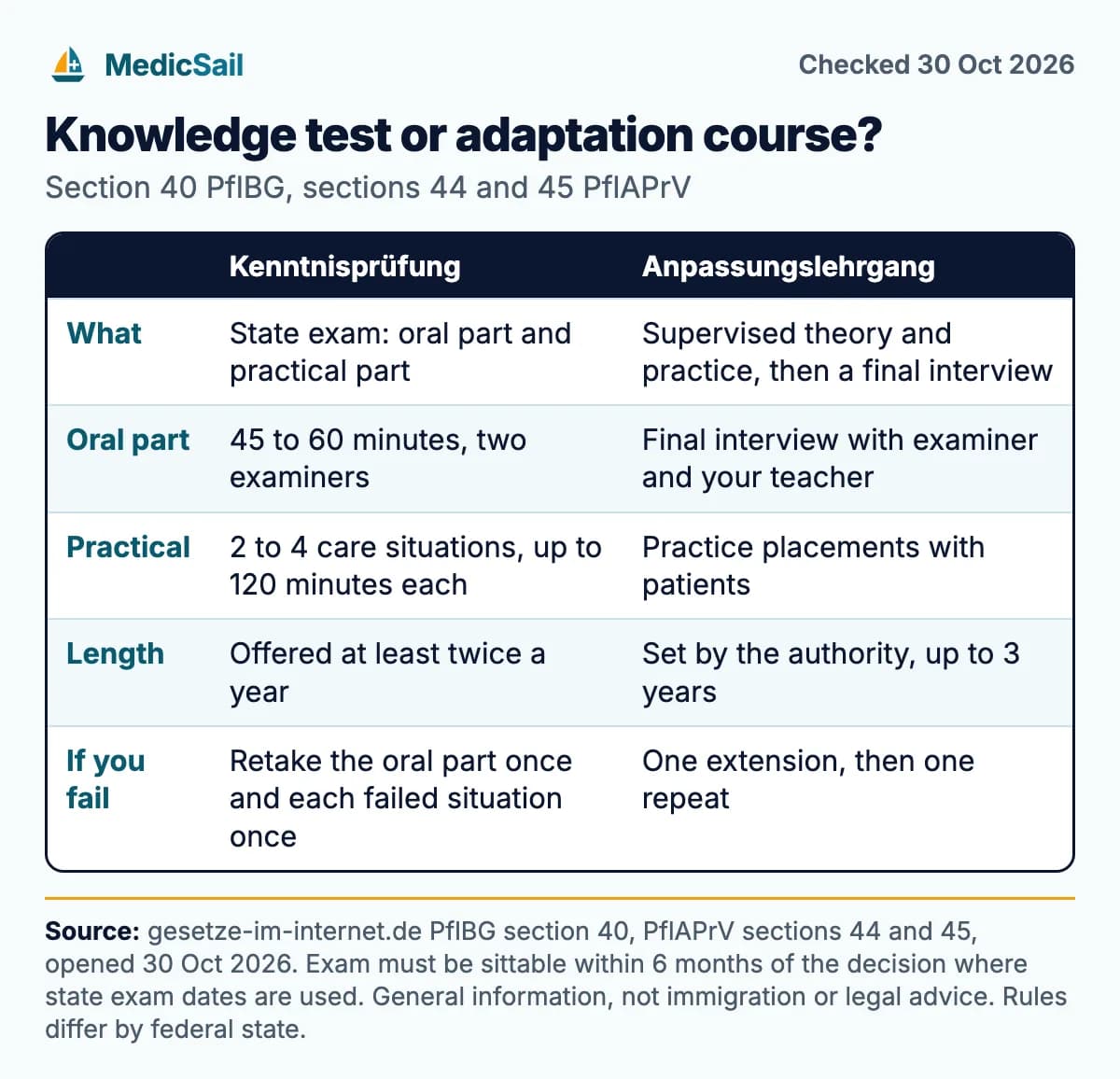
Both measures lead to the same title. The difference is how you prove your competence and how long it takes. The rules are in sections 44 and 45 of the nursing training and examination regulation (PflAPrV).
| Kenntnisprüfung (knowledge test) | Anpassungslehrgang (adaptation period) | |
|---|---|---|
| What it is | A state exam on the content of the German final exam | Supervised theory and practice at a nursing school or approved care setting |
| Format | Oral part: one complex case covering at least three competence areas, 45 to 60 minutes, two examiners. Practical part: two to four care situations chosen by the authority, each up to 120 minutes, normally with real patients | Content and length set by the authority, which may use model reports from the Gutachtenstelle für Gesundheitsberufe. Ends with a final assessment (Abschlussgespräch) with an examiner and your supervising teacher or practice instructor |
| Length | Exam days, plus whatever preparation course you choose | Up to three years by law; the authority sets the length in your notice and it can be shortened or extended on application by the training institution |
| If you fail | The oral part can be repeated once; each failed care situation can be repeated once | The course can be extended once, followed by another final assessment; after that it can be repeated once |
| Availability | Must be offered at least twice a year; where states use the regular exam dates, you must be able to sit it within six months of the decision | Depends on finding a school or employer with a place |
Some states run the knowledge test as a simulation circuit instead (section 45a PflAPrV): several timed stations, each scored by two examiners, similar to an OSCE. Ask your authority which format it uses before you choose a preparation course. Our full guide to the Kenntnisprüfung covers the exam in detail for every profession, including how the doctors' version differs.
How to choose:
- Choose the knowledge test if you are confident clinically, your German is already strong, and you want the title quickly. It is a single high-stakes exam with one retake per part.
- Choose the adaptation period if you want time to learn German care routines, documentation and law on the job. Many hospitals and care homes recruit abroad on this basis and pay you as a nursing assistant during it. It takes longer but the final assessment is less of a single-shot exam.
- If you have a job offer, ask the employer which measure it supports.
German: B1, B2 and the rules by state
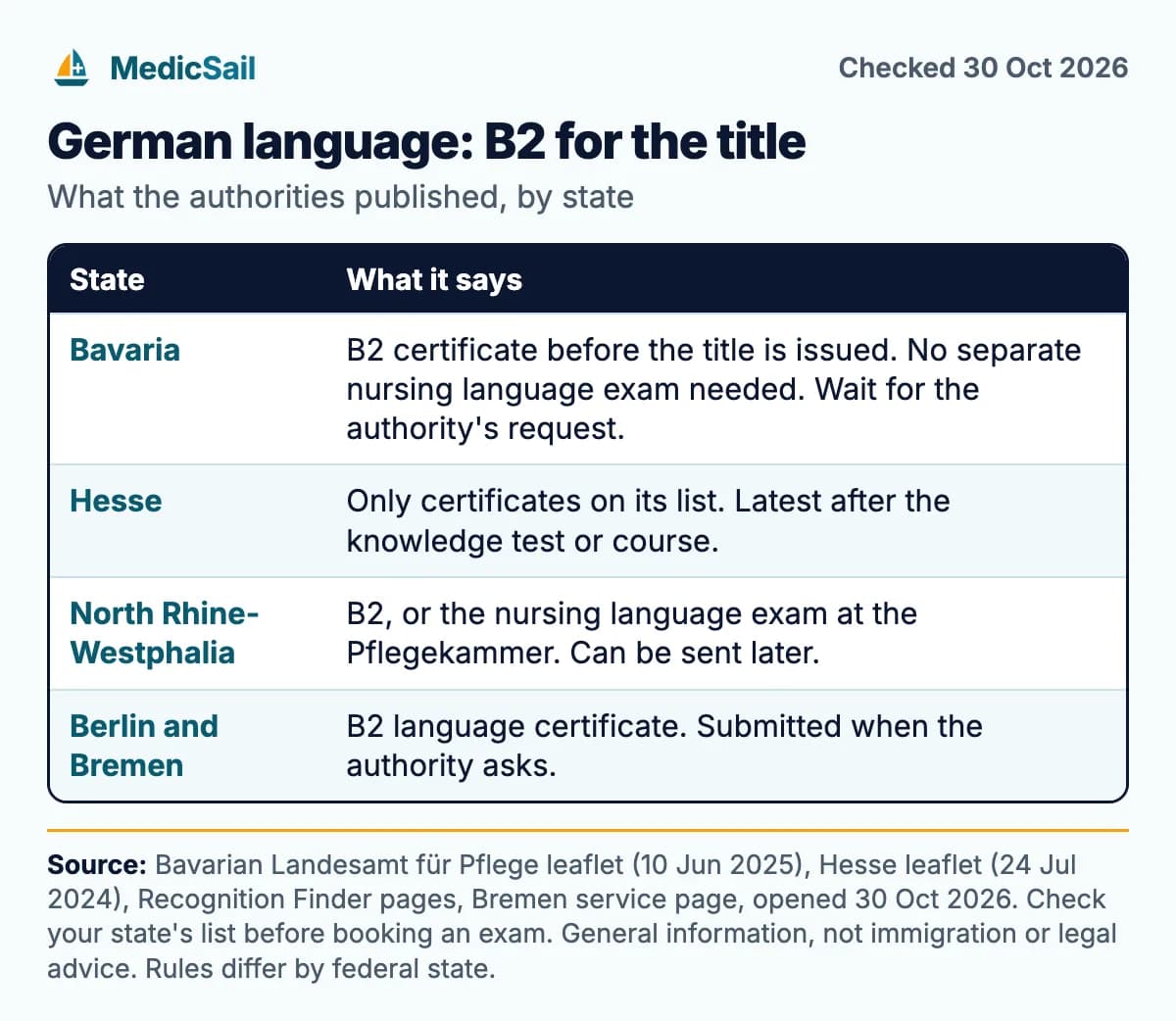
German, not English, is a legal condition for the title (section 2 no. 4 PflBG). The law does not set the level; the states do, and the Recognition Finder and state information sheets we checked all set B2 of the Common European Framework of Reference (CEFR) for the final permit. Where states differ is in which certificates they accept, whether they want a nursing-specific language exam, and when you must submit it.
| State | Level for the title | Accepted proof (as published) | When to submit |
|---|---|---|---|
| Bavaria | B2 | Goethe-Zertifikat B2 and B2 PRO Pflege, TestDaF TDN 3, telc Deutsch B2 and telc Deutsch B2 Pflege, ÖSD B2, ECL B2 (exam date from December 2020), BAMF DTB B2, and others on its list. Bavaria says no separate specialist language exam is currently needed | Only before the certificate is issued; wait for the authority's request |
| Hesse | B2 | Only certificates on its list: telc B2, B2 Beruf, B2 Pflege, B2+ Beruf, DTB B2, Goethe B2, Goethe-Test PRO Pflege, TestDaF level 3, ÖSD B2, ECL B2. A specialist language exam accepted in another state is usually accepted too | At the latest after you pass the knowledge test or complete the adaptation period |
| North Rhine-Westphalia | B2 | A recognised language certificate, or the specialist language exam for nursing at the Pflegekammer NRW | Not needed with the application; can be sent later |
| Berlin | B2 | Language certificate, as the authority specifies | When the authority asks |
| Bremen | Normally B2 | Language certificate, submitted later in the process | When the office asks |
So where does B1 come in? Not for the title. It matters for getting into Germany and starting the process:
- Section 2 AufenthG defines the levels the immigration law uses: A2 is "hinreichende" (sufficient), B1 is "ausreichende" (adequate) and B2 is "gute" (good) German.
- The residence permit for compensation measures and the recognition partnership under section 16d AufenthG generally require at least A2.
- Recruitment programmes and employers often set B1 as their entry requirement. The Triple Win page for Kerala, for example, asks for B1 when you apply for the visa, with B2 to be passed in Germany.
The safe plan is to aim for B2 from the start, sit a certificate your target state lists, and keep the certificate in date. Certificates from some test centres are not accepted everywhere: Bavaria, for example, says it has not accepted telc certificates from Serbian and Bosnian telc institutes since 23 June 2022. IELTS, OET and other English tests do not substitute for German. Doctors face a separate medical language exam, explained in our guide to the Fachsprachprüfung; for nurses, a specialist language exam is required only where your state says so.
Visas: the Aufenthaltsgesetz sections for recognition
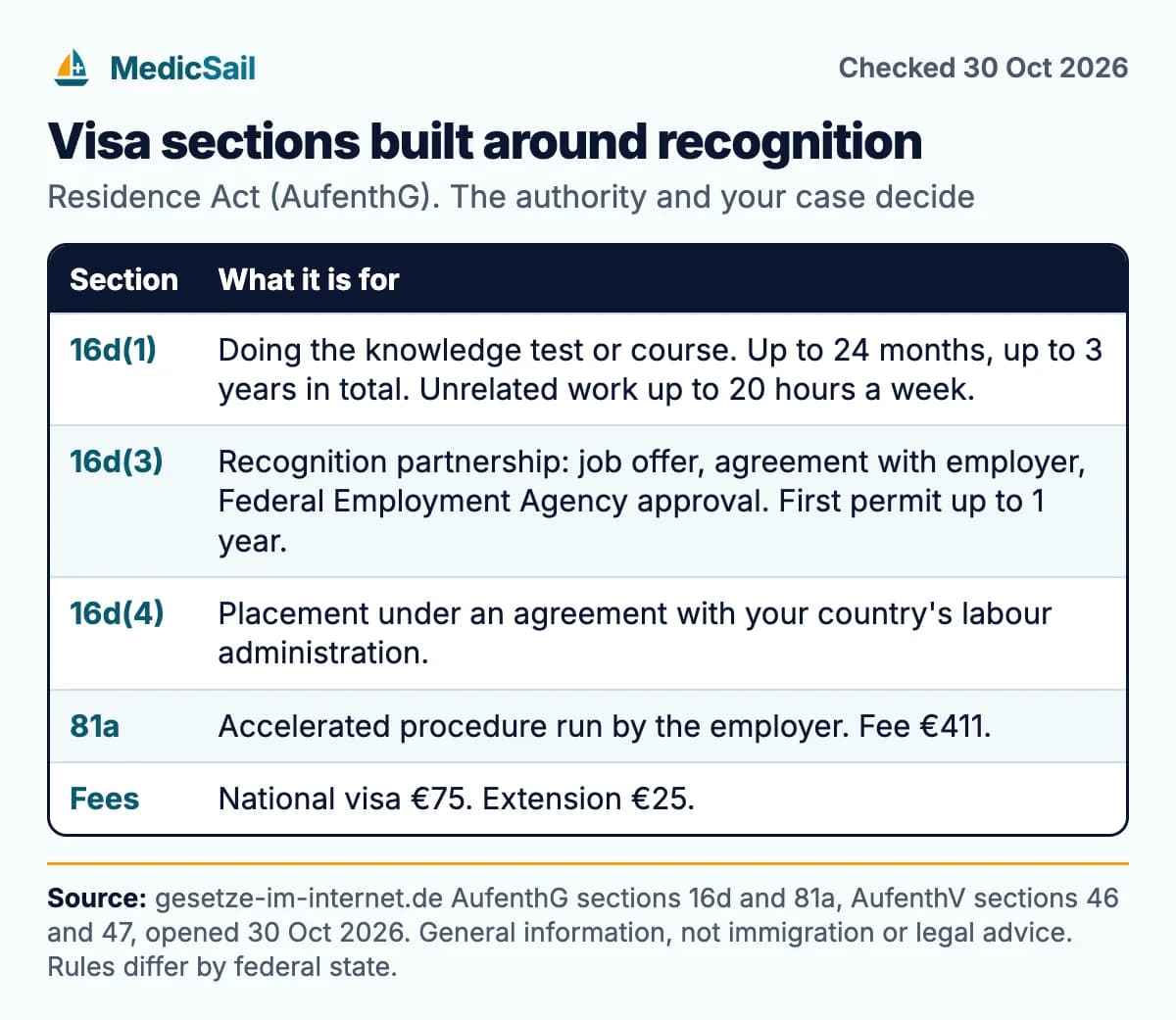
If you are not an EU, EEA or Swiss citizen you need a residence title as well as recognition. The Residence Act has several sections built around recognition. Which one fits depends on where you are in the procedure.
| Section | What it is for | Key conditions (from the law) |
|---|---|---|
| § 16d(1) | Completing a compensation measure (knowledge test preparation or adaptation period) and the exams after it | The authority has found that a measure is needed; generally at least A2 German. Up to 24 months, extendable by up to 12 months at a time to a maximum of three years. Work unrelated to the measure of up to 20 hours a week allowed |
| § 16d(3) | Recognition partnership: you work for a German employer and start recognition after arrival | A state-recognised foreign qualification of at least two years' training (or a degree), a concrete job offer, an agreement with the employer that you will apply for recognition promptly and that the employer will let you complete the measures, German sufficient for the job, and Federal Employment Agency consent. First issued for up to one year, extendable to three years in total |
| § 16d(4) | Placement under an agreement between the Federal Employment Agency and your country's labour administration | One year, extendable yearly to three years; German as the agreement requires (generally at least A2) |
| § 16d(5) | Only to sit recognition exams | Does not allow you to work |
| § 18a | Skilled worker with vocational training, once you hold the title | The law grants a residence permit "for any qualified employment" |
| § 81a | Fast-track procedure for skilled workers, started by the employer at the foreigners' authority in Germany | Covers entry under §§ 16a, 16d, 18a and others. The fee is €411 under section 47 of the Residence Ordinance |
The national (category D) visa itself costs €75 under section 46 of the Residence Ordinance (AufenthV), and extending it costs €25. Processing times are set by each German mission.
A few points that are easy to miss:
- Under the recognition partnership, the law allows a waiver of the "qualified work" requirement for approved care facilities and collectively bound employers, which is how you can work as a nursing assistant before you hold the title.
- Section 16d(1) permits allow only limited side work. If you need to earn from the start, the recognition partnership or a placement programme is usually the better fit.
- Make it in Germany, the federal government's portal, says on its nursing page that the EU Blue Card does not apply to nursing professionals, so plan around § 18a once you are recognised.
- Section 16a covers vocational training. It is the route if you decide to retrain in Germany through the full three-year nursing training instead of recognition.
This is a summary of the law, not immigration advice. Check the current requirements with the German mission that serves you before you apply.
Triple Win and other official routes
You can do everything yourself: apply to the state authority, learn German, find a job and apply for the visa. Many nurses instead go through an employer or a programme. The one that is run entirely by government bodies is Triple Win.
Triple Win is a cooperation between the Federal Employment Agency's International Placement Services (ZAV) and the Deutsche Gesellschaft für Internationale Zusammenarbeit (GIZ). Its stated aim is the sustainable recruitment of nurses from abroad. When we checked, the Federal Employment Agency's Triple Win page listed four partner countries: the Philippines, India (Kerala and Telangana), Indonesia and Tunisia. Cooperation is limited to countries with a surplus of trained nurses.
The Kerala page shows how the programme works:
- Recruitment in Kerala is done by Norka Roots, a Government of Kerala company. You check selection round dates on its website and apply to the job advertisement.
- You need a nursing qualification from an accredited Indian institution (GNM diploma, B.Sc. Nursing (Basic) or an Indian Nurse Registration Certificate) and must be at least 18.
- Selected nurses take a German course from A1 to B1, professional orientation and help preparing the recognition documents. You need B1 when you apply for the visa.
- Placement, language and technical preparation and integration support are free for the nurse, and the programme covers the pre-departure medical examination and measles vaccination.
- After arrival you begin recognition, which the page says should be done within 12 months. The work visa is valid for one year and converts to a residence permit once recognition and a B2 exam are passed.
Outside Triple Win, many German hospitals and care providers recruit directly or through private agencies, often using the recognition partnership. Before you sign, check who pays for the language course, the compensation measure and the visa, and whether there is a repayment clause if you leave early.
If you are comparing Germany with other European destinations, our nursing hub sets the routes side by side, and you can compare the Dutch route in the BIG registration test guide and the Irish route in the NMBI aptitude test and adaptation guide.
What it costs and how long it takes
No authority publishes a single all-in price, because the compensation measure, translations and preparation vary so much. These are the figures the official pages state.
| Item | Amount | Source and notes |
|---|---|---|
| Recognition decision, Berlin | €25 to €430 | Recognition Finder |
| Recognition decision, North Rhine-Westphalia | Up to €277.50 | Recognition Finder; GfG reports extra |
| Recognition decision, Bavaria | €40 to €70, plus €40 certificate | Recognition Finder |
| Knowledge test or adaptation period | Set by the state or provider | The authority tells you the cost |
| Translations and certified copies | Varies | Sworn or authorised translators only |
| National visa (category D) | €75 | AufenthV § 46; extension €25 |
| Fast-track procedure (§ 81a) | €411 | AufenthV § 47; usually paid by the employer |
Timeline, stage by stage:
- Preparation: collecting transcripts, syllabi and employer references, and getting them translated, often takes months. Start before you apply.
- Acknowledgement: within one month of your application, according to the Recognition Finder, with a list of anything missing.
- Decision: within 4 months of a complete file, extendable in specific cases (three months for automatic recognition of EU qualifications).
- Knowledge test: offered at least twice a year; where states use the regular exam dates, within six months of the decision.
- Adaptation period: set by your notice, up to three years by law, often much shorter in practice. Ask the authority.
- German to B2: often the longest stage if you start from scratch. Run it in parallel with the paperwork.
Common mistakes, Gulf experience and next steps
Mistakes that cost nurses months:
- Waiving the equivalence assessment without advice. It cannot be undone, and your experience will not be counted.
- Out-of-date certificates. Good conduct and medical certificates must be no more than three months old when you submit them, so do not order them too early.
- The wrong language certificate. Check your state's list before you book the exam.
- Thin training evidence. A transcript without clinical hours by area invites a broad deficit notice.
- Signing a contract you do not understand. Read the repayment and notice clauses, and ask what pay applies during the adaptation period.
If you are working in the Gulf. A licence from the DHA, DOH, MOHAP, SCFHS, QCHP or another Gulf authority does not transfer to Germany, because German recognition looks at your basic nursing training, not your current licence. Your Gulf experience can help: under section 40(2) PflBG, documented professional experience in any country can make up for training differences, so get detailed employer references with dates, hours, wards and duties before you leave. Ask your Gulf regulator for a certificate of good standing if the German authority wants one, and remember the certificate of good conduct requirement for your home country as well. If you are also weighing the UK, our guide on moving from a Gulf licence to UK registration covers that route.
Next steps:
- Use the Recognition Finder to identify the authority for your target town and download its form and leaflets.
- Decide, with counselling, whether to ask for the full equivalence assessment or opt out.
- Start German now and aim for B2 on a certificate your state accepts.
- Collect training evidence and references, and order translations.
- Decide whether you will go independently, through an employer recognition partnership, or through Triple Win if you are in a partner country.
For the profession overview, including pay and employers, see nursing in Germany. If you are considering the USA too, compare the effort with our NCLEX-RN guide for international nurses.
Questions
The Recognition Finder says the authority confirms receipt within one month and decides within four months of a complete file, extendable in specific cases. After that, a knowledge test must be offered at least twice a year, and an adaptation period can last up to three years by law, usually less. Learning German to B2 is often the longest part.
It is the notice the state authority issues when your training is not equivalent to the German training. It lists the substantial differences and tells you how to close them, normally by a knowledge test or an adaptation period. It also includes instructions on how to challenge the decision.
Neither is better for everyone. The knowledge test is quicker if your clinical skills and German are strong, with one retake per part. The adaptation period takes longer but lets you learn German practice on the job, and many employers pay you as an assistant during it.
For the title Pflegefachfrau or Pflegefachmann, the states we checked all require B2. B1, or sometimes A2, is enough to enter Germany on a recognition visa or programme and start the process, but you must reach B2 before the permit is issued.
Yes. The Recognition Finder says you can apply from abroad, by post, online where the state offers it, or in person. You choose the state where you intend to work.
The recognition decision itself costs €25 to €430 in Berlin, up to €277.50 in North Rhine-Westphalia and €40 to €70 plus €40 for the certificate in Bavaria, according to the Recognition Finder. The knowledge test or adaptation period, translations and the visa cost extra, and the authority tells you the exact amounts.
Under the recognition partnership in section 16d(3) AufenthG you can work for your employer, typically as a nursing assistant, while you complete recognition. A section 16d(1) permit for a compensation measure allows side work of up to 20 hours a week, and a section 16d(5) exam permit allows no work.
Triple Win is a government programme of the Federal Employment Agency's ZAV and GIZ that recruits nurses from partner countries, listed as the Philippines, India (Kerala and Telangana), Indonesia and Tunisia when we checked. For Kerala, placement, language preparation and integration support are free for the nurse.
Make it in Germany's nursing page says the EU Blue Card does not apply to nursing professionals. Once you hold the title, the usual permit is the skilled worker permit under section 18a AufenthG.
No. German recognition assesses your basic nursing training, not your current licence, and UK qualifications count as third-country qualifications. Documented experience can help close training gaps under section 40(2) PflBG.
Sources
- 1Recognition Finder: Pflegefachfrau/Pflegefachmann, Berlin
- 2Recognition Finder: Pflegefachfrau/Pflegefachmann, North Rhine-Westphalia
- 3Recognition Finder: Pflegefachfrau/Pflegefachmann, Bavaria
- 4Gesetze im Internet: PflBG § 1
- 5Gesetze im Internet: PflBG § 2
- 6Gesetze im Internet: PflBG § 40
Show all 22 sourcesShow fewer sources
- 7Gesetze im Internet: PflBG § 41
- 8Gesetze im Internet: PflAPrV § 44 (Anpassungslehrgang)
- 9Gesetze im Internet: PflAPrV § 45 (Kenntnisprüfung)
- 10Gesetze im Internet: AufenthG § 2 (language levels)
- 11Gesetze im Internet: AufenthG § 16d
- 12Gesetze im Internet: AufenthG § 18a
- 13Gesetze im Internet: AufenthG § 81a
- 14Gesetze im Internet: AufenthV § 46 (visa fees)
- 15Gesetze im Internet: AufenthV § 47 (fast-track fee)
- 16Bayerisches Landesamt für Pflege: Merkblatt Sprachnachweis
- 17HLfGP Hessen: Nachweis ausreichender Sprachkenntnisse, Pflegeberufe (2024)
- 18Bremen: Recognition as a nurse with a third-country qualification
- 19Federal Employment Agency: Triple Win
- 20Federal Employment Agency: Triple Win India (Kerala)
- 21Federal Ministry of Health: recognition law for health professions passed (26 March 2026)
- 22Make it in Germany: nursing professionals
Plan it with our free tools
MedicSail
Healthcare licensing consultants for the UK, Europe and the USA
Updated and checked against the sources listed above. How we research and check our guides