


































Moving to the UK as a nurse: your first weeks checklist
A step-by-step checklist for your first weeks in the UK as an international nurse: UKVI account and eVisa, right to work, National Insurance number, bank account, GP registration, renting and council tax, payslip and tax code, OSCE timing and bringing your family.

MedicSail
Published
The short answer
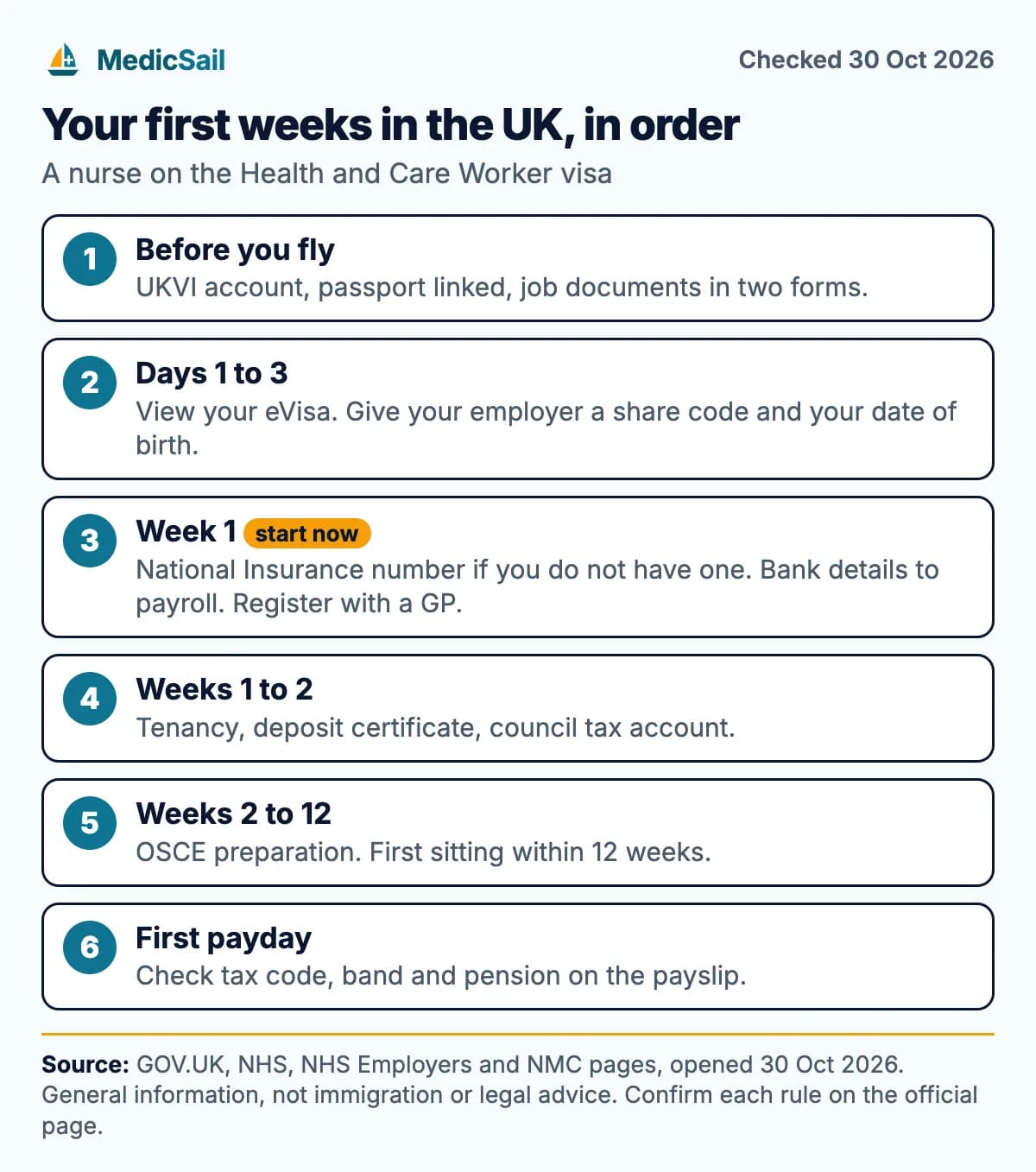
In your first weeks in the UK as a nurse, do these things in roughly this order: get into your UKVI account and check your eVisa, give your employer a share code for the right to work check, apply for a National Insurance number if your eVisa does not already show one, open a bank account, register with a GP, sort out your accommodation and council tax, check your first payslip and tax code, and book or prepare for the NMC OSCE if you have not passed it yet. If your family is coming, they each apply separately and follow later or travel with you.
None of these steps costs a fee to the government except your visa itself, and several have rules people miss. You can start work before your National Insurance number arrives. GP registration needs no proof of address or immigration status. Health and Care Worker visa holders and their families do not pay the Immigration Health Surcharge. In England, private tenancies became assured periodic tenancies on 1 May 2026. Each point below comes from GOV.UK, the NHS website, the NMC or NHS Employers.
| When | Task | Where |
|---|---|---|
| Before you fly | Set up your UKVI account, link your passport, check your certificate of sponsorship and offer | GOV.UK |
| Day 1 to 3 | UK phone number, view your eVisa, share code for your employer | UKVI account |
| Week 1 | National Insurance number (if needed), bank account, GP registration | GOV.UK, bank, NHS website |
| Week 1 to 2 | Tenancy, deposit protection, council tax account | Landlord, local council |
| Weeks 2 to 12 | OSCE preparation and first sitting, if pending | Employer, NMC test centre |
| First payday | Check tax code, pay band, pension deductions | Payslip, HMRC app |
Before you fly: the documents that make week one easier
Most delays in the first week come from something that could have been done at home. Before you travel:
- Create your UKVI account and link your passport. GOV.UK says eVisas have replaced physical immigration documents, that you need a UK Visas and Immigration account to access yours, and that you can travel with your eVisa once your passport or travel document details are added. Setting up the account is free.
- Keep your certificate of sponsorship details and offer letter in digital and paper form: job title, band, salary, start date and the employer's address.
- Bring your nursing documents: passport, NMC correspondence, CBT result, English test result, qualification certificates, registration from your home country and any references. You will need some of them for the NMC ID check and for your employer's pre-employment checks.
- Bring enough money for the first month. Your first UK salary may not arrive for several weeks, and deposits and rent are usually paid in advance. If your employer certified maintenance on your certificate of sponsorship, you did not have to prove the £1,270 GOV.UK sets for the visa, but you still need money to live on.
- Ask your employer what it arranges. Many trusts provide temporary accommodation, airport collection and an induction week for international nurses; others do not. Get this in writing.
If you are still choosing an employer, our guide to finding NHS jobs with visa sponsorship explains how to check that an employer is a licensed sponsor.
Your eVisa, UKVI account and right to work check
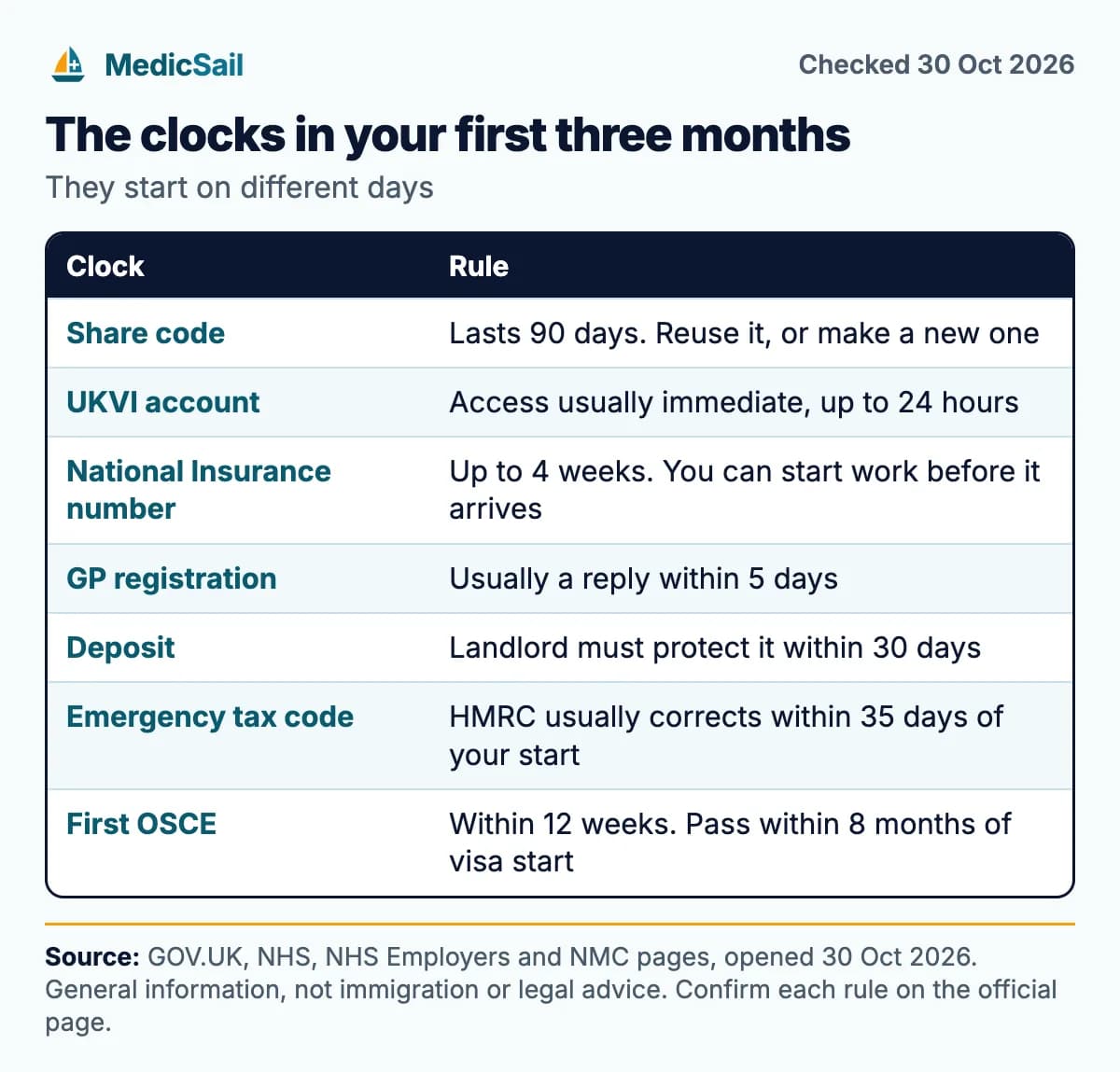
Your eVisa is a digital record of your identity, immigration status and the conditions attached to it, such as whether you can work. GOV.UK says access is usually immediate once your eVisa is linked to your account, but it can take up to 24 hours.
Your employer must check your right to work before you start. You do this by giving them a share code from GOV.UK's "view and prove your immigration status" service, together with your date of birth. GOV.UK says a share code lasts 90 days, can be used as many times as you need before it expires, and you can get a new one whenever you need. You will use share codes again for renting in England and sometimes for opening a bank account.
Keep your UKVI account details up to date. If you renew your passport or change your phone number or email address, update the account, because you need access to the linked phone number or email to sign in. Our glossary entry on the right to work check explains what employers have to do.
National Insurance number
Your National Insurance number is your reference for tax and National Insurance contributions. GOV.UK says that if you have a biometric residence permit, the number may be printed on the back, and that you can also find it by signing in to your UKVI account to view your eVisa. Check this first: many people on work visas already have one.
If you do not have one and you plan to work, you must apply, and GOV.UK says you can only apply while you are in the UK. You apply online. GOV.UK says it can take up to 4 weeks to get your number.
You do not need to wait for it to start work. GOV.UK says you can start work before you receive your National Insurance number if you can prove you have the right to work. Tell your payroll team as soon as the number arrives so your contributions are recorded correctly.
Opening a bank account
You need a UK bank account to be paid. There is no single official list of documents: each bank sets its own identity and address rules. In practice:
- Most banks accept your passport and immigration status as identity. Some ask for a share code.
- Proof of address is the usual obstacle in week one. Ask your employer for a letter confirming your job and address, and ask your landlord or accommodation provider for a tenancy agreement or letter. A letter from your GP surgery or council can also help later.
- App-based banks often have simpler identity checks and can open an account within a day, which helps if you need to be paid quickly. You can move to another bank later.
- Ask your employer's international recruitment team which banks previous nurses used. Many trusts have a list.
Give your bank details to payroll as early as possible. NHS payroll deadlines are usually well before payday, so a late account can push your first salary back by a month.
Registering with a GP and using the NHS
Register with a GP (general practice) surgery near your home as soon as you have an address. The NHS website says everyone in England can register with a GP surgery for free, and that you do not need ID, proof of address or proof of immigration status. You can register online with surgeries that offer it, in about 15 minutes per person, or on a paper form. You will usually hear back within 5 days.
You do not pay the Immigration Health Surcharge on a Health and Care Worker visa. GOV.UK lists health and care workers who are eligible for this visa, and their dependants, among the people who can use the NHS without paying it. Some general online guides tell new arrivals that the surcharge "covers" their NHS care; for you the point is that it was never charged. Standard charges, such as prescription charges in England, still apply in the same way as to everyone else.
Register each family member too. Your occupational health appointment with your employer is separate from GP registration and does not replace it.
Accommodation, deposits and council tax
Right to rent. GOV.UK says that before you can rent in England, you need to prove your right to rent to your landlord, for example with a share code. You do not need to prove your right to rent in Wales, Scotland or Northern Ireland.
Tenancies in England changed in 2026. GOV.UK's deposit protection page says assured periodic tenancies replaced assured shorthold tenancies on 1 May 2026. Many older guides still describe fixed-term assured shorthold tenancies, so read your agreement carefully and ask the landlord or agent to explain notice periods.
Deposit protection. If you pay a deposit for a private rental in England or Wales, GOV.UK says your landlord or letting agent must put it in a government-approved scheme within 30 days of getting it. The schemes are the Deposit Protection Service, MyDeposits and the Tenancy Deposit Scheme. Ask which scheme holds your deposit and keep the certificate.
Council tax. Council tax is a local charge on your home. GOV.UK says you will usually have to pay it if you are 18 or over, and that you can get 25% off your bill if you live on your own (or everyone else in the home is disregarded); you have to apply for the discount. If you rent a room in a shared house, check whether council tax is included in your rent. If you rent a whole property, contact the local council to set up your account when you move in.
- Check the address on your tenancy agreement matches the one you give your employer, bank and GP.
- Take dated photos of the property on the day you move in.
- Never pay a deposit for a property you have not seen, or confirmed through your employer, to an account that does not match the landlord or agency.
Your first payslip, tax code and pension
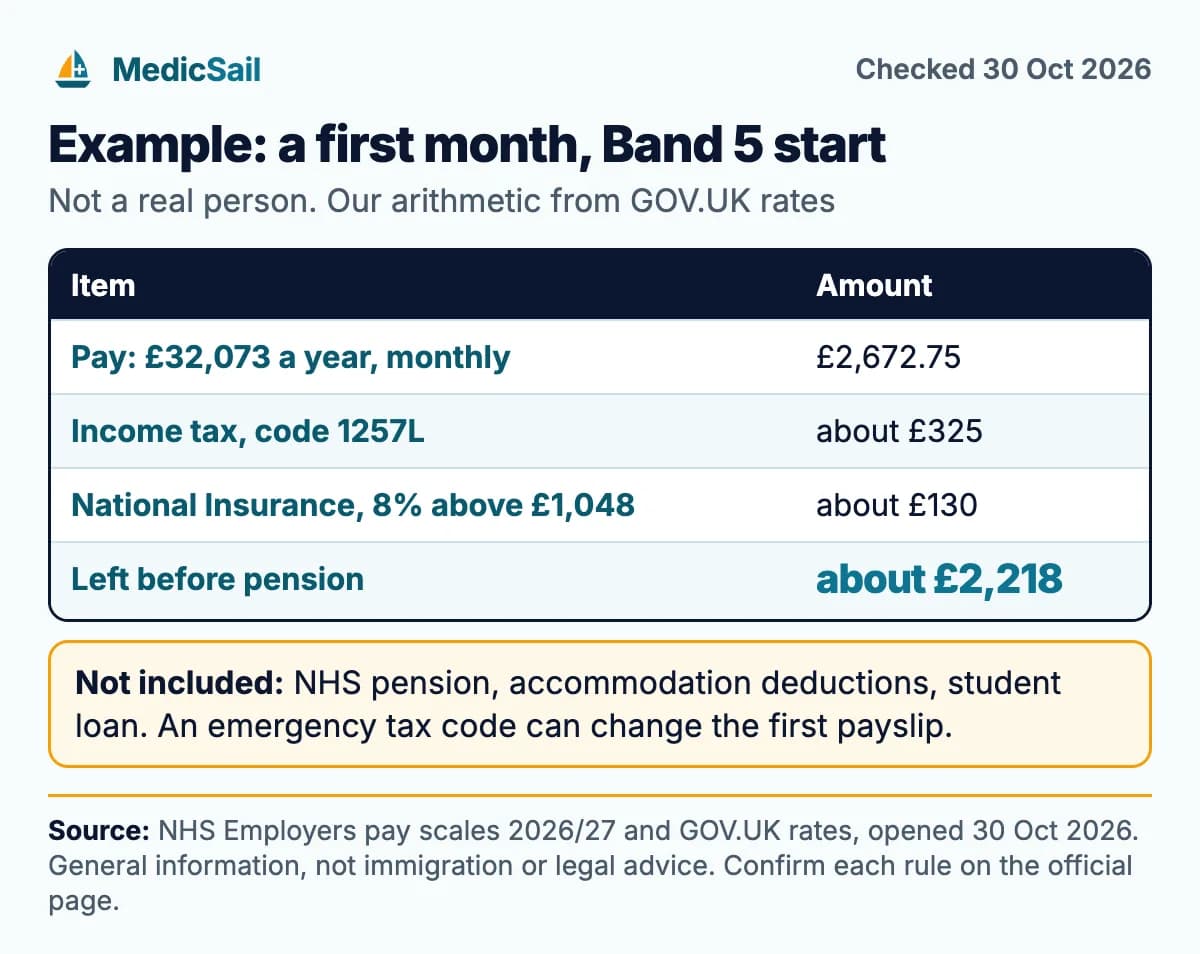
Your band. Before you join the NMC register, many employers employ international nurses as pre-registration nurses on a lower band, and move them to Band 5 once they have their NMC PIN. NHS Employers' guidance says employers should place nurses on the relevant banding for their role and skills. The 2026/27 Agenda for Change rates in England are £25,760 to £27,476 for Band 3, £28,392 to £31,157 for Band 4 and £32,073 to £39,043 for Band 5. Check which band your offer letter states and when it changes. Our NHS take-home pay calculator shows what each band means after tax.
Your tax code. GOV.UK says 1257L is the tax code currently used for most people who have one job or pension; the L means you are entitled to the standard tax-free Personal Allowance. If you have no P45 from a UK job, fill in the starter checklist your employer gives you. If your employer does not have your previous income details, GOV.UK says you will be paid using an emergency tax code, ending in W1, M1 or X. HMRC usually updates your code once it has your details, which GOV.UK says can take up to 35 days from when you start. If you have paid too much tax, you can get a refund. You can check your code in the HMRC app or your online tax account.
Your pension. NHS Business Services Authority says that if you are eligible when you start work, your employer will enrol you in the NHS Pension Scheme, and your contributions appear on your payslip. Read the member guide your employer sends before you make any decision about it.
Check your first payslip for your name, National Insurance number, tax code, band, pay point and any deductions such as accommodation, which some employers take directly from salary.
If your OSCE is still pending
Most international nurses arrive after passing the NMC CBT and sit the OSCE in the UK. NHS Employers' guidance on recruiting overseas nurses and midwives says candidates must sit their first OSCE within 12 weeks and pass within eight months from the start of their visa. Until you register, you work as a pre-registration candidate under your employer's supervision.
The NMC says the OSCE costs £794, with a reduced resit fee of £397 if you need to resit seven or fewer stations. You can sit it up to three times in one application, at least 10 days apart, and all resits must be at the centre where you first sat it. Results are emailed within 5 working days. The three centres are the University of Northampton, Ulster University and Leeds Teaching Hospitals NHS Trust. Many employers pay the first sitting; check your contract for what happens with resits.
Use your first weeks well: attend every OSCE training session your employer offers, practise the stations with your cohort and read the NMC's preparation materials. Our NMC OSCE guide explains every station, and our guide to what happens after you pass covers the PIN and the move to Band 5. The NMC page sets out the full registration route.
Bringing your family
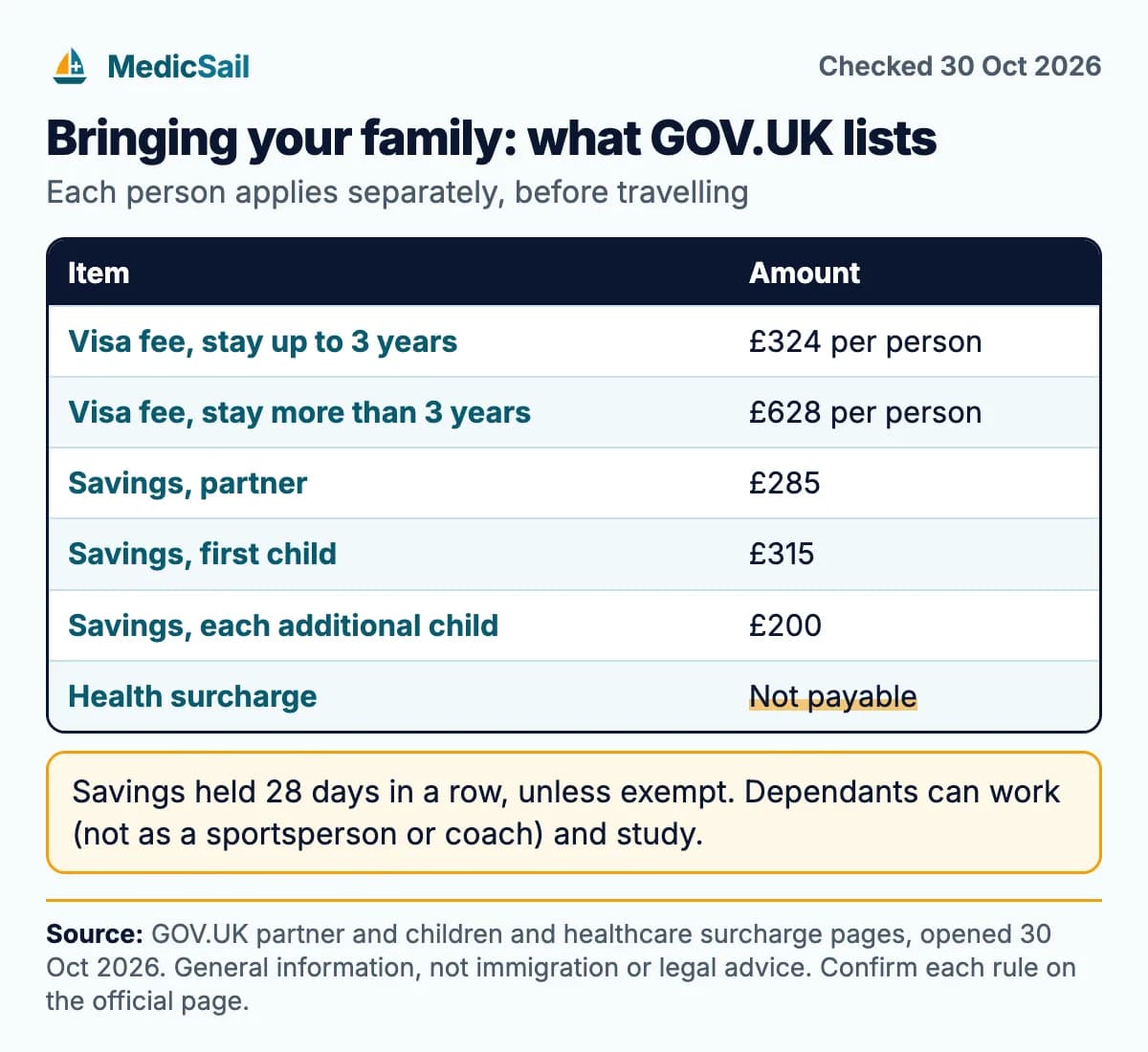
Nurses on the Health and Care Worker visa can usually bring a partner and children under 18 as dependants. GOV.UK says each family member applies separately and pays the same fee as you: £324 per person for up to three years or £628 for more than three years. They need your application number and can use a family linking code if you received one. They must apply before travelling to the UK.
Unless they are exempt, they also need to show savings: GOV.UK sets £285 for your partner, £315 for one child and £200 for each additional child, held for 28 days in a row. They do not need to show this if your employer covers your family's costs for the first month and this is on your certificate of sponsorship, or if you have all been in the UK with a valid visa for at least 12 months.
GOV.UK says dependants can work (except as a sportsperson or sports coach) and study. When your family arrives, repeat the checklist for them: UKVI accounts, GP registration and, for your partner, a National Insurance number if they plan to work. Contact your local council about school places as early as you can. Our Health and Care Worker visa guide and visa cost calculator cover the family rules and fees. These dependant rules are different for care workers; see our guide to the care worker visa changes.
Mistakes that slow down your first month
- Using a different name or address on each form. Use your name exactly as it appears on your passport and eVisa for your employer, bank, HMRC, GP and the NMC. Mismatches cause failed identity checks and delayed pay.
- Letting a share code expire. A share code lasts 90 days. If your employer or landlord checks after that, generate a new one rather than sending an old code.
- Missing the payroll cut-off. Ask payroll for the date your bank details must be in by. Missing it can delay your first salary.
- Ignoring an emergency tax code. If it has not changed after 35 days, follow GOV.UK's guidance on updating your tax code.
- Leaving OSCE preparation until the booking. With the first sitting expected within 12 weeks, start practising in week one.
- Signing a tenancy without reading it. Check the rent, what is included, the deposit scheme and the notice rules before you sign.
- Travelling abroad without checking your eVisa. Make sure your current passport is linked to your UKVI account before any trip.
Other things to sort in the first month
- Driving. Whether you can drive on your licence from home, and for how long, depends on the country that issued it. Use GOV.UK's "driving in Great Britain on a non-GB licence" tool before you drive, and check your insurance.
- Phone and transport. A UK SIM gives you a number for your bank, GP and employer. Ask your employer about staff travel discounts and parking.
- Staff wellbeing. Most trusts have international nurse networks, pastoral leads and staff support services. Join early.
- Revalidation planning. Once you have your PIN, start a simple record of practice hours, CPD and feedback. Our guide to NMC revalidation for international nurses explains what you will need in three years.
- Settlement. Note the date your visa started. Our settlement date calculator works out the earliest date under current rules.
Our UK country guide brings together registration, pay and the health system if you want the bigger picture.
Questions
Sign in to your UKVI account, check your eVisa and give your employer a share code for the right to work check. Then check whether your eVisa shows a National Insurance number, and apply for one if it does not.
Yes. GOV.UK says you can start work before you receive your National Insurance number if you can prove you have the right to work. It can take up to 4 weeks to arrive.
GOV.UK says eVisas have replaced physical immigration documents. You prove your status online through your UKVI account and a share code.
No. The NHS website says you do not need ID, proof of address or proof of immigration status to register with a GP surgery in England, and registration is free.
Not on the Health and Care Worker visa. GOV.UK says health and care workers eligible for this visa, and their dependants, can use the NHS without paying the surcharge.
You are probably on an emergency tax code ending in W1, M1 or X. GOV.UK says HMRC usually corrects it within 35 days once it has your details, and you can get a refund if you paid too much.
GOV.UK says you will usually have to pay it if you are 18 or over. If you live alone you can apply for a 25% discount. In a shared house, check whether council tax is included in the rent.
NHS Employers' guidance says candidates must sit their first OSCE within 12 weeks and pass within eight months from the start of their visa, with up to three attempts.
They can apply at the same time as you or later, but each must apply separately before travelling and pay the visa fee. They do not pay the health surcharge.
GOV.UK says assured periodic tenancies replaced assured shorthold tenancies on 1 May 2026. Deposits must still be protected in an approved scheme within 30 days.
Sources
- 1GOV.UK: eVisas
- 2GOV.UK: View and prove your immigration status
- 3GOV.UK: Apply for a National Insurance number
- 4NHS: How to register with a GP surgery
- 5GOV.UK: Immigration Health Surcharge, who needs to pay
- 6GOV.UK: Prove your right to rent
Show all 17 sourcesShow fewer sources
- 7GOV.UK: Tenancy deposit protection
- 8GOV.UK: Council Tax, who has to pay
- 9GOV.UK: Tax codes, what your tax code means
- 10GOV.UK: Emergency tax codes
- 11NHSBSA: Joining the NHS Pension Scheme
- 12NHS Employers: Pay scales for 2026/27
- 13NHS Employers: Recruitment of overseas nurses and midwives
- 14NMC: OSCE
- 15GOV.UK: Health and Care Worker visa, your partner and children
- 16GOV.UK: Health and Care Worker visa, how much it costs
- 17GOV.UK: Driving in Great Britain on a non-GB licence
Plan it with our free tools
MedicSail
Healthcare licensing consultants for the UK, Europe and the USA
Updated and checked against the sources listed above. How we research and check our guides