


































Care worker visa UK 2026: what changed and who can still apply
What changed for care workers and senior care workers on the Health and Care Worker visa, in GOV.UK's words: the closure to applicants abroad, in-country switching until 22 July 2028, the three-month rule, dependants, English, fees, and what it means for healthcare assistants and nurses.

MedicSail
Published
The short answer
Since 22 July 2025 you cannot make a new Health and Care Worker visa application from outside the UK as a care worker or senior care worker. GOV.UK no longer lists occupation codes 6135 (care workers and home carers) and 6136 (senior care workers) among the jobs eligible for a new application. These codes can still be used if you are already in the UK and are extending, updating or switching to a Health and Care Worker visa. If you are switching into one of these roles, GOV.UK says you must have worked legally in your job for your sponsor for at least three months.
This in-country route is temporary. The Home Office's explanatory memorandum to the July 2025 rule changes (HC 997) says in-country applications from people switching from other visa routes continue for a transition period until 22 July 2028, and the Immigration Rules list 22 July 2028 as the removal date for both codes. The Home Office says it will keep that transitional provision under review. Care workers also face limits on bringing a partner or children, set out on GOV.UK and explained below.
Nothing in the 2026 changes to the Immigration Rules that we checked reopened the route from abroad. What did change in 2026: new applicants need English at level B2 (B1 if you held the visa before 8 January 2026 and are extending), the Immigration Salary List entry for nursing auxiliaries and assistants (6131) has a removal date of 31 December 2026, and the government consulted on longer settlement periods for workers in roles below degree level. This guide uses GOV.UK wording throughout, but it is not legal advice; check GOV.UK on the day you apply. For the visa as a whole, see our Health and Care Worker visa guide.
What changed for care workers, and when
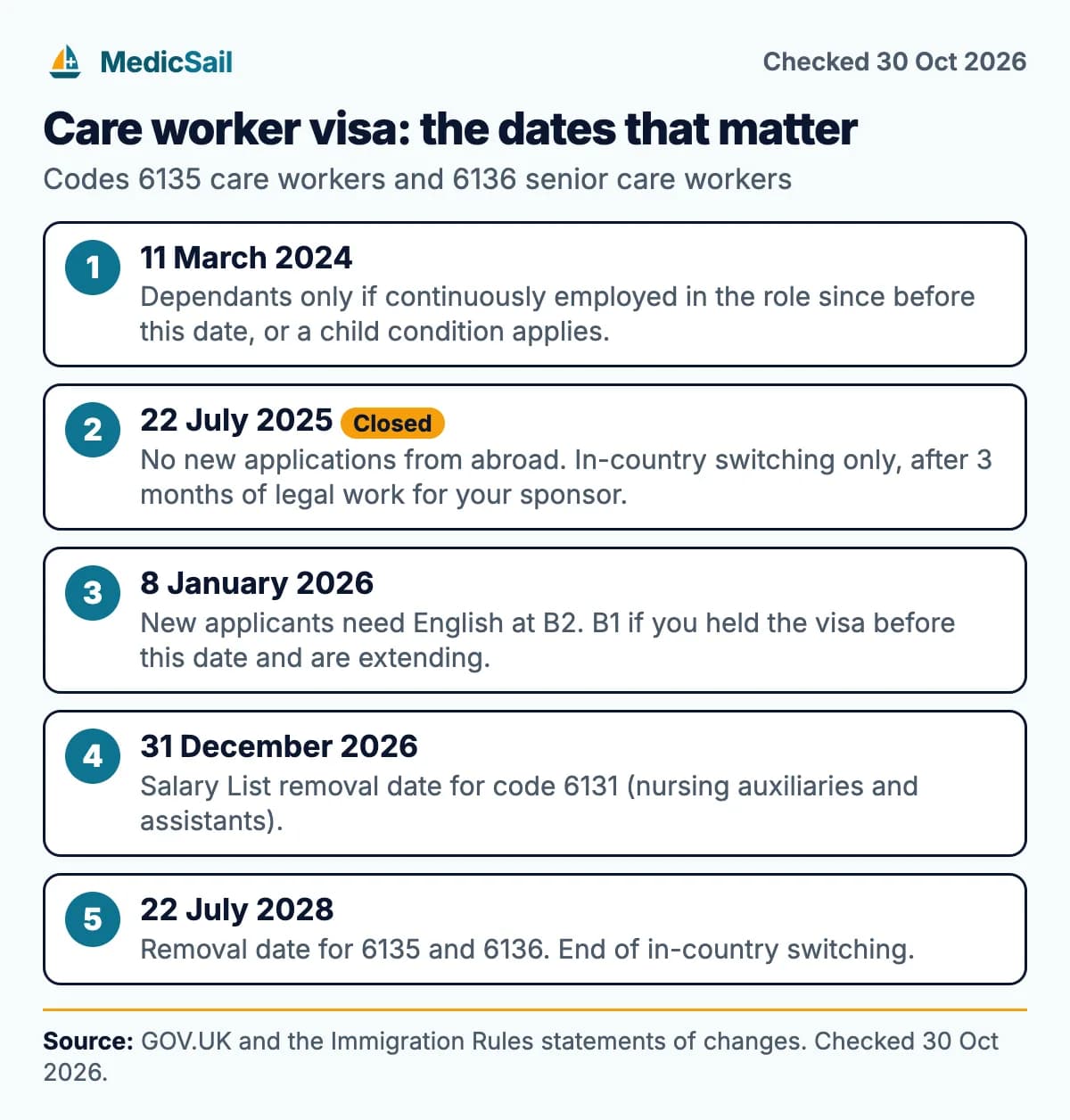
These are the dated changes that affect care workers and senior care workers, from GOV.UK and the Statements of Changes to the Immigration Rules.
| Date | Change | Who it affects |
|---|---|---|
| 11 March 2024 | Care workers and senior care workers can bring dependants only if they have been continually employed in the UK in that role on a Health and Care Worker or Skilled Worker visa since before this date, or meet a child-related condition | Care workers with a partner or children |
| 22 July 2025 | Entry clearance (applications from abroad) closed for codes 6135 and 6136; in-country switching allowed for a transition period; switchers need three months' work for their sponsor | Anyone hoping to come to the UK as a care worker |
| 22 July 2025 | Dependant restrictions extended to other "medium skilled" jobs, with a cut-off date of 22 July 2025 | Healthcare assistants and other medium skilled roles |
| 8 January 2026 | New applicants need English at CEFR level B2; people who held the visa before this date need B1 when extending or updating | All new applicants |
| 31 December 2026 | Removal date on the Immigration Salary List for code 6131 (nursing auxiliaries and assistants) | Healthcare assistants sponsored in code 6131 |
| 22 July 2028 | Removal date for codes 6135 and 6136; end of the in-country transition period | Care workers already in the UK |
The rules on care workers and the Immigration Salary List can change with any new Statement of Changes. The statements published in July and September 2026 that we reviewed (HC 259 and HC 584) did not change the care worker dates above, but always check the latest version.
Who can still get a care worker visa in 2026
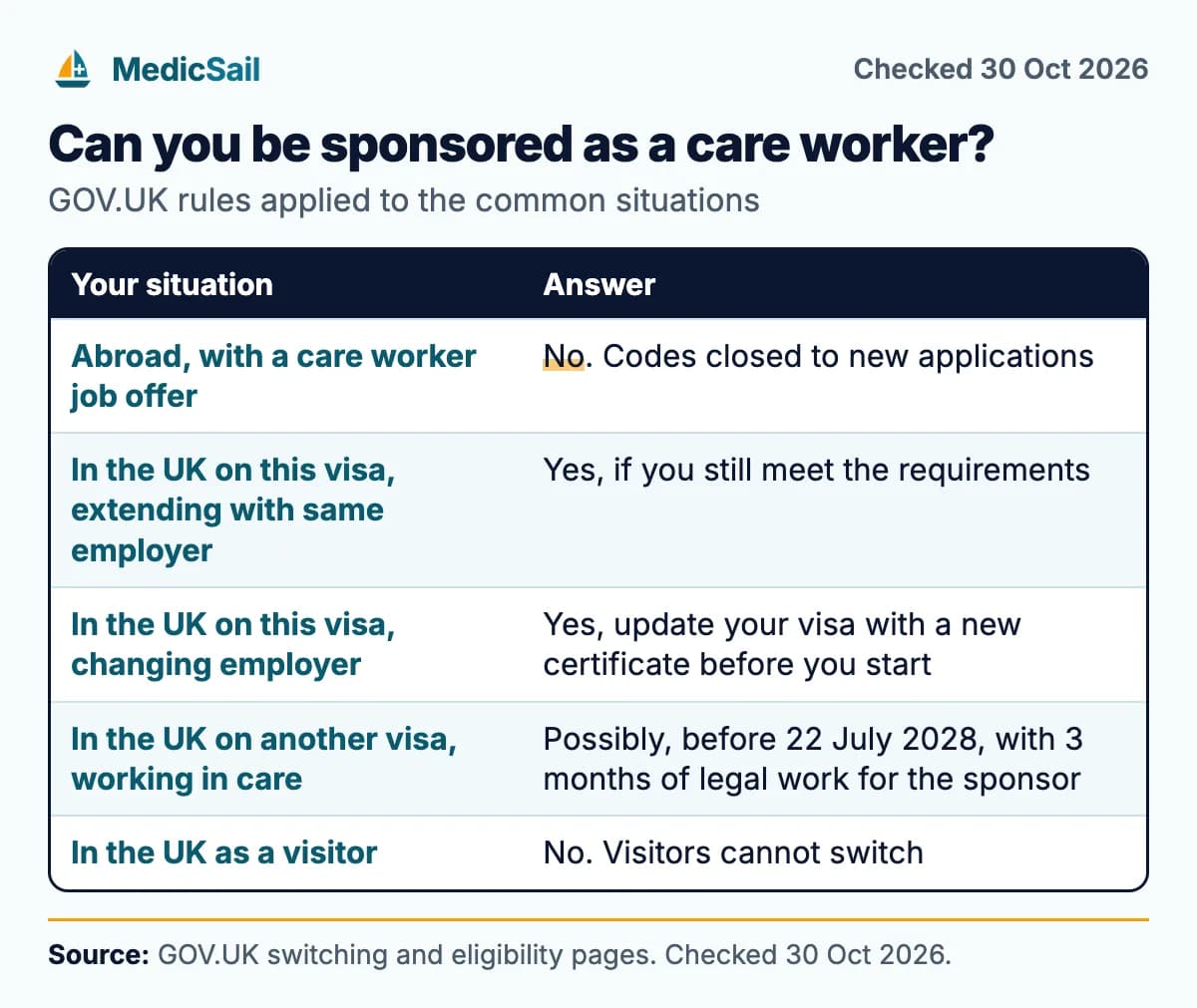
Your situation decides what is possible. This table applies GOV.UK's rules to the common cases.
| Your situation | Can you be sponsored as a care worker or senior care worker? |
|---|---|
| You live outside the UK and have a care worker job offer | No. Codes 6135 and 6136 are not on the list for new applications |
| You are in the UK on a Health and Care Worker visa as a care worker and want to extend with the same employer | Yes, if you still meet the requirements |
| You are a care worker on this visa and want to change employer | Yes, by updating your visa with a new certificate of sponsorship before you start the new job |
| You are in the UK on another visa (for example as a student, a graduate or a dependant) and work in care | Possibly, by switching before 22 July 2028, if you have worked legally in the job for your sponsor for at least three months |
| You are in the UK as a visitor | No. GOV.UK says visitors cannot switch and must apply from abroad |
Watch out for offers that ignore these rules. A job offer from abroad for a care worker role cannot lead to a Health and Care Worker visa in that code, whatever an agent says. If you are being asked to pay for such an offer, our guide to finding genuine NHS sponsorship explains the red flags and how to report them.
Switching into a care worker role from inside the UK
GOV.UK's switching page sets out the conditions. You must already be in the UK, your job must meet the eligibility requirements, you must meet the English requirement, and for care worker and senior care worker roles you must have been working legally in your job for your sponsor for at least three months. The explanatory memorandum to HC 997 says those three months must come before the date your sponsor issues your certificate of sponsorship, and the application must be made before 22 July 2028.
You cannot switch if you are in the UK as a visitor, on a short-term student visa, a Parent of a Child Student visa, a seasonal worker visa or a domestic worker in a private household visa, or on immigration bail or permission granted outside the immigration rules. People in these categories must leave and apply from abroad, where care worker codes are no longer available.
If you are switching from a Student visa, GOV.UK adds that you must have finished your course, or your job start date must be after it ends, unless you are doing a full-time PhD of at least 24 months. GOV.UK says you will usually get a decision within three weeks once you have applied, proved your identity and provided your documents. You prove your identity with the UK Immigration: ID Check app or at a UKVCAS appointment, and there is no fee for giving your biometric information.
For care workers and senior care workers, GOV.UK also states that your partner or children cannot switch as your dependants. That is one of the biggest practical differences from switching into a registered professional role.
Conditions on the employer and the salary
The care worker codes carry extra conditions that do not apply to nurses or other registered professionals:
- CQC registration in England. GOV.UK says your employer must be registered with the Care Quality Commission if you are a care worker or senior care worker working in England. The Immigration Salary List adds that the sponsor must be currently carrying on a regulated activity.
- No private household sponsors. The Immigration Salary List says private households or individuals cannot sponsor care workers, other than sole traders sponsoring someone to work for their business.
- In-country certificates only. GOV.UK's sponsor guidance says an employer cannot request a certificate for a worker applying from abroad in these codes; it can sponsor only workers applying from within the UK who meet the extra requirements.
- Different salary rules. GOV.UK says care workers and senior care workers must meet different salary requirements from other Health and Care Worker jobs, and sets them out on a separate page about different salary requirements. Check the going rate that applies to your code and your certificate date there rather than relying on the £25,000 figure that applies to most health jobs.
Your employer must also hold a sponsor licence with an A rating. You can check this on the GOV.UK register of licensed sponsors; our licensed sponsor glossary entry explains how. The employer pays for your certificate of sponsorship and, under GOV.UK sponsor guidance, must not recover that cost from you.
Bringing a partner or children as a care worker
GOV.UK says that if you are a care worker or senior care worker, at least one of these must be true for your partner or children to apply as your dependants:
- you have been continually employed in the UK as a care worker or senior care worker, on a Health and Care Worker visa or a Skilled Worker visa, since before 11 March 2024
- you are applying for a child born in the UK
- you are the only living parent responsible for your child and you are applying for permission for your child to stay in the UK
- your child's other parent is also sponsored as a care worker or senior care worker and you are applying for permission for your child to stay in the UK
The same structure applies to other jobs GOV.UK lists as "medium skilled", such as nursing auxiliaries and assistants (6131), but with a cut-off date of 22 July 2025: you must have been continually employed in a medium skilled job on one of these visas since before that date, or meet one of the child conditions.
These restrictions do not apply to registered professional roles. A nurse, midwife or allied health professional sponsored in an eligible professional code can bring a partner and children under the normal rules, with each dependant paying the visa fee. This is a major reason why internationally trained nurses working in care roles aim to move into a registered nursing post, covered below.
English, fees and the health surcharge
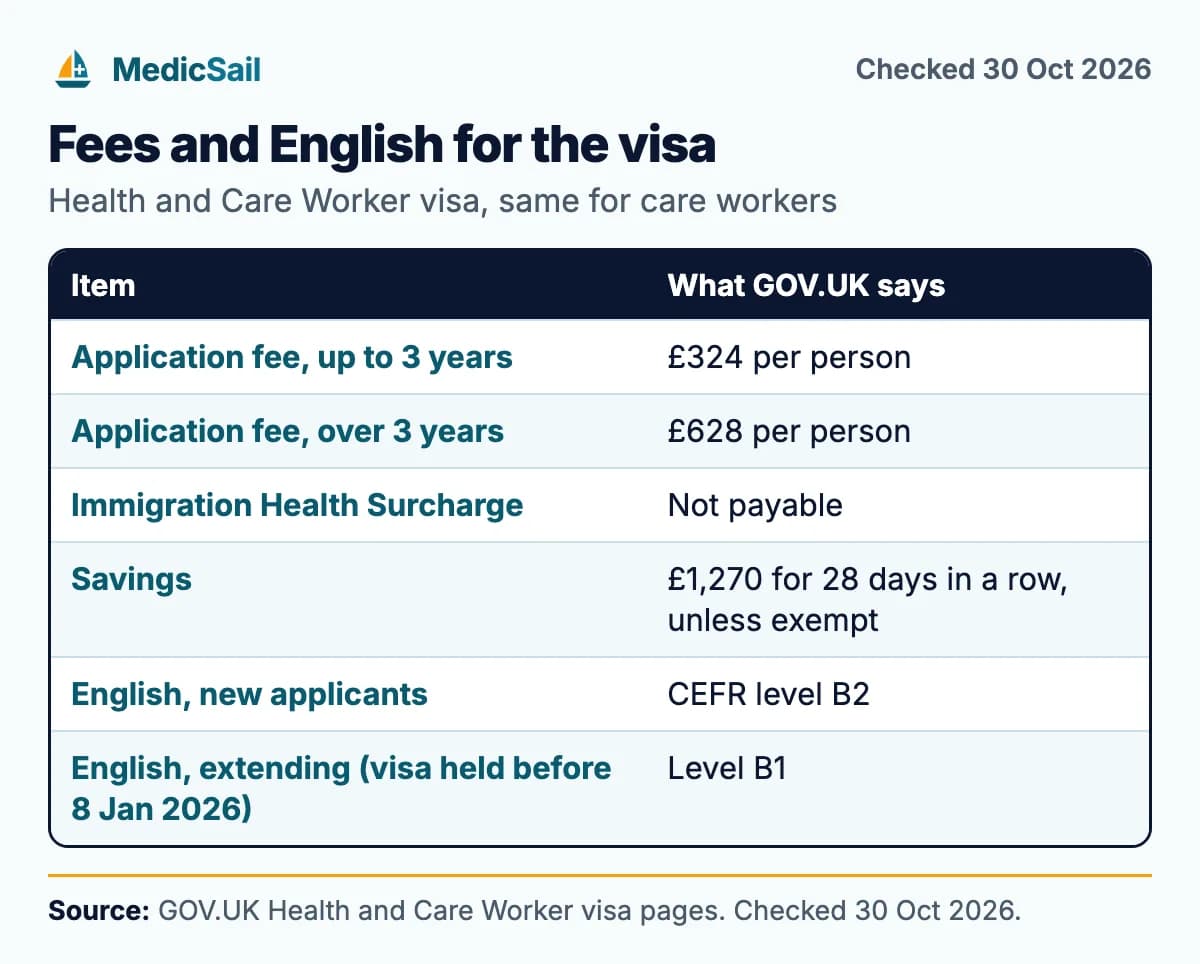
The Health and Care Worker visa costs and English rules apply to care workers in the same way as to other applicants:
| Item | What GOV.UK says |
|---|---|
| Application fee, up to 3 years | £324 per person, inside or outside the UK |
| Application fee, more than 3 years | £628 per person |
| Immigration Health Surcharge | Not payable by health and care workers eligible for this visa, or their dependants |
| Personal savings | At least £1,270 for 28 days in a row, unless you have been in the UK with a valid visa for 12 months or your employer certifies maintenance |
| English, new applicants | At least CEFR level B2 |
| English, extending a visa held before 8 January 2026 | Level B1 |
If you switch from a Skilled Worker visa, GOV.UK says you do not need to prove English again; switching from other visas needs B2. Doctors, dentists, nurses and midwives who have passed an English assessment accepted by their regulator do not need to prove it again, but GOV.UK's English page does not give care workers a similar exemption, so a care worker usually needs an approved Secure English Language Test or another accepted form of evidence. Our Health and Care Worker visa cost calculator adds up the fees for a family.
What it means for healthcare assistants
Healthcare assistants in hospitals are usually sponsored in code 6131 (nursing auxiliaries and assistants), not in the care worker codes. Code 6131 is still on GOV.UK's list of codes for a new Health and Care Worker application, but three rules limit it:
- The Immigration Salary List gives code 6131 a removal date of 31 December 2026. The list says an occupation is included only where the certificate of sponsorship was issued before the removal date shown.
- The same list says that for Skilled Worker purposes code 6131 only applies to roles in environments where registered nurse or other registered healthcare professional roles also exist.
- Code 6131 is a "medium skilled" job, so the dependant restrictions with the 22 July 2025 cut-off apply.
NHS Employers, in its update on immigration policy (last reviewed in October 2026), says workers first sponsored in affected roles at RQF levels 3 to 5 on or after 22 July 2025 lose the ability to extend or change employer in those roles after 31 December 2026, unless they move to a role at RQF level 6 or above. That is NHS Employers' summary of the rules; check the GOV.UK position for your own certificate date before you plan around it. Our page on healthcare assistants and care workers covers the role itself.
What it means for internationally trained nurses
The care worker changes do not affect the nursing codes. Nursing and midwifery roles (codes 2231 to 2237 on GOV.UK's list) can still apply from abroad, can bring their families and follow the standard salary rules based on NHS pay bands. If you are a qualified nurse abroad, the route is NMC registration through the CBT and OSCE, with a sponsored nursing job, not a care worker visa.
Many nurses trained abroad are already in the UK as care workers or senior care workers. If that is you, the usual plan is:
- Meet the NMC's English requirement and open an NMC application. Our IELTS and OET guide sets out the scores.
- Pass the NMC CBT, which you can sit in the UK at a Pearson VUE centre.
- Find an employer that will sponsor you as a nurse and support the OSCE. Some employers sponsor pre-registration nurses while they complete the OSCE.
- Update your visa to the nursing role with a new certificate of sponsorship before you start. Once you are in a registered professional code, the care worker dependant restrictions no longer apply to new dependant applications, although your family must still apply and meet the rules.
Do not leave your care job before your new certificate of sponsorship is assigned and your visa is updated. Our guide to nursing in the UK and the registration timeline calculator help you plan the timing.
Settlement: what GOV.UK says now and what has been proposed
GOV.UK's Health and Care Worker visa page still says that after five years you may be able to apply to settle permanently in the UK, known as indefinite leave to remain. Time as a care worker on this visa currently counts towards those five years in the same way as other roles. Our settlement date calculator works out your earliest date under the current rules.
In November 2025 the government published a consultation, "A Fairer Pathway to Settlement", that proposed raising the standard qualifying period for settlement to ten years and consulted on a 15-year baseline for workers sponsored in roles below RQF level 6 on the Skilled Worker and Health and Care routes, a group that includes care workers and senior care workers. It also proposed applying the changes to people already in the UK who do not yet have settlement. The consultation closed on 12 February 2026.
These are proposals. The Statements of Changes we reviewed up to September 2026 did not put them into the Immigration Rules, and GOV.UK's visa pages still describe the five-year route. If you are a care worker planning for settlement, check GOV.UK for any announcement before you rely on any date, including the ones in this guide. Our indefinite leave to remain glossary entry explains the general requirements.
What to do now, by situation
- You are abroad and were offered a care worker job: do not pay anyone for it. That route is closed for new applications. If you are a qualified nurse or health professional, look at registration in your own profession instead.
- You are a care worker in the UK on this visa: keep your certificate of sponsorship, payslips and employment records in order, and update your visa before any change of employer. Check whether your dependants qualify under the 11 March 2024 rule before you plan for family to join you.
- You are in the UK on another visa and want to switch into care: you need at least three months of legal work for the sponsoring employer before the certificate is issued, and you must apply before 22 July 2028. Your partner and children cannot switch as your dependants.
- You are a healthcare assistant in code 6131: note the 31 December 2026 removal date and plan with your employer if you will need a new certificate after that.
- You are a nurse working as a carer: start your NMC application now. Registration moves you into a professional code without the care worker restrictions.
Immigration rules change often. For advice on your own case, use a regulated immigration adviser or solicitor; you can check an adviser is regulated on GOV.UK.
Questions
No. Since 22 July 2025, codes 6135 (care workers and home carers) and 6136 (senior care workers) are not on GOV.UK's list of jobs for a new Health and Care Worker visa application. They can be used only when extending, updating or switching from inside the UK.
Yes, for applicants abroad. GOV.UK treats code 6136 in the same way as code 6135: it is available only to people extending, updating or switching inside the UK, and has the same 22 July 2028 removal date on the Immigration Rules.
The Home Office's explanatory memorandum to HC 997 says in-country switching continues for a transition period until 22 July 2028. You must have worked legally for your sponsor in the job for at least three months before the certificate of sponsorship is issued.
Only in limited cases. GOV.UK says you must have been continually employed in the UK as a care worker or senior care worker on a Health and Care Worker or Skilled Worker visa since before 11 March 2024, or meet one of the conditions about children.
Yes. GOV.UK lists codes 6135 and 6136 as eligible when you are extending, updating or switching. You must update your visa with a certificate of sponsorship from the new employer before you start, and in England the employer must be registered with the Care Quality Commission.
No. GOV.UK says health and care workers who are eligible for a Health and Care Worker visa, and their dependants, do not pay the surcharge. The visa fee is £324 for up to three years or £628 for longer.
Code 6131 (nursing auxiliaries and assistants) is still on GOV.UK's list for new applications, but the Immigration Salary List gives it a removal date of 31 December 2026 and limits it to settings where registered nurses or other registered professionals also work.
Yes, once you have the registration or pre-registration position your new employer needs. You update your visa with a new certificate of sponsorship in a nursing code, which is not subject to the care worker dependant restrictions.
That was proposed in the government's November 2025 consultation on earned settlement, not confirmed. GOV.UK's visa page still describes settlement after five years. Check GOV.UK for any change before you plan around a date.
New applicants need CEFR level B2. GOV.UK says if you held the visa before 8 January 2026 and are extending or updating it, you need level B1, and if you switch from a Skilled Worker visa you do not need to prove English again.
Sources
- 1GOV.UK: Health and Care Worker visa
- 2GOV.UK: Health and Care Worker visa, your job
- 3GOV.UK: Health and Care Worker visa, different salary requirements
- 4GOV.UK: Health and Care Worker visa, your partner and children
- 5GOV.UK: Health and Care Worker visa, switch to this visa
- 6GOV.UK: Health and Care Worker visa, knowledge of English
Show all 15 sourcesShow fewer sources
- 7GOV.UK: Health and Care Worker visa, how much it costs
- 8GOV.UK: Immigration Health Surcharge, who needs to pay
- 9GOV.UK: Explanatory memorandum to the Statement of Changes HC 997, 1 July 2025
- 10GOV.UK: Immigration Rules Appendix Immigration Salary List
- 11GOV.UK: Workers and Temporary Workers: sponsor a skilled worker
- 12GOV.UK: Statement of Changes HC 584, 3 September 2026
- 13GOV.UK: Statement of Changes in Immigration Rules HC 259 (July 2026)
- 14GOV.UK: A Fairer Pathway to Settlement, consultation on earned settlement
- 15NHS Employers: UK immigration policy, latest updates and employer implications
Plan it with our free tools
MedicSail
Healthcare licensing consultants for the UK, Europe and the USA
Updated and checked against the sources listed above. How we research and check our guides