


































How to get GMC registration without PLAB: every route in 2026
Every way to register with the GMC without sitting PLAB: the accepted postgraduate qualifications (and common ones that are not), GMC-approved sponsorship, specialist and GP registration, European qualifications, the MTI closure, and what every route still requires.

MedicSail
Published
The short answer
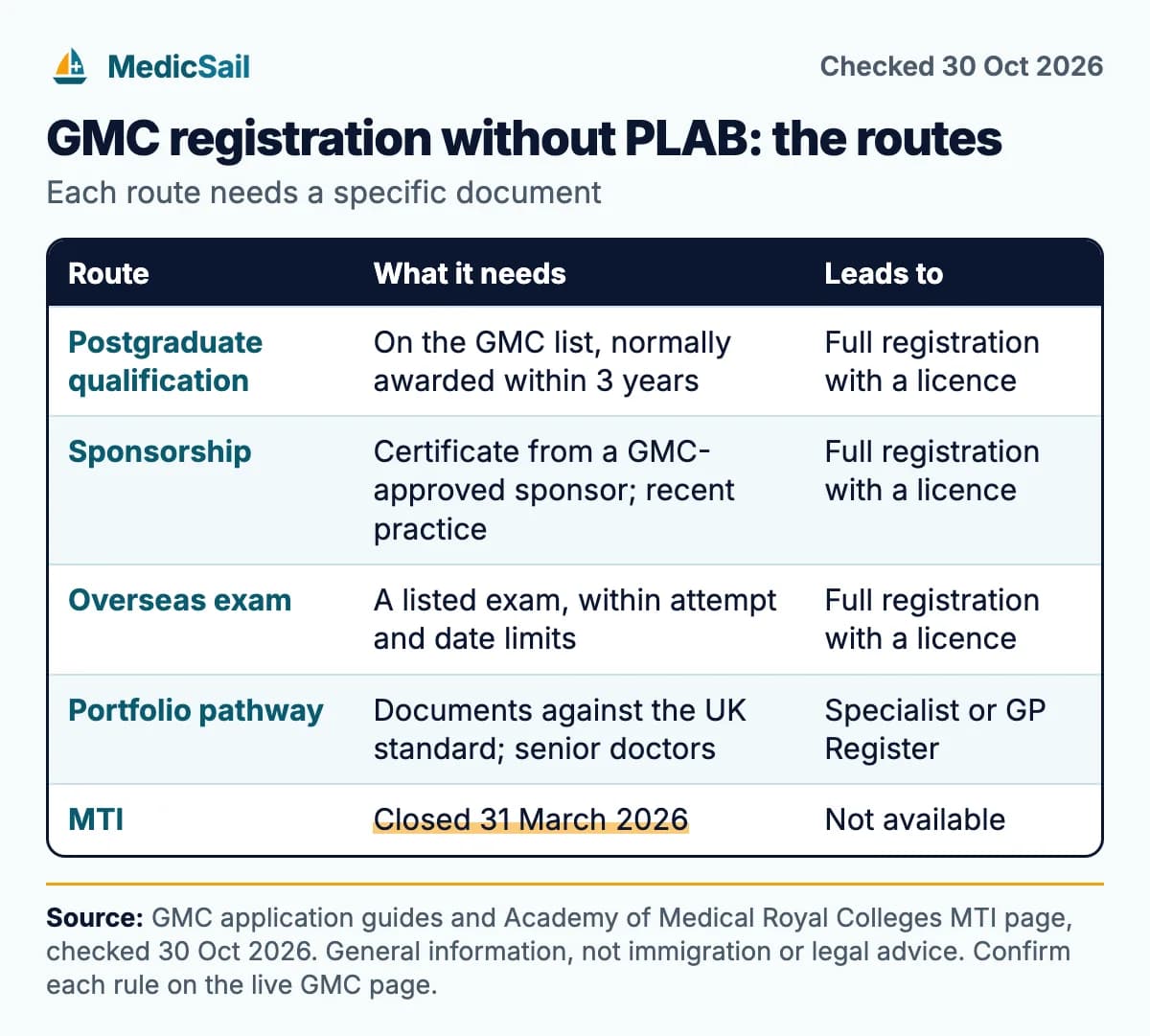
Yes, you can get General Medical Council (GMC) registration without PLAB, but only through a small number of routes, and each has strict conditions. In 2026 the main ones are:
- An acceptable postgraduate qualification on the GMC's list, such as MRCP(UK), MRCS, MRCOG, MRCPCH, MRCPsych, FRCA, FRCR or a listed overseas qualification, normally awarded no more than three years before the GMC approves your application.
- A GMC-approved sponsorship scheme, where a sponsoring body such as an NHS trust, university or royal college issues a Sponsorship Registration Certificate. Every sponsor expects medical practice in three of the last five years, including the most recent 12 months.
- Specialist or GP registration for experienced specialists, through a recognised specialist qualification or the Portfolio pathway (formerly CESR), which costs £1,974 from 1 April 2026.
- Other specific cases: a relevant European qualification, a pass in an overseas registration exam the GMC accepts, or UK graduation through the Medical Licensing Assessment.
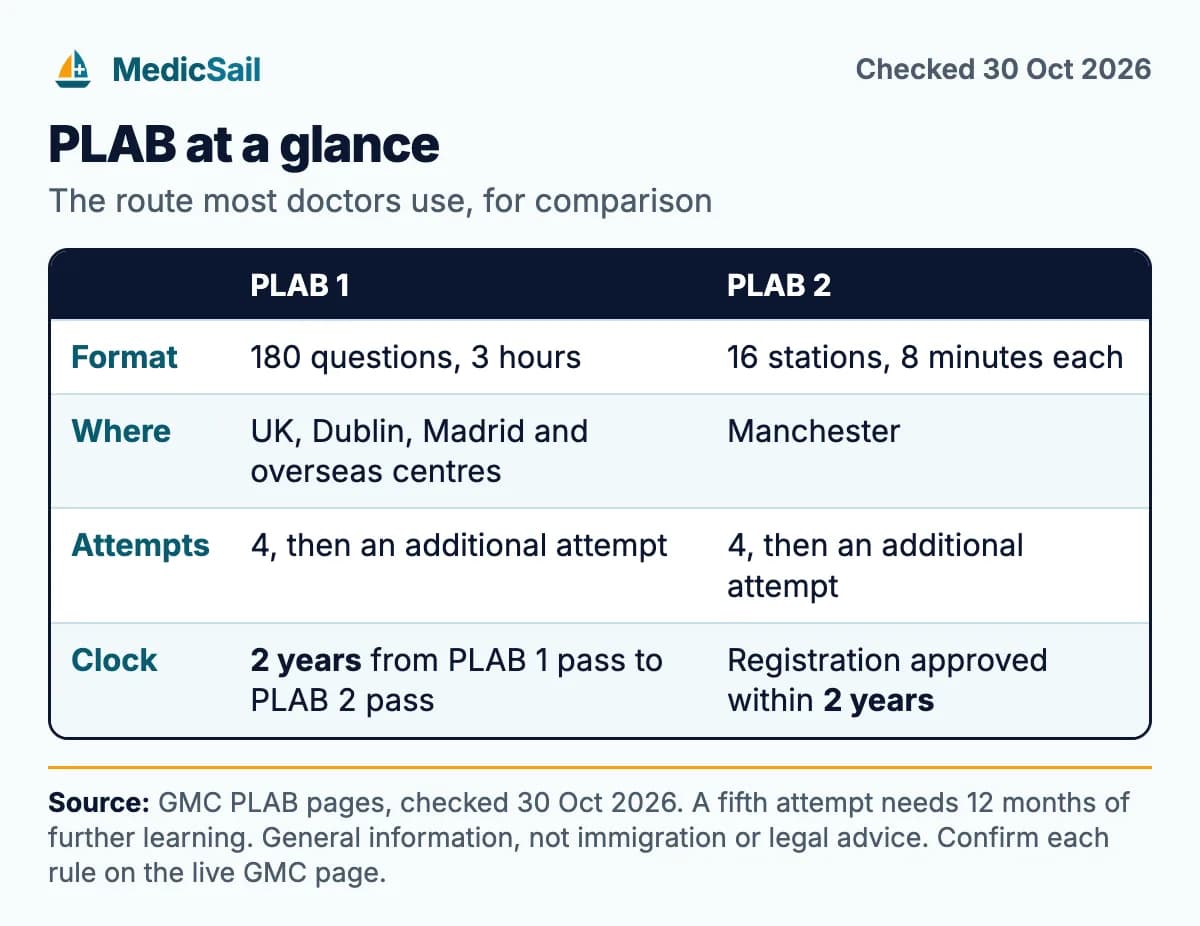
Every route still needs an acceptable primary medical qualification verified through EPIC, English evidence, certificates of good standing and a GMC identity check. The Medical Training Initiative (MTI), long the best-known PLAB-free route, closed to new applicants at noon on 31 March 2026. This guide explains each route, who it suits, what it costs and where people go wrong. For the PLAB route itself, see our guide to PLAB 1 and PLAB 2.
All routes compared
| Route | Who it suits | Key condition | Leads to |
|---|---|---|---|
| PLAB 1 and PLAB 2 | Most international graduates, including recent graduates | Pass both parts; internship or two years' postgraduate practice | Full registration with a licence |
| Acceptable postgraduate qualification | Doctors who hold or are completing a listed UK or overseas qualification | Qualification on the GMC list, normally within three years of approval | Full registration with a licence |
| Sponsorship (Sponsorship Registration Certificate) | Experienced doctors accepted onto a sponsor's scheme | Practice in three of the last five years including the last 12 months; IELTS or OET | Full registration with a licence, linked to the sponsored post |
| Recognised specialist qualification | Specialists with a qualification on the GMC's recognised list | Qualification on that list | Specialist or GP Register |
| Portfolio pathway | Experienced specialists and GPs trained outside UK programmes | Evidence against the UK curriculum, assessed with the royal college | Specialist or GP Register |
| Relevant European qualification | Graduates with qualifying EEA or Swiss qualifications | Covered by current legislation | Registration without PLAB |
| Medical Training Initiative | Closed to new applicants from 31 March 2026 | Not available | Not available |
The GMC's online application finder in GMC Online points you to the right application type based on your answers. Use it before paying for any exam or course. Our route finder compares routes across the UK, Ireland, Europe and the USA if you are still deciding on a country.
Route 1: an acceptable postgraduate qualification
The GMC accepts certain postgraduate qualifications as evidence that you have the knowledge, skills and experience for full registration with a licence. If yours is on its list, you apply for full registration without sitting PLAB.
UK qualifications on the list
When we checked, the UK list included MRCP(UK); MRCS in its collegiate, intercollegiate and ENT forms from the Edinburgh, England and Glasgow colleges; FRCS by examination; MRCOG; Membership of the Royal College of Paediatrics and Child Health (with a college letter); MRCPsych; FRCA and the Primary FRCA (with a college letter confirming completion); MCEM or MRCEM and FRCEM (since 1 August 2018); FRCOphth by examination (with a college letter); FRCPath by examination; FRCR; the Joint Surgical Colleges Fellowship Examination (JSCFE); and the Diploma in Pharmaceutical Medicine awarded since 1 January 2010. Several entries need a letter from the college confirming exactly what you passed and when.
Overseas qualifications on the list
The overseas list is short and specific. When we checked, it included named fellowships from Australian and New Zealand colleges (for example FRACGP awarded since 2007, FACEM since 2001 and FRANZCP since 2012), Canadian qualifications in psychiatry, diagnostic radiology and family medicine, European diplomas in anaesthesiology and intensive care (DESAIC or DESA, and EDIC since 2015), Irish college memberships and fellowships including MRCPI and RCSI qualifications, Hong Kong, Malaysian and Singapore qualifications (some only together with MRCP(UK)), South African fellowships, Sri Lankan MDs from the University of Colombo in some specialties and date ranges, a Bangladesh College of Physicians and Surgeons fellowship in anaesthesia awarded between July 1999 and October 2019, two US board certifications (anaesthesiology and diagnostic radiology), and a University of the West Indies anaesthesia MD within set dates.
Many common qualifications were not on it when we checked, including Pakistan's FCPS, Indian MD, MS and DNB degrees, and Arab Board or Saudi Board certificates. The GMC says that if your qualification is not listed, it is not acceptable for this route. It may accept a letter from a UK medical royal college confirming your international qualification is equivalent to its own. However, the JRCPTB, the Royal College of Anaesthetists and the Faculty of Intensive Care Medicine no longer offer recognition or equivalence for overseas qualifications. The lists change, so always check the live GMC page.
The three-year rule
Your postgraduate qualification should have been awarded no more than three years before the date the GMC approves your application. If it is older, the GMC asks for consultant reports covering at least six months of your last 12 months of practice, and three of your last five years of practice. The postgraduate qualification must also be independently verified, in the same way as your primary qualification, and some qualifications need a supporting college letter that also has to be verified.
The GMC is clear that listed overseas qualifications meet the same standard but are not identical to UK qualifications, and that none of them guarantees entry to UK specialty training.
Using UK membership exams instead of PLAB
Many doctors already preparing for a specialty career sit UK royal college exams overseas, then use the full membership or fellowship for registration. This makes sense when the exam is part of your career plan anyway: MRCP(UK) for medicine, MRCS for surgery, MRCOG for obstetrics and gynaecology, MRCPCH for paediatrics, MRCPsych for psychiatry, FRCA for anaesthesia, MRCEM for emergency medicine or FRCR for radiology.
Points to check before you choose this route over PLAB:
- You need the full qualification as the GMC lists it, not only Part 1. The Primary FRCA is a listed exception, and it needs a college letter.
- Some colleges require a clinical component that is only held in the UK or at limited overseas centres, which affects cost and timing.
- The three-year clock runs from the award date. If you pass and then wait years to move, you will need consultant reports covering recent practice.
- Experience still matters for jobs. A membership qualification may help you apply for more senior non-training posts, but each employer decides the grade it offers.
- Specialty training is separate. The Medical Training (Prioritisation) Act 2026 prioritises certain groups for UK specialty training, so a membership qualification alone does not secure a training post.
For most new graduates, PLAB remains quicker and cheaper. Our guide for new medical graduates choosing between the Foundation Programme and PLAB covers that decision.
Route 2: GMC-approved sponsorship
Some organisations run sponsorship schemes that the GMC has pre-approved. If you meet a sponsor's scheme requirements, it issues you a Sponsorship Registration Certificate (SRC), which you use in place of PLAB when you apply for full registration with a licence.
The conditions
- Every sponsor's criteria include medical practice in three of the last five years, including the most recent 12 months. The GMC says that without this, you are unlikely to have enough evidence for sponsorship.
- You must show English with IELTS Academic or OET Medicine at the GMC's current scores.
- Each scheme sets its own specialty, grade and selection process. Many are linked to a specific post or fellowship.
Who sponsors
The GMC's list includes NHS trusts and health boards, royal colleges and faculties, universities and some other bodies. When we checked, it included international fellowship schemes at trusts such as Guy's and St Thomas', Oxford University Hospitals, Leeds Teaching Hospitals and Manchester University NHS Foundation Trust, many psychiatry fellowship schemes at mental health trusts, the Royal College of Physicians of London, the Royal College of Surgeons of England, the Royal College of Emergency Medicine and the Royal College of Paediatrics and Child Health, and the NHS Wales Shared Services Partnership's All Wales International Medical Recruitment Programme. Some entries on older versions of the list were MTI schemes, which have now closed. Read the live list and contact the scheme directly; the GMC does not run the selection.
Our employer profiles for Guy's and St Thomas', Oxford University Hospitals and Leeds Teaching Hospitals describe their international recruitment.
Do not confuse two kinds of sponsorship
A GMC Sponsorship Registration Certificate is about registration. A visa certificate of sponsorship is about immigration. The GMC says it cannot accept a UK visa certificate of sponsorship for registration. Most sponsored doctors need both: the SRC from the scheme, and a certificate of sponsorship from the employer for the Health and Care Worker visa.
What happened to the MTI
The Medical Training Initiative let doctors come to the UK for up to two years of training, sponsored by a royal college, without PLAB. According to the Academy of Medical Royal Colleges:
- The scheme closed to new participants at 12:00 noon on 31 March 2026.
- Applications involving a medical royal college that were already in progress by that deadline could be submitted until the end of 30 June 2026.
- Doctors already on MTI placements will be supported to complete them as planned.
- NHS England has said future options will be reviewed, but there is no confirmed replacement.
Many websites still describe MTI as open. If an agent or course provider offers you an MTI place for 2026 or 2027, ask for written confirmation from the royal college concerned. If you were planning on MTI, the realistic alternatives are PLAB, a listed postgraduate qualification or a sponsorship scheme.
Route 3: specialist and GP registration
Senior doctors may be able to go straight to the Specialist or GP Register. There are two routes for doctors trained outside UK programmes:
- A recognised specialist qualification. The GMC publishes a list of overseas specialist qualifications it recognises. The fee for an application based on a listed qualification is £516 from 1 April 2026.
- The Portfolio pathway (formerly CESR and CEGPR). You submit evidence that your training and experience meet the UK curriculum for the specialty, and the royal college evaluates it with the GMC. The fee is £1,974 from 1 April 2026, and a review of an unsuccessful application costs £857.
Specialist registration is not the same as a licence: to practise you also need full registration with a licence to practise, which the GMC handles alongside or before the specialist application. The Portfolio pathway glossary entry explains eligibility, the evidence window and processing times, and the CCT entry explains the UK training route it is compared against. Many international specialists first work in the UK as specialty or specialist (SAS) doctors while building a portfolio.
Other cases: European qualifications, overseas exams and UK graduates
Relevant European qualifications
Under current legislation, doctors with a relevant European qualification from the EEA or Switzerland do not need to take PLAB. If you trained in the EU but are not an EEA or Swiss national, or your qualification is from outside those countries, check your case in GMC Online; nationality and where the degree was awarded both matter.
An acceptable overseas registration exam
The GMC has a separate application route for international graduates who have passed an overseas registration exam it accepts. The conditions are specific, including when the exam was passed and whether you have also sat PLAB, so read the GMC's guide for that route before relying on it. We have not listed the accepted exams here because we could not confirm the current list from the GMC page.
UK graduates and the UKMLA
Students graduating from UK medical schools pass the Medical Licensing Assessment (UKMLA) as part of their degree. International doctors cannot sit the medical school version; the GMC says PLAB now meets the MLA requirements and will keep its name for a while longer. So "registration without PLAB" never means registration without meeting the MLA standard: each alternative route is the GMC's way of accepting other evidence of that standard.
What every route still needs
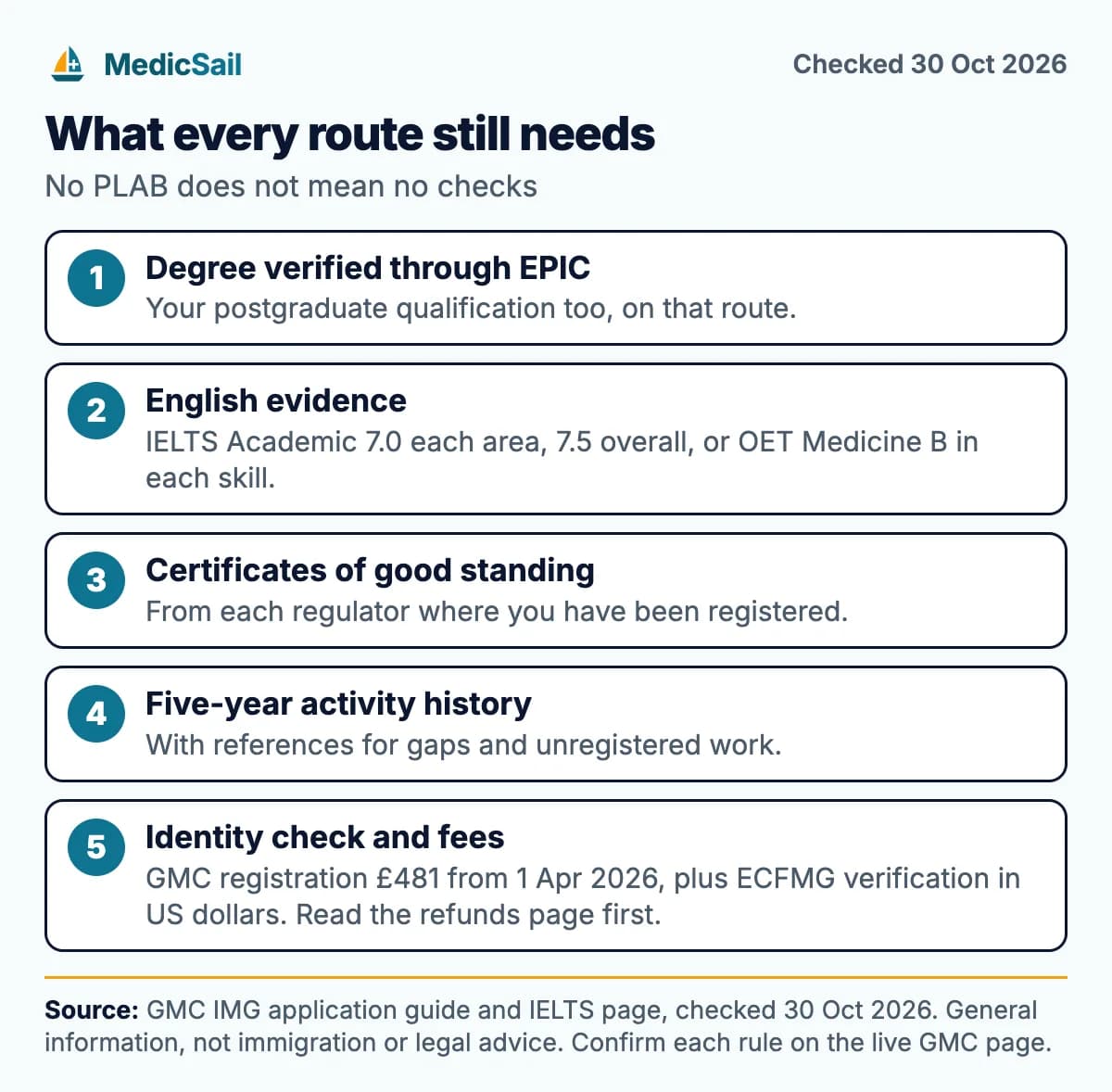
Avoiding PLAB does not avoid the rest of the GMC process. Whichever route you use, expect:
- Primary source verification of your medical degree through EPIC (and of your postgraduate qualification on that route). See our EPIC verification guide.
- English evidence: IELTS Academic with 7.0 in each skill and 7.5 overall, or OET Medicine at grade B in each sub-test, unless an exemption the GMC lists applies to you. Our IELTS or OET guide compares them.
- Certificates of good standing from every regulator you have been registered with in the last five years, each valid for three months from signature.
- A full five-year history of your activities, with references for non-medical work, unregistered medical work and observerships over two months.
- A GMC identity check through the Digidentity app, completed within three months of the invitation.
- The registration fee: £481 for full registration with a licence from 1 April 2026, or £184 if you qualified within the past five years, with a £110 scrutiny fee kept if the application is refused, closed or withdrawn.
Our GMC overview summarises the regulator, and the registration cost estimator totals the fees for your route.
Mistakes that delay a PLAB-free application
- Assuming a qualification is accepted because a colleague used it. The lists are specific about awarding body, specialty and award dates, and they change. Check the live GMC page on the day you apply.
- Relying on Part 1 of a membership exam. Apart from the Primary FRCA with a college letter, the GMC lists full memberships and fellowships.
- Letting the three-year window lapse. If your qualification passes three years before approval, you need consultant reports covering six of your last 12 months and three of your last five years of practice.
- Applying to a sponsor without recent practice. A gap in the last 12 months usually rules out sponsorship, whatever your seniority.
- Mixing up the two certificates. A visa certificate of sponsorship cannot replace a Sponsorship Registration Certificate for the GMC.
- Paying for MTI or "guaranteed sponsorship" offers. MTI is closed to new applicants, and no one can guarantee a sponsor's decision or GMC registration.
- Leaving EPIC and good standing certificates to the end. Verification and overseas certificates are the usual causes of delay on every route.
Which route fits your profile
| Your situation | Most realistic route |
|---|---|
| Recent graduate with an internship, no postgraduate exams | PLAB |
| Holding or close to finishing MRCP(UK), MRCS, MRCOG, MRCPCH, MRCPsych, FRCA, MRCEM or FRCR | Postgraduate qualification route, within three years of the award |
| FCPS, Indian MD or MS, Arab or Saudi Board, with several years of practice | Sponsorship scheme in your specialty, PLAB, or a UK membership exam; check the live GMC list first |
| Consultant-level specialist abroad | Recognised specialist qualification if listed; otherwise Portfolio pathway, often after a UK post |
| Planned on MTI | Sponsorship scheme, PLAB or postgraduate qualification |
| Not practising in the last 12 months | Sponsorship is unlikely; PLAB or a postgraduate qualification route |
If you hold a Gulf licence, our guide to moving from a Gulf licence to UK registration explains which experience helps. Doctors from Pakistan and India can read the country-specific document steps. For the wider picture, see working as a doctor in the UK.
Questions
Yes, if you have a postgraduate qualification on the GMC's accepted list, a Sponsorship Registration Certificate from an approved sponsor, or you qualify for specialist or GP registration. Doctors with a relevant European qualification also do not need PLAB under current legislation.
MRCP(UK) is on the GMC's list of acceptable postgraduate qualifications. It should normally have been awarded no more than three years before the GMC approves your application; if older, you need consultant reports covering recent practice.
FCPS was not on the GMC's list of acceptable overseas postgraduate qualifications when we checked. If a qualification is not listed, the GMC says it is not acceptable for this route, so FCPS holders usually look at PLAB, sponsorship or a UK membership exam.
No. The Academy of Medical Royal Colleges says MTI closed to new participants at noon on 31 March 2026, with a grace period to 30 June 2026 only for applications already in progress. There is no confirmed replacement.
It is a certificate issued by a GMC-approved sponsor, such as an NHS trust or royal college, confirming you meet its scheme. You use it instead of PLAB for full registration. It is not a visa certificate of sponsorship, which the GMC cannot accept for registration.
All sponsors require medical practice in three of the last five years, including the most recent 12 months. Each scheme adds its own specialty, grade and selection criteria.
Possibly, if you hold a recognised specialist qualification on the GMC's list (fee £516 from 1 April 2026) or succeed through the Portfolio pathway (fee £1,974). You also need full registration with a licence to practise.
Yes, unless an exemption the GMC lists applies to you. On the sponsorship route the GMC specifically requires IELTS Academic or OET Medicine at its minimum scores.
Yes. Every route needs your primary medical qualification verified through EPIC, and on the postgraduate route your postgraduate qualification must be verified too.
No. The GMC says listed qualifications do not guarantee entry to UK specialty training, and the Medical Training (Prioritisation) Act 2026 prioritises certain groups of applicants.
Sources
- 1GMC: Acceptable postgraduate qualifications
- 2GMC: Your postgraduate qualification (application guide)
- 3GMC: Applying for registration using sponsorship
- 4GMC: Portfolio pathway application
- 5GMC: Full registration for IMGs who have passed an acceptable overseas registration exam
- 6GMC: PLAB and the MLA requirements
Show all 12 sourcesShow fewer sources
- 7GMC: Your certificate of good standing (application guide)
- 8GMC: Identity checks, frequently asked questions
- 9GMC: Fees for doctors (from 1 April 2026)
- 10GMC: Using your IELTS certificate
- 11Academy of Medical Royal Colleges: MTI scheme closure questions and answers
- 12BMA: What the new law means for UK graduate prioritisation
Plan it with our free tools
MedicSail
Healthcare licensing consultants for the UK, Europe and the USA
Updated and checked against the sources listed above. How we research and check our guides