


































New medical graduate from abroad: UK Foundation Programme or PLAB?
For new international medical graduates: whether you can apply to the UK Foundation Programme or should take PLAB, how your internship decides provisional or full GMC registration, the UKFP 2027 rules and dates, the prioritisation law and FY2-level jobs.

MedicSail
Published
The short answer
For most international medical graduates, the realistic route is to complete an internship, pass PLAB, take full GMC registration and start in a non-training post at FY2 level. The UK Foundation Programme is open to international graduates only in a narrow case: you must not have completed an internship, because anyone eligible for full GMC registration cannot apply. You also need provisional registration (usually through PLAB) by the start date and every UK Foundation Programme Office (UKFPO) deadline met. Since the Medical Training (Prioritisation) Act 2026, international graduates are also allocated places only after UK and other priority-group graduates.
In practice:
- If you have completed, or will complete, a 12-month internship that meets the GMC's criteria, you are likely to get full registration, which makes you ineligible for the two-year Foundation Programme. Your route is PLAB (or another GMC route) and then a job.
- If you have not done an internship and qualify in time, you can apply to the Foundation Programme through the UKFPO eligibility process. For the 2027 programme that window ran from 1 to 22 July 2026 and is now closed. You would join a reserve list behind priority applicants.
- If you graduated on or before 3 August 2025, you must also pass the UKFPO Clinical Assessment, which costs £1,000 for UKFP 2027.
This guide explains provisional and full registration, the UKFPO rules and dates, the prioritisation law, and how the two routes compare on time, cost and outcome. For the exams themselves, see our PLAB 1 and PLAB 2 guide.
Provisional or full registration: the question that decides everything
The GMC has two kinds of registration for new doctors. Provisional registration with a licence to practise lets you work only in a Foundation Year 1 (F1) post. Full registration with a licence lets you work in other posts, including non-training jobs. Which one you are eligible for depends on your practical training after (or immediately before) graduation.
What counts as an internship for the GMC
For full registration the GMC wants either completion of UK F1, or experience outside the UK in one of two patterns:
- At least 12 months' continuous internship immediately before or after graduation. For 12 to 18 months, at least three months each in medicine and surgery; for 18 months or more, at least six months each.
- At least two years' continuous postgraduate practice in a public hospital, with at least three months each in medicine and surgery, under supervision.
The internship must be an approved post (honorary posts do not count), continuous, supervised, with no more than 20 days' absence for sickness or statutory leave in any 12 months (in addition to up to five weeks' annual leave). Observerships, shadowing, clinical attachments and clerkships do not count. The GMC will consider a pre-graduate internship built into the degree, provided it does not all take place before the final year. It assesses your training against the criteria in place when it receives your application.
Why it matters for the Foundation Programme
The UKFPO says applicants must hold or expect to be eligible for provisional registration. If you hold or are eligible for full registration, you are not eligible for the two-year Foundation Programme. A completed 12-month internship that meets the GMC's patterns is likely to lead to full registration, and so to rule you out. If your internship is incomplete or does not meet the patterns, the UKFPO tells applicants to check their registration status with the GMC. Many countries require an internship before a degree or licence is issued, so in practice most international graduates are on the full-registration route. Our glossary explains the Foundation Programme and the licence to practise.
Route A: applying to the UK Foundation Programme as an international graduate
You must use the UKFPO's eligibility application if you are studying at or qualified from a non-UK medical school. UK schools nominate their own students; non-UK graduates cannot be nominated, so eligibility is the only way in. Applications do not carry forward: you apply again each recruitment year. There is no pre-check service, and late applications are not considered.
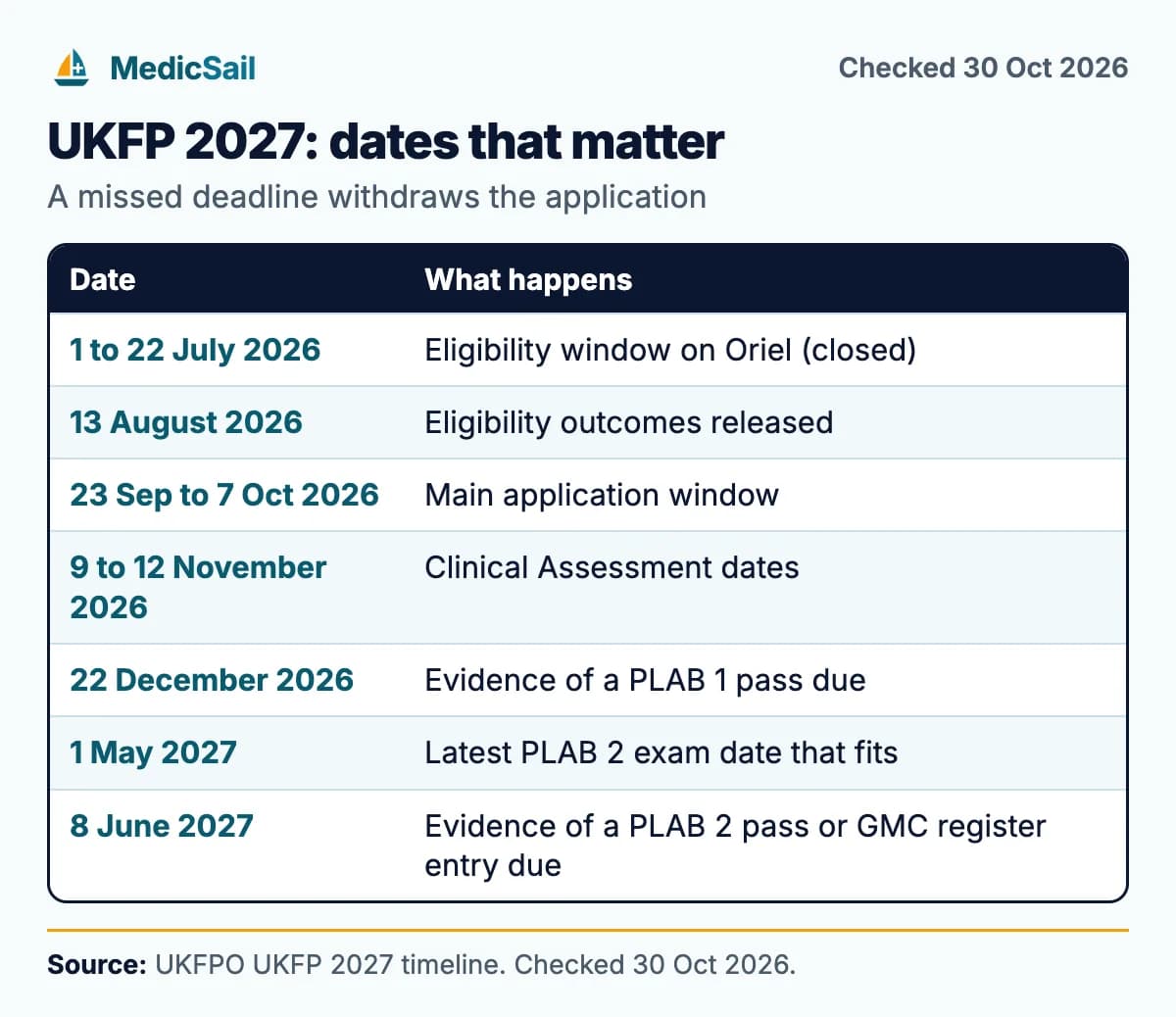
The UKFP 2027 timeline
| Date | What happens |
|---|---|
| 1 to 22 July 2026 (12:00 BST) | Eligibility application window on Oriel |
| 13 August 2026 | Eligibility outcomes released |
| 31 August 2026 | Latest date to qualify if you also need PLAB; deadline for priority PLAB 1 requests to the GMC |
| 17 September 2026 | Clinical Assessment payment window closes |
| 23 September to 7 October 2026 (12:00 BST) | Main Foundation Programme application window |
| 5 November 2026 | Latest PLAB 1 exam date that fits the timeline |
| 9 to 12 November 2026 | Clinical Assessment dates |
| 22 December 2026 | Deadline to send evidence of a PLAB 1 pass |
| 15 January 2027 | Deadline to request priority PLAB 2 access from the GMC |
| 1 May 2027 | Latest PLAB 2 exam date that fits the timeline |
| 8 June 2027 (12:00 BST) | Deadline for evidence of a PLAB 2 pass or GMC register entry |
| By 11 June 2027 | Recommended latest date to apply for provisional GMC registration (apply at least three months before the start) |
The UKFPO is firm that a missed deadline means your application is withdrawn and not reinstated, even after a successful GMC appeal, and that the programme start cannot be deferred because of PLAB. If you need a PLAB date to fit, email [email protected] with evidence of your active eligibility application before the priority deadlines.
Other UKFPO requirements
- A primary medical qualification recognised by the GMC, achieved by the start of the programme. The certificate must clearly show your qualification date. If your medical school is on a GMC list and you are not yet GMC-registered, you must upload GMC evidence that your qualification is currently acceptable, dated no earlier than three months before the window opened.
- A passport or ID document, evidence of right to work and sponsorship information.
- Provisional GMC registration with a licence by the programme start.
- Criminal record and barring clearance and other pre-employment checks by the start.
English: the UKFPO asks for more than the GMC
The UKFPO sets its own English rules, separate from the GMC's, and they are stricter. You do not need to use the same evidence for both.
| Requirement | UKFPO (UKFP 2027 eligibility) | GMC (registration and PLAB) |
|---|---|---|
| IELTS Academic | 7.5 or higher in every skill | 7.0 in each skill and 7.5 overall |
| OET Medicine | 400 or higher in every skill; letter grades not considered | Grade B in each sub-test |
| Test date window | On or after 4 August 2025 and on or before 30 June 2026 | Valid (two years) when you sit PLAB 1 and when registration is approved |
| Medical degree taught in English | Accepted only if the degree is from a country where English is the first and native language, on the GMC's list | Separate GMC rules |
| Exemptions | None, whatever your nationality or GMC status | Limited exemptions set by the GMC |
IELTS General Training and the IELTS Indicator are not accepted by the UKFPO, and OET scores from different sittings cannot be combined. A candidate with 7.0 in writing, for example, may meet the GMC's standard but not the UKFPO's. Our guide to IELTS and OET for UK regulators covers the GMC's side.
The Clinical Assessment for older graduates
If you qualified on or before 3 August 2025, you must take and pass the UKFPO Clinical Assessment for the 2027 programme. Its stated purpose is to assess candidates who qualified more than two years before the programme starts. For UKFP 2027:
- The fee is £1,000, with no financial support or discount. The UKFPO raised it to this level because it had not changed since the assessment was introduced in 2014.
- It is a single session of about four hours with 12 stations of ten minutes each, including one minute's preparation.
- Dates were 9 to 12 November 2026 (one allocated date), at Wythenshawe Hospital and the Oxford Road Campus of Manchester University NHS Foundation Trust.
- Results and a station-by-station report come by email, not on the day.
- A pass from the UKFP 2026 round is valid for two years, so you would not sit it again.
- There are no exemptions, and no other assessment is accepted in its place.
The Clinical Assessment is separate from PLAB 2. If you need PLAB as well, you may face two clinical exams in Manchester in the same recruitment year.
The prioritisation law and what it means for you
The Medical Training (Prioritisation) Act 2026 became law on 5 March 2026. The BMA's summary of how it applied in 2026 is:
- For the Foundation Programme, the priority group was graduates of medical schools in the UK and the Republic of Ireland, plus Iceland, Liechtenstein, Norway and Switzerland.
- International medical graduates were not prioritised for the Foundation Programme, including UK citizens with overseas degrees.
- Standalone FY2 recruitment followed the same groups.
- International students who studied at UK medical schools count as UK graduates.
The UKFPO states that the Act prioritises UK medical graduates for the Foundation Programme and that it allocates all priority-group applicants first. Non-priority applicants go onto a national reserve list and are allocated through Oriel to vacancies that arise, using Preference Informed Allocation. In 2026 the UKFPO planned this reserve-list allocation from the week of 15 June, subject to vacancies. It has not published how many reserve-list applicants were placed, and the Secretary of State can change the priority groups by regulation. Treat a Foundation Programme application as possible but uncertain, and keep PLAB and a job search running in parallel.
For specialty training later, the position is different: the BMA says doctors who complete UK foundation or relevant core training are prioritised for the next stage, as are British citizens and people with indefinite leave to remain. See our glossary on specialty training.
Route B: internship, PLAB, then a job at FY2 level
This is the route most international graduates take, and for anyone with a completed internship it is the only one of the two that applies.
- Finish an internship that meets the GMC's criteria, keeping a signed certificate with the dates and duration of every rotation. The certificate's issue date must match the date the programme ended.
- Get IELTS Academic or OET Medicine at the GMC's scores, then set up GMC Online and have your qualification and English accepted.
- Start EPIC verification early. See our EPIC guide.
- Pass PLAB 1 (£283) and PLAB 2 (£1,036) from 1 April 2026. PLAB is set at the level of a doctor starting F2.
- Apply for full registration with a licence: £481, or £184 if you qualified within the past five years.
- Apply for non-training posts such as trust grade FY2, junior clinical fellow or locally employed doctor roles. Our guide on what to do after passing PLAB 2 covers the job search, the visa and pre-employment checks.
Because PLAB tests the level of a doctor entering F2, employers often recruit newly registered doctors into FY2-level service posts. These are not part of the Foundation Programme and do not lead to a Foundation Programme Certificate of Completion, but they give UK experience, references and evidence for later applications. Some trusts offer posts with teaching and supervision similar to foundation training; ask at interview. If PLAB goes badly, see what to do after a PLAB fail.
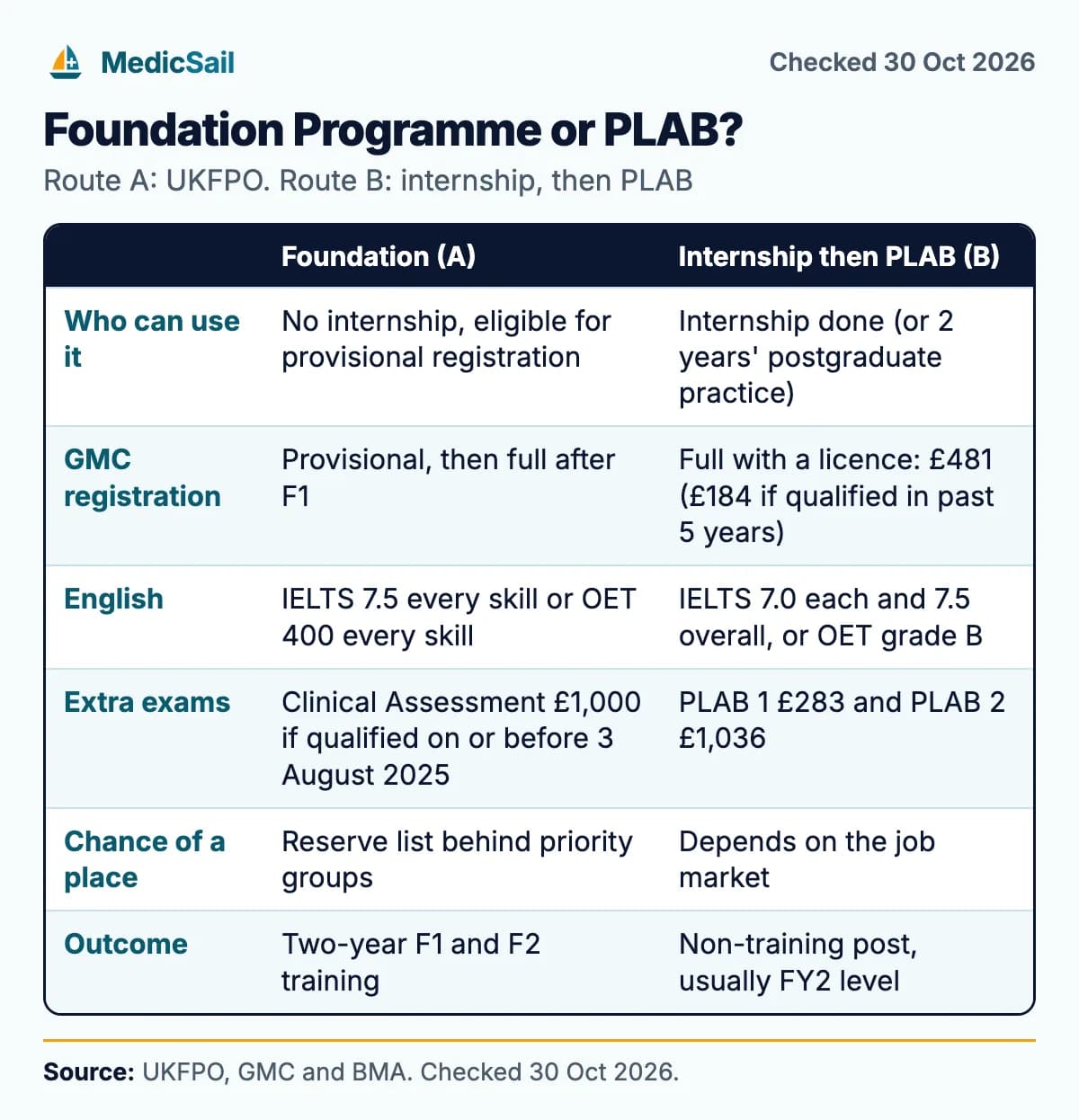
The two routes side by side
| Foundation Programme (Route A) | Internship then PLAB (Route B) | |
|---|---|---|
| Who can use it | Graduates without an internship who are eligible for provisional registration | Graduates with an internship (or two years' postgraduate practice) |
| GMC registration | Provisional with a licence (£26 from 1 April 2026), then full after F1 | Full with a licence (£481, or £184 if qualified in the past five years) |
| English | UKFPO: IELTS 7.5 in every skill or OET 400 in every skill, plus GMC requirements | GMC: IELTS 7.0 each and 7.5 overall, or OET grade B in each sub-test |
| Extra exams | PLAB if required for registration; Clinical Assessment (£1,000) if qualified on or before 3 August 2025 | PLAB 1 and PLAB 2 |
| Deadlines | Fixed UKFPO dates; missing one withdraws the application | GMC validity clocks only |
| Chance of a place | Reserve list behind priority groups since 2026 | Depends on the job market, not allocation |
| Outcome | Structured two-year training post, F1 then F2 | Non-training service post, usually at FY2 level |
| Later prioritisation | Completing UK foundation training counts for core training prioritisation | No automatic training priority; settled status or UK training changes this later |
The Foundation Programme gives a stronger structured start if you get a place, but the odds and the deadlines make it a gamble for most international graduates. Route B is slower to "training" but more predictable. Many doctors apply for the Foundation Programme where eligible while preparing PLAB in parallel; if they are not placed, they move to Route B without losing a year.
What foundation-level doctors earn in 2026/27
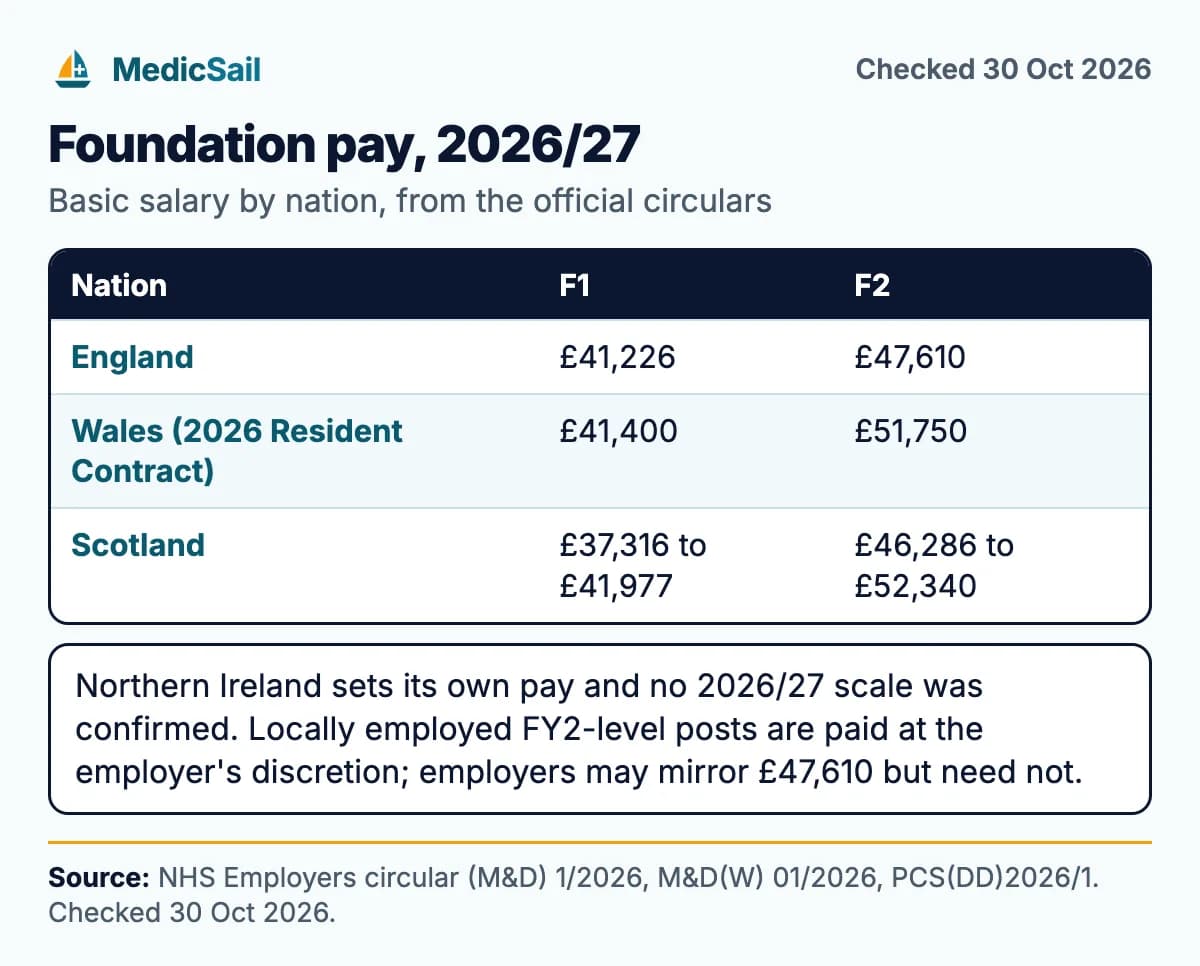
Pay is set nationally for doctors in training and differs by UK nation. Basic salaries for 2026/27 from the official circulars:
| Nation | F1 or FHO1 | F2 or FHO2 | Source and notes |
|---|---|---|---|
| England | £41,226 | £47,610 | NHS Employers circular (M&D) 1/2026 R2, from 1 April 2026 |
| Wales (2026 Resident Contract) | £41,400 | £51,750 | M&D(W) 01/2026; doctors transition to the new contract from 1 August 2026 |
| Scotland | £37,316 to £41,977 | £46,286 to £52,340 | PCS(DD)2026/1 residents addendum; banding supplements are paid on top |
Northern Ireland sets its own pay, and we could not confirm a published 2026/27 scale at the time of review. Locally employed doctors in FY2-level posts in England are paid at the employer's discretion: NHS Employers says employers may mirror the national nodal points (£47,610 at point 2) but are not required to. Full figures for every grade are in our NHS doctor salary guide, and the take-home pay calculator estimates net pay.
Common misunderstandings
- "PLAB gets me into the Foundation Programme." PLAB gives you GMC registration. A Foundation Programme place comes only through the UKFPO's separate eligibility and application process, with its own deadlines.
- "I can skip my internship at home to stay eligible." Check your home country's rules first. Many require an internship to graduate or be licensed, and leaving one unfinished can also complicate certificates of good standing and full registration later if you are not placed.
- "A trust grade FY2 post is the same as F2." It is a service post. It does not give you a Foundation Programme Certificate of Completion, though it does give UK experience and references.
- "The GMC's IELTS score is enough for the UKFPO." It is not. The UKFPO asks for 7.5 in every skill, from a test taken within its date window.
- "Appealing a PLAB result will hold my place." The UKFPO says a GMC appeal does not pause its deadlines, and withdrawn applications are not reinstated.
- "Observerships count as internship." The GMC does not accept observerships, shadowing, clinical attachments or clerkships as practical training.
Which route fits your situation
- Final-year student at a non-UK school, no internship yet: check whether your country requires an internship before your degree or licence. If you can graduate by 31 August of the year before the programme without an internship, and you can meet the UKFPO's English and PLAB deadlines, you may be eligible to apply. Prepare PLAB either way.
- Graduated, internship completed: the Foundation Programme is not open to you. Use PLAB or another GMC route, then non-training posts. See GMC registration without PLAB if you hold a postgraduate qualification.
- Graduated, internship incomplete or not matching the GMC patterns: ask the GMC about your registration status before choosing a route. Do not assume either way.
- Graduated more than two years ago without an internship: the Foundation Programme is possible only with the Clinical Assessment, and the reserve-list position applies. Weigh the cost carefully.
- Studied at a UK medical school as an international student: you are treated as a UK graduate for prioritisation; this guide does not apply to you.
Country pages cover local internship and document rules for doctors from India, Pakistan, Nigeria and Kenya. Our UK doctors page and GMC overview give the wider picture. Visas are covered in our Health and Care Worker visa guide.
Questions
Yes, through the UKFPO eligibility process, but only if you are eligible for provisional (not full) GMC registration and meet every UKFPO requirement and deadline. Since 2026, international graduates are allocated after the priority groups, from a reserve list.
Usually not. A 12-month internship that meets the GMC's criteria is likely to make you eligible for full registration, and the UKFPO says applicants who hold or are eligible for full registration cannot apply to the two-year Foundation Programme.
If PLAB is required for your GMC registration, yes. For UKFP 2027, you had to qualify by 31 August 2026, pass PLAB 1 by an exam on or before 5 November 2026 and PLAB 2 by 1 May 2027, with evidence sent by the UKFPO deadlines.
For UKFP 2027, IELTS Academic with 7.5 or higher in every skill, or OET Medicine with 400 or higher in every skill, from a test taken between 4 August 2025 and 30 June 2026. There are no exemptions.
A 12-station assessment for applicants who qualified on or before 3 August 2025, about four hours long, held in Manchester. For UKFP 2027 it costs £1,000, with no exemptions.
No. Under the Medical Training (Prioritisation) Act 2026, the 2026 priority group was graduates of UK, Irish, Icelandic, Liechtenstein, Norwegian and Swiss medical schools. International graduates were allocated from a reserve list after priority applicants.
You can work in non-training posts at FY2 level, often called trust grade FY2 or junior clinical fellow, once you hold full registration. These are service posts, not the Foundation Programme, and pay is set by the employer.
No. It ran from 1 to 22 July 2026 and the UKFPO says late applications are not considered. You would need to apply in a later recruitment year.
The GMC fee for an application for provisional registration with a licence is £26 from 1 April 2026. Full registration with a licence costs £481, or £184 at the discounted rate.
Completing the UK Foundation Programme brings prioritisation for core training, but places for international graduates are uncertain. The PLAB route is more predictable to a first job, with training applications later.
Sources
- 1GMC: Check if your practical training (internship) is acceptable
- 2GMC: Provisional registration for international medical graduates
- 3GMC: Fees for doctors (from 1 April 2026)
- 4UK Foundation Programme: UKFP 2027 eligibility applications, introduction
- 5UK Foundation Programme: UKFP 2027 eligibility, key changes
- 6UK Foundation Programme: UKFP 2027 eligibility, timeline and deadlines
Show all 18 sourcesShow fewer sources
- 7UK Foundation Programme: UKFP 2027 eligibility, GMC registration
- 8UK Foundation Programme: UKFP 2027 eligibility, PLAB
- 9UK Foundation Programme: UKFP 2027 eligibility, English language proficiency
- 10UK Foundation Programme: UKFP 2027 eligibility, Clinical Assessment
- 11UK Foundation Programme: UKFP 2027 Person Specification (V2)
- 12UK Foundation Programme: Nomination and eligibility
- 13UK Foundation Programme: Prioritisation FAQs and guidance
- 14UK Foundation Programme: Update for applicants on the reserve list
- 15BMA: What the new law means for UK graduate prioritisation
- 16NHS Employers: Pay and Conditions Circular (M&D) 1/2026 R2
- 17NHS Wales: Pay circular M&D(W) 01/2026 Version 2
- 18Scottish Government: NHS Circular PCS(DD)2026/01 (Addendum, Residents)
Plan it with our free tools
MedicSail
Healthcare licensing consultants for the UK, Europe and the USA
Updated and checked against the sources listed above. How we research and check our guides