


































Passed PLAB 2: next steps to GMC registration, your first NHS job and the visa
Everything to do after a PLAB 2 pass, in order: the GMC application and its fees, the English concession, the identity check, which NHS jobs to apply for and what they pay, the Health and Care Worker visa and pre-employment checks.

MedicSail
Published
The short answer
Once you pass PLAB 2, apply to the General Medical Council (GMC) for full registration with a licence to practise through GMC Online. Have your certificates of good standing, five-year activity history and English evidence ready. Then complete the GMC's identity check and start applying for NHS jobs at the same time. The GMC says your registration should be approved within two years of passing PLAB 2. The application fee from 1 April 2026 is £481, or £184 if you gained your primary medical qualification within the past five years.
Most doctors who have just passed PLAB start in a non-training post, usually advertised as a clinical fellow, trust grade, junior clinical fellow or locally employed doctor role, often at a level comparable to Foundation Year 2 or core training. With a job offer from a Home Office approved employer, you then apply for the Health and Care Worker visa, which costs £324 for up to three years or £628 for longer, and holders do not pay the healthcare surcharge.
The GMC does not find you a job, and registration does not guarantee one. The order below is the one that wastes the least time. If you have not yet sat the exams, start with our guide to PLAB 1 and PLAB 2; if you did not pass, see what to do after a PLAB fail.
Your result and the clocks that start now
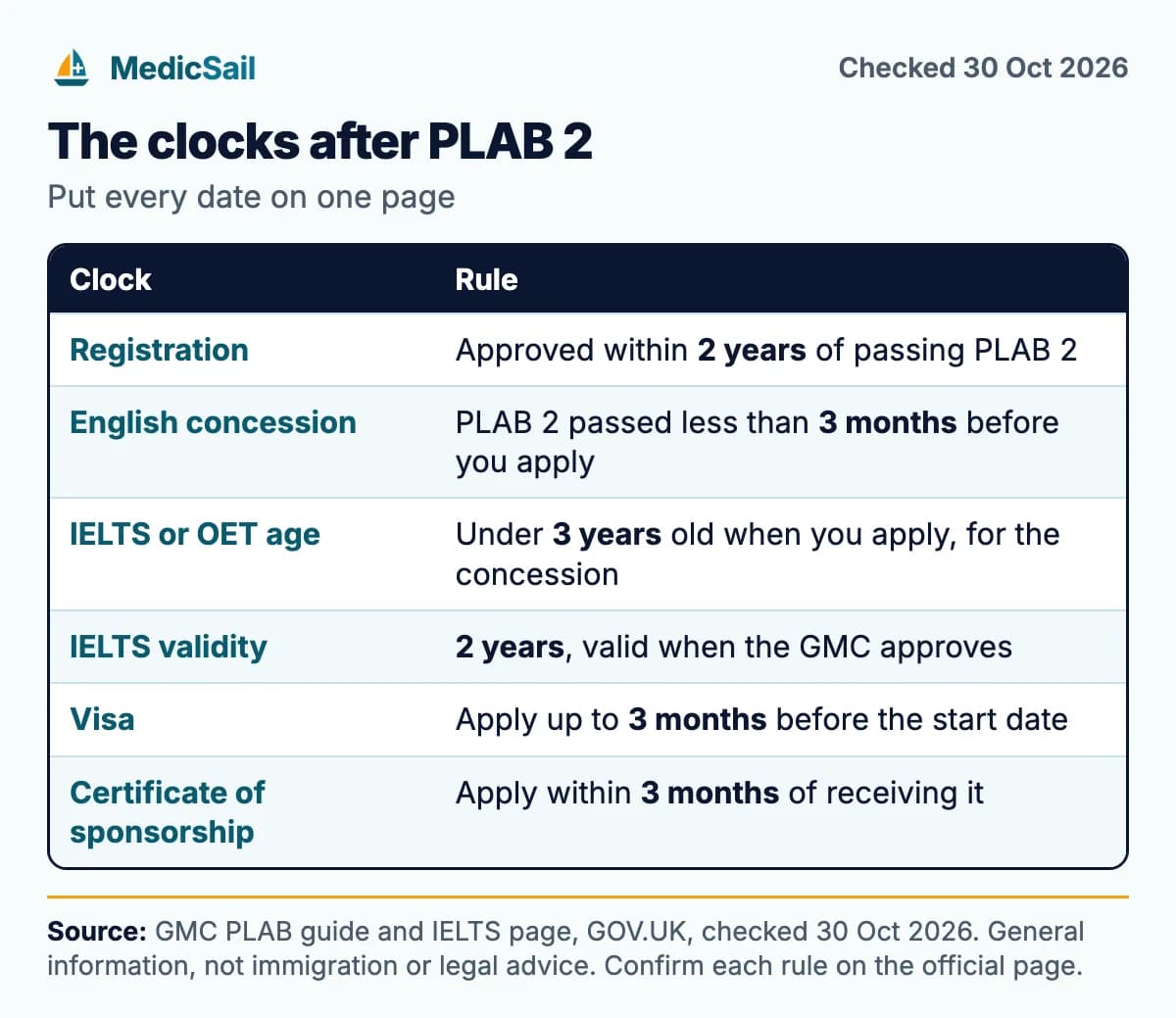
PLAB 2 results are published within a month of the exam in the 'My Tests' section of GMC Online. Three dates now matter:
| Clock | Rule | What to do |
|---|---|---|
| Registration window | Your registration should be approved within two years of passing PLAB 2. Your pass date is the exam date, not the results date. | Apply early. After two years the GMC asks for extra evidence of your knowledge and skills. |
| English evidence | Your IELTS or OET must be valid when the GMC approves your registration, unless the PLAB 2 concession applies. | Check your test date now. |
| PLAB 2 English concession | The GMC currently accepts a recent PLAB 2 pass as evidence you have kept up your English if you passed PLAB 2 less than three months before applying and met its IELTS or OET scores less than three years ago. | If your certificate is near expiry, apply within three months of your PLAB 2 date. The GMC checks this automatically. |
The concession is the reason many doctors submit their application within days of their result. If you miss the three-month window and your certificate has expired, you will need other English evidence, which can mean sitting IELTS or OET again. Our guide to IELTS and OET for UK regulators lists the GMC's scores.
Step 1: apply for registration with a licence to practise
You apply in GMC Online. In the UK, registration and the licence to practise are separate: the licence is what allows you to work as a doctor, prescribe and treat patients, so make sure you apply for full registration with a licence.
What the GMC asks for
- Your primary medical qualification, already verified through EPIC for PLAB. Our EPIC verification guide explains the process if anything is outstanding.
- Evidence of your internship or acceptable postgraduate experience. The GMC's standard is 12 months' continuous internship with at least three months each in medicine and surgery (for 12 to 18 months), or two years' continuous supervised postgraduate practice in a public hospital. Observerships and clinical attachments do not count.
- English evidence, or the PLAB 2 concession above.
- Your passport.
- A certificate of good standing from every medical regulator you have been registered or licensed with in the last five years, even where you never worked. Each certificate is valid for three months from the date it is signed and must still be valid when the GMC approves your application. Ask regulators to email it to the GMC directly where possible; the GMC will then ask you to post the original to its Manchester office and will not return it.
- Your activities for the last five years, medical and non-medical, including gaps such as unemployment, study, maternity leave or career breaks.
- Employer references on the GMC's form for any non-medical work, any medical work done without registration, and any observership or clinical attachment longer than two months. References for current posts are valid for three months from signing.
- A fitness to practise declaration, and certified translations of anything not in English.
The fee
| GMC fee | From 1 April 2026 |
|---|---|
| Application for full registration with a licence | £481 |
| Discounted application (primary medical qualification within the past five years) | £184 |
| Scrutiny fee kept if the application is refused, closed or withdrawn | £110 |
You pay when you submit; you cannot submit without paying. Gulf-registered doctors often have several regulators to cover, for example a health authority licence plus a home-country council, and each needs its own certificate. Our guide to moving from a Gulf licence to UK registration covers those certificates.
Step 2: the GMC identity check
Every applicant for registration must complete a GMC identity check. The GMC now does this through the Digidentity Wallet app. You get an invitation, complete the check in the app, and then log back into GMC Online.
- You must complete the check and log back in within three months of receiving the invitation. If you do not, the GMC says it is likely to refuse your application, and it cannot extend this deadline.
- If your application is refused or closed for this reason, you get a refund minus the scrutiny fee.
- If you cannot use the app, contact the GMC to book an in-person ID check at its London office. Questions about the app itself go to Digidentity.
Some recruiters and older guides say a PLAB 2 identity check replaces this step. The GMC's current FAQ says all applicants must complete a GMC identity check, so follow the instructions in your invitation.
Step 3: start the job search now, not after registration
Do not wait for your licence before applying for jobs. Recruitment and pre-employment checks take weeks, and many employers will interview a doctor whose registration is in progress, although practice varies and some adverts require full registration at the point of application. Put your GMC reference number on every application; our glossary explains the GMC reference number.
Where NHS doctor jobs are advertised
- NHS Jobs for England and Wales, and many trusts' own career pages.
- NHS Scotland's national job site for Scottish health boards, and HSC jobs for Northern Ireland.
- BMJ Careers for medical posts across the UK.
Large teaching trusts recruit international doctors every year. Our employer profiles include Manchester University NHS Foundation Trust, Leeds Teaching Hospitals and University Hospitals Birmingham. Smaller district hospitals often have more posts open to newly registered doctors. Only an employer that holds a Home Office sponsor licence can sponsor your visa; our guide to finding NHS trusts that sponsor visas explains how to check.
What makes an application stand out
- A UK-style CV: reverse chronological, with exact dates and every gap explained (the same gaps you declared to the GMC).
- Audit, quality improvement, teaching and courses, especially UK courses such as life support certificates if you have them.
- A supporting statement mapped to the person specification point by point. Shortlisting is usually scored against it.
- Referees who can be reached by email from an official address, ideally your most recent clinical supervisors.
Preparing for NHS interviews
Interviews for non-training posts are usually short panel interviews, increasingly held online, with a consultant from the department and someone from medical staffing. Formats vary by employer, but most panels cover the same ground:
- Why this post and this trust. Read the department's services and the trust's recent news before the interview.
- A clinical scenario, often an acutely unwell patient on a ward or in the emergency department. Panels want a structured approach (assessment, escalation, senior help) rather than rare diagnoses.
- Patient safety and governance, for example what you would do after a drug error or how you would raise a concern about a colleague.
- Teamwork and communication, including working with nurses, handover and dealing with an upset relative.
- Audit, quality improvement and teaching you have done, with what changed as a result.
- Your plans, such as whether you are aiming for a training post or the Portfolio pathway.
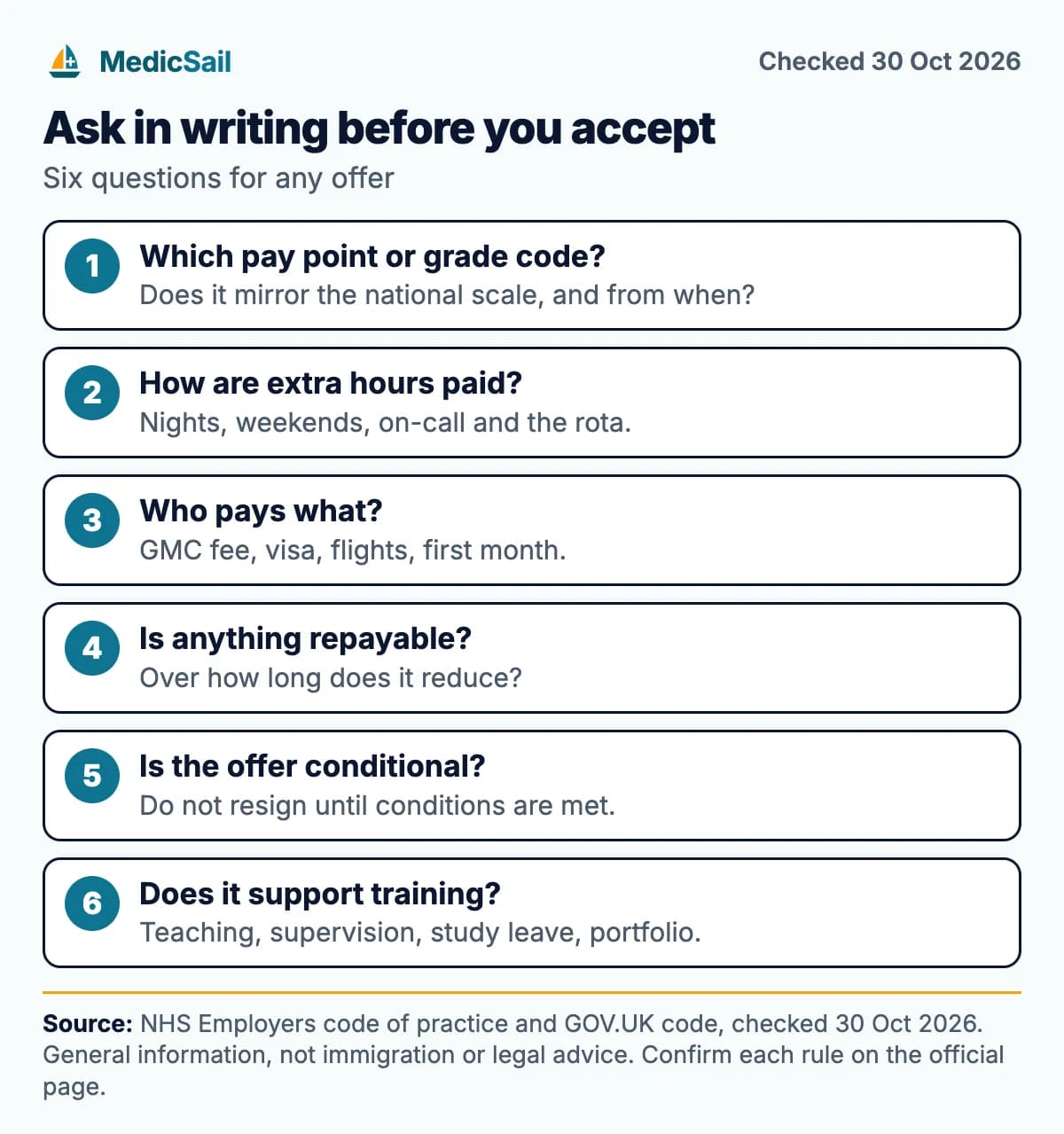
Answer with real cases from your own practice, using a simple structure: the situation, what you did, the result and what you learned. Panels also listen for familiarity with GMC guidance, so read Good medical practice before the interview. Ask at the end about the rota, the pay point, supervision, study leave and whether the post supports a portfolio for training. Those answers tell you more about a first post than the job title does.
Which jobs you can apply for
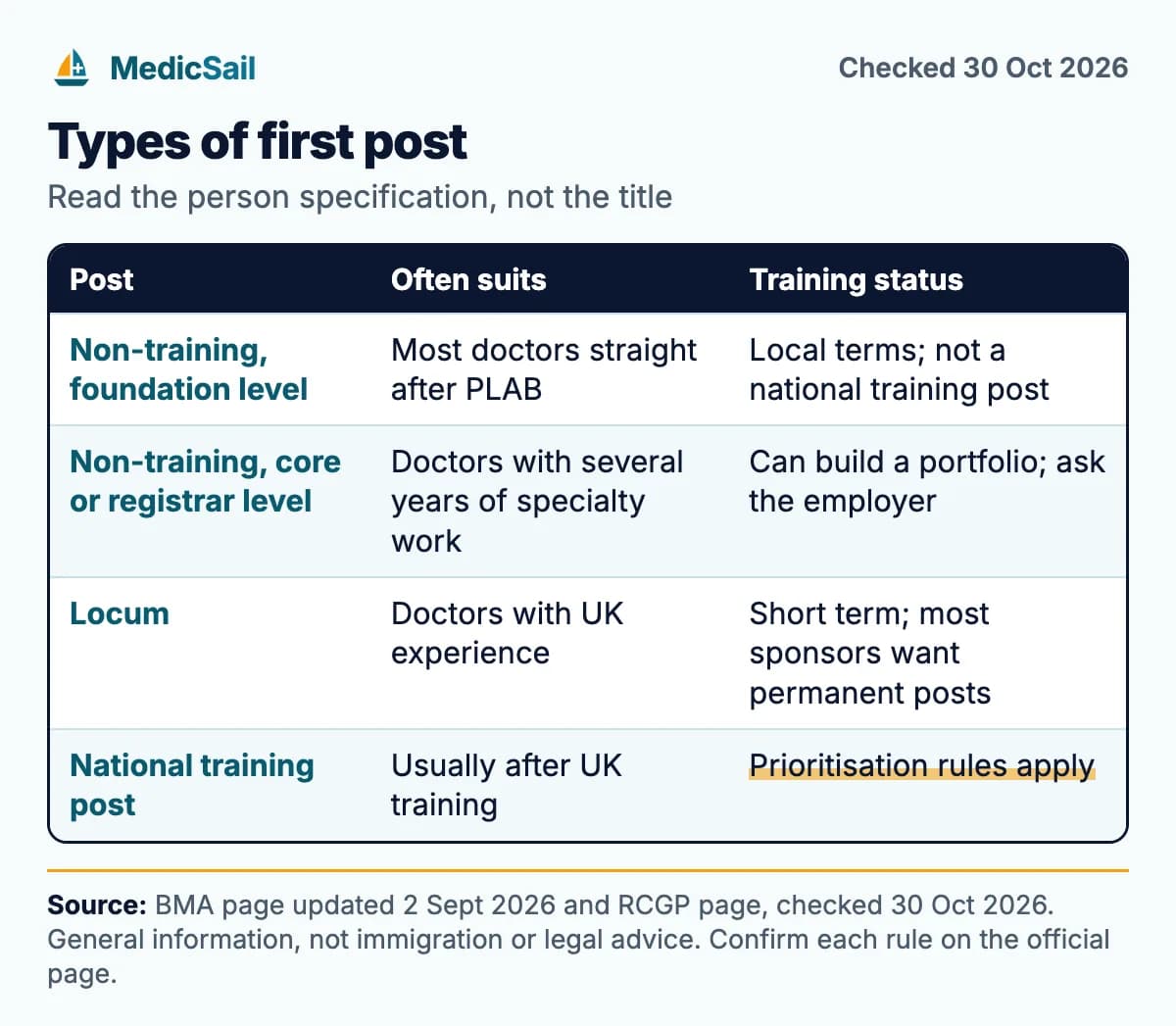
NHS job titles vary, so read the person specification rather than the title. These are the main groups open to a newly registered international doctor:
| Post type | Typical titles | Who it suits | Training status |
|---|---|---|---|
| Non-training post at foundation level | Trust grade FY2, junior clinical fellow, SHO-level clinical fellow | Most doctors straight after PLAB | Not a national training post; some include structured teaching or portfolio support |
| Non-training post at core or registrar level | Clinical fellow, trust registrar, specialty doctor (some) | Doctors with several years' specialty experience | Not training; can build evidence for training or the Portfolio pathway |
| Locum posts | Locum SHO, locum registrar | Doctors with UK experience | Short term; harder as a first job because most need a visa sponsor |
| National training posts | Core training, specialty training, standalone FY2 | Usually after UK experience | Competitive; prioritisation rules apply (below) |
The term locally employed doctor covers most of the first group. These posts are employed by the trust on local terms rather than through a training programme.
Training posts and the 2026 prioritisation law
The Medical Training (Prioritisation) Act 2026 became law on 5 March 2026. The BMA's summary says that for specialty training, prioritised groups include UK and Republic of Ireland graduates (and those from Iceland, Liechtenstein, Norway and Switzerland), doctors who have completed the relevant UK foundation or core training, and people with certain immigration statuses such as British citizenship or indefinite leave to remain. From 2027 recruitment, prioritisation applies at both shortlisting and offer. Standalone FY2 recruitment follows the same groups as the Foundation Programme, where international graduates were not prioritised in 2026. This is the main reason many doctors who pass PLAB spend their first years in non-training posts, and why completing UK training or gaining settled status changes your position later. See our specialty training glossary entry for how UK training is structured.
What your first NHS job pays
In England, national pay scales for resident doctors are set in NHS Employers' Pay and Conditions Circular (M&D) 1/2026 R2, with figures from 1 April 2026. Employers can pay locally employed doctors on matching codes but, the circular states, there is no requirement to do so: local terms are a matter for each employer.
| Level (England, 2026/27) | Nodal point | Basic salary |
|---|---|---|
| FY1 equivalent | 1 | £41,226 |
| FY2 equivalent | 2 | £47,610 |
| CT1 to CT2 / ST1 to ST2 equivalent | 3a and 3b | £55,355 |
| CT3 / ST3 equivalent | 4a | £67,325 |
Basic salary excludes extra pay for additional hours, nights, weekends and on-call, which can add a significant amount depending on the rota. Ask each employer which pay point the post is on, whether it mirrors the national contract and how the rota is paid. Wales applies its national uplifts automatically to locally employed doctors' pay scales; Scotland and Northern Ireland have their own arrangements. Our full breakdown is in NHS doctor salary 2026 by grade, and the NHS take-home pay calculator estimates net pay.
Step 4: the visa and pre-employment checks
Doctors with a job offer from a Home Office approved health employer usually apply for the Health and Care Worker visa. GOV.UK states:
- You need a certificate of sponsorship from your employer describing the role, in an eligible health or care occupation, and a minimum salary that depends on the type of work.
- The fee is £324 per person for up to three years and £628 for more than three years, whether you apply inside or outside the UK.
- You, your partner and your children do not pay the healthcare surcharge.
- You can apply up to three months before your start date and usually get a decision within three weeks.
The employer issues the certificate of sponsorship only after the offer and usually after some checks, so the visa is normally the last step before travel. Our Health and Care Worker visa guide covers family members and settlement, and the visa cost calculator totals the fees for your family. This is general information from GOV.UK, not immigration advice.
Pre-employment checks
After an offer, the employer runs NHS pre-employment checks. Typical items are:
- Confirmation of your GMC registration and licence.
- A right to work check once your visa is granted.
- A criminal record check: a DBS check in England and Wales (Scotland and Northern Ireland have their own schemes), plus overseas police certificates where the employer asks for them.
- Occupational health clearance, including immunisation records.
- References covering your recent employment, from referees the employer can verify.
Delays usually come from references and immunisation records, so collect vaccination evidence and referee contact details before you get an offer.
After you start: what the GMC expects
- Annual fee. You pay an annual fee on the anniversary of your registration: £481 with a licence from 1 April 2026. If your worldwide income is under £38,500, you can apply for a 50% discount once registered; doctors who qualified within the past five years may get the discounted fee of £184.
- Appraisal and revalidation. Licensed doctors have an annual appraisal and must revalidate, normally through the responsible officer at their employer.
- Welcome to UK practice. The GMC encourages doctors new to the UK to book its free Welcome to UK practice workshop in GMC Online, which covers ethical situations and lets you meet other international doctors.
- Induction. Ask for a structured induction and an educational or clinical supervisor even in a non-training post. It is not guaranteed, but many trusts offer it to international doctors.
Our page on working as a doctor in the UK covers the longer career path, including training and specialist registration.
A realistic timeline after PLAB 2
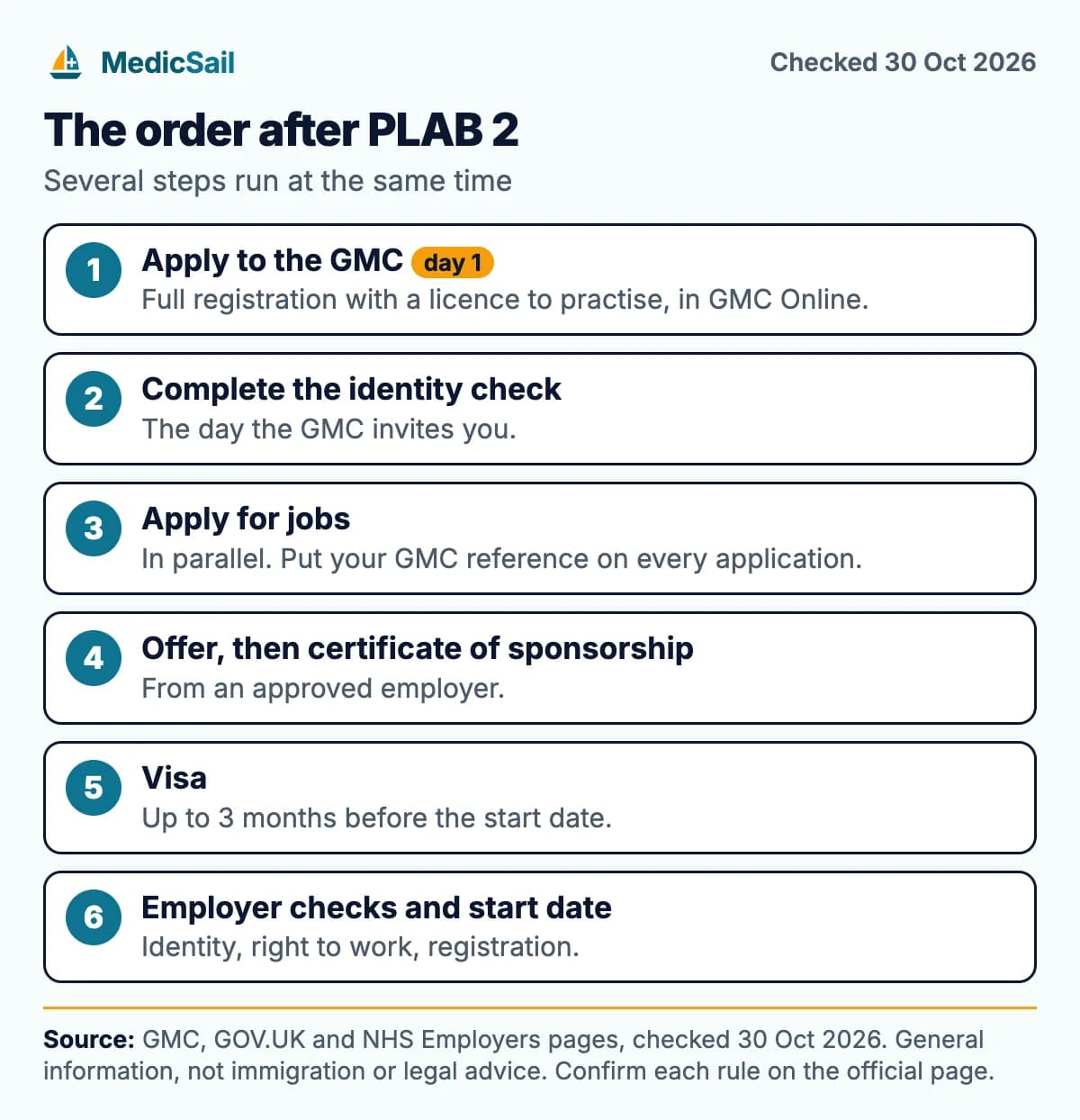
The GMC does not publish a single processing time for every applicant, and employers move at different speeds. This is the usual order, with the fixed rules marked:
- Results: within a month of the exam (GMC).
- Registration application: submit as soon as possible; within three months of your PLAB 2 date if you rely on the English concession (GMC).
- Identity check: within three months of the invitation (GMC).
- Job applications and interviews: in parallel with the GMC stage.
- Offer, certificate of sponsorship and visa: visa application up to three months before the start date, decision usually within three weeks (GOV.UK).
- Pre-employment checks and start date: set by the employer.
Certificates of good standing last three months, so request them close to submission rather than months ahead, and keep the two-year registration limit in view.
Mistakes that cost doctors months
- Waiting for registration before applying for any job.
- Missing the three-month PLAB 2 English concession when the certificate is about to expire.
- Requesting certificates of good standing too early, so they expire before approval.
- Leaving gaps in the five-year history, or a CV that does not match what you told the GMC.
- Assuming every job will sponsor a visa, or confusing a GMC Sponsorship Registration Certificate with a visa certificate of sponsorship.
- Accepting a post without asking which pay point it is on and how extra hours are paid.
If you trained in South Asia or Africa, our pages on moving from India, from Pakistan and from Nigeria cover document and verification issues specific to those countries.
Questions
Apply to the GMC for full registration with a licence to practise in GMC Online, with your certificates of good standing, five-year history and English evidence ready. Start applying for jobs at the same time rather than waiting for registration.
The GMC says your application should be approved within two years of passing PLAB 2, counted from the exam date. After that, the GMC asks for additional evidence of your knowledge and skills.
The GMC currently accepts a recent PLAB 2 pass as evidence of maintained English if you passed PLAB 2 less than three months before applying and achieved its IELTS or OET scores less than three years ago. It checks this automatically when you apply.
From 1 April 2026, the application for full registration with a licence costs £481, or £184 if you gained your primary medical qualification within the past five years. A £110 scrutiny fee is kept if the application is refused, closed or withdrawn.
Usually not. The GMC uses the Digidentity Wallet app, and you must complete the check and log back into GMC Online within three months of the invitation. If you cannot use the app, you can book an in-person check at the GMC's London office.
Yes, and most doctors do. Some employers interview candidates whose registration is in progress, while some adverts require full registration when you apply, so read each person specification.
Most doctors start in non-training posts such as trust grade, clinical fellow or locally employed doctor roles, often at FY2 or core level. National training posts are competitive and, since the Medical Training (Prioritisation) Act 2026, prioritise certain groups.
In England, the national resident doctor pay point 2 (FY2) is £47,610 basic from 1 April 2026. Employers can mirror this for locally employed doctors but are not required to, and extra hours, nights and weekends are paid on top.
Usually the Health and Care Worker visa, with a certificate of sponsorship from an approved employer. GOV.UK sets the fee at £324 for up to three years or £628 for longer, with no healthcare surcharge.
No. The GMC registers doctors but does not recruit, and registration does not guarantee a job. It recommends checking the job market for your specialty and location.
Sources
- 1GMC: PLAB 2, what to do after you get your results
- 2GMC: How do you get your PLAB 2 results?
- 3GMC: Check if your practical training (internship) is acceptable
- 4GMC: Your certificate of good standing (application guide)
- 5GMC: Your activities for the last five years (application guide)
- 6GMC: Identity checks, frequently asked questions
Show all 12 sourcesShow fewer sources
- 7GMC: Fees for doctors (from 1 April 2026)
- 8NHS Employers: Pay and Conditions Circular (M&D) 1/2026 R2
- 9NHS Wales: Pay circular M&D(W) 01/2026 Version 2
- 10BMA: What the new law means for UK graduate prioritisation
- 11GOV.UK: Health and Care Worker visa
- 12GOV.UK: Health and Care Worker visa, how much it costs
Plan it with our free tools
MedicSail
Healthcare licensing consultants for the UK, Europe and the USA
Updated and checked against the sources listed above. How we research and check our guides