


































Failed PLAB 1 or PLAB 2: attempts, appeals and what to do next
What to do after a PLAB 1 or PLAB 2 fail: how the GMC scored you, how to read your feedback, the four-attempt limit and the 12-month fifth attempt, appeal grounds and deadlines, resit fees for 2026 and the alternatives to PLAB.

MedicSail
Published
The short answer
If you failed PLAB 1 or PLAB 2, you can book the same part again as long as you still meet the General Medical Council's requirements. The GMC lets you keep sitting each part until you have failed it four times. After a fourth fail you can apply for one final, fifth attempt, but only after at least 12 months, and only if you have done 12 months of clinical practice or a postgraduate qualification in the meantime. If you have already failed a part more than four times, you can no longer take the test or apply for another attempt.
The GMC no longer re-checks or re-marks results. You can appeal, but only if something went wrong with how the exam was run or an exceptional circumstance affected you on the day, and you must contact the GMC within ten working days of your results being published. Disagreeing with your marks is not a ground for appeal.
A fail does not reset your clocks. You must still pass PLAB 2 within two years of passing PLAB 1, and each resit costs the full fee again: £283 for PLAB 1 and £1,036 for PLAB 2 from 1 April 2026. This guide explains how your result was worked out, how to read your feedback, the attempt and appeal rules exactly as the GMC states them, and how to plan a resit or another route. For the full route from the start, see our complete guide to PLAB 1 and PLAB 2.
How your PLAB 1 result was worked out
PLAB 1 results are published six weeks after the exam. The GMC emails you when they are ready and you read them in the 'My Tests' section of GMC Online. It does not give results by phone or at reception.
The score and the pass mark
Each correct answer is worth one mark, and your score is the number of questions you got right. There is no negative marking in that method: a wrong answer simply scores nothing. Your result shows three numbers: your total score, the score needed to pass that sitting, and the average score of all candidates.
The pass mark is not fixed. The GMC sets it for each test using the Angoff method, a standard-setting process in which experts judge how a borderline candidate would perform on each question, and then adds one standard error of measurement. The aim is to keep the standard the same over time, at the level expected of a doctor entering the second year of the Foundation Programme. After each test, experts review the paper in the light of how candidates performed to make sure every question is fair. The GMC states there is no expected pass rate or average score.
Your feedback by clinical area
The GMC groups PLAB 1 questions into ten areas of clinical practice based on the MLA content map, and tells you the percentage you answered correctly in each, alongside the average for all candidates:
| Area | What to check in your feedback |
|---|---|
| Cardiorespiratory | Acute presentations and long-term conditions |
| Child and adolescent health | Paediatric emergencies, development, safeguarding |
| Endocrine, metabolic and clinical haematology | Diabetes, thyroid, anaemia, electrolytes |
| Gastrointestinal | Acute abdomen, liver disease, bleeding |
| Mental health | Risk assessment, capacity, common disorders |
| Musculoskeletal | Trauma, joint and back problems |
| Neurosciences and senses (including skin) | Neurology, eyes, ENT, dermatology |
| Renal and urology | AKI, CKD, urinary problems |
| Reproductive health | Obstetrics, gynaecology, sexual health |
| Ethics and other | GMC guidance, consent, confidentiality, UK practice |
The right-hand column is our suggestion of what each area usually covers, not the GMC's wording. The areas where you scored well below the candidate average are the ones to fix first.
How your PLAB 2 result was worked out
PLAB 2 results are published within a month of the exam, again in 'My Tests' in GMC Online. PLAB 2 is an objective structured clinical examination (OSCE), and the way it is marked explains why some candidates fail despite feeling they did well in most stations.
Three marking domains in every station
In each station the examiner scores you in three domains:
- Data gathering, technical and assessment skills
- Clinical management skills
- Interpersonal skills
Each domain is scored out of the same total, so your results show where you are stronger. The examiner also makes a separate judgement of Unsatisfactory, Borderline, Satisfactory or Good. That judgement does not decide whether you pass the station, and it is not shown to you, but the GMC uses it to calculate each station's pass mark with a method called borderline regression. The examiner does not know the pass mark when marking you; it is calculated after the exam.
Two conditions to pass overall
To pass PLAB 2 you must do two things at once:
- Reach the overall pass mark, which is the sum of the station cut scores plus one standard error of measurement.
- Pass a minimum number of stations.
Since November 2024 the GMC no longer uses a fixed minimum of ten stations. It calculates the number of stations needed for each exam separately, using a regression method. You are not told exactly how many stations were needed for your exam, but you can ask the GMC at [email protected]. This is why a candidate can reach the overall score and still fail on stations, or pass many stations narrowly and still fall short of the total.
Some other points the GMC makes: pass marks differ between the two Manchester centres on the same day because each runs a different set of stations; the GMC may remove a station from your results for quality reasons, and recalculates the pass mark if it does; and adding up the station pass marks will not give you the overall pass mark, because of the extra standard error of measurement.
Reading your PLAB 2 feedback statements
Alongside the marks, examiners can choose from ten pre-set feedback statements for each station. They must do so if they judged you Unsatisfactory or Borderline, and may do so otherwise. These statements are the most useful part of a PLAB 2 fail, because they point to habits rather than knowledge gaps.
| Statement | What the GMC says it means | What to practise |
|---|---|---|
| Consultation | Disorganised or unstructured consultation; illogical questioning or tasks done in an illogical order | A fixed structure for histories, examinations and explanations |
| Issues | Did not recognise the key problem or priority, for example giving lifestyle advice to an acutely ill patient | Reading the task card for what matters most in eight minutes |
| Time | Poor time management, too long on less important parts | Timed stations with a partner and a clock |
| Findings | Did not identify abnormal findings or their implications | Interpreting observations, results and examination signs aloud |
| Examination | Physical examination not done competently, or instruments not used proficiently | Hands-on examination routines |
| Diagnosis | Wrong working diagnosis or too narrow a differential | Stating a working diagnosis and differentials clearly |
| Management | Plan not in line with current best practice, including follow-up and safety netting | UK guidance, BNF drug names, safety-netting phrases |
| Rapport | Did not build rapport or show sensitivity, including stock phrases | Responding to the actual patient, not a script |
| Listening | Poor active listening; asked questions but did not act on the answers | Exploring ideas, concerns and expectations, then using them |
| Language | Jargon, speaking too fast or not checking understanding | Plain-English explanations and checking back |
The middle column summarises the GMC's published descriptions; the right-hand column is practical advice, not GMC guidance. If the same two or three statements appear across several stations, that pattern is your resit plan. Note that the GMC lists "use of stock phrases" under rapport: memorised empathy lines are something examiners are told to notice.
How many attempts you get
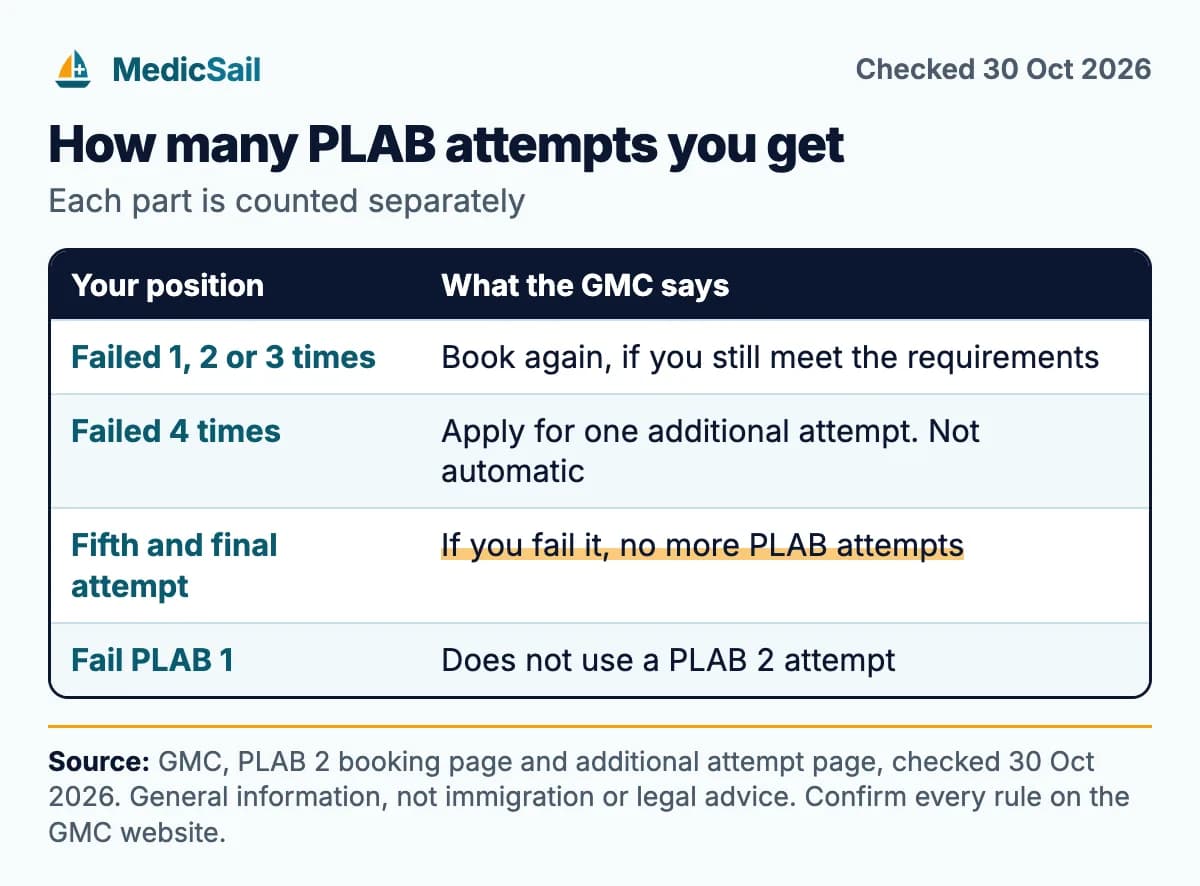
The rules are the same for PLAB 1 and PLAB 2, and each part is counted separately.
| Your position | What the GMC allows |
|---|---|
| Failed once, twice or three times | Book again in GMC Online, provided you still meet all the requirements (including valid English evidence for PLAB 1) |
| Failed four times | No more standard attempts. You can apply for one final additional attempt after at least 12 months, with evidence of further learning |
| Failed more than four times (used the additional attempt and failed) | No longer eligible to take the test or apply for another attempt |
So the absolute maximum is five sittings of each part, and the fifth is not automatic. A fail on PLAB 1 does not use up a PLAB 2 attempt, and the reverse is also true.
What does not count as an attempt
If you become unwell during an exam and tell a GMC staff member straight away, the GMC says it will refund the exam fee once you provide evidence of your illness, annul the result, and the sitting will not count as an attempt. By starting the exam you confirm you are well enough to be assessed, so you cannot claim illness afterwards for a sitting you completed without raising it. An upheld appeal can also annul a result (see below).
Applying for the additional (fifth) attempt
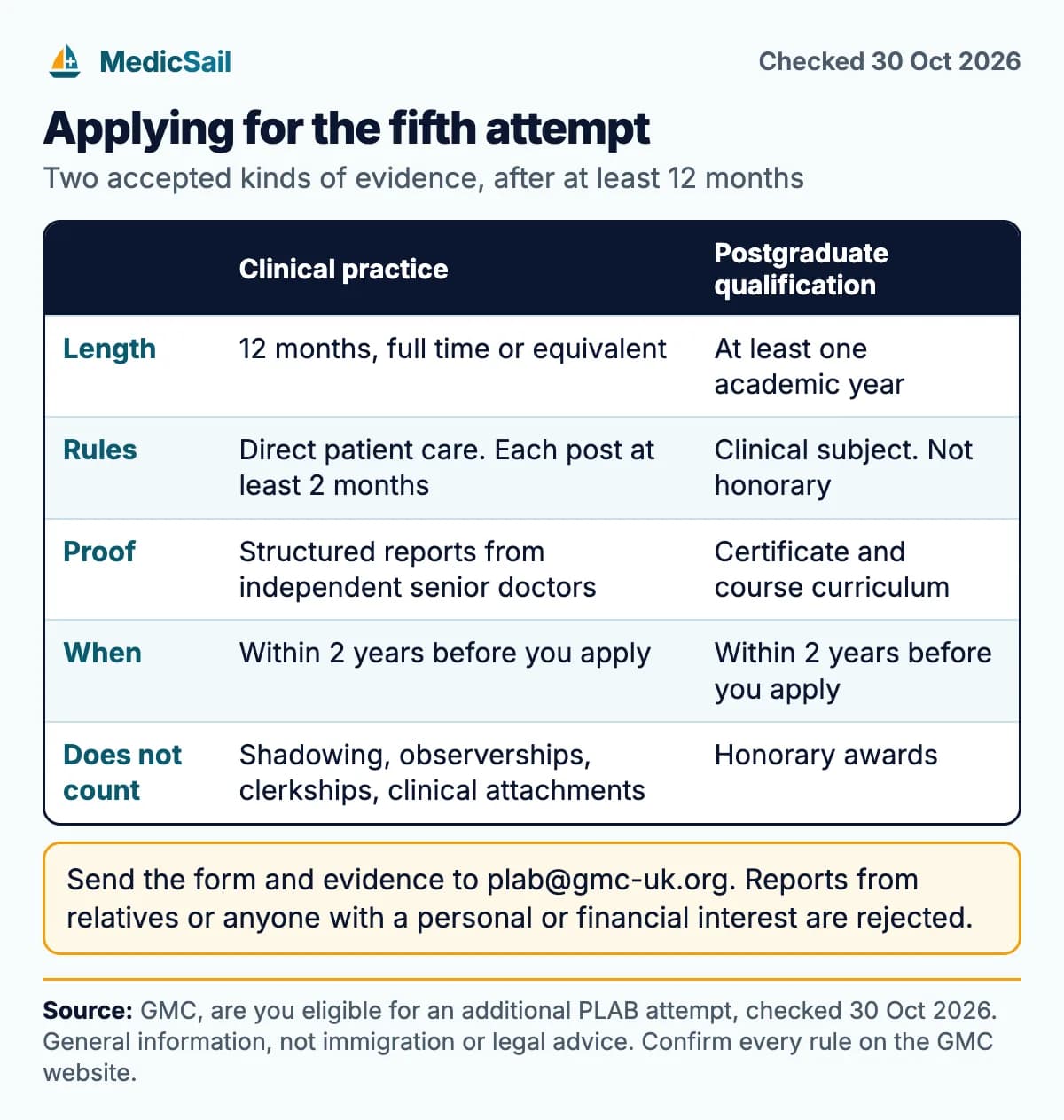
The GMC's conditions for the additional attempt are specific, and they apply to both parts:
- At least 12 months must pass between your fourth failed attempt and your request for an additional attempt.
- In that time you must have completed either 12 months' clinical practice or a postgraduate qualification.
- Either one must have been completed in the two years before you request the attempt, at an institution that meets the regulatory standards of its country and that the GMC can verify.
If you use clinical practice
- At least 12 months full time (or the part-time equivalent) with direct patient care.
- Each post must last at least two months.
- Structured reports from the senior doctors responsible for your work, on the GMC's structured report form, showing satisfactory completion. Each referee must give a work email address.
- Honorary posts, clinical attachments, shadowing, observerships and clerkships do not count.
- The GMC will not accept reports completed by a relative or anyone with whom you have a personal, business or financial interest, or reports that are incomplete.
If you use a postgraduate qualification
- A clinical subject for which a primary medical qualification or another degree is needed for entry.
- At least one academic year of study (or the part-time equivalent), with a certificate from the awarding institution. Honorary qualifications are not accepted.
- You send a copy of the certificate and the course curriculum with the application form.
Applications go to [email protected]. Two knock-on effects catch people out. If you are granted an extra PLAB 1 attempt, you may need to submit valid English evidence again before you can book. If you are granted an extra PLAB 2 attempt and your PLAB 1 pass has expired in the meantime, you may have to sit PLAB 1 again, and possibly provide new English evidence too. Plan the 12 months with those two clocks in mind.
Appeals: when you can challenge a result
The GMC stopped offering manual checks of results because it is confident its marking is robust and that a manual check will not change the outcome. What remains is an appeal, and the grounds are narrow.
Valid grounds
- An irregularity in the conduct of the exam, including administrative errors.
- Unexpected or exceptional circumstances that arose during the exam.
Not valid grounds
- You think your efforts were under-marked.
- You did not understand, or were unaware of, the exam procedures.
- You want to question the exercise of professional or academic judgement.
How to appeal
Contact the GMC within ten working days of the publication of your results, with a full explanation and any evidence of what happened, how it affected your performance and how it meets the grounds. If a problem happened on the day and was not resolved there, the GMC advises you to report it as soon as possible rather than waiting for your result. A late appeal must explain, with evidence, why it could not be sent sooner; the GMC then decides whether to consider it.
If the GMC thinks there are sufficient grounds, a decision maker reviews the case. If the appeal is upheld, possible outcomes include annulling your result, a free attempt, an additional attempt, or a combination of these. You will be told the decision in writing. Feedback or complaints that are not appeals go to [email protected], and the GMC may reclassify an appeal as a complaint or the other way round.
If you are applying to the UK Foundation Programme, note that the UK Foundation Programme Office says a GMC appeal does not pause its PLAB evidence deadlines. Our guide on the Foundation Programme or PLAB for new graduates covers those dates.
Your clocks keep running after a fail
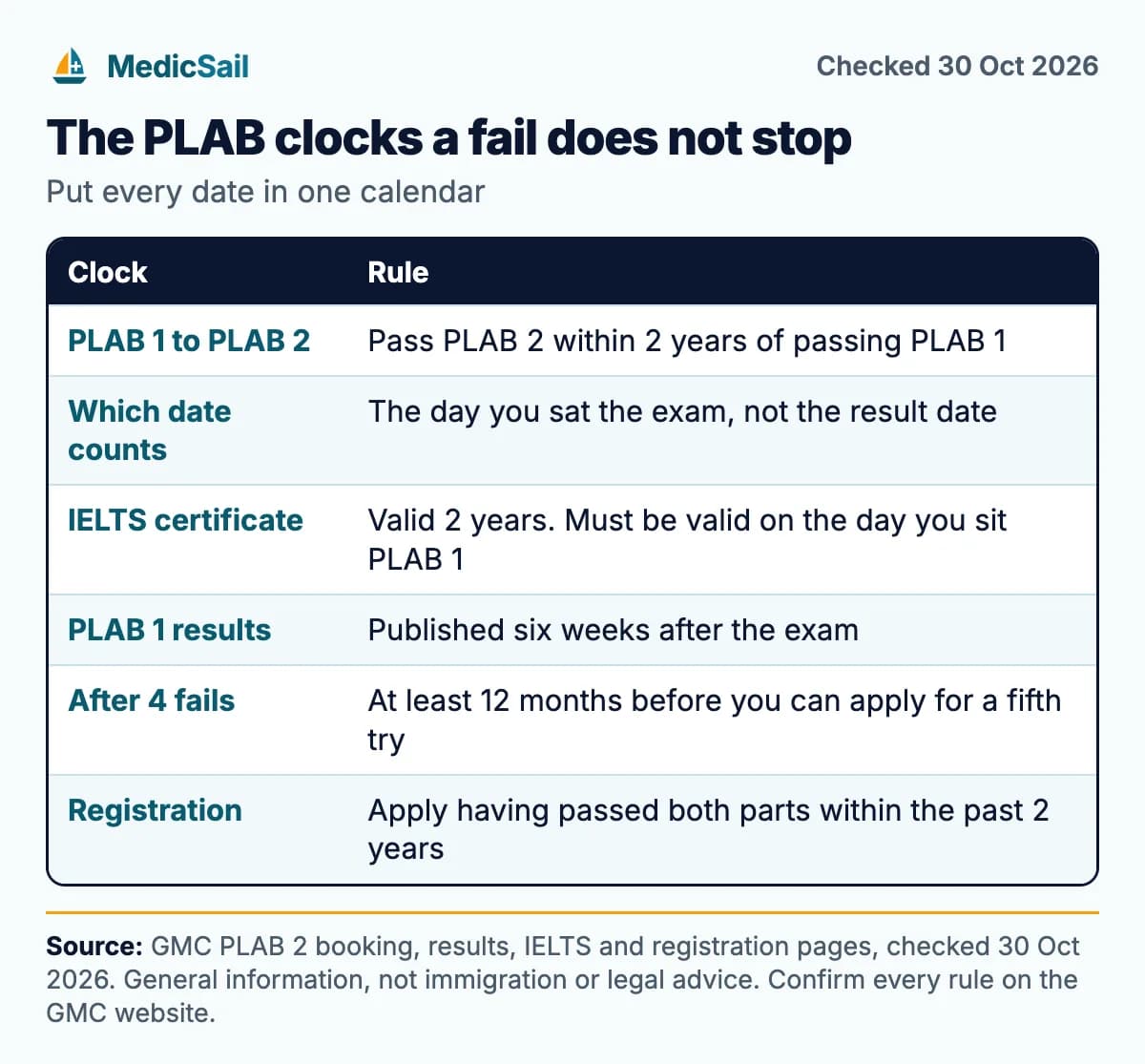
A fail does not stop or reset any of the GMC's time limits:
- PLAB 1 to PLAB 2: you must pass PLAB 2 within two years of passing PLAB 1. The temporary three-year COVID-19 extension ended on 31 March 2025. If you fail PLAB 2 repeatedly and your PLAB 1 pass expires, you need to pass PLAB 1 again.
- Pass dates: the date that counts is the date you sat the exam, not the date the result was issued.
- English: IELTS and OET results last two years for the GMC. Your English evidence must be valid when you sit PLAB 1. If you fail PLAB 1 and your certificate expires before your next sitting, you need new English evidence before you can book. Our comparison of IELTS and OET for UK regulators sets out the scores.
- Registration: after passing PLAB 2, your registration should be approved within two years, or the GMC asks for more evidence.
When something outside your control stops you
The GMC says it will consider support, such as an earlier date or an extension of your eligibility period, if exceptional circumstances beyond your control stop you attempting the exam in time. Its examples are war, severe and ongoing health issues, pregnancy and maternity, ongoing travel restrictions and mandatory military service. Contact the GMC as soon as possible. If an exam sitting is severely disrupted, for example by a power cut, the GMC may annul a failed attempt, offer an additional attempt, arrange a resit or extend your eligibility.
What a resit costs in 2026
Every resit is charged at the full exam fee. These are the GMC's fees from 1 April 2026:
| Item | Fee from 1 April 2026 |
|---|---|
| PLAB 1 (each attempt) | £283 |
| PLAB 2 (each attempt) | £1,036 |
| PLAB 1 cancelled more than 42 days before | £28.30 (10%) |
| PLAB 1 cancelled 42 days or less before | £283 (100%) |
| PLAB 2 cancelled more than 42 days before | £103.60 (10%) |
| PLAB 2 cancelled 42 to 29 days before | £518 (50%) |
| PLAB 2 cancelled 28 days or less before | £1,036 (100%) |
The GMC may refund a cancellation fee in exceptional circumstances such as visa refusal, new travel restrictions, ill health or bereavement: cancel first, then email your evidence. On top of the fee, a PLAB 2 resit means another trip to Manchester, and possibly another UK visit visa, flights and accommodation. If the GMC cancels a sitting itself, it refunds the booking fee but does not cover visa, travel or hotel costs. Our registration cost estimator adds these items up for your situation.
Planning the resit: what to change
The GMC does not publish advice on how long to wait before a resit, and booking depends on available dates. The decisions below are practical points, not GMC rules.
After a PLAB 1 fail
- Compare yourself with the average, area by area. If you were far below the candidate average in two or three areas, those decide your plan. A narrow fail spread evenly across areas usually means exam technique and timing as much as knowledge.
- Re-anchor on UK practice. The GMC says to answer by current UK best practice and published evidence, not local arrangements. Many repeat candidates know the medicine but answer by the protocols of the country they trained in. NICE guidance, the BNF and GMC ethical guidance are the reference points.
- Do not neglect ethics. "Ethics and other" is one of the ten reported areas. GMC guidance on consent, confidentiality and capacity is free to read.
- Check your English date before you book. An expired certificate blocks the booking.
After a PLAB 2 fail
- List your feedback statements across all stations. Repeated statements show patterns; one-off statements are less important.
- Look at your domain totals. A low interpersonal score with good data gathering needs a different plan from the reverse.
- Practise out loud, timed, with feedback. PLAB 2 tests behaviour under an eight-minute clock. Reading alone rarely fixes "Time", "Consultation" or "Listening".
- Watch the two-year clock from your PLAB 1 pass before choosing a date.
If you are working clinically in the meantime, keep records: if you ever need the fifth attempt, 12 months of verifiable clinical practice with structured reports is one of the two accepted forms of evidence.
If PLAB is not working: other routes to consider
PLAB is the most common route, but not the only one. If you are running out of attempts or time, these are the main alternatives:
- An accepted postgraduate qualification. The GMC accepts certain UK and overseas postgraduate qualifications, such as MRCP(UK), MRCS or MRCOG, in place of PLAB, usually awarded within three years of approval. See our guide on how to get GMC registration without PLAB.
- A GMC-approved sponsorship scheme. Some NHS trusts, royal colleges and universities can sponsor experienced doctors for registration. Every scheme expects medical practice in three of the last five years, including the most recent 12 months.
- Another country. Ireland, the USA and other European countries have their own routes. Compare the PRES route to the Medical Council in Ireland and the USMLE route to the USA, or the country overviews on our doctors hub.
Two cautions. The Medical Training Initiative, once a common alternative, closed to new applicants at noon on 31 March 2026, according to the Academy of Medical Royal Colleges. And the GMC keeps its own record of your attempts, so changing route does not erase them; answer any questions about previous attempts honestly. For the regulator's wider requirements, see our GMC overview and our page on working as a doctor in the UK. The term PLAB and its link with the UKMLA are explained in our glossary: the GMC says PLAB now meets the Medical Licensing Assessment requirements, though it will keep the PLAB name for a while longer.
Questions
You can keep booking PLAB 1 until you have failed it four times, provided you still meet the requirements. After four fails you can apply for one additional attempt after at least 12 months, with evidence of 12 months' clinical practice or a postgraduate qualification. If you have already failed more than four times, you are no longer eligible.
Yes. The GMC applies the same rule to each part separately: four standard attempts, then one additional attempt on the same conditions. Failing PLAB 2 does not use up PLAB 1 attempts.
No. The GMC no longer offers manual checks, saying it is confident its marking is robust. You can appeal, but only for an irregularity in how the exam was run or an exceptional circumstance on the day, not because you think you were under-marked.
You must contact the GMC within ten working days of the publication of your results, with a full explanation and evidence. A late appeal must explain why it could not be sent sooner, and the GMC decides whether to consider it.
There is no fixed pass mark. The GMC sets it for each sitting using the Angoff method plus one standard error of measurement, and your results show your score, the pass score for that sitting and the candidate average.
You need both the overall pass score and a minimum number of passed stations. Since November 2024 the number of stations needed is calculated for each exam rather than fixed at ten, and you can ask the GMC at [email protected] about the minimum for your exam.
Yes. You must pass PLAB 2 within two years of passing PLAB 1. If that time runs out, you need to pass PLAB 1 again, and your English evidence must be valid when you resit it.
If you tell a GMC staff member during the exam that you are not well enough to continue, the GMC says it will refund the fee once you provide evidence, annul the result, and it will not count as an attempt. By starting, you confirm you are fit to sit, so raise it at the time.
Each resit costs the full fee: £283 for PLAB 1 and £1,036 for PLAB 2 from 1 April 2026. PLAB 2 also means travel to Manchester, and cancellation fees apply if you change dates.
Possibly. The GMC accepts certain postgraduate qualifications and approved sponsorship schemes instead of PLAB, and specialists may use the Portfolio pathway. Each has its own conditions, and the Medical Training Initiative closed to new applicants on 31 March 2026.
Sources
- 1GMC: PLAB 1, your results
- 2GMC: PLAB 1, what to do after you get your results
- 3GMC: Are you eligible for an additional PLAB 1 attempt?
- 4GMC: How do you appeal your PLAB 1 result?
- 5GMC: How do you get your PLAB 2 results?
- 6GMC: Understanding your PLAB 2 results
Show all 14 sourcesShow fewer sources
- 7GMC: PLAB 2, what to do after you get your results
- 8GMC: Are you eligible for an additional PLAB 2 attempt?
- 9GMC: How do you appeal your PLAB 2 result?
- 10GMC: PLAB 2 cancellations and exam disruptions
- 11GMC: PLAB and the MLA requirements
- 12GMC: Fees for doctors (from 1 April 2026)
- 13UK Foundation Programme: UKFP 2027 eligibility, PLAB
- 14Academy of Medical Royal Colleges: MTI scheme closure questions and answers
Plan it with our free tools
MedicSail
Healthcare licensing consultants for the UK, Europe and the USA
Updated and checked against the sources listed above. How we research and check our guides