


































Medical Council Ireland: supervised division vs general division
How the Medical Council's Supervised and General Divisions differ, who qualifies for each, the PRES Level 2 exemption list for supervised posts, what happens when a post ends, and how to transfer to general registration.

MedicSail
Published
The short answer
The General Division of the Medical Council's register lets you practise medicine anywhere in Ireland, independently and without supervision, in any post you are employed in, though not as a specialist. The Supervised Division is far narrower: it registers you for one individually numbered post that the HSE has proposed you for and the Medical Council has approved, with named consultant supervisors, and you may not practise medicine in Ireland outside that post. If you leave the post, your supervised registration ends.
The entry bar is different too. For general registration, a doctor who qualified outside the EU/EEA must come through the Certificate of Experience route, the Higher Qualification route, or pass both levels of PRES (or hold a PLAB 2 pass). For supervised registration you need an offer of an HSE-approved supervised post first, then a pass in PRES Level 2 or a qualification on the Council's separate Supervised Division exemption list, which is wider than the general list and includes several Gulf and Pakistani board qualifications. You do not sit PRES Level 3 for the Supervised Division.
Supervised registration is time-limited by law: no more than 2 years in aggregate, or 3 years with the HSE's written approval in a particular case. To stay in Ireland beyond that, or to change jobs freely, you transfer to the General Division by meeting the general criteria, and the Council charges a €250 application fee for that transfer. This guide sets out both divisions side by side, who qualifies for each, how supervised posts work in practice, and how to move from supervised to general. For the exam itself, read our separate guide to PRES Level 2 and Level 3; for the whole Irish route, see the Medical Council registration overview.
The divisions of the register at a glance
The Register of Medical Practitioners is split into divisions, and your division decides where and how you can work. The Council's PRES handbook describes four divisions for practising doctors (General, Trainee Specialist, Supervised and Specialist), and the Council also registers interns and allows temporary visiting practice by doctors established in another EU state.
| Division | What it lets you do | Who it is for |
|---|---|---|
| General | Practise independently without supervision, in any post; you may not represent yourself as a specialist | Doctors who meet the general criteria: for non-EU/EEA graduates, the COE, HQ or PRES route |
| Supervised | Practise only in one approved, individually numbered post, under named supervisors | Doctors the HSE has proposed for an approved supervised post, who have passed or are exempt from PRES Level 2 |
| Trainee Specialist | Practise in HSE-allocated posts on a recognised training programme | Doctors who hold, or are eligible for, general registration and are on a recognised programme |
| Specialist | Practise independently and represent yourself as a specialist | Doctors with recognised specialist training, or whose existing training is evaluated as equivalent |
| Internship | Complete the intern year in a recognised hospital post allocated by the HSE | Graduates starting an intern year in Ireland |
For an international medical graduate (IMG) arriving from outside the EU/EEA, the real choice is almost always between the General Division and the Supervised Division. Trainee Specialist registration follows from general eligibility, and Specialist registration needs an evaluation of your training that most doctors apply for later. You can check any doctor's division, including your own once registered, on the Council's public register.
The General Division: who qualifies and what it allows
The Medical Council says doctors with general registration may practise independently without supervision but may not represent themselves as specialists. Most non-consultant hospital doctors (NCHDs) outside training schemes work on general registration, in posts such as senior house officer and registrar, and many stay on the General Division for years. Because it is not tied to a post, you can change hospital, specialty or employer without asking the Council to approve the new job.
If you qualified outside the EU/EEA, the Council says you must pass or be exempt from PRES, and it gives three routes:
- Certificate of Experience (COE) route: your internship was completed in a country whose internship the Council treats as at least equivalent to the Irish one. The list includes Australia, Malaysia, Malta, New Zealand, Pakistan, South Africa, Sudan and the UK, each with conditions about dates and structure.
- Higher Qualification (HQ) route: you hold a postgraduate qualification on the Council's recognised list (for example MRCPI, MRCP(UK), MRCS, MRCOG, MRCPCH, MRCPsych or FRCR), plus a twelve-month internship with at least three months each in medicine and surgery, or at least three years in one accredited training programme.
- PRES route: everyone else passes PRES Level 2 (or an accepted alternative such as PLAB 1 or USMLE Step 1 and Step 2 CK) and PRES Level 3. A pass in the GMC's PLAB 2 exempts you from PRES altogether.
The Council warns that if you apply through a route you do not meet, it closes the application and does not refund the fee, so check the eligibility chart before you pay. The first-time application fee for the General or Trainee Specialist Division is €451, and you then pay an annual registration fee. Every route also needs EPIC verification of your degree, English evidence and certificates of good standing; our EPIC verification guide explains the first of those, and the PRES guide covers the exam route in detail, so we do not repeat it here.
The Supervised Division: how it actually works
The Supervised Division was created by the Medical Practitioners (Amendment) Act 2011 and sits in section 50A of the Medical Practitioners Act 2007. It exists so that the public health service can fill specific posts with doctors who have not met the general criteria, provided each doctor works under supervision arrangements the Council has approved. The key features come straight from the Act and the Council's rules:
- One post only. Registration applies only to an individually numbered, identifiable post approved by the Council. The post must be certified by the HSE as publicly funded, or be funded by a third country that is sponsoring you. You may not practise medicine in the State other than in that post and under its terms and conditions of employment.
- The HSE starts it, not you. The Council's joint arrangement document with the HSE says it cannot consider an application from an individual unless it comes with a proposal from the HSE. The employer completes a section 50A declaration setting out the post, its grade (senior house officer or registrar), your duties, why the hospital needs to employ you, and the supervision in place, including out of hours.
- Named supervisors and reports. Your supervisors must be consultants on the Specialist Division. Under the declaration in the Council's rules, your clinical supervisor completes supervision reports at three months, at six months and every six months after that, gives you a copy, and makes them available to the Council on request.
- A time limit. Section 50A says you may not be registered in the Supervised Division for more than 2 years in aggregate, or more than 3 years in aggregate with the HSE's written approval in a particular case. The Council's own page describes registration as an aggregate of two years in a supervised post.
- Registration ends with the post. If you stop holding the post, you stop being registered in the Supervised Division, and you must stop practising medicine in Ireland.
The registration year runs from 1 July to 30 June, as it does for every division, and you can be registered at any point in it. Once you are declared eligible you pay the registration fee, and the clinical site submits a section 50 form detailing the supervised post.
Who qualifies for supervised registration, and the PRES Level 2 exemption list
The Council's supervised registration page says the division is for doctors who have been offered a post approved by the HSE that has specific supervisory arrangements, and that the HSE should first tell you whether supervised registration is required. It is blunt about timing: do not apply unless a supervised post has already been offered, because application fees are non-refundable.
Beyond the offer, the Council's 2013 rules for the division (S.I. No. 208 of 2013) set two levels of assessment:
- Level 1: verification of your documents, including identity, medical qualifications, a certificate of good standing and the letter of offer for the HSE-certified post, plus the section 50A declaration signed by the hospital's chief executive (or equivalent) and your clinical supervisor.
- Level 2: PRES Level 2, the written knowledge exam, unless you are exempt. The rules allow a maximum of three attempts.
Once you pass both levels, the rules say you are registered in the Supervised Division in a supervised post. There is no PRES Level 3 requirement for this division, which is the main reason it can be quicker than the PRES route to general registration.
Exemptions from PRES Level 2 for the Supervised Division
The Council publishes a separate list, "Supervised Division Exempting Qualifications from PRES 2", last updated in March 2026. It is organised by specialty (anaesthesia, pathology, obstetrics and gynaecology, paediatrics, medicine, surgery, emergency medicine, radiology, general practice, psychiatry, ophthalmology and occupational medicine) and is noticeably wider than the HQ list used for general registration. Examples from the March 2026 list:
- Pakistan: College of Physicians and Surgeons Pakistan Intermediate Module in specialties such as anaesthesiology, medicine and psychiatry, and FCPS in anaesthesia taken after 1998.
- Gulf boards: Saudi Board (Saudi Commission for Health Specialties) intermediate or complete qualifications in several specialties, Arab Board intermediate (Part One) or complete qualifications, Omani Medical Specialty Board certificates, and Kuwait Institute for Medical Specialization board qualifications.
- Partial UK and Irish college exams: for example MRCPI Part 1 in general medicine or paediatrics, MRCS Part A, and the Royal College of Pathologists' Part One examinations.
- Full memberships and fellowships: the Irish, UK, Australian, Canadian, South African and American college qualifications, many of which also appear on the general HQ list.
- Non-specialty exams: PLAB at least Part 1, USMLE at least Step 1 and 2, the Australian Medical Council examination, the Licentiate of the Medical Council of Canada, MCCQE or MCCEE, and NZREX.
For many of the college qualifications the Council adds a condition: you must also have an internship of at least twelve months, with at least three months each in medicine and surgery, or at least three years in an accredited training programme. Check which group your qualification sits in on the current PDF before you rely on it.
You also need English evidence. The supervised page gives IELTS Academic as an example, and the Council's general English language rules (OET Medicine at grade B in each module, or IELTS Academic 7.0 overall with 6.5 in each module) are the standard to plan for.
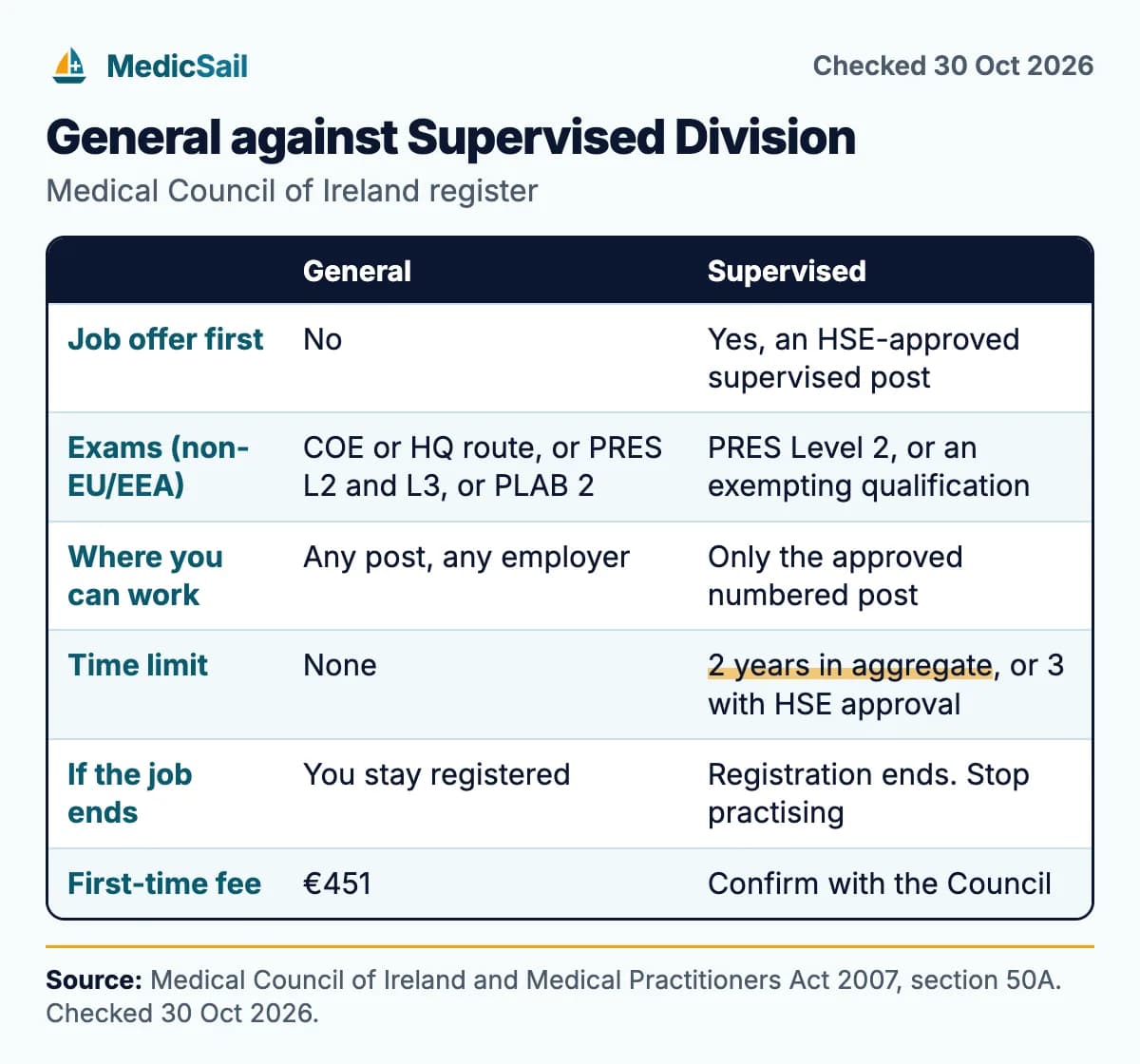
Supervised vs general division: side by side
| General Division | Supervised Division | |
|---|---|---|
| Job offer needed to apply | No | Yes: an offer of an HSE-approved supervised post, proposed by the HSE |
| Exams for non-EU/EEA graduates | COE or HQ route, or PRES Level 2 and Level 3, or a PLAB 2 pass | PRES Level 2, or a qualification on the Supervised Division exemption list |
| Where you can work | Any post, any employer, public or private | Only the approved, individually numbered post |
| Supervision | None required by the Council | Named consultant supervisors and periodic supervision reports |
| Time limit | None, as long as you pay the annual fee and meet competence requirements | 2 years in aggregate, or 3 with HSE written approval |
| If the job ends | You stay registered | Registration ends; you must stop practising |
| Changing job | No Council approval needed | A new post must be proposed and approved |
| Route to training schemes | Eligible for Trainee Specialist registration once on a recognised programme | Not by itself; you need general eligibility first |
| First-time application fee | €451 | Payable but not listed separately on the Council's fees page; confirm with the Council |
In short: general registration is the portable one, and the one to aim for if you want a long-term career in Ireland. Supervised registration is a door into one specific job, usually faster to open, that closes when the job or the time limit ends.
How a supervised application runs, step by step
- Get the offer and confirm the division. A hospital offers you a post and the HSE confirms it is a supervised post. Ask in writing whether the post is being proposed for the Supervised Division, because general-eligible doctors are registered in the General Division instead.
- Open your EPIC account. The Council asks for your EPIC ID, used to verify your basic medical qualification, your internship and the qualification you are relying on for the division. Start early, because verification depends on your medical school responding. Our EPIC guide covers the process and common delays.
- Create your Doctors Portal account and apply. You upload your documents before paying the application fee: a notarised or attested copy of your current passport, evidence of communication skills, and evidence of a qualification accepted for this division. The Council lists who may attest the passport copy and does not accept documents signed by a police officer from another state.
- Arrange certificates of good standing. Each overseas authority you have been registered with must send an original certificate of current professional status, dated within the last three months, directly to [email protected]. Gulf regulators such as DHA, DOH Abu Dhabi, MOHAP, SCFHS and QCHP all issue these on request.
- Hospital paperwork. The hospital's chief executive and your clinical supervisor sign the section 50A declaration. The Council's arrangement with the HSE says an application can only be processed once the HSE has proposed the post and you, provided the declaration, and the Council has approved the post.
- PRES Level 2, if you are not exempt. Once your Level 1 documents are complete, the Council confirms whether you are exempt or must sit Level 2. Book it in good time: the HSE may withdraw its proposal if you have not passed by the start date, which closes your application.
- Registration and start. When you pass (or are exempt) and the documents are complete, you pay the registration fee and your registration is made active for that post.
The most common delays are certificates of good standing that expire before activation, missing EPIC reports, and a Level 2 sitting that comes too late for the planned start date. The Council closes incomplete applications rather than holding them open.
What happens if the post ends or you want to leave
Supervised registration is deliberately fragile. Section 50A says that where you cease to hold the post, you cease to be registered in the Supervised Division, and your employer must notify the Council within 5 days. The Council's page says that if you leave a post before it expires you must stop practising medicine in Ireland, and you complete the SUPDIV2 form (voluntary withdrawal from an individually numbered supervised post), which the hospital also signs, and return it to the Council.
Practical consequences to plan for:
- No gap jobs or locums. You cannot pick up locum shifts or work at another hospital while you hold supervised registration, because you may only practise in the approved post.
- Moving hospital means a new post approval. A new employer would have to propose a new supervised post, with a new declaration, and the time you have already spent counts towards the aggregate limit.
- The clock keeps running. The limit is 2 years in aggregate, extendable to 3 only with the HSE's written approval in a particular case. Plan your next step well before you reach it.
- Immigration follows the job. Your employment permit is tied to your employer and post, so losing the post can affect your permission to stay. Get advice from the relevant authority if this happens; registration and immigration are separate decisions.
Moving from the Supervised Division to the General Division
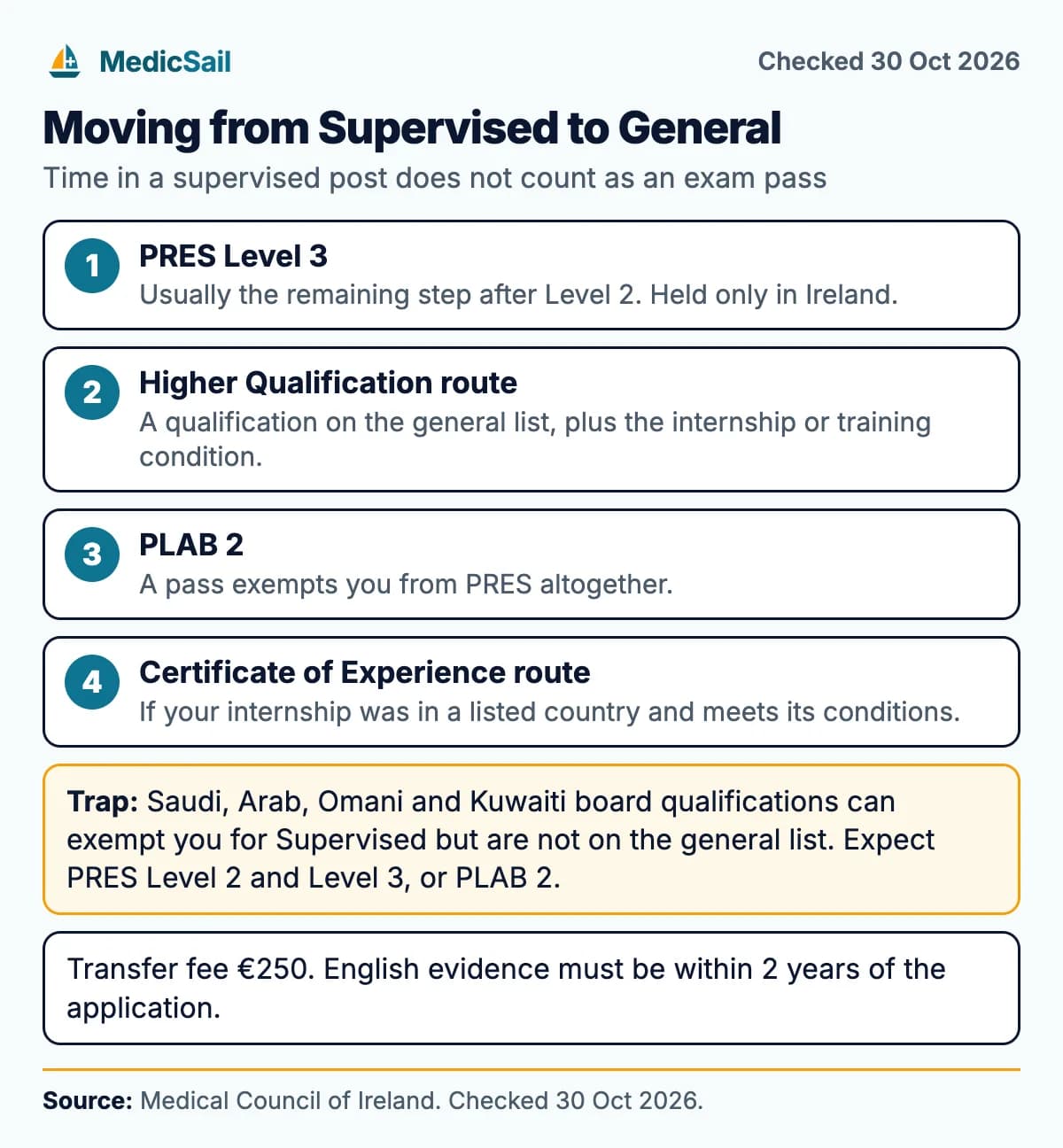
Most doctors use the Supervised Division as a first step and then transfer. The Council's fees page lists an application fee of €250 to transfer from the Supervised Division to the General or Trainee Specialist Division, with the annual registration fee payable as well.
A transfer is not automatic and time in a supervised post does not count as an exam pass. You must meet the general registration criteria, exactly as a new applicant would. In practice that means one of these:
- PRES Level 3. If you passed PRES Level 2 for your supervised application, that pass is part of the PRES route, and the remaining step is usually PRES Level 3, the clinical skills exam held only in Ireland. Being in Ireland already makes Level 3 easier to sit, and the experience of Irish practice helps with its communication stations. Details of booking, fees and attempts are in the PRES guide.
- The HQ route. If you gain a qualification on the general HQ list while in Ireland, such as MRCPI, or already hold one, together with the internship or training condition, you may qualify without PRES.
- PLAB 2. A pass in the GMC's PLAB 2 exempts you from PRES. Some doctors in Ireland sit it because it also counts towards GMC registration in the UK.
- The COE route, if your internship was in a country on the Council's list and meets its conditions.
A trap to avoid: the exemption that got you onto the Supervised Division may not count for general registration. The supervised list includes Saudi Board, Arab Board, Omani and Kuwaiti board qualifications and CPSP intermediate modules, but these are not on the HQ list for general registration, and they are not accepted alternatives to PRES Level 2 for the general route. A doctor who entered the Supervised Division on a Saudi Board qualification, for example, should expect to need PRES Level 2 and Level 3 (or PLAB 2) for general registration. Start that process early in your supervised period, since PRES eligibility runs for two years and Level 3 is offered only a few times a year.
Your certificates of good standing and English certificate must also be in date for the general application. The Council asks for English evidence dated within two years of both the application and registration, so a test you sat for the supervised application may have expired.
Trainee Specialist and Specialist registration: where they fit
Trainee Specialist Division. The Council says that once a doctor holds, or is eligible for, general registration, they are automatically eligible for the Trainee Specialist Division. Registration in it is automatic once your clinical site and training body record your post on the HSE's DIME database, and it defaults back to the General Division when the training post details expire. Because eligibility is tied to the General Division, supervised registration on its own does not open the door to Irish training schemes; transferring to general first is the usual sequence. Training bodies may also run their own international programmes, such as the two-year scholarships RCSI describes for surgical trainees from Pakistan and Sudan, which have their own conditions, including returning home afterwards.
Specialist Division. Doctors who trained as specialists outside the EU/EEA apply for an evaluation of their existing training and experience, carried out by the Irish postgraduate training body for the specialty. The Council's fee is €4,086 (€519 Council administration, €2,900 training body assessment and €667 VAT). This sits alongside, not instead of, the choice between General and Supervised: many consultants-in-waiting work first on general registration. The Medical Council page covers specialist registration in more detail.
HSE posts, job offers and employment permits
Both divisions lead to the same kind of work in practice: NCHD posts in HSE and voluntary hospitals, paid on the HSE's consolidated pay scales by grade. What differs is how you get the job. With general registration you can apply for any advertised NCHD post, including through recruitment agencies and directly to hospitals, and move between them. With supervised registration the post comes first and the registration is built around it.
- Ask which division the post needs. Recruiters sometimes describe a post as "supervised" informally. Only a post approved under section 50A puts you on the Supervised Division, and the HSE should tell you if supervised registration is required.
- Do not resign from your current job too early. The Council advises not accepting a job offer until your registration application is complete and active. For supervised posts, wait until the Council has confirmed your Level 1 documents and your Level 2 status.
- Employment permits are separate. The Department of Enterprise, Trade and Employment decides employment permits, not the Medical Council. Medical practitioners are on the Critical Skills Occupations List, and hospital doctors can also be employed on other permit types; our guide to the Critical Skills Employment Permit for health workers explains the options and the route to Stamp 4.
- Gulf doctors. If you hold a Saudi, Arab, Omani or Kuwaiti board qualification, the Supervised Division can be the fastest way into an Irish post because it may exempt you from PRES Level 2. Weigh that against the general route if you want flexibility: PRES Level 2 is held in Dubai as well as Dublin, so you can start the general route without leaving the Gulf.
For pay, grades and how NCHD careers progress, read our page on working as a doctor in Ireland, and the Ireland country guide for permits, family and living costs.
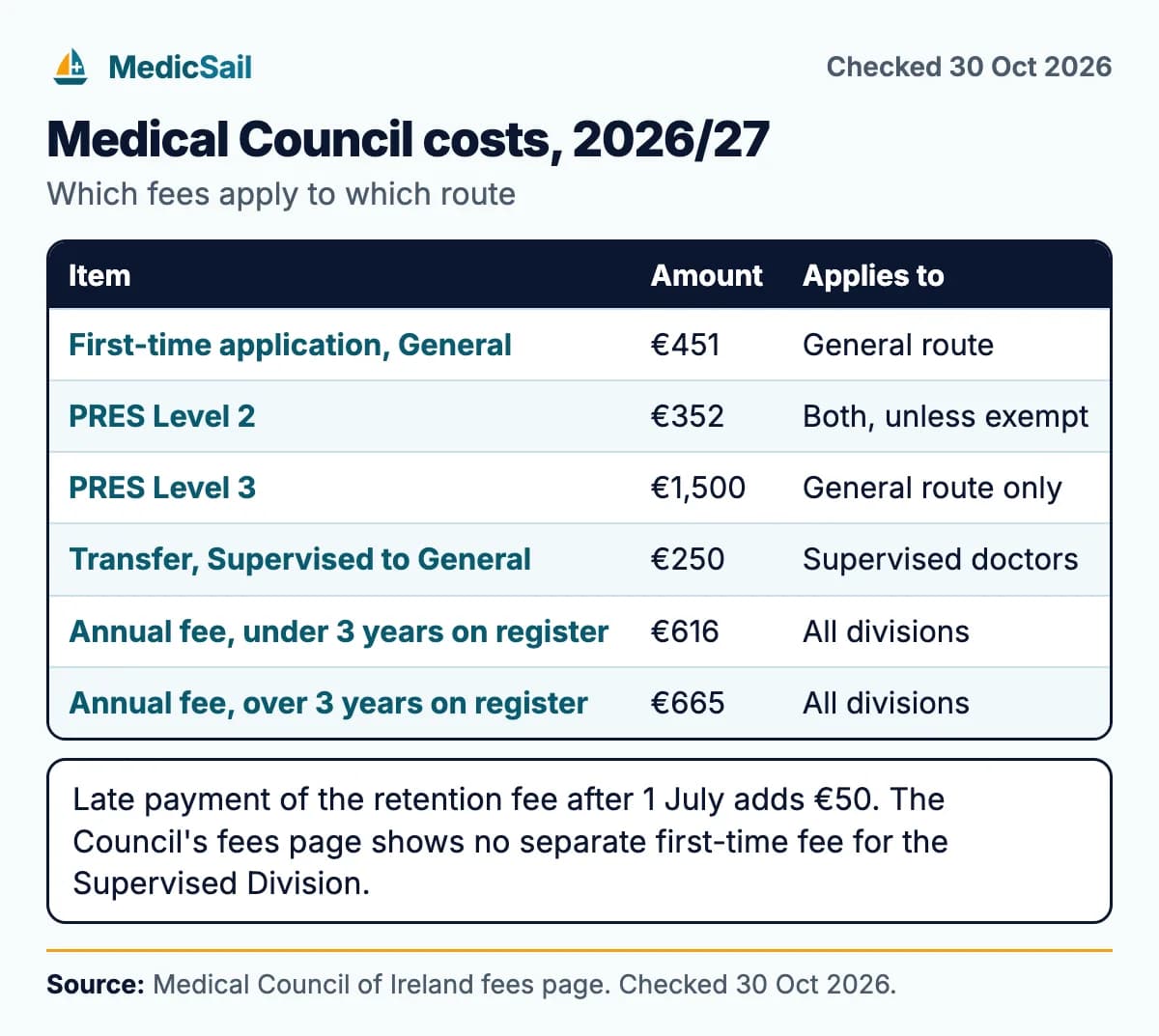
Costs and timeline compared
| Item | Amount (2026/27) | Applies to |
|---|---|---|
| First-time application, General or Trainee Specialist Division | €451 | General route |
| PRES Level 2 | €352 | Both, unless exempt |
| PRES Level 3 | €1,500 | General route only |
| Transfer from Supervised to General or Trainee Specialist Division | €250 | Supervised doctors moving on |
| Annual registration fee, recently registered (under 3 years) | €616 full year; €308 half year (January to April) | All divisions |
| Annual registration fee, more than 3 years on the register | €665 | All divisions |
| Late payment of retention fee | €50 | If you miss the 1 July deadline |
| Certificate of good standing from the Council | €55 | When you later need one for another regulator |
The Council introduced a phased increase from the 2026 retention process: 10% in 2026 and a further 10% in 2027, so check the fees page before you pay. EPIC verification fees are set by ECFMG and paid to it directly. The Council's fees page does not show a separate first-time application fee for the Supervised Division, so confirm the amount with the Council before you apply.
Timeline
- Supervised: driven by the hospital's start date. Documents, EPIC and certificates of good standing take the most time; if you are exempt from Level 2, registration can follow soon after Level 1 is complete. If you need Level 2, add the wait for the next sitting and about six weeks for results.
- General via PRES: both levels, each with results about six weeks after the exam and a limited number of sittings a year, so plan in months rather than weeks. The PRES guide lists the 2026 dates.
- Supervised then general: sit any remaining PRES level during your supervised period, so the transfer is ready before the 2 years in aggregate run out.
Questions
General registration lets you practise independently in any post, though not as a specialist. Supervised registration covers only one individually numbered, HSE-approved post with named consultant supervisors, and it ends if you leave that post. Supervised registration is also limited to 2 years in aggregate, or 3 with the HSE's written approval.
You need to pass PRES Level 2 or hold a qualification on the Council's Supervised Division exemption list. PRES Level 3 is not required for this division. It is required for general registration through the PRES route.
No. The division is only for doctors offered an HSE-approved supervised post, and the Council cannot consider an application without a proposal from the HSE. The Council advises not applying until the post has been offered, because application fees are non-refundable.
For the Supervised Division, several Saudi Board, Arab Board, Omani and Kuwaiti board qualifications appear on the Council's March 2026 exemption list for PRES Level 2. For general registration they are not on the Higher Qualification list, so they do not exempt you from PRES there.
Section 50A of the Medical Practitioners Act 2007 limits it to 2 years in aggregate, or 3 years in aggregate with the HSE's written approval in a particular case. Time in different supervised posts counts towards the same total.
You apply to transfer and pay the Council's €250 transfer fee plus the annual registration fee. You must meet the general criteria: usually PRES Level 3 if you already passed Level 2, or the HQ or COE route, or a PLAB 2 pass.
No. Section 50A says a doctor on the Supervised Division may not practise medicine in Ireland other than in the approved post and under its terms of employment. Locum or extra shifts elsewhere need general registration.
Your supervised registration ends and you must stop practising medicine in Ireland. You and the hospital complete the SUPDIV2 withdrawal form, and the employer must tell the Council within 5 days.
Not directly. The Council says doctors who hold, or are eligible for, general registration are automatically eligible for the Trainee Specialist Division, so supervised doctors normally transfer to the General Division first.
General registration is more flexible and the better long-term goal. Supervised registration can be quicker if you hold an exempting qualification and have a supervised post offer, but it ties you to one post for a limited time. Many doctors start supervised and transfer once they pass the remaining PRES level.
Sources
- 1Medical Council: Supervised registration
- 2Medical Council: Supervised Division exempting qualifications from PRES 2 (March 2026, PDF)
- 3Medical Council and HSE: Supervised Division arrangement document (PDF)
- 4Medical Council: SUPDIV2 withdrawal form (PDF)
- 5Medical Council: General registration, non-EU/EEA trained doctors
- 6Medical Council: Trainee Specialist registration
Show all 13 sourcesShow fewer sources
- 7Medical Council: Registration applications FAQs
- 8Medical Council: Fees
- 9Medical Council: PRES Handbook (PDF)
- 10Medical Council: English language requirements
- 11Medical Practitioners Act 2007, section 50A (revised)
- 12S.I. No. 208/2013: Rules for registration in the Supervised Division
- 13RCSI: International medical graduate scholarships
Plan it with our free tools
MedicSail
Healthcare licensing consultants for the UK, Europe and the USA
Updated and checked against the sources listed above. How we research and check our guides