


































H-1B vs J-1 for international medical graduates: which visa for US residency
How the ECFMG-sponsored J-1 and the H-1B compare for IMGs: eligibility, Step 3, the two-year home residence rule and its waivers, the $100,000 proclamation, families and green card routes.

MedicSail
Published
The short answer
Most international medical graduates (IMGs) who train in the United States do so on a J-1 exchange visitor visa sponsored by ECFMG. A smaller number train on an H-1B specialty occupation visa petitioned by their hospital. The J-1 is easier to get: almost every residency program that takes IMGs accepts it, it needs only USMLE Step 1 and Step 2 CK plus ECFMG certification, and there is no annual cap. Its cost comes later: J-1 physicians in clinical training must spend 2 years in their home country before they can get an H-1B or a green card, unless they obtain a waiver such as a Conrad 30 waiver.
The H-1B has no home residence rule and allows you to pursue a green card while you train, but fewer programs sponsor it, you must normally have passed USMLE Step 3 before the petition is filed, the 6-year limit counts your training years, and in 2025 and 2026 a presidential proclamation added a $100,000 payment for certain new petitions, now tied up in court. In practice the choice is often made for you by the programs that rank you, so the useful question is: which visa does each program on your list sponsor, and what does that mean for the years after training?
This guide is written from the official USCIS, State Department and ECFMG pages, reviewed on October 29, 2026. It is general information, not immigration legal advice: for your own case, speak to the program's visa office or an immigration attorney.
Who sponsors each visa, and why it matters
The two visas come from different parts of US immigration law and are run by different organizations.
- J-1 (physician category): part of the State Department's Exchange Visitor Program. The State Department designates ECFMG as the only sponsor for foreign physicians who come for graduate medical education or training. ECFMG, a division of Intealth, runs this through its Exchange Visitor Sponsorship Program (EVSP). Your hospital does not sponsor a clinical J-1 itself; it offers you a contract, and ECFMG decides whether to sponsor you and issues Form DS-2019. You can read more about ECFMG's wider role on our ECFMG regulator page.
- H-1B: a temporary worker classification decided by US Citizenship and Immigration Services (USCIS). Your employer, the hospital or university running the residency, files the petition on Form I-129 after the Department of Labor certifies a Labor Condition Application. If USCIS approves, you apply for the visa stamp at a US consulate, or change status if you are already in the US in a status that allows it.
A J-1 depends on ECFMG's rules, which are the same for every hospital. An H-1B depends on your employer's willingness to file and pay, which is why some programs say "J-1 only" and others offer both. Before you apply through ERAS, check each program's stated visa policy, and ask at interview if it is not clear. Our USMLE guide for IMGs covers ERAS and the Match in more detail.
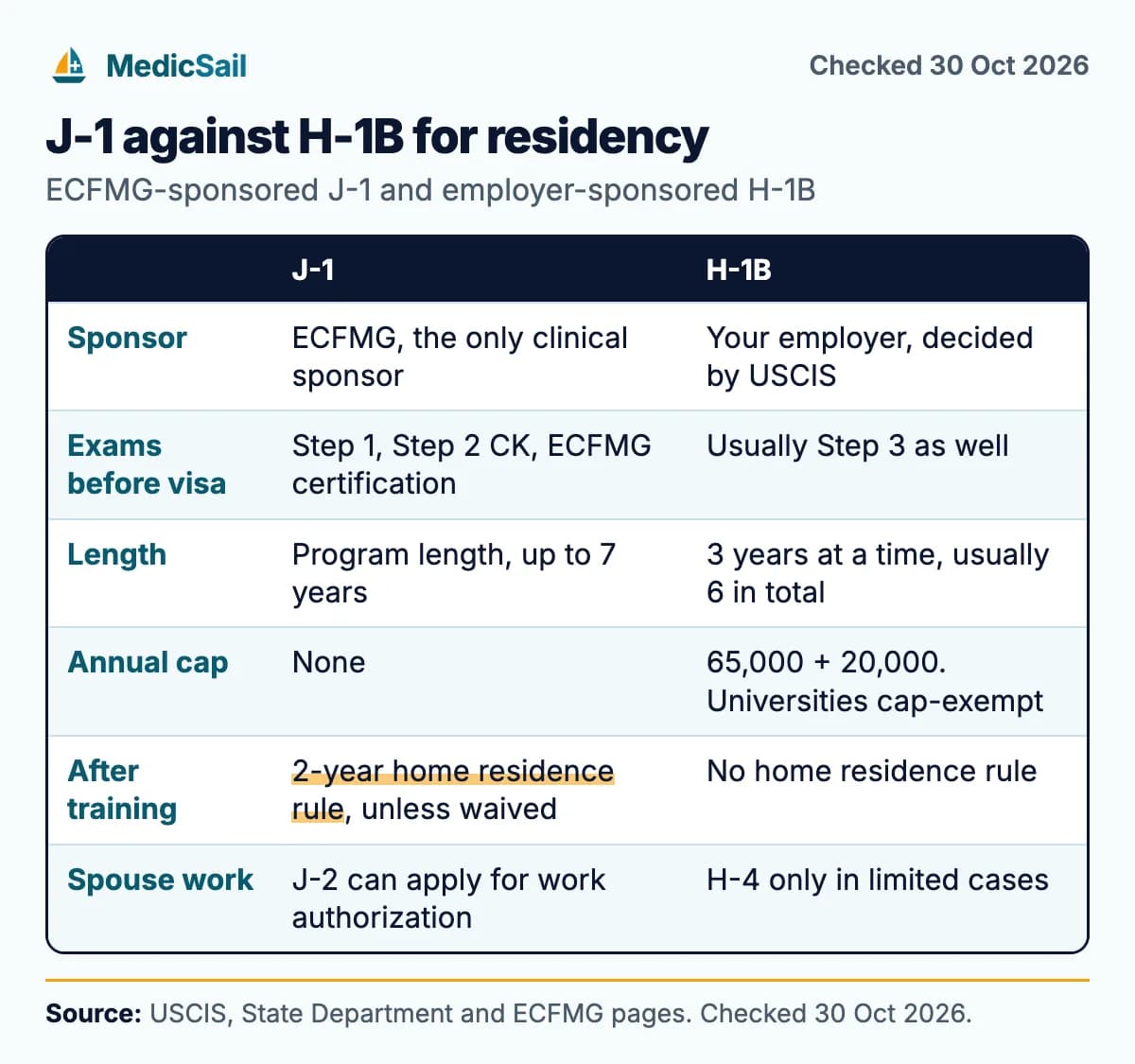
J-1 vs H-1B side by side
| Question | J-1 (ECFMG-sponsored) | H-1B |
|---|---|---|
| Who sponsors | ECFMG (Intealth), the only sponsor for clinical training | Your employer, decided by USCIS |
| Exams before the visa | ECFMG certification (USMLE Step 1 and Step 2 CK plus a Pathway) | Licensing exams passed, which in practice means USMLE Step 1, Step 2 CK and Step 3, plus ECFMG certification |
| Home-country paperwork | Statement of Need from your Ministry of Health | None |
| Length | The time typically required for the program, up to a maximum of 7 years | Up to 3 years at a time, usually 6 years in total |
| Annual cap | No cap | 65,000 plus 20,000 for US master's holders, but universities and their affiliated nonprofits are cap-exempt |
| After training | 2-year home residence requirement under INA 212(e), unless waived | No home residence requirement |
| Green card during training | Blocked by 212(e) until the requirement is met or waived | Possible: USCIS allows extensions beyond 6 years for some green card cases |
| Spouse work | J-2 spouse can apply to USCIS for work authorization | H-4 spouse can work only in limited cases linked to a green card process |
| Extra clinical work | No work outside the sponsored program; since September 2025, supplemental clinical activity at your training site with program director approval | Only for the employer that filed the petition |
| Government fees | Paid mostly by you: ECFMG fee, SEVIS fee, visa fee | Paid by the employer: USCIS filing fees, plus the disputed $100,000 payment for some new petitions |
The J-1 in detail: eligibility, fees and limits
ECFMG's 2026 EVSP reference guide says a foreign physician applying for J-1 sponsorship for clinical training must:
- Hold a valid Standard ECFMG Certificate. Our ECFMG certification guide explains the USMLE, Pathways and OET Medicine requirements. A Pathway-based certificate has an expiry date, so check that yours will be valid on your start date.
- Hold a signed contract or official letter of offer for a position in an approved clinical training program.
- Provide an original Statement of Need from the Ministry of Health of your country of citizenship or most recent legal permanent residence, giving written assurance that your country needs specialists in your field and that you will return when you finish. Once you are under sponsorship, the issuing country cannot be changed.
The State Department's description of the physician category adds that you need competency in oral and written English and a contract from a US accredited medical school, affiliated hospital or scientific institution. Step 3 is not required for a J-1.
Fees you pay
- ECFMG J-1 sponsorship application: ECFMG lists $370, paid through MyIntealth. Sponsorship is renewed each training year, so check the current fee each year on ECFMG's fee page.
- SEVIS fee: ECFMG says the Department of Homeland Security requires all initial applicants to pay a $220 SEVIS fee before the visa interview.
- Visa application fee: paid to the State Department when you apply at a US embassy or consulate. Check the amount on the embassy's own site.
How long you can stay
ECFMG says sponsorship lasts for the time "typically required to complete a program" as defined by the ACGME or the specialty boards, and federal regulations limit it to a maximum of 7 years. That covers most residencies plus a fellowship, but not every long subspecialty sequence. You may change your designated specialty once, within the first two years of sponsorship; from the third year a change is no longer permitted.
Other conditions
- Insurance: federal rules require J-1 physicians and J-2 dependents to hold insurance with medical benefits of at least $100,000 per accident or illness, a deductible no higher than $500, co-insurance no higher than 25%, at least $25,000 for repatriation of remains and at least $50,000 for medical evacuation. Confirm that your hospital's plan meets this before you arrive.
- No moonlighting: ECFMG says work outside the sponsored program and institution, paid or unpaid, is not permitted. Since September 2025, J-1 physicians may do supplemental clinical activities at their training site with their program director's approval.
- Full-time training only: you must stay in the program shown on your DS-2019. If training ends early, sponsorship ends on your last day, not the date on the form.
- Grace period: ECFMG says DHS allows a 30-day grace period after your status ends to prepare to leave, with no permission to work or train during it.
The two-year home residence requirement (212(e))
This is the single biggest difference between the two visas. ECFMG's reference guide says that under section 212(e) of the Immigration and Nationality Act, all exchange visitors sponsored in the J-1 physician category, and all accompanying J-2 dependents, must return to their country of most recent legal permanent residence for an aggregate of at least two years before becoming eligible for certain other US visa statuses. The USCIS Policy Manual lists ECFMG-facilitated programs and "programs whose purpose is graduate medical training" among those that trigger the rule, so there is no question of whether a clinical J-1 doctor is covered: you are.
Until you have spent the 2 years at home or obtained a waiver, the USCIS Policy Manual says you cannot:
- get an immigrant visa or adjust status to permanent residence (a green card),
- get an H, L or K visa, or
- change status inside the US from J to most other nonimmigrant statuses. The main exception for doctors is a change to H-1B for physicians who receive a waiver based on a 3-year waiver job.
A few points people often get wrong:
- The 2 years are aggregate: they can be built up in more than one period. The State Department notes you can still visit the US while you complete them.
- The requirement applies to the country of your most recent legal permanent residence, which may not be your country of citizenship. If you have been living and working in the Gulf on a residence permit, the country that counts is decided by the State Department under its rules, so get that answered early.
- The rule does not stop you working in other countries. Many doctors spend the 2 years in their home country and others look at registration in the UK or Ireland afterwards; see our guides to PLAB and GMC registration and PRES for the Medical Council of Ireland. Time abroad outside your home country does not count toward the 2 years.
Waivers of the two-year rule: Conrad 30 and the alternatives
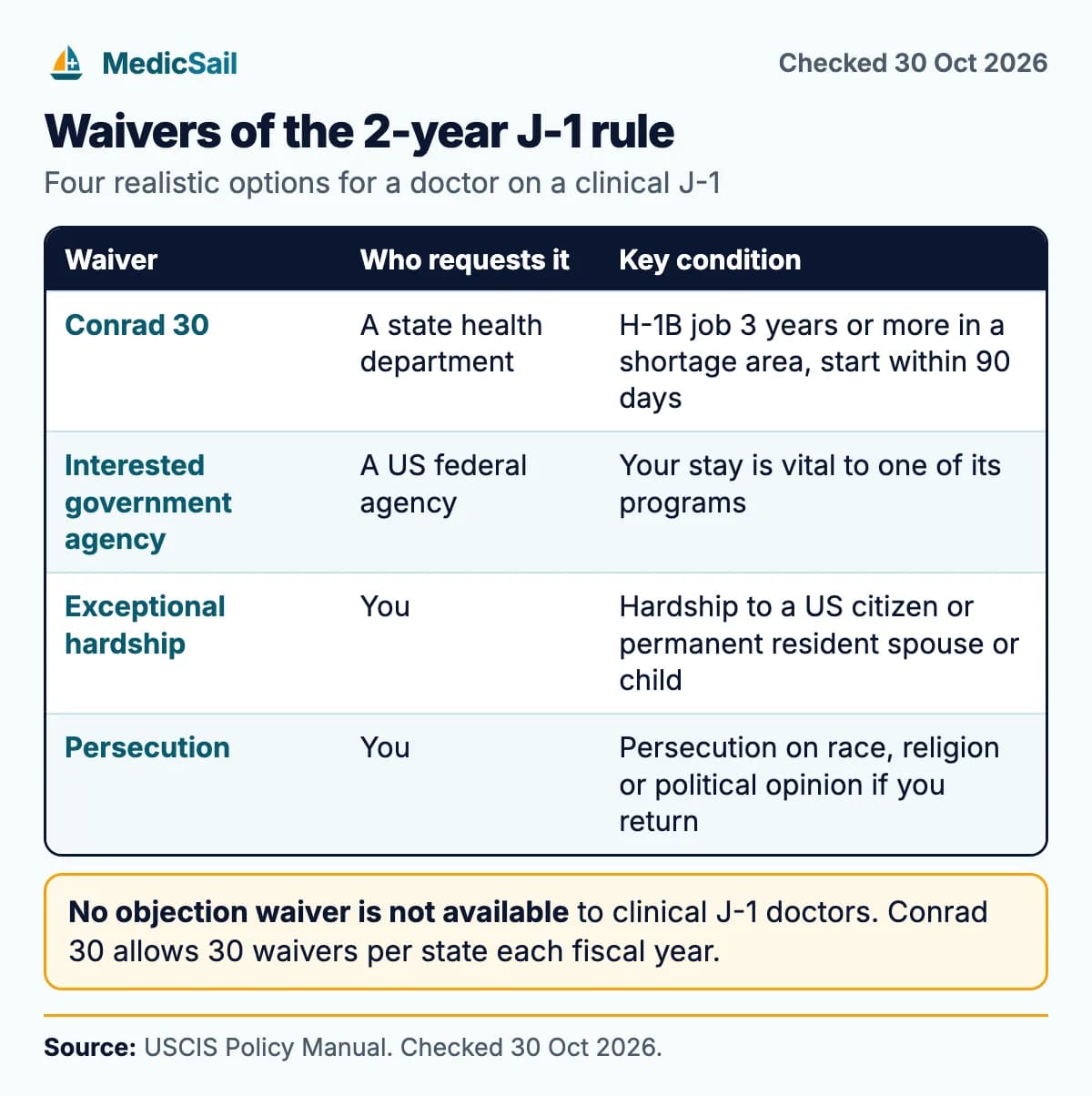
The USCIS Policy Manual lists five bases for a waiver of the foreign residence requirement. For a doctor who trained on a clinical J-1, four are realistic.
| Waiver | Who requests it | Key conditions |
|---|---|---|
| Conrad 30 | A state health department | Full-time H-1B job for at least 3 years in a shortage area (or a flex slot), start within 90 days |
| Interested government agency (IGA) | A US federal agency | The agency shows your stay is vital to one of its programs; for clinical jobs this is usually a federal shortage-area program |
| Exceptional hardship | You, through the State Department and USCIS | Hardship to a US citizen or permanent resident spouse or child beyond the normal hardship of separation or relocation |
| Persecution | You, through the State Department and USCIS | Persecution on account of race, religion or political opinion if you return; a higher standard than asylum |
The no objection route is not available to you. The Policy Manual excludes J-1 visitors who came for graduate medical training from the no objection basis, so a letter from your government saying it does not mind you staying will not waive the rule.
How Conrad 30 works
USCIS says the Conrad 30 program lets J-1 foreign medical graduates apply for a waiver if a state health department sponsors them. The Policy Manual sets the limit at 30 per state in each fiscal year, and states may use up to 10 of these as flex slots for doctors working outside designated shortage areas who still serve patients from those areas. USCIS lists these conditions:
- a contract for full-time medical practice in H-1B status for at least three years at a facility in a Health Professional Shortage Area (HPSA), Medically Underserved Area (MUA) or Medically Underserved Population (MUP); the State Department treats full-time as 40 hours a week,
- starting work at the named facility within 90 days of receiving the waiver,
- a no objection statement from your home government if you are contractually obliged to return.
The steps run in this order: you find a qualifying employer, the state health department sponsors you, you complete the State Department's online waiver application (Form DS-3035), the State Department's Waiver Review Division makes a recommendation, and USCIS makes the final decision. Your employer then files an H-1B petition to change your status, and a J-2 spouse or child files Form I-539 to change to H-4. Each state sets its own window, priorities and specialty rules.
USCIS says that once you complete the 3 years and other conditions, you and your family can apply for an immigrant visa, adjustment of status, or other H or L status. If you do not meet the conditions, the two-year rule applies again. The program's legal authority has to be extended by Congress from time to time, and USCIS has warned that if it is not extended, people admitted in J-1 status after the sunset date will not be eligible. Check the current USCIS Conrad 30 page before you rely on it.
The H-1B in detail: eligibility, the cap and the $100,000 payment
USCIS describes the H-1B as a classification for jobs that need at least a bachelor's degree in a specific field. For doctors, the regulation at 8 CFR 214.2(h)(4)(viii) adds rules that make the H-1B harder to get than the J-1:
- Licence or authorization: if you will give direct patient care, you need the license or other authorization the state requires (for residents, usually a training license or permit issued by the state medical board), plus a full license abroad or a medical degree.
- Exams: the hospital must show you have passed the Federation Licensing Examination "or an equivalent examination as determined by the Secretary of Health and Human Services". The FLEX has been replaced by the USMLE, and programs and immigration counsel read this as passing all three Steps, so most H-1B residency programs require USMLE Step 3 before they file.
- English: competency in oral and written English shown by the test given by ECFMG, which in practice means ECFMG certification.
- Exception: a physician coming primarily to teach or do research at a public or nonprofit institution, with no patient care except what is incidental, does not need these exams. This does not cover residency.
The cap and cap-exempt hospitals
USCIS sets an annual cap of 65,000 new H-1B visas plus 20,000 for people with a US master's degree or higher, allocated through a registration and selection process that usually opens in March for jobs starting on or after October 1. Residency starts on July 1, so a cap-subject employer cannot easily hire a new resident. That is why most H-1B residents work for cap-exempt employers: USCIS says workers employed at an institution of higher education or its affiliated or related nonprofit entities, or at a nonprofit or government research organization, are not subject to the cap. University hospitals and many teaching hospitals affiliated with a medical school fall into this group and can file at any time of year. Whether a given hospital qualifies depends on its legal structure, so ask the program.
How long you can stay
USCIS says H-1B status is granted for up to 3 years at a time, extendable to a total of 6 years. Time in residency and fellowship counts, so a long training path can use up most of the 6 years. USCIS allows extensions beyond 6 years for people with certain pending or approved green card cases.
The $100,000 payment
A presidential proclamation of September 19, 2025 required a $100,000 payment with new H-1B petitions filed at or after 12:01 a.m. eastern daylight time on September 21, 2025. USCIS's guidance applied it to petitions for workers outside the US without a valid H-1B visa, and not to petitions filed before that date or to visas already issued. On June 8, 2026 a federal district court in Massachusetts vacated the agency guidance implementing the payment, and on July 24, 2026 the First Circuit denied the government's request to pause that ruling. USCIS says DHS is complying with the court's order while it considers next steps, and still plans to collect the payment if the order is lifted. Separately, a proclamation of September 18, 2026 extended the restriction until September 21, 2027. The proclamation names no exception for doctors; exceptions are decided case by case by the Secretary of Homeland Security.
For you, this means hospitals may treat a new H-1B for a doctor abroad differently from one for a doctor already in the US, and their policies can change between application season and Match Day. Read the current USCIS H-1B page and ask each program what it is doing before you rank it.
Who pays
The employer files and pays the USCIS fees, which are set in the USCIS fee schedule (Form G-1055). USCIS lists the Asylum Program Fee as $0 for nonprofit employers, and says institutions of higher education, their affiliated nonprofits and nonprofit or government research organizations do not pay the ACWIA training fee.
USMLE Step 3 and timing if you want an H-1B
If you want an H-1B for residency, Step 3 becomes part of your application timeline rather than something you take in your intern year. The USMLE eligibility rules say that, as an IMG, you can sit Step 3 once you have passed Step 1 and Step 2 CK, hold the equivalent of an MD degree from a school listed in the World Directory of Medical Schools, and have a valid ECFMG Certificate. Postgraduate training is recommended but not required.
- Book early. Hospitals need your Step 3 result before they can file, and they file in the spring for a July start. A Step 3 taken in January or February of the Match year leaves little room for a delay or a failure.
- Plan for the result window. Results usually arrive within a few weeks, but USMLE advises allowing at least eight weeks when planning.
- Weigh the trade-off. Sitting Step 3 before residency adds cost (the 2026 and 2027 Step 3 fee is set by the USMLE program; see our USMLE guide) and study time while you are also preparing applications. If none of the programs you are targeting sponsor H-1Bs, it may not be worth doing before the Match.
If you have not yet started the exams, our EPIC verification guide covers the credential checks that come before ECFMG certification.
Spouses and children: J-2 vs H-4
Families are an underrated part of this decision.
- J-2 dependents: ECFMG can issue a DS-2019 for your spouse and children to come as J-2 dependents. USCIS lets a J-2 spouse apply for employment authorization on Form I-765, with evidence that the income will not be used to support you. J-2 dependents are also subject to the 2-year home residence requirement, and must hold insurance that meets the J-1 minimums.
- H-4 dependents: USCIS says your spouse and unmarried children under 21 may seek admission in H-4 status. An H-4 spouse can apply for work authorization only in limited cases, once you have started the process of seeking permanent residence in a way the rules recognize. In the first years of residency, that often means an H-4 spouse cannot work.
If your spouse is also a health professional who wants to work in the US, look at their own route separately. A nurse, for example, would need NCLEX and usually a VisaScreen certificate; see our VisaScreen guide.
Routes to a green card from each visa
Neither visa is a green card, but they lead there differently.
From a J-1
You must first satisfy the 2-year rule or get a waiver. The most common route is a Conrad 30 or federal waiver job, 3 years of H-1B service, and then an employment-based green card. USCIS says a doctor who needs a J-1 waiver must satisfy all the waiver conditions, including the 3 years of service, before USCIS can approve adjustment of status.
From an H-1B
An H-1B doctor is not barred by the 212(e) rule, so an employer can start a green card process during or after training, and USCIS allows H-1B extensions beyond 6 years for some pending green card cases. The main employment-based options for physicians are:
- EB-2 with labor certification: an employer tests the US labor market through the Department of Labor, then files Form I-140. USCIS says the physician must hold, or be eligible for, a permanent license in the area of intended employment.
- EB-2 physician national interest waiver: the USCIS Policy Manual says a physician who agrees to work full time in clinical practice in a designated shortage area, or at a Veterans Affairs facility, for an aggregate of 5 years can have the job offer and labor certification waived, with a federal agency or state department of public health confirming the work is in the public interest. J-1 time does not count toward the 5 years, and you cannot receive permanent residence until you complete the service.
- Other categories, such as EB-1 for people with extraordinary ability or outstanding researchers, apply to a minority of doctors with a strong research record.
All employment-based green cards are subject to the State Department's monthly Visa Bulletin. When demand from your country of birth is high, the wait for a visa number can be many years, so check the current bulletin rather than relying on past estimates.
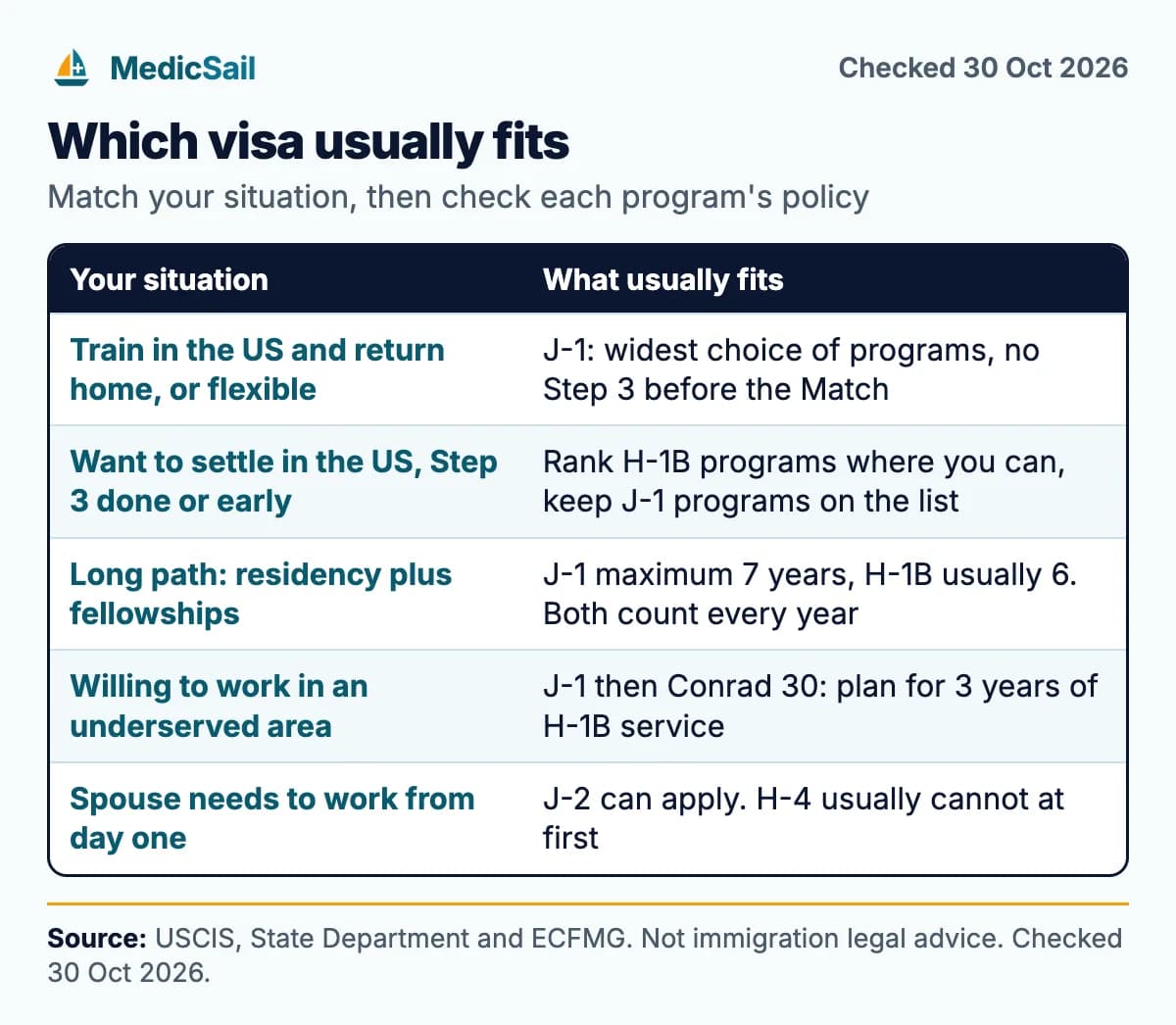
How to choose: common situations
| Your situation | What usually fits |
|---|---|
| You want to train in the US and return home, or you are flexible about where you practice afterwards | J-1: widest choice of programs, no Step 3 before the Match, and the 2-year rule fits your plan |
| You want to settle in the US and have Step 3 done or can pass it early | Rank H-1B programs where you can, but do not drop J-1 programs from your list unless you are a strong applicant |
| You expect a long training path (residency plus one or more fellowships) | Check the numbers: the J-1 maximum is 7 years, the H-1B usually 6 years, and both count every training year |
| You are willing to work in an underserved or rural area after training | A J-1 followed by a Conrad 30 waiver is a well-used route; plan for 3 years of H-1B service |
| Your spouse needs to work from day one | A J-2 spouse can apply for work authorization; an H-4 spouse usually cannot until a green card process is under way |
| You are applying from outside the US for a new H-1B | Ask each program how it is handling the $100,000 proclamation; this changed program behavior in 2026 |
The data that matters most is each program's own policy. Some programs sponsor only J-1s; some sponsor H-1Bs only for certain specialties or only for applicants already in the US. Our guide to working as a doctor in the USA covers the full route from exams to licensure, and the USA country page summarizes the other visa options for health professionals.
If you are a doctor in the Gulf: the visa rules are the same for you as for anyone else. Two Gulf-specific points matter. First, for a J-1 Statement of Need, ECFMG asks for the Ministry of Health of your country of citizenship or most recent legal permanent residence, so decide early which country that is; the same country then counts for the 2-year rule. Second, a Gulf residence visa is not a US status, so if you plan to sit Step 3 or attend interviews in the US, you will need a US visitor visa if your nationality requires one.
Timeline and checklist
- Two years or more before you want to start: pass USMLE Step 1 and Step 2 CK and complete an ECFMG Pathway. Decide whether you will try for H-1B programs.
- If you want H-1B options: sit Step 3 as soon as you hold a valid ECFMG Certificate, ideally before you apply through ERAS.
- When building your ERAS list: record each program's visa policy (J-1 only, J-1 and H-1B, or none). Ask about the $100,000 proclamation at interview if you are abroad.
- After the Match, J-1 route: request your Statement of Need from your Ministry of Health straight away, as it can take months. Apply to ECFMG for sponsorship when your program confirms your contract, pay the SEVIS fee, and book a consular appointment.
- After the Match, H-1B route: your hospital files the Labor Condition Application and Form I-129. You will need your state training license or permit, Step 3 result and ECFMG certificate. Then apply for the visa at a consulate.
- During training (J-1): renew sponsorship each year, keep within the 7-year limit, and start looking at waiver jobs in the year before you finish; many states open their Conrad 30 cycles months before the start date.
- During training (H-1B): track your 6-year clock and talk to your employer about green card timing, especially if you plan a fellowship.
If you are still comparing countries, our doctors hub compares the US with the UK, Ireland, Germany and the Netherlands. Laws and policies in this area change often; recheck every fee and rule on the official pages listed below before you act.
Questions
Neither is better for everyone. The J-1 is accepted by more programs and needs only Step 1, Step 2 CK and ECFMG certification, but it carries a 2-year home residence requirement afterwards. The H-1B avoids that rule and allows a green card process during training, but fewer programs offer it and you usually need Step 3 first.
ECFMG, a division of Intealth, through its Exchange Visitor Sponsorship Program. The State Department designates it as the only sponsor for foreign physicians in graduate medical education or training. The hospital offers the contract, but ECFMG issues the DS-2019.
In practice, yes. The regulation requires a physician giving patient care on an H-1B to have passed the FLEX or an equivalent exam determined by HHS, and the USMLE replaced the FLEX, so programs ask for all three Steps before they file. Step 3 is not required for a J-1.
Not directly. A clinical J-1 doctor is subject to the 2-year home residence rule and cannot change to H-1B status until it is met or waived. The usual route is a Conrad 30 or federal agency waiver, after which the employer files an H-1B petition.
The USCIS Policy Manual limits them to 30 per state in each fiscal year, of which up to 10 can be flex slots for doctors working outside designated shortage areas who serve patients from them. Each state sets its own application window and criteria, so demand and timing vary.
The proclamation applied to certain new H-1B petitions filed from September 21, 2025, mainly for workers outside the US without a valid H-1B visa, and it names no exception for doctors. A federal court vacated the implementing guidance on June 8, 2026, and a September 2026 proclamation extended the restriction to 2027, so check the current USCIS page and each program's policy.
ECFMG says sponsorship lasts for the time typically required to complete your program, up to a maximum of 7 years under federal regulations. You may change specialty once, within the first two years of sponsorship.
A J-2 spouse can apply to USCIS for employment authorization on Form I-765. An H-4 spouse can work only in limited cases linked to the H-1B worker's green card process, so many H-4 spouses cannot work during residency.
Not until you have spent 2 years in your country of most recent legal permanent residence or obtained a waiver. With a Conrad 30 waiver, USCIS will not approve permanent residence until you complete the 3 years of service.
Yes, in practice. The H-1B regulation asks for English competency shown by the test given by ECFMG, and USMLE requires a valid ECFMG Certificate before you can sit Step 3.
Sources
- 1USCIS: H-1B Specialty Occupations
- 2USCIS: H-1B proclamation FAQ
- 3USCIS: Presidential Proclamation on Restriction on Entry of Certain Nonimmigrant Workers
- 4White House: Restriction on Entry of Certain Nonimmigrant Workers (September 2026)
- 5USCIS: H and L filing fees for Form I-129
- 6USCIS: Fee schedule (G-1055)
Show all 20 sourcesShow fewer sources
- 7eCFR: 8 CFR 214.2(h)(4)(viii), H-1B petitions for physicians
- 8USCIS: Conrad 30 Waiver Program
- 9USCIS Policy Manual: Foreign residence requirement (Volume 2, Part D, Chapter 3)
- 10USCIS Policy Manual: Waiver of the foreign residence requirement (Volume 2, Part D, Chapter 4)
- 11USCIS Policy Manual: Physicians (Volume 6, Part F, Chapter 6)
- 12USCIS: Employment-based immigration, second preference EB-2
- 13USCIS: Employment authorization (Form I-765)
- 14US Department of State: J-1 physician program
- 15US Department of State: J-1 common questions (two-year home-country requirement)
- 16US Department of State: Visa Bulletin
- 17ECFMG: EVSP Reference Guide for J-1 Physicians (2026)
- 18ECFMG: EVSP fees
- 19ECFMG: Exchange Visitor Sponsorship Program
- 20USMLE: Eligibility
Plan it with our free tools
MedicSail
Healthcare licensing consultants for the UK, Europe and the USA
Updated and checked against the sources listed above. How we research and check our guides