


































How to become a dentist in the UK, Ireland, Europe or the USA as a foreign-trained dentist
The routes for a foreign-trained dentist in the UK, Ireland, Germany, the Netherlands and the USA side by side: the ORE, the Dental Council Examination, the Kenntnisprüfung, the ACTA BI-test and US advanced standing with the INBDE, with official fees, languages, attempts and the real bottlenecks.

MedicSail
Published
The short answer
To work as a dentist in the UK, Ireland, Germany, the Netherlands or the USA with a degree from outside those countries (and outside the EU/EEA), you almost always have to pass that country's own exam or assessment, meet its language requirement and then register with its regulator. There is no shortcut through a licence held elsewhere, including a Gulf licence.
- UK: pass the General Dental Council's Overseas Registration Exam (ORE), Part 1 and Part 2 (£115 application, £485 and £6,967), with IELTS Academic 7 overall and 6.5 in each skill, then register with the GDC.
- Ireland: pass the Dental Council Examination (€1,500, Part 1 in Dublin and Part 2 in Cork), with IELTS 7.0 in each module or OET grade B, unless you are covered by the Council's agreements with Canada and New Zealand.
- Germany: get the Approbation from a state authority, usually after B2 German, a dental Fachsprachprüfung and the three-part Kenntnisprüfung.
- Netherlands: pass the BI-test for dentists at ACTA in Amsterdam (€1,500), with Dutch at B2+, and register in the BIG register.
- USA: in most states, earn a US DDS or DMD through an advanced standing programme, pass the INBDE and a clinical exam, and apply to a state board. A few states have alternative limited licences.
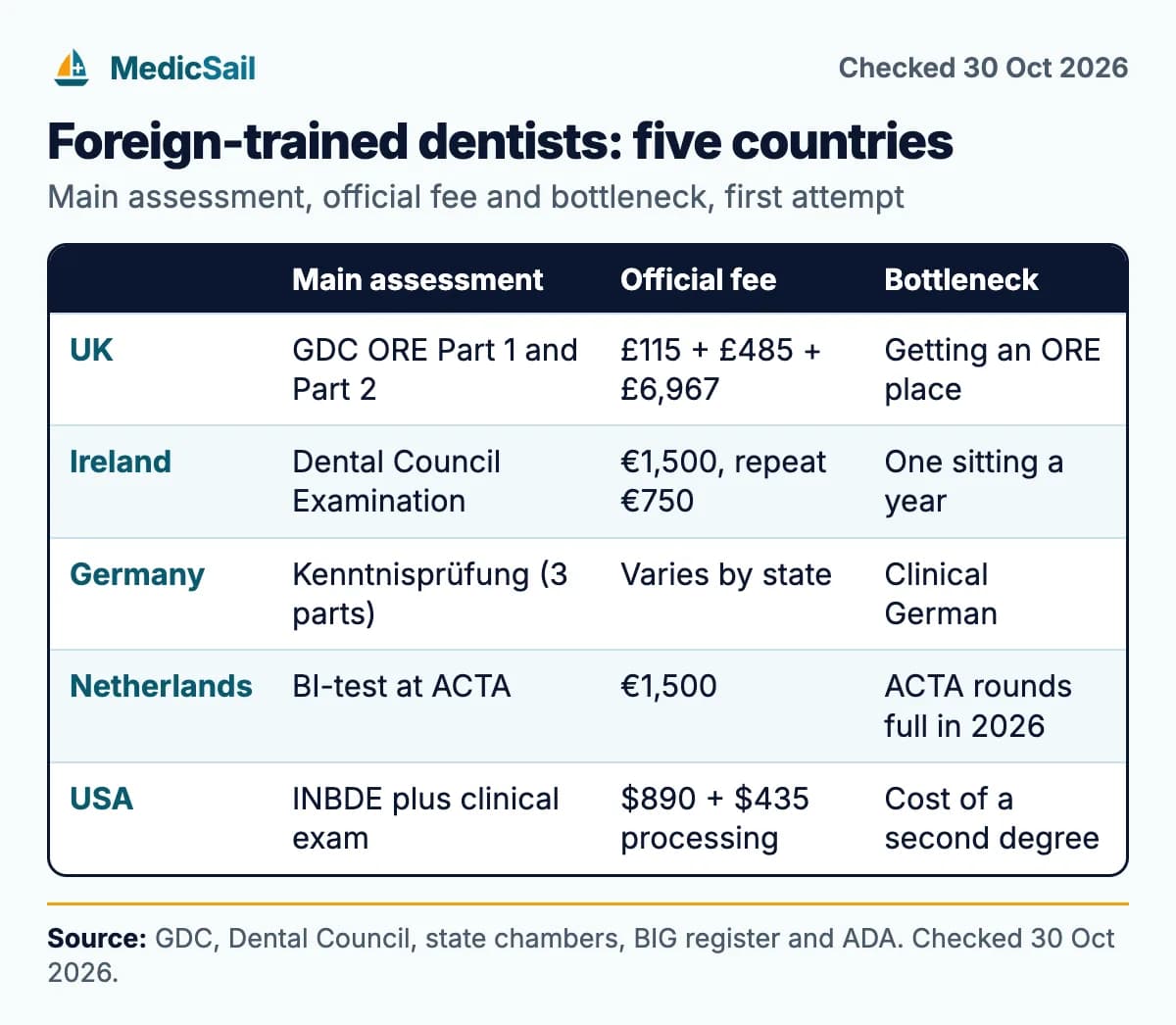
The hardest part is rarely the clinical standard. In the UK it is getting an ORE seat, in the Netherlands an ACTA round, in Germany the language, in Ireland one exam sitting a year, and in the USA the cost of a second degree. This guide compares them side by side with the fees, formats and timelines each official body publishes, checked on 29 October 2026.
The five routes compared
| UK | Ireland | Germany | Netherlands | USA | |
|---|---|---|---|---|---|
| Regulator | General Dental Council | Dental Council | State authority (Approbation) | BIG register (CIBG) | State boards of dentistry |
| Main assessment | ORE Part 1 and Part 2 | Dental Council Examination, Parts 1 and 2 | Kenntnisprüfung (written, oral, practical) if not equivalent | BI-test at ACTA (written and skills) | INBDE plus clinical exam, usually after a US DDS/DMD |
| Where you sit it | Part 1 London venues; Part 2 UCL Eastman, London | Part 1 Dublin; Part 2 Cork | The state dental chamber | ACTA, Amsterdam | INBDE at Prometric centres in the US and Canada |
| Exam fees | £115 + £485 + £6,967 | €1,500 (repeat €750) | Example, Zahnärztekammer Nordrhein: €330 written, €960 oral, €1,210 practical | €1,500 | INBDE $890 + $435 international processing |
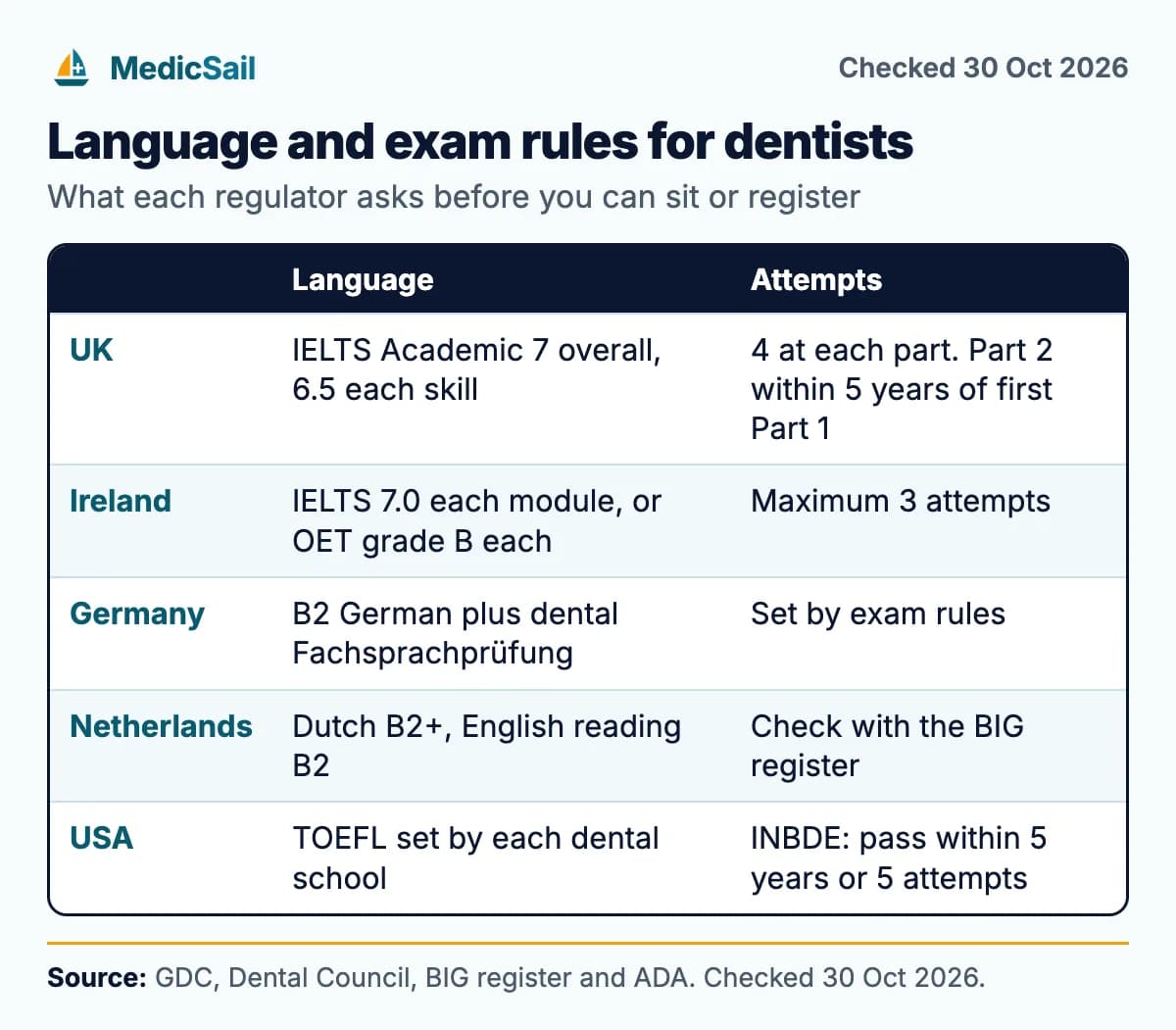
| Attempts | Four at each part; Part 2 within five years of first Part 1 attempt | Maximum three attempts | Set by the exam rules; each part charged again if repeated | Check the current rules with the BIG register | INBDE: no more than four in 12 months; pass within five years or five attempts |
| Language | IELTS Academic 7 overall, 6.5 each | IELTS 7.0 each, or OET grade B each | B2 German plus dental Fachsprachprüfung | Dutch B2+ and English reading B2 | TOEFL set by each dental school |
| Registration fee | £117.23 application, then annual retention £698 | €400 application, €450 annual retention (2026) | Approbation, NRW: €150 to €700 | €85 for five years | Set by each state |
| Main bottleneck | Getting an ORE place | One sitting a year, limited places | German to a clinical level | ACTA rounds full in 2026 | Tuition and length of a second degree |
UK: the ORE and GDC registration
The GDC says that if you qualified as a dentist outside the UK and the EEA you will most likely need to pass the ORE. Only a short list of older qualifications from named universities in Australia, Hong Kong, Malaysia, New Zealand, Singapore and South Africa, granted before set cut-off dates, are recognised for direct registration. Our ORE guide covers each part in detail, and the GDC page covers registration.
How it works
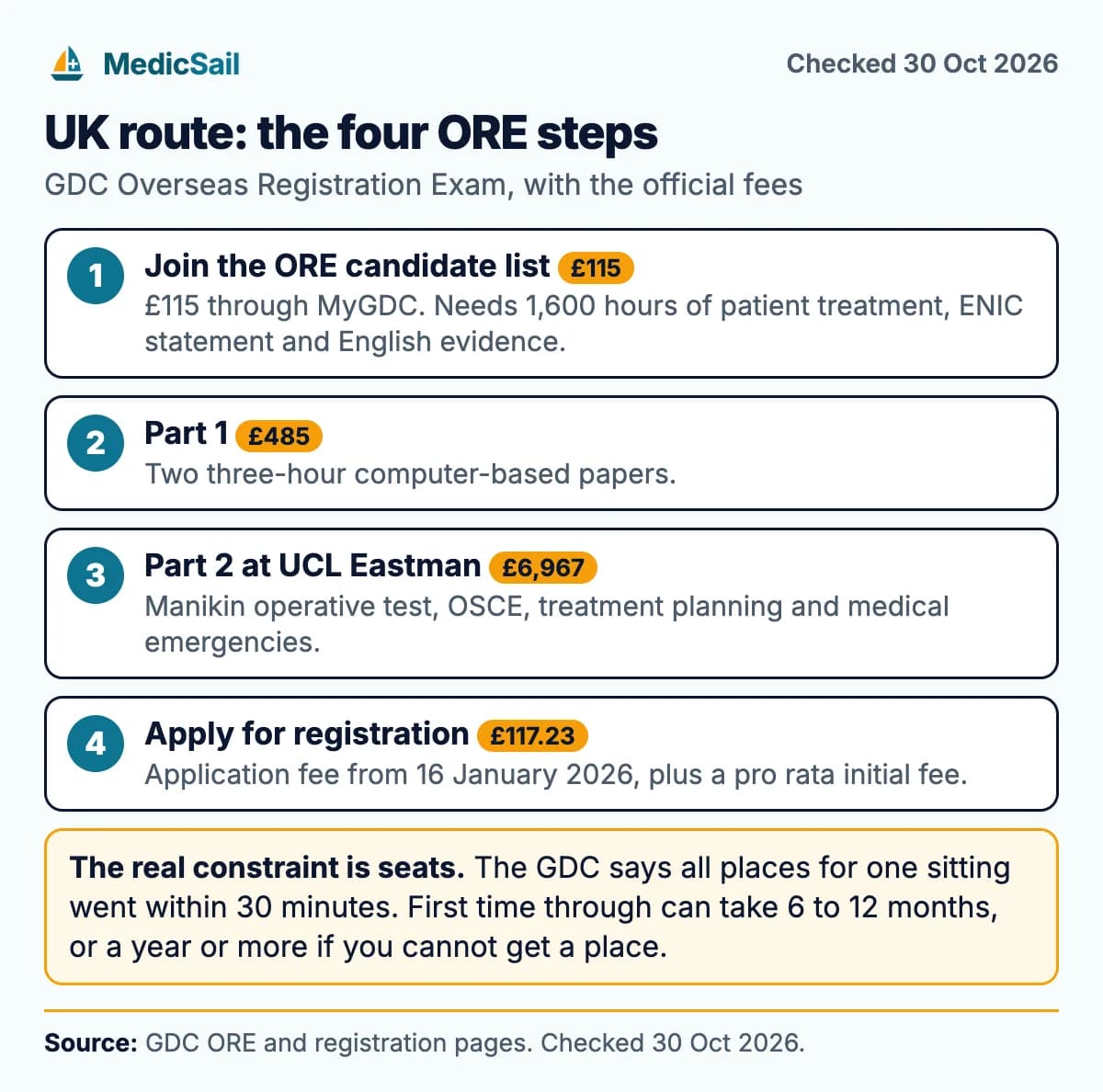
- Apply to join the ORE candidate list through MyGDC (£115), with clinical references showing at least 1,600 hours treating patients, a UK ENIC Statement of Comparability, a good standing certificate under three months old and your English evidence. The GDC aims to process applications within 60 working days.
- Pass Part 1: two three-hour computer-based papers on dental science and human disease, and clinical dentistry including law and ethics (£485).
- Pass Part 2 at the UCL Eastman Dental Institute: an operative test on a manikin, an OSCE, a diagnostic and treatment planning exercise and a medical emergencies exam (£6,967).
- Apply for registration (£117.23 application fee from 16 January 2026, plus a pro rata initial fee).
The real constraint
The GDC says that passing each part first time could take six to 12 months, but demand is extremely high: all places for one sitting this year were taken within 30 minutes of the booking window opening, and applicants may struggle to get a place for 12 months or more. Priority places go to candidates near the five-year limit and to dental professionals with refugee status. Most UK dentists in NHS general practice are self-employed associates, so pay depends on the practice contract; salaried dental core trainees are paid £55,355 to £67,325 from 1 April 2026. See working as a dentist in the UK.
Ireland: the Dental Council Examination
To practise in Ireland you must be on the Register of Dentists kept by the Dental Council. If you qualified outside the EU and are not covered by the Council's mutual recognition agreements with Canada and New Zealand, you normally sit the Dental Council Examination. You send a transcript for assessment first; if your course is acceptable and you can show English competence, you can apply for a place.
The exam
- Part 1, Dublin: written papers on Health, Disease and Society (law and ethics, regulation in Ireland, dental public health and evidence), plus a bench test in operative dentistry on manikin heads. In 2026 it ran from 25 to 28 March.
- Part 2, Cork: written papers in restorative dentistry, oral surgery and oral medicine, and child dental health, an OSCE and clinical vivas, each passed individually. In 2026 it ran from 15 to 18 June.
- Fee €1,500, repeat €750, maximum three attempts. Applications are usually announced between November and December for the following year, and places in 2026 were allocated at random.
English, registration and permits
The Council asks for IELTS Academic 7.0 in each module or OET for Dentistry grade B in each, taken at a centre; IELTS Online and OET@Home are not accepted. You are exempt if your primary qualification, or a postgraduate dental qualification of at least three years, was taught in English. Registration costs €400 and the 2026 retention fee is €450. Dentists are not on the Critical Skills Occupations List, so the usual permit is a General Employment Permit, which normally needs a labour market needs test. Our Ireland route for dentists has the permit thresholds.
Germany: Approbation, the Fachsprachprüfung and the Kenntnisprüfung
To practise without restriction you need the Approbation as a dentist (Zahnärztin or Zahnarzt) from the authority of the federal state where you plan to work, under the Zahnheilkundegesetz. For a third-country dentist the usual sequence is a B2 general German certificate, a dental Fachsprachprüfung run by the state dental chamber, and either a decision that your training is equivalent or a pass in the Kenntnisprüfung. Our general Kenntnisprüfung guide explains the legal basis.
The dental Kenntnisprüfung
- Written: a treatment plan for a clinical case within 45 minutes, using models, radiographs and a periodontal chart, with at least two treatment options.
- Oral: 60 to 90 minutes per candidate, covering prosthetics, orthodontics, oral surgery, maxillofacial surgery and conservative dentistry, plus emergency medicine, pharmacology, hygiene and law.
- Practical: simulated tasks such as crown preparations, a large posterior composite, an anterior composite and an endodontic treatment.
The three parts are taken in order, and failing one delays the next. At the Zahnärztekammer Nordrhein the Fachsprachprüfung costs €450 and the three parts €330, €960 and €1,210. The authority must decide within four months of a complete file, and you must be able to sit the Kenntnisprüfung within six months of the decision; ZApprO says it should be offered at least twice a year. You can usually work on a Berufserlaubnis of up to two years while you prepare.
Germany has no national pay scale for employed dentists that we could confirm; most work in private practices. Make it in Germany lists dentists as a shortage occupation for the EU Blue Card. See dentists in Germany for the visa route.
The Netherlands: the BI-test at ACTA
Tandarts is a protected title, used only by dentists in the BIG register. With a degree from outside the EEA and Switzerland you need a certificate of competence, which for dentists runs through a BI-test at ACTA, the Academic Centre for Dentistry Amsterdam. It has a written part on basic and clinical knowledge and a practical skills test; ACTA's preparation material is on its Canvas courses, and the BIG register's roadmap names the Simodont simulator as an important part of preparation.
- The test costs €1,500 and there are two rounds a year. The BIG register says 2026 places are full and you may not be able to join the next round.
- You need Dutch at B2+ from one of the listed institutes (the Staatsexamen NT2 does not certify B2+) and English reading at B2. The BIG register's average for reaching B2+ is one and a half to two years.
- Results come in three to six weeks; the CBGV then advises within 12 weeks and may recommend courses or internships.
- Registration costs €85, followed by three months under supervision. The KNMT also lists a Dutch radiology course and proof of hepatitis B antibodies for working dentists.
Most Dutch dentists work in general practice, where pay is agreed with the practice. If you need a highly skilled migrant permit, agree a guaranteed salary, because turnover-based pay can make the IND threshold hard to prove. Our BI-test guide has more.
USA: advanced standing, the INBDE and state licensure
In the US, each state's board of dentistry issues licences. The American Dental Association says applicants generally need a degree from a programme accredited by the Commission on Dental Accreditation (CODA), a pass in the Integrated National Board Dental Examination (INBDE) and, in most states, a clinical assessment. A dental degree from outside the US and Canada is not CODA accredited, so in most states you must earn a US DDS or DMD first.
The usual route
- Choose your target state and read its rules using the ADA's state licensure map.
- Get a DENTPIN and an ECE evaluation of your degree.
- Take the TOEFL at the level each school sets, because there is no national dental English test for licensure.
- Pass the INBDE: a two-day, 500-item computer exam, pass or fail, at $890 plus a $435 processing fee for international candidates.
- Apply to advanced standing programmes through ADEA's CAAPID, which are shorter than the four-year US programme and lead to the same degree.
- Pass a clinical licensure exam accepted by your state, then apply to the board.
A few states offer alternatives. Minnesota, for example, grants a limited general dentist licence to graduates of non-accredited programmes who pass the clinical exam and meet board requirements, followed by three years of supervised practice before an unrestricted licence. The BLS gives a median wage of $176,110 for dentists in May 2025. Visa options are usually a student visa during the degree and an employer-sponsored work visa after; this is not legal advice. See the US route for dentists.
Cost and time: a realistic comparison
Comparing total cost is difficult because travel, preparation courses, language study and lost earnings usually exceed the official fees. Using only the fees official bodies publish:
| Country | Official exam and registration fees (first attempt) | Realistic time from first application to working |
|---|---|---|
| UK | About £7,567 in ORE fees, plus GDC registration | The GDC says six to 12 months if you pass first time; seat availability can add a year or more |
| Ireland | €1,500 exam plus €400 registration | At least a year, because there is one sitting a year and places are limited |
| Germany | Several thousand euros across the Approbation, language and Kenntnisprüfung fees, varying by state | Mostly set by how fast you reach clinical German |
| Netherlands | €1,500 BI-test plus €85 registration, plus Dutch courses | One and a half to two years for Dutch, plus the wait for an ACTA round |
| USA | INBDE $1,325 for international candidates, plus clinical exam, state fees and programme tuition | Usually the longest, because of the advanced standing degree |
If you are licensed in the Gulf, request certificates of good standing from every authority you have held a licence with, close to the date each regulator wants them: the GDC and the Dental Council both want them recent (no more than three months old). Gulf practice does not count as practice in a majority English-speaking country for the GDC.
Other European options
The Nordic countries also register foreign dentists, in their own languages. Sweden's Socialstyrelsen uses a proficiency test held at Karolinska Institutet for dentists, followed by a law course and six months of clinical training. Norway's Helsedirektoratet requires Norwegian at B2 and a dental fagprøve at the University of Oslo. Finland's LVV requires a recognised degree, an internship and competence exams at the University of Helsinki before limited licences. Denmark's process includes a written test and oral tests in children's and adult dentistry. Each takes longer than the routes above because of the language stage; see our Sweden country guide for the detail.
If you trained in the EU or EEA, none of the exams above applies in the same way: dentistry is a profession with automatic recognition under Directive 2005/36/EC for qualifications that meet its conditions, and you apply through the destination regulator's EU route instead.
Which route should you choose
- You want to practise in English soon and can afford the fees. Apply to both the GDC's ORE list and Ireland's exam, because seats are the bottleneck in each and you may get one sooner than the other.
- You speak German or will invest in it. The Kenntnisprüfung should be offered at least twice a year, against Ireland's single sitting, and you can usually work on a temporary licence while you prepare.
- You are early in your career and want US pay. The advanced standing route is long and expensive, but leads to a US degree recognised in every state.
- You are considering the Netherlands. Check ACTA's round availability before you start B2+ Dutch.
- You are a dental hygienist or therapist, not a dentist. The UK does not use the ORE for you; see the UK route for dental hygienists.
For an overview of every country, see the international dentist hub, and for English test choices, our IELTS and OET comparison.
Questions
Only if the qualification is on the GDC's short list of recognised overseas qualifications, granted before the cut-off dates, or is an EEA qualification recognised under the GDC's rules. Otherwise the GDC says you will most likely need to pass the ORE.
The GDC lists £115 to join the candidate list, £485 for Part 1 and £6,967 for Part 2, so about £7,567 for first attempts, plus £686 for a medical emergencies retake if needed. Registration fees, IELTS, UK ENIC and travel are extra.
They test similar areas, and neither is officially described as easier. Ireland's exam costs less (€1,500) but runs once a year with limited places allocated at random, and allows three attempts. The ORE allows four attempts at each part, but seats are very hard to book.
No. Germany does not accept IELTS or OET for dentists. You need a B2 German certificate and the dental Fachsprachprüfung, and the Kenntnisprüfung is held in German.
In most states, yes, because a foreign degree is not CODA accredited. A few states, such as Minnesota, offer limited licences for graduates of non-accredited programmes, with years of supervised practice before an unrestricted licence.
The Integrated National Board Dental Examination is a two-day, 500-item pass or fail exam run by JCNDE. It costs $890, plus a $435 processing fee for graduates of non-CODA programmes. You must wait at least 60 days after a failed attempt.
It shows experience and good standing, which you need for applications, but no regulator here registers you on the strength of a Gulf licence. You still sit the ORE, the Irish exam, the German Kenntnisprüfung, the Dutch BI-test or the US route.
There is no reliably fastest route. The GDC says six to 12 months if you pass both parts first time, but getting an ORE place can add a year or more. Ireland has one sitting a year. Germany depends on your German. The US route is usually the longest.
The GDC asks for Academic IELTS 7 overall with 6.5 in each skill. Ireland's Dental Council asks for IELTS Academic 7.0 in each module or OET for Dentistry grade B in each, and does not accept IELTS Online or OET@Home.
Dentistry has automatic recognition under Directive 2005/36/EC for EU and EEA qualifications that meet its conditions, so an EU-trained dentist usually applies through the destination regulator's EU route instead. The UK assesses EEA qualifications under its own rules.
Sources
- 1GDC: about the ORE
- 2GDC: ORE Part 1
- 3GDC: ORE Part 2
- 4GDC: how to apply for the ORE
- 5GDC: recognised overseas qualifications
- 6GDC: guidance on English language controls (PDF)
Show all 34 sourcesShow fewer sources
- 7GDC: registration application fee
- 8GDC: annual retention fee
- 9NHS Employers: Pay and Conditions Circular (M&D) 1/2026 (PDF)
- 10Dental Council: registration of dentists
- 11Dental Council: examination details
- 12Dental Council: language proficiency
- 13Dental Council: fees and online payments
- 14DETE: General Employment Permit
- 15Gesetze im Internet: ZHG § 2
- 16Gesetze im Internet: ZApprO § 105
- 17Gesetze im Internet: ZApprO § 108
- 18Zahnärztekammer Nordrhein: Fachsprachprüfung
- 19Zahnärztekammer Nordrhein: Kenntnisprüfung
- 20Bezirksregierung Münster: Approbation for third-country qualifications
- 21Make it in Germany: EU Blue Card
- 22BIG register: professional tests
- 23ACTA: foreign-qualified dentists
- 24KNMT: requirements for working as a dentist in the Netherlands
- 25BIG register: Dutch language proficiency
- 26ADA: licensure for international dentists
- 27JCNDE: INBDE
- 28JCNDE: INBDE candidate guide (PDF)
- 29ADEA: CAAPID
- 30Minnesota Statutes 150A.06
- 31US Bureau of Labor Statistics: dentists
- 32Socialstyrelsen: dental practitioner proficiency test
- 33LVV: dentist trained outside the EU or EEA
- 34Danish Patient Safety Authority: dentist, non-EU countries
Plan it with our free tools
MedicSail
Healthcare licensing consultants for the UK, Europe and the USA
Updated and checked against the sources listed above. How we research and check our guides