


































GDC registration for overseas dental hygienists and therapists
The GDC route for dental hygienists and dental therapists who qualified outside the UK: no exam, but a panel assessment against the GDC learning outcomes. Documents, references, English, every fee, how the panel decides, the common reasons for refusal, the visa problem for hygienists, and what working in the UK looks like.

MedicSail
Published
The short answer
If you qualified as a dental hygienist or dental therapist outside the UK, you must register with the General Dental Council (GDC) before you can work in either role anywhere in England, Scotland, Wales or Northern Ireland. There is no exam for dental care professionals (DCPs): the Overseas Registration Examination is for dentists only. Instead you apply as an overseas-qualified DCP, and an independent panel of dentally qualified assessors reviews your qualification, training and experience against the GDC's learning outcomes for your title. The GDC Registrar then decides.
The application fee on the GDC's fees page is £625.97 from 16 January 2026. You need Academic IELTS with 7 overall and at least 6.5 in each skill, or one of the GDC's alternative forms of English evidence. The GDC aims to assess complete applications within four months. If you are approved, you pay a registration fee that depends on the month you join, then £108 a year to stay registered.
Two things catch many applicants out. First, you cannot register as a DCP if you hold only an overseas dentistry qualification. Second, dental hygienists can no longer be newly sponsored for a UK work visa, so check your right to work before you spend money. This guide covers both, and every step between. For the regulator at a glance see our GDC registration overview, and for a summary of pay and employers see dental hygienists and therapists in the UK.
Who this route is for, and who it is not
This route is for you if you hold a dental hygiene or dental therapy qualification gained outside the UK. Hygienist and therapist are separate titles on the GDC's register. If you are qualified in both, you can apply for more than one title at the same time, but each title needs its own application form, supporting documents and learning outcomes form. A reduced fee applies to an additional title.
Dentists cannot use this route
The GDC says you can no longer apply for registration as a DCP in the UK if you hold only an overseas diploma in dentistry. Overseas dentists who want to work in UK dentistry need the dentist route, usually the ORE; see our ORE guide. If you also hold a formal hygiene or therapy qualification, you can apply on the strength of that qualification.
The law behind it
The GDC's international registration rules for DCPs came into effect on 9 March 2024. The GDC says it is developing a broader framework of routes for overseas-qualified professionals, which will take time, and that assessed applications for DCPs continue meanwhile. Check its international registration reforms page before you apply.
Other dental care professionals
The same panel route covers overseas-qualified dental nurses, orthodontic therapists, dental technicians and clinical dental technicians, each with its own learning outcomes form. This guide focuses on hygienists and therapists.
What the panel assesses: the learning outcomes
The GDC assesses you against the learning outcomes for your title, which it bases on its Preparing for Practice curricula. These are the outcomes UK hygiene and therapy programmes must produce. They sit in four domains: clinical, communication, professionalism, and management and leadership. Most outcomes apply to the whole dental team; some apply only to certain titles.
| Area (Preparing for Practice) | Dental hygienist | Dental therapist |
|---|---|---|
| Patient assessment, including special investigations and radiography | Yes | Yes |
| Consent, patient management, pain and anxiety management | Yes | Yes |
| Patient safety: infection control, medical emergencies, records, safeguarding | Yes | Yes |
| Health promotion and disease prevention | Yes | Yes |
| Periodontal therapy, including non-surgical removal of deposits and peri-implant care | Yes | Yes |
| Extraction of erupted deciduous teeth under local anaesthetic | No | Yes |
| Restoring teeth with permanent and temporary direct restorations | No | Yes |
| Pulp treatment and preformed crowns for deciduous teeth | No | Yes |
| Population health, the UK dental and healthcare system, communication, professionalism, management | Yes | Yes |
The communication, professionalism and management outcomes are where many overseas files are thin, because syllabuses rarely spell them out. They cover things like raising concerns, working in a team, complaints, CPD and the UK health system. You can support these with a signed and dated self-reflection statement, but the GDC says such statements are unlikely to be enough on their own because they are hard to verify.
Scope of practice once registered
The GDC's Scope of Practice guidance sets out what each title should be able to do. It says, for example, that dental therapists do not carry out procedures involving the pulp in the adult dentition. If your training abroad let you do more than the UK title allows, the UK limits apply once you are registered.
The documents you need
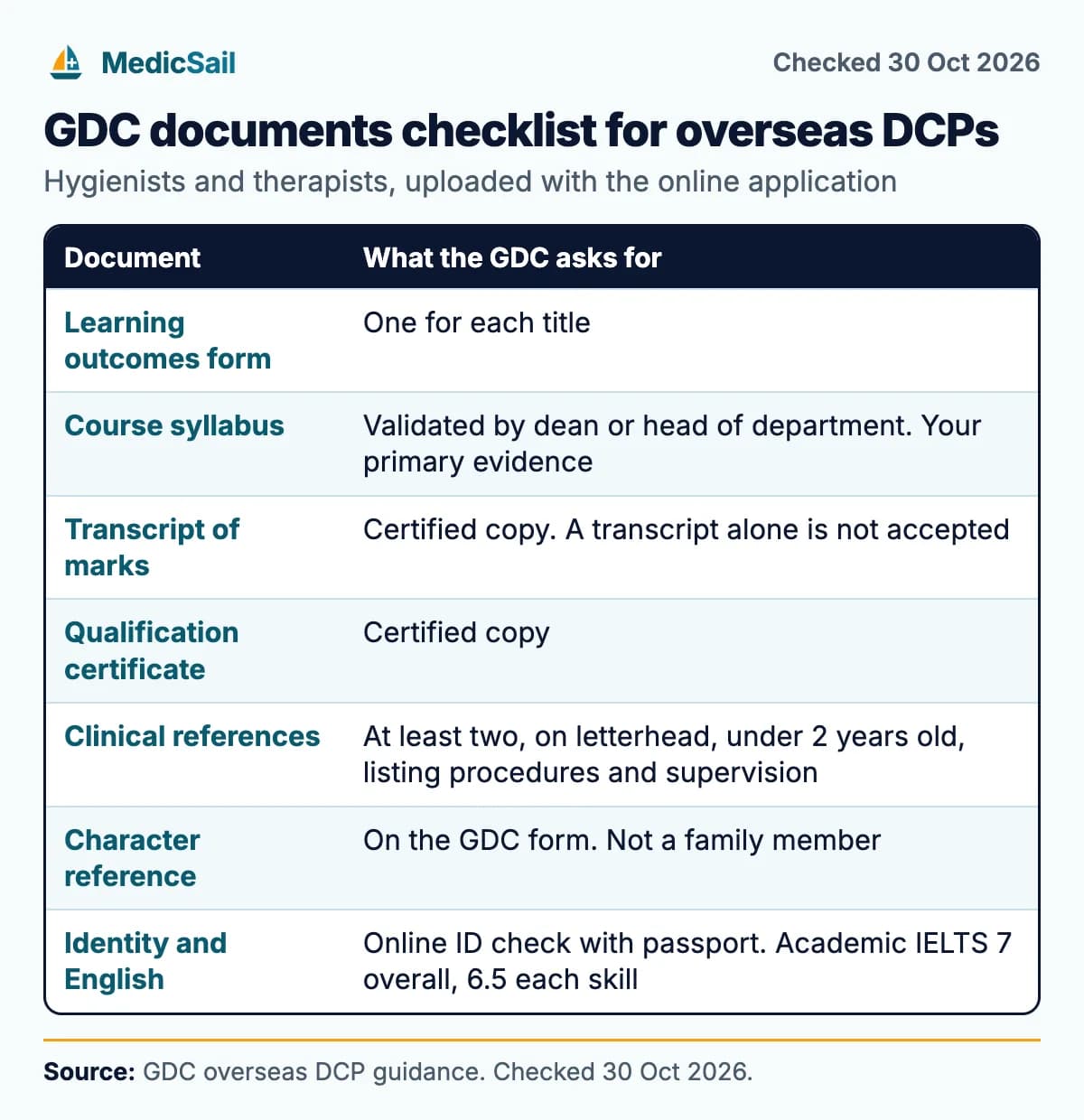
| Document | What the GDC asks for |
|---|---|
| Learning outcomes form | One for each title, completed by you and uploaded with the online application |
| Course syllabus | Issued by your training institution, validated by the dean or head of department, and relevant to when you trained. This is your primary evidence. If you cannot get one from your training period, a letter from the institution confirming the content has not changed, or explaining how it differs |
| Transcript of marks | Certified copy. The GDC says a transcript alone is not accepted, because it lacks hours and subjects studied |
| Qualification certificate | Certified copy |
| Postgraduate qualifications | Certified certificates and a validated syllabus, if relevant |
| Training and CPD | Evidence of relevant courses, with aims and objectives |
| CV | Up to date |
| Clinical references | At least two, on employer or institution letterhead, no more than two years old, giving start and end dates, procedures carried out, knowledge and experience gained, and skill level including whether work was supervised. Recent graduates get them from their dental institution |
| Character reference | On the GDC form. Within 12 months of graduating: the head of your dental school or their nominee. Later: a professional such as a doctor, dentist or lawyer who has known you for over 12 months. Not a family member. Handwritten or scanned signatures only |
| Identity | The GDC online identity check with a valid passport, which works best on a mobile phone |
| English evidence | See below |
Certification
Copies must be certified by a notary public, Commissioner of Oaths, Justice of the Peace, lawyer, solicitor or authorised embassy or consulate official, who is not your character referee, not you and not a relative or partner. The certifier must inspect the originals and write in English: "I have inspected the original document(s) and I certify that this is a true copy", then add their name, address and professional status (if they have no official stamp) and sign. Typed signatures are not accepted. Documents not in English need translations that follow the GDC's translation guidelines.
Step by step
- Check your right to work first. Read the visa section below before paying anything, especially if you are a hygienist.
- Download the learning outcomes form for each title and read every outcome against your training. Mark where your evidence is thin.
- Ask your school for a validated syllabus and certified transcript. Ask for module content and clinical hours. Older graduates often wait months for this, especially if the curriculum has changed.
- Collect clinical references that describe procedures and supervision, not just job titles, from supervisors who know your work. Ask before you leave a post.
- Book Academic IELTS unless another form of English evidence applies to you.
- Get every copy certified with the GDC's exact wording.
- Apply online, complete the identity check and pay.
- Panel assessment. Your file goes to the monthly panel and the Registrar decides.
- Pay the registration fee when approved, arrange indemnity, and join the register.
English language evidence
The GDC's guidance sets the same IELTS scores for dentists and every DCP title: the Academic test, with at least 6.5 in each of reading, writing, listening and speaking and an overall score of 7. The Test Report Form must usually be no more than two years old when you apply. The GDC accepts IELTS One Skill Retake and IELTS Online at the same minimum scores.
Instead of IELTS, the GDC will routinely accept:
- a primary dental qualification no more than two years old, taught and examined in English, with at least 75% of your clinical interaction (patients, relatives and colleagues) in English, shown by a structured English language reference;
- a pass, no more than two years old, in a language test used for registration by a regulator in a country where English is the first language, with evidence from that regulator;
- practice in the preceding two years in a country where English is the first language, with employer references.
The structured reference must give examples of all four skills or it is not accepted. The GDC's English guidance does not list OET, and it says the guidance is under review, so check its English language controls page before booking. Practice in the Gulf, India or the Philippines does not count as practice in a country where English is the first language. Our IELTS or OET guide compares every UK regulator.
Every fee
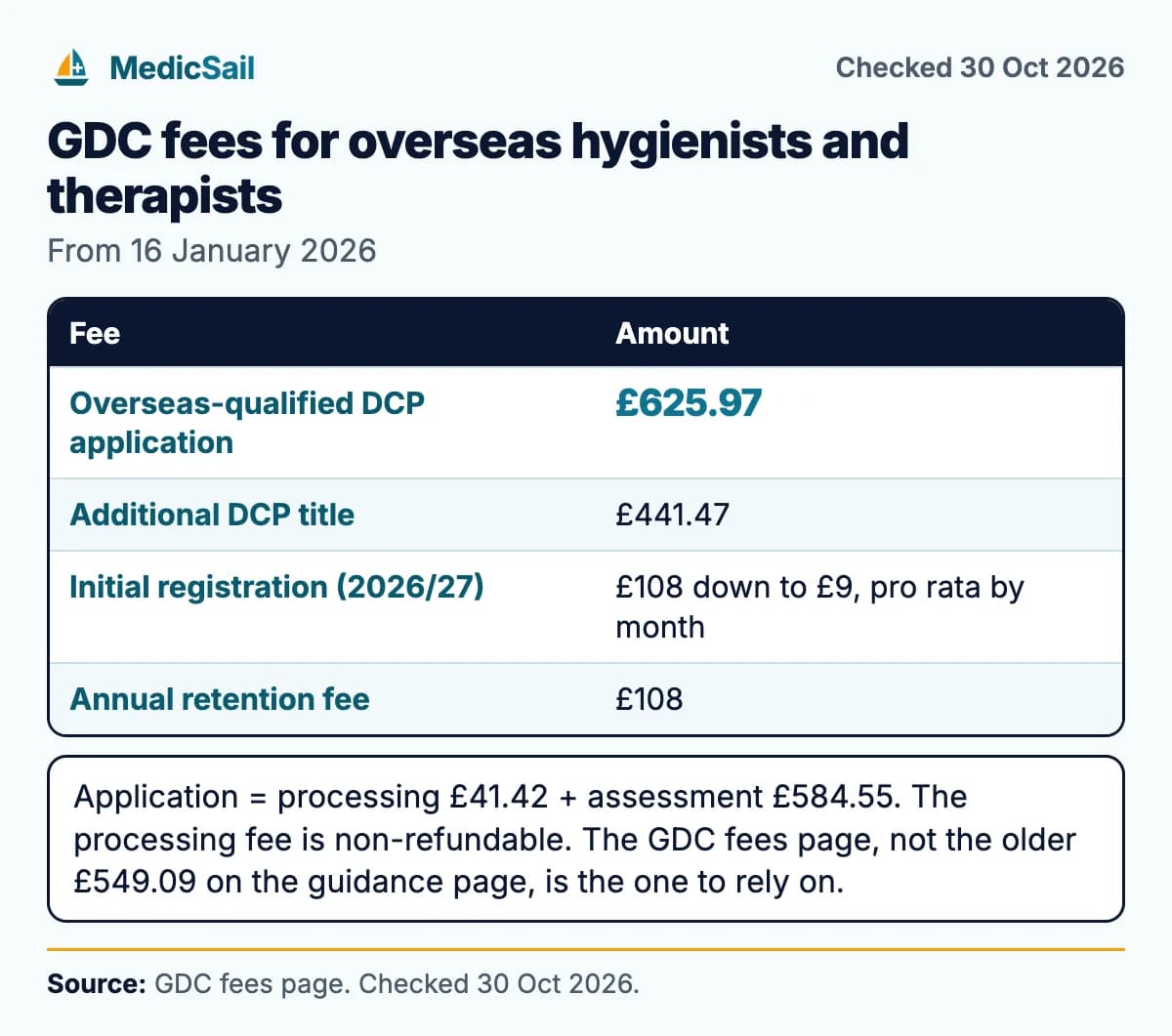
| Fee | Amount | Notes |
|---|---|---|
| Overseas-qualified DCP application | £625.97 | Processing £41.42 plus assessment £584.55, effective from 16 January 2026 |
| Additional DCP title | £441.47 | Processing £41.42, assessment £388.05 and additional title £12.00 |
| Initial registration (2026/27) | £108 down to £9 | Pro rata by month: £108 in August falling by £9 a month to £9 in July. Joining in June or July also means paying the £108 retention fee due by 31 July |
| Annual retention fee | £108 | Covers 1 August to 31 July |
The processing fee is non-refundable and must be paid again on a new application. The GDC says the assessment fee may be refundable only in exceptional circumstances. When we checked, the overseas DCP guidance page still showed an older application fee of £549.09; the GDC's fees page, which carries the 16 January 2026 date, is the one to rely on.
Budget separately for IELTS, notarised copies, translations, school charges for syllabus validation, indemnity cover and, if you need one, a visa. The registration cost estimator helps you total these.
How the panel works and how long it takes
Your application is assessed by an independent registration assessment panel of dentally qualified assessors. The panel advises and recommends; it is not the decision maker. The Registrar reviews its recommendation and then grants registration, asks for further information or clarification, or refuses.
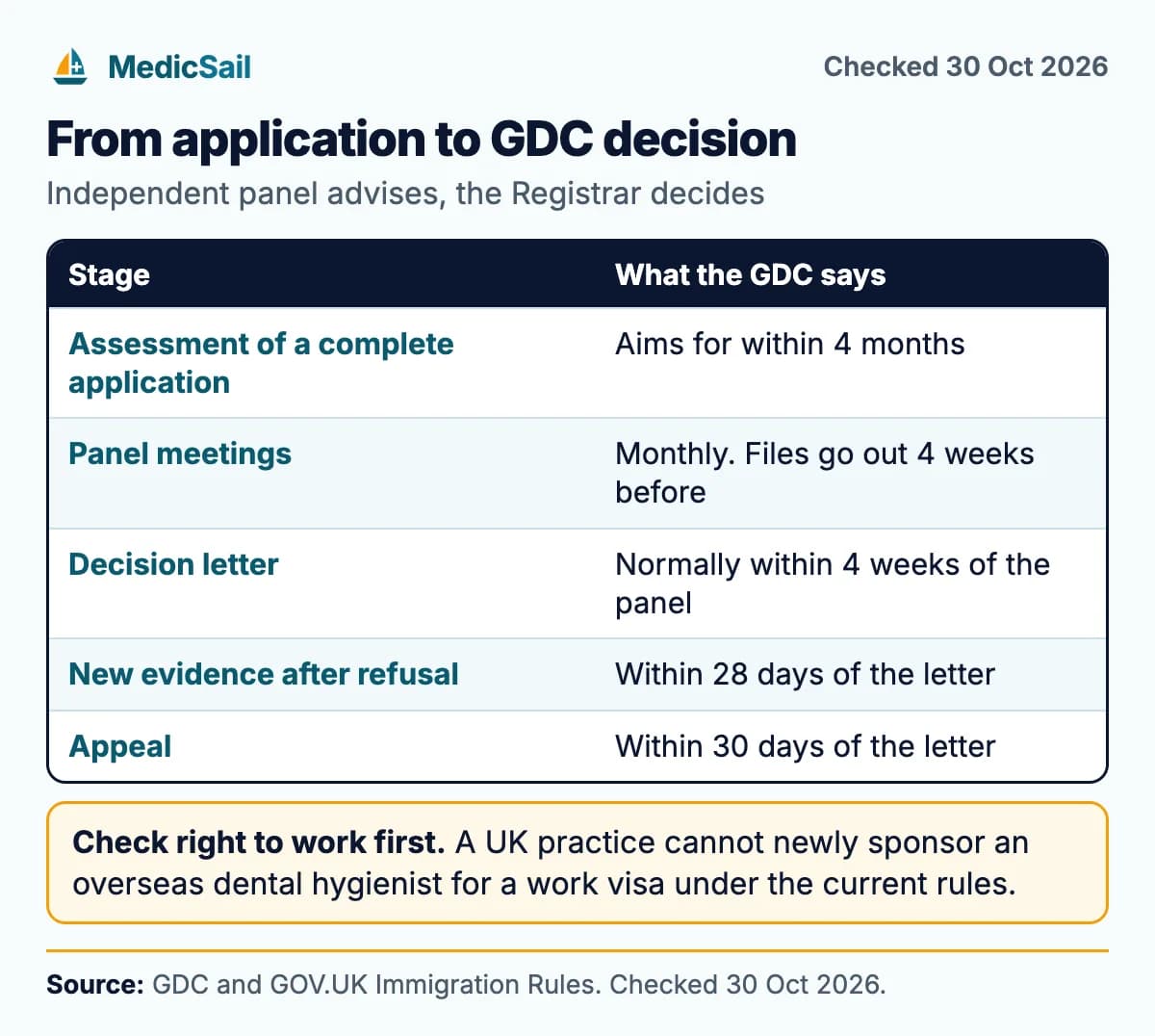
| Stage | What the GDC says |
|---|---|
| Assessment of a complete application | Aims for within four months of receipt; longer at peak times |
| Panel meetings | Monthly; files go to panel members four weeks before |
| Decision letter | Normally within four weeks of the panel meeting |
| New evidence after refusal | Within 28 days of the decision letter |
| Appeal | Within 30 days of the decision letter |
Before the four months starts, allow time for your school, references, IELTS and certification. If your evidence is complete, plan for roughly five to eight months from first contacting your school to registration, which is our estimate rather than a GDC figure. The registration timeline calculator can help you plan.
Why applications are refused, and what to do
The GDC lists three main reasons for refusal:
- information not provided in the format or language the guidance prescribes, for example the syllabus or qualification;
- supporting evidence that is not strong, recent or verifiable for one or more learning outcomes;
- no evidence at all for one or more learning outcomes.
It also publishes a guide to the most common reasons, which covers dental hygienists and dental therapists; read it before you submit. Weak or out-of-date clinical references are the evidence problem most within your control.
Where applications tend to fall short
- A syllabus that is a printed course list with no content, hours or validation signature.
- Relying on a transcript instead of a syllabus.
- Clinical references that only confirm employment dates, or are more than two years old.
- Leaving communication, professionalism and management outcomes with no evidence.
- A therapist application with no evidence of restorations or extractions of deciduous teeth.
- Certification without the GDC's exact wording, or by your character referee.
After a refusal
You have two options. If you have new evidence that addresses the reasons, submit it within 28 days of the decision letter and your file goes back to a panel. If you believe the decision was wrong, appeal within 30 days; the letter explains how. If your circumstances change later, for example after further training, you can make a new application.
The visa problem for dental hygienists
This is the most important practical point for anyone without an existing right to work in the UK. GOV.UK's Immigration Rules place dental hygienist in occupation code 3213, medical and dental technicians, in Table 3a of Appendix Skilled Occupations. Sponsors may only sponsor Skilled Worker applicants in that table if the applicant was granted Skilled Worker permission under the rules in place before 22 July 2025 and has held it continuously since. GOV.UK's Health and Care Worker visa page lists 3213 only for extending or updating a visa where the certificate of sponsorship was issued before 22 July 2025.
In plain terms, a UK practice cannot newly sponsor an overseas dental hygienist for a work visa under the current rules. Dental therapist is not named in the GOV.UK example job titles, and GOV.UK notes that dental roles can fall under different codes. If you are a therapist, ask any prospective sponsor in writing which occupation code it would use, and check that code on GOV.UK yourself.
GDC registration is still worth having if you already have the right to work, for example as the dependant of a visa holder, through settled status or as a British or Irish citizen. Immigration rules change often, so check GOV.UK on the day you decide, and read our Health and Care Worker visa guide for how sponsorship works. This is general information, not immigration advice.
Working in the UK, coming from the Gulf, and next steps
NHS Health Careers says most dental hygienists work in general dental practice, often self-employed, with others in community services, hospitals and domiciliary care. In NHS hospital or community posts they typically start at Agenda for Change Band 5 or 6; in England in 2026/27 that is £32,073 to £39,043 at Band 5 and £39,959 to £48,117 at Band 6. Practice pay is set by the practice.
Hygienists and therapists in the UK can see patients by direct access, without a dentist's referral, for their full scope except tooth whitening. The GDC's direct access guidance, updated on 1 November 2025, says people with overseas qualifications should check their training covered each area and confirm their indemnity cover first, and suggests a period of working on referral to build confidence. You must also meet the GDC's CPD requirements and pay the retention fee each year.
The British Society of Dental Hygiene and Therapy points overseas-qualified hygienists to the GDC for registration questions and lists a Dental Hygienist Adaptation module at the University of Essex.
If you work in the Gulf
A Gulf licence does not transfer, and Gulf practice does not count as English evidence. Your Gulf clinical work is useful: ask your clinical director for references on clinic letterhead, dated within two years, listing the procedures you performed and how you were supervised. If you trained as a dentist and worked as a hygienist in the Gulf, the UK DCP route is closed to you. See moving from a Gulf licence to UK registration. Our dental hygienist hub compares other countries.
Next steps
- Confirm your right to work in the UK before paying any fee.
- Download the learning outcomes form for your title and map your evidence.
- Request a validated syllabus and certified transcript from your school.
- Ask two supervisors for detailed clinical references dated within two years.
- Book Academic IELTS and arrange certification with the GDC wording.
Questions
No. The ORE is for dentists. Overseas-qualified dental hygienists and therapists are assessed on paper by an independent panel against the GDC learning outcomes, and the Registrar decides.
Not with only a dentistry qualification. The GDC says you can no longer apply for DCP registration if you hold only an overseas diploma in dentistry. You need a formal dental hygiene or therapy qualification.
£625.97 from 16 January 2026, made up of a £41.42 processing fee and a £584.55 assessment fee. An additional title costs £441.47. If approved, you pay a pro rata registration fee and then £108 a year.
Academic IELTS with 7 overall and at least 6.5 in each skill, usually no more than two years old. IELTS One Skill Retake and IELTS Online are accepted at the same scores.
The GDC's English guidance does not list OET. It accepts IELTS and a small set of alternatives, and says the guidance is under review, so check with the GDC before relying on another test.
The GDC aims to assess complete applications within four months. Panels meet monthly and decisions normally follow within four weeks of the panel. Gathering documents comes first and often takes longer.
Yes, at the same time, but each title needs its own application form, documents and learning outcomes form. The additional title fee is £441.47.
Not for a new visa under the current rules. Dental hygienist sits in code 3213, which sponsors can only use for people who held Skilled Worker permission before 22 July 2025. Check GOV.UK for any change.
You can send new evidence within 28 days of the decision letter for reassessment by a panel, or appeal within 30 days. You can also make a new application later, paying the processing fee again.
No. The GDC says a transcript alone is not accepted because it lacks hours and subjects. Your validated syllabus is the primary evidence.
Sources
- 1GDC: How to apply as an overseas-qualified DCP
- 2GDC: How overseas DCP applications are assessed
- 3GDC: Overseas DCP learning outcomes
- 4GDC: Preparing for Practice (revised 2015, PDF)
- 5GDC: Registration application fee
- 6GDC: Registration fee
Show all 17 sourcesShow fewer sources
- 7GDC: Annual retention fee
- 8GDC: English language controls
- 9GDC: Guidance on English language controls (PDF)
- 10GDC: International registration reforms
- 11GDC: Scope of practice
- 12GDC: Direct access
- 13GOV.UK: Immigration Rules Appendix Skilled Occupations
- 14GOV.UK: Health and Care Worker visa, your job
- 15NHS Health Careers: Dental hygienist
- 16NHS Employers: Pay scales for 2026/27
- 17British Society of Dental Hygiene and Therapy: Working in the UK
Plan it with our free tools
- Route finderThe regulator, steps and exams for dental hygienists and therapists in the United Kingdom.
- Cost estimatorEvery official fee for dental hygienists and therapists in the United Kingdom, itemised and totalled.
- NHS pay bandsAgenda for Change bands and the band each profession usually starts at.
MedicSail
Healthcare licensing consultants for the UK, Europe and the USA
Updated and checked against the sources listed above. How we research and check our guides