


































HCPC registration for international physiotherapists
The HCPC international route for physiotherapists, step by step and checked against the HCPC's own pages: what the physiotherapy assessors look for, the standards of proficiency mapping document, English scores, every fee, realistic timelines, the test of competence, common reasons for refusal and how to land a first Band 5 post.

MedicSail
Published
The short answer
If you qualified as a physiotherapist outside the UK, you must join the Health and Care Professions Council (HCPC) Register before you can work under the protected titles physiotherapist or physical therapist anywhere in the UK. You apply online through the HCPC international route. There is no licensing exam. Two physiotherapist assessors compare your qualification, training and experience with the HCPC standards of proficiency for physiotherapists, using the evidence you upload, and either accept you, refer you for a test of competence, or refuse.
You pay a non-refundable scrutiny fee of £678.38 when you submit. If you are accepted, most international applicants then pay £370.02 to register. Unless the qualification that first let you practise came from one of the HCPC's listed English-speaking countries, you need IELTS 7.0 with no element below 6.5, OET Physiotherapy at 1400 with no sub-test below 300, or the TOEFL iBT scores the HCPC sets. The HCPC currently says it takes 3 months from a complete application to a first decision, followed by verification checks.
The most important change to know about came on 20 November 2025. The HCPC no longer asks for more information once you have applied. Every application now needs a standards of proficiency mapping document, and gaps lead to a test of competence or a refusal. This guide shows how to build a physiotherapy application that does not leave gaps. For the regulator at a glance, see our HCPC registration overview, and for pay, employers and visas in one place, our page on working as a physiotherapist in the UK.
Who this route is for, and who should use another
The international route is for you if all of these apply:
- you trained as a physiotherapist outside the UK and hold a qualification delivered outside the UK;
- that qualification is the one that first allowed you to practise as a physiotherapist (or physical therapist) in the country where you trained;
- you have never been on the HCPC Register before.
It covers bachelor's graduates, people with a master's or doctor of physical therapy, and experienced clinicians who have since specialised. It does not matter which country you trained in. What matters is whether your evidence shows you meet the UK standards.
Other routes
- Trained in the UK on an HCPC-approved programme: use the UK route, even if you then worked abroad.
- Previously HCPC registered: use readmission, not the international route.
- Trained or practised in Norway, Iceland, Liechtenstein or Switzerland: the HCPC runs a separate Free Trade Agreement route on a paper form, where a period of adaptation is a possible outcome.
- Refugee status: contact the HCPC directly before applying.
What registration does and does not give you
Registration lets you use a protected title and practise. It does not give you the right to live or work in the UK. Most physiotherapists coming from abroad need a sponsored job and a Health and Care Worker visa, which we cover in our Health and Care Worker visa guide. You also cannot work as a physiotherapist while the HCPC is assessing you; you need your registration number first.
What the HCPC assesses for a physiotherapist
The HCPC sends your application to two assessors from the physiotherapy part of the Register. Their first step is to compare your regulated education and training with the standards of proficiency. If they find gaps, they check whether other relevant education, training or experience makes up for them. They decide only on what you submit: the HCPC says it does not contact referees, universities or employers to fill gaps for you.
The current physiotherapy standards took effect on 1 September 2023. There are 15 headline standards shared by every HCPC profession, such as practising within your scope, communicating effectively and keeping records. Inside them sit the standards written only for physiotherapists. These are the ones that decide most physiotherapy applications.
| Standard | What it asks of a physiotherapist | Where your evidence usually sits |
|---|---|---|
| 12.6 | Anatomy and physiology of the neurological, musculoskeletal, cardiovascular and respiratory systems, growth and development across the lifespan, and how physiotherapy causes physiological and structural change | Course information form: anatomy, physiology and pathology modules |
| 12.7 | Physics, biomechanics, applied exercise science and ergonomics, and measurement techniques based on biomechanics or electrophysiology | Biomechanics, exercise physiology and electrotherapy modules |
| 12.8 and 12.9 | Clinical science (pathology, the evidence base for physiotherapy) and behavioural science (psychology, sociology, health promotion and behaviour change, team working) | Clinical and behavioural science modules, plus experience |
| 13.13 and 13.14 | Carry out a thorough, detailed assessment and form a working diagnosis on the basis of your physiotherapy assessment | Placement records and experience accounts |
| 13.15 to 13.17 | Set management plans with timescales, apply clinical reasoning to prioritise, and explain the rationale for interventions | Experience accounts and references |
| 13.18 to 13.20 | Plan interventions to restore movement and function, position or immobilise safely, and apply manual therapy, exercise and movement, electrotherapeutic modalities and kindred approaches | Practical modules and placements across specialties |
| 13.21 and 14.6 | Use population health data to inform practice, and apply safe moving and handling | Public health content, ward experience |
Two things that trip up physiotherapy files
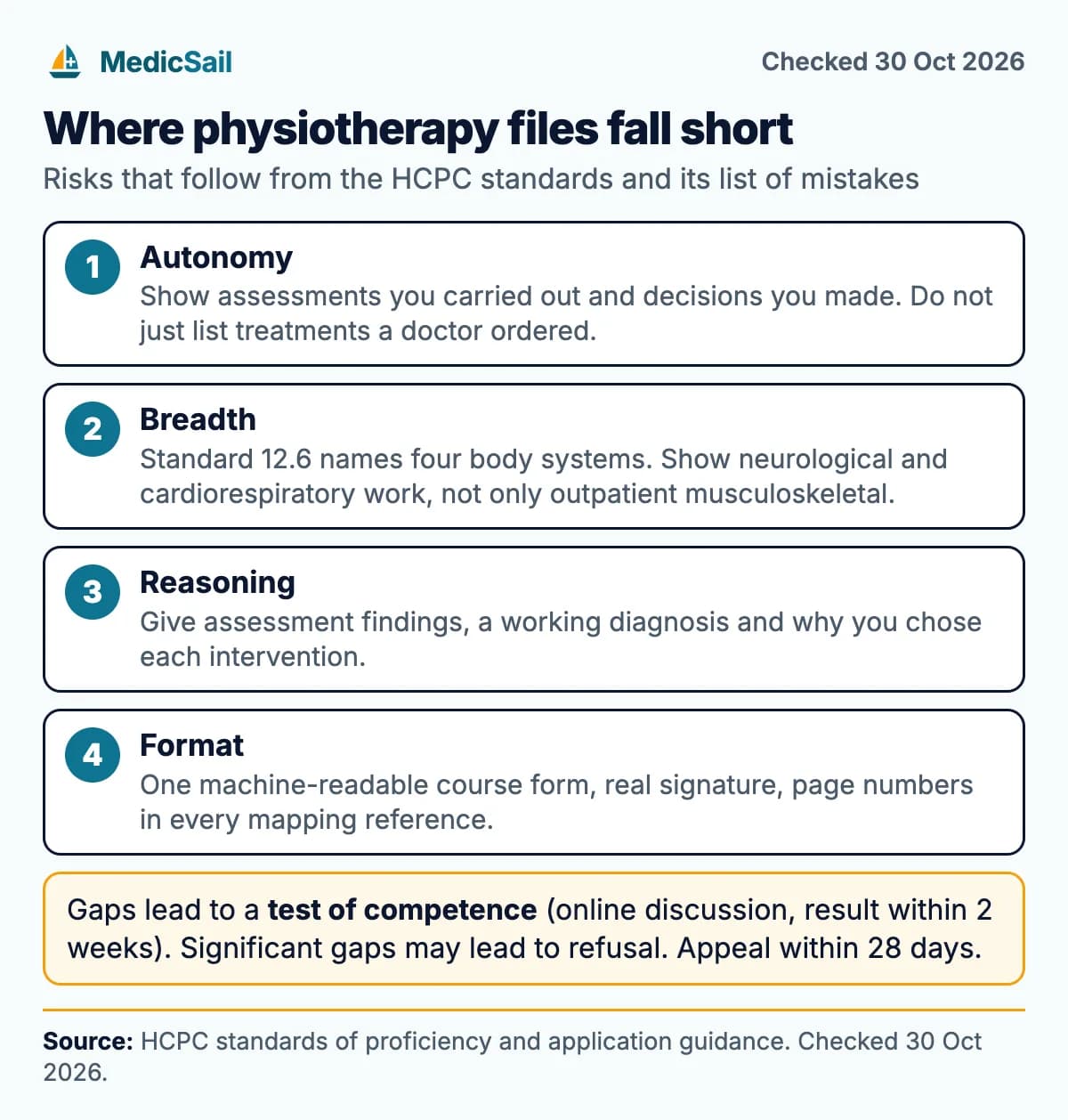
Autonomy. Standards 4 and 13.14 expect you to practise as an autonomous professional who forms a working diagnosis from your own assessment. In many countries physiotherapists treat on a doctor's referral or prescription. If that was your setting, describe the assessments you carried out and the decisions you made yourself, and do not simply list the treatments that were ordered.
Breadth. Standard 12.6 names four body systems, and 13.20 names four groups of skills. If your placements or career were mostly outpatient musculoskeletal work, your course information form and experience section need to show where you learned and used neurological and cardiorespiratory physiotherapy, including acute or ward-based care. If you cannot show it anywhere, that is a likely gap.
The application, step by step
- Read the physiotherapy standards and the guidance first. Download the physiotherapy version of the standards of proficiency mapping document. The HCPC lists downloading the wrong profession's template as a common mistake.
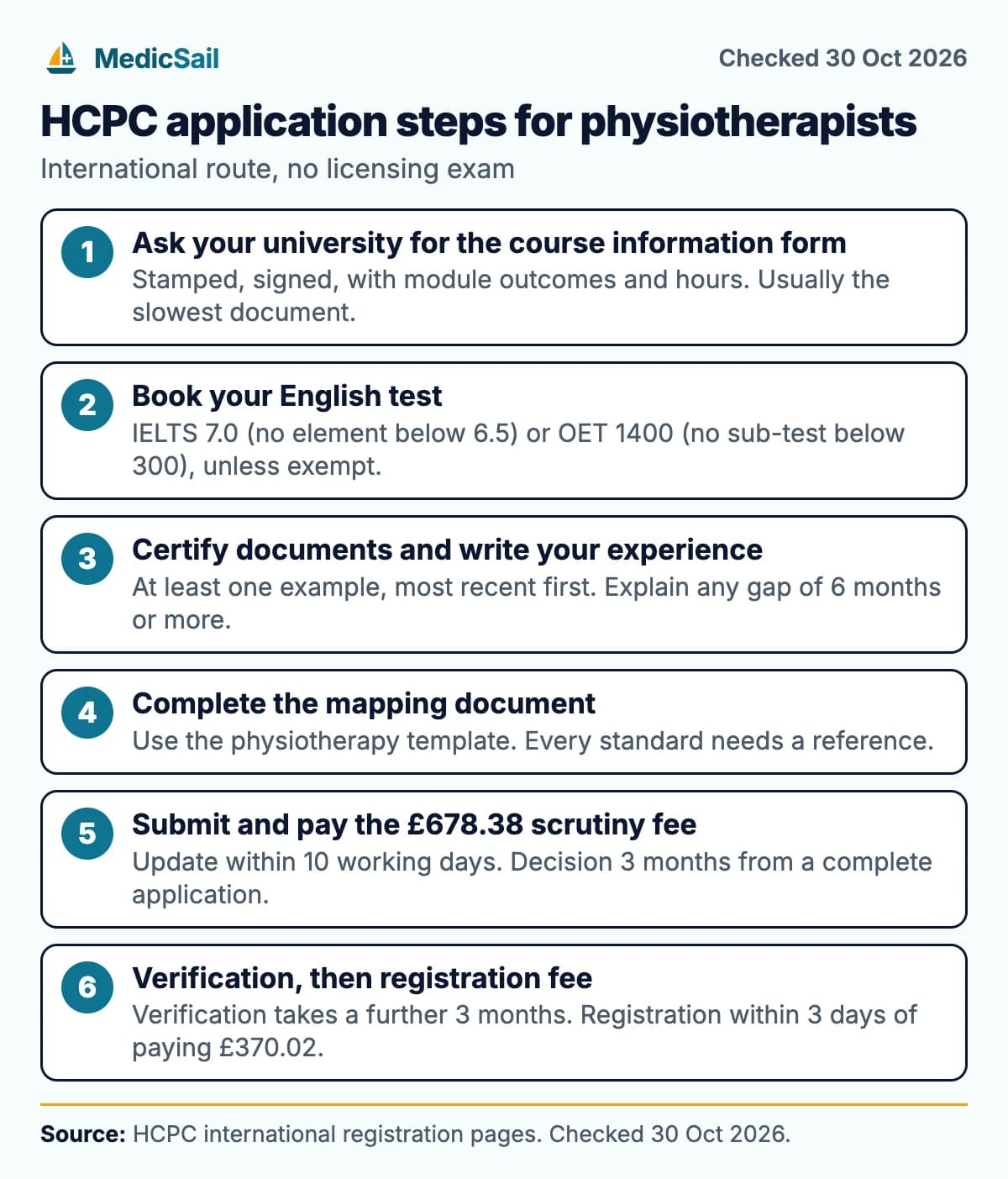
- Ask your university for the course information form. The education provider that awarded your physiotherapy qualification must complete it, with overall and module learning outcomes, content, theoretical and practical hours and assessment methods for each element you studied. It needs the institution's stamp or seal, a named contact and a real or electronic signature (a typed name is not accepted). This is usually the slowest document, so ask for it before anything else.
- Book your English test, unless you are exempt. See the English section below for scores.
- Collect and certify your identity documents and qualification certificate. Copies must be certified by a person of standing in the community, with certified official translations for anything not in English, and uploaded as machine-readable files.
- Write your professional experience section. Give at least one example, most recent first, in your own words, up to 20,000 characters for each account, and explain any career gap of six months or more.
- Complete the mapping document. Reference every standard to a specific place in your application.
- Submit online and pay the £678.38 scrutiny fee by card through Worldpay. Your application is not submitted until the payment goes through.
- Review. The HCPC says you can expect an update within 10 working days. If something is missing, you have six months to supply it before the application is withdrawn.
- Assessment and first decision. Two physiotherapist assessors make a recommendation and the HCPC emails you its decision with a Record of Assessment.
- Verification and registration. If accepted, the HCPC verifies your details with your education provider, regulators and referees, then sends a link to pay the registration fee. Allow up to three days after payment to appear on the Register.
Writing the mapping document and experience section as a physiotherapist
The mapping document is a signpost, not a statement. The HCPC says it must point to evidence found elsewhere in your application and must not contain the evidence itself, such as personal statements or reflections. Anything extra is not assessed and you will be asked to remove it. It is completed in Arial 12 on the profession's Word template, and every standard needs a reference.
How to reference
- Your degree: cite the course information form with the module name and code, page number and the learning outcome (LO) or course content (CC) reference. For example, standard 12.6 might point to your anatomy module learning outcomes on a named page.
- Further training: cite the item in your qualification section, the provider and the page of the certificate or syllabus. Postgraduate courses in manual therapy, neurological rehabilitation or respiratory care often close gaps.
- Experience: cite the role in your experience section, the employer and the supporting document. A job in an intensive care unit can evidence cardiorespiratory skills your degree covered thinly.
What a strong physiotherapy experience account contains
Assessors read for clinical reasoning. For each role, describe the caseload, how you assessed patients (subjective and objective assessment, outcome measures), how you reached a working diagnosis, how you set goals and timescales with the patient, which interventions you chose and why, and how you evaluated progress and discharged. Mention how you worked with doctors, nurses and occupational therapists, how you kept records and how you handled consent and risk.
The HCPC is strict about authorship. You must not use AI tools or text from other sources, and wording copied from job descriptions or employer documents counts as another source. Every document is checked for plagiarism and AI use.
Referees
Each role needs a professional referee who supervised you or was responsible for you, with contact details on the organisation's official email domain. Personal email addresses are not accepted. Ask your head of physiotherapy or rehabilitation lead before you leave a job, because the HCPC contacts referees during verification.
English language requirements for physiotherapists
You do not need a test if the qualification that first let you practise was gained in a country on the HCPC's list, which includes Australia, Canada, Ireland, Kenya, Malta, New Zealand, the USA and a number of Caribbean and Pacific countries and territories. India, Pakistan, the Philippines, Nigeria, Egypt and the Gulf states are not on it, so most applicants need a test even if they studied and worked in English.
| Test | Score the HCPC needs for physiotherapists |
|---|---|
| IELTS (Academic or General, UKVI or not) | 7.0 overall, no element below 6.5 |
| OET (Physiotherapy version) | 1400 overall, no sub-test below 300 |
| TOEFL iBT taken before 21 January 2026 | 100 out of 120 |
| TOEFL iBT taken on or after 21 January 2026 | Reading 4.5, Listening 5, Writing 4.5, Speaking 5, Overall 5 |
The certificate must be no more than two years old when the HCPC receives your application, and the test must be taken at an official test centre, not at home. IELTS one-skill retakes count if taken within six months of the original test and shown on the same report. The HCPC does not accept TOEFL tests taken in the UK, combined scores, superscores or MyBest scores. For a side-by-side comparison with other UK regulators, see IELTS or OET for UK healthcare regulators.
Every fee, and when you pay it
| Fee | Amount | When |
|---|---|---|
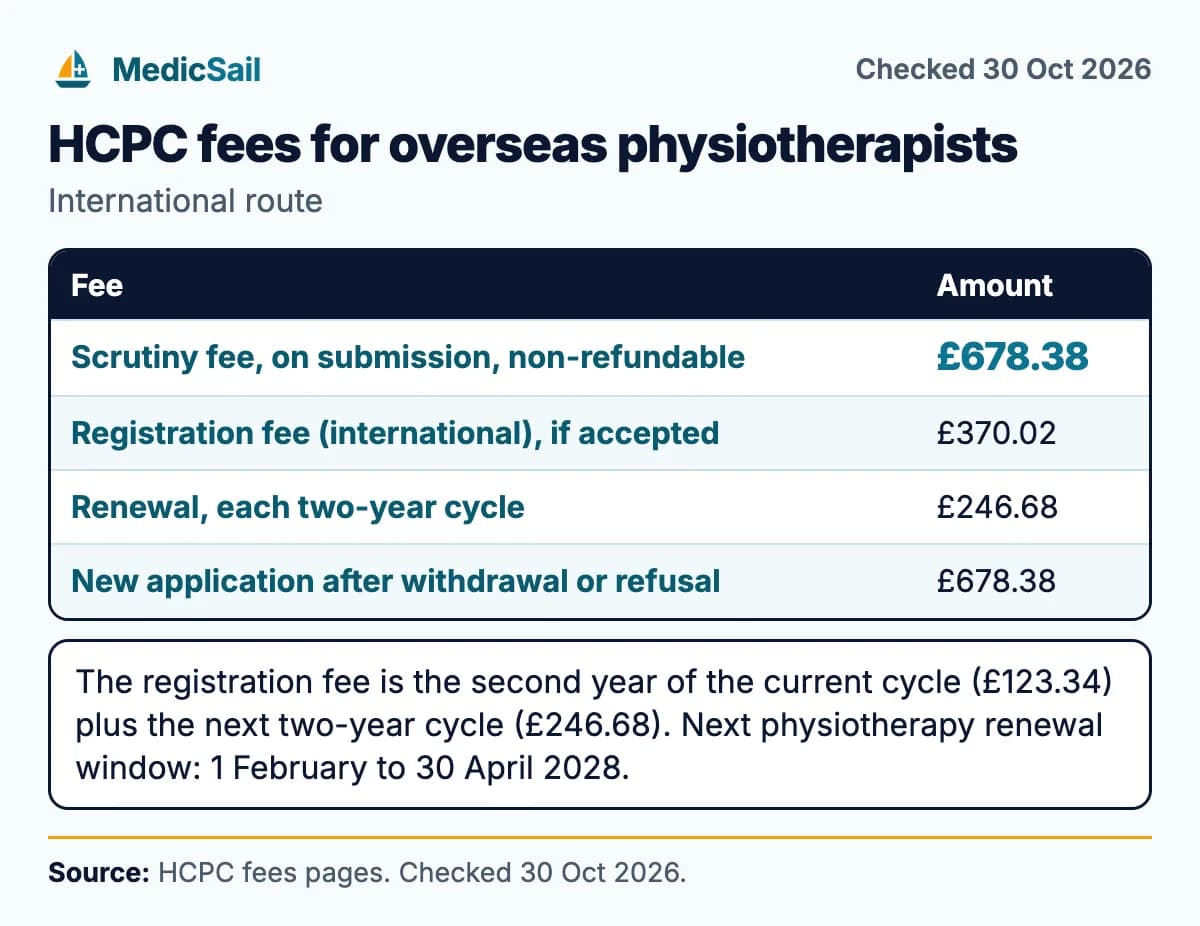
| Scrutiny fee | £678.38 | When you submit; non-refundable |
| Registration fee for international applicants | £370.02 | Only if accepted; covers the second year of the current cycle (£123.34) plus the next two-year cycle (£246.68) |
| Registration if you join in the first year of the cycle | Two years payable | The HCPC says only two years are charged; it states the rule, not a separate figure |
| Renewal | £246.68 for each two-year cycle | Every two years in your profession's window |
| New application after withdrawal or refusal | £678.38 again | A new scrutiny fee applies |
Physiotherapists renew on their own cycle. The HCPC lists the next physiotherapy renewal window as opening on 1 February 2028 with a deadline of 30 April 2028, which tells you where in the cycle you are joining. Outside the HCPC, budget for the English test, certification, translations, your university's charges for the course information form and, later, the visa and Immigration Health Surcharge. Our registration cost estimator adds these up, and the visa cost calculator covers the immigration side.
Before you pay the scrutiny fee, tell your bank you are making an international card payment to the UK. The HCPC warns that Worldpay screens every payment and can block cards for reasons such as unusual payment patterns or mismatched address details.
How long it takes
| Stage | What the HCPC says |
|---|---|
| Review of a new application | An update within 10 working days |
| Missing documents | Six months to supply them, then withdrawal |
| Assessment to first decision | 3 months from a complete application |
| Verification after acceptance | A further 3 months for outstanding checks |
| Test of competence, if referred | Must be completed within 12 months; result within two weeks |
| After paying the registration fee | Allow up to three days |
The HCPC also notes a very high number of international applications, which can lengthen every stage. Add the time before you submit: a course information form from a large university can take weeks or months, and a resit of IELTS or OET adds more. Realistically, plan for most of a year from first contacting your university to holding a registration number if everything goes smoothly, and longer with a test of competence. Our registration timeline calculator maps this against a target start date.
Test of competence, refusal and the common reasons physiotherapy files fall short
Since 20 November 2025 the HCPC carries out one round of documentary assessment. If the assessors find gaps, you are referred for a test of competence. If the gaps are significant, the application may be refused.
The test of competence
It is a structured professional discussion with two physiotherapist assessors, usually online on Microsoft Teams, tailored to the gaps found in your file. Expect clinical and ethical scenarios, questions about your reasoning and reflection on your practice. You must complete it within 12 months of referral. You can reschedule or ask to cancel once; a second cancellation or non-attendance withdraws your application. You receive a pass or fail by email within two weeks.
If you are refused
The HCPC sends its reasons. You can appeal within 28 days of the refusal, or make a new application at any time, with no waiting period, if you can show you have addressed the reasons. A new application means a new scrutiny fee.
Where physiotherapy applications tend to fall short
These are risks that follow from the standards and the HCPC's own list of mistakes, not an official refusal list:
- No evidence of neurological or cardiorespiratory practice because placements and work were mostly outpatient musculoskeletal.
- Experience accounts that list modalities (ultrasound, TENS, traction) without assessment findings, a working diagnosis or the reasoning for each choice.
- A compulsory internship year that the course information form does not cover, with no separate letter from the hospital that supervised it.
- A course information form uploaded in parts, as an unreadable scan, or with a typed signature.
- Mapping references with no page numbers, or personal statements pasted into the mapping document.
- Referees on personal email addresses, or experience text copied from a job description.
- An IELTS result with one element at 6.0, a home-edition test, or a certificate more than two years old.
First jobs, pay and the visa
NHS Health Careers says physiotherapists typically start on Agenda for Change Band 5. Many trusts recruit newly arrived physiotherapists into Band 5 rotational posts that move through musculoskeletal outpatients, wards, critical care and neurology, which also helps fill any breadth gap from your training. Physiotherapists also work in community teams, schools, nursing homes, occupational health, sport and private practice.
| Band (England, from 1 April 2026) | Annual pay points |
|---|---|
| Band 5 | £32,073, £34,592, £39,043 |
| Band 6 | £39,959, £42,170, £48,117 |
| Band 7 | £49,387, £51,932, £56,515 |
These are NHS Employers 2026/27 figures for England; Scotland, Wales and Northern Ireland set their own, and London posts add a high cost area supplement. The NHS pay band explorer shows every point and the take-home pay calculator estimates pay after tax.
Physiotherapists are occupation code 2221, which GOV.UK lists as eligible for the Health and Care Worker visa. You need a job offer and certificate of sponsorship from an approved employer, and GOV.UK says you will usually need to be paid at least £25,000 or the going rate for the job, whichever is higher. NHS Employers notes that the employer needs your HCPC registration number for the certificate of sponsorship, so many trusts interview while your application is under assessment and issue the certificate once you are registered. Some private clinics cannot sponsor on this route; ask before accepting.
The Chartered Society of Physiotherapy (CSP) is the professional body and trade union. It says HCPC registration is a condition of full membership and that it offers services for physiotherapists who qualified overseas. Membership is optional, but the professional liability insurance it provides helps you meet the HCPC's insurance requirement.
If you work in the Gulf, other countries, and what to do next
A DHA, DOH, MOHAP, SCFHS, QCHP or other Gulf licence does not transfer to the HCPC. The assessors look at the physiotherapy qualification that first let you practise, then at your experience. Gulf hospital work in intensive care, post-operative orthopaedics or stroke rehabilitation is strong evidence, provided your accounts describe your own assessment and reasoning. Gulf practice does not exempt you from an English test. If you trained in India, our route from India covers documents and test centres there. Our guide on moving from a Gulf licence to UK registration covers certificates of good standing and timing your exit.
If you are comparing countries, Ireland registers physiotherapists through CORU (see physiotherapy registration in Ireland), and the USA uses state licensure (see physical therapy in the USA). Our physiotherapist hub compares all five countries we cover.
A checklist to start this week
- Email your university for the HCPC course information form and a letter covering any internship year.
- Download the physiotherapy mapping template and the standards, and mark where each standard is evidenced.
- Ask two supervisors with official work email addresses to act as referees.
- Book IELTS or OET Physiotherapy at a test centre.
- Get passport and certificates certified and translated.
- Start applying for Band 5 posts once your first decision is in view.
Questions
No. The HCPC international route is assessed on paper by two physiotherapist assessors. Since 20 November 2025, if they find gaps they refer you for a test of competence, which is a structured professional discussion rather than a written exam.
The scrutiny fee is £678.38 and is non-refundable. If you are accepted, most international applicants pay £370.02 to register, or two years' fees if they join in the first year of the physiotherapy cycle. Renewal is £246.68 every two years.
OET Physiotherapy with 1400 overall and no sub-test below 300. The certificate must be no more than two years old when the HCPC receives your application and the test must be sat at a test centre.
The HCPC does not set a minimum period of experience. Assessors compare your training with the standards and then look at whether experience makes up any shortfall, so documented experience strengthens an application, especially if your degree was narrow.
Not to fill gaps. Since 20 November 2025 the HCPC does not ask for further information about your training or experience after you apply. It can still ask you to replace missing or wrongly certified documents, which you must do within six months.
It can, but the assessors need to see it. If the course information form does not cover the internship, ask the hospital or university that supervised it for a letter setting out the placements and hours, and reference it in your mapping document.
The HCPC does not list one as a required document for the international route. It relies on the course information form completed by your university.
Only if you already have the right to work in the UK through another route. You cannot use the title physiotherapist or physical therapist until you are on the HCPC Register, and a support worker post is not a physiotherapist post for visa purposes, so check the job and visa route with the employer.
Every two years in the physiotherapy renewal window. The HCPC lists the next window as opening on 1 February 2028 with a deadline of 30 April 2028. Where you join in the cycle decides whether your first payment covers two or three professional years.
Yes. You must send a notice of appeal within 28 days of the refusal. You can also make a new application at any time with a new scrutiny fee, if you can show you have dealt with the reasons given.
Sources
- 1HCPC: International applications
- 2HCPC: International route eligibility
- 3HCPC: Documents you need to prepare and certify
- 4HCPC: Certificate of English language proficiency
- 5HCPC: Course information form
- 6HCPC: Standards of proficiency mapping document
Show all 24 sourcesShow fewer sources
- 7HCPC: Professional experience section
- 8HCPC: Paying your scrutiny fee
- 9HCPC: Registration fees for applicants
- 10HCPC: Reviewing your application
- 11HCPC: Assessing your education, training and experience
- 12HCPC: Verifying your information
- 13HCPC: Possible outcomes of your international application
- 14HCPC: Test of competence
- 15HCPC: Refused applications
- 16HCPC: When to renew
- 17HCPC news: Updates to our international applications process (20 November 2025)
- 18HCPC: The professions we regulate
- 19HCPC: Standards of proficiency for physiotherapists
- 20NHS Health Careers: Physiotherapist
- 21NHS Employers: Pay scales for 2026/27
- 22NHS Employers: Recruitment of overseas allied health professionals
- 23GOV.UK: Health and Care Worker visa, your job
- 24Chartered Society of Physiotherapy
Plan it with our free tools
MedicSail
Healthcare licensing consultants for the UK, Europe and the USA
Updated and checked against the sources listed above. How we research and check our guides