


































HCPC registration for international radiographers
How diagnostic and therapeutic radiographers trained outside the UK join the HCPC Register: choosing your branch, the standards each branch is assessed against, IR(ME)R and radiation protection, English scores, fees, timelines, the test of competence, sonography, and first NHS posts.

MedicSail
Published
The short answer
If you trained as a radiographer, radiologic technologist, medical imaging technologist or radiation therapist outside the UK, you must be on the Health and Care Professions Council (HCPC) Register before you can work as a radiographer, diagnostic radiographer or therapeutic radiographer in the UK. These are protected titles. You apply online through the HCPC international route, upload your evidence and a standards of proficiency mapping document, and pay a non-refundable scrutiny fee of £678.38.
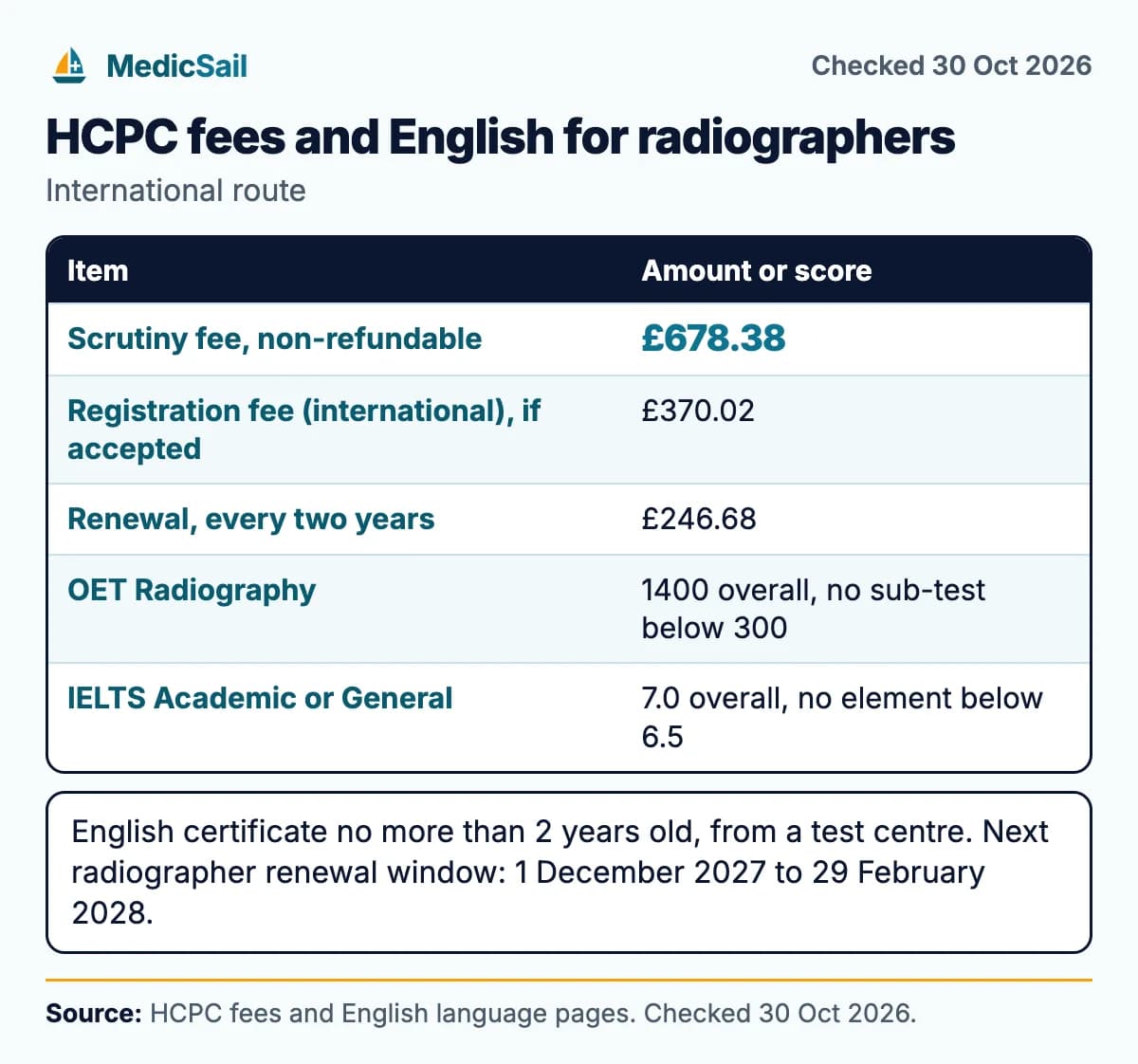
There is no licensing exam. Two radiographer assessors compare your training and experience with the HCPC standards of proficiency for radiographers, which are split into standards for every radiographer and separate standards for the diagnostic and therapeutic branches. They accept you, refer you for a test of competence, or refuse. Unless you are exempt, you need IELTS 7.0 with no element below 6.5, OET Radiography at 1400 with no sub-test below 300, or the HCPC's TOEFL iBT scores. If accepted, most international applicants pay £370.02 to register.
The question that decides most radiographer files is whether your evidence shows the judgement UK radiographers exercise under radiation law, not just skill with equipment. This guide explains how to show it, branch by branch. For the regulator overview see our HCPC registration page, and for a summary of pay, employers and visas see working as a radiographer in the UK.
Diagnostic or therapeutic: which branch you apply for
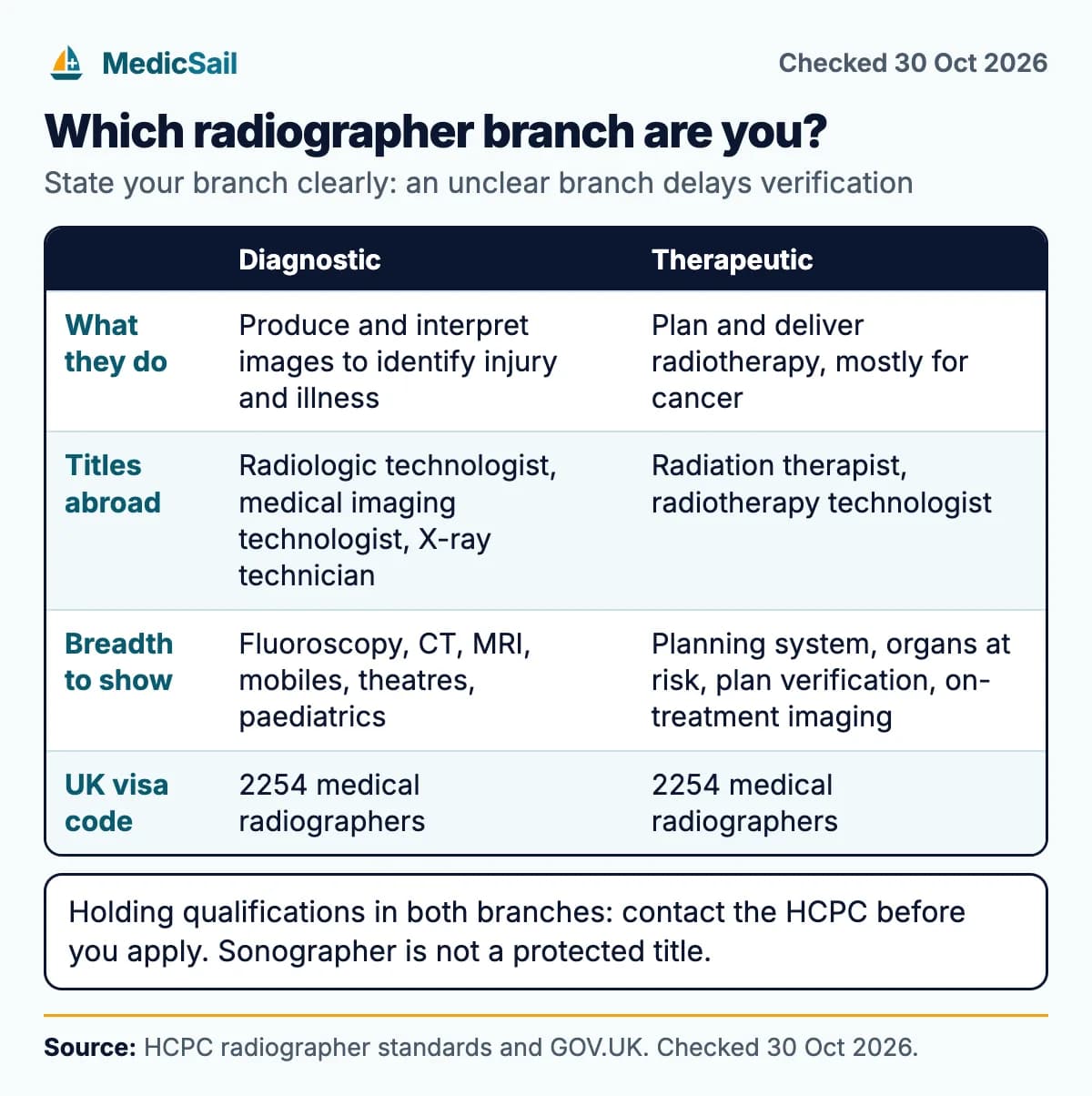
The HCPC regulates radiographers as one profession with three protected titles: radiographer, diagnostic radiographer and therapeutic radiographer. NHS Health Careers describes the difference simply. Diagnostic radiographers produce and interpret images of the body to identify injury and illness. Therapeutic radiographers plan and deliver radiotherapy, mostly for people with cancer.
Your application must make clear which branch your qualification trained you for. The HCPC says an unclear profession or modality stops verification checks from being sent, which delays the whole application. If your title abroad was radiologic technologist, medical imaging technologist or X-ray technician, you are applying as a diagnostic radiographer. If it was radiation therapist or radiotherapy technologist, you are applying as a therapeutic radiographer. If you hold qualifications in both, contact the HCPC before you apply.
Who uses another route
- UK-trained radiographers use the UK route, and former registrants use readmission.
- Radiographers who trained or practised in Norway, Iceland, Liechtenstein or Switzerland use the Free Trade Agreement route.
- Applicants with refugee status should contact the HCPC first.
What about sonographers?
Sonographer is not a protected title, and the HCPC does not regulate sonography as a separate profession. A sonographer who trained as a radiographer can register as a radiographer through this route, but HCPC registration shows you meet the radiography standards, not that you are a qualified sonographer. If ultrasound is your only qualification, read our sonographer guide, which covers the voluntary register and how employers check ultrasound training.
What every radiographer is assessed against
The radiographer standards of proficiency took effect on 1 September 2023. Some apply to both branches. These are where many international files are thin, because in some countries a radiologist or physicist makes the decisions the UK expects a radiographer to make or share.
| Standard | What it expects |
|---|---|
| 2.12 | Practise within current legislation on ionising and non-ionising radiation |
| 12.11 and 12.12 | Understand radiation production and interaction with matter, beam modification, radionuclides, radiation protection and the physics of image formation |
| 12.13 | Understand radiation dosimetry and how doses are calculated |
| 12.14 and 12.15 | Understand how to assess service users before and during a procedure, and the capabilities and range of equipment |
| 12.16 | Distinguish normal from abnormal appearances on images |
| 12.18 to 12.20 | Know the pharmacology of drugs used in radiography, the law and safe methods for giving drugs, and intravenous and oral contrast agents |
| 13.20 | Check that equipment functions within specification |
| 13.39 | Critically analyse clinical images for technical quality |
IR(ME)R in plain terms
UK medical exposures are governed by the Ionising Radiation (Medical Exposure) Regulations 2017, known as IR(ME)R, with a separate version for Northern Ireland. The GOV.UK guidance names four duty holders: the employer, the referrer, the practitioner, who is responsible for justifying an exposure, and the operator, who carries out practical aspects. Each employer's procedures set out who is entitled to act in each role, and radiographers are commonly entitled as operators and, for some examinations, as practitioners who justify them. When you describe your experience, show where you checked a request, decided whether an exposure was justified, chose and adapted the technique, optimised the dose and evaluated the image. If those decisions sat with a radiologist where you worked, say so honestly and point to where your training covered them.
Branch standards: what diagnostic and therapeutic assessors look for
Diagnostic radiographers
| Standard | What it expects |
|---|---|
| 13.23 and 13.24 | Authorise and plan imaging examinations; calculate, record and understand radiation dose |
| 13.25 and 13.28 | Perform a broad range of standard techniques, including contrast examinations, and adapt to non-standard cases |
| 13.27, 13.29, 13.30 | Care for service users before, during and after imaging; mobile and theatre imaging; imaging anaesthetised or unconscious patients |
| 13.31 and 13.32 | Optimise exposure for adults and children; image children |
| 13.34 to 13.38 | Fluoroscopy and interventional procedures, a broad range of CT examinations, standard MRI procedures, and assisting with ultrasound and nuclear medicine |
| 13.40 | Recognise disease, trauma and urgent or unexpected findings and act on them |
The breadth here is the common gap. A technologist who has worked only in CT, or only in general X-ray, needs to show where training covered fluoroscopy, MRI, mobiles, theatres and paediatrics. Placement logbooks broken down by modality are the best evidence; ask your university to include them in the course information form.
Therapeutic radiographers
| Standard | What it expects |
|---|---|
| 13.41 and 13.42 | Plan radiotherapy procedures; help build immobilisation and beam-modifying devices |
| 13.43 and 13.44 | Identify organs at risk on planning images; calculate dose across radiation types with a planning system and verify it |
| 13.45 and 13.46 | CT and MR planning and multimodality imaging; generate a treatment plan and verify its parameters |
| 13.47 and 13.48 | Use image processing for radiotherapy; carry out the full range of radiotherapy processes accurately and safely |
| 13.49 and 13.50 | Manage fluoroscopic procedures with contrast; interpret planning and treatment images to improve dose accuracy |
Radiation therapists who mainly delivered treatment set up by others should show planning-system work, on-treatment image review and patient care during a course of radiotherapy. If planning was done only by dosimetrists or physicists where you worked, point to where your training taught it.
What a strong radiographer experience account looks like
The mapping document is only a signpost: for each standard it points to a module in the course information form (with code, page and learning outcome or content reference), a further qualification, or a role in your experience section. It must not contain reflections or statements. So the experience accounts carry the weight, and the HCPC allows up to 20,000 characters for each.
Diagnostic example
A weak account says you performed chest, skeletal, CT and fluoroscopy examinations in a 600-bed hospital. A strong account describes the same job through decisions: how you checked requests and clinical indications before imaging, when you queried or declined a request, how you adapted technique for trauma, mobile and paediatric patients, how you set exposure factors and used dose reference levels, how you checked pregnancy status and contrast safety, how you evaluated images for technical quality and repeated only when justified, and how you escalated an unexpected finding such as a pneumothorax to the referring team. Name the modalities and give a sense of volume, but let reasoning lead.
Therapeutic example
A weak account says you delivered radiotherapy on linear accelerators. A strong account explains your part in CT simulation and immobilisation, the planning-system tasks you carried out or checked, how you identified organs at risk, how you verified plans and patient position with on-treatment imaging, what tolerances you worked to and what you did when they were exceeded, and how you supported patients through side effects across a course of treatment.
Practical points
- Write in your own words. The HCPC forbids AI tools and text from other sources, including job descriptions, and checks every document for plagiarism and AI use.
- List roles most recent first and explain any career gap of six months or more.
- Give each role a referee who supervised you, such as your chief radiographer or radiotherapy lead, on an official organisation email address. Personal addresses are not accepted.
- Reference short courses in CT, MRI, radiation protection or planning that you finished before you submit. Anything finished after you submit cannot be added.
The application, step by step
- Download the radiographer mapping template and the standards. Read the branch you are applying for line by line.
- Request the course information form from the university that awarded your qualification: overall and module learning outcomes, content, theoretical and practical hours and assessment methods, with a stamp or seal, a named contact and a real or electronic signature. Ask for clinical hours by modality.
- Book your English test if you are not exempt.
- Certify identity documents and your qualification through a person of standing in the community, with certified translations where needed, in machine-readable files.
- Write your experience section, most recent first, at least one example, up to 20,000 characters per account, in your own words, with a referee on an official organisation email for each role.
- Complete the mapping document, referencing every standard.
- Submit and pay £678.38 by card; the application is not submitted until payment succeeds.
- Review (an update within 10 working days), assessment (3 months to a first decision), verification (a further 3 months), then the registration fee.
List every radiography licence you have held, including any national radiation licence or professional council registration. The HCPC contacts regulators and professional bodies during verification, so keep each one in good standing.
English language and fees
You need no test if your first radiography qualification was gained in a country on the HCPC's list, such as Australia, Canada, Ireland, Kenya, Malta, New Zealand or the USA. Otherwise:
| Test | HCPC score for radiographers |
|---|---|
| OET (Radiography version) | 1400 overall, no sub-test below 300 |
| IELTS Academic or General | 7.0 overall, no element below 6.5 |
| TOEFL iBT before 21 January 2026 | 100 out of 120 |
| TOEFL iBT from 21 January 2026 | Reading 4.5, Listening 5, Writing 4.5, Speaking 5, Overall 5 |
The certificate must be no more than two years old when the HCPC receives your application and taken at a test centre. Our IELTS or OET guide compares the two and the English test score checker tests a result against each regulator.
| HCPC fee | Amount | Notes |
|---|---|---|
| Scrutiny fee | £678.38 | On submission, non-refundable |
| Registration fee (international) | £370.02 | If accepted: £123.34 for the second year of the current cycle plus £246.68 for the next cycle; two years only if you join in the first year |
| Renewal | £246.68 | Every two years |
The HCPC lists the next radiographer renewal window as opening on 1 December 2027 with a deadline of 29 February 2028. Budget separately for the test, certification and translations, and the visa; the registration cost estimator brings these together.
How long it takes
- Preparation: universities that never recorded placement hours by modality may need weeks to rebuild them from logbooks. Start this before you book a test.
- Review: an update within 10 working days, according to the HCPC; six months to provide anything missing.
- Assessment: 3 months from a complete application to a first decision. The HCPC warns that very high international application numbers can extend this.
- Verification: a further 3 months after acceptance.
- Test of competence: within 12 months of referral; results within two weeks.
- Registration: up to three days after you pay.
Our registration timeline calculator turns these stages into dates.
Test of competence, refusals and where radiographer files fall short
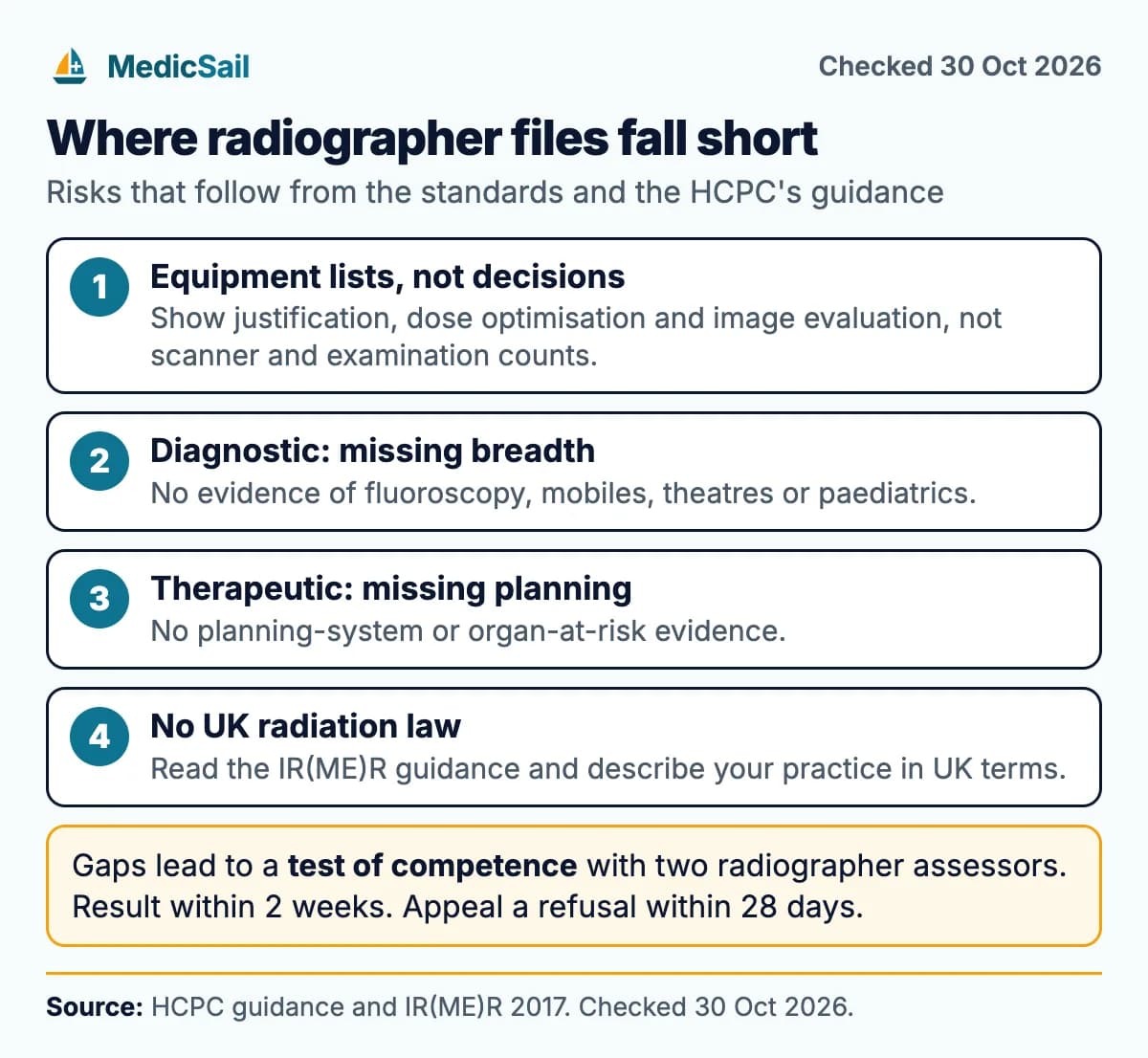
Since 20 November 2025 the HCPC carries out a single round of documentary assessment. It no longer asks you for more information to fill gaps. Gaps lead to a test of competence; significant gaps may lead to refusal.
The test is a structured professional discussion with two radiographer assessors, usually on Microsoft Teams, focused on your gaps. For a diagnostic radiographer that might mean justifying an exposure, optimising a paediatric technique, evaluating image quality or escalating an unexpected finding. For a therapeutic radiographer it might mean organs at risk, plan verification or on-treatment image review. You get one chance to reschedule or cancel, and a pass or fail within two weeks. After a refusal you can appeal within 28 days, or reapply at any time with a new scrutiny fee if you have addressed the reasons.
Common shortfalls
These follow from the standards and the HCPC's guidance, not an official list:
- Experience written as a list of scanners and examination counts, with no justification, dose optimisation or image evaluation.
- No evidence of fluoroscopy, mobiles, theatres or paediatrics for a diagnostic applicant.
- No planning-system or organ-at-risk evidence for a therapeutic applicant.
- An unclear branch, or the wrong profession's mapping template.
- No understanding of UK radiation law shown anywhere in the file.
- Referees on personal email addresses, or copied job description text.
Before writing, read the IR(ME)R guidance on GOV.UK and the Society of Radiographers (SoR) material on radiation regulations, so you can describe your own practice in UK terms.
First jobs, pay, the visa and the Society of Radiographers
NHS Health Careers says both diagnostic and therapeutic radiographers typically start on Agenda for Change Band 5. Diagnostic radiographers can later specialise in CT or MRI, train in sonography, or focus on children, stroke or cancer imaging. Therapeutic radiographers can specialise in particular cancers, children or newer techniques such as proton beam therapy.
| Band (England, from 1 April 2026) | Annual pay points |
|---|---|
| Band 5 | £32,073, £34,592, £39,043 |
| Band 6 | £39,959, £42,170, £48,117 |
| Band 7 | £49,387, £51,932, £56,515 |
These are NHS Employers 2026/27 figures for England on Agenda for Change; see the NHS pay band explorer for every point.
The visa
Both branches use occupation code 2254, medical radiographers, which GOV.UK lists as eligible for the Health and Care Worker visa. GOV.UK says you will usually need at least £25,000 or the going rate, whichever is higher. Radiography assistant practitioner is a different code, 3213, which the Immigration Rules now restrict to people who already held Skilled Worker permission before 22 July 2025, so an assistant role is not a route in. NHS Employers notes the employer needs your HCPC registration number for the certificate of sponsorship. Read our Health and Care Worker visa guide for the rest.
Support for international radiographers
NHS Employers describes the Community Diagnostic Centre programme, which asks employers to offer international recruits contracts of at least two years, and preceptorship work with the Society and College of Radiographers. The SoR, the professional body and trade union, advises getting a UK ENIC statement of comparability before applying (the HCPC does not list it as a required document) and offers two free e-learning sessions for overseas-trained radiographers through the eIntegrity platform, covering the NHS, the radiographer's role under HCPC regulation and the UK career structure.
If you work in the Gulf, other countries, and next steps
A Gulf licence does not transfer. Gulf hospitals often run high-volume CT, MRI and interventional lists, which is useful evidence if you describe the protocols you chose, the contrast and safety checks you made and your dose decisions. If your Gulf title was radiologic technologist, explain which decisions were yours and which sat with the radiologist. Practice in the Gulf does not exempt you from English testing. See moving from a Gulf licence to UK registration, and if you trained in the Philippines, our route from the Philippines.
If you are comparing countries, see radiography registration in Ireland and our radiographer hub.
Next steps
- Confirm your branch and download the radiographer mapping template.
- Ask your university for the course information form with clinical hours by modality.
- Read the IR(ME)R guidance and rewrite your experience around justification, optimisation and image evaluation.
- Line up referees with official email addresses.
- Book OET Radiography or IELTS at a test centre.
- Register for the SoR e-learning and start looking at Band 5 posts.
Questions
No. Two radiographer assessors review your evidence. If they find gaps, you are referred for a test of competence, a structured professional discussion usually held on Microsoft Teams.
Yes, if your qualification first let you practise in diagnostic imaging and your evidence meets the diagnostic radiographer standards. You apply as a diagnostic radiographer and must show the judgement those standards expect, such as justifying exposures and evaluating images.
No. The HCPC does not regulate sonography as a separate profession and sonographer is not a protected title. Radiographers who are also sonographers register as radiographers.
OET Radiography with 1400 overall and no sub-test below 300, no more than two years old and taken at a test centre. IELTS 7.0 with no element below 6.5 is the alternative.
The scrutiny fee is £678.38 and non-refundable. If you are accepted, most international applicants pay £370.02, then £246.68 every two years. The next radiographer renewal deadline is 29 February 2028.
The standards require you to practise within UK radiation legislation, so your evidence should show you understand justification, optimisation and the duty holder roles. Reading the GOV.UK IR(ME)R guidance before writing helps you describe your practice in those terms.
Yes. Both are occupation code 2254, which is eligible for the Health and Care Worker visa. Radiography assistant practitioners are code 3213, which is now restricted for new sponsorship.
No. Since 20 November 2025 gaps lead to a test of competence or refusal. You can only replace missing or wrongly certified documents during review.
The HCPC says 3 months from a complete application to a first decision and a further 3 months of verification after acceptance. Preparation and English testing come before that.
Appeal within 28 days of the refusal, or make a new application at any time, with a new scrutiny fee, once you can show you have addressed the reasons.
Sources
- 1HCPC: International applications
- 2HCPC: International route eligibility
- 3HCPC: Documents you need to prepare and certify
- 4HCPC: Certificate of English language proficiency
- 5HCPC: Course information form
- 6HCPC: Standards of proficiency mapping document
Show all 27 sourcesShow fewer sources
- 7HCPC: Professional experience section
- 8HCPC: Paying your scrutiny fee
- 9HCPC: Registration fees for applicants
- 10HCPC: Reviewing your application
- 11HCPC: Assessing your education, training and experience
- 12HCPC: Verifying your information
- 13HCPC: Test of competence
- 14HCPC: Refused applications
- 15HCPC: When to renew
- 16HCPC news: Updates to our international applications process (20 November 2025)
- 17HCPC: The professions we regulate
- 18HCPC: Standards of proficiency for radiographers
- 19GOV.UK: Guidance to the Ionising Radiation (Medical Exposure) Regulations 2017
- 20Society of Radiographers: Working in the UK
- 21Society of Radiographers: Ionising Radiation (Medical Exposure) Regulations 2017
- 22NHS Health Careers: Diagnostic radiographer
- 23NHS Health Careers: Therapeutic radiographer
- 24NHS Employers: Pay scales for 2026/27
- 25NHS Employers: Recruitment of overseas allied health professionals
- 26GOV.UK: Health and Care Worker visa, your job
- 27GOV.UK: Immigration Rules Appendix Skilled Occupations
Plan it with our free tools
MedicSail
Healthcare licensing consultants for the UK, Europe and the USA
Updated and checked against the sources listed above. How we research and check our guides