


































HCPC registration for overseas speech and language therapists
For speech-language pathologists and speech therapists trained outside the UK: why the HCPC sets a higher English bar for SLTs, what the SLT assessors look for across communication and swallowing, how to write your mapping document, fees, timelines, the test of competence, RCSLT membership and first jobs.

MedicSail
Published
The short answer
If you trained as a speech and language therapist or speech-language pathologist outside the UK, you need Health and Care Professions Council (HCPC) registration before you can work as a speech and language therapist or speech therapist in the UK. Both titles are protected. You apply online through the HCPC international route, pay a non-refundable £678.38 scrutiny fee, and two speech and language therapist assessors compare your training and experience with the HCPC standards of proficiency for your profession. There is no licensing exam; gaps lead to a test of competence or, if significant, refusal.
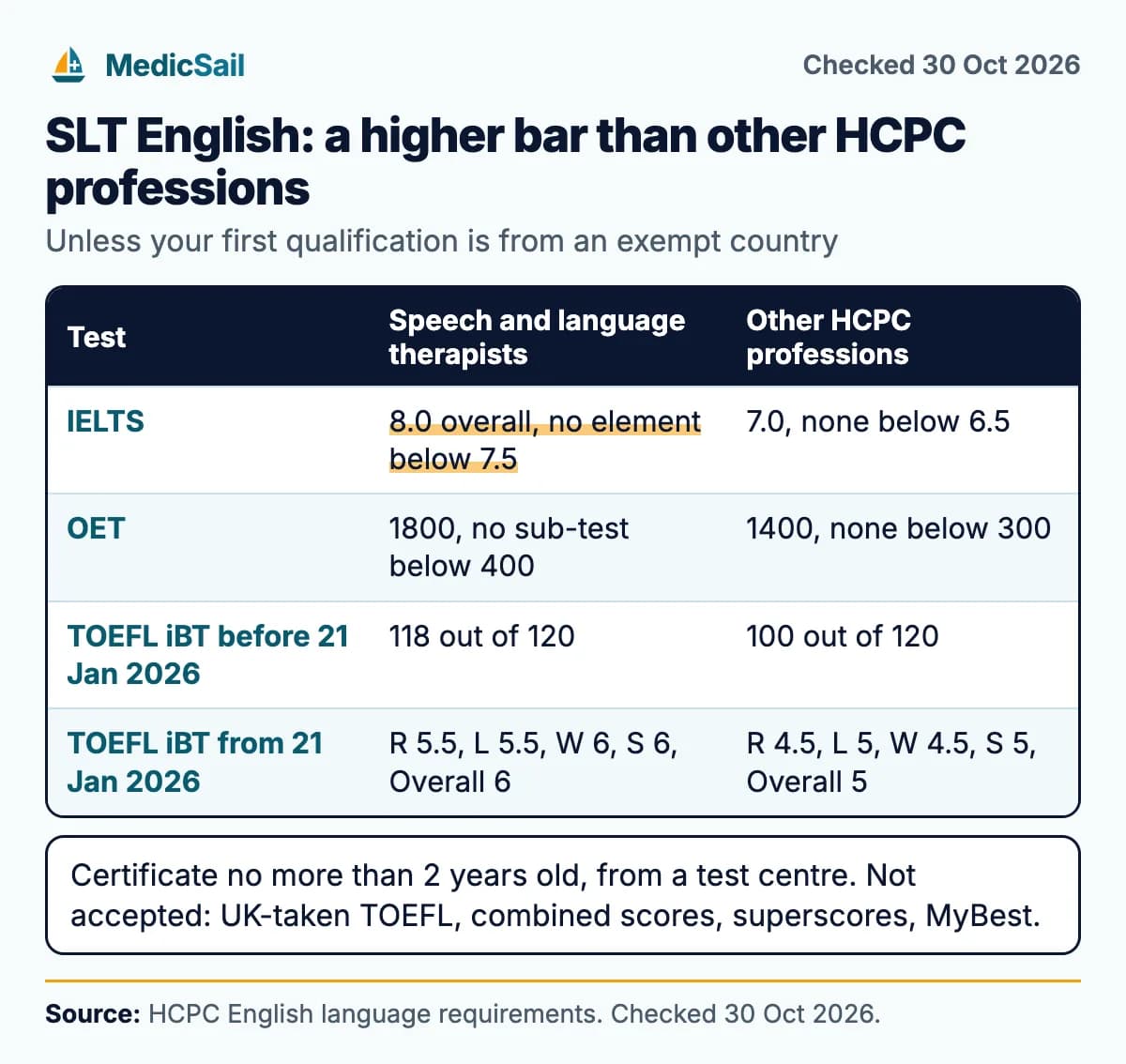
The biggest difference from other HCPC professions is English. The HCPC asks speech and language therapists for IELTS 8.0 with no element below 7.5, or OET at 1800 with no sub-test below 400, or the higher TOEFL iBT scores, unless your qualification came from a listed English-speaking country. Every other HCPC profession needs IELTS 7.0. The requirement is written into the SLT standards themselves, because English communication is a core clinical skill in this profession.
If you are accepted, most international applicants pay £370.02 to register, and the HCPC currently says it takes 3 months from a complete application to a first decision. This guide covers the whole route with the detail that matters for SLTs. Our HCPC registration overview covers the regulator, and speech and language therapy in the UK gives a summary of pay, employers and visas.
Who this route is for
You use the international route if your speech and language therapy qualification was delivered outside the UK, it is the one that first let you practise, and you have never been on the HCPC Register. Titles abroad vary: speech-language pathologist, speech therapist, audiologist and speech-language pathologist (where a combined degree is common), or logopedist. What counts is whether your qualification and experience meet the UK SLT standards.
- UK-trained SLTs use the UK route, and former registrants use readmission.
- Those who trained or practised in Norway, Iceland, Liechtenstein or Switzerland use the Free Trade Agreement route.
- Applicants with refugee status should contact the HCPC first.
What registration does not give you
HCPC registration lets you use the protected titles and practise. It does not give you the right to live or work in the UK, and you cannot practise as an SLT while your application is being assessed. Most SLTs coming from abroad need a sponsored job and a visa as well, covered at the end of this guide.
Combined audiology and speech-language degrees
Many South Asian programmes combine audiology and speech-language pathology. You apply as a speech and language therapist, and the assessors look at the speech and language content. Ask your university to make the course information form show the speech, language and swallowing modules, clinical hours and assessments clearly, so they are not lost among the audiology content. The HCPC has no register for audiologists as such (it regulates hearing aid dispensers), so the audiology half of your degree does not lead to a separate HCPC registration.
What the SLT assessors look for
The current SLT standards of proficiency took effect on 1 September 2023. Beside the shared headline standards, these are the ones written for speech and language therapists:
| Standard | What it expects |
|---|---|
| 12.7 | Understand linguistics and phonetics, psycholinguistics and sociolinguistics, including the differences for people whose home language is not English |
| 12.8 and 12.9 | Biomedical and medical sciences relevant to communication and swallowing, and psychology of lifespan development and typical and impaired communication |
| 12.10 and 12.11 | Sociology in educational, health and workplace settings and multicultural societies; the therapeutic contexts and models of SLT |
| 12.12 | Developmental and acquired disorders of speech, language, communication and swallowing |
| 13.14 | Apply that knowledge to the differential diagnosis of communication and swallowing impairments |
| 13.16 and 13.17 | Recognise how surroundings affect communication and swallowing, and the impact of difficulties on wellbeing of service users, families and carers |
| 13.18 | Communicate in English at IELTS 8 with no element below 7.5 |
| 13.19 | Assess and work with acquired speech and language impairments, developmental or acquired cognitive impairments, developmental speech and language disorders, dysfluency, dysphagia, and voice disorders or voice modification needs |
| 13.20 and 2.13 | Assess and plan in the service user's home language with professional interpreters, and understand the centrality of home language to identity and family life |
| 2.12 | Understand the ethical and legal implications of withholding and withdrawing feeding and nutrition |
The two gaps that matter most
Dysphagia. Standard 13.19 lists dysphagia alongside the communication impairments, and 2.12 brings in the ethics of feeding decisions. In many countries swallowing work is limited in training or done by other professions. If your degree or placements covered little swallowing assessment and management, show where you gained it: hospital work, supervised cases, postgraduate courses finished before you submit.
Range across the lifespan. The 13.19 list spans children and adults, developmental and acquired. Therapists who have worked only in paediatric clinics, or only in adult stroke, need to show where training covered the other side. NHS Health Careers lists UK client groups from children with developmental language disorder, stammering, cleft lip and palate and selective mutism to adults with communication or swallowing problems after stroke, head injury, Parkinson's or dementia.
English: the higher bar for SLTs
You are exempt if the qualification that first let you practise was gained in a country on the HCPC's list, which includes Australia, Canada, Ireland, Kenya, Malta, New Zealand and the USA. India, Pakistan, the Philippines, Egypt, Jordan, Malaysia and the Gulf states are not on the list.
| Test | HCPC score for speech and language therapists | For comparison: other HCPC professions |
|---|---|---|
| IELTS Academic or General | 8.0 overall, no element below 7.5 | 7.0, no element below 6.5 |
| OET (speech and language version) | 1800 overall, no sub-test below 400 | 1400, no sub-test below 300 |
| TOEFL iBT before 21 January 2026 | 118 out of 120 | 100 out of 120 |
| TOEFL iBT from 21 January 2026 | Reading 5.5, Listening 5.5, Writing 6, Speaking 6, Overall 6 | Reading 4.5, Listening 5, Writing 4.5, Speaking 5, Overall 5 |
The certificate must be no more than two years old when the HCPC receives your application and taken at a test centre, not at home. IELTS one-skill retakes count within six months of the original test if on the same report. The HCPC does not accept TOEFL tests taken in the UK, combined scores, superscores or MyBest scores.
Planning for the score
An 8.0 with no band below 7.5 is a high target, and writing is where many candidates fall short. OET's speech and language version uses case notes and referral letters from your own field, which some SLTs find closer to their daily work, but the 1800 and 400 thresholds are just as demanding. Budget for more than one attempt and book early, because the certificate's two-year clock affects when you can submit. Our IELTS or OET guide compares the formats, and the English test score checker tests a result against the HCPC rule.
Documents and steps
- Course information form from your awarding university: overall and module learning outcomes, content, theoretical and practical hours and assessment methods, stamped or sealed, with a named contact and a real or electronic signature, uploaded as one machine-readable file. Ask for clinical hours split by client group and by communication and swallowing.
- English certificate, unless exempt.
- Certified identity documents and qualification certificate, certified by a person of standing in the community, with certified translations where needed.
- Professional experience section: at least one example, most recent first, up to 20,000 characters per account, in your own words, with a referee on an official organisation email for each role. Explain gaps of six months or more.
- The SLT standards of proficiency mapping document, on the SLT template, referencing every standard.
- Submit and pay £678.38 by card through Worldpay.
- Review within 10 working days, assessment by two SLT assessors, a first decision by email with a Record of Assessment, verification with your university, regulators and referees, then the registration fee.
List any registration you hold with a national council or association. The HCPC contacts relevant regulators and professional bodies during verification.
Writing your experience and mapping document as an SLT
The mapping document points to evidence; it does not contain it. Each standard needs a reference to a course information form module (code, page, learning outcome or content reference), a further qualification, or an experience role with its supporting document. The HCPC says statements and reflections in the mapping document are not assessed and must be removed.
What to put in each experience account
- The caseload: ages, conditions and settings, mapped against the six impairment areas in standard 13.19.
- How you assessed: formal and informal assessments, instrumental or bedside swallowing assessment if you did it, and how you reached a differential diagnosis.
- How you planned and delivered therapy, including work with parents, teachers, carers and other professions.
- How you worked with people whose home language was not the language of therapy, including with interpreters. This links to standards 2.13 and 13.20 and suits SLTs from multilingual countries well.
- Swallowing decisions: diet and fluid recommendations, risk discussions with families, and any involvement in decisions about withholding or withdrawing oral intake.
- How you measured outcomes and discharged.
A worked example
Take an adult stroke placement. A thin account says you treated aphasia and dysarthria patients on a neurology ward. A useful account says you screened new admissions for swallowing risk, carried out bedside swallowing assessments, recommended diet and fluid textures and reviewed them as patients changed, explained aspiration risk to families, used a named aphasia battery to profile language and reach a differential diagnosis between aphasia, apraxia of speech and dysarthria, set communication goals with the patient and nursing staff, trained relatives in supported conversation, and worked with an interpreter for a patient whose first language differed from yours. That one account evidences 12.12, 13.14, 13.16, 13.17, 13.19 and 13.20, and your mapping document can point to it for each.
Write it yourself. The HCPC forbids AI tools and text from other sources, including job descriptions, and checks every document for plagiarism and AI use. Name languages honestly: if much of your caseload was in Hindi, Tagalog or Arabic, say so and show how you work in English too. Assessors judge your fit for UK practice, and the English requirement is checked separately.
Fees, renewal and timelines
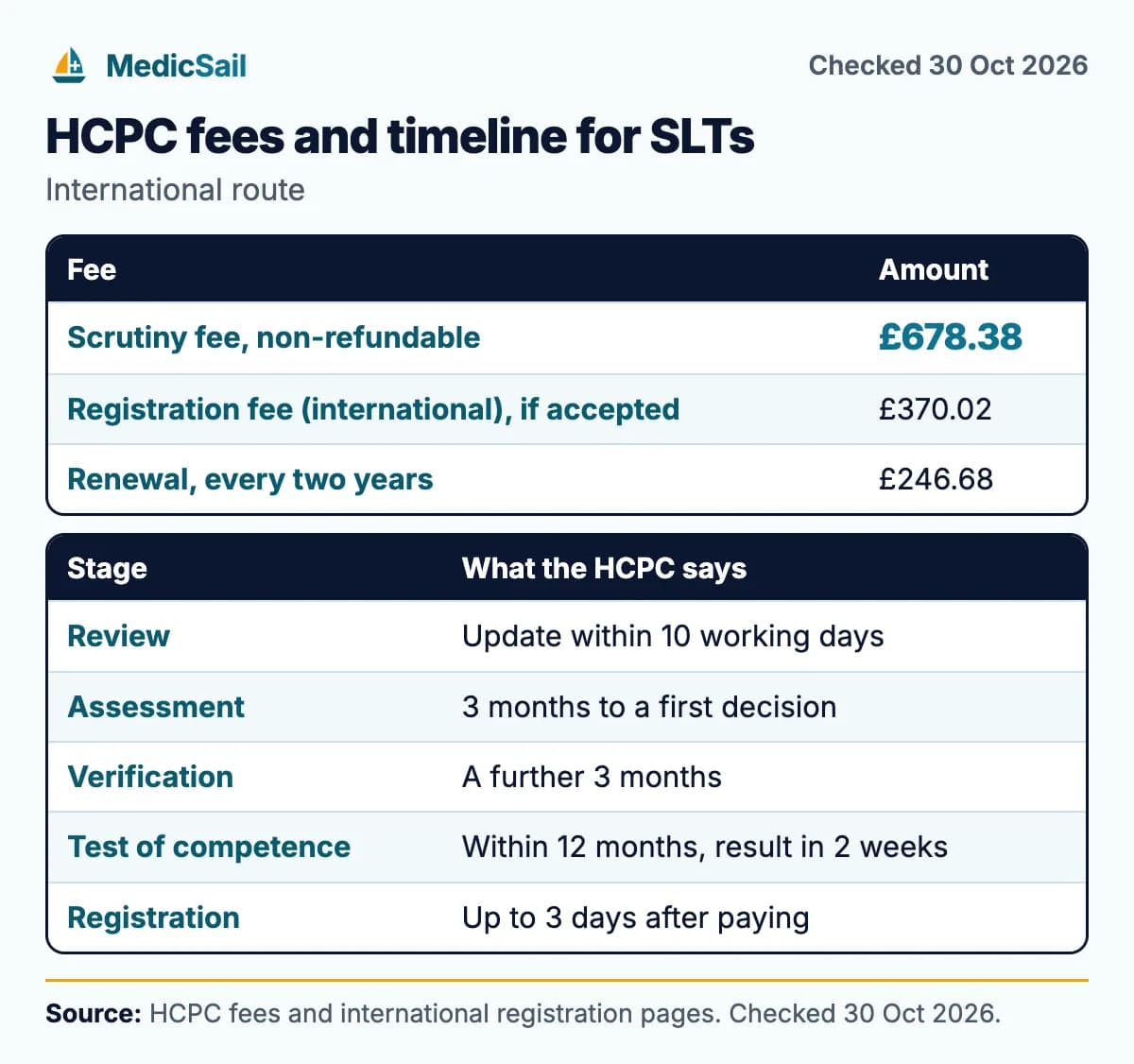
| Fee | Amount | Notes |
|---|---|---|
| Scrutiny fee | £678.38 | On submission, non-refundable |
| Registration fee (international) | £370.02 | If accepted: £123.34 for the second year of the current cycle plus £246.68 for the next; only two years if you join in the first year of the cycle |
| Renewal | £246.68 | Every two years |
| New application after refusal or withdrawal | £678.38 | A new scrutiny fee |
The HCPC lists the next speech and language therapist renewal window as opening on 1 July 2027 with a deadline of 30 September 2027. Use the registration cost estimator to add test, certification and visa costs.
| Stage | What the HCPC says |
|---|---|
| Review | An update within 10 working days; six months to supply anything missing |
| Assessment | 3 months from a complete application to a first decision, longer when application numbers are very high |
| Verification | A further 3 months after acceptance |
| Test of competence | Within 12 months of referral; result within two weeks |
| Registration | Up to three days after paying |
For SLTs, the English score is often the longest step before you can submit. The registration timeline calculator helps you plan around it.
The test of competence, refusals and common SLT pitfalls
Since 20 November 2025 the HCPC carries out one round of documentary assessment and no longer asks for more information to fill gaps. You are referred for a test of competence if there are gaps, and may be refused if they are significant.
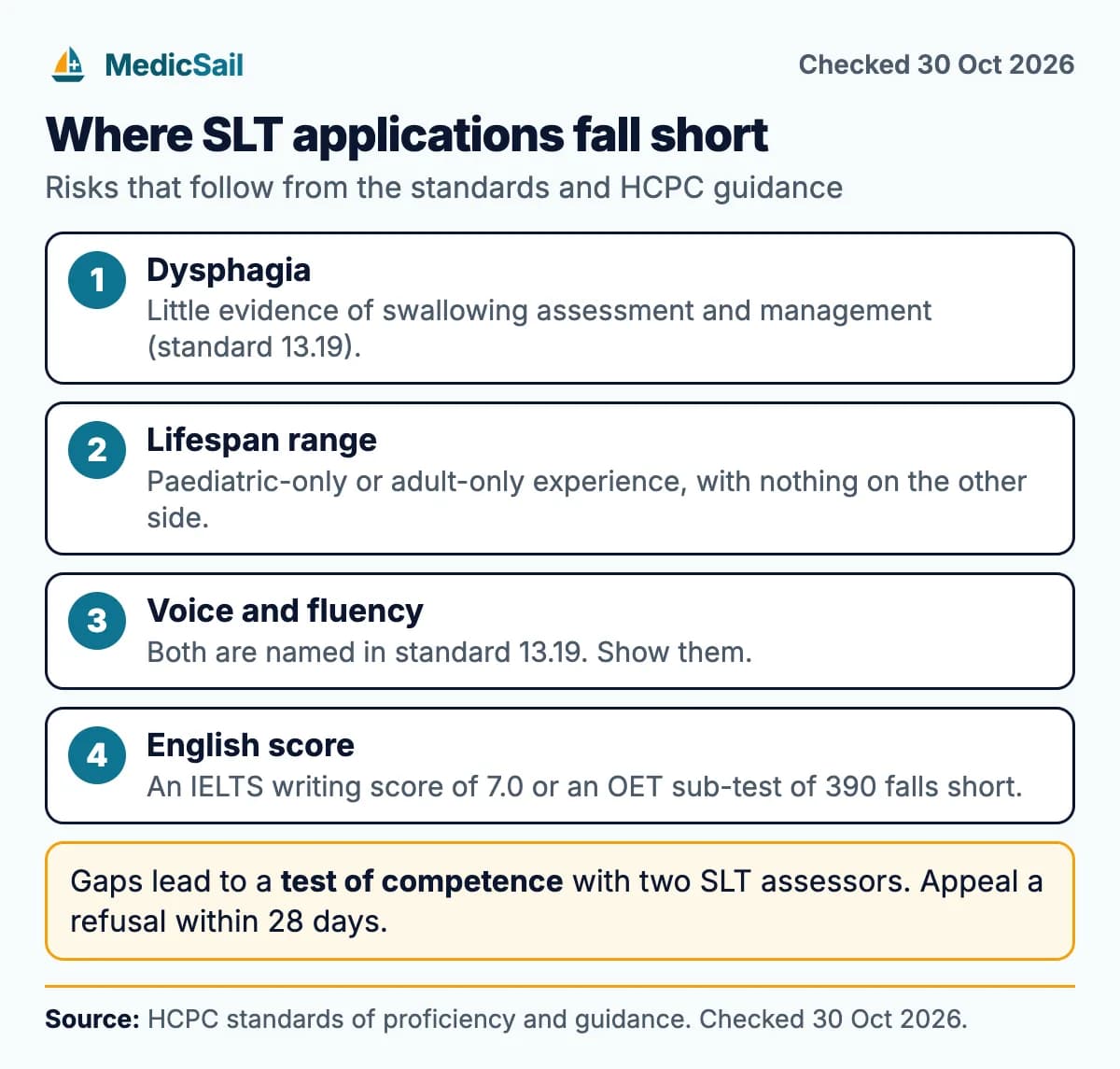
The test is a structured professional discussion with two SLT assessors, usually on Microsoft Teams, built around your gaps. For an SLT that could mean talking through a bedside swallowing assessment and your recommendations, a differential diagnosis for a child with unclear speech, therapy for an adult with aphasia, or an ethical scenario about oral intake at the end of life. You can reschedule or cancel once. The result comes within two weeks. After a refusal you can appeal within 28 days, or reapply at any time with a new scrutiny fee if you have addressed the reasons.
Where SLT applications tend to fall short
These follow from the standards and HCPC guidance, not an official list:
- Little or no evidence of dysphagia assessment and management.
- Paediatric-only or adult-only experience, with nothing on the other side of the lifespan.
- No voice or fluency evidence, both named in standard 13.19.
- Audiology content dominating a combined-degree course information form.
- An IELTS writing score of 7.0, or an OET sub-test of 390, which fall short of the SLT thresholds.
- Referees on personal email addresses, or experience copied from job descriptions.
RCSLT, first jobs, pay and the visa
The Royal College of Speech and Language Therapists
The RCSLT is the professional body; it does not regulate SLTs. You must be HCPC registered before applying to it. Overseas-qualified practitioners start in its supervised category and are expected to complete up to one year of supervised clinical practice, a guide that may vary, and its overseas-qualified practitioner competency framework before certified membership. Members of associations in the Mutual Recognition of Credentials Agreement, which the RCSLT lists as Ireland, the USA, New Zealand, Australia and Canada, can apply for certified membership with a letter of good standing sent directly to the RCSLT. Employers often look for RCSLT membership, so plan for this framework in your first year.
Jobs and pay
NHS Health Careers says SLTs typically start on Agenda for Change Band 5 and work in hospitals, community clinics, schools and patients' homes. NHS Employers 2026/27 annual pay points in England are £32,073 to £39,043 at Band 5, £39,959 to £48,117 at Band 6 and £49,387 to £56,515 at Band 7. See the NHS pay band explorer for every point.
The visa
Speech and language therapists are occupation code 2223, which GOV.UK lists as eligible for the Health and Care Worker visa. That visa needs an NHS employer, an organisation providing services to the NHS, or an adult social care provider as sponsor; school and local authority posts may need another route, so ask before accepting. GOV.UK says pay will usually need to be at least £25,000 or the going rate, whichever is higher. NHS Employers notes the employer needs your HCPC number for the certificate of sponsorship. Our Health and Care Worker visa guide covers the rest.
From the Gulf, other countries, and your next steps
No Gulf licence transfers. Gulf caseloads are often bilingual and paediatric; describe the languages you worked in, how you used interpreters or family members, and any hospital dysphagia work. Gulf practice does not exempt you from English testing, so plan for IELTS 8.0 or OET 1800. See moving from a Gulf licence to UK registration, and if you trained in India, our route from India.
If you are comparing countries, see speech and language therapy in Ireland, speech-language pathology in the USA and our speech and language therapist hub.
Next steps
- Take a practice IELTS or OET to see how far you are from 8.0 or 1800.
- Ask your university for the course information form, with swallowing and communication hours shown separately.
- Map your caseload against the six impairment areas in standard 13.19 and fill the gaps with supervised work or courses before you submit.
- Line up referees with official email addresses.
- Download the SLT mapping template and start referencing.
- Read the RCSLT overseas-qualified practitioner guidance so your first UK year is planned.
Questions
8.0 overall with no element below 7.5, in IELTS Academic or General, taken at a test centre and no more than two years old when the HCPC receives your application. This is higher than the 7.0 the HCPC asks of other professions.
Yes. The speech and language version of OET is accepted at 1800 overall with no sub-test below 400.
Communication in English is treated as a core professional skill for SLTs. The requirement is written into the SLT standards of proficiency at standard 13.18.
You apply as a speech and language therapist. Make sure the course information form clearly shows the speech, language and swallowing content and clinical hours.
The SLT standards list dysphagia among the impairments you must be able to assess and work with. If your training was light on swallowing, show where you gained it through supervised work or courses finished before you submit, or expect it to be explored in a test of competence.
£678.38 for the non-refundable scrutiny fee, then £370.02 to register if accepted, or two years' fees if you join in the first year of the cycle. Renewal is £246.68 every two years.
No, only HCPC registration is a legal requirement. The RCSLT is the professional body; overseas-qualified practitioners join in its supervised category after HCPC registration.
No. The USA is on the HCPC's list of countries where a qualification exempts you from further English evidence. You still go through the full international route.
Only if the sponsor qualifies for that visa, which means the NHS, an NHS service provider or an adult social care provider. Many school posts are with other employers, so ask which route they would use.
Every two years. The HCPC lists the next window as opening on 1 July 2027 with a deadline of 30 September 2027.
Sources
- 1HCPC: International applications
- 2HCPC: International route eligibility
- 3HCPC: Documents you need to prepare and certify
- 4HCPC: Certificate of English language proficiency
- 5HCPC: Course information form
- 6HCPC: Standards of proficiency mapping document
Show all 23 sourcesShow fewer sources
- 7HCPC: Professional experience section
- 8HCPC: Paying your scrutiny fee
- 9HCPC: Registration fees for applicants
- 10HCPC: Reviewing your application
- 11HCPC: Assessing your education, training and experience
- 12HCPC: Verifying your information
- 13HCPC: Test of competence
- 14HCPC: Refused applications
- 15HCPC: When to renew
- 16HCPC news: Updates to our international applications process (20 November 2025)
- 17HCPC: The professions we regulate
- 18HCPC: Standards of proficiency for speech and language therapists
- 19RCSLT: Coming to work in the UK
- 20NHS Health Careers: Speech and language therapist
- 21NHS Employers: Pay scales for 2026/27
- 22NHS Employers: Recruitment of overseas allied health professionals
- 23GOV.UK: Health and Care Worker visa, your job
Plan it with our free tools
MedicSail
Healthcare licensing consultants for the UK, Europe and the USA
Updated and checked against the sources listed above. How we research and check our guides