


































How to work as a psychologist in the UK or Ireland with a foreign qualification
How an overseas-trained psychologist registers with the HCPC in the UK, why BPS chartership is not registration, where CORU's psychologist registers stand, and how Department of Health validation and PSI fit for HSE jobs in Ireland, with fees, English, pay and permits.

MedicSail
Published
The short answer
UK: to work as a clinical, counselling, educational, forensic, health, occupational or sport and exercise psychologist with a foreign qualification, you must be on the Health and Care Professions Council (HCPC) Register as a practitioner psychologist. There is no exam. You apply online, pay a non-refundable £678.38 scrutiny fee, and two psychologists from your domain compare your training and supervised practice with the HCPC standards. If they cannot decide on paper, they refer you for a test of competence. Once accepted you pay £370.02 to register. British Psychological Society (BPS) chartership is a separate, voluntary membership and does not let you practise under a protected title on its own.
Ireland: psychologists are not yet statutorily registered. CORU's Psychologists Registration Board says the first three registers (clinical, counselling and educational psychology) are now expected to open in 2027, with other specialisms to follow. Until then, the gate for public health service jobs is different: the HSE requires an Irish qualification accredited by the Psychological Society of Ireland (PSI) or an equivalent qualification from another jurisdiction validated by the Department of Health, and anyone presenting a non-Irish clinical, counselling or educational psychology qualification must have it recognised by the Department's Validation Unit before taking up employment in the publicly funded health sector. The HSE says validation can take up to six months.
This guide covers both countries in full, as the HCPC, CORU, the HSE and the Department of Health describe them on 29 October 2026, and ends with the alternatives in Germany, the Netherlands and the USA.
UK: the HCPC titles and what they protect
The HCPC regulates practitioner psychologists in seven domains. Its list of protected titles is:
- Practitioner psychologist and registered psychologist (approved in the HCPC's order, but you cannot register solely under them)
- Clinical psychologist
- Counselling psychologist
- Educational psychologist
- Forensic psychologist
- Health psychologist
- Occupational psychologist
- Sport and exercise psychologist
These titles are protected by law, so you cannot advertise yourself as a clinical psychologist in the UK while your application is pending. The list does not include the word psychologist on its own, and you will see other NHS psychology roles, such as assistant psychologist, that are not on the HCPC list. Roles like these can be a way into the NHS while you prepare, but they are not qualified psychologist posts; check each job description for whether HCPC registration is required. See our glossary entry on protected titles and the HCPC registration overview.
HCPC or BPS: which do you need
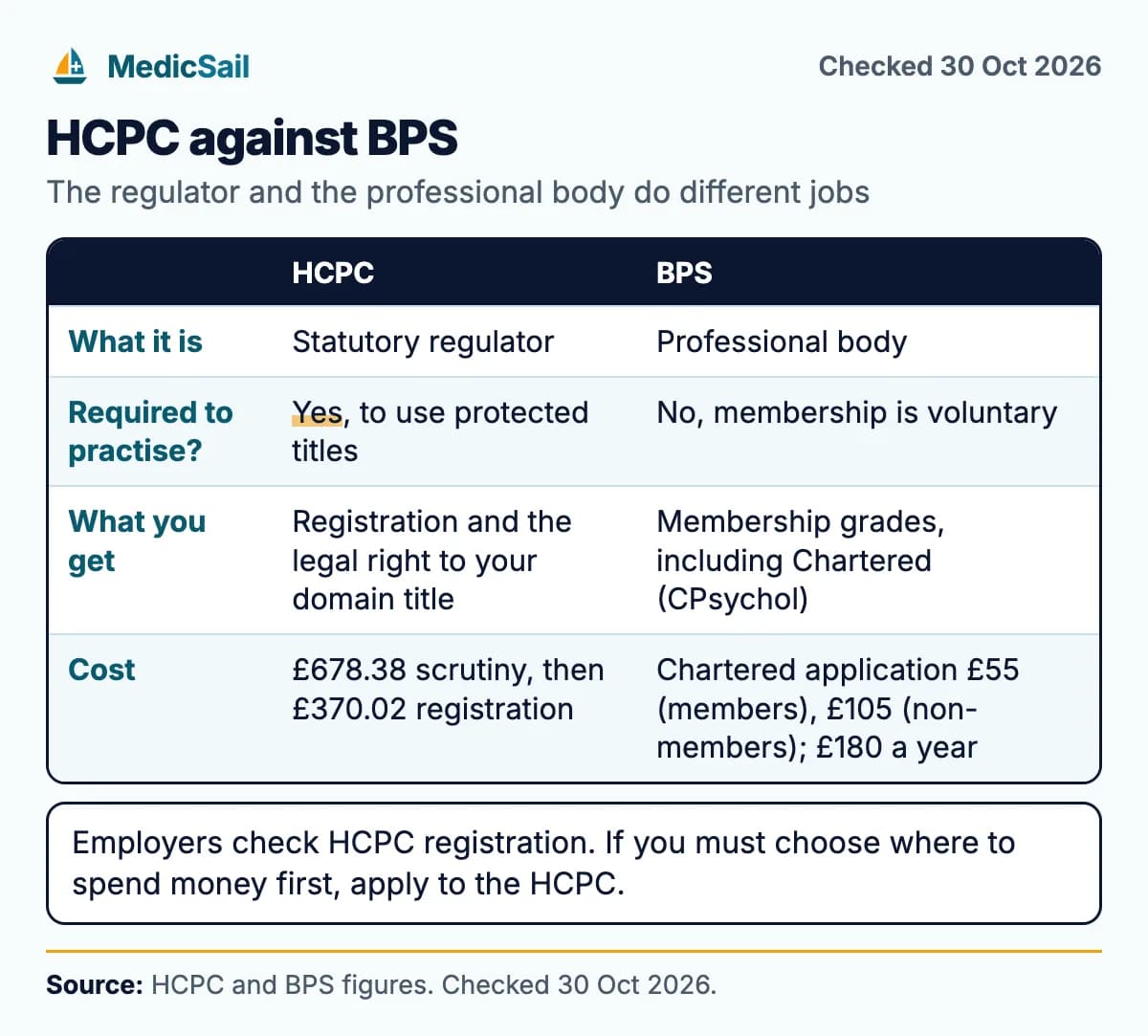
This is the most common confusion for overseas psychologists. The two bodies do different jobs.
| HCPC | BPS | |
|---|---|---|
| What it is | The statutory regulator | The professional body for psychology |
| Required to practise? | Yes, to use any of the protected titles above | No; membership is voluntary |
| What you get | Registration and the legal right to use your domain title | Membership grades, including Chartered membership (CPsychol) |
| Cost | £678.38 scrutiny fee, then £370.02 registration (usually three professional years) | Chartered membership application £55 for members, £105 for non-members; subscription £180 a year (BPS figures) |
| Assessment | Two domain assessors against the HCPC standards of proficiency | BPS's own criteria for each membership grade |
In practice, employers check HCPC registration. Many psychologists also hold BPS chartership for professional standing, networks and divisional membership, but it does not replace registration. If you have to choose where to spend money first, apply to the HCPC.
Who can register with the HCPC from overseas
The HCPC's international route is for people whose qualification was gained outside the UK. For psychologists, assessors usually look for these things:
- A qualification in applied psychology that first allowed you to practise as a psychologist where you trained.
- Training that maps to one of the seven domains, including supervised practice in that domain. The HCPC's standards of proficiency for practitioner psychologists took effect on 1 September 2023 and have both generic and domain-specific parts.
- Evidence of what you did in placements: settings, client groups and hours, stated by your university on the HCPC course information form.
- Supervised practice after qualifying, if your licence depended on it. For master's-level clinical and counselling psychologists this often decides the outcome, because assessors compare your training with UK doctoral programmes.
- Referees who supervised your casework and can reply from a work email address.
- English, unless exempt (see below).
Research-only degrees, psychology degrees with no supervised applied practice, and counselling or psychotherapy qualifications that are not psychology do not meet the practitioner psychologist standards. Our full route for psychologists in the UK lists every document.
The HCPC process, step by step
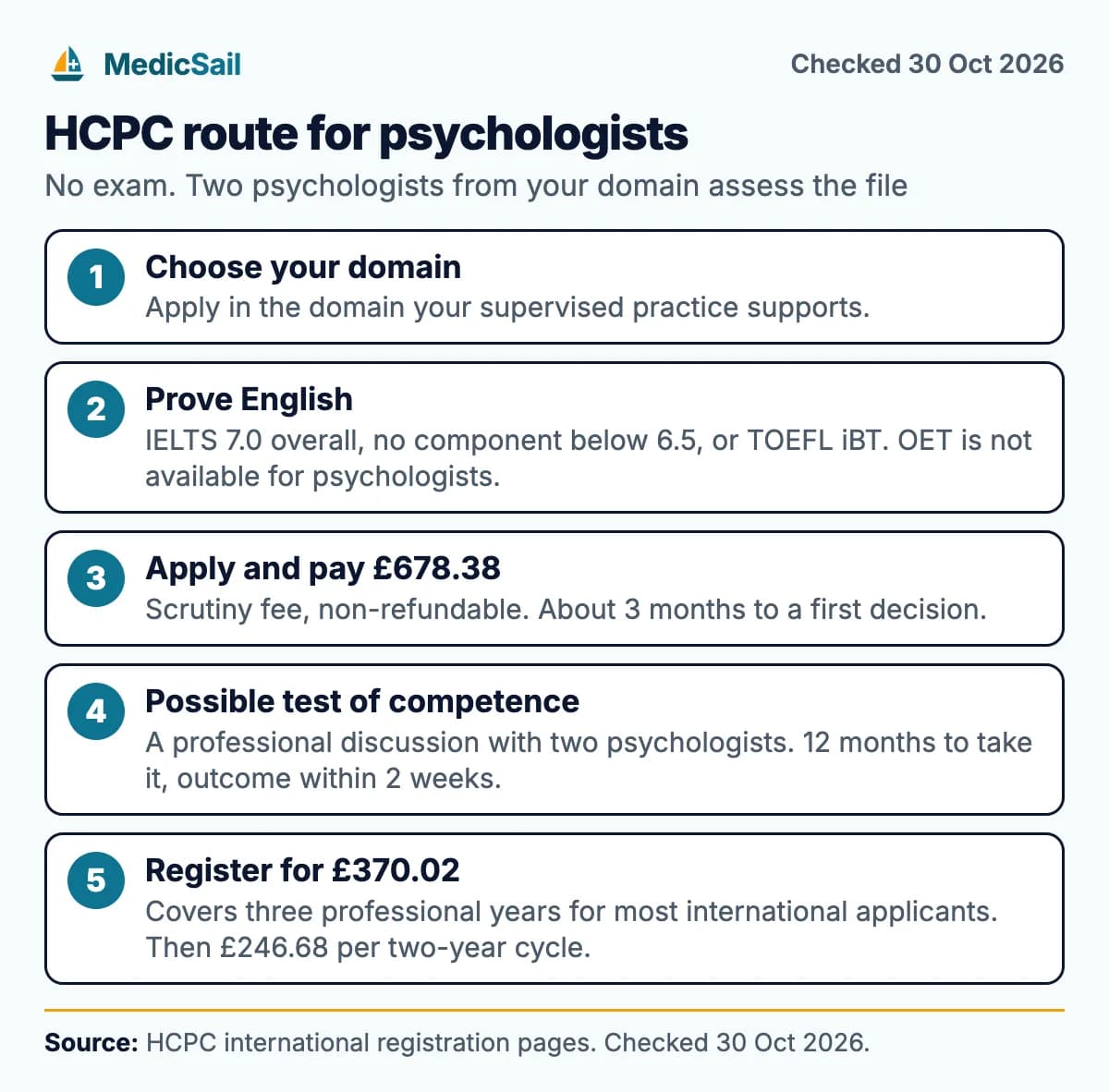
- Choose your domain. Apply in the domain your supervised practice supports, not the job you hope to get. The HCPC currently reports assessment delays for sport and exercise psychologists.
- Prove English. IELTS with 7.0 overall and no component below 6.5, or TOEFL iBT at the HCPC's scores, taken outside the UK. OET is not available for psychologists. If your psychology qualification is from a country the HCPC lists as English-speaking, you do not need a test.
- Collect the evidence. Transcript, course information form completed by your university, supervision logs and letters, your registration in the country where you practise, and a standards mapping in your own words. The HCPC prohibits AI-written or copied text.
- Apply and pay. The international scrutiny fee is £678.38, paid when you submit; it is not refundable.
- Assessment. Two psychologists from your domain review the file. The HCPC's guide is about three months from a complete application to a first decision, followed by verification of your documents.
- Possible test of competence. If the assessors cannot decide on paper, they refer you for a test of competence: for psychologists, a structured professional discussion with two registered psychologists. You have 12 months to take it and receive the outcome by email within two weeks.
- Register. Pay £370.02, which covers three professional years for most international applicants; the two-year cycle after that costs £246.68.
If you are refused, the HCPC explains the reasons and you can appeal. Common reasons are missing supervised practice evidence and a mapping that describes coursework instead of what you actually did with clients.
UK jobs, pay and the visa
NHS Health Careers says qualified clinical psychologists start at Band 7, with routes to supervisory, management and consultant posts. On NHS Agenda for Change pay for 2026/27 in England, Band 7 is £49,387 to £56,515, Band 8a £57,528 to £64,750, Band 8b £66,582 to £77,368 and Band 8c £79,504 to £91,609. Senior posts are banded by each employer. Use the NHS pay band explorer to see every point.
For the visa, GOV.UK lists clinical psychologists (occupation code 2225) and other psychologists (2226, covering counselling, educational, forensic, health, occupational and sport psychologists) as eligible for the Health and Care Worker visa. The sponsor must be the NHS, an NHS service provider or an adult social care provider, so NHS clinical, health and forensic posts usually fit, while council educational psychologists or occupational psychologists in business may need a Skilled Worker visa instead. The fee is £324 for up to three years and £628 for more, and you do not pay the immigration health surcharge. Our Health and Care Worker visa guide covers the rest. This is general information, not immigration advice.
Ireland: where statutory regulation stands
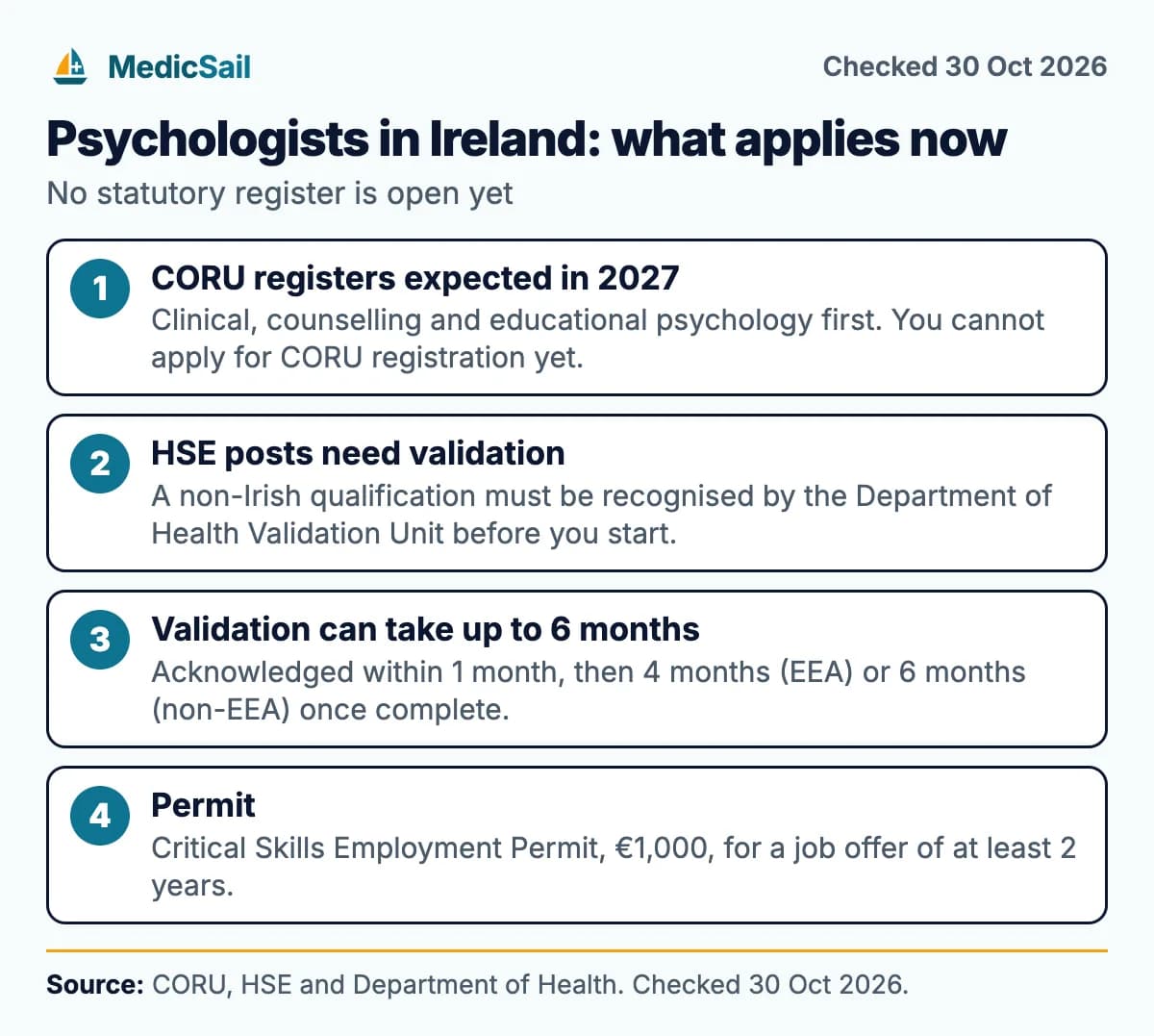
CORU, Ireland's regulator for health and social care professionals, has a Psychologists Registration Board, but no register is open. CORU's page on the statutory regulation of psychologists sets out two phases:
- Phase one: registers for clinical, counselling and educational psychologists. CORU says the opening of these first three registers is now expected in 2027. Technical amendments to the Health and Social Care Professionals Act 2005 are still needed, and the standards of proficiency and education criteria for each are published.
- Phase two: a Psychologists Register for all other specialisms. The Board expects to consult on draft standards of proficiency in autumn 2026.
Once a register opens, CORU says anyone using one of those titles in practice must be registered. CORU has not yet published an international recognition process for psychologists, nor an English requirement for them; for its open registers the standard is IELTS Academic 7.0 with no element below 6.5, or OET grade B in three components and C+ in one. When the register opens, the Board is expected to become the body that recognises non-Irish qualifications, as it does for other professions; see our glossary entry on CORU recognition and the CORU page. Until then, CORU registration is not something you can apply for, whatever a job advert says.
Ireland now: PSI, the Department of Health and HSE eligibility
In the meantime, what decides whether you can work as a psychologist in the public health service is the HSE's eligibility criteria and the Department of Health's validation.
The HSE criteria
HSE job specifications for psychologist posts (clinical, counselling and educational, staff grade) require an honours degree with psychology as a major subject and either an Irish postgraduate professional psychology qualification accredited by the Psychological Society of Ireland, or an equivalent qualification from another jurisdiction validated by the Department of Health. Applicants must also show at least 60 days (or equivalent) of supervised placements or post-qualification supervised work in a health setting for each care group they apply for. For counselling psychologists the HSE says those 60 days must include at least 150 hours of direct client contact.
Department of Health validation
The HSE states that everyone presenting a non-Irish clinical, counselling or educational psychology qualification and wishing to work in Ireland's publicly funded health sector must have it recognised by the Validation Unit before taking up employment, including agency staff and locums. The HSE describes validation as an assessment under Directive 2005/36/EC of equivalence to the Irish qualifications required for public health work. It says validation can take up to six months: the application is acknowledged within one month, and once complete the decision period is four months for EEA nationals and six months for non-EEA nationals. If you are successful at interview but not yet validated, you can be placed on the panel but will not be offered a post until you provide the validation letter, so start early. The Department publishes the application forms and an information note on its psychologist page on gov.ie.
Where PSI fits
The Psychological Society of Ireland is the professional body. It accredits Irish training programmes and runs its own membership grades, including an equivalence route for chartered membership with a non-Irish qualification. Like BPS membership in the UK, PSI membership is voluntary and separate from the Department of Health validation that HSE posts require.
Irish pay and the employment permit
HSE consolidated salary scales from 1 June 2026 set the following annual pay for psychologists:
| Grade | Annual pay from 1 June 2026 |
|---|---|
| Psychologist, clinical, counselling or educational (staff grade) | €63,222 to €108,234 (13 points, including long service increments) |
| Senior psychologist (clinical, counselling or educational) | €100,483 to €118,111 |
| Principal clinical psychologist | €117,272 to €135,950 |
| Trainee clinical, counselling or educational psychologist | €45,872 to €51,952 |
The HSE says new appointees start at the minimum point, with incremental credit for recognised relevant service in Ireland and abroad. Psychologists are on Ireland's Critical Skills Occupations List, so a Critical Skills Employment Permit (€1,000) is the usual route for a non-EEA psychologist with a job offer of at least two years; for public sector posts covered by a pay agreement, the salary test uses the agreement rate. Our Critical Skills Employment Permit guide and Ireland country guide cover the permit, family and Stamp 4 rules.
Other options: Germany, the Netherlands and the USA
- Germany. Psychologist on its own is not a regulated profession, but practising psychotherapy as a Psychotherapeutin or Psychotherapeut needs the Approbation from a state authority, with B2 German and usually a specialist language exam that the Recognition Finder profiles give at C2. See psychologists in Germany.
- Netherlands. Healthcare psychologist (GZ-psycholoog) and psychotherapist are BIG-registered titles. There is no BI-test for psychologists; the CBGV assesses your documents and may advise additional training, and you need Dutch at B2+. See psychologists in the Netherlands.
- USA. State boards license psychologists, usually requiring a doctorate, supervised experience and the EPPP (Part 1 is $600 per sitting, paid to ASPPB). See psychologists in the USA.
For a side-by-side view of every country, see the international psychologist hub.
What to do now
- Decide on the UK, Ireland or both. The HCPC route is open now and gives you a registration you can hold while you look for work. Ireland's public sector route depends on Department of Health validation, which you can pursue in parallel.
- Ask your university for placement and supervision detail now. Both the HCPC and the Validation Unit rely on it, and it is usually the slowest document to get.
- Book IELTS early if you need it, and check the scores in our English test comparison. Remember that OET is not accepted for HCPC psychologists.
- Watch CORU's psychologist page for the register opening date and any transitional rules for people already working in Ireland.
- If you practise in the Gulf, request letters from the authority that licensed you (for example the DHA, DOH or CDA) and from your supervisors. Gulf practice does not exempt you from the HCPC English test unless your psychology qualification itself is from a country the HCPC lists as English-speaking.
Questions
HCPC registration. It is the legal requirement to use titles such as clinical, counselling or educational psychologist. BPS Chartered membership is voluntary professional membership; it is useful but does not let you use a protected title without HCPC registration.
No written exam. Two psychologists from your domain assess your application against the HCPC standards. If they cannot decide on paper, they refer you for a test of competence, which for psychologists is a structured professional discussion.
A non-refundable international scrutiny fee of £678.38 when you apply, then £370.02 to register if accepted, which usually covers three professional years. After that the HCPC lists £246.68 for each two-year cycle.
No. The HCPC accepts profession-specific OET only for some allied health professions, and there is no OET for psychology. Psychologists use IELTS (7.0 overall, no component below 6.5) or TOEFL iBT taken outside the UK, unless exempt.
Not yet. CORU's psychologist registers are not open; CORU expects the clinical, counselling and educational registers to open in 2027. Until then, HSE posts require PSI-accredited Irish training or a non-Irish qualification validated by the Department of Health.
The HSE says it can take up to six months. The application is acknowledged within one month, and once complete the decision period is four months for EEA nationals and six months for non-EEA nationals.
No. The Psychological Society of Ireland is the professional body. Its membership, including chartered membership, is voluntary. It is not statutory registration, and it does not replace the Department of Health validation that HSE posts require.
NHS Health Careers places newly qualified clinical psychologists at Band 7, £49,387 to £56,515 in England for 2026/27. The HSE staff grade psychologist scale runs from €63,222 to €108,234 from 1 June 2026, with senior psychologists on €100,483 to €118,111.
In the UK, clinical psychologists (2225) and other psychologists (2226) are eligible for the Health and Care Worker visa with an eligible sponsor. In Ireland, psychologists are on the Critical Skills Occupations List. This is general information, not immigration advice.
Not through these routes if your qualification is not in psychology. The HCPC's practitioner psychologist standards need applied psychology training with supervised practice, and the HSE's criteria need a psychology degree and a professional psychology qualification.
Sources
- 1HCPC: the professions we regulate (protected titles)
- 2HCPC: international applications
- 3HCPC: international eligibility
- 4HCPC: paying your scrutiny fee
- 5HCPC: registration fees for applicants
- 6HCPC: certificate of English language proficiency
Show all 24 sourcesShow fewer sources
- 7HCPC: what to expect
- 8HCPC: test of competence
- 9HCPC: standards of proficiency, practitioner psychologists
- 10BPS: Chartered membership
- 11NHS Health Careers: clinical psychologist
- 12NHS Employers: pay scales for 2026/27
- 13GOV.UK: Skilled Worker visa eligible occupations and codes
- 14GOV.UK: Health and Care Worker visa, how much it costs
- 15CORU: statutory regulation of psychologists
- 16CORU: language requirements
- 17HSE: Psychologist, Staff Grade job specification NRS15316
- 18HSE: Psychologist, Senior additional campaign information NRS14750
- 19HSE: Consolidated salary scales, 1 June 2026 (PDF)
- 20Department of Health: psychologist (recognition of non-Irish qualifications)
- 21Psychological Society of Ireland: applications from outside Ireland
- 22DETE: Critical Skills Occupations List
- 23DETE: Critical Skills Employment Permit
- 24ASPPB: EPPP registration fees
Plan it with our free tools
MedicSail
Healthcare licensing consultants for the UK, Europe and the USA
Updated and checked against the sources listed above. How we research and check our guides