


































HCPC registration for overseas occupational therapists
A complete guide for occupational therapists trained outside the UK: what the HCPC's OT assessors look for, how to show occupation-focused practice in your mapping document and experience section, English scores, fees, the renewal window, timelines, the test of competence, refusals, and first jobs in the NHS and social care.

MedicSail
Published
The short answer
To work as an occupational therapist in the UK after training abroad, you must be on the Health and Care Professions Council (HCPC) Register, because occupational therapist is a legally protected title. You apply online through the HCPC international route and pay a non-refundable scrutiny fee of £678.38. Two occupational therapist assessors compare your qualification, training and experience with the HCPC standards of proficiency for occupational therapists. There is no written exam; if your evidence has gaps, you are referred for a test of competence, and if the gaps are significant you may be refused.
Unless your first OT qualification came from a country on the HCPC's English-speaking list, you need IELTS 7.0 with no element below 6.5, OET Occupational Therapy at 1400 with no sub-test below 300, or the TOEFL iBT scores the HCPC sets. If you are accepted, most international applicants pay £370.02 to register. The HCPC currently says it takes 3 months from a complete application to a first decision.
What makes or breaks an OT application is whether your evidence shows occupation-focused practice, not just rehabilitation. This guide explains how assessors read an OT file, how to write yours, and what happens after registration. Our HCPC regulator page covers the shared mechanics for all 15 professions, and occupational therapy in the UK covers pay, employers and visas in summary.
Who can use the international route
You use the HCPC international route if you trained as an occupational therapist outside the UK, your qualification is the one that first let you practise as an OT where you trained, and you have never been registered with the HCPC. The HCPC needs to know exactly which profession you are applying for; an unclear profession stops verification from starting.
- UK-trained OTs use the UK route, even after years abroad.
- Former HCPC registrants use readmission.
- OTs who trained or practised in Norway, Iceland, Liechtenstein or Switzerland use the Free Trade Agreement route on a paper form.
- Applicants with refugee status should contact the HCPC first.
- Occupational therapy assistants or technicians without an OT qualification that leads to practice as an occupational therapist cannot register as OTs.
WFOT approval: who asks for it
Many international OTs ask whether their programme must be approved by the World Federation of Occupational Therapists (WFOT). The HCPC's international route pages do not list WFOT approval as a condition; the HCPC assesses your actual course against its standards. WFOT approval matters for the Royal College of Occupational Therapists (RCOT): its terms say overseas-qualified OTs need a WFOT-approved entry-level programme to join as overseas members. Keep the two separate when you plan.
What the HCPC's occupational therapy assessors look for
The current OT standards of proficiency took effect on 1 September 2023. Alongside the 15 headline standards every profession shares, there are standards written only for occupational therapists. The HCPC's assessors compare your training with all of them and then check whether experience makes up for any gaps.
| Area | What the OT standards expect | How to evidence it |
|---|---|---|
| Occupational science | Understand the occupational nature of human beings and how they function in everyday activities such as self care | Theory modules on occupation and occupational science |
| Person, environment, occupation | Understand the relationship between the person, their environment and their chosen occupation | Models of practice taught, and cases where you adapted a home or workplace |
| Activity analysis | Understand and analyse activity and occupation and their effect on health, wellbeing and function | Practical modules, and accounts showing how you graded or adapted activities |
| Occupational justice | Understand the effect of occupational alienation, dysfunction, deprivation and injustice | Theory modules, and work in mental health, prisons or community settings |
| Assessment | Select and use standardised and non-standardised assessment techniques, and observation | Named assessments you used, and why |
| Therapeutic media | Select occupations and activities as therapeutic media, be aware of the broad range available, and adapt media and environments to the service user | Intervention descriptions in your experience accounts |
| Partnership | Engage service users and carers in planning and evaluating, and adopt an approach that centres on the service user | Goal-setting and review in your accounts |
| Safe practice | Apply appropriate moving and handling techniques | Placement records and ward or community work |
The occupation gap
Many OT degrees outside the UK sit inside rehabilitation or medical faculties. Graduates often describe exercises, splinting, range of movement and hand therapy well, but say little about occupational formulation, activity analysis or occupational science. To a UK OT assessor, a file that reads like physiotherapy is a file with gaps. Your evidence needs to show you started from what the person needed and wanted to do, and used occupation as both the goal and the means.
The breadth gap
NHS Health Careers describes UK OTs helping someone adjust after major surgery, supporting people with mental illness or learning disabilities in work or volunteering, and helping older people stay at home with adaptations such as level access showers or stair lifts. If your training and career were mainly in paediatrics, sensory integration or private neuro clinics, plan in advance how your course information form, placements and experience show work with adults, mental health and community settings.
Documents and steps for an OT application
- Course information form. Your awarding university completes it with overall and module learning outcomes, content, theoretical and practical hours and assessment methods for each element you studied. It must carry the institution's stamp or seal, a contact person and a real or electronic signature, and be uploaded as one machine-readable document. OT programmes with long placement blocks across several sites often need the university to collate hours, so ask early.
- Certified identity documents and your OT qualification certificate, certified by a person of standing in the community, with certified official translations where needed.
- English evidence, unless exempt.
- Professional experience section, with at least one example and a referee on an official organisation email address for each role.
- The occupational therapy standards of proficiency mapping document, on the OT template.
- Declarations about health and character, and consent for background checks.
- Submit and pay £678.38 by card. Your application is only submitted once payment succeeds.
- Review, assessment, decision, verification, then the registration fee.
Do not leave a gap in the professional registration section. List every OT licence or registration you have held. The HCPC contacts relevant regulators and professional bodies during verification, so make sure each is in good standing.
Writing your experience and mapping document in occupational terms
The mapping document only signposts. For each standard, you give the exact place in your application where the evidence is: the course information form with module code, page and learning outcome or content reference; a further qualification with its certificate or syllabus page; or an experience role with the employer and supporting document. You must not paste reflections or statements into it, and every standard needs a reference.
Turning a rehabilitation account into an OT account
Compare two ways of describing the same stroke patient. A rehabilitation-style account says you provided upper limb exercises, splinting and ADL training. An occupation-focused account says you listened to the patient's story, learned that cooking for the family mattered most, used a standardised assessment of daily living skills, analysed the meal preparation task, graded it from seated tasks to full meals, recommended kitchen adaptations after a home visit, set goals with the patient and family, and reviewed them at discharge. The second account evidences person, environment and occupation, activity analysis, assessment choice, therapeutic media, partnership and evaluation at once.
Tips that apply to OTs
- Name the models of practice you used and the standardised assessments, and say why you chose them.
- Describe environments: home visits, equipment and adaptation recommendations, workplace or school changes.
- Show mental health practice if you have any, including groups and activity-based interventions.
- Show discharge planning and work with social care, families and other professions.
- Write in your own words. The HCPC forbids AI tools and text from other sources, including job descriptions, and checks everything for plagiarism and AI use.
- Explain any career gap of six months or more, and list roles most recent first.
English language for occupational therapists
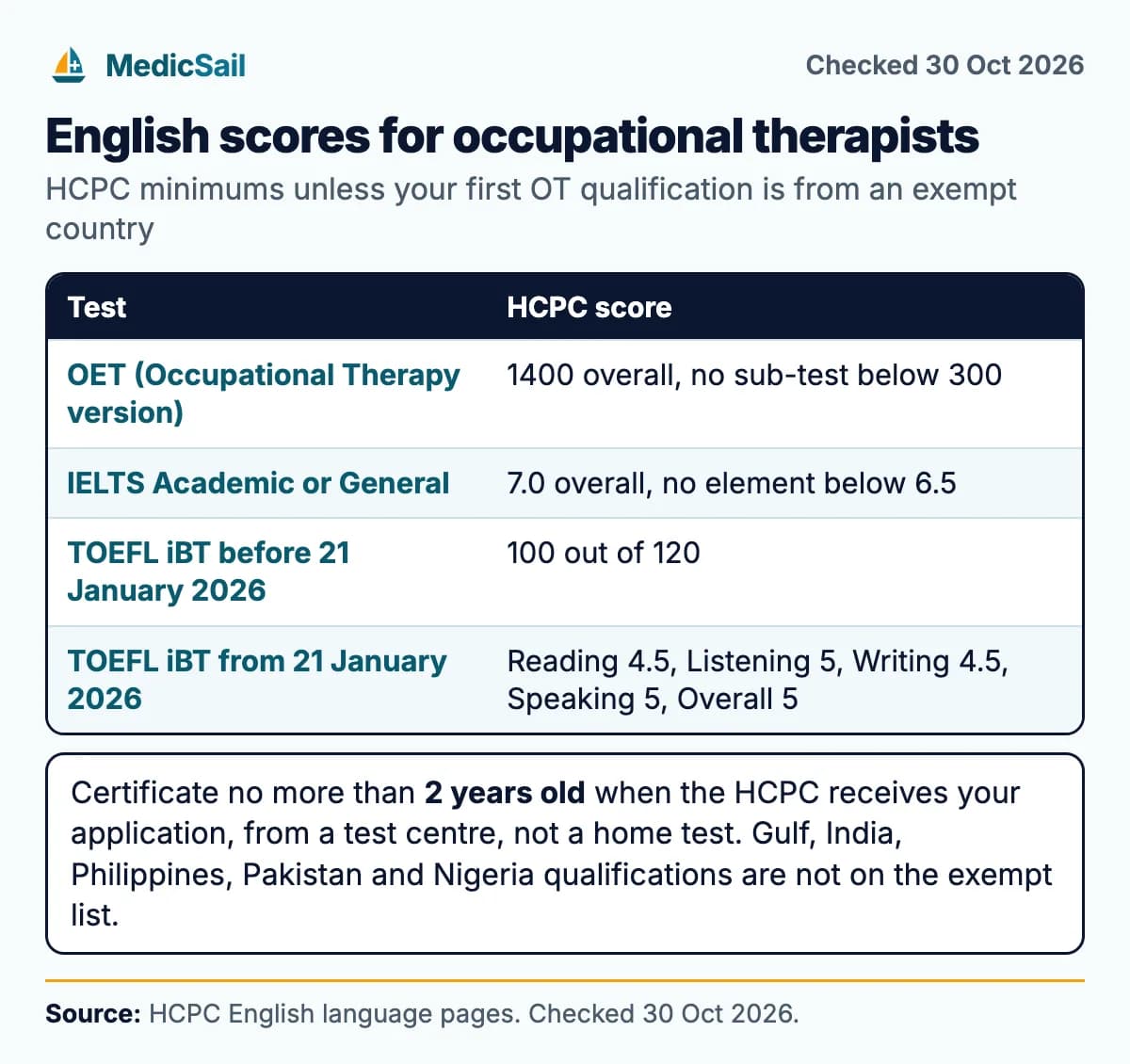
You are exempt if your first OT qualification was gained in a country on the HCPC's list, such as Australia, Canada, Ireland, Kenya, Malta, New Zealand or the USA. Qualifications from India, the Philippines, Pakistan, Nigeria, South Africa, Egypt, Jordan and the Gulf states are not on the list.
| Test | HCPC score for occupational therapists |
|---|---|
| OET (Occupational Therapy version) | 1400 overall, no sub-test below 300 |
| IELTS Academic or General | 7.0 overall, no element below 6.5 |
| TOEFL iBT before 21 January 2026 | 100 out of 120 |
| TOEFL iBT from 21 January 2026 | Reading 4.5, Listening 5, Writing 4.5, Speaking 5, Overall 5 |
The certificate must be no more than two years old when the HCPC receives your application, from a test centre (not a home test). IELTS one-skill retakes count within six months of the original test if shown on the same report. TOEFL taken in the UK, MyBest scores, superscores and combined scores are not accepted. OET Occupational Therapy uses case notes and scenarios from your own field, which many OTs find more familiar than IELTS. The English test score checker tells you whether a result meets the HCPC level. Our IELTS or OET comparison covers both in detail.
Fees and the OT renewal window
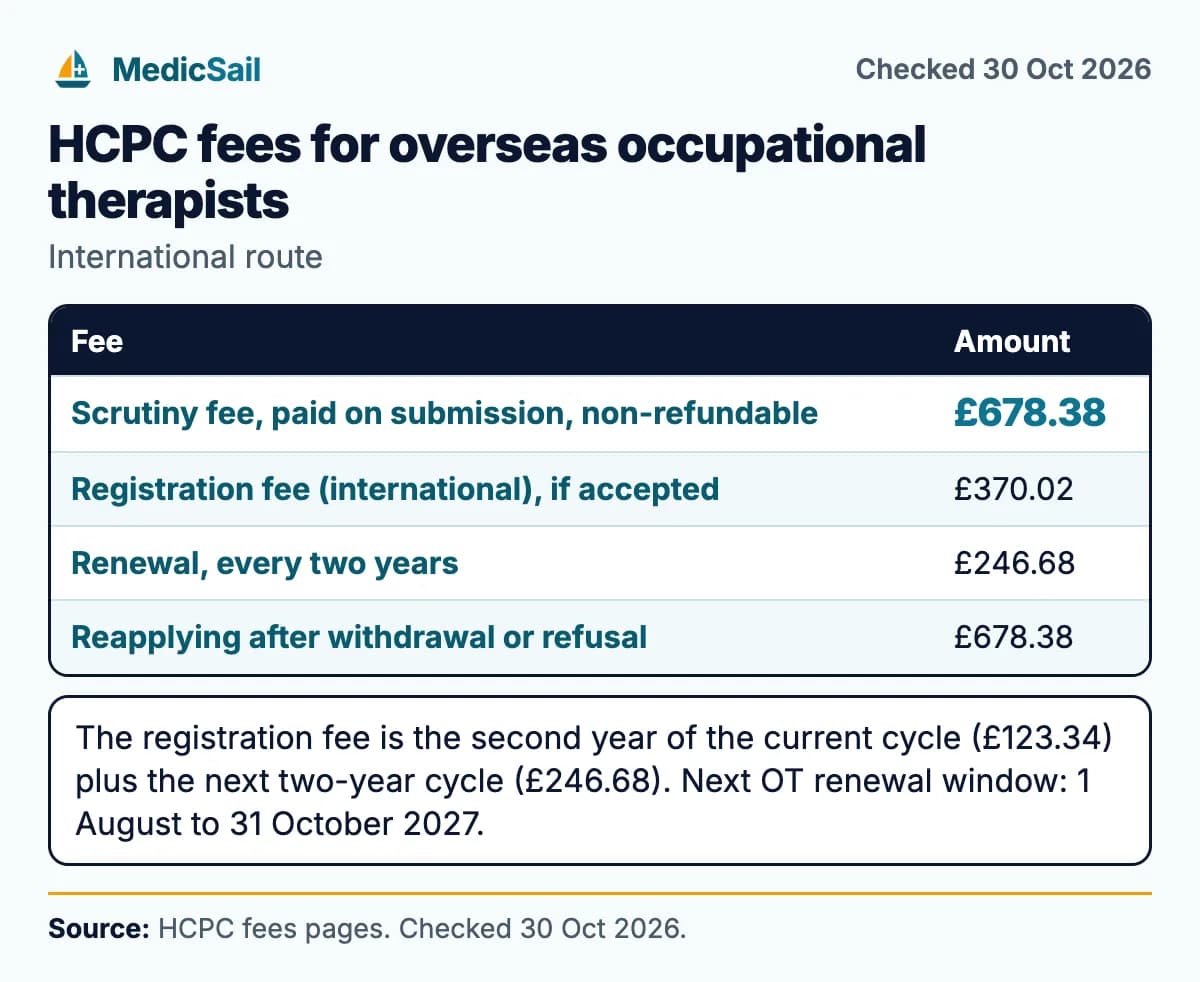
| Fee | Amount | Notes |
|---|---|---|
| Scrutiny fee | £678.38 | Paid on submission, non-refundable, by card through Worldpay |
| Registration fee (international) | £370.02 | If accepted: the second year of the current cycle (£123.34) plus the next two-year cycle (£246.68) |
| Joining in the first year of the cycle | Two years payable | The HCPC states the rule; check the amount on your invitation to pay |
| Renewal | £246.68 every two years | £123.34 per professional year |
| Reapplying after withdrawal or refusal | £678.38 | A new scrutiny fee |
The HCPC lists the next occupational therapist renewal window as opening on 1 August 2027 with a deadline of 31 October 2027. Joining shortly before a renewal window is normal; keep your contact details current in your HCPC account so you receive the reminder.
Other costs sit outside the HCPC: the English test, certification and translations, any university charge for the course information form, RCOT membership if you choose it, and the visa, Immigration Health Surcharge and travel. Our UK country guide lists the visa costs, and the registration cost estimator totals the professional fees.
How long it takes
- Before you apply: allow weeks to months for the course information form, and time for an OET or IELTS resit if one sub-score falls short.
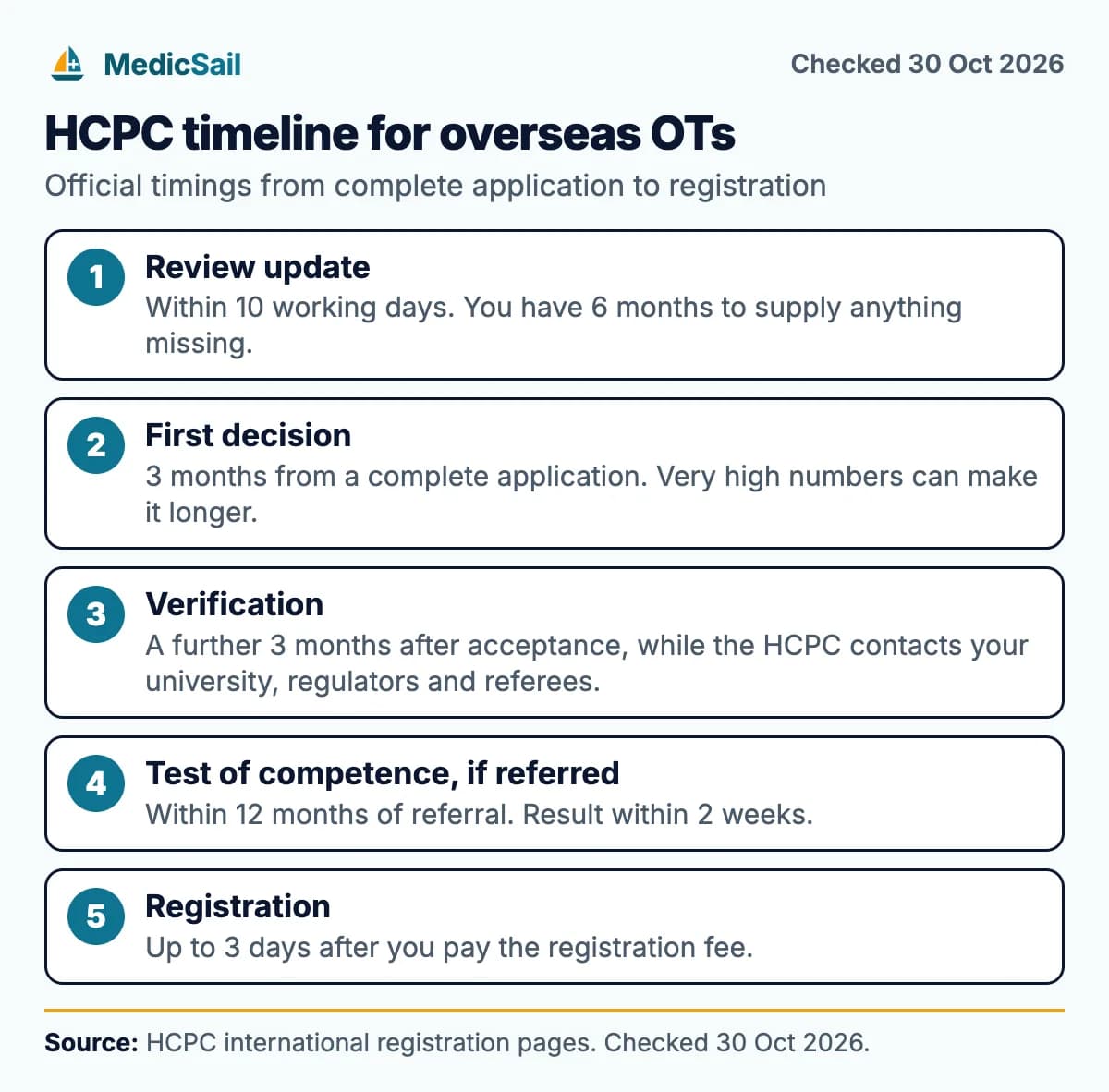
- Review: the HCPC says you can expect an update within 10 working days, and you have six months to supply anything missing.
- First decision: 3 months from a complete application, according to the HCPC, which warns that very high application numbers can make this longer.
- Verification: a further 3 months after acceptance, while the HCPC contacts your university, regulators and referees.
- Test of competence: within 12 months of referral, with the result within two weeks.
- Registration: allow up to three days after paying the registration fee.
From first email to your university to a registration number, most OTs should plan for many months, not weeks. Job applications can run in parallel during assessment. The registration timeline calculator helps you plan a realistic start date. Any continuing professional development you finish before you submit, such as a mental health or occupational science course, can be referenced in your mapping document as further training; anything finished after submission cannot be added.
The test of competence, refusals and common OT pitfalls
Since 20 November 2025 the HCPC carries out one round of documentary assessment and no longer asks you for more information to address gaps. Gaps lead to a test of competence; significant gaps may lead to refusal.
What the test looks like
It is a structured professional discussion with two occupational therapist assessors, usually on Microsoft Teams, built around the gaps in your file. For an OT, that might mean talking through how you would assess and plan for someone with a long-term mental health condition, how you would analyse and grade an activity, or how you would recommend adaptations after a home visit, along with ethical scenarios. You can reschedule or request cancellation once. The result, pass or fail, comes by email within two weeks.
After a refusal
You can appeal within 28 days of the refusal. You can also reapply at any time, with no waiting period, if you can show you have addressed the reasons, and pay a new scrutiny fee.
Common pitfalls for OTs
These follow from the standards and the HCPC's own guidance, not from an official list:
- Experience written as exercise and splinting lists, with no occupational narrative, activity analysis or environment.
- No adult mental health, learning disability or community evidence anywhere in the file.
- Assuming a WFOT-approved degree is enough on its own, and writing a thin mapping document.
- Placements recorded only as total hours with no settings, so the assessors cannot see breadth.
- Using the physiotherapy or another profession's mapping template.
- Referees using personal email addresses, or no referee who directly supervised OT work.
- OET taken in the wrong profession's version, or a writing score of 290.
Where OTs work, pay and the visa
NHS Health Careers says OTs typically start on Agenda for Change Band 5 and work in hospitals, clinics, charities, prisons and social services departments. RCOT says jobs are mainly in the NHS and local authorities. That split matters for an international OT, because pay and sponsorship differ by setting.
| Band (England, from 1 April 2026) | Annual pay points |
|---|---|
| Band 5 | £32,073, £34,592, £39,043 |
| Band 6 | £39,959, £42,170, £48,117 |
| Band 7 | £49,387, £51,932, £56,515 |
These are NHS Employers 2026/27 figures for England on Agenda for Change. Local authority posts use local government pay instead. The NHS pay band explorer shows every point.
The visa
Occupational therapists are occupation code 2222, which GOV.UK lists as eligible for the Health and Care Worker visa. That visa needs a sponsor that is the NHS, an organisation providing services to the NHS, or an adult social care provider. A local authority, school or charity may use a different route, so ask any non-NHS employer which visa it would sponsor before you accept. GOV.UK says you will usually need at least £25,000 or the going rate, whichever is higher. NHS Employers notes the employer needs your HCPC registration number for the certificate of sponsorship. Read our Health and Care Worker visa guide for the rest.
RCOT
The Royal College of Occupational Therapists is the professional body. It suggests joining as an overseas member before you move, to learn about UK policy and legislation, and says its membership includes professional indemnity cover, which helps you meet HCPC requirements. RCOT also runs an international recruitment hub for NHS and social care employers.
Coming from the Gulf, other countries, and your next steps
No GCC licence transfers to the HCPC. The assessors look at the OT degree that first let you practise and at your experience. Much Gulf OT work is in hospital rehabilitation or private paediatric and sensory clinics; describe it in occupational terms, show how culture, family roles and home layout shaped your plans, and add evidence of adult and mental health work if you have it. Gulf practice does not exempt you from the English test. See moving from a Gulf licence to UK registration.
If you are weighing other countries, CORU registers occupational therapists in Ireland (see occupational therapy in Ireland), and the USA uses state licensure (see occupational therapy in the USA). Our occupational therapist hub compares every country we cover.
Your next steps
- Request the course information form from your university, with placement settings and hours.
- Download the OT mapping template and read the OT standards line by line.
- Rewrite your CV roles as occupation-focused accounts with named assessments and models.
- Line up referees with official email addresses.
- Book OET Occupational Therapy or IELTS at a test centre.
- Decide whether you are aiming for the NHS or social care, and check how each would sponsor you.
Questions
No. Two OT assessors review your application on paper. If they find gaps, you are referred for a test of competence, which is a structured professional discussion rather than a written exam.
The HCPC's international route pages do not list WFOT approval as a requirement; the HCPC assesses your course against its standards. RCOT's overseas membership does require a WFOT-approved entry-level programme.
OET Occupational Therapy with 1400 overall and no sub-test below 300, no more than two years old when the HCPC receives your application and taken at a test centre.
£678.38 for the non-refundable scrutiny fee, then £370.02 to register if accepted, or two years' fees if you join in the first year of the OT cycle. Renewal is £246.68 every two years.
Not automatically, but the assessors compare you with standards written for OTs who work across the lifespan and settings. Show where your degree and placements covered adults, mental health and community work, and expect any remaining gap to be explored in a test of competence.
It depends on the council's sponsor licence and the visa route. The Health and Care Worker visa needs an NHS employer, an NHS service provider or an adult social care provider. Ask the employer which route it would use before accepting.
Every two years. The HCPC lists the next OT window as opening on 1 August 2027 with a deadline of 31 October 2027.
Not to address gaps. Since 20 November 2025 gaps lead to a test of competence or refusal. You can still replace missing or wrongly certified documents within six months.
The HCPC says 3 months from a complete application to a first decision, then a further 3 months of verification after acceptance. Add the time to gather documents and pass the English test.
Yes, within 28 days of the refusal. You can also make a new application at any time with a new scrutiny fee if you have addressed the reasons.
Sources
- 1HCPC: International applications
- 2HCPC: International route eligibility
- 3HCPC: Documents you need to prepare and certify
- 4HCPC: Certificate of English language proficiency
- 5HCPC: Course information form
- 6HCPC: Standards of proficiency mapping document
Show all 26 sourcesShow fewer sources
- 7HCPC: Professional experience section
- 8HCPC: Paying your scrutiny fee
- 9HCPC: Registration fees for applicants
- 10HCPC: Reviewing your application
- 11HCPC: Assessing your education, training and experience
- 12HCPC: Verifying your information
- 13HCPC: Possible outcomes of your international application
- 14HCPC: Test of competence
- 15HCPC: Refused applications
- 16HCPC: When to renew
- 17HCPC news: Updates to our international applications process (20 November 2025)
- 18HCPC: The professions we regulate
- 19HCPC: Standards of proficiency for occupational therapists
- 20NHS Health Careers: Occupational therapist
- 21NHS Employers: Pay scales for 2026/27
- 22NHS Employers: Recruitment of overseas allied health professionals
- 23GOV.UK: Health and Care Worker visa, your job
- 24RCOT: Becoming an occupational therapist in the UK from abroad
- 25RCOT: Membership terms and conditions
- 26RCOT: International healthcare recruitment hub
Plan it with our free tools
MedicSail
Healthcare licensing consultants for the UK, Europe and the USA
Updated and checked against the sources listed above. How we research and check our guides